ABC - A New Framework for Block Ciphers
Uri Avraham1? Eli Biham1? Orr Dunkelman2 1
Computer Science Department, Technion - Israel Institute of Technology,
Haifa 32000, Israel.
Email: [email protected], [email protected]
2
Computer Science Department, The Weizmann Institute of Science,
Rehovot 76100, Israel. Email: [email protected]
Abstract. We suggest a new framework for block ciphers named Advanced Block Cipher, or shortly ABC. ABC has additional non-secret parameters that ensure that each call to the underlying block cipher uses a different pseudo-random permutation. It therefore ensures that attacks that require more than one block encrypted under the same secret permutation cannot apply. In particular, this framework protects against dictionary attacks, and differential and linear attacks, and eliminates weaknesses of ECB and CBC modes. This new framework shares a common structure with HAIFA [3], and can share the same logic with HAIFA compression functions. We analyze the security of several modes of operation for ABCs block ciphers, and suggest a few instances of ABCs.
1 Introduction
Block ciphers are widely used in a large variety of modern applications. Traditionally, a block cipher is an algorithm that accepts a plaintext block and a key as inputs, and outputs a ciphertext block. To encrypt long messages,modes of operationare used to iterate the block cipher operation. Several modes of operation were designed to supply encryption with various desirable properties, such as being stateful and disabling an adver-sary who commits a chosen-plaintext attack from controlling the plaintext input of the block cipher. However, all these modes of operation, even when combined with an ideal block cipher, have their pitfalls. In particular, the ciphetexts are usually distinguishable from random sequences. Moreover, an adversary that obtains many ciphertext blocks may still gain some information on the corresponding plaintext, that she should not be able to gain in an ideal situation.
In this paper we suggest a new framework for block-ciphers aimed to prevent such pitfalls when used properly. Our framework introduces two additional input parameters to the underlying block cipher –a salt anda counter. By avoiding repeated key-salt-counter combinations, we guarantee that each permutation is used (at most) once, and thus many known attacks, such as dictionary attack, differential attack, and linear attack become inapplicable.
Our new frameworks also eliminates known weaknesses of ECB and CBC modes. For example, in ECB, two equal ciphertext blocks indicate two equal plaintext blocks. In CBC, one can learn the XOR result of two plaintext blocks if their corresponding ciphertext blocks are equal. These weaknesses disappear when replacing the underlying block cipher in the mode of operation with an ABC and when using the ABC properly (i.e., never repeating the same key-salt-counter combination). Later in this paper we discuss modes of operations for ABCs.
This work can be seen as a sibling of the HAIFA framework for hash functions [3], which fixes many of the pitfalls of traditional hash functions. In our work we borrow these new parameters introduced in HAIFA (i.e., a salt and a counter) to the world of block ciphers in order to protect against many security pitfalls. The ability to borrow new ideas from the world of hash functions and to implement them in the world of block ciphers naturally leads to a discussion about the correlation between the two worlds. We discuss the possibility of building a compression function based on an ABC, taking advantage of their similar APIs.
?
1.1 Related Work
Seeds for some of our new ideas can be found in [14], where the authors suggest a block cipher that has an additional input called atweak. This tweak is used to provide some variability to the encryption, without necessarily ensuring that each block uses a different permutation. In [14], the authors suggest several modes of operation for their new framework, of which one is the Tweakable Authenticated Encryption mode (TAE) where the concatenation of a nonce and the block index is used as a tweak. In our work the nonce (salt) and the index (counter) parameters are separated. This separation is natural due to the difference in the functionality of these two parameters. The salt should be a fixed value in all the ABC calls that are required for an encryption of a single message while the counter should be unique in every such call. The salt value can either be defined by the protocol or chosen by the encrypting party, while the counter value in every ABC call is defined by the protocol and the encrypting party cannot control it. Our framework also has better security than the security of tweakable block ciphers in some of the cases.
A major part of our work is investigating the security of our framework. For this analysis we adapt some security notions that were previously defined in [2].
1.2 Outline of This Paper
In Section 2 we describe our new ABC framework. In Section 3 we introduce the notations and definitions that we use throughout the paper. In Section 4 we define some security notions and provide security proofs for various properties. In Section 5 we discuss the similarity between stream ciphers and encryption schemes that are based on our new framework, and in Section 6 we discuss the relation of our new framework to hash functions. Finally, in Section 7 we suggest several instances for ABC block ciphers that conform to the new framework and examine these implementations.
2 The Framework
2.1 The ABC Block Ciphers
Definition 1 AsaltSis a non-secret parameter that can be considered as defining a family of block ciphers.
The salt value should be chosen by the encrypting party or defined by the protocol (e.g., increased by one for every message).
Definition 2 Acountertis a counter or a dithering, intended to introduce diversity between blocks.
The idea is that, when using an ABC as a building block for an encryption scheme (such as a mode of operation), the counter values for the instances of the ABC will be chosen by the encryption scheme and not by the encrypting party. This way, the counter is a parameter which is not subjected to manipulation by any of the parties.
Our new ABC framework introduces the use of a block counter and a salt as inputs to the underlying block cipher and defined as follows:
Definition 3 Anadvanced block cipher(or shortly anABC) is a function of the form:
E :{0,1}n
| {z }
plaintext
× {0,1}k
| {z }
key
× {0,1}s
| {z }
salt
× {0,1}c
| {z }
counter
→ {0,1}n
| {z }
ciphertext
,
The ABC framework aims at avoiding attacks that take advantage of the iteration of the encryption permu-tation by making sure that the same combination of key, salt and counter will never repeat. To achieve this, we demand that the same key-salt combination will never repeat for different messages, and that the same counter value will not repeat in two different ABC calls that are made while encrypting a single message. This demand limits the maximal length of an encrypted message to2cblocks, but for sufficiently large values ofcthis is not expected to be a problem.
As said, the salt should be defined by the protocol or chosen by the encrypting party in a way that ensures that the same key-salt combination never repeats. This requirement allows salt values to be reused as long as the keys are different. An even stronger requirement would never allow a salt value repeat for two different messages (even if the keys that are used to encrypt these messages are different). Such a requirement provides an even better security.
Note that like block ciphers, or any other kind of cryptographic primitives, ABCs are not necessarily secure, e.g., the identity ABC defined byEK,S,t(M) =M for everyK,S andt, is clearly insecure. In this paper we assume that the ABCs and the (traditional) block ciphers are secure, and discuss the security features of such primitives when combined in modes of operation.
When discussing the security of modes of operations for ABCs, we assume that the underlying ABCs are ideal, and when we develop ABCs we try to make them as close as possible to ideal ABCs.
Definition 4 Anideal block cipheris a family of random permutationsE :{0,1}k× {0,1}n→ {0,1}nsuch that for every keyK∈ {0,1}kthe permutationE
K(·)is chosen uniformly at random from the set of all possible permutations over{0,1}n.
Definition 5 Anideal ABCis a family of random permutations such that for every(K, S, t)combination the permutationEK,S,t(·)is chosen uniformly at random from the set of all possible permutations over{0,1}n.
2.2 Using the New Cipher in Modes of Operation
Modes of operation are used for the encryption of long messages. A mode of operation makes use of several calls to an underlying block cipher. ABCs can also be used in modes of operation, and in this section we discuss a family of modes of operation for ABCs.
Definition 6 Anadvanced mode of operation (or shortlyAMode) is a mode of operation in which the under-lying cipher of the mode is an ABC, and when encrypting a single multi-block message under the mode of operation, all the calls to the underlying ABC get the same salt input, and each call gets a different counter.
Notation 1 Let X be a conventional mode of operation. We denote byAXK,S the AMode that has the same structure asXbut in which the underlying cipher is an ABC that getsSas the salt of all calls to the ABC, and the block index as the counter of each ABC.
Example 1 AECBK,Sis the AMode in which thei’th block satisfies:Ci =EK,S,i(Mi).
Example 2 ACBCK,Sis the AMode in whichC0=IV andCi =EK,S,i(Mi)LCi−1 for everyi= 1, ..., m, wheremis the number of blocks.
2.3 Reasonable Modes of operation and Reasonable AModes
We are specifically interested in a family of modes of operation and a family of AModes that we callreasonable modesandreasonable AModes.
Definition 7 LetXbe a mode of operation. LetEbe any block cipher. We say thatXis areasonable modeif it fulfills all of the following requirements:
1. Xis length preserving (the ciphertext is of the same length as the plaintext), and both plaintext and cipher-text have the same number of blocks, where the length of each block isnbits (recall thatnis the block size ofE).
2. The number of E encryptions performed calculated while encrypting a message M under XKE is equal to the length ofM in blocks. In particular, there exist some functionsf1(·, ...,·) andf2(·, ...,·) such that
Ci =f2(EK(f1(IV, i, M1, ..., Mi, C1, ..., Ci−1)), IV, i, M1, ..., Mi, C1, ..., Ci−1), where:
(a) f2(·;IV, i, M1, ..., Mi, C1, ..., Ci−1)is a permutation over{0,1}n for every possible combination of
IV, i, M1, ..., Mi, C1, ..., Ci−1.
(b) Ciis a permutation ofMi, i.e., the encryption underXKE is invertible and therefore the ciphertext can be decrypted. Formally, the functionhE,K,IV,i,M1,...,Mi−1,C1,...,Ci−1(Mi)
= f2(EK(f1(IV, i, M1, ..., Mi, C1, ..., Ci−1)), IV, i, M1, ..., Mi, C1, ..., Ci−1) is a permutation over {0,1}nfor every possible combination ofE, K, IV, i, M
1, ..., Mi−1, C1, ..., Ci−1.
We associate every instance ofE with a block numberi, and we denote the plaintext input and the ciphertext output of thei’th instance ofEby(xi, yi), respectively.
The above definition deals with modes of operation in which the block size is the same for all blocks. This definition can be trivially extended to deal with modes of operation in which the block size varies, as long as |Mi|=|Ci|for anyi. This extended definition covers all the standard cases where the last block can be shorter thannbits.
The conditions in Definition 7 might seem complicated, but most of the widely used modes of operation, such as ECB, CBC, OFB, and CTR, fulfill these conditions and therefore considered to be reasonable modes.
Example 3 ECB is a reasonable mode wheref1(IV, i, M1, ..., Mi, C1, ..., Ci−1) =Miand
f2(yi, IV, i, M1, ..., Mi, C1, ..., Ci−1) =yi.
Example 4 CBC is a reasonable mode where f1(IV, i, M1, ..., Mi, C1, ..., Ci−1) = Ci−1LMi (fori > 1) andf2(yi, IV, i, M1, ..., Mi, C1, ..., Ci−1) =yi.
Example 5 OFB is a reasonable mode wheref1(IV, i, M1, ..., Mi, C1, ..., Ci−1) =Ci−1LMi−1and
f2(yi, IV, i, M1, ..., Mi, C1, ..., Ci−1) =yiLMi.
Definition 8 An AModeX is areasonable AModeif it satisfies all of the conditions of Definition 7, where the block cipherEK is substituted by theABCEK,S,t, for a keyK, a saltS, and a countert.
Lemma 1 LetXbe a reasonable mode. ThenAXis a reasonableAMode. The proof of Lemma 1 is given in Appendix A.
3 Notations and Definitions
Table 1 lists the notations that we use in this paper.
KKey
kKey size in bits
SSalt
sSalt size in bits
tCounter
cCounter size in bits
M Plaintext message
mnumber of blocks of a messageM.(M =M1||...||Mm)
CCiphertext
Mi, CiThei’th block of the plaintextM, or the ciphertextC |Y|Length in bits of the stringY
XKE(M)The encryption of the messageM under the block cipherEusing the keyKand the mode of operationX XKE−1(C)The decryption of the ciphertextCunder the block cipherE using the keyKand the mode of operationX XK,SE (M)The encryption of the messageM under the ABCEusing the keyK, the saltSand the AModeX
XK,SE −1(C)The decryption of the ciphertextCunder the ABCEusing the keyK, the saltSand the AModeX a←R−AThe operation of choosing an itemauniformly at random out of a setA.
Table 1.Notations
Definition 9 Atraditional symmetric encryption schemeis a pair of deterministic algorithms(E,D),that ac-cept a key and plaintext/ciphertext as parameters. FormallyE andDare defined as:
E :M × K → C ; D:C × K → M,
whereKis the key space,Mis the message space andCis the ciphertext space. We demand that for anyK ∈ K andM ∈ Mit holds thatDK(EK(M)) =M.
The traditional symmetric encryption schemes discussed in this paper are traditional block-ciphers and tradi-tional modes of operations.
Definition 10 Asalted-countered symmetric encryption schemeis a pair of deterministic algorithms(E,D),
that accept as parameters (on top of the key and the plaintext/ciphertext) also a counter and a salt. FormallyE andDare defined as:
E :M × K × S × T → C ; D:C × K × S × T → M,
where S is the salts space andT is the counter space. We demand that for anyK ∈ K,S ∈ S, t ∈ T and
M ∈ Mit holds thatDK,S,t(EK,S,t(M)) =M.
The salted-countered symmetric encryption schemes discussed in this paper are ABCs.
Definition 11 Asalted symmetric encryption schemeis a pair of deterministic algorithms(E,D),that accept as parameters (on top of the key and the plaintext/ciphertext) also a salt but no counter. FormallyE andDare defined as:
E :M × K × S → C ; D:C × K × S → M,
We demand that for anyK∈ K,S∈ S andM ∈ Mit holds thatDK,S(EK,S(M)) =M.
The salted-countered symmetric encryption schemes discussed in this paper are AModes.
4 Security
In this section we discuss the security of ABCs and AModes. We analyze the security of our framework against known generic attacks, and we measure the security of AModes according to some widely-used security no-tions. In order to examine the security features of the AModes, we assume that the underlying ABC is ideal and that any security pitfall results from the mode itself. Nevertheless, we also consider in some cases a realistic ABC and prove that if the ABC is “secure enough” then the AMode using it is also “secure enough”.
The proofs for all the theorems that appear in this section are given in Appendix A.
4.1 Security Against Generic Attacks
As discussed in the introduction, the ABC framework is secure against generic attacks that require many plain-texts encrypted under the same secret permutation. Examples for such attacks are the dictionary attack, differ-ential attack, linear attack and time-memory tradeoff attacks.
In the dictionary attack the adversary collects pairs of plaintext blocks and their respective ciphertexts. She gains information about the encryption permutation without necessarily learning anything about the secret key. Later on she can use the knowledge that she had gained to decrypt ciphertexts or to encrypt plaintexts. This kind of attack is useless against protocols that use ABCs properly, since in such protocols the proper use of the salt and counter inputs ensures that no encryption permutation is used more than once. Thus, any information that the adversary has gained is useless for future encryption or decryption of plaintexts/ciphertexts.
The differential and linear attacks require a large amount of data encrypted under the secret encryption permutationEK(·). These attacks are inapplicable for the ABC framework since a proper use ensures that an encryption permutation is never used more than once, and since in the ideal case, the different permutations used by the ABC for different values of salt-counter combinations are independent. Note that for realistic underlying ABCs, as for block ciphers, the security analysis should consider differential and linear attacks on the particular design. Moreover, it should consider the possibility of extending these attacks using the new parameters, the salt and the counter. In Section 7, where we suggest some instances of ABCs, we make this kind of analysis.
In time-memory tradeoff attacks [12], a large amount of pre-computation, equivalent to exhaustive search, can be used for breaking the encryption many times in the future. As discussed in Section 2, the salt might be reused with different keys. If this is the case (e.g., every time the key is changed the salt is reset to zero) then the pre-computation will be amortized among many instances of the attack, and thus the time-memory tradeoff attack will work against the framework just as they do for traditional block ciphers. On the other hand, if the salt is never reused (not even after changing the key) then the pre-computation cannot be amortized, and therefore time-memory tradeoffs become as inefficient as an exhaustive search.
4.2 Security Notions
Goldwasser and Micali [11] were the first to formally define security notions for encryption schemes. In [2] security notions for symmetric encryption were defined and examined. We adapt some of these notions to ABCs and their extra arguments while we use some of the ideas introduced in [16].
The security notions we consider are indistinguishability from random bits (defined in Section 4.2.2) and semantic security (defined in Section 4.2.3). We consider the security of AModes in the terms of the security notions mentioned above, both in the chosen-plaintext model (CPA), where the adversary is allowed to ask for encryption of messages and in the chosen-ciphertext model (CCA) where the adversary is allowed to ask for decryptions of ciphertexts.
We examine the security of our model in the information-theory sense (rather than in the computational sense). I.e., the adversaries that we consider are limited by the amount of information that they are allowed to have rather than in the time complexity of their computations.
(M, S) – if E is a salted symmetric encryption scheme, or (M, S, t) – ifE is a salted-countered symmetric encryption scheme (whereM ∈ M,S∈ S andt∈ T).
Definition 13 AnE-CCAadversaryis an adversary that has access to an oracle that answers queries of one of three forms: (C) – ifE is a traditional symmetric encryption scheme,(C, S) – ifE is a salted symmetric encryption scheme, or(C, S, t)– ifEis a salted-countered symmetric encryption scheme (whereC ∈ C,S∈ S andt∈ T).
As stated in Section 2, the salt is chosen either by the encrypting party or by the protocol, and the counter is selected by the AMode. For our analysis, we let the adversary to have more power by letting her choose the salt as long as the same salt never repeats. Similarly, if she attacks an ABC rather than an AMode, we let her chose the salt and the counter as long as the same combination of salt-counter never repeats.
Definition 14 LetEbe anABC. AnE-CPAadversary is said to besalt-counter-respectingwhen no two queries it calls have the same salt-counter combination.
Definition 15 LetE be anABC. LetX be an AMode. An XE-CPAadversary is said to besalt-respecting when no two queries it calls have the same salt.
We note that the above definitions hold only for encryption queries and not for decryption queries. A good practice is to make sure that every message is encrypted using a unique key-salt combination, but if for some reason different messages were encrypted using the same key-salt combination then it should be possible to decrypt the resulting ciphertexts. Therefore, we allow a CCA adversary to use the same salt for different queries.
4.2.1 Distinguishers for ABCs An advanced block cipher is a family of permutationsE :{0,1}n×{0,1}k× {0,1}s × {0,1}c → {0,1}n. By fixing a key K ∈ {0,1}k, an ABC defines a salted-countered-family of permutations of the form:EK : {0,1}n× {0,1}s× {0,1}c → {0,1}n. By fixing a keyK, a salt S and a countertwe define a single permutationEK,S,t :{0,1}n→ {0,1}n.
Let SCP erm(s, c, n) be the set of all possible salted-countered-families of permutations of the form:
Π :{0,1}n× {0,1}s× {0,1}c→ {0,1}n.
We adapt the definitions of the advantage of a block-cipher distinguisher defined in [2] to our needs. Let
E : {0,1}n× {0,1}k× {0,1}s× {0,1}c → {0,1}n be an ABC. LetA be an adversary that has access to a salted-countered-family of permutationsπ : {0,1}n× {0,1}s× {0,1}c → {0,1}n. The advantage of an adversaryAin distinguishingEfrom a random family of permutations is defined as:
AdvprpE (A),PrhAEK(·,·,·) K
R
←− {0,1}ki−PrhAπ(·,·,·)π
R
←−SCP erm(s, c, n)i.
We denote bySecprpE (q, t)the maximum advantage of any salt-counter-respecting adversaryAthat is allowed to make queries to a salted-countered-family of permutations, that makes no more thanq queries, and whose running time is bounded byt. Denote byAscr
q,t the set of all salt-counter-respecting adversaries that make no more thanq queries, and whose running time is bounded byt. The maximum is taken over all possible such adversaries, i.e.,SecprpE (q, t),maxA∈Ascr
q,t Adv
prp E (A).
We later show that ifEis an ABC for whichSecprpE (q, t)is small then using a reasonable AMode in which the underlying ABC isEresults with a secure encryption scheme.
4.2.2 Indistinguishability from Random Bits This security notion evaluates the ability of an adversary to distinguish the encryption (decryption) of a message from the encryption (decryption) of an equal length random string of bits.
OEK that answers the query Q = (M) with C = EK(M). The second is a fake encryption oracle O
E
R that answers the same queryQwith a random string of|EK(M)|bits.
Theind−CPAadvantage of anE −CPAadversaryAis defined as:
AdvindE −CPA(A),PrhAOEK(·)= 1K
R
←− Ki−PrhAOER(·) = 1 i
.
For the CCA variant of this notion, consider two other oracles, both answer queries of the form Q= (C)
with a stringM ∈ {0,1}|DK(C)|. The first is the real decryption oracle,OD
K that answers the queryQ= (C)
withM =DK(C). The second is a fake decryption oracle,ODRthat answers the same queryQwith a random string of|DK(C)|bits.
Theind−CCAadvantage of an adversaryAagainst an encryption schemeEis defined as:
AdvindE −CCA(A),PrhAODK(·) = 1K
R
←− Ki−PrhAODR(·)= 1 i
.
We adapt these security notions also to the salted-symmetric encryption scheme, in which the queries are of the formQ= (M, S). Thus, ifE is a salted-symmetric encryption scheme, then
AdvindE −CPA(A),Pr
h
AOEK(·,·) = 1K
R
←− Ki−Pr
h
AOER(·,·)= 1 i
,
AdvindE −CCA(A),Pr
h
AODK(·,·)= 1K
R
←− Ki−Pr
h
AODR(·,·)= 1 i
.
It is important to note that the adversary Amust not repeat the same query twice (or otherwise it will be trivial to distinguish between the real and the random oracles). When discussing AModes, this demand is being respected automatically in the CPA variant of the notion since we consider only salt-respecting adversaries. Since CCA adversaries are allowed to repeat the same salt, we have to explicitly prohibit them from repeating the same query more than once.
We use the abbreviated notations ofOE for the oracleOEK orODK with a random keyK, andORforO
E
R orORD, where it is clear from the context whether the attack is a chosen-plaintext attack or a chosen-ciphertext attack.
We denote by SecindE −CPA(σ) the maximum advantage taken over all E-CPA salt-respecting adversaries that use no more than a total ofσblocks in their queries. Similarly, we denote bySecindE −CCA(σ)the maximum advantage taken over allE-CCAadversaries that use no more than a total ofσblocks in their queries. Denote byAσ the set of all adversaries that use no more than a total ofσblocks in their queries, and denote byAsrσ the set of all salt-respecting adversaries that use no more than a total ofσblocks in their queries. Formally,
SecindE −CPA(σ), max
A∈Asr σ
AdvindE −CPA(A) ; SecindE −CCA(σ), max
A∈Aσ
AdvindE −CCA(A).
The following lemmas examine the ind-CPA security AECB and ACBC AModes.
Lemma 2 LetE be an idealABC. Every possible total length of queries,σ that allows the adversary to be salt-respecting (i.e.,σ ≤2c+s) satisfiesSecindAECB−CPAE (σ) = 0.
Lemma 3 LetE be an ideal ABC. Every possible total length of queries σ that allows the adversary to be salt-respecting satisfiesSecind−CPA
ACBCE (σ) = 0.
The same result can be achieved for any reasonable AMode, as discussed in the following theorem and conclusion.
Theorem 1 LetXbe a reasonableAMode. LetE be anABC. Every possible total length of queries σthat allows the adversary to be salt-respecting satisfiesSecindXE−CPA(σ)≤Sec
prp E (σ).
Conclusion 1 IfEis an idealABC, andXis a reasonableAMode, thenSecXindE−CPA(σ) = 0for everyσthat
allows the adversary to be salt-respecting.
As seen in Conclusion 1, our framework achieves perfect indistinguishability security against chosen-plaintext attacks when the underlying ABC is ideal. This is not the case when considering chosen-ciphertext attacks because of the ability of the adversary who employs the attack to repeat the same salt-counter combina-tion more than once in its queries to the decrypcombina-tion oracle. A CCA adversary can simply ask for a decrypcombina-tion ofC = C1||C2 andC0 = C1, both with the same salt valueS, and return ‘1’ if and only if the corresponding messages,M, M0begin with the same block. This attack works for every reasonable AMode.
However, we claim that the indistinguishability security against chosen-ciphertext attacks of our framework is not worse than the security against chosen-ciphertext attacks of the conventional framework. In particular, the following theorem proves that the ind-CCA security of AECB is not worse than the ind-CCA security of ECB.
Theorem 2 LetE˜be an idealABCand letEbe an ideal block cipher. For everyσit holds thatSecind−CCA
ECBE (σ)≥
Secind−CCA
AECBE˜ (σ).
4.2.3 Semantic Security The semantic security notion was defined first in [11] and was adapted to the symmetric scheme in [2]. This security notion evaluates the ability of an adversary to learn something on a plaintext from its corresponding ciphertext. We adapt this security notion to the parameterized encryption scheme. Let(E,D)be a salted-symmetric encryption scheme. LetAbe an adversary. For the CPA variant of the notion, we consider anE-CPA adversary, and for the CCA variant we consider anE-CCA adversary.
The adversary plays a game of two stages: In the first stage, after A calls its oracle(s) with its queries, it defines some valid distribution function over the message space such that all the messages with non-zero probability are of the same length. In the second stage, A is provided with a salt S∗ chosen uniformly at random, from all the salts that A has not used in its queries, and a ciphertext C∗ = EK,S∗(M∗) for some
plaintextM∗ chosen at random from the message space according to the distribution function defined by A. The adversary then outputs a pair(α, f),wheref is a function, defined for all non-zero-probability messages, that can be computed by the adversary.Awins ifα=f(M∗).LetM0be a message chosen at random from the message space, according to the distribution function defined byAand independently fromM∗. The advantage of an adversaryAis defined in this case as:
AdvsemE −ATK(A), Pr
M∗,K,A[α=f(M
∗
)C∗]− Pr
M0,K,A[α=f(M
0 )],
where ATK = CPA if A employs a chosen-plaintext attack and ATK = CCA if A employs a chosen-ciphertext attack.
We denote by SecsemE −ATK(σ) the maximum advantage taken over allE −ATK adversaries that use no more than a total ofσblocks in their queries. Formally,
SecsemE −ATK(σ), max
A∈Aσ
AdvsemE −ATK(A).
Theorem 3 LetX be a reasonable AMode, and letE be an ideal ABC. ThenSecXsemE−ATK(σ) = 0,where
ATK∈ {CPA,CCA}.
4.3 Security Pitfalls of Conventional Modes of Operation
4.3.1 ECB Obviously, The conventional ECB mode does not provide the indistinguishability security notion defined in Section 4.2.2. In the simplest attack the adversaryAasks for the encryption ofM =M1||M2where
M1 =M2and getsC =C1||C2. It returns ‘1’ ifC1 =C2and ‘0’ otherwise. Therefore every underlying block cipherEsatisfiesAdvindECB−ECCA(A) = 1−2
−n, and the adversary can achieve even a higher advantage by using longer messages. In practice, this means that an adversary that obtains a ciphertext in which two blocks are equal learns that the two corresponding blocks of the plaintext are equal as well.
4.3.2 CBC The conventional CBC mode provides no security against chosen-ciphertext attacks in the in-distinguishability sense (ind-CCA). Consider the following attack: The adversaryAasks for the decryption of
C =C1||C1and getsM =M1||M2 as an answer. It returns ‘1’ ifM1LM2 =C1LIV and ‘0’ otherwise. The advantage ofAisAdvind−CCA
CBCE (A) = 1−2
−n, and the adversary can get even a higher advantage by using longer ciphertexts.
The CBC mode does not provide good ind-CPA security as well. When encrypting a message longer than
2n/2 blocks, it is expected (due to the birthday paradox) that two of the ciphertext blocks will collide (i.e.,
Ci=Cj for somei6=j), and thus an adversary that has access only to an encryption oracle, can check whether
MiLMj =Ci−1LCj−1and distinguish between the encryption and random bits with high probability.
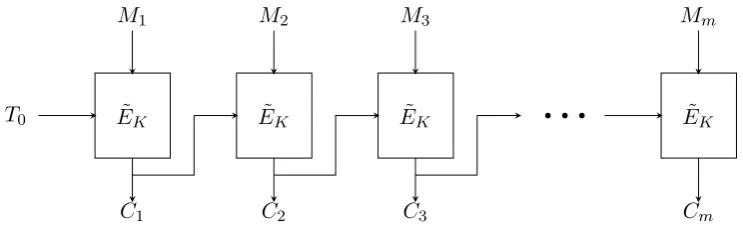
4.3.3 TBC In [14], the authors suggest several modes of operation for tweakable block ciphers. In one of them, called TAE, the tweak is used as a concatenation of a nonce (that has the same functionality as our salt) and a counter. This mode is equivalent to our AECB, and therefore provides the same security properties. But the tweak is not limited to this kind of usage, and when it is used differently the result can be an insecure mode. An example for this is the Tweakable Block Chaining (TBC) mode, suggested in [14]. The TBC mode is illus-trated in Figure 1. The indistinguishability security of reasonable AModes is better than the indistinguishability security of TBC in some cases, and not worse in the others.
M1
C1
˜
EK
M2
C2
˜
EK
M3
C3
˜
EK
Mm
Cm
˜
EK
T0
Fig. 1.TBC mode of operation
LetE˜be an ideal tweakable block cipher, letEbe an ideal ABC, and letXbe a reasonable AMode. An ind-CPA adversary that attacksT BCE˜ can ask for the encryption of a messageM = M1||...||Mm, where all the message blocks are equal. Ifm≥2n/2, it is excepted that there exist some1≤i < j ≤msuch thatCi =Cj. If the output is a result of a real TBC encryption, rather than a random string, then for every1 ≤l ≤ m−j
it holds thatCi+l =Cj+l. If this is the case then the adversary can guess that she is facing the real encryption oracle. Otherwise, she is definitely facing the random oracle. Therefore, following Conclusion 1, for every
σ ≥2n/2it holds thatSecind−CPA
T BCE˜ (σ)>Sec
ind−CPA XE (σ).
An ind-CCA adversaryA˜that attacksT BCE˜and is limited to a total of two blocks in its queries can ask for the decryption of the messageT0||T0, whereT0is also the initial tweak, and obtain the oracle’s answer –M =
1−2−n. When an ind-CCA adversaryAthat attacksXE is limited to a total of two blocks in its queries, then the two blocks must be decrypted with a different salt-counter combination. Therefore,AdvindXE−CCA(A) = 0,
and thus,Secind−CCA
T BCE˜ (2)>Sec
ind−CCA XE (2).
5 Comparison with Stream Ciphers and CTR Mode
A main requirement for our framework is that the same combination of key, salt, and counter should never be used twice. Apparently, if this requirement is fulfilled, then there is no reason that the function EK,S,t(·) will be a pseudo-random permutation. It is enough to demand that for every combination ofS, tandM, the function fS,t,M : {0,1}k → {0,1}n, defined by fS,t,M(K) = EK,S,t(M), is a pseudo-random function. For example, assume that we have a pseudo-random function g : {0,1}k × {0,1}s × {0,1}c → {0,1}n, and definefS,t,M(K) = g(K, S, t)LM. Thus, the AECB encryption using the underlying ABC defined by
EK,S,t(M) = g(K, S, t)LM can be viewed as a stream cipher in which the messageM is XORed with the streamg(K, S, t). Under the assumption that the same(K, S, t)combination is never used more than once, this encryption is secure, but if these assumptions do not hold for some reason then it is no longer secure since an adversary who holds a single(M, C)pair is able to calculate the appropriateg(K, S, t)for every block of
M and therefore can encrypt (decrypt) any message (ciphertext) with the same K and S values. Therefore, constructing an ABC which is a pseudo-random permutation for every(K, S, t)combination provides us with a system that is more tolerant for misuse and guarantees some security even when the same(K, S, t)is used more than once.
A good example is the CTR mode [7]. In the CTR mode, the message is XORed with a stream generated by encrypting a counter block. Formally,C =C1||...||CmwhereCi =Mi
L
EK(ctr+i)for some numberctr. In [9] it is suggested that the`least significant bits of the counter block are used as a counter while the other
n−`bits are used as a nonce. In this particular case, the CTR mode can be seen as a special case of AMode where its encryption functionECTRK,S,t(M) =ML
EK(S+t), whereSis a multiply of2`,0≤t <2`, and the maximal length of a message is2lblocks.
We note, however, that our framework with the explicit separation of the salt and the counter has some advantages over the CTR mode and other stream ciphers:
1. Tolerance for misuse — In CTR mode, just as in any stream cipher, a reuse of the same stream (i.e., a reuse of the same nonce and counter) results with an immediate compromise of the security. When the same stream is used for two different messagesM1, M2thenM1LM2can be calculated from the corresponding ciphertexts C1, C2. Moreover, an adversary who has a pair (M, C) of plaintext-ciphertext blocks for a specific nonceSand a specific countertcan calculate the encryption of any other message with the same nonce and counter.
2. Time-memory-data tradeoffs — Time memory-data tradeoffs are widely discussed for stream ciphers. If the salt values are reused every time the key is changed, then the security of our framework against these attacks is the same as for stream ciphers. In the more strict version in which the salt is never repeated (not even after changing the key) then these attacks become inapplicable.
3. The security of our framework is a little bit better than the security of the CTR mode (particularly in the indistinguishability and semantic senses). This is because of the fact that in CTR mode, for every message M = M1||...||Mm and for every1 ≤ i < j ≤ m it is certain thatCiLCj 6= MiLMj. For example, an ind-CPA adversary can take advantage of this fact. The adversary asks for the encryption of a message M = M1||...||M2n/2 in which all of the 2n/2 blocks are identical (i.e.,Mi = Mj for every
1≤i < j ≤2n/2). If the adversary receives an answer from the real encryption oracle it is guaranteed that
6 The Relation to Hash Functions
In [3] the HAIFA framework for cryptographic hash function is presented. This framework introduces the idea of salt and bits-counter for compression functions. A natural question to ask is how can these new compres-sion functions and block ciphers relate. In this section we discuss the possibility of using a single underlying primitive to build both ABCs and compression functions. We focus on the well known Davies-Meyer construc-tion [5]. Other possible construcconstruc-tions were studied in [15] – some of them could be used for our purpose as well.
6.1 Using Davies-Meyer Construction
The Davies-Meyer construction is used for building a compression function, CDM using a block cipher E. Given a block cipherE :{0,1}n× {0,1}k→ {0,1}n, the compression functionC
DM :{0,1}n× {0,1}k → {0,1}nis defined as:C
DM(h, M) =EM(h)Lh. Here,kis the length of the message block for the compres-sion function andnis the length of the chaining value.
A major drawback of the Davies-Meyer construction is that it is easy to find fixpoints. One can find a fixpoint(h∗, M∗)simply by fixing a message block M∗ and decrypting the zero constant byh∗ = EM−1∗(0).
Such a fixpoint can be used for a second-preimage attack as shown in [6].
We note that with our new block cipher framework and the HAIFA framework, this problem is fixed. We can use a Davies-Meyer construction to build a HAIFA compression function CDMHAIF A : {0,1}n × {0,1}b × {0,1}s × {0,1}c → {0,1}n (where n is the length of the chaining value and b = k is the block size) using an ABC, E. Such a compression function will be defined as CDMHAIF A(h, M, S,#bits) =
EM,S,f(#bits)(h)L
h,for some functionf that outputs a unique counter value for every possible#bitsvalue (typically,f =d#bitsn e). The#bitsparameter of the compression function (tparameter inE) prevents attacks that take advantage of the easy-to-find fixpoints. It is still possible to find a tuple(h∗, M∗, S∗,#bits∗)such that
CDM(h∗, M∗, S∗,#bits∗) = h∗, but for any #bits0 6= #bits∗ (and specifically for the value of#bits0 that matches the next block) it holds, with a very high probability, thatCDM(h∗, M∗, S∗,#bits0)6=h∗. Moreover, it is difficult to find a message blockM0such thatCDM(h∗, M0, S∗,#bits0) =h∗. Therefore, a fixpoint cannot be used to expand the message and create a second preimage.
It might be better, for performance reasons, to use the message block of the compression function as thesalt of the ABC and not as the key, so the key scheduling algorithm is not re-executed for every block. However, the Davies-Meyer construction might not be practical since it demands that the key size (or salt size) of the cipher equals the size of compression function’s message block and that the size of the compression function’s chaining value equals the size of the cipher’s block. This is not the case with today’s compression functions and symmetric block ciphers. The typical size for message blocks in hash functions today is much larger than the typical key size of block ciphers and the typical size of a chaining value is much larger than the typical size of ciphers’ block. The size of the chaining value of a compression function should be large enough so finding collisions will be difficult, and the size of the compression function’s message block should be large enough for performance reasons. Increasing the lengths of the block cipher’s key and message block would increase the complexity of the block cipher’s execution (in particular the key schedule), and will influence especially on encryption of short messages.
7 Simple ABCs Based on AES
In this section we describe three AES-based ABCs, all of which with 128-bit keys, 128-bit salts and 64-bit counters.
7.1 ABC1
Our first ABC uses AES [17] as a black-box and is implemented as follows:
whereK0 =AES-128K(S)andt0 =t||t.
7.2 ABC2
ABC2 modifies the key scheduling algorithm of AES-256 to allow a mixing of the salt and the counter. The key scheduling algorithm is modified as follows: given a 128-bit keyKand a 128-bit saltS, an intermediate 256-bit keyK0is computed byK0 =K||AES-128K(S). The intermediate keyK0 is then expanded using the original AES-256 key scheduling algorithm, to the (15) round keysRK1[0], ..., RK1[14]. The counter is mixed into five of these round keys –RK1[2], RK1[4], RK1[7], RK1[10], andRK1[12]: each time the counter is mixed into a round key it is XORed into two consecutive (cyclicly) columns of the round key, when the counter is represented as big endian. The counter is mixed into the following round keys: columns 0,1 ofRK1[2]; 1,2 ofRK1[4]; 2,3 ofRK1[7]; 3,0 ofRK1[10] and 0,1 ofRK1[12]. The result is another set of round keysRK2. Encryption is performed using the AES-256 encryption algorithm with the resulting round keysRK2[0], ..., RK2[14]. Note that an efficient implementation of ABC2 does not have to compute the key scheduling for every counter. Instead, it computesRK1once and XORs the counter into the right locations during the encryption process.
In order to allow a full diffusion of a counter before the next counter mixing occurs, we selected to have at least two AES rounds between consecutive counter mixings. A full diffusion of a counter mixing ensures that all of the bytes of the state are influenced by the counter. The next counter mixing, changes only two of the four columns of the state, while keeping the other two unchanged.
7.3 ABC3
ABC3 modifies the key scheduling algorithm of AES-128 to allow a mixing of the salt and the counter. The key scheduling algorithm is modified as follows: given a 128-bit keyK and a 128-bit saltS, three temporary keysK1, K2, andK3 are calculated. Each of the temporary keys is expanded by the original key scheduling algorithm of AES-128 into the (11) round keys. Then, a fourth set of round keys is calculated as the XOR of the three sets of round keys. Formally,
K1 =K ; RK1 =KS(K1)
K2 =AES-128K1(S) ; RK2=KS(K2)
K3 =AES-128RK1⊕RK2(K) ; RK3 =KS(K3)
RK4=RK1⊕RK2⊕RK3,
whereKSis the key scheduling algorithm of AES-128. The notation AES-128RK, whereRK is a set of round keys rather than a key, refers to the AES algorithm that uses the round keysRK instead of deriving them from a 128-bit key.
The counter is then mixed into five round keys of RK4 – columns 0,1 and columns 2,3 ofRK4[1]; 1,2 ofRK4[3]; 2,3 ofRK4[5]; 3,0 ofRK4[7]; and columns 0,1 and columns 2,3 ofRK[9]. The result is another set of round keysRK5. Encryption is performed using the AES-128 encryption algorithm with the round keys
RK5[0], ..., RK5[10]. As in ABC2, an efficient implementation of ABC3 does not have to compute the key scheduling for every counter. Instead, it computes RK4 once and XORs the counter into the right locations during the encryption process.
7.4 Security of ABC1, ABC2 and ABC3
7.4.1 Equivalent Keys In an ideal ABC it is very unlikely that two different key-salt-counter combinations
(K1, S1, t1) = (6 K2, S2, t2) specify the same permutation. Therefore, like in block ciphers, the design of an ABC should result with permutations that do not collide.
In ABC1 the AES algorithm is used three times. Due to the use ofK in the middle encryption, every pair of(K, S) generates a unique set of round keys for the triple encryption. Therefore, we claim that there are no pairs(K1, S1) 6= (K2, S2)and a countertfor whichABC1K1,S1,t(M) = ABC1K2,S2,t(M)for everyM. Moreover, we claim that there do not exist different key-salt-counter combinations(K1, S1, t1)6= (K2, S2, t2) for whichABC1K1,S1,t1(M) = ABC1K2,S2,t2(M)for everyM.
In ABC2, for two different key-salt pairs (K1, S1) 6= (K2, S2) the derived keys K10, K20 are necessarily different. Therefore, there is a difference in at least one of the first two round keys. Such a difference diffuses to other round keys. In case that (K1, S1) = (K2, S2) but t1 6= t2 then there is necessarily a difference in round keys 2, 4, 7, 10, and 12, that are influenced by the counter. Thus, every two different key-salt-counter combinations(K1, S1, t1)= (6 K2, S2, t2)necessarily produce a different set of round keysRK2. We claim that there are no two such different key-salt-counter combinations that define the same permutation.
In ABC3 every key-salt pair generates a unique set of round keys(RK1, RK2). We claim that every key-salt pair generates a unique set of round keys(RK1, RK2, RK3), and thatRK4 = RK1 ⊕RK2⊕RK3 is also unique for each key-salt pair. Moreover, we claim that every key-salt-counter combination results with a unique set of round keysRK5, which specifies a unique permutation.
7.4.2 Security of ABC1 Against Any Known or Chosen Plaintext Attack We show a reduction from any known/chosen plaintext attack on ABC1 to a known/chosen plaintext attack on AES. We conclude that the security of ABC1 against known/chosen plaintext attacks (e.g., differential attack, linear attack and time-memory tradeoff attacks) is similar to the security of AES against these attacks.
Consider a known/chosen plaintext attackAon ABC1. We build an attackBon AES-128 using the attack
A. Whenever A asks for the encryption of a plaintext blockM, with a saltS, and with a counter t, B asks forK0 =AES-128K(S). ThenB computesV1 = AES-128K0(M)⊕t0, asks forV2 = AES-128K(V1), and
computesC =AES-128K0(V2⊕t0), thus receivingC = ABC2K,S,t(M). OnceAannounces the recovered key K(or any information on the key),Bannounces the same keyK(or the same information thatAannounced). Therefore,Blearns exactly the same information on the key asAdoes.
7.4.3 Security of ABC2 and ABC3 Against Linear Attacks ABC2 and ABC3 are based on the AES al-gorithm and use its S Box. The maximal bias of a linear approximation of this S Box, as shown in [4], is2−3. Using a computer program we found that the lower bound of active S Boxes in a linear characteristic is 80 for ABC2, and 55 for ABC3. Therefore, the bias of any linear approximation of the full ABC2 and ABC3 is bounded by 2−240 and2−165, respectively. We note that the introduction of the counter might allow the ad-versary to attack the cipher using a shorter characteristic of 12 rounds in ABC2, or 9 rounds in ABC3. The number of active S Boxes in 12 rounds of ABC2 is lower bounded by 75 and the number of active S Boxes in 9 rounds of ABC is lower bounded by 51. Therefore the bias of a linear approximation of 12 rounds of ABC2 or 9 rounds of ABC3 are bounded by2−225 and2−151, respectively. These biases would require over
2300 known plaintexts for a linear attack while there are only2128plaintexts in the whole block space, which makes this attack impossible. We note that in our model an adversary can use more than2128plaintext-counter combinations for a linear attack, but the number of encryptions required for such an attack is larger than2128– the number of encryptions required for an exhaustive search, and therefore such an attack is also unapplicable.
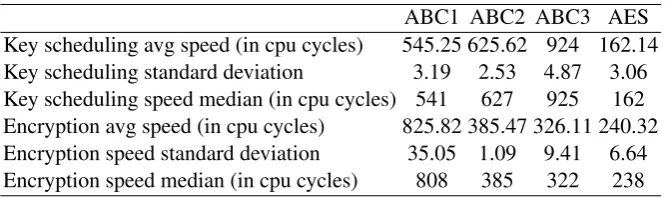
ABC1 ABC2 ABC3 AES Key scheduling avg speed (in cpu cycles) 545.25 625.62 924 162.14 Key scheduling standard deviation 3.19 2.53 4.87 3.06 Key scheduling speed median (in cpu cycles) 541 627 925 162 Encryption avg speed (in cpu cycles) 825.82 385.47 326.11 240.32 Encryption speed standard deviation 35.05 1.09 9.41 6.64 Encryption speed median (in cpu cycles) 808 385 322 238
Table 2.Performance of the different implementations
Definition 16 We use the termextended differential characteristic for a differential characteristic that may include a salt difference and/or a counter difference in addition to the plaintext difference. An attack that uses an extended differential characteristic is calledextended differential attack.
We note that using an extended differential characteristic that has a salt difference is useless when attacking ABC2 or ABC3, since in both ABCs the salt is encrypted by the secret key before it is used. Thus, an adversary who uses such a characteristic has no information about the differential that is actually in use. Therefore, we limit our analysis to the case where there is no salt difference. Obviously, a counter difference can partially “fix” a plaintext difference and slow down the diffusion of the difference. Therefore, we expect that the diffusion of differences will be slightly slower in ABC2 and ABC3 than in AES. Nevertheless, we claim that both ABCs are still secure against extended differential attacks, and indeed, a simulation that checks all possible differential trails shows that after six rounds of ABC2 and after seven rounds of ABC3 there are always at least 25 active S Boxes. In a full run of 14 rounds of ABC2 there are at least 53 active S Boxes, and in a full run of 10 rounds of ABC3 there are at least 30 active boxes. Thus, ABC2 does not have any extended differential characteristic (without a salt-difference) that has probability higher than(2−6)53 = 2−318. Similarly, ABC3 does not have such an extended differential characteristic that has probability higher than(2−6)30= 2−180.
7.5 Performance of Our ABCs
Bibliography
[1] Mihir Bellare, John Black, Philip Rogaway,OCB: A Block-Cipher Mode of Operation,ACM Transactions on Information and System Security (TISSEC), vol. 6, no. 3, pp. 365-403, August 2003. Earlier version in Eighth ACM Conference on Computer and Communications Security (CCS-8), ACM Press, 2001. [2] Mihir Bellare, Anand. Desai, Eron Jokipii, Philip Rogaway, A Concrete Security Treatment of Symmetric
Encryption, proceedings of the 38th Annual Symposium on Foundations of Computer Science, IEEE, 1997, pp. 394–403.
[3] Eli Biham, Orr Dunkelman, A Framework for Iterative Hash Functions - HAIFA, Second NIST Crypto-graphic Hash Workshop, 2006.
[4] Joan Daemen and Vincent Rijmen, AES Proposal: RijndaelNIST AES proposal, 1998.
[5] D. W. Davies and W. L. Price,The Application of Digital Signatures Based on Public-Key Cryptosystems, Proceeding of Fifth International Computer Communications Conference, pp. 525–530, 1980.
[6] Richard Drews Dean, Formal Aspects of Mobile Code Security, Ph.D Dissertation, Princeton University, January 1999.
[7] Whitfield Diffie and Martin Edward Hellman, Privacy and Authentication: An Introduction to Cryptog-raphy, Proceedings of the IEEE, Vol. 67, No. 3, pp. 397-427, March 1979.
[8] Danny Dolev, Cynthia Dwork, Moni Naor, Non-Malleable Cryptography, SIAM Journal on computing, Vol. 30, No. 2, pp. 391–437, 2000.
[9] Morris Dworkin, Recommendation for Block Cipher Modes of Operation - Methods and Techniques, NIST Special Publication 800-38A, 2001.
[10] Brian Gladman, AES Source Code, http://www.gladman.me.uk/.
[11] Shafi Goldwasser and Silvio Micali, Probabilistic Encryption, Special issue of Journal of Computer and Systems Sciences, Vol. 28, No. 2, pp. 270-299, April 1984.
[12] Martin E.Hellman, A Cryptanalytic Time-Memory Tradeoff, IEEE Transactions on Information Theory, Vol. 26, pp. 401-406, July 1980.
[13] John Kelsey and Bruce Schneier, Second Preimages on n-Bit Hash Functions for Much Less than 2n Work, EUROCRYPT 2005, pp. 474-490.
[14] Moses Liskov, Ronald L. Rivest, David Wagner, Tweakable Block Ciphers, Advances in Cryptology – CRYPTO 2002, Lecture Notes in Computer Science 2442, pp. 31–46, Springer-Verlag, 2002.
[15] Bart Preneel, Ren´e Govaerts and Joos Vandewalle, Hash Functions Based on Block Ciphers: A Synthetic Approach, Crypto 1993, pp. 368-378.
[16] Philip Rogaway, Nonce-Based Symmetric Encryption, Fast Software Encryption (FSE) 2004, Lecture Notes in Computer Science vol. 3017, pp. 348-359, Springer, 2004.
[17] US National Institute of Standards and Technology,Advanced Encryption Standard, Federal Information Processing Standards Publications No. 197, 2001.
A Security Proofs
A.1 Proof of Lemma 1
Lemma 1 LetXbe a reasonable mode. ThenAXis a reasonableAMode.
Proof. AXis built by replacing the instances of a block cipher in Xwith instances of an ABC. LetE˜ be an ABC with a block size ofn bits, and letE be a block cipher with a block size ofnbits. We show thatAX
1. X is a reasonable mode of operation and therefore,XKE(·)is a length preserving encryption for every key
K. Therefore,AXE˜˜
K,S, by its definition, is also a length preserving encryption for every keyKand a saltS. The number of plaintext blocks inAXE˜
˜
K,Sis equal to the number of plaintext blocks inX E
Kand the number of ciphertext blocks inAXE˜˜
K,Sis equal to the number of ciphertext blocks inX E
K. Therefore, the number of plaintext blocks inAXEK,S˜˜ equals the number of ciphertext blocks. Moreover, all the plaintext and ciphertext blocks ofAXE˜˜
K,Saren-bits blocks. 2. Letf1 andf2be the functions such that
Ci=f2(EK(f1(IV, i, M1, ..., Mi, C1, ..., Ci−1)), IV, i, M1, ..., Mi, C1, ..., Ci−1).
By its definition,AXis the AMode in which
Ci=f2( ˜EK,S,i(f1(IV, i, M1, ..., Mi, C1, ..., Ci−1)), IV, i, M1, ..., Mi, C1, ..., Ci−1). (a) By its definition,f2(·;IV, i, M1, ..., Mi, C1, ..., Ci−1)is a permutation over{0,1}n.
(b) DenotegE,K,IV,i,M1,...,Mi−1,C1,...,Ci−1(Mi)
=f2(EK(f1(IV, i, M1, ..., Mi, C1, ..., Ci−1)), IV, i, M1, ..., Mi, C1, ..., Ci−1), and denoteg˜E,K,S,IV,i,M1˜ ,...,Mi−1,C1,...,Ci−1(Mi)
=f2( ˜EK,S,i(f1(IV, i, M1, ..., Mi, C1, ..., Ci−1)), IV, i, M1, ..., Mi, C1, ..., Ci−1).LetE˜(S,i)be the block cipher that is defined byE˜K(S,i)(M) = ˜EK,S,i(M). Now we can write:
˜
gE,K,S,IV,i,M1,...,M˜ i−1,C1,...,Ci−1(Mi) =gE˜(S,i),K,IV,i,M1,...,M
i−1,C1,...,Ci−1(Mi).
The function on the right of the last equation is a permutation. The function on the left side of the equation (˜g) equals thei’th block ofAXE˜˜
K,S. Thus inAX,Ci is a permutation ofMi.
QED.
A.2 Proof of Theorem 1
Theorem 1 LetXbe a reasonableAMode. LetE be anABC. Every possible total length of queries σthat allows the adversary to be salt-respecting satisfiesSecindXE−CPA(σ)≤Sec
prp E (σ).
Proof. LetA be an ind-CPA adversary against XE that uses q queries of total length ofσ blocks and that achieves the maximal advantage such an adversary can achieve, i.e.,AdvindXE−CPA(A) = Sec
ind−CPA
XE (σ). We
build an adversaryB againstEthat usesσqueries and such thatAdvprpE (B) = AdvindXE−CPA(A).
LetOB be the oracle that answersB’s queries (OB can be eitherEK(·,·,·)orπ(·,·,·)).B simulates an oracleOforA.Oworks as follows: wheneverAmakes a queryQ = (S, M =M1||...||Mm)toO,B makes
mqueries to its own oracleOB:Qi= (S, i, xi)for1≤i≤m, and gets an answeryi, wherexiis the plaintext input of thei’th instance ofE inX (note thatB is able to calculatexi when necessary). From the answers it gets for its queries,B calculatesCi =f2(yi, IV, i, M1, ..., Mi, C1, ..., Ci−1)and returnsC = C1||...||Cm.B letsArun onOand answers asA.
First, we notice that when OB = EK(·,·,·) then O = OXE
K(·,·). This follows immediately from the
building ofO. Second, we claim that whenOB=π(·,·)thenO=OX
E
R (·,·). This is becauseXis a reasonable mode and as such,Ciis a permutation ofyiwhich is a random string in that case. Therefore, for every1≤i≤
m,Ciis actually chosen uniformly at random from{0,1}nand thus,Cis a random string of length|XK,SE (M)|. Now, we can write:
AdvprpE (B) = Pr
h
BEK(·,·,·) = 1 K
R
←− {0,1}ki−Pr
h
Bπ(·,·,·)= 1π
R
←−SCP erm(s, c, n)
i
= Pr
AOXE
K
(·,·)
= 1K
R
←− {0,1}k
−PrhAπ(·,·)= 1i= AdvindXE−CPA(A).
A.3 Proof of Theorem 2
Theorem 2 LetE˜be an idealABCand letEbe an ideal block cipher. For everyσit holds thatSecindECB−CCAE (σ)≥
Secind−CCA
AECBE˜ (σ).
In order to prove Theorem 2 we need to prove the following two lemmas.
Lemma 4 LetEbe an idealABC. LetAbe anind-CCAadversary againstAECBE that uses no more than a total ofσblocks in its queries. Then there exists a deterministicind-CCAadversaryA0that uses no more than a total ofσblocks in its queries and such thatAdvindAECB−CCAE (A)≤Adv
ind−CCA AECBE (A
0).
Proof. Consider a representation ofAas a decision tree. Letvbe a state in the decision tree whereAperforms a coin-flip. Letu1, ..., umbe the children ofv, so upon arriving to statev,Aflips a coin and, according to the result, decides to which one ofv’s children it should move. LetAvbe the event in whichAreaches statev. The advantage ofAcan be written as
AdvindAECB−CCAE (A) = Pr
h
AAECBKE(·,·)= 1
K
R
←− {0,1}ki−PrhAOR(·,·)= 1i
= PrhAO(·,·)= 1
O=OE
i
−PrhAO(·,·)= 1
O=OR
i
= PrhAO(·,·)= 1
O=OE∧Av i
·PrhAv
OE
i
+ PrhAO(·,·)= 1
O=OE∧ ¬Av i
·Prh¬Av
OE
i
−PrhAO(·,·)= 1
O=OR∧Av i
·Pr [Av|OR]−PrhAO(·,·)= 1
O=OR∧ ¬Av i
·Prh¬Av OR
i
.
We note thatPrhAO(·,·) = 1
Av
i
=Pm
i=1Pr h ui Av i
·PrhAO(·,·)= 1
Aui
i .
Define
j= arg max 1≤i≤m{Pr
h
Av
O=OE
i
·PrhAO(·,·)= 1
O=OE∧Aui
i
−PrhAv
O=OR
i
·PrhAO(·,·)= 1
O=OR∧Aui
i
}.
Now, consider the adversaryA(v)of which decision tree is identical to the decision tree ofA, besides the fact that upon reaching the statev,A(v)does not flip a coin, but moves touj.
For any statew, denote byOw
Ethe event in whichO=OEand the adversary (which can be eitherAorA(v) – according to the context) reaches statew. Denote byO¬Ewthe event in whichO=OE and the adversary does not reach statew. Similarly, denote byORwandOR¬wthe events in whichO =ORand the adversary reaches or not, respectively, statew.
AdvindAECB−CCAE (A
(v)
) = PrhA(v)O(·,·)= 1O=OE i
−PrhA(v)O(·,·)= 1O=OR i
= PrhA(v)O(·,·)= 1OvE
i
·PrhA(v)v
OE
i
+ PrhA(v)O(·,·)= 1O
¬v E
i
·Prh¬A(v)v|OE
i
−PrhA(v)O(·,·)= 1O
v R
i
·PrhA(v)v
OR
i
−PrhA(v)O(·,·)= 1O
¬v R
i
·Prh¬A(v)v
OR
i
= PrhA(v)O(·,·)= 1O
uj
E
i
·PrhA(v)v
OE
i
−PrhA(v)O(·,·)= 1O
uj
R
i
·PrhA(v)v
OR
i
+ Pr
h
A(v)O(·,·)= 1O
¬v E
i
·Pr
h
¬A(v)v
OE
i
−Pr
h
A(v)O(·,·)= 1O
¬v R
i
·Pr
h
¬A(v)v
OR i ≥ m X i=1
PruiAv
·PrAvOE
·Pr
h
AO(·,·)= 1O
ui
E
i
−PrAvOR
·Pr
h
AO(·,·)= 1O=O
ui
R
i
+ PrhA(v)O(·,·)= 1O
¬v E
i
·Prh¬A(v)v
OE
i
−PrhA(v)O(·,·)= 1O
¬v R
i
·Prh¬A(v)v
OR i = m X i=1 Pr
uiAv
·Pr
AvOE
·PrhAO(·,·)= 1O
ui E i − m X i=1
Pr [ui|Av]·Pr [Av|OR]·PrhAO(·,·)= 1|Oui
R
i
+ PrhA(v)O(·,·)= 1O
¬v E
i
·Prh¬A(v)v
OE
i
−PrhA(v)O(·,·)= 1O
¬v R
i
·Prh¬A(v)v
OR
i
= PrhAO(·,·)= 1O
v E
i
·Pr
AvOE
+ PrhAO(·,·)= 1O
¬v E
i
·Pr
¬AvOE
−PrhAO(·,·)= 1 O v R i ·Pr Av OR
−PrhAO(·,·)= 1 O ¬v R i ·Pr ¬Av OR
=AdvindAECB−CCAE (A).
By induction, we can create an adversaryA0which does not perform any flip-coins and for whichAdvindAECB−CCAE (A
0)≥
AdvindAECB−CCAE (A).
QED.
Definition 17 The sequence of queries made by anind-CCAadversary A to an oracleO, and the answers received for them is denoted bystream.
When discussing a deterministic adversary A, the output of the adversary in a single run depends only on the stream generated by A’s run (and since this is a deterministic adversary, the output actually depends only on the answers received by the oracle). Thus, the contribution of a single streamuthatAaccepts to the advantage ofAis the difference between the probability of gettinguwhenAruns onOE and the probability of gettinguwhenAruns onOR. Formally, denote byU the set of all streams upon whichAoutputs ‘1’. Then,
AdvindE −CCA(A) =P
u∈U(Pr[u|O =OE]−Pr[u|O=OR]).
Lemma 5 LetXbe a reasonableAMode. LetEbe an idealABC. LetAbe a deterministicind-CCAadversary againstXE that uses no more than a total ofσ blocks in its queries, and such thatAdvindXE−CCA(A) ≥ 0. If
there are 1 ≤ `streams thatA accepts (outputs ‘1’) then there exists a deterministic adversary B that uses no more than a total of σ blocks in its queries, accepts2n ≤ `0 streams and such that AdvindXE−CCA(B) ≥
AdvindXE−CCA(A).
Proof. If2n ≤ ` thenB = A and we are done. If1 ≤ ` < 2n then letu be a stream that Aaccepts and such thatPr[u|O = OE]−Pr[u|O = OR] ≥ 0(obviously, there is at least one such stream). LetS1 be the first salt inu and letC1 be the answer to the first block of the first query inu. Letπ be a permutation over {0,1}n. Consider the stream u
Now, letUAbe the set of streams thatAaccepts. Let{πi}2
n
i=1be a set of2npermutations such thatπi(C1)6=
πj(C1)for everyi=6 j. LetUB =UAS2
n
i=1uπi and letBbe the adversary that accepts the streams that are in UBand rejects the other streams.Baccepts at least2nstreams and
AdvindXE−CCA(B) =
X
u∈UB
(Pr[u|O=OE]−Pr[u|O=OR])
= X
u∈UA
(Pr[u|O=OE]−Pr[u|O=OR]) +
≥0
z }| {
X
u∈UB\UA
(Pr[u|O=OE]−Pr[u|O=OR])
≥Advind−CCA
XE (A)
QED. Now we can prove Theorem 2.
Proof. Let A be an ind-CCA adversary against AECBE˜ that uses no more than a total of σ blocks in its queries. W.l.g., A is deterministic (following Lemma 4). In case A does not accept any streams then
Advind−CCA
AECBE˜,A = 0. In case that there are streams thatAaccepts then w.l.g., there are at least2
nsuch streams (following Lemma 5).
Every sequence thatAaccepts is generated byORwith probability of at least2−nσ and therefore, in case that there are sequences thatAaccepts,Pr[AOR(·,·)= 1]≥2−n(σ−1). Therefore, we can write
Advind−CCA
AECBE˜ (A) = Pr h
AO(·,·)= 1
O=OE i
−PrhAO(·,·)= 1
O =OR i
≤1−2−n(σ−1),
and conclude thatSecind−cca
AECB˜E(σ)≤1−2
−n(σ−1).
Now, consider an ind-CCA adversaryB that works againstECBE and is defined as follows: B asks a single query ofσblocks, all equal and accepts (outputs ‘1’) if and only if allσblocks of the answer are equal.
Obviously,Pr[BOE(·)= 1] = 1andPr[BOR(·)= 1] = 2−n(σ−1). Therefore we get
SecindECB−CCAE (σ)≥Adv
ind−CCA
ECBE (B) = 1−2
−n(σ−1) ≥Secind−CCA AECBE˜ (σ).
QED.
A.4 Proof of Theorem 3
Theorem 3 LetX be a reasonable AMode, and letE be an ideal ABC. ThenSecXsemE−ATK(σ) = 0,where
ATK∈ {CPA,CCA}.
In order to prove Theorem 3 we need to prove the following lemmas.
Lemma 6 LetXbe a reasonable AMode. LetEbe an idealABC. Then, for every messageM =M1||...||Mm, and every1 ≤ i ≤m,c ∈ {0,1}|Mi|,K ∈ {0,1}k,S ∈ {0,1}s,it holds thatPr[C
i = c] = 2−|Mi|,where
C =XE
K,S(M)and when the randomness results from choosing the random permutationsEK,S,tfor different counter valuest.
Proof. SinceEis an ideal ABC thenEK,S,iis a random permutation chosen uniformly from the permutation spaces. Therefore, for every possiblexi ∈ {0,1}|Mi|and for every y ∈ {0,1}|Mi| we get thatPr[yi = y] =
Pr[EK,S,i(xi) =y] = 2−|Mi|.
SinceXis a reasonable AMode in whichCiis a permutation ofyithen for everyc∈ {0,1}|Mi|we get that
QED.
Lemma 7 Let X be a reasonable AMode. Let E be an ideal ABC. Then, for every message M, and every
c ∈ {0,1}|M|,K ∈ {0,1}k,S ∈ {0,1}s,it holds thatPr[C =c] = 2−|M|,whereC =XE
K,S(M)and when the randomness results from choosing the random permutationsEK,S,tfor different counter valuest.
Proof. According to Lemma 6,Pr[Ci =ci] = 2−|Mi|for every1≤i≤m, (wheremis the number of blocks inM) and for everyci ∈ {0,1}|Mi|. SinceX is a reasonable AMode then all the instances ofE inX define independent permutations and therefore,
Pr[C=c] =
m
Y
i=1
Pr[Ci =ci] = m
Y
i=1
2−|Mi|= 2−Pmi=1|Mi|= 2−|M|.
QED.
Lemma 8 LetX be a reasonable AMode, letE be an idealABC, and letM be a message chosen at random according to some valid distribution functionγ (i.e., γ gives non-zero probability only to messages of length
`=|M|).
Then, for everym, c∈ {0,1}`,K ∈ {0,1}k,S∈ {0,1}s,it holds thatPr[M =m|C =c] =γ(m),where
C =XK,SE (M)and when the randomness results from choosing the random permutationsEK,S,tfor different counter valuest.
Proof. In Lemma 7 we show that Pr[C = c] = 2−|M| for every message M, and every c ∈ {0,1}|M|,
K ∈ {0,1}k, S ∈ {0,1}s.Therefore, we can writePr[C = c|M] = 2−|M|. By applying Bayes’ law, and
following thatPr[C=c]6= 0:
Pr[M =m|C =c] = P r[M =m]·Pr[C=c|M =m]
P r[C=c] =
γ(M)·2−`
2−` =γ(M).
QED. Now we can prove Theorem 3.
Proof. For every(α, f)thatAcan output it holds that
Pr[α=f(M∗)|C∗] = X
m:γ(m)>0, f(m)=α
P r[m|C∗] = X
m:f(m)=α
γ(m).
On the other hand,
Pr[α=f(M0)] = X
m:γ(m)>0, f(m)=α
γ(m) = Pr[α =f(M∗)|C∗].