Available Online atwww.ijcsmc.com
International Journal of Computer Science and Mobile Computing
A Monthly Journal of Computer Science and Information Technology
ISSN 2320–088X
IJCSMC, Vol. 4, Issue. 7, July 2015, pg.299 – 304
RESEARCH ARTICLE
A Self-Destructive System for Data
Privacy on Web Services
Ganesh Z Bhade
1, Prof. Vikrant Chole
21Department of Computer Science and Technology
1G.H. Raisoni Academy of Engineering and Technology, Nagpur, India 2
Department of Computer Science and Technology
2
G.H. Raisoni Academy of Engineering and Technology, Nagpur, India
Abstract: Now a days more and more services and applications are emerging in the Internet, exposing sensitive electronic data in the internet has become easier. Web services causes personal data to be cached, copied, and archived by third parties, often without our knowledge or control. We propose a secure self-destructing scheme for data, which can protect a user’s sensitive data by making the sensitive and important data automatically destructed after particular period of time. Specifically, we first encrypt the data into a cipher text. Then, we associate the cipher text, and extract a part of the cipher text to make it incomplete. There will be one time passwords to decrypt the data. In addition, a time-to-live (TTL) is integrated into the executable to provide an additional layer of security so that the data is only accessible within a defined time period.
Keywords:Data privacy, self destruction, time to leave (TTL), web services.
I. INTRODUCTION
data one key will be generated which is valid for only one time. In addition Time to live (TTL) is provided which will increase security so that data is only accessible within a defined time period.
In this paper, Self Destruction (SeDas) present a solution to implement a self destructing data system, Which consist of two main parts: 1) secret key part-generate a pair of keys through RC4 algorithm. 2) survival time part-specify time limit to each keys. Through this it can meet the following advantages: 1) No explicit delete action by any third party. 2) The keys can be self destructed after user specified time and also reduces the communication overhead as well as network delay. 3)Increase processing speed and it will meet all the privacy preserving goals.
1.1 RC4 Algorithm
RC4 is ideal for storing information that is highly sensitive and highly important. A RC4 method can secure a secret over multiple servers and remain recoverable despite multiple server failure. The dealer may act as several district participants, distributing the shares among the participants. Each share may be stored on a different server, but the dealer can recover the secret even if several servers break down as long as they can recover. The algorithm divides a message into fix sized large blocks and encrypts these blocks concurrently on multi core machine.
1.2 Self Destruction using Time to Live property
Time to Live is a mechanism that limit the lifespan or lifetime of keys stored in cloud. TTL may be implemented as a counter or timestamp attached to or embedded in the keys. Once the prescribed event occur or time span has elapsed, keys can be self destructed without any user intervention. In computing application, TTL is used to improve performance of caching or to improve privacy from the leakages.
II. BACK GROUND
Web services allow user to take benefit from all the technologies, without the need for deep knowledge about or expertise with each one of them. It is not only sharing of resources but can also dynamically reallocating as per demands. User subjectively hope service providers will provide security policy to protect the data from the leakages. To protect these data is important also take more and more risk in web services environment. To provide privacy they perform encryption using key. On the other hand, When data is being processed, transformed and modified by the hackers and intruders. To overcome these problem sedas system provide more security in cloud environment through Shamir algorithm and also reduce the runtime overhead as well as network delay.
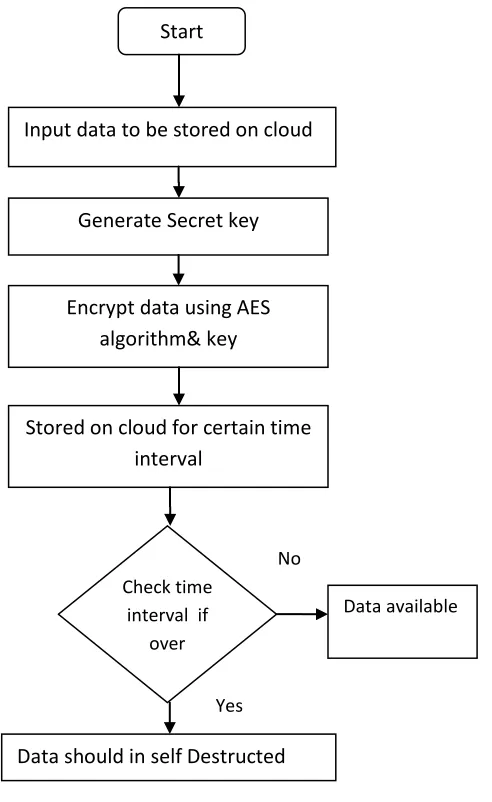
III. SYSTEM ARCHITECTURE
Fig 1.System Model
In Proposed system, sedas method implement automatic self destruction of keys to avoid explicit delete or modification of data in cloud environment by any third party or attackers. It leads several advantages are reduces communication overhead, network delay, generate pair of keys to single file (keys length is 2bytes) , increase processing speed, increase I/O performance and also it will meets all privacy preserving goals.
IV. MODULES
User Authentication
Secret Key Part
Start
Input data to be stored on cloud
Encrypt data using AES
algorithm& key
Generate Secret key
Check time interval if
over
Data should in self Destructed
Stored on cloud for certain time
interval
Yes No
4.1 Modules Description
User Authentication:- A new user has to first create a profile. This is done by registration. A user id and password are submitted by the user. The user can login successfully only if user id and password are entered correctly. The login is a failure if the incorrect user id or wrong password is entered by the user. This helps in preventing unauthorized access.
Secret Key Part:- RC4 is a stream cipher algorithm and operates on individual bits to secure the algorithm. Rc4 is the most common algorithm and is used in popular protocols like secure socket layer (SSL) to protect web browsing and in WEP to protect the wireless networks. The algorithm divides a message into fix sized large blocks and encrypts these blocks concurrently on multi core machine.
File Uploading:- Before upload file in cloud the user perform encryption using pair of keys generated by RC4. When a user upload only a encrypted file in cloud and stores his keys using sedas method, it should specify the file, keys and TTL as the arguments for uploading procedure. When the keys are self destructed after a user specified time.
Downloading File:- Users who has permission can download data stored in the server . The data must be decrypted before use. If the self destruct operation has not triggered, the client can get enough key shares to reconstruct the keys successfully. During download process, Shamir algorithm checks the given keys are expired or not. If the keys are not expiring, the user can easily download. Otherwise, Shamir algorithm generates a new pair of keys to the authorized user.
Self Destruction Method:- Self destruction mainly aims at protecting the user data privacy. All the keys become self destructed or unreadable after user specified time. The result demonstrate that the sedas meet all goals of privacy preserving. Sedas does not affect the normal use of storage system and can also meet the requirement of self destructing data under a survival time by user controllable keys. These are multiple storage services for a user to store data. Meanwhile, to avoid problem produced by the centralized “trusted” third party, the responsibility of sedas is to protect the user keys and provide the function of self destructing data.
VI. CONCLUSION
Each authenticated user, the RC4 generate a pair of keys also the user specify the lifetime of each keys. After user specified time the keys can be self destructed without user intervention. During the download process the RC4 check the validity of the keys. If the keys are expired, The RC4 generate new pair of keys to the user through this only the sedas system meet all the privacy preserving goals. The future work of the sedas system further to increase the key length to provide user data privacy in web infrastructure
REFERENCES
[1] Y. Tang, P. P. C. Lee, J. C. S. Lui, and R. Perlman, “FADE: Secure overlay cloud storage with file assured deletion,” in Proc.Secure Comm, 2010.
[2] C. Wang, Q. Wang, K. Ren, and W. Lou, “Privacy-preserving public auditing for storage security in cloud computing,” in Proc. IEEE INFOCOM, 2010.
[3] R. Geambasu, T. Kohno, A. Levy, and H. M. Levy, “Vanish: Increasing data privacy with self-destructing data,” in
Proc. USENIX Security Symp., Montreal, Canada, Aug. 2009, pp. 299–315.
“Defeating vanish with low-cost sybil attacks against large DHEs,” in Proc. Network and Distributed System Security Symp., 2010.
[10] R. Perlman, “File system design with assured delete,” in Proc. Third IEEE Int. Security Storage Workshop (SISW), 2005.