An Analysis Dissertation on Big Data and Hadoop and its
Applications
S.L.Anusha & G.Niveditha
Assistant professor in Department of CSE Geethanjali College of Engineering and Technology [email protected] , [email protected]
Abstract: The term ‘Big Data’ describes innovative techniques and
technologies to capture, store, distribute, manage and analyze petabyte- or larger-sized datasets with high-velocity and different structures. Big data can be structured, unstructured or semi-structured, resulting in incapability of conventional data management methods. Data is generated from various different sources and can arrive in the system at various rates. In order to process these large amounts of data in an inexpensive and efficient way, parallelism is used. Big Data is a data whose scale, diversity, and complexity require new architecture, techniques, algorithms, and analytics to manage it and extract value and hidden knowledge from it. Hadoop is the core platform for structuring Big Data, and solves the problem of making it useful for analytics purposes. Hadoop is an open source software project that enables the distributed processing of large data sets across clusters of commodity servers. It is designed to scale up from a single server to thousands of machines, with a very high degree of fault tolerance. The challenges that are hindering the growth of Big Data Analytics are accounted for in depth in the paper. This topic has been segregated into two arenas- one being the practical challenges faces whilst the other being the theoretical challenges. The hurdles of securing the data and democratizing it have been elaborated amongst several others such as inability in finding sound data professionals in required amounts and software that possess ability to process data at a high velocity. Through the article, the authors intend to decipher the notions in an intelligible manner embodying in text several use-cases and illustrations.
Keywords -Big Data, Hadoop, Map Reduce, HDFS, Hadoop Components
1. INTRODUCTION
A. Big Data: Definition
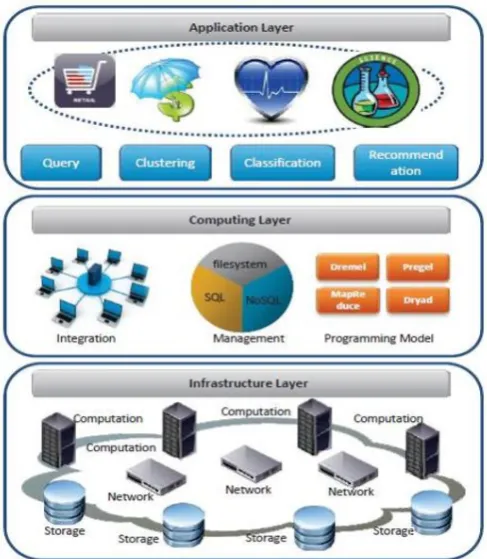
Big data is a term that refers to data sets or combinations of data sets whose size (volume), complexity (variability), and rate of growth (velocity) make them difficult to be captured, managed, processed or analyzed by conventional technologies and tools, such as relational databases and desktop statistics or visualization packages, within the time necessary to make them useful. While the size used to determine whether a particular data set is considered big data is not firmly defined and continues to change over time, most analysts and practitioners currently refer to data sets from 30-50 terabytes(10 12 or 1000 gigabytes per terabyte) to multiple petabytes (1015 or 1000 terabytes per petabyte) as big data. Figure No. 1.1 gives Layered Architecture of Big Data System. It can be decomposed into three layers, including Infrastructure Layer, Computing Layer, and Application Layer from top to bottom.
B. 3 Vs of Big Data
Volume of data: Volume refers to amount of data. Volume of
data stored in enterprise repositories have grown from megabytes and gigabytes to petabytes.
Variety of data: Different types of data and sources of data. Data variety exploded from structured and legacy data stored in enterprise repositories to unstructured, semi structured, audio, video, XML etc.
Velocity of data: Velocity refers to the speed of data processing. For time-sensitive processes such as catching fraud, big data must be used as it streams into your enterprise in order to maximize its value.
Figure 1: Layered Architecture of Big Data System
C. Problem with Big Data Processing
i. Heterogeneity and Incompleteness
When humans consume information, a great deal of heterogeneity is comfortably tolerated. In fact, the nuance and richness of natural language can provide valuable depth. However, machine analysis algorithms expect homogeneous data, and cannot understand nuance. In consequence, data must be carefully structured as a first step in (or prior to) data analysis. Computer systems work most efficiently if they can store multiple items that are all identical in size and structure. Efficient representation, access, and analysis of semi-structured data require further work.
Of course, the first thing anyone thinks of with Big Data is its size. After all, the word “big” is there in the very name. Managing large and rapidly increasing volumes of data has been a challenging issue for many decades. In the past, this challenge was mitigated by processors getting faster, following Moore’s law, to provide us with the resources needed to cope with increasing volumes of data. But, there is a fundamental shift underway now: data volume is scaling faster than compute resources, and CPU speeds are static.
iii. Timeliness
The flip side of size is speed. The larger the data set to be processed, the longer it will take to analyze. The design of a system that effectively deals with size is likely also to result in a system that can process a given size of data set faster. However, it is not just this speed that is usually meant when one speaks of Velocity in the context of Big Data. Rather, there is an acquisition rate challenge
iv. Privacy
The privacy of data is another huge concern, and one that increases in the context of Big Data. For electronic health records, there are strict laws governing what can and cannot be done. For other data, regulations, particularly in the US, are less forceful. However, there is great public fear regarding the inappropriate use of personal data, particularly through linking of data from multiple sources. Managing privacy is effectively both a technical and a sociological problem, which must be addressed jointly from both perspectives to realize the promise of big data.
v. Human Collaboration
In spite of the tremendous advances made in computational analysis, there remain many patterns that humans can easily detect but computer algorithms have a hard time finding. Ideally, analytics for Big Data will not be all computational rather it will be designed explicitly to have a human in the loop. The new sub-field of visual analytics is attempting to do this, at least with respect to the modeling and analysis phase in the pipeline. In today’s complex world, it often takes multiple experts from different domains to really understand what is going on. A Big Data analysis system must support input from multiple human experts, and shared exploration of results. These multiple experts may be separated in space and time when it is too expensive to assemble an entire team together in one room. The data system has to accept this distributed expert input, and support their collaboration.
2. LITERATURE REVIEW
S. Vikram Phaneendra & E. Madhusudhan Reddy et.al.
Illustrated that in olden days the data was less and easily handled by RDBMS but recently it is difficult to handle huge data through RDBMS tools, which is preferred as “big data”. In this they told that big data differs from other data in 5 dimensions such as volume, velocity, variety, value and complexity. They illustrated the hadoop architecture consisting of name node, data node, edge node, HDFS to handle big data systems. Hadoop architecture handle large data sets, scalable algorithm does log management application of big data can be found out in financial, retail industry, health-care, mobility, insurance. The authors also focused on
the challenges that need to be faced by enterprises when handling big data: - data privacy, search analysis, etc [1].
Kiran kumara Reddi & Dnvsl Indira et.al. Enhanced us with the knowledge that Big Data is combination of structured , semi-structured ,unstructured homogenous and heterogeneous data .The author suggested to use nice model to handle transfer of huge amount of data over the network .Under this model, these transfers are relegated to low demand periods where there is ample ,idle bandwidth available . This bandwidth can then be repurposed for big data transmission without impacting other users in system. The Nice model uses a store –andforward approach by utilizing staging servers. The model is able to accommodate differences in time zones and variations in bandwidth. They suggested that new algorithms are required to transfer big data and to solve issues like security, compression, routing algorithms [2].
Jimmy Lin et.al. used Hadoop which is currently the large – scale data analysis “ hammer” of choice, but there exists classes of algorithms that aren’t “ nails” in the sense that they are not particularly amenable to the MapReduce programming model . He focuses on the simple solution to find alternative non-iterative algorithms that solves the same problem. The standard MapReduce is well known and described in many places .Each iteration of the pagerank corresponds to the MapReduce job. The author suggested iterative graph, gradient descent & EM iteration which is typically implemented as Hadoop job with driven set up iteration &Check for convergences. The author suggests that if all you have is a hammer, throw away everything that’s not a nail [3].
Wei Fan & Albert Bifet et.al. Introduced Big Data Mining as the capability of extracting Useful information from these large datasets or streams of data that due to its Volume, variability and velocity it was not possible before to do it. The author also started that there are certain controversy about Big Data. There certain tools for processes. Big Data as such hadoop, strom, apache S4. Specific tools for big graph mining were PEGASUS & Graph. There are certain Challenges that need to death with as such compression, visualization etc.[4].
Albert Bifet et.al. Stated that streaming data analysis in real time is becoming the fastest and most efficient way to obtain useful knowledge, allowing organizations to react quickly when problem appear or detect to improve performance. Huge amount of data is created everyday termed as “ big data”. The tools used for mining big data are apache hadoop, apache big, cascading, scribe, storm, apache hbase, apache mahout, MOA, R, etc. Thus, he instructed that our ability to handle many exabytes of data mainly dependent on existence of rich variety dataset, technique, software framework [5].
based storage. The Hadoop architecture is used to process unstructured and semi-structured using map reduce to locate all relevant data then select only the data directly answering the query. The advent of Big Data has posed opportunities as well challenges to business [6].
Sameer Agarwal et.al. Presents a BlinkDB, a approximate query engine for running interactive SQL queries on large volume of data which is massively parallel. BlinkDB uses two key ideas: (1) an adaptive optimization framework that builds and maintains a set of multi-dimensional stratified samples from original data over time, and (2) A dynamic sample selection strategy that selects an appropriately sized sample based on a query’s accuracy or response time requirements [7].
Yingyi Bu et.al. Used a new technique called as HaLoop which is modified version of Hadoop MapReduce Framework, as Map Reduce lacks built-in-support for iterative programs HaLoop allows iterative applications to be assembled from existing Hadoop programs without modification, and significantly improves their efficiency by providing inter iteration caching mechanisms and a loop-aware scheduler to exploit these caches. He presents the design, implementation, and evaluation of HaLoop, a novel parallel and distributed system that supports large-scale iterative data analysis applications. HaLoop is built on top of Hadoop and extends it with a new programming model and several important optimizations that include (1) a loop-aware task scheduler, (2) loop-invariant data caching, and (3) caching for efficient fix point verification [8].
Shadi Ibrahim et.al. Project says presence of partitioning skew1 causes a huge amount of data transfer during the shuffle phase and leads to significant unfairness on the reduce input among different data nodes In this paper, author develop a novel algorithm named LEEN for locality aware and fairnessaware key partitioning in MapReduce. LEEN embraces an asynchronous map and reduce scheme. Author has integrated LEEN into Hadoop. His experiments demonstrate that LEEN can efficiently achieve higher locality and reduce the amount of shuffled data. More importantly, LEEN guarantees fair distribution of the reduce inputs. As a result, LEEN achieves a performance improvement of up to 45% on different workloads. To tackle all this he presents a present a technique for Handling Partitioning Skew in MapReduce using LEEN [9].
Kenn Slagter et.al. Proposes an improved partitioning algorithm that improves load balancing and memory consumption. This is done via an improved sampling algorithm and partitioner. To evaluate the proposed algorithm, its performance was compared against a state of the art partitioning mechanism employed by Tera Sort as the performance of MapReduce strongly depends on how evenly it distributes this workload. This can be a challenge, especially in the advent of data skew. In MapReduce, workload distribution depends on the algorithm that partitions the data. One way to avoid problems inherent from data skew is to use
data sampling. How evenly the partitioner distributes the data depends on how large and representative the sample is and on how well the samples are analyzed by the partitioning mechanism. He uses an improved partitioning mechanism for optimizing massive data analysis using MapReduce for evenly distribution of workload [10].
3. HADOOP: SOLUTION FOR BIG DATA PROCESSING
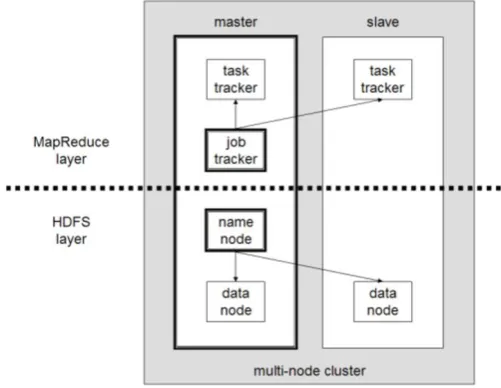
Hadoop is a Programming framework used to support the processing of large data sets in a distributed computing environment. Hadoop was developed by Google’s MapReduce that is a software framework where an application break down into various parts. The Current Appache Hadoop ecosystem consists of the Hadoop Kernel, MapReduce, HDFS and numbers of various components like Apache Hive, Base and Zookeeper. HDFS and MapReduce are explained in following points.
Figure 2: Hadoop Architecture
A. HDFS Architecture
Figure 3: HDFS Architecture
B. MapReduce Architecture
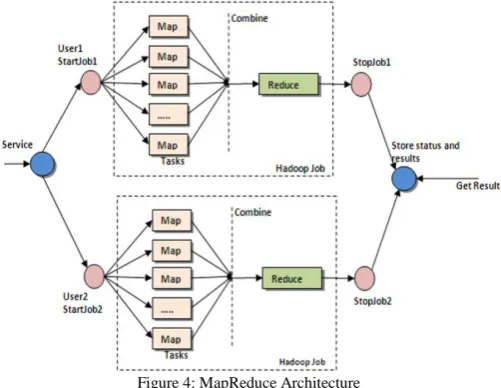
The processing pillar in the Hadoop ecosystem is the MapReduce framework. The framework allows the specification of an operation to be applied to a huge data set, divide the problem and data, and run it in parallel. From an analyst’s point of view, this can occur on multiple dimensions. For example, a very large dataset can be reduced into a smaller subset where analytics can be applied. In a traditional data warehousing scenario, this
Figure 4: MapReduce Architecture
might entail applying an ETL operation on the data to produce something usable by the analyst. In Hadoop, these kinds of operations are written as MapReduce jobs in Java. There are a number of higher level languages like Hive and Pig that make writing these programs easier. The outputs of these jobs can be written back to either HDFS or placed in a traditional data warehouse. There are two functions in MapReduce as follows:
map – the function takes key/value pairs as input and generates an intermediate set of key/value pairs
reduce – the function which merges all the intermediate values associated with the same intermediate key
4. APPLICATIONS
Big Data is slowly becoming ubiquitous. Every arena of business, health or general living standards now can implement big data analytics. To put simply, Big Data is a field which can be used in any zone whatsoever given that this large quantity of data can be harnessed to one‘s advantage. The major applications of Big Data have been listed below.
The Third Eye- Data Visualization Organizations
worldwide are slowly and perpetually recognizing the importance of big data analytics. From predicting customer purchasing behavior patterns to influencing them to make purchases to detecting fraud and misuse which until very recently used to be an incomprehensible task for most companies big data analytics is a one-stop solution. Business experts should have the opportunity to question and interpret data according to their business requirements irrespective of the complexity and volume of the data. In order to achieve this requirement, data scientists need to efficiently visualize and present this data in a comprehensible manner. Giants like Google, Facebook, Twitter, EBay, Wal-Mart etc., adopted data visualization to ease complexity of handling data. Data visualization has shown immense positive outcomes in such business organizations. Implementing data analytics and data visualization, enterprises can finally begin to tap into the immense potential that Big data possesses and ensure greater return on investments and business stability.
Figure.5.: Analysis as generated by IBM institute of Business Value 2014 Analytics Study
Big Data in Healthcare: Healthcare is one of those arenas
in which Big Data ought to have the maximum social impact. Right from the diagnosis of potential health hazards in an individual to complex medical research, big data is present in all aspects of it [12]. Devices such as the Fitbit [13], Jawbone [14] and the Samsung Gear Fit [15] allow the user to track and upload data. Soon enough such data will be compiled and made available to doctors, which will aid them in the diagnosis. Several partnerships like the Pittsburgh Health Data Alliance have been established. The Pittsburgh Health Data Alliance [16] is a collaboration of the Carnegie Mellon University, University of Pittsburgh and the UPMC. In their website, they state [16], ―The health care field generates an enormous amount of data every day. There is a need, and opportunity, to mine this data and provide it to the medical researchers and practitioners who can put it to work in real life, to benefit real people……The solutions we develop will be focused on preventing the onset of disease, improving diagnosis and enhancing quality of care…….Further, there is the potential to lower health care costs, one of the greatest challenges facing our nation. And the Alliance will also drive economic growth in Pittsburgh, attracting hundreds of companies and entrepreneurs, and generating thousands of jobs, from around the world…‖The patients diagnosis will be analyzed and compared with the symptoms of others to discover patterns and ensure better treatment. IBM [17] has taken initiative in a large scale to implement big data in healthcare systems be in its collaboration with healthcare giant Fletcher Allen or with the Premier healthcare alliance to change the way unstructured but useful clinical data is made available to more medical practitioners so as to improve population health. Big Data can also be used in major clinical trials like cure for various forms of cancer and developing tailor-made medicines [12] for individual patients according to their genetic makeup. To summarize, Sundar Ram of Oracle stated [18], ―Big Data solutions can help the industry acquire organize & analyze this data to optimize resource allocation, plug inefficiencies, reduce cost of treatment, improve access to healthcare & advance medicinal research.
Big Data and the World of Finance: Big Data can be a very useful tool in analyzing the incredibly complex stock market moves and aid in making global financial decisions. For example, intelligent and extensive analysis of the big data available on Google Trends can aid in forecasting the stock market. Though this is not a fool-proof method, it definitely is an advancement in the field. A research study [19] by the Warwick Business School drew on records from Google, Wikipedia and Amazon Mechanical Trunk in the time period of 2004-2012 and analyzed the link between Internet searches on politics or business and stock market moves. In the paper, the author states, ―We draw on data from Google and Wikipedia, as well as Amazon Mechanical Turk. Our results are in line with the intriguing possibility that changes in online information gathering behavior relating to both politics and business were historically linked to subsequent stock market moves….Our results provide evidence that for complex events such as large financial market moves, valuable information may be contained in search engine data for keywords with less-obvious semantic connections to the event in question. Overall, we find that increases in searches for information about political issues and business tended to be followed by stock market falls.‖ Big Data is also being implemented in a field called ‗Quantitative Investing‘ [20] where data scientists with negligible financial training are trying to incorporate computing power into predicting securities prices by drawing ideas from sources like newswires, earning reports, weather bulletins, Facebook and Twitter.
One very interesting avenue of using Big Data in finance is the sentiment extraction [21] from news articles. Market sentiment refers to the irrational belief in investors about cash-flow returns [22]. The Heston-Sinha‘s Application of the Machine Learning algorithm [23] provides us with the probability of an article being ‗positive‘, ‗negative‘ and ‗neutral‘ using two other popular methods, one being with the use of the Harvard IV Dictionary. In general, big data is set to revolutionize the landscape of Finance and Economy. Several financial institutions are adopting big data policies in order to gain a competitive edge. Complex algorithms are being developed to execute trades through all the structured and unstructured data gained from the sources. The methods adopted so far has not been completely adept, however, extensive research ensures growing dependence of the stock markets, financial organizations and economies on big data analytics.
5. CONCLUSION
We have entered an era of Big Data. The paper describes the concept of Big Data along with 3 Vs, Volume, Velocity and variety of Big Data. The paper also focuses on Big Data processing problems. These technical challenges must be addressed for efficient and fast processing of Big Data. The challenges include not just the obvious issues of scale, but also heterogeneity, lack of structure, error-handling, privacy, timeliness, provenance, and visualization, at all stages of the analysis pipeline from data acquisition to result interpretation. These technical challenges are common across a large variety of application domains, and therefore not costeffective to address in the context of one domain alone. The paper describes Hadoop which is an open source software used for processing of Big Data.
REFERENCES
[1]. S.Vikram Phaneendra & E.Madhusudhan Reddy “Big Data- solutions for RDBMS problems- A survey” In 12th IEEE/IFIP Network Operations & Management Symposium (NOMS 2010) (Osaka, Japan, Apr 19{23 2013).
[2]. Kiran kumara Reddi & Dnvsl Indira “Different Technique to Transfer Big Data : survey” IEEE Transactions on 52(8) (Aug.2013) 2348 { 2355}
[3]. Jimmy Lin “MapReduce Is Good Enough?” The control project. IEEE Computer 32 (2013).
[4]. Umasri.M.L, Shyamalagowri.D ,Suresh Kumar.S “Mining Big Data:- Current status and forecast to the future” Volume 4, Issue 1, January 2014 ISSN: 2277 128X
[5]. Albert Bifet “Mining Big Data In Real Time” Informatica 37 (2013) 15–20 DEC 2012
[6]. Bernice Purcell “The emergence of “big data” technology and analytics” Journal of Technology Research 2013.
[7]. Sameer Agarwal†, Barzan MozafariX, Aurojit Panda†, Henry Milner†, Samuel MaddenX, Ion Stoica “BlinkDB: Queries with Bounded Errors and Bounded Response Times on Very Large Data” Copyright © 2013ì ACM 978-1-4503-1994 2/13/04
[8]. Yingyi Bu _ Bill Howe _ Magdalena Balazinska _ Michael D. Ernst “The HaLoop Approach to Large-Scale Iterative Data Analysis” VLDB 2010 paper “HaLoop: Efficient Iterative Data Processing on Large Clusters. [
[9]. Shadi Ibrahim ⋆ _ Hai Jin _ Lu Lu “Handling Partitioning Skew in MapReduce using LEEN” ACM 51 (2008) 107–113
[10].Kenn Slagter · Ching-Hsien Hsu “An improved partitioning mechanism for optimizing massive data analysis using MapReduce” Published online: 11 April 2013
[11].Ahmed Eldawy, Mohamed F. Mokbel “A Demonstration of SpatialHadoop:An Efficient MapReduce Framework for Spatial Data” Proceedings of the VLDB Endowment, Vol. 6, No. 12 Copyright 2013 VLDB Endowment 21508097/13/10.
[12].Jeffrey Dean and Sanjay Ghemawat “MapReduce: Simplified Data Processing on Large Clusters” OSDI 2010
[13].Niketan Pansare1, Vinayak Borkar2, Chris Jermaine1, Tyson Condie “Online Aggregation for Large MapReduce Jobs” August 29September 3, 2011, Seattle, WA Copyright 2011 VLDB Endowment, ACM [14].Tyson Condie, Neil Conway, Peter Alvaro, Joseph M. Hellerstein
“Online Aggregation and Continuous Query support in MapReduce” SIGMOD’10, June 6–11, 2010, Indianapolis, Indiana, USA. Copyright 2010 ACM 978-1-4503-00322/10/06.
[15].Jonathan Paul Olmsted “Scaling at Scale: Ideal Point Estimation with ‘Big-Data” Princeton Institute for Computational Science and Engineering 2014.
[16].Jonathan Stuart Ward and Adam Barker “Undefined By Data: A Survey of Big Data Definitions” Stamford, CT: Gartner, 2012. [17].Balaji Palanisamy, Member, IEEE, Aameek Singh, Member, IEEE
Ling Liu, Senior Member, IEEE” Cost-effective Resource Provisioning for MapReduce in a Cloud”gartner report 2010, 25
[18].Mrigank Mridul, Akashdeep Khajuria, Snehasish Dutta, Kumar N “ Analysis of Bidgata using Apache Hadoop and Map Reduce” Volume 4, Issue 5, May 2014” 27
[19].Kyong-Ha Lee Hyunsik Choi “Parallel Data Processing with MapReduce: A Survey” SIGMOD Record, December 2011 (Vol. 40, No. 4)
[20].Chen He Ying Lu David Swanson “Matchmaking: A New MapReduce Scheduling” in 10th IEEE International Conference on Computer and Information Technology (CIT’10), pp. 2736–2743, 2010.
About the authors:
S.L.Anusha working as an Assistant professor in department of CSE at Geethanjali college of Engineering and Technology affiliated to JNTU Hyderabad. She has 2 years teaching experience. Her Research interests include Big Data Analytics and Artificial Intelligence.