LBlock: A Lightweight Block Cipher
⋆Wenling Wu and Lei Zhang
State Key Laboratory of Information Security, Institute of Software, Chinese Academy of Sciences, Beijing 100190, P. R. China
E-mail:{wwl, zhanglei1015}@is.iscas.ac.cn
Abstract. In this paper, we propose a new lightweight block cipher called LBlock. Similar to many other lightweight block ciphers, the block size of LBlock is 64-bit and the key size is 80-bit. Our security evaluation shows that LBlock can achieve enough security margin against known attacks, such as differential cryptanalysis, linear cryptanalysis, impossi-ble differential cryptanalysis and related-key attacks etc. Furthermore, LBlock can be implemented efficiently not only in hardware environ-ments but also in software platforms such as 8-bit microcontroller. Our hardware implementation of LBlock requires about 1320 GE on 0.18µm technology with a throughput of 200 Kbps at 100 KHz. The software implementation of LBlock on 8-bit microcontroller requires about 3955 clock cycles to encrypt a plaintext block.
Key words: Block cipher, Lightweight, Hardware efficiency, Design, Cryptanalysis.
1
Introduction
With the development of electronic and communication applications, RFID tech-nology has been used in many aspects of life, such as access control, parking management, identification, goods tracking etc. In this kind of new cryptogra-phy environment, the applications of RFID technology and sensor networking both have similar features, such as weak computation ability, small storage space, and strict power constraints. Therefore, traditional block ciphers such as AES are not suitable for this kind of extremely constrained environment. Hence, in recent years, research on lightweight ciphers has received a lot of attention. Compared with traditional block ciphers, lightweight ciphers have the following three main properties. Firstly, applications for constrained devices are unlikely to require the encryption of large amounts of data, and hence there is no requirement of high throughput for lightweight ciphers. Secondly, in this cryptography environment, attackers are lack of data and computing ability, which means lightweight ciphers only need to achieve moderate security. Lastly, lightweight ciphers are usually
⋆This paper was first published at ACNS 2011, LNCS 6715, pp. 327-344.
implemented in hardware environment, and small part of them are also imple-mented on software platforms such as 8-bit microcontroller. Therefore, hardware performance will be the primary consideration for lightweight ciphers. Hardware efficiency can be measured in many different ways: the length of the critical path, latency, clock cycles, power consumption, throughput, area requirements, and so on. Among them area requirement is the most important parameter, since small area requirement can minimize both the cost and the power consumption effi-ciently. Therefore, it has become common to use the term hardware efficient as a synonym for small area requirements, and the area requirements are usually measured as gate equivalents (GE). At present, for the hardware implementation of lightweight cipher, area requirements are usually dominated by the registers storing the data state and the key, since registers typically consist of flipflops which have a rather high area and power demand. For example, when using the standard cell library it requires between 6 and 12 GE to store a single bit [26]. Therefore, in the design of lightweight block ciphers, 64-bit block size and 80-bit key size are popular parameters.
Meet-in-the-middle attacks to the KTANTAN family with a key of 80 bits were presented in [36]. TWIS is inspired from the existing block cipher CLEFIA [29]. However, a differential distinguisher with probability 1 for full-round TWIS was presented in [31]. SEA is a Feistel cipher with scalable block and key sizes, and its round function only consists of rotation, XOR, and a single 3-bit S-box operations. TEA [33] and XTEA [34] are lightweight block ciphers proposed several years earlier.
In this paper we propose a new lightweight block cipher called LBlock. The design of its structure and components, such as S-box layer, P permutation layer etc, all represent the trade-off between security and performance. Our se-curity analysis shows that full-round LBlock can provide enough sese-curity margin against known cryptanalytic techniques, such as differential cryptanalysis, linear cryptanalysis, impossible differential cryptanalysis, related-key attack etc. Fur-thermore, the performance evaluation of LBlock shows that not only hardware efficiency but also software implementations on 8-bit/32-bit platforms are ultra lightweight. The rest of this paper is organized as follows. Sect. 2 presents the specification of LBlock. Sect. 3 introduces the design rationale briefly. Sect. 4 and Sect. 5 describe the security analysis and performance evaluation of LBlock respectively. Finally, Sect. 6 concludes the paper.
2
Specification of LBlock
The block length of LBlock is 64-bit, and the key length is 80-bit. It employs a variant Feistel structure and consists of 32 rounds. The specification of LBlock consists of three parts: encryption algorithm, decryption algorithm and key scheduling.
2.1 Notations
In the specification of LBlock, we use the following notations: − M: 64-bit plaintext
− C: 64-bit ciphertext − K: 80-bit master key − Ki: 32-bit round subkey
− F: Round function − s: 4×4 S-box
− S: S-box layer consists of eightsin parallel − P, P1: Permutations operate on 32-bit
2.2 Encryption Algorithm
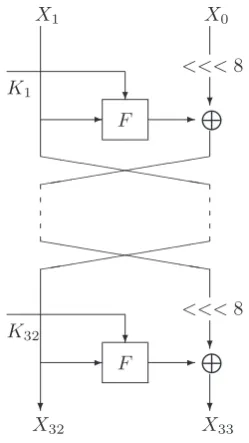
The encryption algorithm of LBlock consists of a 32-round iterative structure which is a variant of Feistel network. The encryption procedure is illustrated in Fig. 1. LetM =X1||X0denote a 64-bit plaintext, and then the data processing procedure can be expressed as follows.
1. Fori= 2,3, . . . ,33, do
Xi=F(Xi−1, Ki−1)⊕(Xi−2<<<8)
2. Output C=X32||X33 as the 64-bit ciphertext
X1 X0
<<<8
? L ?
K1
- F
-hhhhhh
hhh ( ( ( ( ( ( ( ( (
hhh
hhhhh
h ( ( ( ( ( ( ( ( (
?
<<<8
? L
? ?
K32
- F
-X32 X33
Fig. 1.Encryption procedure of LBlock
Specifically, the components used in each round are defined as follows.
(1) Round functionF
The round functionF is defined as follows, whereS andP denote the con-fusion and diffusion functions which will be defined later.
F : {0,1}32× {0,1}32 −→ {0,1}32
(X, Ki) −→ U =P(S(X⊕Ki))
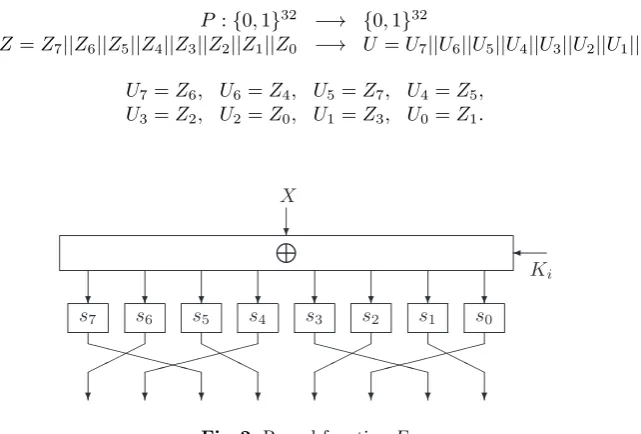
Fig. 2 illustrates the structure of round functionF in detail.
Confusion functionS denotes the non-linear layer of round functionF, and it consists of eight 4-bit S-boxessi in parallel.
S : {0,1}32−→ {0,1}32
Y =Y7||Y6||Y5||Y4||Y3||Y2||Y1||Y0 −→ Z=Z7||Z6||Z5||Z4||Z3||Z2||Z1||Z0
Z7=s7(Y7), Z6=s6(Y6), Z5=s5(Y5), Z4=s4(Y4),
Z3=s3(Y3), Z2=s2(Y2), Z1=s1(Y1), Z0=s0(Y0).
The contents of eight 4-bit S-boxes are listed in Table 1.
(3) Diffusion function P
Diffusion functionP is defined as a permutation of eight 4-bit words, and it can be expressed as the following equations.
P :{0,1}32 −→ {0,1}32
Z=Z7||Z6||Z5||Z4||Z3||Z2||Z1||Z0 −→ U =U7||U6||U5||U4||U3||U2||U1||U0
U7=Z6, U6=Z4, U5=Z7, U4=Z5,
U3=Z2, U2=Z0, U1=Z3, U0=Z1.
X
Ki ?
L
? ? ? ? ? ? ? ?
s7 s6 s5 s4 s3 s2 s1 s0
XX
XXXX
H H
H
XX
XXXX
H H
H
? ? ? ? ? ? ? ?
Fig. 2.Round functionF
2.3 Decryption Algorithm
The decryption algorithm of LBlock is the inverse of encryption procedure, and it consists of a 32-round variant Feistel structure too. LetC=X32||X33 denotes a 64-bit ciphertext, and then the decryption procedure can be expressed as follows.
1. Forj = 31,30, . . . ,0, do
Xj = (F(Xj+1, Kj+1)⊕Xj+2)>>>8
2.4 Key Scheduling
The 80-bit master key K is stored in a key register and denoted as K =
k79k78k77k76... k1k0. Output the leftmost 32 bits of current content of register
K as round subkeyK1, and then operate as follows:
1. Fori= 1,2, . . . ,31, update the key register Kas follows: (a) K <<<29
(b) [k79k78k77k76] = s9[k79k78k77k76] [k75k74k73k72] = s8[k75k74k73k72]
(c) [k50k49k48k47k46]⊕[i]2
(d) Output the leftmost 32 bits of current content of register K as round subkeyKi+1.
wheres8 ands9 are two 4-bit S-boxes, and they are defined in Table 1.1
Table 1.Contents of the S-boxes used in LBlock
s0 14, 9, 15, 0, 13, 4, 10, 11, 1, 2, 8, 3, 7, 6, 12, 5 s1 4, 11, 14, 9, 15, 13, 0, 10, 7, 12, 5, 6, 2, 8, 1, 3 s2 1, 14, 7, 12, 15, 13, 0, 6, 11, 5, 9, 3, 2, 4, 8, 10 s3 7, 6, 8, 11, 0, 15, 3, 14, 9, 10, 12, 13, 5, 2, 4, 1 s4 14, 5, 15, 0, 7, 2, 12, 13, 1, 8, 4, 9, 11, 10, 6, 3 s5 2, 13, 11, 12, 15, 14, 0, 9, 7, 10, 6, 3, 1, 8, 4, 5 s6 11, 9, 4, 14, 0, 15, 10, 13, 6, 12, 5, 7, 3, 8, 1, 2 s7 13, 10, 15, 0, 14, 4, 9, 11, 2, 1, 8, 3, 7, 5, 12, 6 s8 8, 7, 14, 5, 15, 13, 0, 6, 11, 12, 9, 10, 2, 4, 1, 3 s9 11, 5, 15, 0, 7, 2, 9, 13, 4, 8, 1, 12, 14, 10, 3, 6
3
Design Rationale
3.1 Structure
The structure of LBlock is a variant of Feistel network, and its design decisions contain a lot of considerations about security and efficient implementations (such as area, cost and performance etc.). In the aspect of implementation, the most important consideration is the area requirement when implemented in hardware. Therefore, we try to reduce the number of S-boxes used in each round and also minimize the size of each S-box used. Hence a Feistel-type structure seems a
1 There are some errors in the contents of s
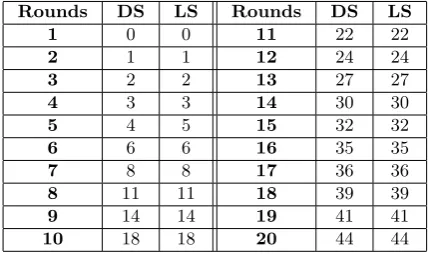
proper choice. Furthermore, for all kinds of generalized Feistel structures which operate less bits in each round, to achieve enough security margin they must take more rounds iteration which will affect its performance (such as speed and throughput). Therefore, in each round of LBlock, we choose only half of the data to go through round functionF, and the other half applies a simple rota-tion operarota-tion. In the diffusion layer, we also choose to use permutarota-tion which can be implemented with no cost in hardware. However, instead of the bitwise permutation usually used, we apply a 4-bit word-wise permutation which can be implemented cheaply not only in hardware but also in software environments such as 8-bit microprocessor platforms. For example, the word-wise permutation in round function F can be combined with the S-box layer to form 8×8 ta-ble lookups. Moreover, we specifically choose the rotation offsets of right half in each round as 8 bits which can be omitted in 8-bit platform implementation. On the other hand, in the aspect of security requirement, we choose the word-wise permutation carefully so that the structure of LBlock satisfies that in both en-cryption and deen-cryption directions it can achieve best diffusion [32] in 8 rounds. Furthermore, the number of differential and linear active S-boxes both increase quickly, and the following Table 2 lists the guaranteed number of active S-boxes before 20 rounds.
Table 2.Guaranteed number of active S-boxes of LBlock
Rounds DS LS Rounds DS LS
1 0 0 11 22 22
2 1 1 12 24 24
3 2 2 13 27 27
4 3 3 14 30 30
5 4 5 15 32 32
6 6 6 16 35 35
7 8 8 17 36 36
8 11 11 18 39 39
9 14 14 19 41 41
10 18 18 20 44 44
3.2 Diffusion Layer
The diffusion permutation of LBlock consists of two parts, namely the word-wise permutation in round function which is denoted asP, and the rotation of right half data in each round which is denoted as P1. Both of these permutations can be implemented by wiring in hardware which needs no additional area cost. For software environments such as 8-bit and 32-bit microprocessor platforms,
andP1(8-bit rotation) can be implemented quite easily. Therefore, the diffusion permutations of LBlock can be implemented efficiently both in hardware and in software environments. Furthermore, the combination ofPandP1can guarantee the best diffusion rounds and the least number of active S-boxes of LBlock. For example, there already exist at least 32 active S-boxes for 15-round LBlock.
3.3 S-Box Layer
On the pursuit of hardware efficiency, we use 4×4 S-boxes s : F4
2 → F24 in LBlock. Compared with the regular 8×8 S-box, small S-box has much more advantage when implemented in hardware. For example, to implement the S-box of AES in hardware more than 200 GE are needed. On the other hand, for the 4×4 S-boxes used in LBlock, all of them can be implemented in hardware with only about 22 GE. Furthermore, in the aspect of security, the S-boxes used in LBlock are carefully chosen so that they all fulfill the following conditions: no fix point, completed, best non linearity, best differential probability, and good algebraic order etc.
3.4 Key Scheduling
Similar to many other lightweight block ciphers, the key scheduling of LBlock is also designed in a stream cipher way. We only apply simple rotation and non-linear operations to generate the round subkeys. First of all, the operation of 29-bit left rotation can be implemented freely in hardware, and it can also break the 4-bit word structure, which helps to improve the security of LBlock against related-key attacks. Secondly, we choose to use two 4×4 S-boxes as the non-linear operation which represents a trade-off between security and performance. Lastly, the exact values of rotation offset, constants and positions of constant addition are carefully chosen, so as to avoid weak relations between round subkeys.
4
Security Evaluation
4.1 Differential Cryptanalysis
For differential cryptanalysis, we adopt an approach to count the number of ac-tive S-boxes of differential characteristics. This is a regular method to evaluate the security against differential attack, which were adopted by many other block ciphers, such as AES [12], Camellia [1] and CLEFIA [29] etc. We found the guaranteed number of differential active S-boxes of LBlock by computer pro-gram, and the results before 20-round are listed in Table 2. Considering that there are at least 32 active S-boxes for 15-round LBlock and the best differential probabilities ofsi are all equal to 2−2, then the maximum probability of
differ-ential characteristics for 15-round LBlock satisfies DCP15r
4.2 Linear Cryptanalysis
We also apply the method of counting active S-boxes for the evaluation of LBlock against linear cryptanalysis. Since there are at least 32 active S-boxes for 15-round LBlock and the best linear bias of each si is 2−2, the maximum bias of
linear approximations for 15-round LBlock satisfiesLCP15r
max≤232−1·232×(−2)= 2−33. Therefore, according to the complexity estimation of linear cryptanalysis, we can conclude that it is difficult to find useful 15-round linear-hulls which can be used to distinguish LBlock from a random permutation. As a result, we believe that the full 32-round LBlock has enough security margin against linear cryptanalysis.
4.3 Impossible differential Cryptanalysis
Impossible differential attack [3] is one of the most powerful cryptanalytic tech-niques, and its applications to many block ciphers (such as Camellia and CLEFIA etc.) represent the best cryptanalytic results obtained so far. We search for the impossible differential characteristic of LBlock using the algorithm proposed by Kim et al. [16]. The best distinguisher found is the following 14-round impossible differential characteristic:
(00000000,00α00000) 14r
̸→(0β000000,00000000), (1)
where α, β∈ {0,1}4\{0}represent non-zero differences. Note that by changing the positions of α, β, we can construct other 14-round impossible differential characteristics in a similar way.
Based on the 14-round impossible differential distinguishers, we can mount a key recovery attack on 20-round LBlock. The attack procedure can be described as follows.
1. Choose a set of 212plaintexts to construct a structure, where the 4-bit words
X0,1,X0,3andX1,2take all possible values and all the other words take con-stants. Then each structure can generate about 223plaintext pairs satisfying the input difference (∆X1, ∆X0) = (00000∗00,0000∗0∗0). Choose 251 different structures which can generate about 274 candidate plaintext pairs. 2. For each corresponding ciphertext structure after 20-round encryption, choose
the pairs satisfying the output difference (∆X21, ∆X20) = (∗ ∗00∗ ∗0∗,000∗ 0∗ ∗0), where∗ denotes non-zero difference. After this test, there remains about 274×2−32= 242candidate pairs.
3. For every guess of 28-bit subkeyK20,0, K20,1, K20,2, K20,4, K20,5, K20,6, K20,7, partially decrypt Round 20 to check if the pairs satisfying (∆X20, ∆X19) = (000∗0∗∗0,00∗0000∗). After this test, there remains about 242×2−12= 230 pairs.
5. For every guess of the 8-bit subkey K18,1, K18,7, partially decrypt Round 18 to check if the candidate pairs satisfying (∆X18, ∆X17) = (∗0000000,0∗ 000000). After this test, there remains about 222×2−4= 218 pairs.
6. For every guess of the 4-bit subkeyK17,6, partially decrypt Round 17 to check
if the candidate pairs satisfying (∆X17, ∆X16) = (0∗ 000000,00000000). After this test, there remains about 218×2−4= 214 pairs.
7. For every guess of the 8-bit subkeyK1,2,K1,7, partially encrypt Round 1 to check if the candidate pairs satisfying (∆X2, ∆X1) = (00∗00000,00000∗00). After this test, there remains about 214×2−4= 210 pairs.
8. For every guess of the 4-bit subkeyK2,5, partially encrypt Round 2 to check
if the candidate pairs satisfying the following equation:
(∆X3, ∆X2) = (00000000,00∗00000).
9. If there still remains a pair satisfying the impossible differential, then the 68-bit subkey guessed must be wrong. Delete it from the candidate subkey table. If the table of candidate subkey is not empty after analyzing all the remaining pairs, output the subkey remained in table as correct subkey.
For each of the candidate pair in Step 8, the probability that it satisfies the filtering condition is about 2−4. Therefore, for a wrong subkey guess, the probability of its remaining after Step 8 is about (1−2−4)210 ≈2−95. Then we can expect that after all these filtering, there remains about 268×2−95≈2−27 wrong subkey guess, and only the correct subkey will be output.
The data and time complexities of above attack can be estimated as follows. First of all, we choose 251structures and the data complexity is 251×212= 263 chosen plaintexts. The time complexity is dominated by Step 7 to Step 8, and each step needs about 278 S-box operations. Therefore, the time complexity of the attack is about 2×2×278×18×201 ≈272.720-round encryptions. According to the complexities of impossible differential attack on 20-round LBlock, we expect that the full 32-round LBlock has enough security margin against this attack.
4.4 Integral Attack
Since LBlock is a 4-bit word oriented cipher, we also consider that integral attack [18] may be one of the most powerful attacks against LBlock. The best integral characteristic found is the 15-round distinguisher. Table 3 illustrates one of the 15-round integral distinguisher in detail, whereCdenotes a constant word, A denotes an active word and B denotes a balanced word respectively. Note that by changing the position of C in plaintext, we can obtain similar integral distinguishers easily.
Based on the 15-round integral distinguisher, we can mount a key recovery attack up to 20-round LBlock. For simplicity, we first give the integral attack on 18-round LBlock, and the attack procedure is as follows.
Table 3.15-Round integral distinguisher of LBlock
Rounds Integral characterisitcs
0 AAAC AAAA AAAA AAAA
1 AAAC ACAC AAAC AAAA
2 CCCC AAAC AAAC ACAC
3 ACAC CCCC CCCC AAAC
4 CCCC ACCC ACAC CCCC
5 ACCC CCCC CCCC ACCC
6 CCCC CCCC ACCC CCCC
7 CCCC CCAC CCCC CCCC
8 CCCC CCCA CCCC CCAC
9 CCCC AACC CCCC CCCA
10 CCCC AAAC CCCC AACC
11 CCAA ACAA CCCC AAAC
12 CAAB AAAA CCAA ACAA
13 B?AA BBAA CAAB AAAA 14 ?B?B ?B?B B?AA BBAA 15 ? ? ? ? ? ? ? ? ?B?B ?B?B
of{0,1}60. Obtain the corresponding ciphertext after 18-round encryption. Count the number of valueX18,6, X18,4, X18,1, X19,6, X19,0 occurs, and dis-card the values which occur even times.
2. Guess corresponding subkeys to decrypt the ciphertexts.
(a) For every guess of the 8-bit subkey (K18,1, K18,4), partially decrypt
Round 18 to compute X17,4 =s4(X18,4⊕K18,4)⊕X19,6 and X17,6 =
s1(X18,1⊕K18,1)⊕X19,0.
(b) For every guess of the 4-bit subkeyK17,4, partially decrypt Round 17 to computeX16,4=s4(X17,4⊕K17,4)⊕X18,6.
(c) For every guess of the 4-bit subkeyK16,4, partially decrypt Round 16 to
computeX15,4=s4(X16,4⊕K16,4)⊕X17,6. 3. Check if the equation⊕
l
X15,4= 0 is satisfied, wherelis the number of plain-texts. If the equation is satisfied, thenX15,4 is a balance word. Otherwise, guess another subkey and repeat until we get the correct subkey.
The complexity of this attack can be estimated as follows. Step 1 needs about 260plaintexts which requires 260encryptions. For the five words counted in Step 1, there are at most 220values. Therefore, the time complexity of Step 1 to Step 3 are less than 220×216 encryptions. For a wrong subkey guess, the probability that equation⊕
l
X15,4= 0 is satisfied is about 2−4. Therefore, to discard all the wrong 16-bit subkey guesses, we need about five plaintext structures. Therefore, the total data and time complexities of this attack are both 5×260.
on 18-round LBlock, and we add two additional rounds in the end. Therefore, 12 subkey words need to be guessed and the data and time complexities will increase to about 13×260≈263.7.
4.5 Related-Key Attacks
Recently, the combination of related-key [2, 17] and traditional cryptanalysis has become one of the most powerful attacks, and its application to some ciphers has improved the cryptanalytic results significantly [4, 6–8, 13]. Therefore, we have studied the possible related-key differential characteristic of LBlock so as to evaluate the security of LBlock against related-key attacks. In order to get related-key differential characteristic with high probability, we have to control the number of active S-boxes. Therefore, we first choose the output differences of 10 S-boxes (8 S-boxes in round function and 2 S-boxes in key scheduling) in Roundiall have hamming weight less than 2. Then we search for the related-key differential before Roundiin the decryption direction and after Roundiin the encryption direction respectively, and count the total number of active S-boxes. The best related-key differential obtained so far is a 13-round distinguisher with 26 active S-boxes, and its probability is (2−2)25·(2−3) = 2−53. For the 14-round related-key differential obtained, there are 32 active S-boxes and its probability is less than (2−2)31·(2−3) = 2−65. Table 4 illustrates the propagation of 14-round related-key differential of LBlock in detail.
Table 4.14-Round related-key differential characteristic of LBlock
Rounds ∆XL ∆RK ∆IS ∆OP ∆XR
5
Performance Evaluation
5.1 Hardware Performance
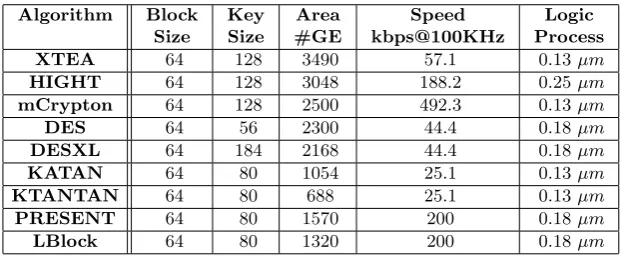
We implemented LBlock in VHDL and synthesized it on 0.18µm CMOS tech-nology to check for its hardware complexity. Figure 3 in Appendix III shows the datapath of an parallelization implementation of LBlock, which performs one round in one clock cycle. In this optimized implementation, we use a 64-bit width datapath and implement the eight S-boxes of round function in parallel. Then, to encrypt 64-bit plaintext with an 80-bit key occupies about 1320 GE and requires 32 clock cycles. Table 5 compares the hardware performances of LBlock with other lightweight block ciphers.
Table 5.Comparison of lightweight block cipher implementations
Algorithm Block Key Area Speed Logic Size Size #GE kbps@100KHz Process
XTEA 64 128 3490 57.1 0.13µm
HIGHT 64 128 3048 188.2 0.25µm
mCrypton 64 128 2500 492.3 0.13µm
DES 64 56 2300 44.4 0.18µm
DESXL 64 184 2168 44.4 0.18µm
KATAN 64 80 1054 25.1 0.13µm
KTANTAN 64 80 688 25.1 0.13µm
PRESENT 64 80 1570 200 0.18µm
LBlock 64 80 1320 200 0.18µm
Specifically, in the above implementation the area requirement is occupied by flip-flops for storing the key and the data state. To store the 80-bit key requires about 480 GE and to store the 64-bit data state requires two 32-bit registers (denoted asmemleftandmemright) which are about 384 GE. For round function
register can be reduced to 212 GE, while additional RAM is needed. Further-more, the data state in encryption can also reuse the 32-bit key register and the area requirements can be reduced to 192 GE. Then the control logic and other counters need about 70 GE. Therefore, this area-optimized implementation of LBlock only needs about 866.3 GE with additional RAM. Since the register is reused in both key scheduling and encryption, the generation of each round sub-key will need 12 clock cycles, and the encryption procedure will need 192 clock cycles. Therefore, to encrypt 64-bit plaintext with 80-bit key needs about 576 clock cycles in total. Table 6 in Appendix II summarizes the area requirement of LBlock in detail.
5.2 Software Implementations
For some resource-constraint environments, such as smart card and sensor net-working system, the embedded CPU is usually 8-bit oriented. Therefore, in the design of LBlock, we consider the implementation performance of LBlock not only in hardware environment but also in software platform such as 8-bit micro-controller. The choices of 4-bit word permutation in round function and 8-bit rotation in right half of each round are suitable for both hardware and software platforms. For example, in case of 8-bit oriented software implementation, the eight S-boxes and 4-bit word permutationP in round function can be combined together and realized as four 8-bit lookup tables. Our software implementation of LBlock on 8-bit microcontroller only requires about 3955 clock cycles to en-crypt a plaintext block. Hence, LBlock can achieve competitive hardware and software performances compared with other known lightweight block ciphers.
6
Conclusion
Acknowledgments. This work is supported by the National Natural Science Foundation of China (No.60873259), and the Knowledge Innovation Project of The Chinese Academy of Sciences. Moreover, the authors are very grateful to the anonymous referees for their comments and editorial suggestions.
References
1. Aoki, K., Ichikawa, T., Kanda, M., Matsui, M., Moriai, S., Nakajima, J., Tokita, T.: Camellia: A 128-Bit Block Cipher Suitable for Multiple Platforms - Design and Analysis. In: Stinson, D.R., Tavares, S. (eds.) SAC 2000. LNCS, vol. 2012, pp. 39-56. Springer, Heidelberg (2001)
2. Biham, E.: New Types of Cryptanalytic Attacks Using Related Keys. Journal of Cryptology, 7(4): 229-246. Springer, Heidelberg (1994)
3. Biham, E., Biryukov, A., Shamir, A.: Cryptanalysis of Skipjack Reduced to 31 Rounds Using Impossible Differentials. EUROCRYPT 1999. LNCS, vol. 3027, pp. 12-23. Springer, Heidelberg (1999)
4. Biham, E., Dunkelman, O., Keller, N.: A Related-Key Rectangle Attack on the Full KASUMI. In: Roy, B. (ed.) ASIACRYPT 2005. LNCS, vol. 3788, pp. 443-461. Springer, Heidelberg (2005)
5. Biham, E., Shamir, A.: Differential Cryptanalysis of the Data Encryption Standard. Berlin: Springer-Verlag (1993)
6. Biryukov, A., Khovratovich, D.: Related-Key Cryptanalysis of the Full AES-192 and AES-256. In: Matsui, M. (ed.) ASIACRYPT 2009. LNCS, vol. 5912, pp. 1-18. Springer, Heidelberg (2009)
7. Biryukov, A., Khovratovich, D., Nikolic, I.: Distinguisher and related-key attack on the full AES-256. In: Halevi, S. (ed.) CRYPTO 2009. LNCS, vol. 5677, pp. 231-249. Springer, Heidelberg (2009)
8. Biryukov, A., Nikolic, I.: Automatic Search for Related-Key Differential Character-istics in Byte-Oriented Block Ciphers: Application to AES, Camellia, Khazad and Others. In: Gilbert, H. (ed.) EUROCRYPT 2010. LNCS, vol. 6110, pp. 322-344. Springer, Heidelberg (2010)
9. Bogdanov, A., Knudsen, L.R., Leander, G., Parr, C., Poschmann, A., Robshaw, M.J.B., Seurin, Y., Vikkelsoe, C.: PRESENT: An Ultra-Lightweight Block Cipher. In: Paillier, P., Verbauwhede, I. (eds.) CHES 2007. LNCS, vol. 4727, pp. 450-466. Springer, Heidelberg (2007)
10. De Canniere, C., Dunkelman, Orr., Knezevic, M.: KATAN and KTANTAN - A Family of Small and Effcient Hardware-Oriented Block Ciphers. In: Clavier, C., Gaj, K. (eds.) CHES 2009. LNCS, vol. 5747, pp. 272-288. Springer, Heidelberg (2009)
11. De Canniere, C., Preneel, B.: Trivium Specifications. eSTREAM submission, avail-able online at http://www.ecrypt.eu.org/stream/triviump3.html.
12. Daemen, J., Rijmen, V.: The Design of Rijndael. Berlin: Springer-Verlag (2002) 13. Dunkelman, O., Keller, N., Shamir, A.: A Practical-Time Attack on the A5/3
Cryptosystem Used in Third Generation GSM Telephony. Faculty of Mathematics and Computer Science Weizmann Institute of Science P.O. Box 26, Rehovot 76100, Israel. (2010)
15. Izadi, M., Sadeghiyan, B., Sadeghian, S., Khanooki, H.: MIBS: A New Lightweight Block Cipher. In: Garay, J.A., Miyaji, A., Otsuka, A. (eds.) CANS 2009. LNCS, vol. 5888, pp. 334-348. Springer, Heidelberg (2009)
16. Kim, J., Hong, S., Sung, J., Lee, C., Lee, S.: Impossible differential cryptanalysis for block cipher structure. In: Johansson, T., Maitra, S. (eds.) INDOCRYPT 2003. LNCS, vol. 2904, pp. 82-96. Springer, Heidelberg (2003)
17. Knudsen, L.R.: Cryptanalysis of LOKI91. In: Seberry, J., Zhang,Y. (eds.) Auscrypt 1992. LNCS, vol. 718, pp. 196-208. Springer, Heidelberg (1993)
18. Knudsen, L., Wagner, D.: Integral Cryptanalysis. In: Daemen, J., Rijmen, V.(eds.) FSE 2002. LNCS, vol. 2365, pp. 112-127. Springer, Heidelberg (2002)
19. Leander, G., Paar, C., Poschmann, A.: New Lightweight DES Variants. In: Biryukov, A. (ed.) FSE 2007. LNCS, vol. 4593, pp. 196-210. Springer, Heidelberg (2007)
20. Lim, C.H.: A Revised Version of CRYPTON: CRYPTON v1.0. In: Knudsen, L.(ed.) FSE 1999. LNCS, vol. 1636, pp. 31-45. Spinger, Heidelberg (1999)
21. Lim, C., Korkishko, T.: mCrypton - A Lightweight Block Cipher for Security of Low-cost RFID Tags and Sensors. In: Song, J., Kwon, T., Yung, M. (eds.) WISA 2005. LNCS, vol. 3786, pp. 243-258. Springer, Heidelberg (2006)
22. Matsui, M.: Linear Cryptoanalysis Method for DES Cipher. In: Hellenseth, T. (ed.) EUROCRYPT 1993. LNCS, vol. 765, pp. 386-397. Springer, Heidelberg (1993) 23. Ojha, S., Kumar, N., Jain, K., Sangeeta.: TWIS - A Lightweight Block Cipher. In:
Prakash, A., Gupta, I. (eds.) ICISS 2009. LNCS, vol. 5905, pp. 280-291. Springer, Heidelberg (2009)
24. Ozen, O., Varici, K., Tezcan, C., Kocair, C.: Lightweight Block Ciphers Revisited: Cryptanalysis of Reduced Round PRESENT and HIGHT. In: Boyd, C., Gonzalez Nieto, J. (eds.) ACISP 2009. LNCS, vol. 5594, pp. 90-107. Springer, Heidelberg (2009)
25. Park, J.: Security Analysis of mCrypton Proper to Low-cost Ubiquitous Computing Devices and Applications. International Journal of Communication Systems, 22(8): 959-969. (2009)
26. Parr, C., Poschmann, A., Robshaw, M.J.B.: New Designs in Lightweight Symmetric Encryption. In: Kitsos, P., Zhang, Y. (eds.) RFID Security: Techniques, Protocols and System-on-Chip Design, pp. 349-371. Springer, Heidelberg (2008)
27. Renauld, M., Standaert, F.-X.: Algebraic Side-Channel Attacks. Cryptology ePrint Archive, report 2009/179. http://eprint.iacr.org/2009/279
28. Robshaw, M.J.B.: Searching for Compact Algorithms: CGEN. In: Nguyen, P.Q. (ed.) VIETCRYPT 2006. LNCS, vol. 4341, pp. 37-49. Springer, Heidelberg (2006) 29. Shirai, T., Shibutani, K., Akishita, T., Moriai, S., Iwata, T.: The 128-bit Block-cipher CLEFIA (Extended Abstract). FSE 2007. LNCS, vol. 4593, pp. 181-195. Springer, Heidelberg (2007)
30. Standaert, F.-X., Piret, G., Gershenfeld, N., Quisquater, J.-J.: SEA: A Scalable Encryption Algorithm for Small Embedded Applications. In: Domingo-Ferrer, J., Posegga, J., Schreckling, D. (eds.) CARDIS 2006. LNCS, vol. 3928, pp. 222-236. Springer, Heidelberg (2006)
31. Su, B., Wu, W., Zhang, L., Li, Y.: Full-Round Differential Attack on TWIS Block Cipher. In: Y. Chung and M. Yung (eds.) WISA 2010. LNCS, vol. 6513, pp.234-242. Springer, Heidelberg (2010)
32. Suzaki, T., Minematsu, K.: Improving the Generalized Feistel. In: Hong, S., Iwata, T. (eds.) FSE 2010. LNCS, vol. 6147, pp. 19-39. Springer, Heidelberg (2010) 33. Wheeler, D., Needham, R.: TEA, a Tiny Encryption Algorithm. In: Preneel, B.
34. Wheeler, D., Needham, R.: TEA Extensions. October 1997. (Also Correction to XTEA. October 1998) Available via www.ftp.cl.cam.ac.uk/ftp/users/djw3/ 35. Yang, L., Wang, M., Qiao, S.: Side Channel Cube Attack on PRESENT. In: Garay,
J.A., Miyaji, A., Otsuka, A. (eds.) CANS 2009. LNCS, vol. 5888, pp. 379-391. Springer, Heidelberg (2009)
36. Andrey Bogdanov and Christian Rechberger. Generalized Meet-in-the-Middle At-tacks: Cryptanalysis of the Lightweight Block Cipher KTANTAN. In: A. Biryukov, G. Gong and D. R. Stinson (eds.) SAC 2010. LNCS, vol. 6544, pp.228-238. Springer, Heidelberg (2010)
Appendix I: Test Vectors
Test vectors for LBlock are shown in hexadecimal notation as follows.
Plaintext Key Ciphertext
00 00 00 00 00 00 00 00 00 00 00 00 00 00 00 00 00 00 c2 18 18 53 08 e7 5b cd 01 23 45 67 89 ab cd ef 01 23 45 67 89 ab cd ef fe dc 4b 71 79 d8 eb ee 0c 26
Appendix II
Table 6.Area requirement of LBlock
Module Speed Area
Optimized Optimized 64-bit Data Register 384 192
Key Addition 87 87
S-box Layer 174.8 174.8
P Layer 0 0
32-bit XOR 87 87
80-bit Key Register 480 212 S-boxes (Key Scheule) 43.7 30
5-bit Constant XOR 13.5 13.5
Control Logic 50 70
Sum 1320 GE 866.3 GE