A preliminary version of this paper appears in the proceedings of Asiacrypt 2011. This is the full version.
Cryptography Secure Against
Related-Key Attacks and Tampering
Mihir Bellare1 David Cash2 Rachel Miller3
August 2011
Abstract
We show how to leverage the RKA (Related-Key Attack) security of blockciphers to provide RKA security for a suite of high-level primitives. This motivates a more general theoretical question, namely, when is it possible to transfer RKA security from a primitive P1 to a primitive P2? We provide both positive and negative answers. What emerges is a broad and high level picture of the way achievability of RKA security varies across primitives, showing, in particular, that some primitives resist “more” RKAs than others. A technical challenge was to achieve RKA security even for the practical classes of related-key deriving (RKD) functions underlying fault injection attacks that fail to satisfy the “claw-freeness” assumption made in previous works. We surmount this barrier for the first time based on the construction of PRGs that are not only RKA secure but satisfy a new notion of identity-collision-resistance.
1
Department of Computer Science & Engineering, University of California San Diego, 9500 Gilman Drive, La Jolla, California 92093, USA. Email: [email protected]. URL:http://www.cs.ucsd.edu/users/mihir. Supported in part by NSF grants CNS-0904380 and CCF-0915675.
2
IBM T.J. Watson Research Center, Yorktown Heights, NY 10598, USA.. Email: [email protected]. URL:http://www. cs.ucsd.edu/users/cdcash. Supported in part by NSF grant CCF-0915675.
3
Contents
1 Introduction 3
2 Technical approach 6
3 Preliminaries 8
4 Classes of RKDFs and RKA-PRFs 8
5 ICR PRGs: A tool in our constructions 11
6 Relations 12
A Proof of Proposition 4.1 19
B Proof of Proposition 5.1 20
C Proof of Theorem 6.1 21
D Proof of Theorem 6.2 24
E Strong Φ-RKA Security 25
1
Introduction
By fault injection [16, 9] or other means, it is possible for an attacker to induce modifications in a hardware-stored key. When the attacker can subsequently observe the outcome of the cryptographic primitive under this modified key, we have a related-key attack (RKA) [4, 20].
The key might be a signing key of a certificate authority or SSL server, a master key for an IBE system, or someone’s decryption key. Once viewed merely as a way to study the security of phers [8, 28, 4], RKAs emerge as real threats in practice and of interest for primitives beyond blockci-phers.
It becomes of interest, accordingly, to achieve (provable) RKA security for popular high-level prim-itives. How can we do this?
Practical contributions. One approach to building RKA-secure high-level primitives is to do so directly, based, say, on standard number-theoretic assumptions. This, however, is likely to yield ad hoc results providing security against classes of attacks that are tied to the scheme algebra and may not reflect attacks in practice.
We take a different approach. RKA security is broadly accepted in practice as a requirement for blockciphers; in fact, AES was designed with the explicit goal of resisting RKAs. We currently have blockciphers whose resistance to RKAs is backed by fifteen years of cryptanalytic and design effort. We propose to leverage these efforts.
We will provide a general and systematic way to immunize any given instance of a high-level primitive against RKAs with the aid of an RKA-secure blockcipher, modeling the latter, for the purpose of proofs, as a RKA-secure PRF [4]. We will do this not only for symmetric primitives that are “close” to PRFs like symmetric encryption, but even for public-key encryption, signatures and identity-based encryption. Our methods are cheap, non-intrusive from the software perspective, and able to completely transfer all the RKA security of the blockcipher so that the high-level primitive resists attacks of the sort that arise in practice.
Theoretical contributions. The ability to transfer RKA security from PRFs to other primitives lead us to ask a broader theoretical question, namely, when is it possible to transfer RKA security from a primitiveP1to a primitiveP2? We provide positive results across a diverse set of primitives, showing, for example, that RKA-secure IBE implies RKA-secure IND-CCA PKE. We also provide negative results showing, for example, that RKA-secure signatures do not imply RKA-secure PRFs.
All our results are expressed in a compact set-based framework. For any primitiveP and class Φ of related-key deriving functions —functions the adversary is allowed to apply to the target key to get a related key— we define what it means for an instance ofPto be Φ-RKA secure. We letRKA[P] be the set of all Φ such that there exists a Φ-RKA secure instance of primitiveP. A transfer of RKA security fromP1 to P2, expressed compactly as a set containmentRKA[P1]⊆RKA[P2], is a construction of a Φ-RKA secure instance of P2 given both a normal-secure instance of P2 and a Φ-RKA secure instance of P1. Complementing this are non-containments of the form RKA[P2]6⊆RKA[P1], which show the existence of Φ such that there exists a Φ-RKA instance of P2 yet no instance of P1 can be Φ-RKA secure, indicating, in particular, that RKA security cannot be transferred fromP2 to P1.
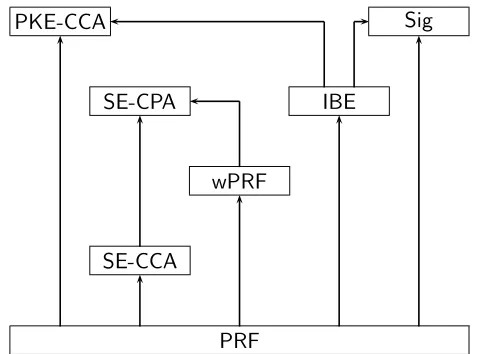
As Figure 1 shows, we pick and then focus on a collection of central and representative cryptographic primitives. We then establish these containment and non-containment relations in a comprehensive and systematic way. What emerges is a broad and high level picture of the way achievability of RKA security varies across primitives, showing, in particular, that some primitives resist “more” RKAs than others.
We view these relations between RKA[P] sets as an analog of complexity theory, where we study relations between complexity classes in order to better understand the computational complexity of particular problems. Let us now look at all this more closely.
random challenge bit b and random target key K ∈ K. For each L ∈ K the game picks a random functionG(L,·): D → R, and next allows the adversary multiple queries to an oracle that given a pair (φ, x) with φ: K → Kand x∈ DreturnsF(φ(K), x) if b= 1 andG(φ(K), x) if b= 0. They say thatF
is Φ-RKA secure, where Φ is a class of functions mapping K to K, if the adversary has low advantage in predictingb when it is only allowed in its queries to use functionsφfrom Φ.
Let RKA[PRF] be the set of all Φ for which there exists a Φ-RKA secure PRF. Which Φ are in this set? All the evidence so far is that this question has no simple answer. Bellare and Kohno [4] gave natural examples of Φ not inRKA[PRF], showing the set is not universal. Membership of certain specific Φ inRKA[PRF] have been shown by explicit constructions of Φ-RKA PRFs, first under novel assumptions [30] and then under standard assumptions [3]. Beyond this we must rely on cryptanalysis. Modern blockciphers including AES are designed with the stated goal of RKA security. Accordingly we are willing to assume their Φ-RKA security —meaning that Φ ∈ RKA[PRF]— for whatever Φ cryptanalysts have been unable to find an attack.
Beyond PRFs. Consideration of RKAs is now expanding to primitives beyond PRFs [21, 2, 23]. This is viewed partly as a natural extension of the questions on PRFs, and partly as motivated by the view of RKAs as a class of sidechannel attacks [20]. An RKA results when the attacker alters a hardware-stored key via tampering or fault injection [16, 9] and subsequently observes the result of the evaluation of the primitive on the modified key. The concern that such attacks could be mounted on a signing key of a certificate authority or SSL server, a master key for an IBE system, or decryption keys of users makes achieving RKA security interesting for a wide range of high-level primitives.
Definitions. We focus on a small but representative set of primitives for which interesting variations in achievability of RKA security emerge. These are PRF (pseudorandom functions), Sig (Signatures),
PKE-CCA (CCA-secure public-key encryption), SE-CCA (CCA-secure symmetric encryption), SE-CPA
(CPA-secure symmetric encryption),IBE (identity-based encryption) andwPRF(weak PRFs [32]). We define what it means for an instance of P to be Φ-RKA secure for each P ∈ {wPRF,IBE,Sig,SE-CCA, SE-CPA,PKE-CCA}. We follow the definitional paradigm of [4], but there are some delicate primitive-dependent choices that significantly affect the strength of the definitions and the challenge of achieving them (cf. Section 2). We letRKA[P] be the set of all Φ for which there exists a Φ-RKA secure instance of P. These sets are all non-trivial.
Relations. We establish two kinds of relations between sets RKA[P1] and RKA[P2]:
• Containment: A proof that RKA[P1] ⊆ RKA[P2], established by constructing a Φ-RKA secure instance ofP2 from a Φ-RKA secure instance ofP1, usually under the (minimal) additional assump-tion that one is given a normal-secure instance of P2. Containments yield constructions of Φ-RKA secure instances ofP2.
• Non-containment: A proof thatRKA[P2]6⊆RKA[P1]. Here we exhibit a particular Φ for which we (1) construct a Φ-RKA secure instance ofP1 under some reasonable assumption, and (2) show, via attack, that any instance ofP2 is Φ-RKA insecure.
We show that RKA-secure PRFs are powerful enablers of RKA-security: Given a Φ-RKA PRF and a normal-secure instance of P, we construct a Φ-RKA secure instance of P for all P ∈ {wPRF,IBE,Sig, SE-CCA,SE-CPA,PKE-CCA}. This is represented by the string of containments in the first row of the table in Figure 1. On the practical side, instantiating the PRF with a blockcipher yields a cheap way to immunize the other primitives against RKAs. On the theoretical side, instantiating the PRF with the construct of [3] yields Φ-RKA secure instances of the other primitives based on standard assumptions. The separations shown in the first column of the table of Figure 1, however, also show that RKA-PRFs are overkill:all the other primitives admit Φ-RKA secure instances for a Φ for which no Φ-RKA PRF exists. This leads one to ask whether there are alternative routes to RKA-secure constructions of beyond-PRF primitives.
PKE-CCA
SE-CPA
wPRF
SE-CCA
IBE
Sig
PRF
P
R
F
w
P
R
F
IB
E
S
ig
S
E
-C
C
A
S
E
-C
P
A
P
K
E
-C
C
A
PRF ⊆ ⊆ ⊆ ⊆ ⊆ ⊆ ⊆
wPRF 6⊆ ⊆ 6⊆ ⊆ 6⊆
IBE 6⊆ 6⊆ ⊆ ⊆ 6⊆ 6⊆ ⊆
Sig 6⊆ 6⊆ ⊆ 6⊆ 6⊆ 6⊆
SE-CCA 6⊆ ⊆ ⊆
SE-CPA 6⊆ 6⊆ 6⊆ ⊆ 6⊆
PKE-CCA 6⊆ 6⊆ 6⊆ 6⊆ ⊆
Figure 1: Relations between RKA[P]classes. A containment RKA[P1]⊆RKA[P2] is represented in the picture by an arrow P1 → P2 and in the table by a “⊆” in the row P1, column P2 entry. A non-containment RKA[P1] 6⊆ RKA[P2] is represented in the table by a “6⊆” in the row P1, column
P2 entry. The picture does not show non-containments. The picture sometimes shows a redundant containment (for example the arrow PRF → Sig when there is already a path PRF → IBE → Sig) because it corresponds to an interesting direct construction. A blank entry in the table means we do not know.
preserves RKA-security, allowing us to turn a Φ-RKA secure IBE scheme into a Φ-RKA secure Sig
scheme. Similarly, we show that the transform of Boneh, Canetti, Halevi and Katz (BCHK) [15] turns a Φ-RKA secureIBEscheme into a Φ-RKA securePKE-CCAscheme. What lends these transforms well to RKA-security is that they do not change the secret key. We also show that given a Φ-RKA secure wPRF we can build a Φ-RKA secure SE-CPA scheme. (A wPRF is like a PRF except that is only required to be secure on random inputs [32].) These results motivate finding new Φ-RKA secure IBE schemes and wPRFs.
As the table of Figure 1 indicates, we show a number of other non-containments. Sig emerges as a very “RKA-resilient” primitive in the sense that it can be secure against strictly more RKAs than most other primitives. Some of the non-containments, such as RKA[PKE-CCA] 6⊆ RKA[SE-CPA] might seem odd; doesn’t PKE always imply SE? What we are saying is that the trivial transformation of a PKE scheme to an SE one does not preserve RKA-security and, moreover, there are Φ for which no
transform exists that can do this.
Claws ok. All previous constructions of Φ-RKA secure primitives [4, 30, 3, 21, 2, 23, 24] assume Φ is claw-free (distinct functions in φ disagree on all inputs) because it is hard to do the proofs otherwise, but the Φ underlying practical fault injection attacks are not claw-free, making it desirable to get constructions avoiding this assumption. For the first time, we are able to do this. In Section 2 we explain the technical difficulties and sketch our solution, which is based on the construction of a Φ-RKA PRG that has a novel property we call identity-collision-resistance (ICR), a variant of the collision-resistance property from [25].
We are seeing growing interest in RKA security for primitives other than PRFs. Goldenberg and Liskov [21] study related-secret security of lower-level primitives, namely one-way functions, hardcore bits and pseudorandom generators. Applebaum, Harnik and Ishai [2] define RKA security for (random-ized) symmetric encryption, gave several constructions achieving that definition for interesting Φ and then presented numerous applications. Connections with point obfuscation are made by Bitansky and Canetti [10].
Gennaro, Lysyanskaya, Malkin, Micali and Rabin [20] suggest that RKAs may arise by tampering. They show that one can achieve security when related keys are derived via arbitrary key modification, but assume an external trusted authority signs the original secret key and installs the signature on the device together with its own public key, the latter being “off limits” to the attacker. (Meaning, the related-key deriving functions may not modify them.) In our case, no such authority is assumed. The off-limit quantities are confined to pre-installed public parameters. No information that is a function of the parameters and the key is installed on the chip.
Ishai, Prabhakaran, Sahai and Wagner [26] are concerned with tampering of wires in the computation of a circuit while we are concerned with tampering with hardware-stored keys. Dziembowski, Pietrzak and Wichs [19] develop an information theoretic method for preventing tampering and show that a wide class of limited, but non-trivial, Φ can be achieved (unconditionally) for any so-called “interactive stateful system.”
Independent work. Interest in RKA security for higher-level primitives is evidenced by Goyal, O’Neill and Rao [23, 24], who define correlated-input (CI) hash functions, show how to construct them from theq-DHI assumption based on Boneh-Boyen signatures [13, 14] and the Dodis-Yampolskiy PRF [18], and apply this to get Φ-RKA secure signatures fromq-DHI for a class Φ consisting of polynomials over a field of prime order. (They indicate their approach would also work for other primitives.) Their construction is similar to ours. Their definitions and results, unlike ours, are restricted to claw-free Φ. Also, we start from Φ-RKA-PRFs and thus get in-practice security for any class Φ for which blockciphers provide them, while they start from a number-theoretic assumption and get security for a specific class Φ, related to the scheme algebra. Their work and ours are concurrent and independent. (Ours was submitted to, and rejected from, Eurocrypt 2011, while theirs was submitted to, and accepted at, TCC 2011.)
Kalai, Kanukurthi and Sahai [27] provide encryption and signature schemes that protect against both tampering and leakage via the idea of key-updates that originated in forward-secure signatures [6]. They allow arbitrary tampering functions but only allow a bounded number of tampering queries within each time period. Their work and ours are again concurrent and independent.
2
Technical approach
Before providing formal definitions, constructions and proofs of our many positive and negative results, we would like to illustrate one technical issue, namely the challenges created by Φ that are not claw-free and how we resolve them. For concreteness, our discussion is restricted to the design of Φ-RKA signatures based on Φ-RKA PRFs.
The claw-freeness assumption. All known constructions of Φ-RKA-secure primitives [4, 30, 3, 21, 2, 23, 24] are restricted to Φ that areclaw-free. This means that any two distinct functions in Φ disagree onall inputs. This assumption is made for technical reasons; it seems hard to do simulations and proofs without it. Yet the assumption is undesirable, for many natural and practical classes of functions are
Definitions and issues. The degree to which claw-freeness is embedded in current approaches is made manifest by the fact that the very definition of Φ-RKA secure signatures of [23, 24] assumes it and is unachievable without it. Let us take a closer look to see how.
The signature RKA-security game of [23, 24] picks secret signing key sk and associated public verification key vk. It gives the adversary a signing oracle Sign that takes m and φ∈Φ, and returns the signature of message m under key φ(sk). The adversary eventually outputs m, σ. Besides validity of m, σ under vk, winning requires that m be “new,” meaning not “previously signed.” The delicate question is, how do we define this? The choice of [23, 24] is to disallow signing queryid, m, whereid is the identity function. But the adversary can easily define a functionφ that is the identity on all but a negligible fraction of its inputs. A query φ, m is then valid sinceφ6=id, but almost always returns the signatureσ of m undersk, so the adversary can outputm, σ and win. By assuming Φ is claw-free and contains id, [23, 24] ensure that such a φis not in Φ and the attack is ruled out.
Our altered definition of m being “new” is that there was no signing queryφ, m withφ(sk) = sk. This seems, indeed, the natural requirement, ruling out nothing more than thatmwas signed undersk. We now have a much more general definition that is meaningful even for the non claw-free Φ that arise in practice, but it has a subtle feature that makes achieving it a challenge. Namely, checking whether
the adversary won apparently requires knowing sk for we have to test whether or not φ(sk) = sk. In
the reduction proving security, we will be designing an adversaryB attempting to distinguish “real” or “random” instances of some problem given an adversaryAbreaking the signature scheme; B will see if
A won, declaring “real” if so and “random” otherwise. ButB will be simulating A and will not know
sk, so the difficulty is how it can test that Awon.
Overview of solution. We start from a Φ-RKA secure PRF F: K × D → R that has what we call a key fingerprint for the identity function. This is a relaxation of the notion of a key fingerprint of [3]. It consists of a vector w over D such that for all K and all φ ∈ Φ with φ(K) 6= K there is some i
such thatF(K,w[i])6=F(φ(K),w[i]). This allows statistical disambiguation of the original keyK from other keys. Such fingerprints exist for the Φ-RKA PRFs of [3] and for blockciphers and are thus a mild assumption.
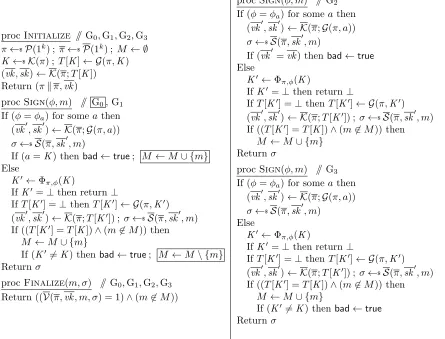
We now turn F into a PRG (Pseudorandom Generator) G that has two properties. First, it is Φ-RKA secure; this means the adversary has low advantage in determining the challenge bitbin the game that picks a random target keyK and random functionR, and then gives the adversary an oracleGen that on inputφ returnsG(φ(K)) if b= 1 andR(φ(K)) if b= 0. This is of course easily obtained from a Φ-RKA PRF. We call the new second property Φ-ICR (Identity-Collision-Resistant); this means that for a hidden keyK, it is hard for the adversary to findφ∈Φ such thatφ(K)6=K yetG(φ(K)) =G(K). At first it might seem this follows from Φ-RKA security but Proposition 5.1 shows it does not. However Proposition 5.2 shows how to build a PRG that is both Φ-RKA and Φ-ICR secure from a Φ-RKA PRF with an identity key fingerprint, without assuming Φ is claw-free.
We build our Φ-RKA secure signature scheme from this PRGGand a base (normal secure) signature scheme, as follows. The secret key of our new signature scheme is a key K for the PRG. The output of the PRG on input K, G(K), is used as randomness to run the key-generation algorithm K of the base signature scheme, yielding a public key pk which becomes the public key of our scheme, and the corresponding secret key which is discarded. (Recall the secret key of the new scheme is the PRG key
K.) To sign a message m under K, run G on K to get coins for K, run the latter with these coins to getpk,sk and finally signmundersk with the base signature scheme. Verification is just as in the base signature scheme.
For the proof we must construct an adversaryBbreaking the Φ-RKA security ofGgiven an adversary
random function. So B would like to test if A’s forgery was a winning one, outputting 1 if so and 0 otherwise, to win its game. The difficulty is that it cannot test this because, not knowingK, it cannot test whether or not A made a Sign query φ, m with φ(K) = K. The Φ-ICR property of G comes to the rescue, telling us that whether or notφ(K) =K may be determined by whether or not the outputs of G on these two inputs, whichB does have, are the same.
This sketch still pushes under the rug several subtle details which are dealt with in the full proof of Theorem 6.2, to be found in Appendix D.
3
Preliminaries
Notation. For sets X, Y, Z let Fun(X, Y) be the set of all functions mapping X to Y, and let
FF(X, Y, Z) = Fun(X × Y, Z). The empty string is denoted ε. If v is a vector then |v| denotes the number of its coordinates and v[i] denotes its i-th coordinate, meaning v = (v[1], . . . ,v[|v|]). A (binary) stringx is identified with a vector over {0,1} so that|x|is its length andx[i] is its i-th bit. If
a1, . . . , anare strings thena1k · · · kandenotes their concatenation. IfSis a set then|S|denotes its size
and s←$S the operation of picking a random element of S and calling its. We say that a real-valued function on the integers isnegligible if it vanishes faster than the inverse of any polynomial.
Algorithms. Unless otherwise indicated, an algorithm is PT (Polynomial Time) and may be ran-domized. An adversary is an algorithm. If A is an algorithm and x is a vector then A(x) denotes the vector (A(x[1]), . . . , A(x[|x|])). By y ← A(x1, x2, . . .;r) we denote the operation of running A on inputsx1, x2, . . . and coins r ∈ {0,1}∗. We denote by y←$A(x1, x2, . . .) the operation of picking r at random and letting y←A(x1, x2, . . .;r). We denote by [A(x1, x2, . . .)] the set of all possible outputs of
Aon inputs x1, x2, . . .. We denote byk∈Nthe security parameter and by 1k its unary encoding. It is assumed that the length of the output of any algorithmAdepends only on the lengths of its inputs. In particular we can associate to single-input algorithmA itsoutput length ℓsatisfying |A(x)|=ℓ(|x|) for allx. IfA, B are algorithms thenAkB denotes the algorithm that on any inputxreturnsA(x)kB(x). Games. Some of our definitions and proofs are expressed via code-based games [7]. Recall that such a game consists of an Initialize procedure, procedures to respond to adversary oracle queries and a Finalize procedure. A gameGis executed with an adversary Aas follows. First,Initialize executes on input 1k and its output is the input to A. Then A executes, its oracle queries being answered by the corresponding procedures ofG. WhenAterminates, its output becomes the input to the Finalize procedure. The output of the latter, denoted GA, is called the output of the game. We let “GA⇒d”
denote the event that this game output takes valued. IfFinalize is absent it is understood to be the identity function, so the game output is the adversary output. Boolean flags are assumed initialized to
false.
4
Classes of RKDFs and RKA-PRFs
Classes of RKDFs. In [4], a class Φ of related-key deriving functions (RKDFs) is a finite set of functions, all with the same domain and range. Our more general, asymptotic treatment requires extending this, in particular to allow the functions to depend on public parameters of the scheme. For us a class Φ = (P,Q) of RKDFs, also called a RKA specification, is a pair of algorithms, the second deterministic. On input 1k, parameter generation algorithm P produces parameters π. On input π, a key K and a description φ of an RKD function, the evaluation algorithmQ returns either a modified key or ⊥. We require that for all φ, π, either Q(π, K, φ) = ⊥ for all K or for no K. We let Φπ,φ(·) = Q(π,·, φ). We require that Φ always includes the identity function. (Formally, there is a
procInitialize // PRF π←$P(1k) ; K←$K(π)
b←${0,1}
Returnπ
procFn(φ, x) // PRF K′← Q(π, K, φ)
IfK′=⊥then return⊥
Ifb= 1 then
T[K′, x]← F(π, K′, x)
Ifb= 0 and T[K′, x] =⊥then
T[K′, x]←$Rng(π)
ReturnT[K′, x]
procFinalize(b′) // PRF
Return (b=b′)
procInitialize // PRFReal,PRFRand π←$P(1k)
K←$K(π)
Returnπ
procFn(φ, x) // PRFReal K′← Q(π, K, φ)
IfK′=⊥then return⊥
ReturnF(π, K′, x)
procFn(φ, x) // PRFRand K′← Q(π, K, φ)
IfK′=⊥then return⊥
IfT[K′, x] =⊥then
T[K′, x]←$Rng(π)
ReturnT[K′, x]
procInitialize // IDFP π←$P(1k)
K←$K(π)
w←$IKfp(π)
Returnπ,w
procFn(φ) // IDFP K′←Φπ,φ(K)
If (K′=⊥) then return⊥
If (K′6=K) then
If (F(K′,w) =F(K,w)) then
Win←true
ReturnF(K′,w)
procFinalize() // IDFP
ReturnWin
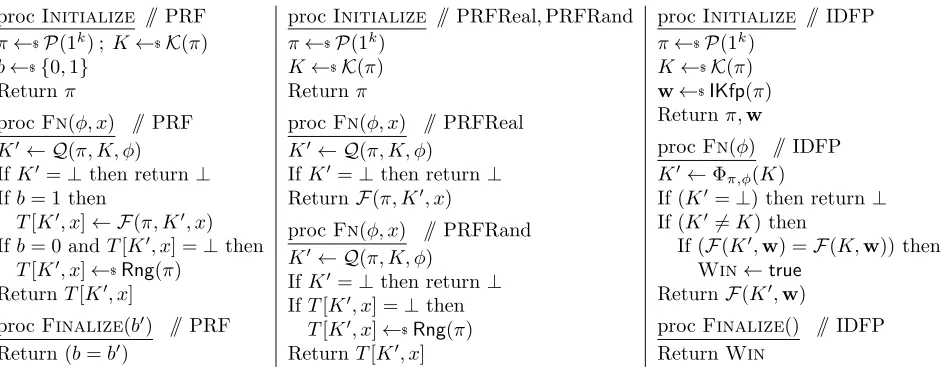
Figure 2: Games defining Φ-RKA PRF security and Φ-IDFP security of function family
FF
= (P,K,F) having rangeRng(·).
A scheme (regardless of the primitive) is a tuple (P,· · ·) of algorithms, the first of which is a parameter generation algorithm that on input 1k returns a string. If ℓ is the output length of P, we
say that Φ = (P,Q) is compatible with the scheme if the string formed by the first ℓ(k) bits of the output of P(1k) is distributed identically to the output of P(1k) for all k ∈ N. This is done so that,
in constructing one Φ-RKA primitive from another, we can extend the parameters of the constructed scheme beyond those of the original one without changing the class of RKDFs.
We say that Φ = (P,Q) is claw-free if φ6=φ′ implies Q(π, K, φ) 6=Q(π, K, φ′) (or both values are
⊥) for all π, K. This property has been assumed almost ubiquitously in previous work [4, 30, 21, 3] because of the technical difficulties created by its absence, but its assumption is in fact quite restrictive since many natural classes do not have it. We are able to remove this assumption and provide constructs secure even for non-claw-free classes via new technical approaches. We letCFbe the set of all Φ that are claw-free.
The class Φconst
= (P,Qconst
) of constant functions associated to class Φ = (P,Q) is defined by Φconst
π,a (K) =afor all K, a∈ {0,1} ∗
and allπ. The union Φ1∪Φ2= (P,Q) of classes Φ1 = (P,Q1) and Φ2= (P,Q2) is defined by havingQ(π, K, φ) parseφas ikφ∗
fori∈ {1,2} and returnQi(π, K, φ∗
). Discussion. In a non-asymptotic treatment, there is no formal line between “secure” and “insecure.” This makes it unclear how to rigorously define the sets RKA[P]. Lead, accordingly, to pursue an asymptotic treatment, we introduce parameter dependence; this allows us to capture constructs in the literature [30, 3] where RKDFs are defined over a group that is now parameter-dependent rather than fixed. (We note that even in the non-asymptotic case, a treatment like ours is needed to capture constructs in [30] relying on a RSA group defined by random primes. This issue is glossed over in [30].) A dividend of our treatment is a separation between an RKDF and its encoding, the latter being what an adversary actually queries, another issue glossed over in previous work.
Function families. A function family
FF
= (P,K,F) consists of a parameter generator, a key generator, and an evaluator, the last deterministic. For each k ∈ N and π ∈ [P(1k)], the schemealso defines PT decidable and sampleable setsDom(π) and Rng(π) such thatF(π, K,·) maps elements of Dom(π) to Rng(π). We assume there are polynomials d, l, called the input and output lengths, respectively, such that Dom(π) ⊆ {0,1}d(k) and Rng(π) ⊆ {0,1}l(k). Unless otherwise indicated we assumeRng(π) ={0,1}l(k) and l(k) =ω(log(k)) and|Dom(π)| ≥2k for all π ∈[P(1k)] and allk∈N.
true]−1 when the game has input 1k. We say
FF
is Φ-RKA secure if this advantage function isnegligible. For our proofs it is useful to also consider games PRFReal,PRFRand of Figure 2. Standard arguments imply thatAdvprf-rkaFF,A,Φ(k) equals Pr
PRFRealA⇒1
−Pr
PRFRandA⇒1 .
Identity key fingerprints. An identity key fingerprint function with vector length v(·) for
FF
= (P,K,F) is an algorithm IKfp that for every π ∈ [P(1k)] and every k ∈ N returns, on input π, av(k)-vector over Dom(π) all of whose coordinates are distinct. Game IDFP of Figure 2 is associated to
FF
and a RKA specification Φ = (P,Q) that is compatible withFF
. Let AdvidfpFF,A,Φ(k) equal Pr[IDFPA ⇒ true] when the game has input 1k. We sayFF
is Φ-IDFP secure if this advantagefunction is negligible.
The key fingerprint notion of [3] can be seen as allowing statistical disambiguation of any pair of keys. They showed that the Naor-Reingold PRF NR had such a fingerprint, but in general, it does not seem common. Interestingly, their own Φ-RKA PRFs, which build on NR, are not known to have such a fingerprint. Our relaxation can be seen as asking for computational disambiguation of the original key from other keys, and ends up being much easier to achieve. In particular, such fingerprints exist for the constructs of [3]. This is a consequence of something more general, namely that any Φ-RKA secure PRF with large enough range is Φ-IDFP secure if Φ is claw-free, usingany point in the domain functioning as the fingerprint. This is formalized by Proposition 4.1 below, with a proof in Appendix A. Φ-IDFP security for the constructs of [3] follows as the Φ they use is claw-free.
Proposition 4.1 Suppose Φ is claw-free and
FF
is a Φ-RKA secure PRF with associated domainDom(·) and super-polynomial size range Rng(·). Let IKfp be any algorithm that on input π returns a
1-vector overDom(π). Then
FF
is Φ-IDFP secure.In practice Φ-IDFP security seems like a mild assumption even when Φ is not claw-free. A vector of a few, distinct domain points ought to be a suitable fingerprint for any practical blockcipher. This does not follow from a standard assumption on it such as PRF, but is consistent with properties assumed by cryptanalysts and can be proved in the ideal cipher model.
Φ-IDFP security of given Φ-RKA PRFs, even for non-claw-free Φ, will be important in the con-structions underlying our containment results, and we make it a default assumption on a Φ-RKA PRF. The above shows that this is a mild and reasonable assumption.
RKA sets. We say that an RKA specification Φ = (P,Q) is achievable for the primitivePRF if there exists a Φ-RKA and Φ-IDFP secure PRF that is compatible with Φ. We let RKA[PRF] be the set of all Φ that are achievable for PRF.
What can attacks modify? We view the system as a whole as having the following components: algorithms (code), parameters, public keys (if any) and secret keys. Of these, our convention is that only secret keys are subject to RKAs. This is not the only possible model, nor is it necessarily the most realistic if considering tampering attacks in practice, but it is a clear and interesting one with some justification. Parameters are systemwide, meaning fixed beforehand and independent of users, and may, in an implementation, be part of the algorithm code. Public keys are accompanied by certificates under a CA public key that is in the parameters, so if parameters are safe, so are public keys. This leaves secret keys as the main target. One consequence of this is that in a public key setting the attack is only on the holder of the secret key, meaning the signer for signatures and the receiver for encryption, while in the symmetric setting, both sender and receiver are under attack, making this setting more complicated.
procInitialize // PRG π←$P(1k)
K ←$K(π) ; b←${0,1}
Returnπ
procGen(φ) // PRG
K′ ←Φπ,φ(K)
IfK′ =⊥then return⊥
IfT[K′] =⊥then
Ifb= 1 thenT[K′]← G(π,K′)
ElseT[K′]←${0,1}r(k)
ReturnT[K′]
procFinalize(b′) // PRG
Return (b=b′)
procInitialize // ICR π←$P(1k)
K ←$K(π) ; T0← G(π,K)
Returnπ
procGen(φ) // ICR
K′ ←Φπ,φ(K)
IfK′=⊥then return⊥
S← G(π,K′)
If ((S=T0)∧(K 6=K′)) thenWin←true
ReturnS
procFinalize() // ICR
ReturnWin
Figure 3: Games defining Φ-RKA security and identity-collision-resistance for PRG
PRG
= (P,K,G, r).5
ICR PRGs: A tool in our constructions
We will be using Φ-RKA PRFs to build Φ-RKA instances of many other primitives. An important technical difficulty will be to avoid assuming Φ is claw-free. A tool we introduce and use for this purpose is a Φ-RKA PRG satisfying a weak form of collision-resistance under RKA that we call Φ-ICR. In this section we define this primitive and show how to achieve it based on a Φ-RKA and Φ-IDFP secure PRF.
RKA PRGs. A PRG
PRG
= (P,K,G, r) is specified by a parameter generation algorithm, a key generation algorithm, an evaluation algorithm and an output length r(·). Game PRG of Figure 3 is associated toPRG
and an RKA specification Φ that is compatible withPRG
. Let AdvprgPRG,A,Φ(k) = 2 Pr[PRGA ⇒ true]−1 when the game has input 1k. We sayPRG
is Φ-RKA secure if this advantagefunction is negligible for allA.
We clarify that unlike a normal PRG [11], we don’t require a Φ-RKA PRG to be length extending, meaning that outputs need not be longer than inputs. The utility of the primitive is getting RKA security, for which length extension is irrelevant. If one does want a length extending Φ-RKA PRG (we won’t) one can get it by applying a normal-secure PRG to the output of a given Φ-RKA PRG.
ICR.We define and use a weak form of collision-resistance for PRGs which requires that the adversary be unable to findφso that Φπ,φ(K)6=K yetG(Φπ,φ(K)) =G(K). Game ICR of Figure 3 is associated to
PRG
and a RKA specification Φ that is compatible withPRG
. LetAdvicrPRG,C,Φ(k) equal 2 Pr[ICRC ⇒true]−1 when the game has input 1k. We say
PRG
is Φ-ICR (Identity-Collision-Resistant) secure ifthis advantage function is negligible.
Does RKA security imply ICR security? At first glance it would seem that if a PRG
PRG
= (P,K,G, r) is Φ-RKA secure then it is also Φ-ICR secure. Indeed, suppose an adversary has φ such that Φπ,φ(K)6=K yetG(Φπ,φ(K)) =G(K). Let it queryR0 ←Gen(id) andR1 ←Gen(φ) and return 1 if R0 = R1 and 0 otherwise. In the real (b = 1) case R0, R1 are equal but in the random (b = 0) case they would appear very unlikely to be equal, so that that this strategy would appear to have high advantage in breaking the Φ-RKA security ofPRG
. The catch is in our starting assumption, which made it appear that Φπ,φ(K)6=K yetG(Φπ,φ(K)) =G(K) was an absolute fact, true both forb= 0 andb= 1. If Φπ,φ(K) and K are different in the real game but equal in the random game, the adversary
sees an output collision in both cases and its advantage disappears. Can this actually happen? It can, and indeed the claim (that Φ-RKA security implies Φ-ICR security) is actually false:
Proposition 5.1 Suppose there exists a normal-secure PRG
PRG
= (P,K,G, r) with r(·) =ω(log(·)).is notΦ-ICR secure.
A proof is in Appendix B. Briefly, the constructed PRG
PRG
adds a redundant bit to the seed ofPRG
so that seeds differing only in their first bits yield the same outputs, meaning create non-trivial collisions. But Φ is crafted so that that its members deviate from the identity function only in the real game, so that output collisions appear just as often in both cases but in the real game they are non-trivial while in the random game they are trivial. The difficulty is showing how to do this while retaining Φ-RKA security.Construction. We saw above that not all Φ-RKA PRGs are Φ-ICR secure. Our containments will rely crucially on ones that are. We obtain them from Φ-RKA PRFs that have key fingerprints for the identity function:
Proposition 5.2 Let
FF
= (P,K,F) be a Φ-RKA PRF with output length l. Let IKfp be a Φ-IDFPsecure identity key fingerprint function for
FF
with vector length v. Let r = lv and let K, on inputπkw, return K(π). Define PRG
PRG
= (P kIKfp,K,G, r) viaG(πkw, K) =F(π, K,w[1])k · · · k F(π, K,w[|w|]).
Then
PRG
is Φ-RKA secure and Φ-ICR secure.The proof is relatively straightforward and is omitted.
6
Relations
We first present a containment and a non-containment related to Sig. Then, we illustrate a non-containment related to wPRFs that uses a different technique. Then we turn to IBE-related results. We then briefly indicate how other relations may be obtained via the same ideas.
Signatures. A signature scheme
DS
= (P,K,S,V) is specified as usual by its parameter generation, key generation, signing and verifying algorithms. Game Sig of Figure 4 is associated toDS
and an RKA specification Φ that is compatible withDS
. LetAdvsig-rkaDS,A,Φ(k) = Pr[SigA⇒true] when the game has input 1k. We sayDS
is Φ-RKA secure if this advantage function is negligible. Normal security ofa signature scheme is recovered by considering Φ that contains only the identity function. One feature of the definition worth highlighting is the way we decide which messages are not legitimate forgeries. They are the ones signed with the real key sk, which means that oracle Sign needs to check when a related key equals the real one and record the corresponding message, which is a source of challenges in reduction-based proofs.
Attacks. It is instructive to see an attack that shows that there are some (quite simple) Φ such that
nosignature scheme is Φ-RKA secure, meaning Φ6∈RKA[Sig]. This indicates that the setRKA[Sig] is non-trivial. Our attack is adapted from [5, 20]. Let
DS
= (P,K,S,V) be a signature scheme. An RKD function is described by a pair (i,sk∗) whereiis an integer andsk∗ is a signing key. We let Φπ,(i,sk∗)(sk)returnsk if sk[i] = 1 and sk∗ otherwise. On input π,vk, adversaryA will generate a fresh key pair via (vk∗,sk∗)←$K(π). It will pick a message m and then for eachiit will querySign(i, m) to get back a signatureσi. IfV(π,vk, m, σi) = 1 then it sets x[i] = 1 else it sets x[i] = 0. At the end of the loop, it
has recovered in x the target secret key sk. (Unless sk[i] = 0 yet σi is valid under vk for some i, but
in this case the adversary would have broken the signature scheme under a normal, meaning not-RKA, attack, and thus we can assume this is unlikely.) Once it hassk it can of course trivially win. Similar attacks can be presented for other primitives. We turn now to positive results.
FromΦ-RKA PRGs toΦ-RKA signatures. We will prove containments of the formRKA[PRF]⊆ RKA[P] by provingRKA[PRG]⊆RKA[P] and exploiting the fact thatRKA[PRF]⊆RKA[PRG].
We start with a Φ-RKA PRG
PRG
= (P,K,G, r) and a normal-secure signature schemeDS
= (P,K,S,V) such that r(·) is the number of coins used by K. We now build another signature schemeDS
= (P k P,K′procInitialize // Sig π←$P(1k) ; M ← ∅
(vk,sk)←$K(π)
Return (π,vk)
procSign(φ, m) // Sig
sk′ ←Φπ,φ(sk)
Ifsk′ =⊥then return⊥
Ifsk′ =sk thenM ←M ∪ {m}
Returnσ←$S(π,sk′, m)
procFinalize(m, σ) // Sig
Return ((V(π,vk, m, σ) = 1)∧(m6∈M))
procInitialize // IBE
π←$P(1k) ; (mpk,msk)←$M(π)
b←${0,1}; id∗← ⊥; S← ∅
Return (π,mpk) procKD(φ,id) // IBE
msk′ ←Φπ,φ(msk)
Ifmsk′ =⊥then return⊥
Ifmsk′ =msk thenS←S∪ {id}
If (msk′=msk)∧(id =id∗) then return⊥
Returndk ←$K(π,mpk,msk′,id)
procLR(id, m0, m1) // IBE
If|m0| 6=|m1| then return⊥ id∗←id ; Ifid∗∈S then return⊥
ReturnC←$E(π,mpk,id, mb)
procFinalize(b′) // IBE
Return (b=b′)
Figure 4: Games defining Φ-RKA security for primitivesSig,IBE.
1. Parameters: Parameters for
DS
are the concatenation πkπ of independently generated parameters forPRG
andDS
.2. Keys: Pick a random seed K←$K(π) and let (vk,sk) ← K(π;G(K)) be the result of generating verifying and signing keys with coinsG(K). The new signing key isK and the verifying key remains
vk. (Keysk is discarded.)
3. Signing: To sign messagem with signing keyK, recompute (vk,sk)← K(π;G(K)) and then signm
under S usingsk.
4. Verifying: Just as in the base scheme, namely, verify that σ is a base scheme signature of m under
vk usingV.
Signature scheme
DS
remains compatible with Φ since the parameters ofPRG
prefix those ofDS
. We wantDS
to inherit the Φ-RKA security ofPRG
. In fact we will show more, namely thatDS
is (Φ∪Φc)-RKA secure where Φc is the class of constant RKDFs associated to Φ. The intuition is deceptively simple. A signing query φ, m of an adversary A attackingDS
results in a signature ofm under what is effectively a fresh signing key, since it is generated using coins G(φ(K)) that are computationally independent of G(K) due to the assumed Φ-RKA security of the PRG. These can accordingly be simulated without access to K. On the other hand, signing queries in which φ is a constant function may be directly simulated. The first difficulty is that the adversary attacking the Φ-RKA security of
PRG
that we must build needs to know when A succeeds, and for this it needs to know when a derived seed equals the real one, and it is unclear how to do this without knowing the real seed. The second difficulty is that a queried constant might equal the key. We take an incremental approach to showing how these difficulties are resolved, beginning by assuming Φ is claw-free, which makes the first difficulty vanish:Theorem 6.1 Let signature scheme
DS
= (P k P,K′,S,V) be constructed as above fromΦ-RKA PRG
PRG
= (P,K,G, r) and normal-secure signature schemeDS
= (P,K,S,V) and assume Φ is claw-free.Then
DS
is (Φ∪Φc)-RKA secure.Theorem 6.2 Let signature scheme
DS
= (P k P,K′,S,V)be constructed as above from Φ-RKA secure
and Φ-ICR secure PRG
PRG
= (P,K,G, r) and normal-secure signature schemeDS
= (P,K,S,V).Then
DS
is (Φ∪Φc)-RKA secure.A proof of Theorem 6.2 is in Appendix D. Proposition 5.2 says we can get the PRGs we want from Φ-RKA PRFs so Theorem 6.2 establishes the containment RKA[PRF] ⊆ RKA[Sig]. (Theorem 6.1 only established RKA[PRF]∩CF⊆RKA[Sig]∩CF.)
Our construction has the advantage that the verification process as well as the form of the signatures and public key are unchanged. This means it has minimal impact on software, making it easier to deploy than a totally new scheme. Signing in the scheme now involves evaluation of a Φ-RKA-PRG but this can be made cheap via an AES-based instantiation. However, signing also involves running the key-generation algorithmK of the base scheme which might be expensive.
This construction also meets a stronger notion of Φ-RKA security where the adversary cannot even forge a signature relative to the public keys associated with the derived secret keys. We elaborate on this in Appendix E.
Some base signature schemes lend themselves naturally and directly to immunization against RKAs via Φ-RKA PRFs. This is true for the binary-tree, one-time signature based scheme discussed in [22], where the secret key is already that of a PRF. If the latter is Φ-RKA secure we can show the signature scheme (unmodified) is too, and moreover also meets the strong version of the definition alluded to above. See Appendix E.
Separating Φ-RKA PRFs from Φ-RKA signatures. Having just shown that RKA[PRF] ⊆ RKA[Sig] it is natural to ask whether the converse is true as well, meaning whether the sets are equal. The answer is no, soRKA[Sig]6⊆RKA[PRF]. The interpretation is that there exist Φ such that there exist Φ-RKA secure signatures, but there are no Φ-RKA PRFs. An example is when Φ = Φc is the set of constant functions. Theorem 6.1 implies that there exists a Φc-RKA secure signature scheme by setting Φ = ∅ in the theorem, so that
PRG
need only be a normal-secure PRG. But attacks from [4] show that no PRF can be Φc-RKA secure. Thus, this separation is quite easily obtained. We will later see others which are technically more interesting. This separation motivates finding other avenues to Φ-RKA signatures. Below we will show that IBE is one such avenue.wPRF.We turn to wPRFs so that we can illustrate an interesting separation, namely with PRFs. Let
wPRF
= (P,K,F) be a family of functions as defined in Section 3 andDomwPRF(π),RngwPRF(π) the finite domain and range sets associated to parameters π. Game wPRF of Figure 5 is associated towPRF
and an RKA specification Φ = (P,Q) that is compatible withwPRF
. Let Advwprf-rkawPRF,A,Φ(k) equal 2 Pr[wPRFA ⇒ true]−1 when the game has input 1k. We saywPRF
is Φ-RKA secure if thisadvantage function is negligible for allA.
SeparatingΦ-RKA PRFs fromΦ-RKA wPRFs. ObviouslyRKA[PRF]⊆RKA[wPRF]. We show that the converse is not true, namely RKA[wPRF] 6⊆ RKA[PRF]. In this case constant RKDFs do
not provide the separation since both primitives are insecure under these functions. Instead we create RKDFs which only help the attacker if the function may be invoked on the same input for different RKDFs, which is not possible in the wPRF game. Proceeding to the details, let
wPRF
= (P,K,F) be a normal-secure wPRF and for simplicity assume that keys are random (k−1)-bit strings. (Formally,K(π) induces the uniform distribution on {0,1}k−1 for all π ∈[P(1k)] and all k ∈N.) If K ∈ {0,1}∗
we let K−
denote the string that is K with the first bit flipped. We construct a class Φ = (P,Q) of RKDFs as follows. On input π ∈[P(1k)], key K ∈ {0,1}∗
and description φi, algorithm Q returns K
if K[i] = 1 andK−
otherwise, for 1≤i≤ |K|. Also givenπ, K and description flipit returnsK−
procInitialize // PKE π←$P(1k)
b←${0,1}; C∗← ⊥
(ek,dk)←$K(π)
Return (π,ek)
procDec(φ, C) // PKE
dk′←Φπ,φ(dk)
Ifdk′=⊥then return⊥
If ((dk′ =dk)∧(C=C∗))
then return⊥
ReturnM ← D(π,dk′, C)
procLR(m0, m1) // PKE
If (|m0| 6=|m1|) then return⊥ ReturnC∗←$E(π,ek, mb)
procFinalize(b′) // PKE
Return (b=b′)
procInitialize // wPRF π←$P(1k)
K←$K(π)
b←${0,1}
Returnπ
procFn(φ) // wPRF K′←Φπ,φ(K)
IfK′=⊥then return⊥
x←$DomwPRF(π)
Ifb= 1 then y← F(π, K′, x)
Elsey←$Rng
wPRF(π)
Return (x, y)
procFinalize(b′) // wPRF
Return (b=b′)
procInitialize // SECPA,SECCA π←$P(1k) ; b←${0,1}; S← ∅
K←$K(π)
Returnπ
procDec(φ, C) // SECCA K′←Φπ,φ(K)
IfK′=⊥then return⊥
If ((K′, C)∈S) then return⊥
ReturnM ← D(π, K′, C)
procLR(φ, m0, m1) // SECPA,SECCA
If (|m0| 6=|m1|) then return⊥
K′←Φπ,φ(K)
IfK′=⊥then return⊥
C∗←$E(π, K′, mb) ; S←S∪ {(K′, C∗)}
ReturnC∗
procFinalize(b′) // SECPA,SECCA
Return (b=b′)
Figure 5: Games defining Φ-RKA security for primitives PKE-CCA,wPRF,SE-CPA,SE-CCA.
all queries use the samex.) The result should be that K′
=K, meaningAhas recovered the key. Once it has the key, it can easily win by making a few queries under id at random inputs and returning 1 if the results are consistent with K′
and 0 otherwise.
There is one subtlety above, however. Namely if F(π, K, x) =F(π, K−
, x), meaning the functions under keysK and K−
agree atx, then the attack will recover the stringK′
= 1ℓ(k) and not recover the key. This is in general problematic because a PRF may very well have the property that the functions defined by two different keys are the same. It is to resolve this problem that we put flipin Φ. Φ-RKA security now ensures that the functions defined by keys K, K−
look like random, independent ones. Thus, our adversary can simply return 1 ifK′
= 1ℓ(k), meaning declare that the challenge bit was 1. What remains is to show that there exists a wPRF that is Φ-RKA secure. We construct
wPRF
= (P,K,F) based on the normal-securewPRF
= (P,K,F) whose existence we assumed at the start. Parameter generation is unchanged. Keys are random k-bit strings. FunctionF(π, K, x) letsL be the last (k−1)-bits of K and returnsF(π, L, x). The result is that functionsF(π, K,·) andF(π, K−,·) are identical. In the wPRF case this, rather than contradicting Φ-RKA security as in the PRF case, helps us prove it. We claim we can reduce the Φ-RKA security of
wPRF
to the normal security ofwPRF
. The reason is that on inputK, all the RKDFs we put in Φ return either K or K−and thus no matter what RKDFs the adversary queries the result can be simulated by access to F(π, K,·). As long as no input is repeated, the simulation will be correct, and since the domain has size at least 2k and inputs
are random rather than adversary-selected, the probability of a repeated input in q queries is at most
q2/2k which is negligible. We omit the details.
IBE.Our specification of an IBE scheme
IBE
= (P,M,K,E,D) adds a parameter generation algorithmP that given 1kreturns parameters πon which the masterkey generation algorithmMruns to produce
the master public keympk and master secret keymsk. The rest is as usual except that algorithms getπ
as an additional input. Game IBE of Figure 4 is associated to
IBE
and an RKA specification Φ = (P,Q) that is compatible withIBE
. An adversary is allowed only one query to LR. LetAdvibe-rkaFromΦ-RKA IBE to Φ-RKA signatures. We show that RKA[IBE]⊆RKA[Sig] by proving that the standard Naor transform preserves RKA security. Given a Φ-RKA IBE
IBE
= (P,M,K,E,D) we obtain signature schemeDS
= (P,K,S,V) as follows: the signature parameters are the IBE pa-rameters; the verifying and signing keys are the IBE master public and secret keys; messages being signed are identities; and signatures are decryption keys for these identities. In the most general case verification is performed by encrypting a random message (this is an IBE message) under the identity (the message whose signature is being verified) and seeing whether the ciphertext decrypts correctly under the decryption key (signature being verified). However with all the specific IBE schemes we know (eg. [17, 12, 34]), there is a direct, deterministic verification algorithm based on the algebra. The signature schemeDS
remains compatible with Φ since its parameters are exactly those ofIBE
. The following saysDS
inherits the Φ-RKA security ofIBE
.Theorem 6.3 Let signature scheme
DS
= (P,K,S,V) be constructed as above from Φ-RKA IBEscheme
IBE
= (P,M,K,E,D). ThenDS
is Φ-RKA secure.When the adversary against the signature scheme makes Sign queries we can simulate them via KD queries. The delicate point is that the correctness of this simulation relies on the fact that the challenge identity has not yet been defined, which means that the two procedures fail in exactly the same cases. Once the signing adversary outputs its forgery with message id and signature dk, we pick two random
k-bit messagesm0, m1 and queryLR(id, m0, m1) to get a challenge ciphertextC∗. We then decryptC∗ usingDwith decryption keydk and return 1 if we get back m1 and 0 otherwise. We omit the details.
This motivates finding Φ-RKA secure IBE schemes, which we leave as an interesting open problem. Another interesting open question is whether or not the converse of the above is true, namely, is
RKA[Sig]⊆RKA[IBE]?
PKE.A public-key encryption scheme
PKE
= (P,K,E,D) is specified as usual by parameter generation, key generation, encryption and decryption algorithms. Game PKE of Figure 5 is associated toPKE
and an RKA specification Φ = (P,Q) that is compatible withPKE
. An adversary is allowed only one query toLR. LetAdvpke-cc-rkaPKE,A,Φ (k) equal 2 Pr[PKE
A⇒true]−1 when the game has input 1k. We say
PKE
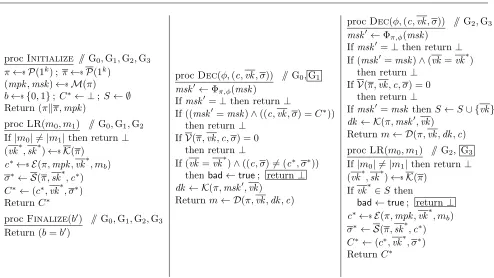
isΦ-RKA secure if this advantage function is negligible for allA. The attack is on the secret key, which is the decryption key, so that we are considering a chosen-ciphertext related-key attack (CC-RKA). The decryption oracleDec refuses to act only when the ciphertext it is given matches the challenge oneand the derived key equals the real one.
FromΦ-RKA IBE toΦ-RKA PKE-CCA.We show the containmentRKA[IBE]⊆RKA[PKE-CCA] by showing that the construction of Boneh, Canneti, Halevi, and Katz [15] preserves RKA security. We start with a Φ-RKA IBE scheme
IBE
= (P,M,K,E,D) and a signature schemeDS
= (P,K,S,V), and construct a PKE schemePKE
as follows:1. Parameters: Parameters for
PKE
are the concatenation πkπ of parameters forIBE
andDS
.2. Keys: Pick (mpk,msk)← M(π), and usempk as the public key and msk as the secret key.
3. Encryption: To encrypt a message m under mpk, generate a signing-verification key pair (vk,sk)← K(π). Then encrypt m for the identity id =vk by computing c←$E(π,vk, m) and sign c under S usingsk to get a signature σ. The ciphertext is (c,vk, σ).
4. Decryption: To decrypt a ciphertext (c,vk, σ), first verify thatσ is a valid signature on c under vk, and output ⊥ if verification fails. Then compute the user secret key for the identity id = vk, and decrypt c using that key.
By construction, we have that Φ is compatible with
PKE
whenever it is compatible withIBE
. In order to prove security, we require thatDS
satisfy (regular-secure) strongly unforgeability, which we recall in Appendix F.Theorem 6.4 Let PKE scheme
PKE
= (P′,K′
,E′
,D′
) be constructed as above from Φ-RKA IBE
scheme
IBE
= (P,M,K,E,D) and normal-secure strongly-unforgeable signature schemeDS
= (P,K,A proof is given in Appendix F. It is an adaptation of the original proof for the non-RKA version of this theorem. The primary difference is in showing that the RKA games for IBE and PKE-CCA will cooperate, because they each have rules for disallowing certain queries (with IBE one cannot extract a key forid∗, and in PKE-CCA one cannot decryptC∗
, but both rules only hold under the original secret key). Handily, the Boneh et al. construction has a structure that allows these rules to fit together. SE. Symmetric encryption is interesting because both sender and receiver have the secret key and the RKA can now be mounted on the encryption, not merely on the decryption. A symmetric encryption scheme
SE
= (P,K,E,D) is specified as usual by parameter generation, key generation, encryption and decryption algorithms. Games SECPA,SECCA of Figure 5 are associated toSE
and a RKA specification Φ = (π,Q) that is compatible withSE
. An adversary is now allowed multiple queries to LR. Let Advse-cp-rkaSE,A,Φ (k) equal 2 Pr[SECPAA ⇒ true]−1 when the game has input 1k. We saySE
isΦ-RKA-CPA secure if this advantage function is negligible. LetAdvse-cc-rkaSE,A,Φ (k) equal 2 Pr[SECCAA⇒true]−1 when the game has input 1k. We say
SE
is Φ-RKA-CCA secure if this advantage function is negligible. Remaining relations. Containments of the formRKA∗[PRF]⊆RKA∗[P] can be established for all the other primitivesP using the same idea as illustrated above forP =Sig. All our non-containments emanate from two basic techniques. One is based on constants, as we illustrated with RKA[Sig] 6⊆RKA[PRF]. Another example use of this technique is to show RKA[PKE-CCA] 6⊆ RKA[SE-CCA]. This is true because constant functions are fine for the first but, due to the RKA on the encryption oracle, not for the second. However sometimes we want to show RKA[P1]6⊆RKA[P2] when constant functions are either fine for both or not fine for either. We do this based on variants of the technique used above to establish RKA[wPRF] 6⊆ RKA[PRF] where the idea can be viewed as using RKDFs that flip-flop between two keys depending on a bit of the original key in such a way that there is a Φ-RKA on P2 yet the two keys are functionally equivalent under a Φ-RKA on P1. This can be used for example to show that RKA[SE-CPA] 6⊆ RKA[SE-CCA]. In this case the attack exploits the fact that the decryption oracle rejects if a query (φ, C) results in (K′
, C) being in S, meaning thatC was a challenge ciphertext created under K′, and this can be made to happen depending on a certain bit ofK so that the rejection leaks information aboutK that eventually allows the attacker to recover K. We omit details on these and the remaining relations shown in Figure 1.
Acknowledgments
We thank Susan Thomson, Martijn Stam, Pooya Farshim and the Asiacrypt 2011 reviewers for their comments and corrections.
References
[1] M. Albrecht, P. Farshim, K. Paterson, and G. Watson. On cipher-dependent related-key attacks in the ideal-cipher model. Cryptology ePrint Archive, Report 2011/213, 2011. http://eprint.iacr.org/. (Cited on page 5.)
[2] B. Applebaum, D. Harnik, and Y. Ishai. Semantic security under related-key attacks and applications. In A. C.-C. Yao, editor,ICS 2011. Tsinghua University Press, 2011. (Cited on page 4, 5, 6.)
[3] M. Bellare and D. Cash. Pseudorandom functions and permutations provably secure against related-key attacks. In T. Rabin, editor, CRYPTO 2010, volume 6223 ofLNCS, pages 666–684. Springer, Aug. 2010. (Cited on page 4, 5, 6, 7, 9, 10.)
[5] M. Bellare and T. Kohno. Hash function balance and its impact on birthday attacks. In C. Cachin and J. Camenisch, editors, EUROCRYPT 2004, volume 3027 of LNCS, pages 401–418. Springer, May 2004. (Cited on page 12.)
[6] M. Bellare and S. K. Miner. A forward-secure digital signature scheme. In M. J. Wiener, editor,CRYPTO’99, volume 1666 of LNCS, pages 431–448. Springer, Aug. 1999. (Cited on page 6.)
[7] M. Bellare and P. Rogaway. The security of triple encryption and a framework for code-based game-playing proofs. In S. Vaudenay, editor,EUROCRYPT 2006, volume 4004 ofLNCS, pages 409–426. Springer, May / June 2006. (Cited on page 8, 20, 23.)
[8] E. Biham. New types of cryptoanalytic attacks using related keys (extended abstract). In T. Helleseth, editor, EUROCRYPT’93, volume 765 ofLNCS, pages 398–409. Springer, May 1993. (Cited on page 3.)
[9] E. Biham and A. Shamir. Differential fault analysis of secret key cryptosystems. In B. S. Kaliski Jr., editor, CRYPTO’97, volume 1294 ofLNCS, pages 513–525. Springer, Aug. 1997. (Cited on page 3, 4.)
[10] N. Bitansky and R. Canetti. On strong simulation and composable point obfuscation. In T. Rabin, editor, CRYPTO 2010, volume 6223 ofLNCS, pages 520–537. Springer, Aug. 2010. (Cited on page 6.)
[11] M. Blum and S. Micali. How to generate cryptographically strong sequences of pseudorandom bits. SIAM Journal on Computing, 13(4):850–864, 1984. (Cited on page 11.)
[12] D. Boneh and X. Boyen. Efficient selective-ID secure identity based encryption without random oracles. In C. Cachin and J. Camenisch, editors,EUROCRYPT 2004, volume 3027 ofLNCS, pages 223–238. Springer, May 2004. (Cited on page 16.)
[13] D. Boneh and X. Boyen. Short signatures without random oracles. In C. Cachin and J. Camenisch, editors, EUROCRYPT 2004, volume 3027 ofLNCS, pages 56–73. Springer, May 2004. (Cited on page 6.)
[14] D. Boneh and X. Boyen. Short signatures without random oracles and the SDH assumption in bilinear groups. Journal of Cryptology, 21(2):149–177, Apr. 2008. (Cited on page 6.)
[15] D. Boneh, R. Canetti, S. Halevi, and J. Katz. Chosen-ciphertext security from identity-based encryption. SIAM Journal on Computing, 36(5):915–942, 2006. (Cited on page 5, 16.)
[16] D. Boneh, R. A. DeMillo, and R. J. Lipton. On the importance of checking cryptographic protocols for faults (extended abstract). In W. Fumy, editor, EUROCRYPT’97, volume 1233 ofLNCS, pages 37–51. Springer, May 1997. (Cited on page 3, 4.)
[17] D. Boneh, B. Lynn, and H. Shacham. Short signatures from the Weil pairing. In C. Boyd, editor, ASI-ACRYPT 2001, volume 2248 ofLNCS, pages 514–532. Springer, Dec. 2001. (Cited on page 16.)
[18] Y. Dodis and A. Yampolskiy. A verifiable random function with short proofs and keys. In S. Vaudenay, editor, PKC 2005, volume 3386 ofLNCS, pages 416–431. Springer, Jan. 2005. (Cited on page 6.)
[19] S. Dziembowski, K. Pietrzak, and D. Wichs. Non-malleable codes. In A. C.-C. Yao, editor, ICS 2010. Tsinghua University Press, 2010. (Cited on page 6.)
[20] R. Gennaro, A. Lysyanskaya, T. Malkin, S. Micali, and T. Rabin. Algorithmic tamper-proof (ATP) security: Theoretical foundations for security against hardware tampering. In M. Naor, editor, TCC 2004, volume 2951 ofLNCS, pages 258–277. Springer, Feb. 2004. (Cited on page 3, 4, 6, 12.)
[21] D. Goldenberg and M. Liskov. On related-secret pseudorandomness. In D. Micciancio, editor,TCC 2010, volume 5978 of LNCS, pages 255–272. Springer, Feb. 2010. (Cited on page 4, 5, 6, 9.)
[22] O. Goldreich. Foundations of Cryptography: Basic Applications, volume 2. Cambridge University Press, Cambridge, UK, 2004. (Cited on page 14, 27.)
[23] V. Goyal, A. O’Neill, and V. Rao. Correlated-input secure hash functions. In Y. Ishai, editor, TCC 2011, volume 6597 of LNCS, pages 182–200. Springer, Mar. 2011. (Cited on page 4, 5, 6, 7, 18.)
[24] V. Goyal, A. O’Neill, and V. Rao. Correlated-input secure hash functions. Cryptology ePrint Archive, Report 2011/233, 2011. Full version of [23],http://eprint.iacr.org/. (Cited on page 5, 6, 7.)