On the Security of
Tandem-DM
Full version of the paper (2009/02/03) Ewan Fleischmann, Michael Gorski, Stefan Lucks
{ewan.fleischmann,michael.gorski,stefan.lucks}@uni-weimar.de Bauhaus-University Weimar, Germany
Abstract. We provide the first proof of security forTandem-DM, one of the oldest and most
well-known constructions for turning a blockcipher with n-bit blocklength and 2n-bit keylength into a 2n-bit cryptographic hash function. We prove, that whenTandem-DMis instantiated with AES-256,
i.e.blocklength 128 bits and keylength 256 bits, any adversary that asks less than 2120.4
queries cannot find a collision with success probability greater than 1/2. We also prove a bound for preimage resistance ofTandem-DM. Interestingly, as there is only one practical construction known (FSE’06, Hirose)
turn-ing such an (n,2n)-bit blockcipher into a 2n-bit compression function that has provably birthday-type collision resistance, Tandem-DMis one out of two structures that possess this desirable feature.
Keywords: Cryptographic hash function, blockcipher based, proof of security, double-block length, ideal cipher model, Tandem-DM.
1 Introduction
A cryptographic hash function is a function which maps an input of arbitrary length to an output of fixed length. It should satisfy at least collision-, preimage- and second-preimage resistance and is is one of the most important primitives in cryptography [23].
Blockcipher-Based Hash Functions. Since their initial design by Rivest, MD4-family hash functions (e.g.MD4, MD5, RIPEMD, SHA-1, SHA2 [26, 27, 29, 30]) have dominated cryptographic practice. But in recent years, a sequence of attacks on these type of functions [7, 11, 36, 37] has led to a generalized sense of concern about the MD4-approach. The most natural place to look for an alternative is in blockcipher-based constructions, which in fact predate the MD4-approach [22]. Another reason for the resurgence of interest in blockcipher-based hash functions is due to the rise of size restricted devices such as RFID tags or smart cards: A hardware designer has to implement only a blockcipher in order to obtain an encryption function as well as a hash function. But since the output length of most practical encryption functions is far too short for a collision resistant hash function, e.g. 128-bit for AES, one is mainly interested in sound design principles fordouble block length (DBL) hash functions [2]. A DBL hash-function uses a blockcipher with n-bit output as the building block by which it maps possibly long strings to 2n-bit ones.
Our Contribution. Four ’classical’ DBL hash functions are known:MDC-2,MDC-4,Abreast-DM
and Tandem-DM[3, 4, 21]. At EUROCRYPT’07, Steinberger [34] proved the first security bound
for the hash functionMDC-2: assuming a hash output length of 256 bits, any adversary asking less
than 274.9 queries cannot find a collision with probability greater than 1/2.
In this paper, we prove the first security bound for the compression function Tandem-DMin
asking less than 2120.4 queries cannot find a collision with probability greater than 1/2. We will also prove an upper bound for success if an adversary is trying to find a preimage. This bound is rather weak as it essentially only states, that the success probability of an adversary asking strictly less than 2n queries is asymptotically negligible.
Beyond providing such a proof of security for Tandem-DM in the first place, our result even
delivers one of the most secure rate 1/2 DBL compression functions known. The first practical DBL compression function with rate 1/2 (without bit-fixing and other artificial procedures like employing two different blockciphers) that has a birthday-type security guarantee was presented at FSE’06 by Hirose [14]. He essentially states (see Appendix B for a proof), that no adversary asking less than 2124.55 queries, again for 2n= 256, can find a collision with probability greater then 1/2. These two compression functions (Hirose’s FSE ’06 proposal and Tandem-DM) are the only rate
1/2 practical compression functions that are known to have a birthday-type security guarantee. Outline. The paper is organized as follows: Section 2 includes formal notations and definitions as well as a review of related work. In Section 3, we proof that an adversary asking less than 2120.4 oracle queries has negligible advantage in finding a collision for the Tandem-DM compression
function. A bound for preimage resistance of Tandem-DM is given in Section 4. In Section 5 we
discuss our results and conclude the paper.
2 Preliminaries
2.1 Iterated DBL Hash Function Based on Blockciphers
Ideal Cipher Model. An (n, k)-bit blockcipher is a keyed family of permutations consisting of two paired algorithms E : {0,1}n × {0,1}k → {0,1}n and E−1 : {0,1}n × {0,1}k → {0,1}n both
accepting a key of size k bits and an input block of size n bits. For simplicity, we will call it an (n, k)-blockcipher. Let BC(n, k) be the set of all (n, k)-blockciphers. Now, for any one fixed key K ∈ {0,1}k, decryption E−1
K =E−1(·, K) is the inverse function of encryption EK =E(·, K), so
thatE−K1(EK(x)) =xholds for any input X∈ {0,1}n.
Most of the attacks on hash functions based on block ciphers do not utilize the internal structure of the blockciphers. The security of such hash functions is usually analyzed in theideal cipher model [2, 9, 18]. In the ideal cipher model the underlying primitive, the blockcipher E, is modeled as a family of random permutations{Ek} whereas the random permutations are chosen independently
for each keyK, i.e. formallyE is selected randomly fromBC(n, k).
DBL Compression Functions. Iterated DBL hash functions with two blockcipher calls in their compression function are discussed in this article. A hash function H : {0,1}∗ → {0,1}2n can be built by iterating a compression function F :{0,1}3n → {0,1}2n as follows: Split the padded message M into n-bit blocks M1, . . . , Ml, fix (G0, H0), apply (Gi, Hi) = F(Gi−1, Hi−1, Mi) for i= 1, . . . , l and finally set H(M) := (Gl, Hl). Let the compression functionF be such that
(Gi, Hi) =F(Gi−1, Hi−1, Mi),
whereGi−1, Hi−1, Gi, Hi, Mi ∈ {0,1}n. We assume that the compression functionF consists ofFT,
the top row, and FB, the bottom row. We explicitly allow the results of FT to be fed into the
calculation of FB. Each of the component functionsFB and FT performs exactly one call to the
Gi = FT(Gi−1, Hi−1, Mi) =E(XT, KT)⊕ZT, Hi =FB(Gi, Gi−1, Hi−1, Mi) =E(XB, KB)⊕ZB,
whereXT, KT, ZT are uniquely determined byGi−1, Hi−1, Mi andXB, KB, ZB are uniquely
deter-mined by Gi, Gi−1, Hi−1, Mi.
We define the rater of a blockcipher based compression/hash functionF by
r = |Mi|
(number of block cipher calls in F)×n.
It is a measure of efficiency for such blockcipher based constructions.
2.2 The Tandem-DM Compression Function
TheTandem-DMcompression function was proposed at EUROCRYPT’92 by Lai and Massey [21].
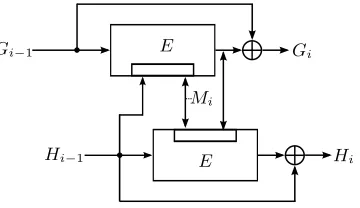
It uses two cascaded Davies-Meyer [2] schemes. The compression function is illustrated in Figure 1 and is formally defined in Definition 1.
E
E Gi−1
Hi−1
Gi
Hi Mi
Figure 1. The compression function Tandem-DM FT DM where E is an (n,2n)-blockcipher, the small rectangle inside the cipher rectangle indicates which input is used as key
Definition 1. Let FT DM : {0,1}2n × {0,1}n → {0,1}2n be a compression function such that
(Gi, Hi) = FT DM(Gi−1, Hi−1, Mi) where Gi, Hi, Mi ∈ {0,1}n. FT DM is built upon an (n,2n )-blockcipher E as follows:
Wi=E(Gi−1, Hi−1|Mi)
Gi=FT(Gi−1, Hi−1, Mi) =Wi⊕Gi−1
Hi=FB(Gi−1, Hi−1, Mi) =E(Hi−1, Mi|Wi)⊕Hi−1.
2.3 Related Work
Schemes with non-optimal or unknown collision resistance. Preneelet al.[28] discussed the security of SBL hash functions against several generic attacks. They concluded that 12 out of 64 hash functions are secure against the attacks. However, formal proofs were first given by Black et al. [2] about 10 years later. Their most important result is that 20 hash functions – including the 12 mentioned above – are optimally collision resistant. Knudsen et al. [19] discussed the insecurity of DBL hash functions with rate 1 composed of (n, n)-blockciphers. Hohl et al. [15] analyzed the security of DBL compression functions with rate 1 and 1/2. Satohet al.[33] and Hattoriset al.[12] discussed DBL hash functions with rate 1 composed of (n,2n)-blockciphers. MDC-2 and MDC-4 [16, 1, 4] are (n, n)-blockcipher based DBL hash functions with rates 1/2 and 1/4, respectively. Steinberger [34] proved that for MDC-2 instantiated with, e.g., AES-128 no adversary asking less than 274.9 can usually find a collision. Nandi et al. [25] proposed a construction with rate 2/3 but it is not optimally collision resistant. Furthermore, Knudsen and Muller [20] presented some attacks against it. Gauravaram et al. [10] proposed a new approach based on iterated halving to design a hash function with a blockcipher. At EUROCRYPT’08 and CRYPTO’08, Steinberger [31, 32] proved some security bounds for fixed-key (n, n)-blockcipher based hash functions, i.e. permutation based hash functions, that all have small rates and low security guarantees. None of these schemes/techniques mentioned so far are known to have birthday-type collision resistance. Schemes with Birthday-Type Collision Resistance. Merkle [24] presented three DBL hash functions composed of DES with rates of at most 0.276. They are optimally collision resistant in the ideal cipher model. Hirose [13] presented a class of DBL hash functions with rate 1/2 which are composed of two different and independent (n,2n) blockciphers that have birthday-type collision resistance. At FSE’06, Hirose [14] presented a rate 1/2 and (n,2n) blockcipher based DBL hash function that has birthday-type collision resistance. As he only stated the proof for the hash function, we have given the proof for his compression function in Appendix B.
3 Collision Resistance
In this section we will discuss the collision resistance of the compression function Tandem-DM.
3.1 Defining Security – Collision Resistance of a Compression Function
Insecurity is quantified by the success probability of an optimal resource-bounded adversary. The resource is the number of queries to the ideal cipher oracles E or E−1. For a set S, let z ←R S
represent random sampling from S under the uniform distribution. For a probabilistic algorithm
M, letz← MR mean that zis an output ofMand its distribution is based on the random choices of M.
An adversary is a computationally unbounded but always-halting collision-finding algorithm
A with access to an oracle E ∈ BC(n, k). We can assume (by standard arguments) that A is
deterministic. The adversary may make a forward query (K, X)f wd to discover the corresponding
value Y = EK(X), or the adversary may make a backward query (K, Y)bwd, so as to learn the
corresponding value X = E−K1(Y) for which EK(X) = Y. Either way the result of the query is
stored in a triple (Xi, Ki, Yi) and the query history, denoted Q, is the tuple (Q1, . . . , Qq) where Qi = (Xi, Ki, Yi) is the result of the i-th query made by the adversary and where q is the total
Without loss of generality, it is assumed that Aasks at most only once on a triplet of a key Ki, a
plaintext Xi and a ciphertextYi obtained by a query and the corresponding reply.
The adversary’s goal is to output two different triplets (G, H, M) and (G0, H0, M0) such that
F(G, H, M) = F(G0, H0, M0). We impose the reasonable condition that the adversary must have
made all queries necessary to computeF(G, H, M) andF(G0, H0, M0). We will in fact dispense the adversary from having to output these two triplets, and simply determine whether the adversary has been successful or not by examining its query historyQ. Formally, we say thatColl(Q) holds
if there is such a collision and Qcontains all the queries necessary to compute it.
Definition 2. (Collision resistance of a compression function)LetF be a blockcipher based
compression function, F : {0,1}3n → {0,1}2n. Fix an adversary A. Then the advantage of A in
finding collisions inF is the real number
AdvCollF (A) = Pr[E←R BC(n, k); ((G, H, M),(G0, H0, M0))← AR E,E−1 :
((G, H, M)6= (G0, H0, M0))∧F(G, H, M) =F(G0, H0, M0)].
For q≥1 we write
AdvCollF (q) = max
A {Adv
Coll
F (A)}
where the maximum is taken over all adversaries that ask at mostq oracle queries (i.e.E andE−1
queries).
3.2 Security Results
Our discussion will result in a proof for the following upper bound:
Theorem 1. Let F := FT DM as in Definition 1 and n, q be natural numbers with q < 2n. Let
N0 = 2n−q and let α be any positive number with eq/N0 ≤α and τ = αN0/q (and ex being the exponential function). Then
AdvCollF (q)≤q2neqτ(1−lnτ)/N0 + 4qα/N0+ 6q/(N0)2+ 2q/(N0)3.
The proof is given on page 11 and is a simple corollary of the discussion and lemmas below. As this theorem is rather incomprehensible, we will investigate what this theorem means for AES-256. The bound obtained by this theorem depends an a parameter α. We do not require any specific value α
as anyα (meeting to the conditions mentioned in Theorem 1) leaves us with a correct bound. For Theorem 1 to give a good bound one must choose a suitable value for the parameter α. Choosing large values of α reduces the value of the first term but increases the value of the second term. There seems to be no good closed for forαas these will change with everyq. The meaning ofα will be explained in the proof. We will optimize the parameterα numerically as given in the following corollary.
Corollary 1. For the compression function Tandem-DM, instantiated with AES-256, any
3.3 Proof of Theorem 1
Analysis Overview. We will analyze if the queries made by the adversary contain the means
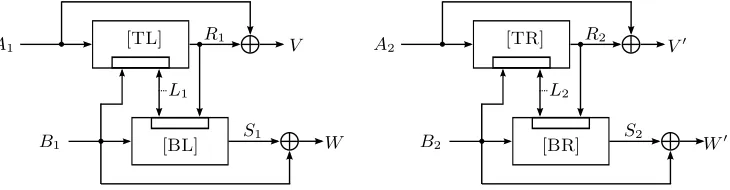
of constructing a collision for the compression function FT DM. Effectively we look to see whether there exist four queries that form a collision (see Figure 2).
To upper bound the probability of the adversary obtaining queries than can be used to construct a collision, we upper bound the probability of the adversary making a query that can be used as the final query to complete such a collision. Namely for each i, 1 ≤ i ≤ q, we upper bound the probability that the answer to the adversary’s i-th query (Ki, Xi)f wd or (Ki, Yi)bwd will allow the
adversary to use the i-th query to complete the collision. In the latter case, we say that the i-th query is ’successful’ and we give the attack to the adversary.
As the probability depends naturally on the first i−1 queries, we need to make sure that the adversary hasn’t already been too lucky with these (or else the probability of the i-th query being successful would be hard to upper bound). Concretely, being lucky means, that there exists a large subset of the firsti−1 queries that all have the same XOR output (see below for a formal definition). Our upper bound thus breaks down into two pieces: an upper bound for the probability of the adversary getting lucky in one defined specific way and the probability of the adversary ever making a successfuli-th query, conditioned on the fact that the adversary has not yet become lucky by its (i−1)-th query.
Analysis Details. Fix numbersn, q and an adversaryA askingq queries to its oracle. We upper
bound Pr[CollT DM(Q)] by exhibiting predicates Lucky(Q), Win1(Q), Win2(Q) and Win3(Q)
such thatCollT DM(Q)⇒Lucky(Q)∨Win1(Q)∨Win2(Q)∨Win3(Q) and then by upper
bound-ing separately the probabilities Pr[Lucky(Q)], Pr[Win1(Q)], Pr[Win2(Q)] and Pr[Win3(Q)]. Then
obviously Pr[Coll(Q)]≤Pr[Lucky(Q)] + Pr[Win1(Q)] + Pr[Win2(Q)] + Pr[Win3(Q)]. The event Lucky(Q) happens if the adversary is lucky, whereas if the adversary is not lucky but makes a
successfuli-th query then one of the other predicates hold.
To state the predicates, we need one additional definition. Let a(Q) be a function defined on query sequences of lengthq as follows:
a(Q) = max
Z∈{0,1}n|{i:Xi⊕Yi =Z}|is the maximum size of a set of queries inQ whose XOR outputs are all the same.
The event Lucky(Q) is now defined by
Lucky(Q) =a(Q)> α,
where α is the constant from Theorem 1 (it is chosen depending on n and q by a numerical optimization process). Thus as α is chosen larger Pr[Lucky(Q)] diminishes. The other events, Win1(Q), Win2(Q) and Win3(Q) are different in nature from the event Lucky(Q). Simply put,
they consider mutually exclusive configurations on how to find a collision for Tandem-DM (see
[TL]
[BL] A1
B1
V
W L1
R1
S1
[TR]
[BR] A2
B2
V0
W0
L2
R2
S2
Figure 2.Generic configuration for a collision if (V =V0, W =W0) for theTandem-DMcompression function.
We will call the configuration necessary for, e.g., predicate Win1a(Q) simply 1a. Now, take for
example just this configuration of predicate Win1a(Q) (i.e. all four queries are different and a
collision is found; it will be defined in Definition 3). Formally, the four queries Qi, Qj, Qk, Ql ∈ Q
fit configuration 1aif and only if
(i6=j)∧(i=6 k)∧(i6=l)∧(j 6=k)∧(j6=l)∧(k6=l)∧ (Xi⊕Yi=Xk⊕Yk)∧(Xj ⊕Yj =Xl⊕Yl)∧
(Ki =Xj|Kj(1...n/2))∧(Kj =Ki(n/2+1...n)|Yi)∧
(Kk =Xl|Kk(1...n/2))∧(Kl =Kk(n/2+1...n)|Yk).
We say, that Fit1a(Q) holds if there exist i, j, k, l ∈ {1,2, . . . , q} such that queries Qi, Qj, Qk, Ql
fit configuration 1a. The other predicatesFit1b(Q),Fit1c(Q),Fit1d(Q),Fit2a(Q), . . . ,Fit2d(Q)
andFit3a(Q), . . .Fit3d(Q) whose configurations are given in Definition 3 are likewise defined. We
also let Fitj(Q) =Fitja(Q)∨. . .∨Fitjd(Q) forj = 1,2,3.
Definition 3. Fit1(Q): The last query is used only once in positionTL. Note that this is equal to
the case where the last query is used only once in position TR.
Fit1a(Q) all queries used in the collision are pairwise different,
Fit1b(Q) BL=TR andBR is different to TL, BL, TR,
Fit1c(Q) BL=BR andTR is different to TL, BL, BR,
Fit1d(Q) TR=BR and BL is different to TL, TR,BR,
Fit2(Q): The last query is used only once in positionBL. Note that this is equal to the case where
the last query is used only once in position BR.
Fit2a(Q) all queries used in the collision are pairwise different,
Fit2b(Q) TL=TR and BRis different to TL,BL, TR,
Fit2c(Q) TL=BR and TRis different to TL,BL, BR,
Fit2d(Q) TR=BR and TL is different to BL, TR,BR,
Fit3(Q): The last query is used twice in a collision. Then:
Fit3a(Q) last query used inTL,BL(TL=BL) andTR6=BR,
Fit3b(Q) last query used in TL,BL (TL=BL) and TR=BR,
Fit3c(Q) last query used in TL,BR (TL=BR) and BL6=TR,
In Lemma 1 we will show that these configurations cover all possible cases of a collision. We now define
Win1(Q) =¬Lucky(Q)∧Fit1(Q),
Win2(Q) =¬(Lucky(Q)∨Fit1(Q))∧Fit2(Q),
Win3(Q) =¬(Lucky(Q)∨Fit1(Q)∨Fit2(Q))∧Fit3(Q).
ThusWin3(Q), for example, is the predicate which is true if and only ifa(Q)< α(i.e.¬Lucky(Q))
andQcontains queries that fit configurations 3a,3b,3cor 3dbutQdoes not contain queries fitting configurations 1a, . . . ,1d,2a, . . .2d.
We now show, that CollT DM(Q) =⇒Lucky(Q)∨Win1(Q)∨Win2(Q)∨Win3(Q).
Lemma 1. CollT DM(Q) =⇒Lucky(Q)∨Win1(Q)∨Win2(Q)∨Win3(Q).
Proof. As Fit1a(Q)∨. . .∨Fit3d(Q) =⇒Win1a(Q)∨. . .Win3d(Q), it is sufficient to show that CollT DM(Q) =⇒ Fit1a(Q)∨. . .∨Fit3d(Q). Now, say CollT DM(Q). Then a collision can be
constructed from the queries Q. That is, our query history Q contains queries Qi, Qj, Qk, Ql (see
Figure 2) such that we have a collision, i.e. V =V0 and W =W0 and TL 6=TR. Note, that the
last condition suffices to ensure a real collision (a collision from two different inputs).
First assume that the last query is used once in the collision. If it is used in position TL, then
we have to consider the queriesBL,TRandBR. If these three queries are all different (and as the
last query is only used once), then Fit1a(Q). If BL=TR and BRis different, thenFit1b(Q). If BL=BR and TR is different, then Fit1c(Q). If TR=BRand BLis different, then Fit1d(Q).
IfBL=TR=BR, then we have BL=BRand TL=TRand this would not result in a collision
since the inputs to the two compression functions would be the same. As no cases are left, we are done (for the case that the last query is used only in position TL).
If the last query is used once in the collision and is used in positionBL, then we have to consider
the queries TL,TR and BR. If these three queries are all different (and as the last query is only
usedonce), thenFit2a(Q). IfTL=TRandBRis different, thenFit2b(Q). IfTL=BRandTR
is different, thenFit2c(Q). IfTR=BRand TLis different, then Fit2d(Q). IfTL=TR=BR,
it followsTL=TRand BL=BR and this would not result in a collision since the inputs to the
two compression functions would be the same. As no cases are left, we are done.
We now analyze the case when the last query is used twice in the collision. First, assume that the query is used for the positionsTLandBL(TL=BL). IfTR6=BR, thenFit3a(Q), ifTR=BR,
thenFit3b(Q). Now assume that the query is employed for the pairTLandBR(TL=BR). Note,
that this case is equal to the case where the query is employed forBLand TR. IfBL6=TR, then Fit3c(Q), if BL=TR, thenFit3d(Q). The other cases, i.e.the last query is employed either for TL=TR orBL=BR, do not lead to a real collision as this would imply the same compression
function input. As no cases are left, we are done.
If the last query is used more than twice for the collision we do not get a real collision as this case would imply either TL = TR or BL = BR and we have the same input, again, for both
compression functions.
The next step is to upper bound the probability of the predicates Lucky(Q),Win1(Q), Win2(Q)
Lemma 2. Let α be as in Theorem 1. If α > eand τ =N0α/q, then Pr[Lucky(Q)]≤q2neτ ν(1−lnτ).
The proof is quite technical and is given in Appendix A.
Lemma 3. Pr[Win1(Q)]≤qα/N0+ 2q/(N0)2+q/(N0)3.
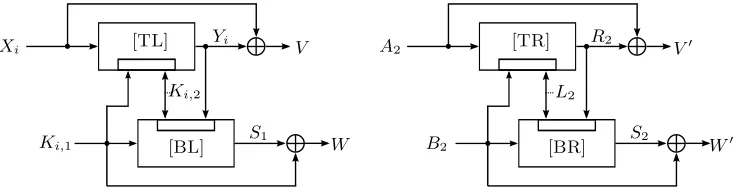
Proof. AsWin1(Q) =¬Lucky(Q)∧Fit1(Q), we will upper bound the probabilities ofFit1a(Q), Fit1b(Q), Fit1c(Q) and Fit1d(Q) separately in order to get an upper bound for Pr[Fit1(Q)]≤ Fit1a(Q) +. . .+Fit1d(Q). We will use the notations given in Figure 3.
[TL]
[BL] Xi
Ki,1
V
W Ki,2
Yi
S1
[TR]
[BR] A2
B2
V0
W0
L2
R2
S2
Figure 3.Notations used forWin1(Q)
LetQi denote the firstiqueries made by the adversary. The term ’last query’ means the latest
query made by the adversary (we examine the adversary’s queries (Ki, Xi)f wd or (Ki, Yi)bwd one at
a time as they come in). The last query is always given indexi. We say the last query is successful if the output Xi or Yi for the last query is such that a(Qi) < α and such that the adversary can
use the query (Xi, Ki, Yi) to fit the configuration given in Figure 3 using only queries in Qi (in
particular, the last query must be used once in the fitting for that query to count as successful). The goal is thus to upper bound the adversary’s chance of ever making a successful last query. The basic setup for upper bounding the probability of success in a given case is to upper bound the maximum number of different outputsYi orXi (depending on whether the last query is a forward
or a backward query) that would allow the query (Xi, Ki, Yi) to be used to fit the configuration,
and then divide this number byN0 = 2n−q (since eitherYi orXi, depending, is chosen randomly among a set of at least 2n−qdifferent values). The ratio is then multiplied byq, since the adversary makesq queries in all, each of which could become a successful last query.
(i) Fit1a(Q): The last query, wlog. (Xi, Ki,1|Ki,2, Yi), is used in position TL. We do not care
whether the last query was a forward or backward query since the analysis below is the same. All queries are, as claimed, pairwise different. We give the adversary for free the an-swer to the forward query BL, (Ki,1, Ki,2|Yi, S1). Then we have V = Yi ⊕Xi and W = S1⊕Ki,1. This pair of queries is successful if the adversary’s query historyQi−1 contains a pair (A2, B2|L2, R2),(B2, L2|R2, S2) such that V =Xi⊕Yi =R2⊕A2 =V0 and W =S1⊕Ki,1 =
S2⊕B2=W0. There are at mostα queries inQi−1 that can possibly be used for query in TR that all lead to a collision in the top row, i.e.V =V0. Therefore we have at mostαpossibilities for the query in BRsince the query in TR uniquely determines the query BR. Thus, the last
query has a chance of ≤α/N0 of succeeding. So the total chance of making a successful query
(ii) Fit1b(Q): Again, the last query, wlog. (Xi, Ki,1|Ki,2, Yi), is used in position TL. We give the
adversary for free the answer to the forward query BL, (Ki,1, Ki,2|Yi, S1). By our claim, as BL=TR, we have A2 = Ki,1, B2 = Ki,2, L2 = Yi and R2 = S1. It follows that for any given
queryiforTL, we have at most one query forTRto form a collisionV =V0 (as the queryTL
uniquely determines the query BL and the queries BLand TR are equal) and therefore have
at most one query BR in our query history to form a collisionW =W0. The last query has a
chance of ≤1/(N0 ·N0) of succeeding and so the total chance of making a successful query in
the attack is ≤q/(N0)2.
(iii) Fit1c(Q): As this analysis is essentially the same as for Fit1b(Q) we conclude with a total
chance of success for this type of query of ≤q/(N0)2.
(iv) Fit1d(Q): Again, the last query, wlog. (Xi, Ki,1|Ki,2, Yi), is used in position TL. We give the
adversary for free the answer to the forward queryBL, (Ki,1, Ki,2|Yi, S1). Note, that this query
is trivially different from the query inTL as we assume that the last query is only used once in
this configuration (the case in which the two queries, TLandBL, are equal is discussed in the
analysis of Win3(Q)). We have V =Yi⊕Xi and W =S1⊕Ki,1. As by our claim, we assume TR = BR. The pair of queries for TL and BL is successful if the adversary’s query history
Qi−1 contains a query (A2, B2|L2, R2) such that V =R2⊕A2 =V0 and W =R2 ⊕A2 =W0, i.e. V =W =V0 =W0. Moreover, it follows fromB2 =R2 =L2 thatV =W =V0 =W0 = 0. As at least three of them are chosen randomly by the initial query input (wlog. V, W, V0), the query has a chance of success in thei-th query≤1/(N0·N0·N0) and therefore a total chance
of success ≤q/(N0)3.
The claim follows by adding up the individual results.
Lemma 4. Pr[Win2(Q)]≤qα/N0+ 2q/(N0)2+q/(N0)3.
As the proof and the result is (in principle) identical to the proof of Pr[Win1(Q)] we omitted the
details of the proof.
Lemma 5. Pr[Win3(Q)]≤2qα/N0+ 2q/(N0)2
Proof. The same notations and preliminaries as in the proof of Lemma 3 are used.
(i) Win3a(Q): The last query, wlog. (Xi, Ki,1|Ki,2, Yi) is used in positionsTLand BL. We do not
care whether the last query is a forward or backward query since the analysis is the same. It follows, that Xi = Ki,1 = Ki,2 = Yi and therefore V = Xi⊕Yi = W = 0. We assume that
the adversary is successful concerning these restraints, i.e. has found a query TLthat can also
be used for BL such as Xi = Yi = Ki,1 = Ki,2. (Note, that this condition is quite hard.) We
do have at most α queries in Qi−1 that can possibly be used for a query inTR and that lead to a collision in the top row, i.e. 0 = V =V0. For every such query TR we have at most one
corresponding query inQi−1 that can be used in positionBR. So the last query has a chance of
≤α/N0 of succeeding and so the total chance of making a successful query of this type during the attack is ≤qα/N0.
(ii) Win3b(Q): The last query, wlog. (Xi, Ki,1|Ki,2, Yi) is used in positions TLandBL. We do not
follows, thatXi=Ki,1=Ki,2 =Yi and thereforeV =Xi⊕Yi=W = 0. We assume again that
the adversary is successful concerning these restraints, i.e. has found a query TLthat can also
be used forBL. We do have at mostαqueries in Qi−1 that can possibly be used for a query in TRand that lead to a collision in the top row, i.e. 0 =V =V0. We assume that we can use any
such query equally as the corresponding query for BR. In reality, this gives the adversary with
high probability more power than he will have. Thus, the last query has a chance of≤α/N0 of succeeding and so the total chance of making a successful query of this type during the attack is ≤qα/N0. As discussed above, this upper bound is likely to be generous.
(iii) Win3c(Q): The last query, wlog. (Xi, Ki,1|Ki,2, Yi) is used in positionsTLand BR. Note, that
this situation is equal to the last query being used in position BL and TR. We do not care
whether the last query is a forward or backward query. We give the adversary for free the answer to the forward query BL, (Ki,1, Ki,2|Yi, S1). We also give the adversary for free the
answer to the backward query TR, (A2, Xi|Ki,1, Ki,2). The probability for thei-th query to be
successful is equal to Pr[V =V0]·Pr[W =W0], and asW and V0 are guaranteed to be chosen independently and randomly the chance of success is ≤1/(N0)2. The total chance of success is therefore ≤q/(N0)2.
(iv) Win3d(Q): The last query, wlog. (Xi, Ki,1|Ki,2, Yi) is used in positions TLandBR. Note, that
this situation is equal to the last query being used in position BL and TR. We do not care
whether the last query is a forward or backward query. We give the adversary for free the answer to the forward query BL, (Ki,1, Ki,2|Yi, S1). (This query is also used for position TR and it
follows (by comparing the input values of query BL that is used for TR with them of BR) Ki,2|Yi = Xi|Ki,1 and S1 = Ki,2. Comparing the outputs we get a collision in the top row of the compression functions Pr[V =V0] = Pr[EKi,1|Ki,2(Xi)⊕Xi =EKi,2|Yi(Ki,1)⊕Ki,1], where
Yi=EKi,1|Ki,2, with probability≤1/N
0. This is, because the input valuesX
i, Ki,1, Ki,2 have to be in such a way that the two inputs to theE oracle are different (if they are not, we wold have no colliding inputs for the two compression functions). For the bottom row of the compression function we get, similarly, a collision with probability≤1/N0. So the total chance for succeeding is in this case≤q/(N0)2 as we have again at most q queries by the adversary.
We now give the proof for Theorem 1. Proof. (of Theorem 1)
The proof follows directly with Lemma 1, 2, 3, 4 and Lemma 5.
4 Preimage Resistance
Although, the main focus is on collision resistance, we are also interested in the difficulty of inverting the compression function of Tandem-DM. Generally speaking, second-preimage resistance is a
stronger security requirement than preimage resistance. A preimage may have some information of another preimage which produces the same output. However, in the ideal cipher model, for the compression function Tandem-DM, a second-preimage has no information useful to find another
The adversary’s goal is to output a preimage (G, H, M) for a givenσ, whereσ is taken randomly from the output domain, such as F(G, H, M) = σ. As in the proof of Theorem 1 we will again dispense the adversary from having to output such a preimage. We will determine whether the adversary has been successful or not by examining its query history Q. We say, that PreImg(Q)
holds if there is such a preimage and Qcontains all the queries necessary to compute it.
Definition 4. (Inverting random points of a compression function)LetF be a blockcipher
based compression function, F :{0,1}3n → {0,1}2n. Fix an adversaryA that has access to oracles
E, E−1. Then the advantage of A of invertingF is the real number
AdvInvF (A) = Pr[E←R BC(n, k);σ ← {R 0,1}2n: (G, H, M)← AR E,E−1(σ) :F(G, H, M) =σ].
Again, forq ≥1, we write
AdvInvF (q) = max
A {Adv
Inv F (A)}
where the maximum is taken over all adversaries that ask at most q oracle queries.
Note, that there has been a discussion on formalizations of preimage resistance. For details we refer to [2, Section 2, Appendix B].
4.1 Preimage Security
The preimage resistance of the compression function Tandem-DMis given in the following
Theo-rem.
Theorem 2. Let F :=FT DM be as in Definition 1. For every N0 = 2n−q andq >1
AdvInvF (q)≤2q/(N0)2.
Proof. Fix σ = (σ1, σ2) ∈ {0,1}2n where σ1, σ2 ∈ {0,1}n and an adversary A asking q queries to its oracles. We upper bound the probability that A finds a preimage for a given σ by examining the oracle queries as they come in and upper bound the probability that the last query can be used to create a preimage, i.e. we upper bound Pr[PreImg(Q)]. LetQi denote the firsti queries made
by the adversary. The term ’last query’ means the latest query made by the adversary since we examine again the adversary’s queries (Ki, Xi)f wd or (Ki, Xi)bwd one at a time as they come in.
The last query is always given index i.
Case 1: The last query (Xi, Ki, Yi) is used in the top row. EitherXiorYiwas randomly assigned by the oracle from a set of at least the sizeN0. The query is successfulin the top row ifXi⊕Yi=σ1 and thus has a chance of success of≤1/N0. InQ
i−1 there is at most one queryQj that matches
for the bottom row. If there is no such query in Q we give this query Qj the adversary for free. This ’bottom’ query is successful if Xj⊕Yj =σ2 and therefore has a chance of success of
≤1/N0. So the total chance of success afterq queries is≤q/(N0)2
Case 2: The last query (Xi, Ki, Yi) is used in the bottom row. The analysis is essentially the same as in case 1. The total chance of success if ≤q/(N0)2, too.
5 Discussion and Conclusion
In this paper, we have investigated the security of Tandem-DM, a long outstanding DBL
com-pression function based on an (n,2n)-blockcipher. In the ideal cipher model, we showed that this construction has birthday-type collision resistance. As there are some generous margins in the proof it is likely, that Tandem-DM is even more secure. Our bound for preimage resistance is far from
optimal, but we have not found an attack that would classify this bound as tight.
Somewhat surprisingly, there seems to be only one practical rate 1/2 DBL compression function that also has a birthday-type security guarantee. It was presented at FSE’06 by Hirose [14]. Taking into account that it was presented about 15 years after Tandem-DM, it is clear that there needs
still to be a lot of research done in the field of blockcipher based hash functions, e.g.there are still security proofs missing for the aforementioned Abreast-DM and MDC-4 compression or hash
functions.
References
[1] ANSI.ANSI X9.31:1998: Digital Signatures Using Reversible Public Key Cryptography for the Financial Services Industry (rDSA). American National Standards Institute, pub-ANSI:adr, 1998.
[2] John Black, Phillip Rogaway, and Thomas Shrimpton. Black-Box Analysis of the Block-Cipher-Based Hash-Function Constructions from PGV. In Moti Yung, editor,CRYPTO, volume 2442 ofLecture Notes in Computer Science, pages 320–335. Springer, 2002.
[3] C. Meyer and S. Matyas. Secure program load with manipulation detection code, 1988.
[4] D. Coppersmith, S. Pilpel, C. H. Meyer, S. M. Matyas, M. M. Hyden, J. Oseas, B. Brachtl, and M. Schilling. Data authentication using modification dectection codes based on a public one way encryption function. U.S. Patent No. 4,908,861, March 13, 1990.
[5] Ronald Cramer, editor. Advances in Cryptology - EUROCRYPT 2005, 24th Annual International Conference on the Theory and Applications of Cryptographic Techniques, Aarhus, Denmark, May 22-26, 2005, Proceedings, volume 3494 ofLecture Notes in Computer Science. Springer, 2005.
[6] Richard Drews Dean. Formal aspects of mobile code security. PhD thesis, Princeton, NJ, USA, 1999. Adviser-Andrew Appel.
[7] Bert den Boer and Antoon Bosselaers. Collisions for the Compressin Function of MD5. InEUROCRYPT, pages 293–304, 1993.
[8] Eberhard Freitag and Rolf Busam. Complex Analysis, Springer; 1st edition, 2005.
[9] Shimon Even and Yishay Mansour. A Construction of a Cipher From a Single Pseudorandom Permutation. In Hideki Imai, Ronald L. Rivest, and Tsutomu Matsumoto, editors,ASIACRYPT, volume 739 ofLecture Notes in Computer Science, pages 210–224. Springer, 1991.
[10] Praveen Gauravaram, William Millan, and Lauren May. CRUSH: A New Cryptographic Hash Function using Iterated Halving Technique. In Ed Dawson and Wolfgang Klemm, editors,Cryptographic Algorithms and their Uses, pages 28–39. Queensland University of Technology, 2004.
[11] H. Dobbertin. The status of MD5 after a recent attack, 1996.
[12] Mitsuhiro Hattori, Shoichi Hirose, and Susumu Yoshida. Analysis of Double Block Length Hash Functions. In Kenneth G. Paterson, editor, IMA Int. Conf., volume 2898 of Lecture Notes in Computer Science, pages 290–302. Springer, 2003.
[13] Shoichi Hirose. Provably Secure Double-Block-Length Hash Functions in a Black-Box Model. In Choonsik Park and Seongtaek Chee, editors,ICISC, volume 3506 ofLecture Notes in Computer Science, pages 330–342. Springer, 2004.
[14] Shoichi Hirose. Some Plausible Constructions of Double-Block-Length Hash Functions. In Matthew J. B. Robshaw, editor,FSE, volume 4047 of Lecture Notes in Computer Science, pages 210–225. Springer, 2006. [15] Walter Hohl, Xuejia Lai, Thomas Meier, and Christian Waldvogel. Security of Iterated Hash Functions Based
on Block Ciphers. In Stinson [35], pages 379–390.
[17] John Kelsey and Bruce Schneier. Second Preimages on n-Bit Hash Functions for Much Less than 2n Work. In Cramer [5], pages 474–490.
[18] Joe Kilian and Phillip Rogaway. How to Protect DES Against Exhaustive Key Search. In Neal Koblitz, editor, CRYPTO, volume 1109 ofLecture Notes in Computer Science, pages 252–267. Springer, 1996.
[19] Lars R. Knudsen, Xuejia Lai, and Bart Preneel. Attacks on Fast Double Block Length Hash Functions. J. Cryptology, 11(1):59–72, 1998.
[20] Lars R. Knudsen and Fr´ed´eric Muller. Some Attacks Against a Double Length Hash Proposal. In Bimal K. Roy, editor,ASIACRYPT, volume 3788 ofLecture Notes in Computer Science, pages 462–473. Springer, 2005. [21] Xuejia Lai and James L. Massey. Hash Function Based on Block Ciphers. InEUROCRYPT, pages 55–70, 1992. [22] M. Rabin. Digitalized Signatures. In R. DeMillo, D. Dobkin, A. Jones and R.Lipton, editors, Foundations of
Secure Computation, Academic Press, pages 155–168, 1978.
[23] Alfred Menezes, Paul C. van Oorschot, and Scott A. Vanstone.Handbook of Applied Cryptography. CRC Press, 1996.
[24] Ralph C. Merkle. One Way Hash Functions and DES. In Gilles Brassard, editor,CRYPTO, volume 435 of Lecture Notes in Computer Science, pages 428–446. Springer, 1989.
[25] Nandi, Lee, Sakurai, and Lee. Security Analysis of a 2/3-Rate Double Length Compression Function in the Black-Box Model. InIWFSE: International Workshop on Fast Software Encryption, LNCS, 2005.
[26] NIST National Institute of Standards and Technology. FIPS 180-1: Secure Hash Standard. April 1995. See http://csrc.nist.gov.
[27] NIST National Institute of Standards and Technology. FIPS 180-2: Secure Hash Standard. April 1995. See http://csrc.nist.gov.
[28] Bart Preneel, Ren´e Govaerts, and Joos Vandewalle. Hash Functions Based on Block Ciphers: A Synthetic Approach. In Stinson [35], pages 368–378.
[29] R. L. Rivest. RFC 1321: The MD5 Message-Digest Algorithm. Internet Activities Board, April 1992.
[30] Ronald L. Rivest. The MD4 Message Digest Algorithm. In Alfred Menezes and Scott A. Vanstone, editors, CRYPTO, volume 537 ofLecture Notes in Computer Science, pages 303–311. Springer, 1990.
[31] Phillip Rogaway and John P. Steinberger. Constructing Cryptographic Hash Functions from Fixed-Key Block-ciphers. In David Wagner, editor,CRYPTO, volume 5157 ofLecture Notes in Computer Science, pages 433–450. Springer, 2008.
[32] Phillip Rogaway and John P. Steinberger. Security/Efficiency Tradeoffs for Permutation-Based Hashing. In Nigel P. Smart, editor, EUROCRYPT, volume 4965 of Lecture Notes in Computer Science, pages 220–236. Springer, 2008.
[33] Satoh, Haga, and Kurosawa. Towards Secure and Fast Hash Functions. TIEICE: IEICE Transactions on Communications/Electronics/Information and Systems, 1999.
[34] John P. Steinberger. The Collision Intractability of MDC-2 in the Ideal-Cipher Model. In Moni Naor, editor, EUROCRYPT, volume 4515 ofLecture Notes in Computer Science, pages 34–51. Springer, 2007.
[35] Douglas R. Stinson, editor. Advances in Cryptology - CRYPTO ’93, 13th Annual International Cryptology Conference, Santa Barbara, California, USA, August 22-26, 1993, Proceedings, volume 773 ofLecture Notes in Computer Science. Springer, 1994.
[36] Xiaoyun Wang, Xuejia Lai, Dengguo Feng, Hui Chen, and Xiuyuan Yu. Cryptanalysis of the Hash Functions MD4 and RIPEMD. In Cramer [5], pages 1–18.
[37] Xiaoyun Wang, Yiqun Lisa Yin, and Hongbo Yu. Finding Collisions in the Full SHA-1. In Victor Shoup, editor, CRYPTO, volume 3621 ofLecture Notes in Computer Science, pages 17–36. Springer, 2005.
A Proof of Lemma 2
We can rephrase the problem of upper bounding Pr[Lucky(Q)] = Pr[a(Q)> α] as a balls-in-bins
question. Let N = 2n be the number of bins and q be the number of balls to be thrown. The i-th
ball falls into thej-th bin if the XOR output of the i-th query is equal to the XOR output of the
j-th query, i.e.Xi⊕Yi=Xj⊕Yj. In the following we will upper bound the probability that some
of thei-th query is chosen uniformly at random from a set of size at least 2n−q. If we letB(k) be the probability of having exactly kballs in a particular bin, say bin 1, then
B(k)≤pk
q k
.
Let ν = qp, where ν is an upper bound for the expected number of balls in any bin. By Stirlings approximation [8] (andex being the exponential function)
n!≤√2πn·n e
n
·e1/(12n)
we can upper boundB(k) as follows
B(k)≤pk q! k!(q−k)!
≤ p
k
√
2π
r q
k(q−k) ·
qq kk(q−k)1−k ·
ek·eq−k eq ·e
1
12(q−k−(q−k))
≤k−kνk
q q−k
≤νk·k−k·ek.
Since α=τ ν we get
B(α)≤ ν
τ νeτ ν
(τ ν)τ ν = eτ ν ττ ν =e
τ ν(1−lnτ).
AsB(α) is a decreasing function ofαif (1−lnτ)<0. It follows thatB(α) is a decreasing function ifα > e. And so we have
Pr[a(Q)> α] ≤ 2n·
q
X
j=α B(j)
≤ q2nB(α) ≤ q2neτ ν(1−lnτ).
This proves our claim.
B Security of the FSE’06 Proposal by Hirose for a DBL Compression Function
B.1 Compression Function
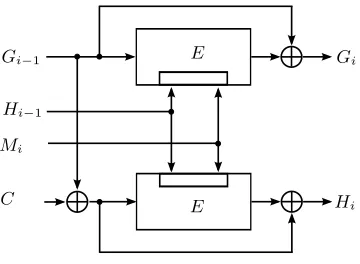
Definition 5. Let FHirose : {0,1}2n × {0,1}n → {0,1}2n be a compression function such that
(Gi, Hi) = FHirose(Gi−1, Hi−1, Mi) where Gi, Hi, Mi ∈ {0,1}n. FHirose is built upon a (n,2n )-blockcipher E as follows:
Gi =FT(Gi−1, Hi−1, Mi) =E(Gi−1, Hi−1|Mi)⊕Gi−1
Hi =FB(Gi−1, Hi−1, Mi) =E(Gi−1⊕C, Hi−1|Mi)⊕Gi−1⊕C, where | represents concatenation andc∈ {0,1}n− {0n} is a constant.
A visualization of this compression function is given in the following Figure 4.
E
E Gi−1
Hi−1
Gi
Hi Mi
C
Figure 4. The compression function FHirose, E is an (n,2n)-blockcipher, the small rectangle inside the cipher rectangle indicates the position of the key
B.2 Security of Compression Function
As the security proof of Hirose [14, Theorem 4] only states the collision resistance of a hash function built usingFHirose we will give a security proof for the compression function alone. In particular,
we will show
Theorem 3. Let F :=FHirose be a compression function as in Defintion 5. Then,
AdvCollF (q)≤ 2q 2
(2n−2q)2 + 2q
2n−2q.
In numerical terms, it means that no adversary performing less than 2124.55 oracle calls has more than an even chance, i.e.0.5, in finding a collision.
Due to the special structure of the compression function, the following definition is useful for the proof.
Definition 6. A pair of distinct inputs (Gi−1, Hi−1, Mi),(G0i−1, Hi0−1, Mi0) to FHirose is called a
matchingpair if(G0
i−1, Hi0−1, Mi0) = (Gi−1, Hi−1, Mi⊕C. Otherwise they are called anon-matching
Note, that the proof is essentially due to Hirose [14], but as he stated it only for the hash function and not for the compression function itself. We will give a proof here for the compression function.
Proof. Let Abe an adversary that asks q queries to oracles E, E−1. Since
Gi=E(Gi−1, Hi−1|Mi)⊕Gi−1
depends both on the plaintext and the ciphertext ofE and one of them is fixed by a query and the other is determined by the answer it follows thatGi is determined randomly. We give the adversary for free the answer to the query for Hi. Let (Xi, Ki,1|Ki,2, Yi) and (Xi⊕C, Ki,1|Ki,2, Zi) be the
triplest ofE obtained by thei-th pair of queries and the corresponding answers.
For every 2≤i≤q, let Ci be the event that a colliding pair of non-matching inputs are found
forF with the i-th pair of queries. Namely, it is the event that, for some i0 < i F(Xi, K1,i, K2,i) =F(Xi0, K1,i0, K2,i0) or F(Xi0⊕C, K1,i0, K2,i0)
or
F(Xi⊕C, K1,i, K2,i) =F(Xi0, K1,i0, K2,i0) or F(Xi0⊕C, K1,i0, K2,i0)
which is equivalent to
(Yi⊕Xi, Zi⊕Xi⊕C) = (Yi0 ⊕Xi0, Zi0 ⊕Xj0⊕C) or (Zi0 ⊕Xi0⊕C, Yi0 ⊕Xj0).
It follows, that
Pr[Ci]≤ 2(i−1)
(2n−(2i−2))(2n−(2i−1)) ≤
2q
(2n−2q)2.
LetCbe the event that a colliding pair of non-matching inputs are found forFHirosewithq (pairs)
of queries. Then,
Pr[C]≤ q
X
i=2
Pr[Cj]≤ q
X
i=2 2q
(2n−2q)2 ≤
2q2
(2n−2q)2.
Now, let ˆCi be the event that a colliding pair of matching inputs is found forF. It follows, that
Pr[ ˆCi]≤ 2
(2n−2q).
Let ˆC be the event that a colliding pair of matching inputs are found forFHirose withq (pairs) of
queries. Then,
Pr[ ˆC]≤ q
X
i=2
Pr[ ˆCi]≤ 2q
2n−2q.