The Cube Attack on Stream Cipher Trivium
and Quadraticity Tests
∗Piotr Mroczkowski and Janusz Szmidt
Military Communication Institute ul. Warszawska 22A, 05-130 Zegrze, Poland
Military University of Technology ul. Kaliskiego 2, 00-980 Warsaw, Poland
November 14, 2010
Abstract
In 2008 I. Dinur and A. Shamir presented a new type of algebraic attack on symmetric ciphers named cube attack. The method has been applied to reduced variants of stream ciphers Trivium and Grain-128, reduced variants of the block ciphers Serpent and CTC and to a reduced version of the keyed hash function MD6. Independently a very similar attack named AIDA was introduced by M. Vielhaber. In this paper we develop quadraticity tests within the cube attack and apply them to a variant of stream cipher Trivium reduced to 709 initialization rounds. Using this method we obtain the full 80-bit secret key. In this way it eliminates the stage of brute force search of some secret key bits which occured in previous cube attacks.
1
Introduction
The cube attack has been introduced by Itai Dinur and Adi Shamir [8] as a known plaintext attack on symmetric primitives. The method has been further developed in [2, 3, 9, 10]. The ciphertext bits produced by this algorithm are values of polynomials p(v1, . . . , vm, x1, . . . , xn) depending on public variablesv1, . . . , vm (bits of a plaintext for block ciphers or bits of an initial vector for stream ciphers) and depending on secret variablesx1, . . . , xn (bits of a key). The attack consists of two stages. In the firstpreprocessing
stage the attacker has access to public and secret variables. He sums up ciphertext bits obtained for chosen k-dimensional cubes in public variables
∗This papre was presented at the 10th Central European Conference on Cryptology in
and fixed key variables. The attacker chooses different keys and obtains a function depending on key bits. The task of this stage is to find the cases where this function is affine or quadratic and reconstruct it. The tools to investigate the linearity or quadraticity of the resulting Boolean functions are the linearity and quadraticity tests, developed in [1, 5]. The preprocessing
stage is the most time consuming part of the attack. Heuristic considerations and experiments are involved to find suitable cubes.
In the next on line stage of the attack a key is secret and the attacker only has access to public variables. He sums up over the same cubes as in thepreprocessing stage to obtain the right hand sides of linear and quadratic equations. Having the system of all equations the attacker tries to solve it to get values of some key bits. To solve the resulting system of quadratic equations, linearization methods can be applied. The remaining, unknown bits of the key can be calculated by brute force searching. Dinur and Shamir [8] applied the cube attack to variants of stream cipher Trivium reduced to 672, 735 and 767 initialization rounds (the whole cipher runs over4×288 =
1152 initial rounds before producing output key bits). They used linearity tests and obtained a system of linear equations for key bits. In the case of 767 initialization rounds they obtained 35 linear expressions for key bits. The remaining 80 - 35 = 45 bits of the secret key dominate the complexity of an attack being O(245
) cipher executions which is below the complexity
O(280
) of the brute force search of all key bits. In [8] it was suggested to apply quadraticity tests within the cube attack.
We realize this idea and obtain quadratic and linear expressions involv-ing key bits for a variant of Trivium reduced to 709 initialization rounds. Quadratic terms appear more often than linear ones and this leads to more equations for key bits. In our attack we used 22 and 23 dimensional cubes. We found 41 bits of a randomly chosen secret key using linear terms and 39 remaining bits of this key using quadratic equations. In fact, quadratic equations were solvedby hand: substituting bits obtained from linear equa-tions and doing some manipulaequa-tions. This way the brute force searching of some bits of the secret key was completely eliminated. The complexity of the
on line stage of our cube attack is about229
executions of reduced Trivium with 709÷713 initialization rounds. The system of linear and quadratic expressions obtained during the preprocessing stage can be used to find any secret key.
2
Linearity and Quadraticity Tests
Let F2n be the n-dimensional vector space over the binary field F2 and f : Fn
2 −→ F2 a Boolean function of nbinary variables. The Boolean function f is affine if it satisfies the linearity test:
f(x⊕x0) =f(x)⊕f(x0)⊕f(0)
for allx, x0 ∈Fn
2. Such a function has the following Algebraic Normal Form
(ANF):
f(x1, . . . , xn) = M
1≤i≤n
aixi⊕a0,
where a0, a1, . . . , an are binary coefficients.
The Boolean function f is quadratic if it satisfies the quadraticity test:
f(x⊕x0⊕x00) =f(x⊕x0)⊕f(x⊕x00)⊕f(x0⊕x00)
⊕f(x)⊕f(x0)⊕f(x00)⊕f(0)
for allx, x0, x00∈Fn
2. Such a function has the following ANF form:
f(x1, . . . , xn) = M
1≤i<j≤n
aijxixj ⊕ M
1≤i≤n
aixi⊕a0
for some binary coefficients aij, ai, a0.
Let us note that a function satisfying the linearity test also satisfies the quadraticity test, with all aij equal to zero. The main phenomenon ap-pearing in the cube attack is that quadratic or affine Boolean functions can be detected with high probability by executing the quadraticity or linearity tests only for a very small number of triples(x, x0, x00) or pairs (x, x0).
Lin-earity tests and their information-theoretical applications were investigated by Blum, Luby and Ribenfeld [5]. Testing of low-degree polynomials overF2
was developed by Alon, Kaufman, Krivelevich, Litsyn and Ron in [1]. The coefficients in the Algebraic Normal Form can be calculated by sum-ming over suitable cubes. The task of the preprocessing stage is to collect, for the cipher under study, as many quadratic and linear expressions in key bits as possible.
3
Specification of Trivium
3.1 Key Stream Generation
state bits are then rotated and the process repeats. The generation of the ouput bitstring (zi) of the maximal length of up to N = 2
64
bits, can be represented as follows:
for i=1 to N
t1 ←s66+s93 t2 ←s162+s177 t3 ←s243+s288 zi←t1+t2+t3
t1 ←t1+s91·s92+s171 t2←t2+s175·s176+s264
t3 ←t3+s286·s287+s69
(s1, s2, . . . , s93)←(t3, s1, . . . , s92) (s94, s95, . . . , s177)←(t1, s94, . . . , s176) (s178, s179, . . . , s288)←(t2, s178, . . . , s287)
end for
3.2 Key and Initial Value Setup
The 288-bit inner state of Trivium is initialized in the following way:
(s1, s2, . . . , s93)←(k1, k2, . . . , k80,0, . . . ,0) (s94, s95, . . . , s177)←(IV1, IV2, . . . , IV80,0, . . . ,0)
(s178, s179, . . . , s288)←(0,0, . . . ,0,1,1,1)
for i = 1 to 1152
t1 ←s66+s93 t2 ←s162+s177 t3 ←s243+s288 t1 ←t1+s91·s92+s171 t2←t2+s175·s176+s264
t3 ←t3+s286·s287+s69
(s1, s2, . . . , s93)←(t3, s1, . . . , s92) (s94, s95, . . . , s177)←(t1, s94, . . . , s176) (s178, s179, . . . , s288)←(t2, s178, . . . , s287)
4
Results of the Cube Attack
4.1 Linear Expressions
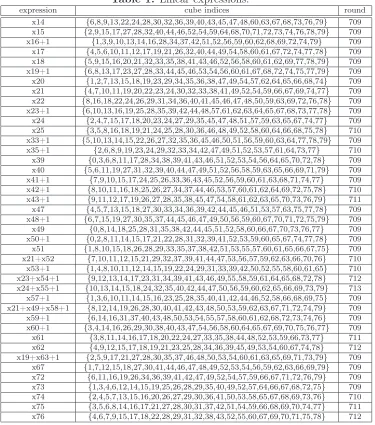
In thepreprocessing stage we found linear expressions involving unknown key bits. These expressions were obtained by summing up over cubes, which were chosen among initial value variables. 240 linearity tests were performed for each cube from Table 1. The dimensions of the cubes (22 and 23) were fixed experimentally. In fact, the cubes were chosen randomly but also we found a method to obtain a new cube from another one with a linear expression: one must increase the indices of a cube by one (if possible) and increase the number of initialization rounds by one.
Table 1. Linear expressions.
expression cube indices round
After collecting linear expressions and the corresponding cubes we per-formed theon line stage of cube attack. We chose a random 80-bit key (the secret in our experiment). Then we summed up the ciphertext bits obtained for the chosen cubes and the secret key, where the bits of initial vectors be-yond the cube indices were equal to zero. This way we got the exact values of the terms from Table 1 and we obtained the system of linear equations
x14 = 1 x15 = 0 x16 = 0 (1)
x17 = 0 x18 = 0 x19 = 1 (2)
x20 = 1 x21 = 0 x22 = 1 (3)
x23 = 0 x24 = 0 x25 = 1 (4)
x33 = 1 x35 = 0 x39 = 1 (5)
x40 = 1 x41 = 0 x42 = 0 (6)
x43 = 1 x47 = 1 x48 = 1 (7)
x49 = 1 x50 = 1 x51 = 0 (8)
x21 +x52 = 0 x53 = 0 x23 +x54 = 1 (9)
x24 +x55 = 0 x57 = 1 x21 +x49 +x58 = 1 (10)
x59 = 1 x60 = 1 x61 = 0 (11)
x62 = 0 x19 +x63 = 1 x67 = 0 (12)
x72 = 1 x73 = 0 x74 = 0 (13)
x75 = 0 x76 = 1 (14)
The equations (1)÷(14) give the values of 41 bits of the key:
x14, x15, x16, x17, x18, x19, x20, x21, x22, x23, x24, x25, x33, x35, x39, x40, x41, x42, x43, x47, x48, x49, x50, x51, x52, x53, x54, x55,
x57, x58, x59, x60, x61, x62, x63, x67, x72, x73, x74, x75, x76.
It remained to find 39 bits of the secret key.
4.2 Quadratic Expressions
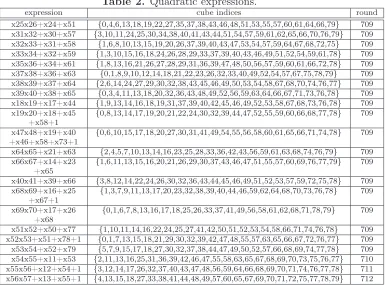
cube attack was done with the same secret key obtaining this way the values of these terms.
Table 2. Quadratic expressions.
expression cube indices round
x25x26+x24+x51 {0,4,6,13,18,19,22,27,35,37,38,43,46,48,51,53,55,57,60,61,64,66,79} 709 x31x32+x30+x57 {3,10,11,24,25,30,34,38,40,41,43,44,51,54,57,59,61,62,65,66,70,76,79} 709 x32x33+x31+x58 {1,6,8,10,13,15,19,20,26,37,39,40,43,47,53,54,57,59,64,67,68,72,75} 709 x33x34+x32+x59 {1,3,10,15,16,18,24,26,28,29,33,37,39,40,43,46,49,51,52,54,59,61,78} 709 x35x36+x34+x61 {1,8,13,16,21,26,27,28,29,31,36,39,47,48,50,56,57,59,60,61,66,72,78} 709 x37x38+x36+x63 {0,1,8,9,10,12,14,18,21,22,23,26,32,33,40,49,52,54,57,67,75,78,79} 709 x38x39+x37+x64 {2,6,14,24,27,29,30,32,38,43,45,46,49,50,53,54,58,67,68,70,74,76,77} 709 x39x40+x38+x65 {0,3,4,11,13,18,20,32,36,43,48,49,52,56,59,63,64,66,67,71,73,76,78} 709 x18x19+x17+x44 {1,9,13,14,16,18,19,31,37,39,40,42,45,46,49,52,53,58,67,68,73,76,78} 709 x19x20+x18+x45 {0,8,13,14,17,19,20,21,22,24,30,32,39,44,47,52,55,59,60,66,68,77,78} 709
+x58+1
x47x48+x19+x40 {0,6,10,15,17,18,20,27,30,31,41,49,54,55,56,58,60,61,65,66,71,74,78} 709 +x46+x58+x73+1
x64x65+x21+x63 {2,4,5,7,10,13,14,16,23,25,28,33,36,42,43,56,59,61,63,68,74,76,79} 709 x66x67+x14+x23 {1,6,11,13,15,16,20,21,26,29,30,37,43,46,47,51,55,57,60,69,76,77,79} 709
+x65
x40x41+x39+x66 {3,8,12,14,22,24,26,30,32,36,43,44,45,46,49,51,52,53,57,59,72,75,78} 709 x68x69+x16+x25 {1,3,7,9,11,13,17,20,23,32,38,39,40,44,46,59,62,64,68,70,73,76,78} 709
+x67+1
x69x70+x17+x26 {0,1,6,7,8,13,16,17,18,25,26,33,37,41,49,56,58,61,62,68,71,78,79} 709 +x68
x51x52+x50+x77 {1,10,11,14,16,22,24,25,27,41,42,50,51,52,53,54,58,66,71,74,76,78} 709 x52x53+x51+x78+1 {0,1,7,13,15,18,21,29,30,32,39,42,47,48,55,57,63,65,66,67,72,76,77} 709 x53x54+x52+x79 {5,7,9,15,17,18,27,30,32,37,38,44,47,49,50,52,57,66,68,69,74,77,78} 709 x54x55+x11+x53 {2,11,13,16,25,31,36,39,42,46,47,55,58,63,65,67,68,69,70,73,75,76,77} 710 x55x56+x12+x54+1 {3,12,14,17,26,32,37,40,43,47,48,56,59,64,66,68,69,70,71,74,76,77,78} 711 x56x57+x13+x55+1 {4,13,15,18,27,33,38,41,44,48,49,57,60,65,67,69,70,71,72,75,77,78,79} 712
We got the following quadratic equations:
x25x26 +x24 +x51 = 0 (15)
x31x32 +x30 +x57 = 1 (16)
x32x33 +x31 +x58 = 0 (17)
x33x34 +x32 +x59 = 0 (18)
x35x36 +x34 +x61 = 0 (19)
x37x38 +x36 +x63 = 1 (20)
x38x39 +x37 +x64 = 0 (21)
x39x40 +x38 +x65 = 0 (22)
x18x19 +x17 +x44 = 0 (23)
x19x20 +x18 +x45 +x58 = 1 (24)
x47x48 +x19 +x40 +x46 +x58 +x73 = 0 (25)
x64x65 +x21 +x63 = 0 (26)
x40x41 +x39 +x66 = 1 (28)
x68x69 +x16 +x25 +x67 = 0 (29)
x69x70 +x17 +x26 +x68 = 0 (30)
x51x52 +x50 +x77 = 0 (31)
x52x53 +x51 +x78 = 0 (32)
x53x54 +x52 +x79 = 1 (33)
x54x55 +x11 +x53 = 1 (34)
x55x56 +x12 +x54 = 1 (35)
x56x57 +x13 +x55 = 0 (36) We substituted the 41 known key bits to equations (15)÷(36)to obtain new 22 values of key bits:
x11 = 1, x12 = 0, x26 = 0, x30 = 1, x31 = 1, x32 = 1, x34 = 0, x36 = 1
x37 = 0, x38 = 0, x44 = 0, x45 = 0, x46 = 1, x64 = 0, x65 = 1, x66 = 0, x68 = 1, x69 = 1, x70 = 1, x77 = 1, x78 = 0, x79 = 1.
The equation (29) takes the formx68x69 = 1and the equation (36) gives the relation x56 =x13.At this moment we were left with the remaining 17 unknown key bits:
x0, . . . , x10, x13, x27, x28, x29, x56, x71.
These key bits were found by considering the following cubes and corre-sponding quadratic expressions.
Table 3. Quadratic expressions.
expression cube indices round
x8x9+x7+x34 {2,4,5,8,9,11,13,15,17,23,26,41,43,56,63,64,65,67,68,70,71,73,75} 709 x7x8+x6+x33 {1,4,8,9,16,22,25,28,29,34,42,48,49,53,55,57,59,62,70,73,75,76,79} 709 x9x10+x8+x35 {3,5,6,9,10,12,14,16,18,24,27,42,44,57,64,65,66,68,69,71,72,74,76} 710 x10x11+x9+x36 {4,6,7,10,11,13,15,17,19,25,28,43,45,58,65,66,67,69,70,72,73,75,77} 711 x11x12+x10+x37 {5,7,8,11,12,14,16,18,20,26,29,44,46,59,66,67,68,70,71,73,74,76,78} 712 x70x71+x27+x69 {0,2,5,8,13,14,16,17,27,35,38,43,50,52,53,56,57,60,65,69,75,78,79} 709 x6x7+x5+x32 {0,3,6,9,13,15,16,21,27,33,40,41,43,47,53,57,58,59,61,70,71,76,78} 709 x4x5+x3+x30 {1,4,9,13,14,16,19,24,33,37,38,43,44,45,46,47,54,56,59,68,70,73,76} 709 x3x4+x2+x29 {0,1,2,5,8,9,14,16,25,30,31,40,47,53,54,58,60,61,63,69,75,77,78} 709 x30x31+x29+x56 {8,11,15,20,23,24,27,31,32,36,42,45,50,52,53,54,56,59,60,61,62,68,75} 709 x5x6+x4+x31 {0,5,7,8,9,12,20,25,31,35,42,45,46,47,51,56,58,60,67,68,69,70,71} 709 x1x2+x0+x27+1 {7,8,11,14,15,31,36,37,40,41,44,48,49,55,58,59,62,64,66,67,69,75,78} 709 x2x3+x1+x28 {1,2,6,7,8,10,13,15,23,27,30,32,35,48,49,50,52,53,56,58,68,69,70} 709 x7x8+x16x53+x19x20 {0,2,5,19,20,22,28,29,31,36,37,39,40,50,54,55,65,68,71,72,75,77,79} 710
+x6+x27+x33+1
The results of the on line stage of attack led us to the second system of quadratic equations:
x8x9 +x7 = 1 x7x8 +x6 = 0 (37)
x9x10 +x8 = 1 x9 +x10 = 0 (38)
x10 = 1 x27 +x71 = 0 (39)
x6x7 +x5 = 0 x4x5 +x3 = 1 (40)
x3x4 +x2 +x29 = 0 x29 +x56 = 1 (41)
x5x6 +x4 = 0 x1x2 +x0 +x27 = 1 (42)
x2x3 +x1 +x28 = 1 x7x8 +x6 +x27 = 0 (43)
x28 +x71 = 0 x28 +x29 = 1 (44) The above equations after solving them (by hand) gave the following key bits:
x0 = 1 x1 = 0 x2 = 1
x3 = 1 x4 = 0 x5 = 0
x6 = 0 x7 = 1 x8 = 0
x9 = 1 x10 = 1 x27 = 0
x28 = 0 x29 = 1 x56 = 0
x71 = 0
Finally, we gotx13 = 0, since x13 =x56. These are all key bits:
[x0, . . . , x79] =
[1,0,1,1,0,0,0,1,0,1,1,1,0,0,1,0,0,0,0,1,1,0,1,0,0,1,0,0,0,1,1,
1,1,1,0,0,1,0,0,1,1,0,0,1,0,0,1,1,1,1,1,0,0,0,1,0,0,1,0,1,1,0,
0,0,0,1,0,0,1,1,1,0,1,0,0,0,1,1,0,1]
We would like to indicate that, in the above cube attack with quadratic-ity tests on a variant of Trivium reduced to 709 initialization rounds, the resulting system of quadratic equations was fairly simple. The method of solving it in two steps enabled us to find solutions just using only some ele-mentary tricks. We have chosen this number of initialization rounds because a reduced variant of Trivium (called Bivium) having only two registers and
References
[1] N. Alon, T. Kaufman, M. Krivelevich, S. Litsyn, and D. Ron. Testing Low-Degree Polynomials over GF(2). RANDOM 2003 and APPROX 2003, S. Arora, K. Jansen, J.D.P. Rolim, and A. Sahai, editors. LNCS, vol 2764, pp. 188-199. Springer 2003.
[2] J-P. Aumasson, W. Meier, I. Dinur, and A. Shamir. Cube Testers and Key Recovery Attacks on Reduced Round MD6 and Trivium. Fast Soft-ware Encryption 2009. Orr Dunkelman, editor. LNCS, vol 5665, pp. 1-22. Springer 2009.
[3] J-P. Aumasson, I. Dinur, L. Henzen, W. Meier, and A. Shamir. Effi-cient FPGA Implementations of High-Dimensional Cube Testers on the Stream Cipher Grain-128. IACR Cryptology ePrint Archive, 2009/218. [4] S. S. Bedi and R. Pillai. Cube Attacks on Trivium. IACR Cryptology
ePrint Archive. 2009/15.
[5] M. Blum, M. Luby, and R. Rubinfeld.Self-Testing/Correcting with Ap-plications to Numerical Problems.Journal of Computer and System Sci-ences, vol 47(1993), pp. 549-595.
[6] Ch. DeCannière and B. Preneel.Trivium. M.J.B. Robshaw and O. Bilet, editors. New Stream Cipher Designs. LNCS, vol 4817, pp. 244-246. Springer 2008.
[7] P. Crowley, Trivium, SSE2, CorePy, and the "cube attack". Published on http://www.lshift.net/blog/
[8] I. Dinur and A. Shamir. Cubic Attacks on Tweakable Black Box Poly-nomials. EUROCRYPT 2009. A. Joux, editor. LNCS, vol 5479, pp. 278-299. Springer 2009.
[9] I. Dinur and A. Shamir. Side Channel Cube Attacks on Block Ciphers. IACR Cryptology ePrint Archive, 2009/127.
[10] P. Mroczkowski and J. Szmidt. The Cube Attack on Courtois Toy Ci-pher. IACR Cryptology ePrint Archive, 2009/497. To appear in Pro-ceedings of WEWoRC 2009. LNCS. Springer.
[11] P. Mroczkowski and J. Szmidt.The Cube Attack on Stream Cipher Triv-ium and Quadraticity Tests.Rump Session. CRYPTO 2010.
[12] M. Vielhaber,Breaking ONE.TRIVIUM by AIDA an Algebraic IV Dif-ferential Attack. IACR Cryptology ePrint Archive, 2007/413.