Available online: https://edupediapublications.org/journals/index.php/IJR/ P a g e | 190
Enabling Cloud Storage Auditing With Key Exposure Resistance
1CHINTHA LAVANYA, 2G.ARUN & 3V.SRIDHARREDDY
1M-Tech, Dept. of CSE Vignana Bharathi Institute Of Technology Ghatkesar, Mail Id: -
2Associate professor, Dept. of CSE Vignana Bharathi Institute Of Technology Ghatkesar,
Mail Id: - [email protected]
3Associate professor, Dept. of CSE Vignana Bharathi Institute Of Technology
Ghatkesar, Mail Id: - [email protected]
Abstract
Key-exposure resistance has always been an important issue for in-depth c yber defense in many
security applications. Recently, how to deal with the key exposure problem in the settings of
cloud storage auditing has been proposed and studied. To address the challenge, existing
solutions all require the client to update his secret keys in every time period, which may
inevitably bring in new local burdens to the client, especially those with limited computation
resources, such as mobile phones. In this paper, we focus on how to make the key updates as
transparent as possible for the client and propose a new paradigm called cloud storage auditing
with verifiable outsourcing of key updates. In this paradigm, key updates can be safely out
sourced to some authorized party, and thus the key-update burden on the client will be kept
minimal. In particular, we leverage the third party auditor (TPA) in many existing public
auditing designs, legit play the role of authorized party in our case, and make it in charge of both
the storage auditing and the secure key updates for key-exposure resistance. In our design, TPA
only needs to hold an encrypted version of the client’s secret key while doing all these
burdensome tasks on behalf of the client. The client only needs to download the encrypted secret
key from the TPA when uploading new files to cloud. Besides, our design also equips the client
with capability to further verify the validity of the encrypted secret keys provided by the TPA.
All these salient features are carefully designed to make the whole auditing procedure with key
exposure resistance as transparent as possible for the client. We formalize the definition and the
security model of this paradigm. The security proof and the performance simulation show that
our detailed design instantiations are secure and efficient.
Key words: - Cloud storage, outsourcing computing, cloud storage auditing, key update,
Available online: https://edupediapublications.org/journals/index.php/IJR/ P a g e | 192
1. INTRODUCTION
Cloud computing, as a new technology
paradigm with promising further, is
becoming more and more popular
nowadays. It can provide users with
seemingly unlimited computing resource.
Enterprises and people can outsource time
consuming computation workloads to cloud
without spending the extra capital on
deploying and maintaining hardware and
software. In recent years, outsourcing
computation has attracted much attention
and been researched widely. It has been
considered in many applications including
scientific computations, linear algebraic
computations, linear programming
computations and modular exponentiation
computations, etc. Besides, cloud computing
can also provide users with seemingly
unlimited storage resource. Cloud storage is
universally viewed as one of the most
important services of cloud computing.
Although cloud storage provides great
benefit to users, it brings new security
challenging problems. One important
security problem is how to efficiently check
the integrity of the data stored in cloud. In
recent years, many auditing protocols for
cloud storage have been proposed to deal
with this problem. These protocols focus on
different aspects of cloud storage uditing
such as the high efficiency, the privacy
protection of data, the privacy protection of
identities, dynamic data operations, the data
sharing, etc. The key exposure problem, as
another important problem in cloud storage
auditing, has been considered recently. The
problem itself is non-trivial by nature. Once
the client’s secret key for storage auditing is
exposed to cloud, the cloud is able to easily
hide the data loss incidents for maintaining
its reputation, even discard the client’s data
rarely accessed for saving the storage space.
Yu et al. constructed a cloud storage
auditing protocol with key-exposure
resilience by updating the user’s secret keys
periodically. In this way, the damage of key
exposure in cloud storage auditing can be
reduced. But it also brings in new local
burdens for the client because the client has
to execute the key update algorithm in each
time period to make his secret key move
forward. For some clients with limited
computation resources, they might not like
doing such extra computations by
themselves in each time period. It would be
obviously more attractive to make key
Available online: https://edupediapublications.org/journals/index.php/IJR/ P a g e | 193
client, especially in frequent key update
scenarios. In this paper, we consider
achieving this goal by outsourcing key
updates. However, it needs to satisfy several
new requirements to achieve this goal.
Firstly, the real client’s secret keys for cloud
storage auditing should not be known by the
authorized party who performs outsourcing
computation for key updates. Otherwise, it
will bring the new security threat. So the
authorized party should only hold an
encrypted version of the user’s secret key
for cloud storage auditing. Secondly,
because the authorized party performing
outsourcing computation only knows the
encrypted secret keys, key updates should be
completed under the encrypted state. In
other words, this authorized party should be
able to update secret keys for cloud storage
auditing from the encrypted version he
holds. Thirdly, it should be very efficient for
the client to recover the real secret key from
the encrypted version that is retrieved from
the authorized party. Lastly, the client
should be able to verify the validity of the
encrypted secret key after the client retrieves
it from the authorized party. The goal of this
paper is to design a cloud storage auditing
protocol that can satisfy above requirements
to achieve the outsourcing of key updates.
The main contributions are as follows: We
propose a new paradigm called cloud
storage auditing with verifiable outsourcing
of key updates. In this new paradigm,
key-update operations are not performed by the
client, but by an authorized party. The
authorized party holds an encrypted secret
key of the client for cloud storage auditing
and updates it under the encrypted state in
each time period. The client downloads the
encrypted secret key from the authorized
party and decrypts it only when he would
like to upload new files to cloud. In addition,
the client can verify the validity of the
encrypted secret key. We design the first
cloud storage auditing protocol with
verifiable outsourcing of key updates. In our
design, the third party auditor (TPA) plays
the role of the authorized party who is in
charge of key updates. In addition, similar to
traditional public auditing protocols, another
important task of the TPA is to check the
integrity of the client’s files stored in cloud.
The TPA does not know the real secret key
of the client for cloud storage auditing, but
only holds an encrypted version. In the
detailed protocol, we use the blinding
Available online: https://edupediapublications.org/journals/index.php/IJR/ P a g e | 194
form the encryption algorithm to encrypt the
secret keys held by the TPA. It makes our
protocol secure and the decryption operation
efficient. Meanwhile, the TPA can complete
key updates under the encrypted state. The
client can verify the validity of the
encrypted secret key when he retrieves it
from the TPA. Therefore, the designed
protocol satisfies the above mentioned four
requirements. We formalize the definition
and the security model of the cloud storage
auditing protocol with verifiable outsourcing
of key updates. We also prove the security
of our protocol in the formalized security
model and justify its performance by
concrete implementation.
2. RELEGATED WORK
2.1 Existing System
Yu et al. constructed a cloud storage
auditing protocol with key-exposure
resilience by updating the user’s secret keys
periodically. In this way, the damage of key
exposure in cloud storage auditing can be
reduced. But it also brings in new local
burdens for the client because the client has
to execute the key update algorithm in each
time period to make his secret key move
forward. For some clients with limited
computation resources, they might not like
doing such extra computations by
themselves in each time period. It would be
obviously more attractive to make key
updates as transparent as possible for the
client, especially in frequent key update
scenarios. Wang et al. proposed a public
privacy-preserving auditing protocol. They
used the random masking technique to make
the protocol achieve privacy preserving
property.
2.2 Proposed System
We propose a new paradigm called cloud
storage auditing with verifiable outsourcing
of key updates. In this new paradigm,
key-update operations are not performed by the
client, but by an authorized party. The
authorized party holds an encrypted secret
key of the client for cloud storage auditing
and updates it under the encrypted state in
each time period. The client downloads the
encrypted secret key from the authorized
party and decrypts it only when he would
like to upload new files to cloud. In addition,
the client can verify the validity of the
encrypted secret key. We design the first
cloud storage auditing protocol with
verifiable outsourcing of key updates. In our
design, the thirdparty auditor (TPA) plays
Available online: https://edupediapublications.org/journals/index.php/IJR/ P a g e | 195
charge of key updates. We formalize the
definition and the security model of the
cloud storage auditing protocol with
verifiable outsourcing of key updates. We
also prove the security of our protocol in the
formalized security model and justify its
performance by concrete implementation.
3. IMPLEMENTATION
3.1 SysSetup:
The system setup algorithm is run by
theclient. It takes as input a security
parameter k and the total number of time
periods T , and generates anencrypted initial
client’s secret key E SK0, a decryptionkey
DK and a public key P K . Finally, the client
holdsDK , and sends E SK0 to the TPA.
3.2 EkeyUpdate
The encrypted key update algorithm is runby
the TPA. It takes as input an encrypted
client’s secretkey E SK j , the current period
j and the public key P K ,and generates a
new encrypted secret key E SK j+1
forperiod j + 1.
3.3 Ver ESK:
The encrypted key verifying algorithm is
runby the client. It takes as input an
encrypted client’s secretkey E SK j , the
current period j and the public key PK ,if
ESK j is a well-formed encrypted client’s
secret key,returns 1; otherwise, returns 0.
3.4 Dec ESK:
The secret key decryption algorithm is run
bythe client. It takes as input an encrypted
client’s secret key ESK j , a decryption key
DK , the current period j and the public key
PK , returns the real client’s secretkey SK j
in this time period.
3.5 AuthGen:
The authenticator generation algorithm is
runby the client. It takes as input a file F, a
client’s secret key SKj , the current period j
and the public key P K , and generates the
set of authenticators for F in timeperiod j.
3.6 Proof Gen:
The proof generation algorithm is run by
thecloud. It takes as input a file F, a set of
authenticators ,a challenge Chal, a time
period j and the public keyP K , and
generates a proof P which proves the
cloudstores F correctly.
3.7 Proof Verify:
The proof verifying algorithm is run bythe
TPA. It takes as input a proof P, a challenge
Chal, a time period j, and the public key P K
, and returns“True” if P is valid; or
Available online: https://edupediapublications.org/journals/index.php/IJR/ P a g e | 196
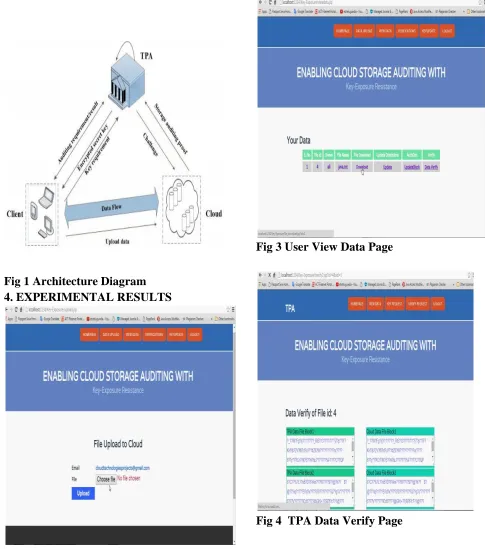
Fig 1 Architecture Diagram 4. EXPERIMENTAL RESULTS
Fig 2 File Upload Page
Fig 3 User View Data Page
Available online: https://edupediapublications.org/journals/index.php/IJR/ P a g e | 197
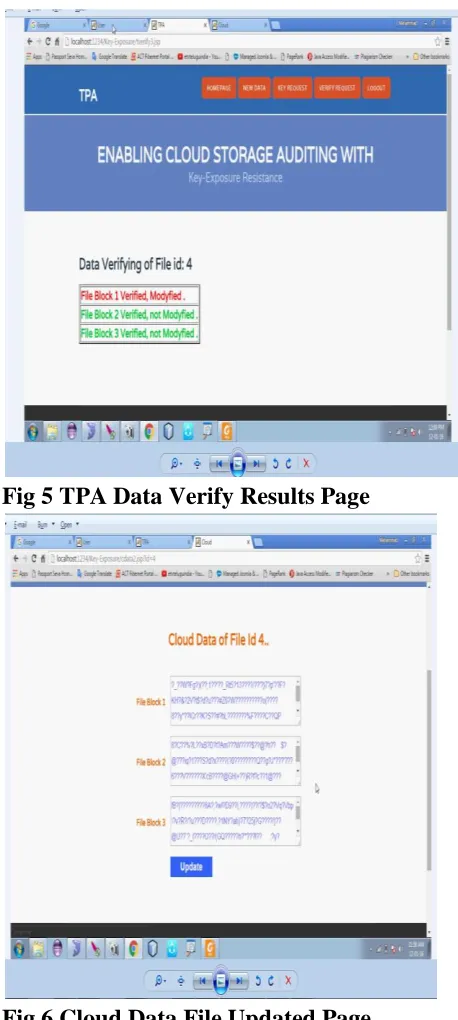
Fig 5 TPA Data Verify Results Page
Fig 6 Cloud Data File Updated Page 5. CONCLUSION
In this paper, we study on how to deal with
the client’s key exposure in cloud storage
auditing. We propose a new paradigm called
auditing protocol with key-exposure
resilience. In such a protocol, the integrity of
the data previously stored in cloud can still
be verified even if the client’s current secret
key for cloud storage auditing is exposed.
We formalize the definition and the security
model of auditing protocol with
key-exposure resilience, and then propose the
first practical solution. The security proof
and the asymptotic performance evaluation
show that the proposed protocol is secure
and efficient.
6. REFERENCE
[1] G. Ateniese, R. Burns, R. Curtmola, J.
Herring, L. Kissner, Z. Peterson, and D.
Song, “Provable Data Possession at Untrusted Stores,” Proc. 14th ACM Conf.
Computer and Comm. Security, pp.
598-609, 2007.
[2] G. Ateniese, R.D. Pietro, L. V. Mancini,
and G. Tsudik, “Scalable and Efficient Provable Data Possession,” Proc. 4th
International Conference on Security and
Privacy in Communication Networks, 2008
[3] F. Sebe, J. Domingo-Ferrer, A.
Martinez-balleste, Y. Deswarte, and J.
Quisquater, “Efficient Remote Data
Integrity checking in Critical Information
Available online: https://edupediapublications.org/journals/index.php/IJR/ P a g e | 198
Knowledge and Data Engineering, vol. 20,
no. 8, pp. 1-6, 2008.
[4] R. Curtmola, O. Khan, R. Burns, and G.
Ateniese, “MRPPDP: Multiple-Replica
Provable Data Possession,” Proc. 28th IEEE
International Conference on Distributed
Computing Systems, pp. 411-420, 2008.
[5] H. Shacham and B. Waters, “Compact
Proofs of Retrievability,” Advances in
Cryptology-Asiacrypt’08, pp. 90-107, 2008.
[6] C. Wang, K. Ren, W. Lou, and J. Li,
“Toward Publicly Auditable Secure Cloud Data Storage Services,” IEEE Network, vol.
24, no. 4, pp. 19-24, July/Aug. 2010.
[7] Y. Zhu, H. Wang, Z. Hu, G. J. Ahn, H.
Hu, and S. S. Yau, “Efficient Provable Data Possession for Hybrid Clouds,” Proc. 17th
ACM Conference on Computer and
Communications Security, pp. 756-758,
2010.
[8] K. Yang and X. Jia, “Data Storage
Auditing Service in Cloud Computing:
Challenges, Methods and opportunities,”
World Wide Web, vol. 15, no. 4, pp.
409-428, 2012.
[9] K. Yang and X. Jia, “An efficient and
secure dynamic auditing protocol for data
storage in cloud computing,” IEEE Trans.
Parallel and Distributed Systems, Vol. 24,
No. 9, pp. 1717-1726, 2013.
[10] C. Wang, S. Chow, Q. Wang, K. Ren,
and W. Lou, “Privacy-Preserving Public Auditing for Secure Cloud Storage,” IEEE
Trans. Computers, Vol. 62, No. 2, pp. 362-