Available Online atwww.ijcsmc.com
International Journal of Computer Science and Mobile Computing
A Monthly Journal of Computer Science and Information Technology
ISSN 2320–088X
IMPACT FACTOR: 5.258
IJCSMC, Vol. 5, Issue. 6, June 2016, pg.391 – 397
Ontology for Exploring Knowledge in
C++ Language
Ankita Malve
1, Prof. P. M. Chawan
2 ¹Department of Computer and IT, VJTI, Mumbai, India²Department of Computer and IT, VJTI, Mumbai, India
1
[email protected]; 2 [email protected]
Abstract- In computer science, ontology is a formal naming and definition of the classes, subclasses, properties, and the relationships between the entities that are exist for a particular domain [1].Therefore it is a practical application of philosophical ontology, with taxonomy. In this paper we discuss a methodology to create domain ontology for C++.This paper shows various classes, subclasses, various individuals and their relationships present in C++. Accordingly we have created data properties and object properties for each relationship. After that, using OntoGraph we have shown graphical structure of C++ ontology which is useful for understanding the co relations of keywords in the language. Reasoner plays very important and useful in building ontologies because it’s only way to analyze the errors generated while creating ontology.
Keywords— OWL, OWLviz, OntoGraf, Ontology Engineering, OntoGraph
I. INTRODUCTION
II. ONTOLOGY ENGINEERING
In philosophy science, ontology or ontologies in general, is of interest to study what types of things exist, what are the entities that are out there in the universe. Expression derives from the Greek origin meaning "being". A branch of metaphysics is the study of first principles or essence of things
. [
3] In the field of information technology, ontology is the business model of the entities and interactions in the field of specific knowledge or practices, such as e- commerce. In general, it is in the field of computer science and information technology, that we find ontology is a formal representation of a set of concepts within a particular field as well as relations between these concepts.[4][5] Various Definitions in knowledge engineering, natural languages processing and cooperative information systems, in addition to intelligent information integration, and knowledge management reports about the applications of ontologies in developing and using system in WWW.[6]Ontology is the formal characterization of a particular domain by defining the important
concepts and
their attributes and relationships betweenthese relations
. Concepts are usually organized according to a hierarchical relationship of globalization and localization between these concepts. In this hierarchical concept there is the offspring of the broader concept of it. For example: "student" is a "human"and "human" is an
"Object" (the
concept of "student" is the son of the concept "human). All concepts are implicitly members
of the concept
“Thing” [
7]. Ontology is used in artificial intelligence, Semantic Web, systems engineering, library science and building information as a form of knowledge representation of the world or part of it. [
5] The ontology may be as simple as some of the definitions, or may be a division or classification hierarchy, more complex concepts and categories or technology as a solution to the problems based onthe significance of
information sharing[6]
.After all of this, we can ask: why are we using Ontology? The most important reasons are:
To share common understanding of the structure of information among people or software agents
To enable reuse of domain knowledge
To make domain assumptions explicit
To analyze domain knowledge easy way to comply with the conference paper
formatting requirements is to use this document as a template and simply type your
text into it.
III.CREATION OF C++ONTOLOGY
For building
ontology
for C++, we have used Protege-5.0.0-beta-21.Protégé
is a free, open-source platform that provides atool
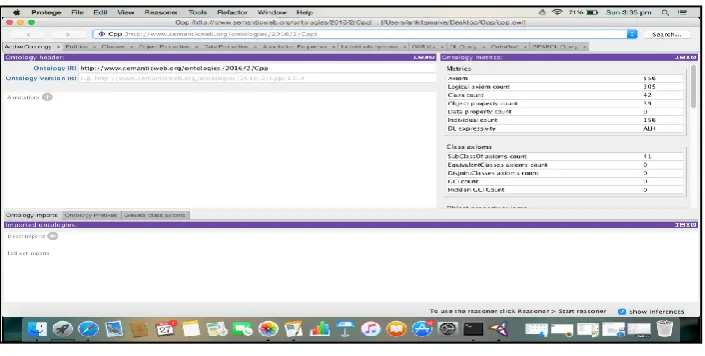
to construct knowledge-basedand domain models applications with ontologies.Active Ontology tab shows ontology metrics for given Ontology. For C++ Ontology following is a count of metrics present in active Ontology:
Axioms= 556
Logical Axiom count= 305
Classes=42
Object Property Count= 39
Individuals count= 156
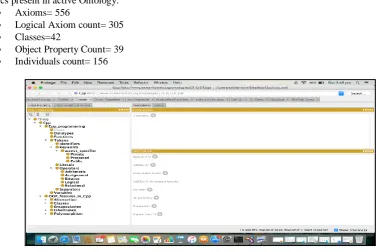
Fig. 2 Classes present in the C++ Ontology
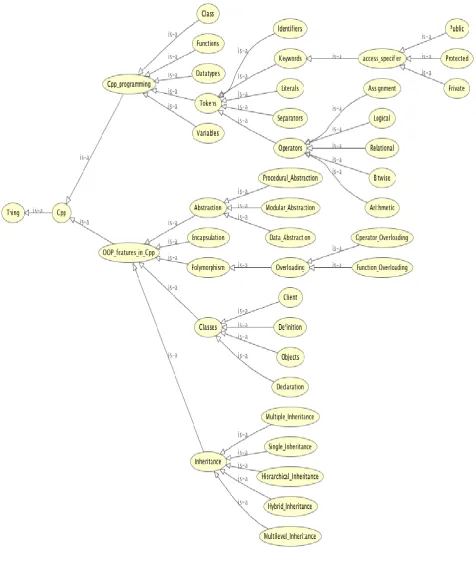
In above Figure, Cpp is a super class which is majorly divided into two subclasses such as
Cpp programming and OOP features in Cpp. Class Cpp programming shows various
concepts while writing a actual program in C++ language. Hence the subclasses of Cpp
programming will be Class, Data Types, Functions, Tokens and Variables. From which
Tokens are further divided into Keywords, Identifiers, Operators, and Separators. Keywords
are further divided into access specifiers which are private, public and protected. Another
class is OOP features in Cpp shows basic object oriented features present in C++, such as
Abstraction, Inheritance, Polymorphism and Encapsulation.
Fig. 3 Object Properties in C++ Ontology
Fig. 4 Individuals by Class
Above figure shows individuals of class keyword. Individuals are instances of a Class by
which it is very easy to give relations between them. There are total 156 individuals for each
class in given C++ ontology.
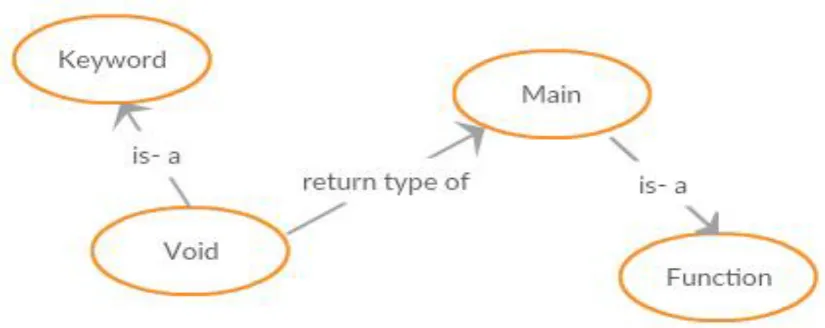
Fig. 5 Relationship between individuals using object properties
Fig. 6OWLViz Displaying the Asserted Hierarchy for C++
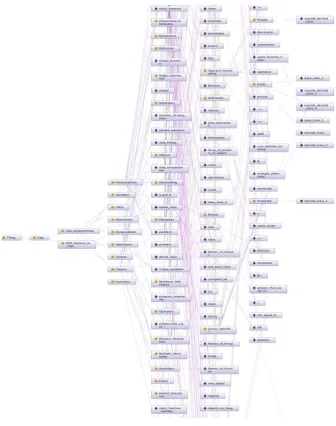
Fig. 7OntoGraf for C++
OntoGraf provides interactive navigation of the relationships present in OWL
ontologies. Layouts
are present for automatic structuringof ontology
. OntoGraph shows different relationships such as subclass, individual, domain/range object properties, and equivalence.Relationships and node types can be
organized
and desired view of ontology can be takesplace. Above
figure shows the OntoGraf for C++ which includes classes, subclasses, individuals and their relationships using object property. OntoGraf is very useful and important as it gives a clear idea about relations so that overcoming errors is feasible.
IV.CONCLUSIONS
ACKNOWLEDGEMENT
First of all, praise be to GOD, who has helped me to succeed in my project. I would like to
thank my project Guide Prof. P. M. Chawan for her support and good guidance. I would like
to thank all my colleagues and relatives for supporting me. Many thanks go to all the
lecturers and the administrative staff of Veermata Jijabaai Technological Institute, Mumbai.
R
EFERENCES
[1] The Website.{Online].Available: https://en.wikipedia.org/wiki/Ontology_(information_science)
[2] Mr. Izzeddin A.O. Abuhassan1 and Akram M.O. AlMashaykhi2, Domain Ontology for Programming Languages, Journal of Computations & Modelling, vol.2, no.4, 2012, 75-91 ISSN: 1792-7625 (print), 1792-8850 (online)Scienpress Ltd, 2012
[3] Loris Bozzato, Mauro Ferrari and Alberto Trombetta, Building a domain ontology from glossaries: a general methodology, 2010.
[4] Model Driven Engineering and Ontology Development, Second Edition, Springer Dordrecht Heidelberg, London, New York, February 2009
[5] Ontology Modeling and Object Modeling in Software Engineering, International Journal of Software Engineering and Its Applications, 3(1), (January, 2009, 43-60.
[6] Graciela Brusa, Ma. Laura Caliusco and Omar Chiotti, A Process for Building a Domain Ontology: an Experience in Developing a Government Budgetary Ontology, 2006