CLASSROOM VERBAL INTERACTION PATTERNS IN
RELATION TO STUDENT PERFORMANCE IN PHYSICS IN
BARINGO CENTRAL SUB-COUNTY, KENYA
BY
DANIEL KIPRONO CHERUIYOT
E55/CE/14137/2009
A THESIS SUBMITTED IN PARTIAL FULFILMENT OF THE
REQUIREMENTS FOR THE AWARD OF THE DEGREE OF
MASTER OF EDUCATION IN THE SCHOOL OF EDUCATION
OF KENYATTA UNIVERSITY
DECLARATION
This Thesis is my original work and has not been presented for a degree in any other
university, or award.
Signature ………..… Date ……….
Daniel Kiprono Cheruiyot (E55/CE/14137/2009)
Department of Educational Communication and Technology
SUPERVISORS
We confirm that the work presented in this thesis was carried out by the candidate and has been submitted with our approval as university supervisors.
Signature……… Date ………
Prof. John N. Maundu
Department of Educational Communication and Technology
Signature………. Date………..
Prof. Nicholas W. Twoli
ACKNOWLEDGEMENT
First and foremost I wish to take this opportunity to thank all the lecturers of Kenyatta
University for their professional support either directly or in directly in making the
undertaking of this research work a success. However I must single out my Supervisors
Prof. John N. Maundu, Prof. Nicholas W. Twoli and my corrections overseer Dr. Gichuhi
Waweru for their immense support, direction and guidance during the entire period of
undertaking this research work. Without their support this exercise would not have been
accomplished. Beside my supervisors I wish to recognise the contributions of all the
lecturers in the Department of Educational Communication and Technology, Kenyatta
University.
I would also like to gratefully acknowledge the participation of my colleagues for all the
consultative forums we shared together during the entire period of our course. I cannot
also forget to thank my family for their support, sacrifices and understanding during the
undertaking of this course. I also appreciate the Secondary School Principals, Physics
teachers and Physics students who aided me to gather the valuable data.
I also sincerely wish to thank the Ministry of Education for giving me the sponsorship to
undertake my studies.
Much gratitude also goes to the National commission of science Technology and
innovation, ministry of interior and co-ordination of national Government and ministry of
Education science and technology for authorising me to conduct research in Baringo
Ta
ble of ContentsDECLARATION ... ii
ACKNOWLEDGEMENT ... iii
TABLE OF CONTENTS ... ....iviii
LIST OF APPENDICES ... viii
LIST OF TABLES ... ix
LIST OF FIGURES ... x
ABBREVIATIONS AND ACRONYMS ... xi
ABSTRACT ... xii
CHAPTER ONE: INTRODUCTION ... 1
1.1 Background of the Study. ... 1
1.2 Statement of the Problem ... 8
1.3 Purpose of the study ... 10
1.4 Objectives of the study ... 10
1.5 Research Questions ... 10
1.6 Significance of the Study ... 11
1.7 Scope and Limitations ... 12
1.7.1 Scope ... 12
1.7.2 Limitations ... 12
1.8 Basic Assumptions of the Study... 12
1.9 Theoretical Framework ... 13
1.10 Conceptual framework ... 14
1.11 Definition of Terms ... 15
CHAPTER TWO: LITERATURE REVIEW ... 17
2.1 Introduction ... 17
2.3 Classroom Interaction ... 18
2.4 Importance of Interaction in the classroom ... 19
2.5 Approaches used in Classroom observation of Interaction ... 20
2.5.1The Structured or Systematic Approach ... 20
2.5.2 The Unstructured Approach ... 21
2.5.3 Rating Scales ... 22
2.5.4 The Criticism of the Structured and unstructured approach. ... 22
2.6 Approaches to the Teaching of Physics ... 23
2.6.1 Expository Approaches ... 23
2.6.2 Inquiry Approach ... 24
2.6.3 Guided Inquiry Approach ... 24
2.6.4 Un-guided inquiry ... 25
2.7 Factors Influencing Classroom Interaction ... 26
2.8 Classroom Interaction and Achievement ... 27
2.9 Classroom Interaction and Gender ... 27
2.10 Status of Classroom Verbal Interaction in Third World Countries ... 28
2.11 Status of Classroom Verbal Interaction in Kenya. ... 31
2.12 Measuring Classroom Interaction ... 33
2.13 Gaps in literature review ... 34
CHAPTER THREE: RESEARCH METHODOLOGY ... 36
3.1. Introduction ... 36
3.2. The Study Design ... 36
3.3 Target Population ... 38
3.3.1 Sample Description ... 38
3.3.2 Sample Selection Techniques ... 39
3.4 Research Instruments ... 42
3.4.1 Students Physics Achievement Test (SPAT) (Appendix A) ... 42
3.4.2 Physics Teachers‟ Questionnaire (PTQ) (Appendix B). ... 42
3.4.3 Flanders Interaction Analysis Category (FIAC) (Appendix C) ... 42
3.4.4 Attitude Scale for Students (AS) (Appendix D)... 43
3.5 Piloting the Instruments. ... 43
3.6 Reliability and Validity of Research Instrument ... 43
3.6.1 Validity ... 44
3.6.2 Reliability ... 45
3.7 Data Collection Procedure ... 46
CHAPTER FOUR: DATA ANALYSIS, RESEARCH FINDINGS AND DISCUSSION47 4.1 Introduction ... 47
4.2 Background Information ... 48
4.2.1 Data Analysis ... 48
4.2.2 Respondents by Gender ... 48
4.2.3 Teacher and Student Population across the Type of Schools ... 50
4.2.4 Professional Qualification of Physics Teacher ... 52
4.2.5 Teaching Experience of Physics Teachers ... 53
4.2.6 Classes Taught by Physics Teachers ... 54
4.2.7 Main Teaching/Learning method used in teaching Physics ... 55
4.2.8 Category of School ... 56
4.3 Relationship between Verbal Interaction Patterns and the Learner‟s Participation in Learning Activities as analysed from FIAC ... 58
4.3.1 Teachers Views‟ on Learner‟s Participation in Learning Activities ... 59
4.3.2 Students Views on Learner‟s Participation in Learning Activities ... 61
4.3.4 Physics Teachers Spend Most of the Time in Class Giving Directions ... 66
4.4 The Relationship between Verbal Interaction Patterns and the Learner‟s Participation in Learning Activities ... 67
4.4.1 Relationship between Verbal Interaction Patterns and Learner‟s Participation as Analysed from Attitude Scale (AS) ... 68
4.4.2 Relationship between Verbal Interaction and Learner‟s Participation as Analysed from FIAC ... 69
4.5 The Ratio of Teachers Direct to Indirect Behaviour Based on Verbal Interactions in Physics Classrooms. ... 71
4.5.1 Descriptive Statistics on Teachers Indirect Influence ... 71
4.6 Relationship between Various Classroom Verbal Interaction Patterns and Student Performance in Physics ... 75
4.6.1 Classroom Verbal Interaction Patterns and Student Performance in Physics ... 75
4.6.2 Pearson Correlation between Classroom Verbal Interaction Patterns and Physics Achievement ... 77
CHAPTER FIVE: SUMMARY, CONCLUSIONS AND RECOMMENDATIONS ... 79
5.1 Introduction ... 79
5.2 Summary ... 79
5.3 Conclusions ... 82
5.4 Recommendations ... 83
5.5 Areas for Further Research ... 84
REFERENCES ... 85
LIST OF APPENDICES
APPENDIX A: Students‟ Physics Achievement Test (SPAT) ... 93
APPENDIX B: Physics Teachers Questionnaire (PTQ) ………...96
APPENDIX C: Flanders Scale for Interaction Analysis ... 99
APPENDIX D: Attitude Scale for Students (AS) ... 101
APPENDIX E: Map of Baringo County ... 106
APPENDIX F: List of Public Secondary Schools in Baringo Central Sub- County. ... 107
APPENDIX G : Research Authorization Letter from National Commission for Science, Technology and Innovation. ... 108
APPENDIX H: Research Authorization Letter from Ministry of Education, Science and Technology. ... 109
LIST OF TABLES
Table 1.1: Baringo Central Sub- County Student Performance in KCSE Physics (2006 –
2010). ... 6
Table 1.2: National Candidates Performance in KCSE (2006- 2008). ... 7
Table 3.1: Distribution of Schools in Baringo Central Sub- County. ... 38
Table 3.2: Sampling Grid for Schools. ... 40
Table 4.1: Teacher and Student Population across the Type of Schools ... 50
Table 4.2 Classes Taught by Physics Teachers ... 54
Table 4.3 Relationship between Verbal Interaction Patterns and the Learner‟s Participation in Learning Activities ... 58
Table 4.4 Teachers Views‟ on Learner‟s Participation in Learning Activities ... 60
Table 4.5: Students Views‟ on Learner‟s Participation in Learning Activities ... 62
Table 4.6: Students Views on Verbal Interaction Patterns ... 65
Table 4.7: Relationship between Verbal Interaction Patterns and Learner‟s Participation as Seen in (PTQ) Analysis ... 68
Table 4.8 Relationship between Verbal Interaction Patterns and Learner‟s Participation as Analysed from Attitude Scale (AS) ... 69
Table 4.9: Relationship between Verbal Interaction and Participation (Student talk)... 70
Table 4.10: Descriptive Statistics on Teachers Indirect Influence ... 71
Table 4.11: Descriptive Statistics on Teachers Direct Influence ... 73
Table 4.12: Descriptive Statistics on Ratio of Indirect to Direct Behaviour Based on Verbal Interactions in Physics Classrooms ... 74
Table 4.13 Classroom Verbal Interaction Patterns and Student Performance In Physics .... 76
LIST OF FIGURES
Figure 1.1: Conceptual Framework of the study ... 14
Figure 3.1: Flow Chart of the Study Design and process ... 37
Figure 4.1 Respondents by Gender ... 49
Figure 4.2 Professional Qualifications of Physics Teachers ... 52
Figure 4.3: Teaching Experience of Physics Teachers ... 53
Figure 4.4: Main Teaching/Learning Method used in Teaching Physics ... 55
Figure 4.5: Category of School students ... 57
ABBREVIATIONS AND ACRONYMS
AS: Attitude Scale
ASEI: Activity Student centred Experimentation and Improvisation.
BOM: Board of Management
CDE: County Director of Education
EFL: Extra Foreign Language
FIAC: Flanders Interaction Analysis Category
KCSE: Kenya Certificate of Secondary Education
KICD: Kenya Institute of Curriculum Development
KNEC: Kenya National Examinations Council
PDSI: Plan Do See and Improve
PGDE: Post Graduate Diploma in Education
PTQ: Physics Teachers Questionnaire
QASO: Quality Assurance and Standards Officer
SMASSE: Strengthening Mathematics and Science in Secondary Education
SPAT: Students Physics Achievement Test
SPSS: Statistical Package for Social Sciences
TSC: Teachers Service Commission
ABSTRACT
CHAPTER ONE: INTRODUCTION
1.1 Background of the Study.
Physics is a branch of science which deals with the study of matter in relation to energy
(Minishi, Muni and Okumu, (2008)). It consists of basic concepts used to explain real life
situations, for example: why objects always fall towards the centre of the Earth which is
explained by the concept of Force of Gravity as discovered by Sir Isaac Newton; Why
large ships made of steel can float on water despite steel being about ten times denser than
water is explained by the concept of Up thrust; Law of Floatation and Archimedes
Principle which are associated with the great Greek scientist called Archimedes; and the
Crackling sound produced when removing a nylon cloth from the body is explained by the
concept of static charges (Minishi et al., (2008)). Through the study of Physics, the various
forms of Energy available can be harnessed for a more easily manageable and fulfilling
life. Thus, a waterfall or a hot spring is seen as a source of electrical energy. On the other
hand, Radio waves and Microwaves as means of energy propagation have been put into
use in the working of the radio, television, satellites, computers and telephone. As a
subject, the study of Physics involves measurement of quantities and collection of data.
Through experimentation and observations, hypothesis are drawn, tested and consequently
laws and principles established.
Rabari (2003) considers that Physics as a study may be split into six branches, namely:
mechanics, electricity and magnetism, thermodynamics, geometrical optics, waves and
The field of Mechanics involves the study of motion of bodies under the influence of
forces. In mechanics, the characteristics of linear, circular and oscillatory motion are
explained. The equilibrium of forces for bodies and fluids at rest and when in motion are
also explored. The Italian physicist and astronomer Galileo brought together the ideas of
other great thinkers of his time and began to analyze motion in terms of distance travelled
from some starting position and the time taken. He showed that falling objects accelerate
steadily during the time of their fall. This acceleration is the same for both heavy and light
objects, provided air friction (air resistance) is discounted. The English mathematician and
physicist Sir Isaac Newton improved this analysis by defining force and mass and relating
them to acceleration. For objects travelling at speeds close to the speed of light, Newton‟s
laws were superseded by Albert Einstein‟s theory of relativity. For atomic and subatomic
particles, Newton‟s laws were superseded by quantum theory. For everyday phenomena,
however, Newton‟s three laws of motion remain the cornerstone of dynamics, which is the
study of what causes motion.
Electricity and Magnetism deals with the relationship between electric currents magnetic
fields and their extensive applications when operating Electric motor, Magnetic relay,
Telephone receiver, Electric bell, Circuit breakers among others.
On the other hand thermodynamics is the study of transformation of heat to and from other
forms of energy (Onah, (2010)). A major reference is made to gas behaviour in which
thermal exchanges and the accompanying changes of pressure and volume are explained in
Geometrical optics focuses on the behaviour of light as it traverses various media. Optical
instruments such as telescopes, microscopes, periscopes and laws governing their working
form a major part of this branch of Physics.
Waves deal with the propagation of energy through space. In addition, effects such as
reflection, refraction, diffraction and polarisation of sound and light are easily explained
using wave theory.
Last but not least, atomic Physics involves the study of the behaviour of particles
constituting the nucleus and the accompanying energy changes. It is within this area that
radioactivity, nuclear fusion and fission are studied. Atomic Physics also studies atoms as
an isolated system of electrons and an atomic nucleus. It is primarily concerned with the
arrangement of electrons around the nucleus and the processes by which these
arrangements change. This includes ions as well as neutral atoms unless otherwise stated,
for the purposes of this discussion it should be assumed that the term atom includes ions.
Atomic model consists of a single nucleus that may be surrounded by one or more bound
electrons (Minishi et al., (2008)). It is not concerned with the formation of molecules
(although much of the Physics is identical) nor does it examine atoms in a solid state as
condensed matter. It is concerned with processes such as ionization and excitation by
photons or collisions with atomic particles, by this consideration atomic Physics provides
the underlying theory in plasma Physics and atmospheric Physics even though both deal
with huge numbers of atoms.
The secondary school Physics course pays special attention to the needs of the majority of
the learners who may terminate their Physics studies at the end of secondary school level
conservation, road safety measures among others. It also caters for the needs of learners
who may pursue their studies in the subject and the related disciplines hence using Physics
for vocational and career needs. Secondary school Physics course also caters for those
who want to advance their knowledge in Physics in higher institutions of learning like
universities hence becoming practising physicists. Emphasis is laid on the understanding
of the Physics basic and integrated process skills requiring application, analysis, synthesis
and evaluation. This necessitates a great variety of learning experiences in contrast to the
talk and chalk methods.
The chain of events which occur one after the other in class, each occupying only a small
segment of time is referred to as classroom interaction. The analysis of classroom
interaction according to Nurmasita (2010:89),
May be defined as an instrument which is designed to record categories of verbal interaction during, or from, recorded teaching/ learning sessions. It is a technique for capturing qualitative and quantitative dimensions of teachers‟ verbal behaviour in the class-room. It can be used for studying the chain of classroom events in such a fashion that each event is taken into consideration.
Galloway (1976), also observed that verbal language assumes a tremendous burden for
coherency of communication between human beings and verbal language serves well for it
is obvious to state that teachers rely overwhelmingly upon words to state and clarify ideas
and meanings to students. According to Omar (1996:81),
Although there might be several aspects which determine the teachers‟ effectiveness in the
classroom, one of the most important is probably, classroom teacher-student interaction.
Effectiveness of teaching and learning may be determined by the type and quality of
classroom interaction between the teacher and the students. The type and quality of
classroom verbal interaction may determine not only the effectiveness of the learning
situation, but also the attitude, interest and in part, even the personality of pupils. In a
classroom, the psychological atmosphere found inside is of extreme importance in
moulding the character of students and determining the efficiency with which learning
takes place. This atmosphere is mainly determined by the teacher who can make a
classroom conducive for students to learn, by using pupils as a rich source of enthusiasm,
(Muthwii, (1987)).
McFarland (1971), added his voice also by saying students will tend to like teachers who
try to talk to them and understand their problems in the classroom. When the students are
motivated and reinforced equally (evenly), most of them will feel free and learning will be
enhanced, unlike classes where teachers do not accommodate weaknesses, feelings and
ideas of students. According to McFarland, (1971:105),
In traditional classroom, one stipulation was shared among teachers which guided and dictated the teaching method. Wisdom and knowledge were supposed to flow from the teacher to the pupil, whereas the teacher was the final authority with regard to the acquisition of knowledge, the pupils were supposed to remain passive as they listen to the person presenting the knowledge. The interaction of the teacher and pupil, which is an important aspect of the educative process, was and may still be one of the most neglected aspects,
On the account of the above arguments, there arises a need for some research to expound
Baringo Central Sub- County, Kenya where student performance in Physics has been
relatively poor over the years.
Education matters in a County are managed by County Directors of Education while at
County level are managed by County Education Boards whose secretary is
Sub-County Education Officers (S.C.E.Os).
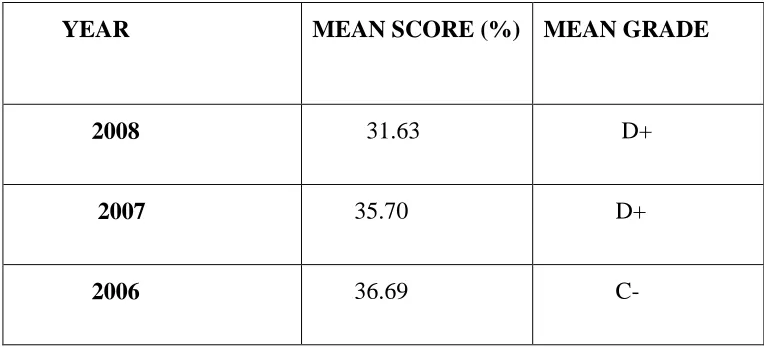
Data obtained from Sub-County Education‟s office Baringo Central Sub-County indicated
that student performance in Physics in KCSE has been dismal as shown in table 1.1
Table 1.1: Baringo Central Sub- County Student Performance in KCSE Physics (2006 – 2010).
YEAR MEAN SCORE (%) MEAN GRADE
2008 31.63 D+
2007 35.70 D+
2006 36.69 C-
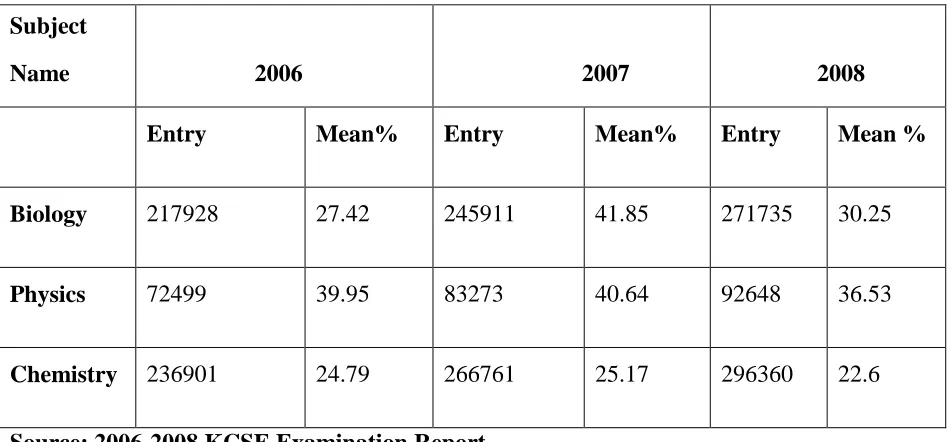
The student performance in KCSE Physics country wide may not be very different from Baringo‟s.
Table 1.2: National Candidates Performance in KCSE (2006- 2008).
Source: 2006-2008 KCSE Examination Report.
NB. KNEC Examination is “NORM REFERENCED” hence difficult to know the grades
which the percentages in table 1.1 would actually correspond to.
From Table 1.2, it is clear that student performance in KCSE (Physics) was below average
for the three years. It is also notable that although Physics appears to have been done
generally better than Chemistry and Biology, its enrolment is much lower meaning Physics
scores could have been lower if the enrolment was comparable to Chemistry and Biology.
Biology and Chemistry was brought in because they are also sciences hence there was
need to compare student performance in Physics and the other sciences. Scores from table
1.1 and 1.2 show that student performance in Physics in Baringo Central Sub-County and
in the entire Country is comparable. The question therefore is “what can be done to change
this”? According to Maritim (1983), part of the answer to this question may be to improve
teacher-student classroom verbal interaction. Teachers themselves may be frequently Subject
Name 2006 2007 2008
Entry Mean% Entry Mean% Entry Mean %
Biology 217928 27.42 245911 41.85 271735 30.25
Physics 72499 39.95 83273 40.64 92648 36.53
responsible for discouraging some students by interacting with them in a way that makes
the students to develop negative attitude towards the teacher and the subject leading to low
achievement.
1.2 Statement of the Problem
The study of Physics is important in all aspects of life. In Kenya, Physics is a key subject
for advancement in science and technology and needed for most professional careers.
These careers include both health sciences (Medicine, Nursing, Laboratory technology)
and Engineering.
There has been a tendency to teach with established methods of classroom interaction and
approaches of teaching which are largely expository. The tendency has been the same with
Physics teaching as far as classroom interaction is concerned (Kiviu, (1985)). Physics is an
optional subject as from third year of secondary education cycle (Form Three); at this
point the choice of the subject may be influenced by the prior interaction patterns between
the teacher and students which in turn help to create interest in the subject since learners
usually take teachers as persons with authority in a given academic field including Physics.
Many African countries envision being industrialized by the year 2030 and Kenya is no
exception. However, looking at the student performance in mathematics and science
subjects at Secondary education level in Kenya, the vision to be industrialised is in doubt
because the performance in these subjects has been poor. Improving the performance of
Mathematics and Science education is a great societal need in Kenya not only for
Research done by one of the key stakeholders in secondary education in Kenya, the
Strengthening of Mathematics and Science in Secondary Education (SMASSE) project in
1998 has shown that consistent failure and negative attitude by students, towards Physics
and Mathematics, continues to characterize the classroom learning. Based on this same
research, teachers have been found to present lessons that are teacher-centred with the
teacher being the main actor and sometimes the only actor in the classroom as students
remain passive recipients. Mathematics and Science lessons have been found to be
difficult, boring and lacking in effective teaching/learning materials (SMASSE, (1998)).
This is the practice also widely employed in Africa. The challenge thus has been how to
make Physics more “alive”, more “real” and more “accessible”. ASEI and PDSI
approaches advocated for by SMASSE have not yielded much. Njuguna (2000), argues
that students‟ involvement during lessons must be enhanced to increase motivation,
effective teaching/learning materials used and lessons should be made more interesting
Statistics obtained from County Director of Education (CDE‟s) office Baringo indicate
that student performance in Physics has been ranging between grades D+ and C-, since the
year 2006 to date (refer to table 1.1). Countrywide student performance in Physics Kenya
Certificate of Secondary Education (KCSE) Examination is below average (Kenya
National Examination Council Report, (2008)). It is with this in mind that the researcher
investigated the classroom interaction patterns in boys‟, girls and mixed schools, to find
out if there is a significant difference in the interaction patterns in different categories of
schools in relation to student performance in Physics. The researcher was interested in
investigating how direct and indirect verbal interaction patterns relate to student
In this study, the independent variable is verbal classroom interaction patterns while the
dependent variable is student performance. The investigator did not in any way influence
verbal interaction patterns but studied and reported how various verbal interaction patterns
relate with student performance in Physics.
1.3 Purpose of the study
The purpose of the study was to investigate classroom verbal interaction patterns in
relation to student performance in Physics in Baringo Central Sub-County.
1.4 Objectives of the study
The study was guided by the following objectives:
a) To investigate the relationship between verbal interaction patterns and the level of
learners‟ participation in learning activities in Physics classrooms.
b) To establish the ratio of teachers‟ direct to indirect behaviour based on verbal
interactions in Physics classrooms.
c) To investigate the relationship between classroom verbal interaction patterns and
student performance in Physics.
1.5 Research Questions
a) How do verbal interaction patterns and the learners‟ participation in Secondary School
Physics learning activities relate?
b) What proportion of teachers depicts direct or indirect behaviour based on verbal
c) To what extent do various classroom interaction patterns relate to students‟ performance
in Physics?
1.6 Significance of the Study
The study findings would be beneficial to the following:
a) Physics Teachers
Teachers are the implementers of any school curriculum. The research findings may
stimulate Physics Teachers at secondary school level to improve their teaching behaviour
in order to maximize students‟ learning in Physics.
b) Quality Assurance and Standards Officers(QASO’S)
The research findings will assist the secondary school Quality Assurance and Standards
Officers in their day to day monitoring of learning in secondary schools to lay more
emphasis on appropriate classroom verbal interaction patterns when advising secondary
school Physics teachers.
c) Physics Teacher Trainers
The results of the research would be used to sensitize teacher trainers on appropriate
classroom interaction patterns and their effects on Physics performance. This would enable
them in the process of preparing Physics teachers to emphasise the topic of classroom
interaction patterns in the unit of Physics teaching methods for undergraduate students and
d) Physics Curriculum Developers at KICD
The findings of this research would enable Physics curriculum developers and all those
charged with developing Physics curriculum to identify specific classroom verbal
interaction patterns for various topics of secondary school Physics and be put in the
syllabus and teachers guide text books.
1.7 Scope and Limitations
1.7.1 Scope
The study focused on students and teachers in stratified randomly sampled public
secondary schools in Baringo Central Sub- County. Baringo Central Sub- County was used
because it had a suitable sample due to its dynamic cultural diversity.
1.7.2 Limitations
The main limitation of the study was resources (time). Inadequate time for the programme
(one year research work) limited the extension of the research to other parts of the country.
1.8 Basic Assumptions of the Study
It was assumed that:
a) The sample used was a representative of the wider population of secondary school
students and teachers in Baringo Central Sub- County.
b) There was relationship between variables identified in the study and student
achievement in Physics.
d) All secondary schools investigated adhere to a uniform Physics syllabus.
1.9 Theoretical Framework
This study was based on theories that propagate the need for learners to take a greater role
in the learning process as teachers act as facilitators. Many claims for learning by
discovery and learners participation in classroom activities are made in educational
psychology as enumerated by various theories for example Gestalt psychologists and
educational philosophies like pragmatism.
Main Proponents of inquiry-discovery method were Pestalozzi, Montessori and Dewey.
According to Dietar (1990), knowledge of the nature of a child is essential to best
instruction and the methods of interaction could vastly aid or retard education, hence most
valuable lessons are to be learnt through direct experiences and participation of the learner.
This laid basis for classroom interaction and learner cantered approach of
teaching/learning strategies. Physics is a subject that requires full participation of learners
both in theory and practical lessons. This study was therefore not only looking at
classroom verbal interactions but also trying to determine whether these verbal interactions
Independent variables
Dependent variables Factors affecting verbal
interaction patterns
Teaching/learning resources
Teachers‟ attitude
Teachers awareness of verbal interaction
Verbal interaction patterns
Direct interaction pattern
Indirect interaction pattern
Student performance
Participation in class
Good results
Figure 1.1 Conceptual framework of the study Intervening Variables
Source: Muteti J.W. (2009), Verbal Interaction in Physics Classrooms in Some Selected Schools in Matungulu Division Kangundo District, Unpublished Thesis, Nairobi, Kenyatta University
1.10 Conceptual framework
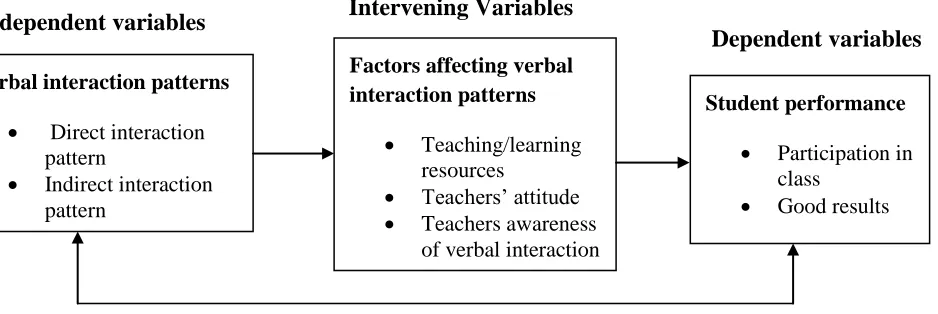
The conceptual framework shows the correlates of student performance in Physics. The
independent variables are verbal interaction patterns. These independent variables interact
with each other and eventually influence student performance in Physics which is the
dependent variable. The intervening variables are teaching/learning resources, teachers‟
attitude and teachers‟ awareness of verbal interaction patterns. Bloom (1984), noted that
the blame for the failure of students rested on poor classroom practices and not the in
ability of the students to learn. Classroom verbal interaction patterns is one of the
classroom practices and based on Bloom‟s assumption, the researcher endeavoured to find
out whether these classroom practices which include verbal interaction patterns relates to
student performance in Physics. Figure 1.1 is the summary of the conceptual framework
1.11 Definition of Terms
In this study, the following words were used for the purpose of and with the intention as
explained below.
Achievement Test: It is a test developed primarily to find out how much students have
learnt in a given area of curriculum such as the secondary school Physics curriculum for
Kenya.
Attitude Scale: It is an instrument purporting to measure emotions, values and feelings
related to a particular discipline or subject like Physics.
Autocratic Teacher Behaviour: It is a teacher‟s verbal behaviour whereby the pupils‟
feelings are not considered and the teacher dominates the talk or discussion. A student
simply listens and obeys orders from the teacher.
Classroom Interaction: It is a chain of events which occur in the classroom, one after the
other, each occupying only a small segment of time.
Democratic Teacher Behaviour: Refers to classroom teachers‟ verbal behaviour whereby
the pupils are allowed to share or contribute a lot and feel free in a discussion.
Form Two: refers to the second year of secondary school. At the end of this year Physics
becomes optional.
Form Three: refers to the third year of secondary school.
Ratio: Refers to the ratio of all categories (tally totals) falling under indirect verbal
influence of teacher divided by the categories falling under direct verbal influence of a
Interaction Analysis Tool: This is an instrument which is designed to record categories of
verbal interaction during, or from, recorded teaching learning sessions. It is a technique for
capturing qualitative and quantitative dimensions of teacher‟s verbal behaviour in the
class-room. It can be used for studying the chain of classroom events in such a fashion that
each event is taken into consideration.
Observation System: Refers to any technique designed for the purposes of identifying,
examining, classifying and /or quantifying specific interacting variables of a given
instructional / learning situation.
Pattern: It is a short chain of events that can be identified and occurs frequently enough to
be of interest, and can be given a label.
Indirect/Integrative Behaviour Pattern: This is a pattern of the behaviour which
accepts, clarifies and support the ideas, feelings of students, Praises and encourages
students, asks questions to stimulate students‟ participation in decision making and asks
questions to orient students to classroom work.
Direct/Diminutive Behaviour Pattern: This is a pattern of teacher behaviour which
expresses or lectures about one‟s own ideas or knowledge, Gives directions or orders to
students, Criticizes or depreciates students‟ behaviour with intent to change it and Justifies
his/her own position
Time Sampling Unit: This refers to the number of observations made per minute
CHAPTER TWO: LITERATURE REVIEW
2.1 Introduction
In this chapter, the researcher presents a review of literature related to the study. The
chapter covers literature on importance of interaction, approaches used in classroom
interaction among others. It finally covers measurement of classroom interaction.
2.2 General objectives of secondary school Physics curriculum
The general objectives of secondary school Physics curriculum (Kenya Certificate of
Secondary Education syllabus, (2002)) are to:
1. Help learners to discover and understand the order of the physical environment.
2. Make the learners aware of the effects of scientific knowledge in everyday life
through application to the management and conservation of the environment, the
utilisation of resources and production of goods.
3. Enable the learner to acquire knowledge and skills for solving problems.
4. Enable the learner to reason critically in any given situation.
5. Enable the learner to appreciate the responsibility of a scientist to the society.
6. Inculcate in the learner a willingness to co-operate in using scientific knowledge to
foster development in the society.
7. Prepare the learner for further studies and/or vocational training.
The Kenya Certificate of Secondary Education (KCSE) is an Examination done at the end
of fourth year of the Secondary education system. The examination is set adhering to the
Physics examination at all levels; they guide the teaching of Physics in secondary schools
in Kenya.
2.3 Classroom Interaction
Interaction occurs every day in the classroom activities between the teacher and the
learners. Interaction is commonly defined as a kind of action that occurs as two or more
objects have an effect upon one another. The idea of a two-way effect is essential in the
concept of interaction, as opposed to a one-way causal effect (www.wikipedia.com).
Education with its correlated activities of teaching and learning process involves
interaction between teacher and students as channels of realizing its objectives. Interaction
occurs every day in teaching and learning process. It is managed by everyone, not only by
the teacher in the classroom, but also the students. This interaction is usually used to
express their ideas together. Allwright and Bailey (1991), stated that Interaction is viewed
as significant because it is argued that:
a) Only through interaction, the learner can break down the Teaching/Learning structures
and derive meaning from classroom events.
b) Interaction gives learners the opportunities to incorporate Teaching/Learning structures
into their own speech (the scaffolding principles) and
c) The meaningfulness for learners of classroom events of any kind, whether thought of as
interactive or not will depend on the extent to which communication has been jointly
2.4 Importance of Interaction in the classroom
Teacher–student interaction is very important in the teaching and learning process because
students benefit from this interaction at both the social and academic level (Beyazkurk and
Kesner, (2005)). Such interaction is referred to as “classroom interaction” and is defined as
the process of face-to-face interaction (Robinson, (1994)).
A fundamental problem in classroom interaction is that teachers try every day to
encourage students to participate effectively in classroom discussions but unfortunately
these efforts may fall flat (Moguel, (2004)). According to Beyazkurk and Kesner (2005),
elementary school students benefit from encouraging relationships and positive interaction
with their teachers. Also, students in early childhood educational settings are more socially
competent and do better in their classes as a result of positive interactions with their
teachers (Egeland and Hiester, (1995)).
Previous research done by Cazden (1986), on classroom interaction focused mostly on
pedagogical methodology, and on teachers' actions during the lesson by Edwards and
Westgate (1994), although teachers engage in a great deal of interaction with their students
while in the classroom, most teachers have difficulties remembering these interactions
(Good and Brophy, (1994)). However, teachers could make „mental notes‟ to record which
students interact more, interact less or do not interact at all. Such mental notes will help
teachers to encourage students to interact appropriately and improve learning (Willson,
2.5 Approaches used in Classroom observation of Interaction
The main approaches that have been used for classroom observation are the structured and
the unstructured approaches. Some researchers have used rating scales and checklists.
2.5.1The Structured or Systematic Approach
This involves using pre- conceived structured schedule which is used for coding classroom
behaviour to provide data which is quantified and then used for discussion (Muthwii,
(1987)) and (Opie, (2004)). Power (1977) quoted in Muthwii (1987), noted over 200
structured or systematic observation systems which had been produced for this purpose.
The reason which he gave to explain why so many schedules had been produced was
because of the complexity of classroom behaviour. According to Ober (1971), to acquire
an understanding of what an observer is about to witness and to learn the necessary
techniques require that at least the basic conditions be met.
a) The observer needs to know precisely what s/he is looking for. S/he must have clearly
in mind his or her own personal conceptualization of what constitutes the
instructional-learning situation. S/he must be able to recognise and identify the role of each.
b) In order to develop a plan of action for observing the classroom setting, the observer
needs to be able to see variables both as separate, discrete phenomenon and as they interact
with each other within the dynamics of classroom operation. Both conceptualization of
what classroom setting is and the development of a plan of action can be boosted by
systematic observation. Systematic observation represents a useful means of identifying,
studying, classifying and measuring specific variables as they interact within the
adds meaning and precision to observational experiences (Opie, (2004)). By using
observational techniques that are provided by systematic observation approaches, the
observer is able to conceptualise the interaction of the variables that make up the
instructional situation, finally s/he is able to study the interacting variables in a line or
ongoing situation (Ober, (1971)). systematic observation is an acceptable method of
organizing observed teaching acts in a manner which allows any trained person who
follows stated procedures to observe, record and analyse interaction with the assurance
that others viewing the same situation would agree to a great extend with his or her
recorded sequence of behaviours in the same way though viewing a wide variety of
classroom or interaction settings. The basic purpose of systematic observation is to help
operationalize teaching objectives in teaching strategies. Direct observation should and can
be used in the search for effective patterns of teaching learning behaviours (Wragg,
(1994)). Observation allows individual teachers to study and analyse their own teaching
strategies in the privacy of the classroom and Home. Systematic observation provides the
opportunity for continuous monitoring of teaching behaviour-the examination of
class-relevant variables in the light of activities necessary to teach as planned.
2.5.2 The Unstructured Approach
Here the structure has no previously designed schedule which is used for coding behaviour
(Wragg and Opie, (2004)). It‟s quite informal in nature since the observer has no pre
determined method of coding some specific events. S/he selects at random what she thinks
is useful and available for description and discussion. His/her beliefs, attitudes and
interpretive framework play an important role in determining what is selected (Power,
2.5.3 Rating Scales
These are alternative approaches which have been used by researchers such as (Sutherland,
(1997)). However their validity and reliability have been questioned (Wragg and Opie,
(2004)).
2.5.4 The Criticism of the Structured and unstructured approach.
Those who criticize the use of structured approach such as Robinson (1975), argue that the
true reliability of classroom life as perceived by the teachers and pupils is distorted when
the structured approach is used for studying classroom interaction because categories
contribute only a small portion of the total classroom events. This happen especially when
events are coded only once per given period or time sampling unit. The actual language
used in the intellectual transactions between the teacher and pupils is not recorded and
there is loss of sequence in classroom events when recorded. This is termed as
“reductionism” (Ajeyalemi, (1983)) quoted in Muthwii (1987).
The advocates of the unstructured approach argue that an experienced and sensitive
observer can capture what‟s important of the essential qualities of classroom events, s/he
randomly chooses what s/he judges to be important. The result of such an observation is
liable to distortion bias or reduction (Power, (1977)) quoted in Muthwii (1987). Power
(1977), also disagreed with the informal approach because of its random nature of data
selection. This cannot be useful due to the complexity and rapidity of classroom events. In
fact it also suffers from the weaknesses of the structure method of losing the sequence and
2.6 Approaches to the Teaching of Physics
A teaching approach involves all the ways and steps a teacher uses when presenting lesson
content. According to Ornstein (1995: xix):
“The key role of teachers is to teach students learning strategies that will increase students‟ chances for achievement and reduce the loss of human potential which is so pervasive in our society today. Helping students to learn is the goal of the teacher. The extent to which
this is done is influenced by how well the teacher can select suitable methods of teaching the skills employed and the level of preparation”.
Maundu, Muthwii and Sambili (2005), suggest that the two common approaches of
teaching sciences are the expository approach and the inquiry approach. This agrees with
Sutherland (1997), who argues that there are three teaching approaches in science:
Problem solving, informing and inquiring approaches, though enquiries and
problem-solving can be categorised under learner-centred approaches while informing falls under
teacher-centred approaches.
2.6.1 Expository Approaches
This involves the kind of classroom teaching which is characterised by the predominance
of the teacher (Maundu et al., (2005)). The teacher gives facts, explains concepts,
illustrations and applications. The learner‟s participation in learning is in listening and
answering teachers‟ questions. This approach limits the verbal interaction in the classroom
and therefore it is not useful in the presentation of Physics as a practical science subject.
Lang, Mc Beath and Hebert (1995), agree with Maundu et al. (2005), that there are some
cases which call for the use of this method while teaching. Rugiri and Magondu (2004),
assert that the expository approach is not very effective in teaching sciences although some
topics call for its use because of their very nature, which is they are difficult to teach
largely teacher-centred strategies that are particularly effective for presenting declarative
information in a step – by – step way, through lecture, explanation and the provision of
guided practice through oral drills or written seatwork. Twoli (2006), observed that there
should be less emphasis on the expository type of methods while teaching sciences and
hence more emphasis should be put on the discovery/heuristic approaches.
2.6.2 Inquiry Approach
Lang, Mc Beath and Hebert (1995), observe that inquiry approach encourages learners to
investigate a range of topics, thus taking responsibility for their own learning. They also
argue that this approach consists of two main branches which are the guided inquiry and
the un-guided inquiry. Maundu et al. (2005), argue that the inquiry approach is also
referred to as the scientific or discovery approach. Learning is by discovery. It trains the
learners to follow instructions carefully and it is characterised by development of the
scientific skills such as the ability to make observations, collecting and presenting data,
drawing conclusions, inferring and the ability to use the skill of manipulating apparatus.
2.6.3 Guided Inquiry Approach
The guided inquiry has its own advantages, guided inquiry is a useful strategy for moving
students gradually from direct to indirect instruction. The teacher asks questions and uses
prompts, cues and probes to obtain thoughtful responses; this creates adequate verbal
interaction in the classroom (Lang, Mc Beath and Hebert (1995)). Maundu et al. (2005),
suggest that this interaction motivates the learners because of their co-operation with the
expert that is the teacher. The presence of the expert also makes work proceed on
put a high demand on resources and time but this cannot be compared with the rewards it
brings to learners in terms of meaningful learning with more motivational orientation. He
further adds that, in the teaching of Chemistry and any other Science, application of
inquiry approaches should be done.
2.6.4 Un-guided inquiry
Lang (1995), asserted that un-guided inquiry is an open – ended teaching strategy that
targets raising both students‟ interest in learning and the degree of personal responsibility
they take for the learning process. While using the unguided approach, the teacher gives
the learners some opportunities to interact verbally through making discoveries and then
questioning and exploring what they have observed. Lang, Mc Beath and Hebert (1995),
agree with Maundu et al. (2005), that the unguided inquiry approach sharpens the students‟
skills on how to plan their own investigations and how to solve problems with less
dependence on the teacher. Challenging inquiries can stimulate classroom discussions in a
Physics classroom as well as every other school subject.
Sutherland (1997), advocates for learning by experience as this gives the learner a better
base for later thinking since the concepts will be accurate and there will be a room for
further development. Sutherland (1997), further argues that scientific principles are not
learned from text books or by watching other people‟s experiments but they are what the
individual has discovered by initiating activities, observing and interpreting their results.
Although most of the writers come to a consensus that the inquiry approach is better
placed in the teaching of sciences, they again agree on the fact that the approach is time
interaction (Sutherland, (1997)).Teachers should try as much as possible to increase verbal
interactions during the teaching-learning process. The indirect instructional strategies
involve the learners more as compared to the direct instructional strategies.
2.7 Factors Influencing Classroom Interaction
The nature of classroom interaction is often influenced by students' Homes,
neighbourhoods and culture (Eggen and Kauchak, (1997)). Many students come from
cultures in which adults and children interact in ways that differ from that found in most
classrooms (Eggen and Kauchak, (1997)). According to Helgesen and Brown (1994), each
culture has different „rules‟ about how students should act in the classroom. In some
countries, it is regarded as beneficial – and important – to answer the teacher's questions
and interrupt him/her when something is not understood. However, in other countries,
students are expected to listen; only the teacher should speak in class. For example, most
Japanese students are taught to listen and not to question a teacher in class and therefore
have little or no experience with in-class interaction with the teacher, such as questioning,
commenting or giving feedback. Students are usually taught to be quiet and respectfully
listen to the teacher (Snell, (1999)). It is suggested that Hawaiian students in the USA do
not interact effectively in regular classroom lessons; either they do not participate at all, or
they participate in inappropriate ways, such as breaking in or interrupting other
participants. These behaviour patterns and their consequences often result in lower
2.8 Classroom Interaction and Achievement in Europe
Younger, Warrington and Williams (1999) findings regarding the relationship between
interaction and achievement revealed that high-achieving students initiated more
interactions than low-achieving ones. Their study also found that the nature of interactions
among high achievers differed from those of low achievers. High achievers initiated
interactions to volunteer answers, whereas low achievers interacted primarily to seek help.
Professionals in the field of education consider teacher–student interaction fundamental to
the learning process. Student involvement in classroom discussions can be a major element
in effective instruction. Verbally active students are more likely to be high achievers, and
student–teacher interaction can help students develop their cognitive skills (Jones and
Gerig, (1994)). Various studies on classroom interaction revealed that these students
control interaction because they are more active in the learning process and participate
more willingly than others (Willson, (1999)).
2.9 Classroom Interaction and Gender
Research done in Europe by Younger, Warrington and Williams (1999), found that more
girls than boys take the opportunity to initiate questions, seek clarification on work-related
matters, make best use of the support of the teacher. Shomoossi, Amouzadeh and Ketabi
(2008) indicated that girls participated less in class than boys and took less verbal initiative
in their interaction with the teacher. They are more „passive‟ than boys in the classroom
and less persistent than them in their non-compliance with the teacher. Kramer (1985)
offered comments less frequently than boys. Others have found that boys do not dominate
classroom talk and teacher time (Swann and Graddol, (1988)).
A number of studies have shown gender bias in teacher-initiated interaction in the
classroom (Kerr, (1991)), (Sadker and Sadker, (1985)) and (Younger, Warrington and
Williams, (1999)). While some researchers like Sadker and Sadker (1985), found that
teachers responded differently to boys and girls in the class, with boys tending to dominate
classroom interactions and teachers accepting their dominance. Comfort (1996), indicated
that girls received more positive feedback from their teachers. Although Comfort (1996)
found that teachers initiated more contact with, and directed more questions to boys than
girls, they criticised boys more than girls. In fact, girls received more positive
reinforcement.
2.10 Status of Classroom Verbal Interaction in Third World Countries
The teaching-learning process at the secondary level in Third world countries is mostly
based on memorization (UNDP, (1997)). There is little provision for the development of
intellectual and thinking skills among students who are given less time for active
participation and interaction, and the teacher seems to have a very dominant role in the
class. Unfortunately, a poorly structured classroom quickly deteriorates into a vacuous
waste of time (UNDP, (1997)). Based on a large-scale meta-analysis conducted by
Walberg (1991), research indicates that the following seven factors are key elements to the
effectiveness of teaching: engaged academic learning time, use of positive reinforcement,
cooperative learning activities, positive class atmosphere, higher-order questioning, cues
Maritim (1983), found that the quality of teacher- pupil interaction correlates positively
and significantly with the pupil performance. He further points out that academic
achievement depends upon self concept, school facilities, socio - economic background,
teachers‟ personality, biological factors, motivation, rewards and punishment and previous
learning. He further noted that if lack of classroom participation persists, eventually the
pupil‟s academic self concept will diminish and subsequently his or her performance. To
save the pupil from developing this defeatist attitude the teachers must play a simulative
role in the classroom.
WaSanga (1982), investigated and analysed the classroom interaction of Kenyan
secondary school teachers and their undesirable behaviours and found that there was a
positive relationship between teacher‟s way of teaching and his/her undesirable behaviour
as given by students. Using Flanders technique for observing the classroom teaching,
teachers found to have poor classroom teaching were also found to have much undesirable
behaviour which was characterised by criticizing, non appreciation and punishments. S/he
observed that those teachers who establish good working relationship with most of their
individual students and consider their students as human beings are usually effective
teachers (those whose students learn more in their classrooms). It was realised that
teachers have many undesirable behaviours and poor teaching habits like unnecessary
criticisms, calling on only few students from a whole class failing to use students‟ ideas
and not rewarding students.
Tuckman (1972), states that some teachers teaching approaches are more of student
centred, some are more of teacher centred, some ask more questions, others do more
social emotional spheres. This implies that sources of variability in classroom are
represented by; the teachers‟ philosophy or orientation, the manner in which the teacher
manages the classroom and how teachers behave towards students
Flanders (1970), originally developed a research tool, named the Flanders Interaction
Analysis (FIA), which became a widely used coding system to analyze and improve
teaching skills. As a result of research with his coding instrument, Flanders uncovered the
two-thirds rule: about two-thirds of classroom time is devoted to talking, about two-thirds
of this time the person talking is the teacher, and two-thirds of the teacher‟s talk is “direct”
(that is, lecturing, giving directions, and controlling students). The two-thirds rule is
actually three related two-thirds rule that serves to substantiate that typically teachers
verbally dominate the classroom. Teacher verbal domination of the classroom conditions
makes students to become passive and dependent on the teacher. This dependency has
adverse effects on students‟ attitudes toward learning and students‟ performance in school.
Flanders in his observation technique found that when teachers are trained they become
aware of the importance of language in the classroom, their verbal monopoly decreases.
To use the Flanders Interaction Analysis, one codes the verbal interaction in one of ten
categories in the Flanders Interaction Analysis Coding Instrument (Flanders, (1970)).
There has been much research on teacher talk (Long and Sato, (1983)). Issues such as the
amount and type of teacher talk, speech modifications made by teachers, instructions and
explanations, error correction and questions have been more or less the centre of attention.
Questions have also been cited as very important ingredients of classroom interactions.
Lynch (1991) characterizes a question as an utterance with a particular illocutionary force.
Long and Sato (1983) and Brock (1986) investigated the role of questions in second
language learning in the classroom environment. They worked on the role of teacher's
question types (especially display and referential questions) and their facilitation to
learning. Brock (1986), contends that referential questions increase the amount of learner
output; therefore, an increased use of referential questions by teachers may create
discourse which can produce a flow of information from students to the teacher, and may
create a more near-normal speech. However, it is believed that display questions require
short or even one-word answers and hence are less likely to get learners to produce large
amounts of speech. Lynch quotes a number of researchers who investigated the balance
between referential questions and display questions in the foreign language classroom.
Onduru (2002), did research on cognitive level of classroom instructional questions and
their implications on student achievement in Biology, and found that question levels asked
in class could not be the factor responsible for the high or low achievement in Biology.
Teachers observed involved in activities such as explaining biological concepts, drawing
diagrams on the board and giving or dictating notes to the students thus reducing the
interaction of teacher and students through questioning. Comprehension questions formed
the bulk of the questions followed by knowledge questions in the end of term examination.
Analysis questions were very rare in most of the examinations done during and at the end
of term.
2.11 Status of Classroom Verbal Interaction in Kenya.
While research has been done in other aspects of classroom interaction for example
students in Nairobi by Njuguna (2000), Analysis of classroom interaction patterns in
Kenyan secondary schools Chemistry teachers and their undesirable behaviours by
Wasanga (1982), and Verbal interactions in Physics classrooms in Kangundo District by
Muteti (2009). Very little or none has been done in Classroom verbal interaction patterns
in relation to student performance in Physics, hence the need for the present study.
The 1998 SMASSE baseline study documented several factors that directly or indirectly
contributed to the poor performance in science and Mathematics. Some of them being:
Poor attitude towards Sciences and Mathematics, lack of practical teaching and learning
approach, poor teacher preparation etc. Considering these factors, it cannot be lost on any
keen observer that the teaching/learning of these subjects needs a new orientation in terms
of approaches and methodologies and in terms of priorities and policies. The prevailing
situations where it is either little or no concern as to whether quality teaching/learning of
sciences takes place or outright negative attitude needs to be altered. Attitude has far
reaching influence in almost every aspect of a person‟s mode of operation. It influences
perspective and hence decision and actions. A positive attitude is an asset while a neutral
and negative attitude is a drawback (Njuguna, (2000)).
Preferred teaching behaviour/styles may promote positive attitude towards learning of
Physics concepts which is likely to improve student performance in Physics. This study
sought to find out the above immediate statement.
The present secondary school Physics curriculum is built on the conception of science as
both product and process. As a process, Physics has to do with the skills that are called
into play by scientists in carrying out scientific investigation. This implies adopting an
Physics is viewed as consisting of scientific facts, principles, laws and generalizations
derived from scientific investigations. The new curriculum of science (Physics) adopts a
child-centred approach, which requires that the teacher provides guidance to the students
as the students participate actively in the teaching-learning process. Teaching of science,
especially Physics, and performance of students at the secondary school level have been
the concern of government and parents (Onah, (2010)).
2.12 Measuring Classroom Interaction
The present study involved observing Physics teachers when teaching. It was however, not
possible to sit in a classroom and describe accurately what was happening because of the
complexity of the spontaneous class behaviour. This view was also expressed by Flanders
(1970), who observed that, even trained observers struggle with the same biases that
distort the testimony of a witness at the scene of an accident. Too often the observers‟
preconceptions of what s/he thinks should happen to allow him to perceive certain
behaviours but prevent him from perceiving others. Interaction analysis is however an
observation schedule designed to minimize these difficulties by permitting systematic
record of spontaneous acts and scrutinizing the process of instruction by taking into
account small bits of interaction that take place in classroom instruction.
Classroom interaction is particularly concerned with the influence patterns of the teachers‟
behaviour. This might be considered biased, but it is bias in terms of pre determined
concepts. The concepts in this case refer to teachers‟ control of students‟ freedom of
action. Flanders (1970), Stated that it is not possible to record every detail of what