Automatic Gas Cooker Control System
A. H. Alkali1, D. E. Mshelia2, S. Isuwa3, H. T. Bolori4
Lecturer I, Dept. of Computer Engineering, University of Maiduguri, Maiduguri, Borno State, Nigeria1
Lecturer II, Dept. of Computer Engineering, University of Maiduguri, Maiduguri, Borno State, Nigeria2
Graduate Assistant, Dept. of Computer Engineering, University of Maiduguri, Maiduguri, Borno State, Nigeria3
Graduate, Dept. of Computer Engineering, University of Maiduguri, Maiduguri, Borno State, Nigeria4
ABSTRACT: Cooking has evolved from using open fires using wood to gas cookers using liquefied petroleum gas. With the advantages that comes with the advancements also comes issues such as gas leakage as a result of unintended leakages leading to disasters. This work presents a system consisting of an Arduino Uno as the control platform and interfaced with flame sensor, servo motor and a utensil detector to automatically detect when to allow gas flow to commence in order to ignite a flame. It also uses the utensil detector to automatically extinguish the flame by closing the gas flow. The system can be useful to new users of the gas cooker and also persons with disability.
KEYWORDS: Liquified Pertoleum Gas, Flame sensor, Arduino Uno, Gas cooker.
I. INTRODUCTION
Fires were left burning for long periods by our predecessors as starting fire was a skill on its own. Cooking was therefore on open fires on the ground and later simple masonry construction was used to hold the wood and/or cooking utensils. Simple ovens were used by the ancient Greeks for making bread and baked goods. By the middle ages, taller brick and Mortar hearths, often with chimneys were being built. The food to be cooked was often placed in metal cauldrons that were hung above the fire.
However, inventors began making improvement to wood burning stoves primarily to contain the smoke that was being produced. Fire chambers were invented that contained the wood fire, and holes were built into the top of these chambers that cooking pots with flat buttons could be placed directly upon replacing the cauldron.
Over the years, alternatives were created with a view to reducing the efforts in cooking while improving the efficiency. Kerosene stove is one of such alternatives but comes with disadvantages such as smoke, soot, and explosion as a result of adulteration and/or leakage. Another alternative is the liquefied petroleum gas (cooking gas). Although cheaper and does not produce smoke and soothe when burning, it is however more affected by explosion due to leakage as it is gaseous and containing it is more difficult. Safety precautions such as pressurized container is used to reduce its volatility but the most common issue associated with using cooking gas is unattended gas flow rather than the leakage.
Gas leakage can occur due to valve fault or even pipe leakages which can only be confined by repairs. The other important issue is the unattended/unintended gas flow occurs when the knob controlling the flow of the cooking gas is opened and left without an ignition to start the fire. As the gas concentration increases in a location, the possibility of explosion in the presence of a spark increases. Thus when left to cumulate and a spark is introduced, explosion occurs and disaster follows. This unintended gas flow could result from lack of know-how, forgetfulness, arsonic intents and misuse by minors.
Safety by avoiding unintended gas flow and thus fire outbreak,
User friendliness to new users and especially persons with disability,
Encourages use of cooking gas as an alternative to wood thereby reducing deforestation.
Reliable and cost effective.
The work involves the product based on design of a gas cooker automated gas flow regulator during and after cooking and uses algorithms to make informed decisions based on sensors conditions.
II. LITERATURE REVIEW
Safety has become the primary concern in product selection especially in those that have higher elements of risks such as gas cookers. Although gas cookers provide efficiency, hygiene and comfort, it also comes with hazards directly related to the use of the liquefied petroleum gas (LPG). An error in its handling and/or use of the product could result in serious consequences including loss of lives. Thus features are required to provide improved safety to handle unforeseen, unintended and to some extent even deliberate misuse of the product. This is with a view to enhance the safety of lives and properties while dealing with the flammable cooking gas in cooking, especially cooking at homes.
Many homes in developing countries are migrating to the use of LPG for energy source in cooking using gas cooker (Apeh, Erameh, & Iruansi, 2014). A gas cooker or stove is an apparatus with valves and regulators that allows the control of gas flow as an energy source for fire. Since the auto ignition temperature of LPG is between 410 – 580oC (Indian Oil, 2017), the product is not likely to ignite itself at normal storage without a spark. All gas cookers are manually operated except for the spark source in some configurations while turning the valve control knob.
Many works have been reported towards gas leakage detection systems where gas sensors are used in detecting the leakage and a sub-system initiates an action such as alert procedure to forestall to likely disaster.
In (Priya & Babu, 2014), a system was developed to detect gas leakage and sound an alarm. The system operates on a 9V battery towards driving a gas sensor module. When gas leakage is above a set threshold, the gas sensor module an astable multivibrator that works as a tone generator. The system only sounds an alarm thus requiring a person to act if nearby. Similarly (Gurusamy, Ahmed, Gaurav, & Mahavignesh, 2016) developed a system that detects when the concentration of LPG flow in an area exceeds a given level in the air a gas sensor. The system alerts a subscribed person via SMS through the GSM module about the gas leakage. The system only alerts a person who may be too far away to do anything. The works by (Hazarathaiah, Mohan, Rahulgowtham, & Mariselvam, 2016) is also to do with detection and alerting a subscribed person via SMS when gas leakage is detected. On their part, (Mujawar, Bachuwar, Kasbe, Shaligram, & Deshmukh, 2015) proposed a sensor network based leakage detection system. The proposed design detects gas leakage through its concentration in air. The system then collects the data of the gas leakage as well as the location of the leakage and then uses a XBee to send the collected date to the monitoring system. Any mobile phone with the SMS facility could control the developed system. Although this approach utilized a wireless sensor network, it is also an alert system like the others discussed.
A Kitchen Gas Leakage Detection and Automatic Gas Shut off System was proposed by (Apeh, Erameh, & Iruansi, 2014). The system alerts a subscriber through alarm when gas leakage is detected. It also sounds alarm and displays the status in addition to turning off the gas supply valve as a primary safety measure. The system is more of a first aid as it is only useful during.
III. METHODOLOGY
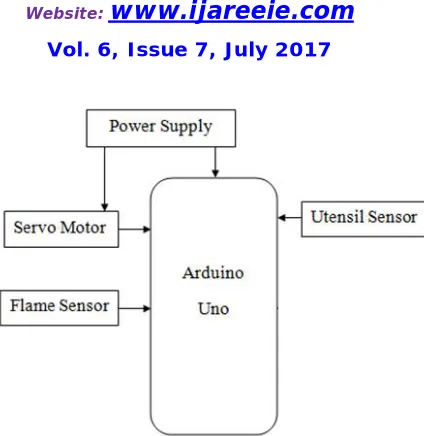
Figure 1: Block Diagram of the automatic gas cooker control system.
Flame Sensor
The flame sensor used was the KY 026 arduino compatible flame sensor which can be used to detect fire or other heat sources within the 760nm to 1100nm range of wavelength and accurate up to about 3 feet. In this work, it is being interfaced with the arduino to detect the presence of ignited flame in order to rotate the gas valve to ignite the cooker. When the temperature reaches a certain threshold, the output goes low which was read by the microcontroller.
Figure 2: Flame sensor module
Utensil Sensor
A mechanical push button served as the utensil sensor and was connected via a long insulated rod that protruded beside the burner such that placing a utensil on the burner ensures that it was pressed. This then completed a circuit that ensured voltage flow, which was read on the output pin of the button and read by the microcontroller. Once the utensil was removed the push button opened the once completed circuit resulting in no voltage flow to the microcontroller.
Servo Motor
A servomotor was used in this work to allow for precise control of angular position of the gas control knob.
The circuit diagram of the system is shown in Figure 3 showing the interfacing of the individual components to the Arduino Uno.
Figure 3: System circuit diagram
a. Ignition Mode
During the ignition mode, the system reads the utensil sensor whisc is a push botton that is activated when a utensil is placed on the burner. If it is switched “ON”, then the microcontroller returns a YES as its decision. Thereafter the next task was to detect a presence of a spark via the flame sensor module that was placed at an appropriate distance from the burner but not too close to be affected during cooking. If a spark is detected, then the servo motor is activated by the microcontroller but whose power is external. The servo motor was connected to the gas knob such that its rotation to allow flow of gas coincided with rotating in a counterclockwise direction. When a spark was present, a flow of gas ensures ignition. If however there was no spark, even though a utensil was detected, then the decision would be a return to start again. This was necessary since between detecting a utensil to non-detection of spark could have resulted in removal of the utensil. In this case, if the decision had not been to return the start, then a waste of gas could be a result if there was no utensil.
b. Extinguishing Stage
Cooking continued as long as long as a utensil was detected as highlighted in Figure 2(b). Immediately a utensil was removed from the burner and the utensil sensor reading returned a “NO”, the microconttroller turns the servo motor in a closewise direction to close the know and thus stop further gas flow. This then extinguishes the flame and cooking ceased.
IV. RESULT AND DISCUSION
During the implementation of this work, efficiency and compatibility of the components used were of utmost concern. It consists of interpreting the components into the circuit and determining the right ones to be used in the construction. After identifying the right components, the components were interfaced on a breadboard. Finally the components were transferred to a Vero board. The system was powered ON using Personal computer Via USB port or a 9v battery pack, and then the system and serial monitor of the Sketch were used to verify the results.
The integrated system was tested and Table 1 shows the results of ignition mode of the tested system. Four tests were carried out severally, and the results all indicated agreement with the result presented in the Table. In this mode, the servo motor only turns in counterclockwise direction to allow flow of gas upon meeting two conditions; that a utensil is detected and a spark is also present. Once this condition is met, the gas flows and flame is ignited allowing for cooking.
Table 1: Result for ignition mode
S/N Utensil Sensor Spark Sensor Servo Motor Flame
1.
OFF No Spark NO Rotation NO2.
OFF Spark NO Rotation NO3.
ON No Spark NO Rotation NO4.
ON Spark CCW Rotation YESFor the extinguishing mode, as long as the flame is burning and the utensil sensor is “ON”, the flame continued to burn as the servo motor remained in its open position. But as soon as the utensil is removed, the servo motor rotated in the clockwise direction and the flow ceased forcing the flame to extinguish. This summary is shown in Table 2.
Table 2: Result for extinguishing mode S/N Utensil Sensor Servo Motor Flame
1.
ON NO Rotation YES2.
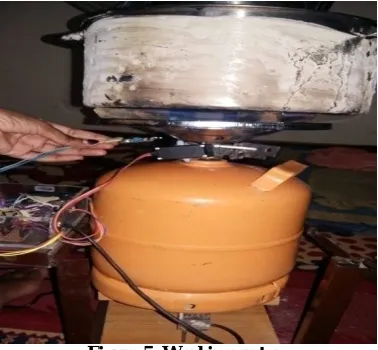
OFF CW Rotation NOThe overall working system is shown in Figure 5, with specific details to the location of the flame sensor.
V. CONCLUSION
From the project implemented, gas cooker ignition depends solely on the presence of a cooking utensil and a spark. Once the microcontroller detects both, it automatically turns the gas valve to ignite the flame. Upon detecting absence of a cooking utensil, the system turns off the gas flow and thereby extinguishing the flame.
The system however assumes a utensil as an initiation for cooking which may actually be an empty pot. Perhaps future work can be extended using weight sensors to identify empty utensils. The flame could also be auto ignited once the right cooking condition is met rather than having to manually induce a spark.
REFERENCES
[1] S. Apeh, K. B. Erameh, U. Iruansi, “Design and Development of Kitchen Gas LeakageDetection and Automatic Gas Shut off System,” Journal of Emerging Trends in Engineering and Applied sciences, vol. 5, no. 3, pp. 222 – 228, 2014.
[2] P. Gurusamy, E. Ahmed, K. Gaurav, S. Mahavignesh, “LPG Detection Using GSM Module,” International Journal of Advanced Research in Electrical, Electronics and Instrumentation Engineering , vol. 5 no. 1, pp. 12 – 15, 2016
[3] Hazarathaiah, C. K. Mohan, S. Rahulgowtham, A. K. Mariselvam, “Gas Leakage Detection and Rectification Using GSM,” International Journal of Applied Engineering Research, vol. 11, no. 9, pp. 6861 – 6864, 2016
[4] Indian Oil. (2017, 05 03). Indian Oil Corporations Ltd. Retrieved 05 03, 2017, from www.iocl.com: https://www.iocl.com/products/LPGSpecifications.pdf
[5] T. H. Mujawar, V. D. Bachuwar, M. S. Kasbe, A. D. Shaligram, L. P. Deshmukh, “Development of wireless sensor network system for LPG gas leakage detection system,” International Journal of Scientific & Engineering Research , vol. 6, no. 4, pp. 558 – 563, 2015