GARRISON, G. A. 1953. Effects of clipping on some range shrubs. J. Range Manage. 6:309-317.
HOLMGREN, A. H., AND J. L. REVEAL. 1966. Checklist of the vascular plants of the Intermountain Region. U.S. Forest Serv. Res. Paper INT.-32. 160 p.
HORMAY, A. L. 1943. Bitterbrush in California. U.S. Forest Serv., Calif. Forest and Range Exp. Sta. Res. Note 34. 12 p.
LAYCOCK, W. A. 1967. How heavy grazing and protection affects sagebrush-grass range. J. Range Manage. 20:206- 213.
NEFF. D. J. 1963. The effect of use on the vigor of browse plants. Job. Compl. Rep., Fed. Aid Project No. PRW- 78-R., Ariz. Game and Fish Dep. Processed. 8 p. + XII. PECHANEC, J. F., AND G. D. PICKFORD. 1937a. A weight
estimate method for the determination of range or pasture production. J. Amer. Sot. Agron. 29:894-904.
PECMANEC, J. F., AND G. D. PICKFORD. 1937b. A compari-
son of some methods used in determining percentage uti- lization of range grasses. J. Agr. Res. 54:753-756. SMITH, A. D. 1949. Effects of mule deer and livestock
upon a foothill range in northern Utah. J. Wildl. Manage. 13:421423.
SMITH, A. D., AND D. M. GAUFIN. 1950. The use of mov- able paddocks in the study of forage preferences of mule deer and livestock. Tran. N. Am. Wildl. Conf. 15:512- 518.
SMITH, A. D., AND D. D. DOELL. 1968. Guides to allo- cating forage between cattle and big game on big game winter range. Utah State Div. of Fish and Game Publ. 68-11. 32 p.
SMITH, A. D., AND P. J. URNESS. 1962. Analysis of the twig length method of determining utilization of browse. Utah State Dept. of Fish and Game Publ. 62-9. 34 p.
U.S. DEPT. COMMERCE. 1961-69. Climatological data- Utah Vols. 63-71.
Three Methods of Determining Diet, Utilization,
and Trampling Damage on Sheep Ranges’
WILLIAM A. LAYCOCK, HAYLE BUCHANAN, AND
WILLIAM C. KRUEGER
Principal Plant Ecologist, Intermountain Forest and Range Experiment Station, Forest Seroice, U.S. Department
of
Agriculture, Ogden, Utah; AssociateProfessor
of
Botany, Weber State College, Ogden, Utah; and Range Management Specialist, Oregon State University, Cowallis.Highlight
Esophageal fistula sampling and ocular utilization estimates gave similar figures for dietary composition and for percentage utilization by sheep for most plant species in the tall-forb type. The paired-plot method gave higher utiliza- tion figures than the above methods because it estimated not only herbage eaten, but also that trampled. As a result, this method overestimated the dietary com- position of species most susceptible to trampling damage; trampling accounted for one-half to two-thirds of the herbage removed by grazing.
Studies of sheep diet on range- land generally are conducted to determine the quality and quantity of herbage eaten or the proportion of herbage eaten. Knowledge of what and how much herbage ani- mals eat is needed for proper man- agement of both the animals and the range. Discussions of the vari- ous methods used to study diet and utilization have been published [Smith et al., 1962; National Acad- emy of Sciences-National Research Council (NAS-NRC), 1962; Martin,
l Received August 23, 1971.
2 Stationed in Logan, Utah, at the For-
estry Sciences Laboratory, maintained in cooperation with Utah State Uni- versi ty.
1970; and others], but few studies have compared these methods.
The objective of this study was to compare three sampling methods- esophageal fistula; paired (caged and open) plot; and ocular utiliza- tion estimates-for determining bo- tanical composition of the diet of sheep and the percentage of each plant species utilized on tall-forb range. The study also enabled us to estimate the amount of herbage trampled at different periods dur- ing the summer.
Procedures
Data reported here were obtained in conjunction with another study to determine daily and seasonal
trends in the botanical and chemi- cal composition of the diet of sheep on a tall-forb summer range. De- tails are reported elsewhere by Buchanan et al.3 and only informa- tion necessary for the comparisons made will be repeated here.
This study was conducted during the summer of 1967 on the U.S. Sheep Experiment Station* summer range in southwestern Montana. The study area, located on a gentle, north-facing slope at an elevation of approximately 2,380 m (7,800 ft), had a fairly uniform cover of tall forbs dominated by sticky geranium. Six pastures, each 0.12 ha (0.3 acre) in size, were used-two each in early summer (mid-July), midsummer (early August), and late summer (late August). For comparisons of methods, data are presented only for the early summer trial in order
3 Buchanan, Hayle, W. A. Laycock, and D. A. Price. Botanical composition and nutritive content of the diet of sheep at three periods during the summer on a tall-forb range in south- western Montana. Intermountain For- est and Range Experiment Station, Ogden, Utah. (In preparation.) 4 Range management research here is
DIET AND UTILIZATION SAMPLING 353
to reduce amount of tabular mate- rial. Data from all three periods are used to estimate forage intake and trampling damage.
Clipped, Paired-Plot Method For each trial, 10 pairs of plots, 0.45 m2 (4.8 ft2) in size, were located on a restricted random basis in each pasture prior to grazing. All plots were marked and one of each pair was randomly selected to be caged. Plots were at least 3 m apart to minimize the effect of the cage on the open plot. Immediately after grazing, the 20 pairs of plots in the two pastures used in each trial were clipped to ground level. The amount and percentage of each spe- cies removed from the open plots were calculated from the difference between herbage weight on caged plots and that on open plots. Total utilization calculated in this man- ner included herbage eaten plus that destroyed by trampling. Total dry weight production of each spe- cies on the caged plots was used as a control to compute utilization by the other methods.
Esophageal Fistula Method Seven esophageally fistulated sheep were used (four in one pas- ture and three in the other) during each 6-day grazing trial to collect samples representative of the diet. Three samples taken on alternate days were used for analysis of botan- ical composition. Data presented are combined from the two pastures used simultaneously in each trial. Total fecal output was collected from four bagged yearling wethers (two in each pasture) that grazed with the fistulated sheep. Amount of acid-detergent fiber in fistula and fecal samples was determined (Van Soest, 1963) and dry-matter intake was calculated by the lignin-ratio technique (Forbes and Garrigus,
1948).
Total grazing pressure was 250- 300 sheep days per ha (loo-120 sheep days per acre), a rate similar to that on adjacent herded ranges. The average dry-matter intake per sheep per day multiplied by the total number of days all sheep
grazed provided an estimate of the total dry weight of forage consumed per trial in each pasture.
Microscopic point sampling was used to obtain the percentage com- position of each species found in the fistula samples. In order to com- pare results of the three methods, the composition of fistula samples was converted from a surface area basis to a weight basis. The weight: surface area ratios calculated for the same plant species by Krueger (1970) were used to make the con- version. This method indirectly de- termines composition by weight. Hand separation of fistula material (Leigh and Mulham, 1966), the only direct method, was considered too time consuming and laborious for this study.
To obtain percentage utilization for each species, the total dry weight intake of all sheep for the entire trial was converted to intake by species according to percentage com- position in fistula samples. This amount, expressed as a percentage of the total amount of each species produced on the 20 caged plots, was an estimate of utilization. Because of the number of steps and the sam- pling errors associated with each, utilization figures obtained by this method probably are much less re- liable than those given by the other two methods.
Ocular-Estimate-by-Plot Method Percentage utilization by weight was estimated immediately after grazing in each trial, by the ocular- estimate-by-plot method (Pechanec and Pickford, 1937). The average utilization for each species was com- puted for eighty 0.45-m2 plots (40 in each pasture). In each trial, this percentage multiplied by the aver- age dry-weight production of each species from the 20 cage plots was an estimate of the total amount eaten. The percentage each species contributed to the diet was also computed.
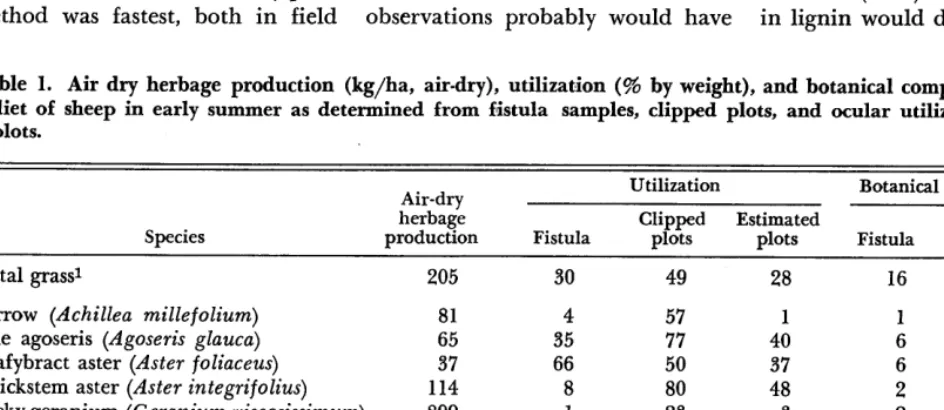
Results and Discussion Clipped, Paired-Plot Method Generally, the botanical composi- tion of the diet estimated from
paired-plot clippings was similar to that obtained by the other methods
(Table 1). Major exceptions were: yarrow and sticky geranium, which had considerably higher dietary composition estimates; and north- west cinquefoil, which had lower dietary composition estimates from clipped plots.
The paired-plot method consist- ently gave higher utilization per- centages than the other methods because the difference between the caged and open plots represented not only herbage eaten by the sheep, but also that destroyed by them in other ways (e.g., trampling). Deer or other game animals did not use any forage in the pastures. Utiliza- tion by insects and rodents and nor- mal loss of plant parts by shattering or lodging might affect the differ- ence; however, these factors should have about the same effect on both plot types. Cages were in place only 8 days; so any changes in growth as the result of microclimatic altera- tions should be minimal.
Esophageal Fistula Method Because fistula samples were a portion of the sheep’s actual diet, this method was the standard against which diet computed by the other two methods was compared. These comparisons are presented under the discussions for the other methods.
was 16% of the mean at the 95% confidence level. However, for some of the less abundant species the half-confidence interval was larger. It was 35% of the mean for pale agoseris, which had a frequency of occurrence in the plots of 80%. The half-confidence interval was consid- erably higher for mountain sorrel and thickleaf groundsel, both of which had low frequencies (30% and 100/o, respectively).
Ocular-Estimate-by-Plot Method
The percentage utilization and the botanical composition of the diet indicated by ocular estimates generally were similar to figures ob- tained by the fistula method (Table 1). Major exceptions were: low estimates of both utilization and diet for mountain knotweed. The reason was learned only after fis- tula samples were examined. Sheep pulled many of these annuals from the ground and consumed roots,
stems, and leaves. Few partially eaten stems remained; consequently, utilization estimates were inaccu- rate.
The ocular-estimate-by-plot method was fastest, both in field
and computation time. However, considerable training is necessary to achieve proficiency and observer bias can also affect accuracy of data (Smith et al., 1962). A major dis- advantage of the method is the pos- sibility of bias when a positive or negative correlation exists between amount eaten and amount present. To get unbiased estimates, each uti- lization estimate must be weighted by production on the same plot (Smith, 1968). However, in the tall- forb type, this technique would only partially correct estimates. “In- visible” utilization (use by sheep that is not readily discerned), such as that described for mountain knot- weed, would not be detected by this technique. Reasonable esti- mate of this type of utilization can only be obtained from comparisons of caged and open plots or from careful observations on the same plots before and after grazing. Weighted production values would also be biased by the amount of herbage trampled and overlooked by estimators. Some trampled herb- age “disappears” when it is mixed with the litter or loose soil. Careful observations probably would have
separated some of the recently trampled material from the previ- ous year’s litter.
Intake
Results of all methods showed a stable or slightly increased dry- weight intake from early to late summer (Table 2). The NAS-NRC (1957) suggested 1.8 kg per day of air-dry feed for the class of sheep (50-kg rams) most comparable to our test animals. The intake com- puted by the clipped plot method was higher than this because trampling losses were included in the figure. Intake from the ocular estimate method is lower than the NAS-NRC’s suggested intake be- cause utilization estimates for some plant species probably were low due to “invisible” utilization. The reason for low intake figures from fistula and fecal samples is not known; however, salivary wetting followed by drying may have arti- ficially increased the apparent amount of lignin in fistula samples as suggested by Lesperence and Bohman (1964). Such an increase in lignin would decrease the feces:
Table 1. Air dry herbage production (kg/ha, air-dry), utilizat,ion (% by weight), and botanical composition (%) of the diet of sheep in early summer as determined from fistula samples, clipped plots, and ocular utilization estimates on plots.
Air-dry Utilization Botanical composition of diet
herbage Estimated
Species production Fistula Clipped plots plots Fistula Clipped Estimated plots plots
Total grass1 205 30 49 28 16 10 12
Yarrow (Achilles millefolium) 81 4 57 1 1 5 t2
Pale agoseris (Agoseris glauca) 65 35 77 40 6 7 10
Leafybract aster (Aster foliaceus) 37 66 50 37 6 1 3
Thickstem aster (Aster integrifolius) 114 8 80 48 2 6 8
Sticky geranium (Geranium viscosissimum) 899 1 23 3 2 28 8
Stickseed (Hackelia floribunda) 21 31 54 21 2 2 1
Mountain knotweed (Polygonurn montanum) 83 25 43 2 5 4 t
Northwest cinquefoil (PotentiZZa gracilis) 476 26 37 42 32 17 45
Mountain sorrel (Rumex paucifolius) 16 100+ 78 54 7 3 5
Thickleaf groundsel (Senecio crassulus) 2 100+3 7 63 5 t t
Other forbs 221 27 65 12 16 17 8
Total forbs 2,015 16 39 16 84 90 88
All vegetation 2,200 17 40 17 100 100 100
l Grass species were not differentiated in fistula samples. a Less than 0.5oJ, of the diet.
3 Utilization of 100+~o
DIET AND UTILIZATION
SAMPLING
355
Table 2. Comparison of amount of air-dry forage eaten (kg/sheep/day) com- puted from fistula and fecal samples, clipped plots, and utlilization estimates.
Method
Fistula and fecal samples Paired, clipped plots Utilization estimates
Early summer
0.9 2.3 1.0
Midsummer
1.1 3.1
1.0
Late summer
1.1 2.3 1.1
fistula lignin ratio and the intake value.
Trampling Losses
Trampling losses were considered
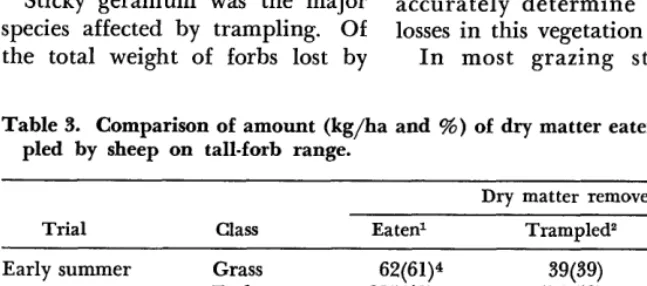
to be the total amount of forage removed minus the amount eaten. The total amount removed was the difference between the amounts of herbage on caged and open plots and the amount eaten was the in- take calculated from fistula and fecal samples (Table 3). Approxi- mately one-half of the total herbage removed in early and late summer was eaten, one-half was destroyed by trampling. Trampling damage was most severe in midsummer when it accounted for approxi- mately two-thirds of the herbage removed. By early August, all forbs had reached maximum height and were still quite succulent. Conse- quently, they were particularly sus- ceptible to being knocked over or otherwise damaged by the sheep. Sticky geranium was the major species affected by trampling. Of the total weight of forbs lost by
trampling, this species made up 43% in early summer, 70% in mid- summer, and 26% in late summer. Sticky geranium contributed 30- 40% of the herbage present, but was unpalatable to the sheep. Stems apparently were knocked down or broken off by animals as they for- aged. Yarrow, which has rather slender, easily broken leaves, was also severely affected by trampling. Thickstem aster was damaged by trampling in the early summer trial. Alpine leafybract aster, which flowers in middle to late summer, was damaged by trampling in late summer.
The trampling loss figures in Table 3 may be too high because intake figures might be low. How- ever, even if the amount of feed is increased to the suggested NAS- NRC level, 14% to 40% of the total forage removed can be attributed to trampling. A more sophisticated study design would help to more accurately determine trampling losses in this vegetation type.
In most grazing studies the
Table 3. Comparison of amount (kg/ha and %) of dry matter eaten and tram- pled by sheep on tall-forb range.
Dry matter removed
Trial Class Eaten1 Trampled2 Total3
Early summer Grass 62(61)4 39(39) 101
Forb 325(41) 471(59) 796
Total 387(43) 510(57) 897
Midsummer Grass 26(55) 21(45) 47
Forb 310(36) 544(64) 901
Total SlO(36) 565(63) 901
Late summer Grass 24( 12) 168(88) 192
Forb 395(62) 242(38) 637
Total 419(51) 410(49) 829
l Amount eaten ‘by sheep, calculated from fistula and fecal samples. s Amount trampled = total removed minus amount eaten.
aTotal amount removed, based on difference between herbage weights on caged and open plots.
’ Figures in parentheses are values expressed in percent.
amount of herbage lost by trampling has been all but ignored. Brown (1954) and Wagner et al. (1950) dis- cussed trampling loss as a factor that complicates evaluation of herb- age consumption on cultivated pas- tures, but they gave no quantitative data. Grelen (1967) found that uti- lization based on production inside and outside stationary cages on pine-bluestem ranges was greatly overestimated when grazing was heavy, but he did not attribute any of the error to trampling loss. Quinn and Hervey (1970) measured trampling loss on a sandhills grass range at 22 kg/ha (1% to 5% of the standing crop). This loss is small compared with the 410 to 465 kg per ha (17% to 23% of the standing crop) trampled in the present study. Differences in vegetation type (sod versus tall forb) and the animal type (cattle versus sheep) probably account for variances in the amounts
trampled in the two studies. The difference in amount of herbage present on caged and open plots was the method suggested for calculating the intake of grazing animals in the International Biolog- ical Program (Milner and Hughes, 1968). Correction for increased growth rate in areas caged for long periods was also suggested for IBP studies, but the authors did not propose any correction for trampling losses. In some vegeta- tion, such as the tall-forb type, trampling losses may be substantial, so the difference method overesti- mates total intake and gives a biased estimate of the botanical composi- tion of the diet.
production or cover in following years. By artificially flattening the stems of tall bluebell (Mertensia arizonica var. leonardi) during the
early flowering and fruiting stages for 4 consecutive years, Laycock and Conrad (1969) found that herb- age production was reduced by ap- proximately 50%. Similar studies for other species are needed to clar- ify the effect of trampling upon herbage production and vigor.
Conclusions
1. The esophageal fistula method is the most accurate method tested for determining the actual composition (either botanical or chemical) of the diet of sheep; how- ever, it is extremely time con- suming, both in the field and in the laboratory. For this reason, it is basically a research tool and not a technique suitable for actual range management operations. The fistula method does not accurately measure the total impact of grazing on the range because it accounts only for forage consumed and not for other losses, such as trampling. Utilization percentages of indi- vidual species are also inaccurate because of the number of steps and associated sampling errors in- volved in the calculation.
2. The difference in amount of herbage on paired, clipped plots is the best method for measuring the total impact of grazing on the range because it measures total herbage loss, both by consumption and by trampling. However, it is also time consuming. Because trampling losses are included, it is not a good method for determining the botani- cal composition of the actual diet of sheep. Plant species susceptible to trampling will be overrepre- sented in the diet.
3. The ocular-estimate-by-plot method probably is the best com- promise for determining both diet and utilization on large-scale range operations. It is rapid to use and yields relatively reliable data for most plant species. Whenever pos- sible, utilization estimates should be weighted by herbage production on the same plots (Smith, 1968).
Also important are adequate train- ing, procedures to minimize the ef- fect of personal bias, and other techniques to improve the method suggested by Smith et al. (1962). Observations before and after grazing or comparisons of produc-
tion on protected and grazed areas should be made to minimize the errors caused bv “invisible” utili- zation.
4. Studies are needed to deter- mine the amount of trampling damage that occurs in different vegetation types and the effect of trampling on production and vigor of individual species. With this information, management systems could be devised to minimize trampling damage and thus make more efficient use of rangelands.
Literature Cited
BROWN, DOROTHY. 1954. Methods of surveying and measuring vegetation. Commonwealth Bur. Pasture and Field Crop Bull. 24. 223 p.
FORBES, R. M., AND W. P. GARRIGUS. 1948. Application of a lignin ratio technique to the determination of the nutrient intake of grazing ani- mals. J. Anim. Sci. 7:373.
GRELEN, HAROLD E. 1967. Compari- son of cage methods for determining utilization on pine-bluestem ranges. J. Range Manage. 20:94-96.
KRUEGER, WILLIAM C. 1970. Rela- tionships of the special senses to forage selection. Ph.D. Diss., Utah State Univ., Logan, Utah. 87 p. LAYCOCK, W. A., AND P. W. CONRAD.
1969. How time and intensity of clipping affect tall bluebell. J. Range Manage. 22:299-303.
LEIGH, J. H., AND W. E. MULHA~~ 1966. Selection of diet by sheep grazing semi-arid pastures on the Riverine Plain. I. A bladder salt- bush (Atriplex vesicaria)-cotton bush (Koch&z aphyllu) community. Aus- tralian J. Exp. Agr. and Anim. Husb. 6:460-467.
LESPERENCE, A. L., AND V. R. BOHMAN. 1964. Chemical changes in forage induced by sample preparation. West. Sec. Amer. Sot. Anim. Sci. Proc. 15:54.
LULL, H. W. 1959. Soil compaction on forest and range lands. U.S. Dep. Agr. Misc. Pub. 768, 33 p.
MARTIN, S. CLARK. 1970. Relating vegetation measurement to forage
consumption by animals. P. 93-100,
in: Range and Wildlife Habitat
Evaluation-a Research Symposium. U.S. Forest Serv. Misc. Pub. 1147. MILNER, C., AND R. E. HUGHES. 1968.
Methods for the measurement of the primary production of grassland. Int. Biol. Program Handbook 6, 70 p. Blackwell Sci. Publications, Oxford. NATIONAL ACADEMY OF SCIENCES-NA-
TIONAL RESEARCH COUNCIL. 1957. Nutrient requirements of domestic animals: No. 5, nutrient require- ments of sheep. Nat. Acad. Sci.-Nat. Res. Count. Pub. 504, Wash., D.C. 33 p.
NATIONAL ACADEMY OF SCIENCES-NA- TIONAL RESEARCH COUNCIL. 1962.
Basic problems and techniques in range research. Nat. Acad. Sci.-Nat. Res. Count. Pub. 890, Wash., DC. 341 p.
PACKER, PAUL E. 1953. Effects of trampling disturbance on watershed conditions, runoff, and erosion. J. Forest. 51:28-31.
PECHANEC, J. F., AND G. D. PICKFORD. 1937. A comparison of some methods used in determining percentage uti- lization of range grasses. J. Agr. Res. 54: 753-765.
QUINN, JAMES A., AND DONALD F. HERVEY. 1970. Trampling losses and travel by cattle on sandhills range. J. Range Manage. 23:50-54. REYNOLDS, HUDSON G., AND PAUL E.
PACKER. 1962. Effects of trampling on soil and vegetation. P. 116-122, a : Range Research Methods: A rymposium, Denver, Colo., May 1962. U.S. Dep. Agr. Misc. Pub. 940. SMITH, DIXIE R. 1968. Bias in esti-
mates of herbage utilization derived from plot sampling. J. Range Man- age. 21: 109-l 10.
SMITH, DWIGHT R., P. 0. CURIE, J. V. BASILE, AND N. C. FRISCHKNECHT. 1962. Methods for measuring forage utilization and differentiating use by different classes of animals. P. 93- 102, in: Range Research Methods: A Symposium, Denver, Cola., May
1962. U.S. Dep. Agr. Misc. Pub. 940. VAN SOEST, P. J. 1963. Use of deter- gents in the analysis of fibrous feeds, II. A rapid method for the deter- mination of fiber and lignin. J. Assoc. Offic. Agr. Chem. 46:829. WAGNER, R. E., M. A. HEIN, J. B.