Nonlinearity of transform tone distortion white balancing
Contrast enhancementusing generalized equalization
Mudu Kavtiha1&Mr.K.Baskar2 1
M-Tech Dept. of ECE, SwarnaBharathi College of Engineering, Khammam.
2
HOD &Associative professor Dept. of ECE, SwarnaBharathi College of Engineering, Khammam.
Abstract
Generalized equalization model is proposed for image and video enhancement. Based on our analysis on
therelationships between image histogram and contrast enhancement/white balancing, is established by
integrating contrastenhancement and white balancing into a unified framework of convex programming
of image histogram. The imageenhancement tasks can be accomplished by the proposed model using
different configurations of parameters. With two definingproperties of histogram transform, namely
contrast gain and nonlinearity, the model parameters for different enhancementapplications can be
optimized. And then deriving an optimal image enhancement algorithm that theoretically achieves the
bestjoint contrast enhancement and white balancing result with trading-off between contrast
enhancement and tonal distortion.
Keywords:Contrast enhancement, generalized equalization, nonlinearity of transform, tone distortion,
white balancing.
Introduction
Image enhancement is conversion of the original
imagery to a better understandable level in
spectral quality for feature extraction or image
interpretation. It is useful to examine the image
Histograms before performing any image
enhancement. The x-axis of the histogram is the
range of the available digital numbers, i.e. 0 to
255. The y-axis is the number of pixels in the
image having a given digital number. Examples
of enhancement functions include
Contrast stretching to increase the tonal
distinction between various features in a
scene.
Filtering is commonly used to restore
imagery by avoiding noises to enhance
the imagery for better interpretation and
to extract features such as edges and
lineaments [1].
The most common types of filters: mean,
Figure.1 SPOT band before and after contrast
stretching with histogram.
Generally, tone mapping algorithms can be
classified into two categories by their
functionalities during the imaging process.
White Balancing:Color balance is the global
adjustment of the intensities of the colors. Color
balance changes the overall mixture of colors in
an image and is used for color correction;
generalized versions of color balance are used to
get colors other than neutrals to also appear
correct or pleasing. Several aspects of the
acquisition and display process make such color
correction essential – including the fact that the
acquisition sensors do not match the sensors in
the human eye, that the properties of the display
medium must be accounted for, and that the
ambient viewing conditions of the acquisition
differ from the display viewing conditions [2].
Contrast enhancement: Normally color images
are stored in RGB color space. At the first
glance it seems simple to apply histogram
equalization to a color image: just does it on
each channel. However, applying histogram
equalization separately on each channel of a
RGB will probably destroy the balance of
different color components and result in poor
image quality [3].
PRIOR ART:
In this section, we briefly describe some
enhancement methods. Graham D. Finlayson
proposed color by correlation: a simple,
unifying framework for color constancy related
work, where image of a three-dimensional scene
depends on a number of factors. First, it depends
on the physical properties of the imaged objects
thatare on their reflectance properties. But, it
also depends on the shape and orientation of
these objects and on the position, intensity, and
color ofthe light sources. Finally, it depends on
the spectral sampling properties of the imaging
device. Color constancy is the tendency to
perceive surface color consistently, despite
variations in ambient illumination. Central to
solving the color constancy problem is
recovering an estimate of the scene illumination
and it is that problem which is the focus of this
paper. Specifically, we consider how, given an
image of a scene taken under an unknown
illuminant, we can recover an estimate of that
light. Ji-heehan proposed novel 3-d color
histogram equalization method with uniform 1-d
of color histogram equalization methods do not
yield uniform histogram in gray scale. After
converting a color histogram equalized image
into gray scale, the contrast of the converted
image is worse than that of a 1-D gray scale
histogram equalized image. We propose a novel
3-D color histogram equalization method that
produces uniform distribution in gray scale
histogram by defining a new cumulative
probability density function in 3-D color space.
Test results with natural and synthetic images
are presented to compare and analyze various
color histogram equalization algorithms based
upon 3-D color histograms. In gamut mapping,
the gamut of colors in a test image is remapped
to the visible gamut under a standard illuminant,
and that mapping constrains the illuminant. In
normalization approaches, the range of
reflectances is normalized in each color channel,
and the adjustment required for normalization
yields an estimate of the illuminant. The
Bayesian algorithm is shown also to perform
significantly better than the grey world
algorithms, even when the grey world
algorithms are enhanced by inclusion of an
illumination [5].
Related Work
Image enhancement:
Image enhancement transforms images to
provide better representation of the subtle
details. It is an indispensable tool for researchers
in a wide variety of fields including (but not
limited to) medical imaging, art studies,
forensics and atmospheric sciences. It is
application specific: an image enhancement
technique suitable for one problem might be
inadequate for another. For example, forensic
images/videos employ techniques that resolve
the problem of low resolution and motion blur
while medical imaging benefits more from
increased contrast and sharpness. To cater for
such an ever increasing demand of digital
imaging, commercial software’s were released
for users who want to edit and visually enhance
the images. The purpose of this research is to
evaluate if image enhancement techniques
improve the visualization of these images and to
study the effect of such an approach.
Additionally, this work aims at contributing
towards shortening the training period of the
novice researchers in the lab [4].
Implementation
To overcome the disadvantages in existing
enhancement techniques, here we are dealing
with generalized equalization model.
Generalized equalization technique: Generalized
equalization model for image and video
enhancement, establishes a relationships
between image histogram and contrast
contrast enhancement and white balancing into a
unified framework of convex programming of
image histogram. System model: This method
unifies spatial filtering based enhancement
methods, including bi-lateral filter, non-local
means filter, steering regression and so on,
which has potential applications in image
enhancement. However, the computational
complexity of filtering based method is much
higher than traditional histogram based method
in most situations. In many cases, such as
real-time video surveillance, the histogram based
methods are still being widely used [8].
Figure.2 Block diagram of proposed model.
Whitening balance: Color balance is the global
adjustment of the intensities of the colors. Color
balance changes the overall mixture of colors in
an image and is used for color correction;
generalized versions of color balance are used to
get colors other than neutrals to also appear
correct or pleasing
Histogram Analysis On Gamma Correction:
Histogram-based algorithm has been widely
used in contrast enhancement Gamma refers to
the brightness of a monitor or computer display.
By applying gamma correction, the brightness
and contrast of the display are enhanced,
making the images appear brighter and more
Figure.3 Image and its histogram value.
Histogram equalization is a method in image
processing of contrast adjustment using the
image histogram. This method usually increases
the global contrast of many images, especially
when the usable data of the image is represented
by close contrast values. Through this
adjustment, the intensities can be better
distributed on the histogram. This allows for
areas of lower local contrast to gain a higher
contrast. Histogram equalization accomplishes
this by effectively spreading out the most
frequent intensity values [9].
Contrast Enhancement: Contrast enhancement
is a common operation in image processing. It's
a useful method for processing scientific images
such as X-Ray images or satellite images. And it
is also useful to improve detail in photographs
that are over or under-exposed. The goal of this
assignment is to develop a contrast enhancement
application that uses GPU acceleration. On this
page, the basic ideas and principles of contrast
enhancement using histogram modification are
given. We start with the simple case, contrast
enhancement for grayscale images. Then, we try
to apply the similar method to color images.
Weighting Distribution: The Gaussian blur is a
type of image-blurring filters that uses a
Gaussian function (which also expresses the
normal distribution in statistics) for calculating
the transformation to apply to each pixel in the
image.
Figure.4 Graphical representations of gamma
correction and CRT gamma correction.
Gamma encoding of images is required to
compensate for properties of human vision,
bandwidth relative to how humans perceive
light and color. Human vision, under common
illumination conditions, follows an approximate
gamma or power function, with greater
sensitivity to relative differences between darker
tones than between lighter ones [7].
Experimental Work
The generalized equalization model provides a
joint strategy for image enhancement. If we
relax to a small positive number, we can
combine white balancing and enhancement into
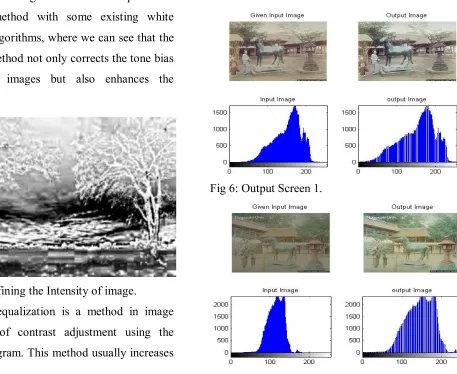
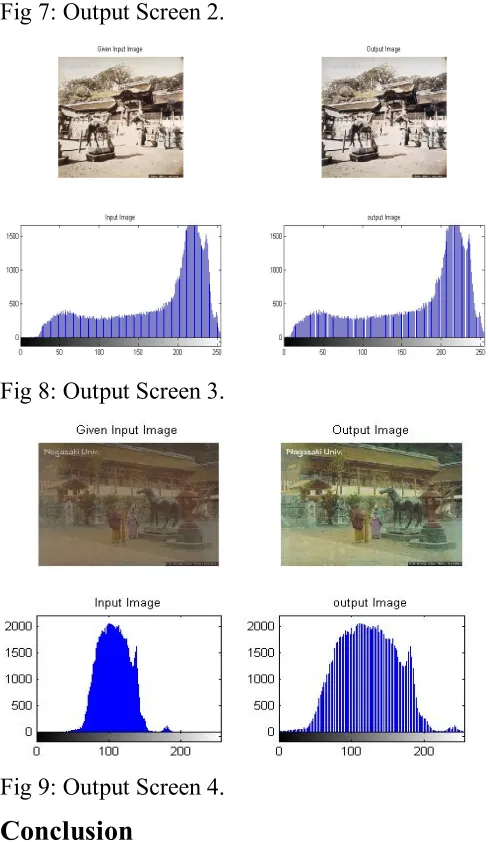
an integrated algorithm. we compare the
proposed method with some existing white
balancing algorithms, where we can see that the
proposed method not only corrects the tone bias
in original images but also enhances the
contrast.
Figure.5 Defining the Intensity of image.
Histogram equalization is a method in image
processing of contrast adjustment using the
image histogram. This method usually increases
the global contrast of many images, especially
when the usable data of the image is represented
by close contrast values. Through this
adjustment, the intensities can be better
distributed on the histogram. This allows for
areas of lower local contrast to gain a higher
contrast. Histogram equalization accomplishes
this by effectively spreading out the most
frequent intensity values. By applying gamma
correction, the brightness and contrast of the
display are enhanced, making the images appear
brighter and more natural looking [10].
Fig 7: Output Screen 2.
Fig 8: Output Screen 3.
Fig 9: Output Screen 4.
Conclusion
I have analyzed the relationships between image
histogram and contrast/tone and established
generalizedequalization model for global image
tone mapping. Extensive experimental results
suggest that the proposed methodhas good
performances in many typical applications
including image contrast enhancement, tone
correction, whitebalancing and post-processing
of de-hazed images. In future work, I have to
expand the values of dark pixels in animage
while compressing the higher values and
compress the dynamic range of images with
large variations in pixelvalues by using Bi-log
transformation algorithm.
References
1. T. Arici, S. Dikbas, and Y. Altunbasak, “A
histogram modification framework and its
application for image contrast enhancement,”
IEEETrans. Image Process., vol. 18, no. 9, pp.
1921–1935, 2009.
2. P. Milanfar, “A tour of modern image
filtering: New insights and methods, both
practical and theoretical,” IEEE Signal Process.
Mag.,vol. 30, no. 1, pp. 106–128, 2013.
3. R. C. Gonzalez and R. E. Woods, Digital
Image Processing, 3rd ed. Upper Saddle River,
NJ: Prentice- Hall, 2009.
4. A. K. Forrest, “Color histogram equalization
of multichannel images,” in Proc. IEEE Vis.
Image Signal Process., Dec. 2005, vol. 152,no.
6, pp. 677–686.
5. S. Naik and C. Murthy, “Hue-preserving
color image enhancement without gamut
problem,” IEEE Trans. Image Process., vol. 12,
no. 12,pp. 1591–1598, Dec. 2013.
6. X. Wu, “A linear programming approach for
optimal contrast-tone mapping,” IEEE Trans.
Image Process., vol. 20, no. 5, pp. 1262–
7. X. Zhu and P. Milanfar, “Restoration for
weakly blurred and strongly noisy images,” in
Proc. 2011 IEEE Workshop Applications
ofComputer Vision (WACV), 2011, pp. 103–
109.
8. X. Wu, “A linear programming approach for
optimal contrast-tone mapping,” IEEE Trans.
Image Process., vol. 20, no. 5, pp. 1262–
1272,2010.
9. J. A. Stark, “Adaptive image contrast
enhancement using generalizations of histogram
equalization,” IEEE Trans. Image Process., vol.
9,no. 5, pp. 889–896, 2000.
10. R. Tan, “Visibility in bad weather from a
single image,” in Proc. IEEE Int. Conf.
Computer Vision and Pattern Recognition,
2008, pp. 1–8.
Authors Profile
Name: MUDU KAVTIHA
B-Tech in Pulipati Prasad Institute Of
Technology And Science, Khammam,
percentage is 75.00%, year of completed April
2014.M.tech[ECE] (Electronics And
Communication Engineering)
College: SwarnaBharathi College Of
Engineering (SBCE), Khammam.
Mail.id: [email protected]
Phone number: 9949401125
Name:Mr.K.BASKAR, M-Tech (P.hd)
He is working as Associative professor in
Department of Electronics&communication
ENGINEERING at SWARNA BARATHI
COOLEGE OF ENGINEERING(SBCE),
KHAMMAM.He had 14 years teaching
experience. His research interests are Digital