Research Article
A Parallel Framework for Multipoint Spiral Search in
ab Initio
Protein Structure Prediction
Mahmood A. Rashid,
1,2Swakkhar Shatabda,
1,2M. A. Hakim Newton,
1Md Tamjidul Hoque,
3and Abdul Sattar
1,21Institute for Integrated & Intelligent Systems, Science 2 (N34) 1.45, 170 Kessels Road, Nathan, QLD 4111, Australia 2Queensland Research Lab, National ICT Australia, Level 8, Y Block, 2 George Street, Brisbane, QLD 4000, Australia 3Computer Science, 2000 Lakeshore Drive, Math 308, New Orleans, LA 70148, USA
Correspondence should be addressed to Mahmood A. Rashid; [email protected]
Received 31 October 2013; Revised 4 February 2014; Accepted 6 February 2014; Published 16 March 2014 Academic Editor: Rita Casadio
Copyright © 2014 Mahmood A. Rashid et al. This is an open access article distributed under the Creative Commons Attribution License, which permits unrestricted use, distribution, and reproduction in any medium, provided the original work is properly cited.
Protein structure prediction is computationally a very challenging problem. A large number of existing search algorithms attempt to solve the problem by exploring possible structures and finding the one with the minimum free energy. However, these algorithms perform poorly on large sized proteins due to an astronomically wide search space. In this paper, we present a multipoint spiral search framework that uses parallel processing techniques to expedite exploration by starting from different points. In our approach, a set of random initial solutions are generated and distributed to different threads. We allow each thread to run for a predefined period of time. The improved solutions are stored threadwise. When the threads finish, the solutions are merged together and the duplicates are removed. A selected distinct set of solutions are then split to different threads again. In ourab initioprotein structure prediction method, we use the three-dimensional face-centred-cubic lattice for structure-backbone mapping. We use both the low resolution hydrophobic-polar energy model and the high-resolution20 × 20energy model for search guiding. The experimental results show that our new parallel framework significantly improves the results obtained by the state-of-the-art single-point search approaches for both energy models on three-dimensional face-centred-cubic lattice. We also experimentally show the effectiveness of mixing energy models within parallel threads.
1. Introduction
Proteins are essentially linear chain of amino acids. They adopt specific folded three-dimensional structures to per-form specific tasks. The function of a given protein is
determined by its native structure, which has the lowest
possible free energy level. Nevertheless, misfolded proteins cause many critical diseases such as Alzheimer’s disease,
Parkinson’s disease, and cancer [1,2]. Protein structures are
important in drug design and biotechnology.
Protein structure prediction (PSP) is computationally a
very hard problem [3]. Given a protein’s amino acid sequence,
the problem is to find a three-dimensional structure of the protein such that the total interaction energy amongst the
amino acids in the sequence is minimised. The protein fold-ing process that leads to such structures involves very
com-plex molecular dynamics [4] and unknown energy factors. To
deal with the complexity in a hierarchical fashion, researchers have used discretised lattice-based structures and simplified
energy models [5–7] for PSP. However, the complexity of the
simplified problem still remains challenging.
There are a large number of existing search algorithms that attempt to solve the PSP problem by exploring
fea-sible structures calledconformations. For population-based
approaches, a genetic algorithm (GA+ [8]) reportedly
pro-duces the state-of-the-art results using hydrophobic-polar (HP) energy model. On the other hand, for local search
approaches, spiral search (SS-Tabu) [9], which is a tabu-based
local search, produces the best results using HP model. Both algorithms use three-dimensional (3D) face-centred-cubic (FCC) lattice for conformation representation.
The approaches used in [10–13] produced the
state-of-the-art results using the high resolution Berrera 20 × 20
energy matrix (henceforth referred to as BM energy model). Nevertheless, the challenges in PSP largely remain in the fact that the energy function that needs to be minimised in order to obtain the native structure of a given protein is
not clearly known. A high resolution20 × 20energy model
(such as BM) could better capture the behaviour of the actual energy function than a low resolution energy model (such as HP). However, the fine grained details of the high resolution interaction energy matrix are often not very informative for guiding the search. Pairwise contributions that have low magnitudes could be dominated by the accumulated pairwise contributions having large magnitudes. In contrast, a low resolution energy model could effectively bias the search towards certain promising directions particularly emphasis-ing on the pairwise contributions with large magnitudes.
In a collaborative human team, each member may work individually on his/her own way to solve a problem. They may meet together occasionally to discuss the possible ways they could find and may then refocus only on the more viable options in the next iteration. We envisage this approach to be useful in finding a suitable solution when there are enormously many alternatives that are very close to each other. We therefore try this in the context of conformational search for protein structure prediction.
In this paper, we present a multithreaded search tech-nique that runs SS-Tabu in each thread that is guided by
either HP energy or by20 × 20BM energy model. The search
starts with a set of random initial solutions by distributing these solutions to different threads. We allow each thread to run for a predefined period of time. The interim improved solutions are stored threadwise and merged together when all threads have finished their execution. After removing the duplicates from the merged solutions, a selected distinct set of solutions is then considered for next iteration. In our approach, multipoint start first helps find some promising results. For the next set of solutions to be distributed, the most promising solutions from the merged list are selected. Therefore, multipoint parallelism reduces the search space by exploring the vicinities of the promising solutions recursively. In our parallel local search, we use both the HP energy
model and 20 × 20 BM energy model on the 3D FCC
lattice space. The experimental results show that our new approach significantly improves over the results obtained by the state-of-the-art single-point search approaches for the similar models.
The rest of the paper is organized as follows:Section 2
describes the background of the protein structure;Section 3
presents the related work;Section 4.1presents the SS-Tabu
algorithm used in the parallel search approach; Section 4
describes our parallel framework in detail;Section 5discusses
and analyses the experimental results; and finally,Section 6
presents the conclusions and outlines the future work.
1, 0,−1
−1, −1, 0 −1, −1, 0
Z X
Y
0,
0,1,1
0,1,−1
1,1,0
1,0,1
1,−1,0
0, 0
0, −1, −1
0, −1, 1 −1, 0, −1
−1, 0, 1
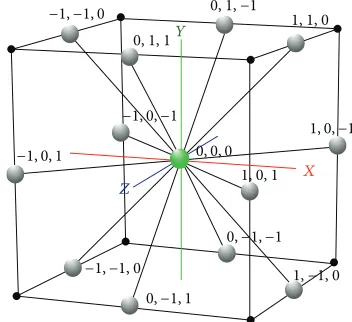
Figure 1: A unit 3D FCC lattice with 12 basis vectors on the Cartesian coordinates.
2. Background
There are three computational approaches for protein
struc-ture prediction. These are homology modeling [14], protein
threading [15,16], andab initiomethods [17,18]. Prediction
quality ofhomology modelingandprotein threadingdepends
on the sequential similarity of previously known protein
structures. However, our work is based on the ab initio
approach that only depends on the amino acid sequence of
the target protein. Levinthal’s paradox [19] and Anfinsen’s
hypothesis [20] are the basis ofab initiomethods for PSP.
The idea was originated in 1970 when it was demonstrated that all information needed to fold a protein resides in its amino acid sequence. In our simplified protein structure prediction model, we use 3D FCC lattice for conformation
mapping, HP and 20 × 20BM energy models for
confor-mation evaluation, and the spiral search algorithm [9]
(SS-Tabu) in a parallel framework for conformation search. The simplified models (lattice model and energy models) and local search are described below.
2.1. Simplified Model. In this research, we use 3D FCC lattice
points for conformation mapping to generate backbone of
protein structures. We use the HP and20 × 20BM energy
model for conformation evaluation. The 3D FCC lattice, the HP energy model, and BM energy model are briefly described below.
2.1.1. 3D FCC Lattice. The FCC lattice has the highest
packing density compared to the other existing lattices
[21]. The hexagonal close packed (HCP) lattice, also known
as cuboctahedron, was used in [22]. In HCP, each lattice
point has 12 neighbours that correspond to 12 basis vertices with real-numbered coordinates, which causes the loss of
structural precision for PSP. In FCC, each lattice point has12
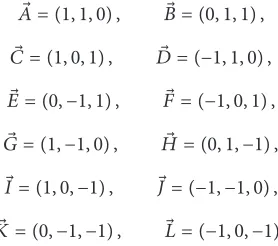
Figure 1 shows the 12 basis vectors with respect to the
origin. The basis vectors are presented below denoting as
⃗
𝐴 ⋅ ⋅ ⋅ ⃗𝐿:
⃗
𝐴 = (1, 1, 0) , ⃗𝐵 = (0, 1, 1) , ⃗𝐶 = (1, 0, 1) , 𝐷 = (−1, 1, 0) ,⃗ ⃗𝐸 = (0, −1, 1) , ⃗𝐹 = (−1, 0, 1) , ⃗𝐺 = (1, −1, 0) , 𝐻 = (0, 1, −1) ,⃗ ⃗𝐼 = (1, 0, −1) , ⃗𝐽 = (−1, −1, 0) , ⃗𝐾 = (0, −1, −1) , ⃗𝐿 = (−1, 0, −1) .
(1)
In simplified PSP, conformations are mapped on the
lattice by a sequence of basis vectors or by therelative vectors
that are relative to the previous basis vectors in the sequence.
2.1.2. HP Energy Model. The 20 amino acid monomers
are the building block of protein polymers. These amino acids are broadly divided into two categories based on their
hydrophobicity: (a) hydrophobic amino acids (Gly,Ala,Pro,
Val, Leu, Ile, Met, Phe, Tyr, Trp) denoted by H; and (b)
hydrophilic or polar amino acids (Ser, Thr, Cys, Asn, Gln,
Lys,His,Arg,Asp,Glu) denoted by P. In the HP model [23],
when two nonconsecutive hydrophobic amino acids become topologically neighbours, they contribute a certain amount
of negative energy, which for simplicity is shown as−1 in
Table 1. The total energy (𝐸) of a conformation based on the HP model becomes the sum of the contributions of all pairs of nonconsecutive hydrophobic amino acids as follows:
𝐸 = ∑
𝑖<𝑗−1
𝑐𝑖𝑗⋅ 𝑒𝑖𝑗. (2)
Here, 𝑐𝑖𝑗 = 1 if amino acids 𝑖 and 𝑗 are nonconsecutive
neighbours on the lattice, otherwise0; and𝑒𝑖𝑗= −1if𝑖th and
𝑗th amino acids are hydrophobic, otherwise0.
2.2. BM Energy Model. By analysing crystallised protein
structures, Miyazawa and Jernigan [24] in 1985 statistically
deduced a 20 × 20 energy matrix that considers residue
contact propensities between the amino acids. By calculat-ing empirical contact energies on the basis of information available from selected protein structures and following the
quasichemical approximation Berrera et al. [25] in 2003
deduced another20 × 20 energy matrix. In this work, we
use the latter model and denote it by BM energy model.
Table 2shows the BM energy model with amino acid names at the left-most column and the bottom-most row and the interaction energy values in the cells. The amino acid names
that have boldface are hydrophobic. We draw lines inTable 2
to show groupings based on H-H, H-P, and P-P interactions. In the context of this work, it is worth noting that most energy contributions that have large magnitudes are from H-H interactions followed by those from H-H-P interactions.
The total energy𝐸bm (shown in (3)) of a conformation
based on the BM energy model is the sum of the contributions
over all pairs of nonconsecutive amino acids that are one unit lattice distance apart:
𝐸bm= ∑
𝑖<𝑗−1
c𝑖𝑗⋅ 𝑒𝑖𝑗. (3)
Here,c𝑖𝑗= 1if amino acids at positions𝑖and𝑗in the sequence
are nonconsecutive neighbours on the lattice, otherwise0;
and𝑒𝑖𝑗is the empirical energy value between the𝑖th and𝑗th
amino acid pair specified in the matrix for the BM model.
2.3. Local Search. Starting from an initial solution, local
search algorithms move from one solution to another to find a better solution. Local search algorithms are well known for
efficiently producing high quality solutions [9,26,27], which
are difficult for systematic search approaches. However, they
are incomplete [28] and suffer from revisitation and
stagna-tion. Restarting the whole or parts of a solution remains the typical approach to deal with such situations.
2.4. Tabu Metaheuristic. Tabu metaheuristic [29, 30]
enhances the performance of local search algorithms. It maintains a short-term memory storage to remember the local changes of a solution. Then any further local changes for those stored positions are forbidden for a certain number of subsequent iterations (known as tabu tenure).
3. Related Work
There are a large number of existing search algorithms that attempt to solve the PSP problem by exploring feasible structures on different energy models. In this section we
explore the works related to HP and20× 20energy models as
below.
3.1. HP Energy-Based Approaches. Different types of
meta-heuristic have been used in solving the simplified PSP
prob-lem. These include Monte Carlo Simulation [31], Simulated
Annealing [32], Genetic Algorithms (GA) [33, 34], Tabu
Search with GA [35], Tabu Search with Hill Climbing [36],
Ant Colony Optimisation [37], Immune Algorithms [38],
Tabu-based Stochastic Local Search [26,27], and Constraint
Programming [39].
The Bioinformatics Group, headed by Rolf Backofen,
applied Constraint Programming [40–42] using exact and
complete algorithms. Their exact and complete algorithms work efficiently if similar hydrophobic core exists in the repository.
Cebri´an et al. [26] used tabu-based local search, and
Shatabda et al. [27] used memory-based local search with
tabu heuristic and achieved the state-of-the-art results.
How-ever, Dotu et al. [39] used constraint programming and
found promising results but only for smaller sized (length<
100amino acids) proteins. Besides local search, Unger and
Moult [33] applied population-based genetic algorithms to
PSP and found their method to be more promising than
the Monte Carlo-based methods [31]. They used absolute
Table 1: HP energy model [23].
H P
H −1 0
P 0 0
model. Later, Patton [43] used relative encodings to represent
conformations and a penalty method to enforce the self-avoiding walk constraint. GAs have been used by Hoque et al.
[22] for cubic and 3D HCP lattices. They used DFS-generated
pathways [44] in GA crossover for protein structure
predic-tion. They also introduced a twin-removal operator [45] to
remove duplicates from the population to prevent the search
from stalling. Ullah et al. in [12,46] combined local search
with constraint programming. They used a20 × 20 energy
model [25] on FCC lattice and found promising results.
In another hybrid approach [47], tabu metaheuristic was
combined with genetic algorithms in two-dimensional HP model to observe crossover and mutation rates over time.
However, for the simplified model (HP energy model and 3D FCC lattice) that is used in this paper, a new
genetic algorithm GA+ [8] and a tabu-based local search
algorithm Spiral Search [9] currently produce the
state-of-the-art results.
3.2. Empirical 20 × 20 Matrix Energy Based Approaches.
A constraint programming technique was used in [48] by
Dal Pal`u et al. to predict tertiary structures of real pro-teins using secondary structure information. They also used
constraint programming with different heuristics in [49]
and a constraint solver named COLA [50] that is highly
optimized for protein structure prediction. In another work
[51], a fragment assembly method was utilised with empirical
energy potentials to optimise protein structures. Among other successful approaches, a population-based local search
[52] and a population-based genetic algorithm [13] were used
with empirical energy functions.
In a hybrid approach, Ullah and Stein¨ofel [12] applied a
constraint programming-based large neighbourhood search technique on top of the output of COLA solver. The hybrid approach produced the state-of-the-art results for several
small sized (less than75amino acids) benchmark proteins.
In another work, Ullah et al. [46] proposed a two stage
optimisation approach combining constraint programming and local search. The first stage of the approach produced compact optimal structures by using the CPSP tools based on the HP model. In the second stage, those compact structures were used as the input of a simulated annealing-based local search that is guided by the BM energy model.
In a recent work [10], Shatabda et al. presented a mixed
heuristic local search algorithm for PSP and produced the state-of-the-art results using BM energy model on 3D FCC lattice. The mixed heuristic local search in each iteration randomly selects a heuristic from a given number of heuris-tics designed by the authors. The selected heurisheuris-tics are then used in evaluating the generated neighbouring solutions of the current solution. Although the heuristics themselves are weaker than the BM energy, their collective use in the random
mixing fashion produces results better than the BM energy itself.
3.3. Parallel Approaches. Vargas and Lopes [53] proposed
an Artificial Bee Colony algorithm based on two parallel approaches (master slave and a hybrid hierarchical) for protein structure prediction using the 3D HP model with sidechains. They showed that the parallel methods achieved a good level of efficiency while compared with the sequential version. A comparative study of parallel metaheuristics was
conducted by Trantar et al. [54] using a genetic algorithm, a
simulated annealing algorithm, and a random search method in grid environments for protein structure prediction. In
another work [55], they applied a parallel hybrid genetic
algorithm in order to efficiently deal with the PSP problem using the computational grid. They experimentally showed the effectiveness of a computational grid-based approach. All-atom force field-based protein structure prediction using parallel particle swarm optimization approach was proposed
by Kandov in [56]. He showed that asynchronous
parallelisa-tion speeds up the simulaparallelisa-tion better than the synchronous one and reduces the effective time for predictions
signifi-cantly. Among others, Calvo et al. in [57,58] applied a
par-allel multiobjective evolutionary approach and found linear speedups in structure prediction for benchmark proteins and
Robles et al. in [59] applied parallel approach in local search to
predict secondary structure of a protein from its amino acid sequence.
4. Our Approach
The driving force of our parallel search framework is SS-Tabu
[9] that has two versions: (i) the existing algorithm, designed
for HP model (as shown in Algorithm 1 and described in
Section 4.1) and (ii) the customised spiral search algorithm,
designed for 20 × 20 BM energy model (as shown in
Algorithm 5and described inSection 4.2). We feed the two versions of spiral search algorithms in different threads in different combinations. The variations are described in the experimental results section.
4.1. SS-Tabu: Spiral Search. SS-Tabu is a hydrophobic core
directed local search [9] that works in a spiral fashion. This
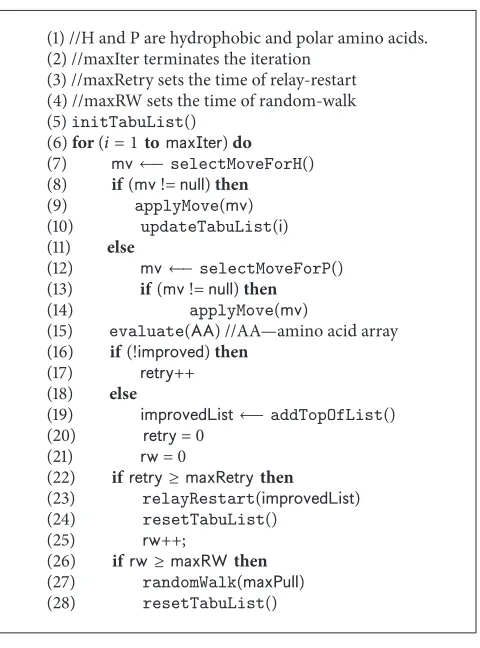
algorithm (the pseudocode in Algorithm 1) is the basis of
the proposed parallel local search framework. SS-Tabu is
composed of H and P move selections, random-walk [60],
and relay-restart [9]. However, this algorithm is further
customised for detailed20 × 20energy model as described
inSection 4.2. Both versions of SS-Tabu are used in paral-lel threads with different combinations within the paralparal-lel framework. The features of existing SS-Tabu are described in
Algorithm 1.
4.1.1. Applying Diagonal Move. In a tabu-guided local search
(seeAlgorithm 1), we use the diagonal move operator (shown inFigure 2) to build H-core. A diagonal move displaces𝑖th amino acid from its position to another position on the lattice
(1) //H and P are hydrophobic and polar amino acids. (2) //maxIter terminates the iteration
(3) //maxRetry sets the time of relay-restart (4) //maxRW sets the time of random-walk
(5)initTabuList()
(6) for (𝑖 = 1tomaxIter) do
(7) mv←selectMoveForH()
(8) if (mv!=null) then
(9) applyMove(mv)
(10) updateTabuList(i)
(11) else
(12) mv←selectMoveForP()
(13) if (mv!=null) then
(14) applyMove(mv)
(15) evaluate(AA) //AA—amino acid array
(16) if (!improved) then
(17) retry++
(18) else
(19) improvedList←addTopOfList()
(20) retry= 0
(21) rw= 0
(22) ifretry≥maxRetrythen
(23) relayRestart(improvedList)
(24) resetTabuList()
(25) rw++;
(26) ifrw≥maxRWthen
(27) randomWalk(maxPull)
(28) resetTabuList()
Algorithm 1:SpiralSearchHP(C).
A D
D
A
B B
C D G C G
E F E F
Figure 2: Diagonal move operator. For easy understanding, the figures are presented in 2D space.
preceding(𝑖 − 1)th amino acids in the sequence. The move is
just a corner-flip to an unoccupied lattice point.
4.1.2. Forming H-Core. Protein structures have hydrophobic
cores (H-core) that hide the hydrophobic amino acids from water and expose the polar amino acids to the surface to be
in contact with the surrounding water molecules [61]. H-core
formation is an important objective for HP-based protein structure prediction models. In our work, we repeatedly use the diagonal-move to aid forming the H-core. We maintain a tabu list to control the amino acids from getting involved in the diagonal moves. SS-Tabu performs a series of diagonal moves on a given conformation to build the H-core around
the hydrophobic core centre (HCC) as shown inFigure 3. The
Cartesian distance between the HCC and the current position
or a new position is denoted by𝑑1and𝑑2, respectively. The
d1
d1
d2
d2
HCC
HCC
HCC
Figure 3: Spiral search comprising a series of diagonal moves with tabu metaheuristics. For simplification and easy understanding, the figures are presented in 2D space.
diagonal move squeezes the conformation and quickly forms the H-core in a spiral fashion.
4.1.3. Selecting Moves for HP Model. In H-move selection
algorithm (Algorithm 2), the HCC is calculated (Line 2) by
finding arithmetic means of 𝑥, 𝑦, and𝑧 coordinates of all
hydrophobic amino acids using (4). The selection is guided
by the Cartesian distance 𝑑𝑖 (as shown in (5)) between
(1) //H denotes hydrophobic amino acids. (2) hcc←findHCoreCentre(S) (3) for (𝑖 = 1toseqLength) do
(4) if ((type[i]=“H”) and (¬tabuList[i])) then
(5) cfn←findCommonFreeNeigh(𝑖 + 1,𝑖 − 1)
(6) mvlocal←findShortestMove(hcc, cfn)
(7) moveList⋅add(mv)
(8) mvglobal←findShortestMove(moveList) (9) return mv
Algorithm 2: Thepseudocodeof H-move selection:selectMoveForH().
the 𝑖th hydrophobic amino acid, the common topological
neighbours of the (𝑖 − 1)th and (𝑖 + 1)th amino acids
are computed. The topological neighbours (TN) of a lattice point are the points at unit lattice-distance apart from it. From the common neighbours, the unoccupied points are identified. The Cartesian distance of all unoccupied common
neighbours is calculated from the HCC using (5). Then the
point with the shortest distance is picked. This point is listed
in the possible H-move list for𝑖th hydrophobic amino acid
if its current distance from HCC is greater than that of the selected point. When all hydrophobic amino acids are traversed and the feasible shortest distances are listed in H-move list, the amino acid having the shortest distance in H-move list is chosen to apply the diagonal move on it (Algorithm 1 Line 9). A tabu list is maintained for each hydrophobic amino acid to control the selection priority amongst them. For each successful move, the tabu list is updated for the respective amino acid. The process stops when no H-move is found. In this situation, the control is transferred to select and apply P-moves. Consider
𝑥hcc =
1 𝑛ℎ
𝑛ℎ
∑
𝑖=1
𝑥𝑖, 𝑦hcc=
1 𝑛ℎ
𝑛ℎ
∑
𝑖=1
𝑦𝑖, 𝑧hcc=
1 𝑛h
𝑛ℎ
∑
𝑖=1
𝑧𝑖,
(4)
where 𝑛ℎ is the number of H amino acids in the protein.
Consider
𝑑𝑖= √(𝑥𝑖− 𝑥hcc)
2+ (𝑦
𝑖− 𝑦hcc)
2+ (𝑧
𝑖− 𝑧hcc)
2. (5)
However, in P-move selection (Algorithm 1Line 12), the
same kind of diagonal moves is applied as H-move. For each
𝑖th polar amino acid, all free lattice points that are common
neighbours of lattice points occupied by(𝑖 − 1)th and(𝑖 +
1)th amino acids are listed. From the list, a point is selected
randomly to complete a diagonal move (Algorithm 1, Line 14)
for the respective polar amino acid. No hydrophobic-core-center is calculated, no Cartesian distance is measured, and no tabu list is maintained for P-move. After one try for each polar amino acid the control is returned to select and apply H-moves.
4.1.4. Handling Stagnation. For hard optimisation problems
such as protein structure prediction, local search algorithms often face stagnation. In HP model-based conformational
search, stagnation is encountered when a premature H-core is formed. Handling the stagnations is a challenging issue for conformational search algorithms (e.g., GA, LS). Thus, handling such situation intelligently is important to proceed further. To deal with stagnation, in SS-Tabu, random-walk
[60] and relay-restart techniques are used on an on-demand
basis.
Random-Walk.Premature H-cores are observed at local
min-ima. To escape local minima, a random-walk [60] algorithm
(Algorithm 1, Line 27) is applied. This algorithm uses pull
moves [62] to break the premature H-cores and to create
diversity.
Relay-Restart.When the search stagnation situation arises, a
new relay-restart technique (Algorithm 1Line 23) is applied
instead of a fresh restart or restarting from the current best
solution [26, 27]. We use relay-restart when random-walk
fails to escape from the local minima. The relay-restart starts from an improving solution. We maintain an improving solution list that contains all the improving solutions after the initialisation.
4.1.5. Further Implementation Details. Like other search
algo-rithms, SS-Tabu requires initialisation. It also needs evalua-tion of the soluevalua-tion in each iteraevalua-tion. It starts with a randomly generated or parameterised initial solution and enhances it in a spiral fashion. Further, it needs to maintain a tabu meta-heuristic to guide the local search.
Tabu Tenure.Intuitively we use different tabu-tenure values
based on the number of hydrophobic amino acids (hCount) in the sequence. We calculate tabu-tenure using the following formula:
tenure= ( 10 +ℎCount
10 ) . (6)
The tabu-tenure calculated using (6) is used at Lines 5, 24, and
28 inAlgorithm 1during initialising and resetting tabu-list.
Evaluation.After each iteration, the conformation is
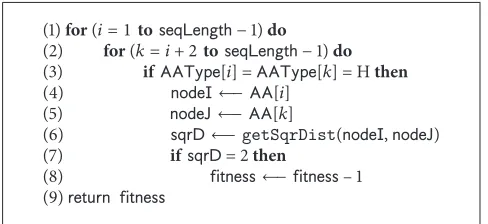
evalu-ated by counting the H-H contacts (topological neighbours)
where the two amino acids are nonconsecutive. The
pseu-docodeinAlgorithm 3presents the algorithm of calculating
(1) for (𝑖 = 1toseqLength−1) do
(2) for (𝑘 = 𝑖 + 2toseqLength−1) do
(3) ifAAType[𝑖] =AAType[𝑘] = H then
(4) nodeI←AA[𝑖]
(5) nodeJ←AA[𝑘]
(6) sqrD←getSqrDist(nodeI,nodeJ)
(7) ifsqrD= 2 then
(8) fitness←fitness– 1
(9)return fitness
Algorithm 3:evaluate(AA).
value is negation of the H-H contact count. For20 × 20BM
energy model the pairwise contact potentials are found in
matrix presented inTable 2.
Initialisation. Our algorithm starts with a feasible set of
conformations known as population. We generate each initial conformation following a randomly generated self-avoiding
walk (SAW) on FCC lattice points. Thepseudocode of the
algorithm is presented in Algorithm 4. It places the first
amino acid at(0, 0, 0). It then randomly selects a basis vector
to place the successive amino acid at a neighbouring free lattice point. The mapping proceeds until a self-avoiding walk is found for the whole protein sequence.
4.2. BM Model Adopted Spiral Search. The basic difference
between the HP energy based original spiral search (SS-Tabu
[9]) and the BM energy guided adopted spiral search lies on
the move selection criteria. In former version of spiral search, the amino acids are divided into two groups (H and P). The moves are selected based on these two properties of the amino acids that are guided by the distance of H amino acid from
the HCC. However, to adopt 20 × 20 BM energy model,
all 20 amino acids need to be taken into consideration and the move selection criteria are guided by the distance of any amino acid from the core centre (CC) of the current structure (Algorithm 5). The CC and the distance are calculated using
(7) and (8), respectively.
4.2.1. Selecting Moves for BM (20 × 20) Model. In move
selection (Algorithm 5Line 6), the CC is calculated by finding
arithmetic means of 𝑥, 𝑦, and 𝑧 coordinates of all amino
acids using (7). The selection is guided by the Cartesian
distance 𝑑𝑖 (as shown in (5)) between CC and the amino
acids in the sequence. For the𝑖th amino acid, the common
topological neighbours of the(𝑖 − 1)th and(𝑖 + 1)th amino
acids are computed. The topological neighbours (TN) of a lattice point are the points at unit lattice distance apart from it. From the common neighbours, the unoccupied points are identified. The Cartesian distance of all unoccupied common
neighbours is calculated from the CC using (8). Then the
point with the shortest distance is picked. This point is listed
in the possible move list for 𝑖th amino acid if its current
distance from CC is greater than that of the selected point. When all amino acids are traversed and the feasible shortest distances are listed in move list, the amino acid having the
Table 3: Combination of SS-Tabu variations amongst different threads.
Combinations HP guide SS-Tabu BM guide SS-Tabu
1 (PSSB4H0) 0 thread 4 threads
2 (PSSB3H1) 1 thread 3 threads
3 (PSSB2H2) 2 threads 2 threads
4 (PSSB1H3) 3 threads 1 thread
5 (PSSB0H4) 4 threads 0 thread
shortest distance in move list is chosen to apply the diagonal
move on it (Algorithm 5, Line 8). A tabu list is maintained
for each amino acid to control the selection priority amongst them. For each successful move, the tabu list is updated (Algorithm 5, Line 9) for the respective amino acid:
𝑥cc=
1 𝑛
𝑛
∑
𝑖=1
𝑥𝑖, 𝑦cc=
1 𝑛
𝑛
∑
𝑖=1
𝑦𝑖, 𝑧cc=
1 𝑛
𝑛
∑
𝑖=1
𝑧𝑖, (7)
where𝑛is the number of amino acids in the protein. Consider
𝑑𝑖= √(𝑥𝑖− 𝑥cc)2+ (𝑦𝑖− 𝑦cc)2+ (𝑧𝑖− 𝑧cc)2. (8)
4.3. Parallel Framework. In our implemented prototype, we
use four parallel threads. The two versions of SS-Tabu are
distributed amongst the four threads as shown inTable 3.
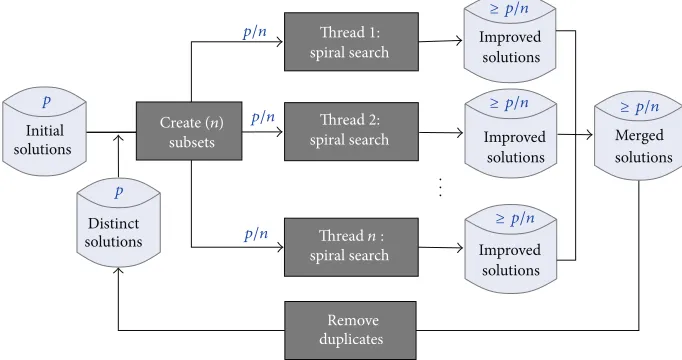
Figure 4 shows the architecture of our parallel search algorithm. In this framework, the search starts with a set of
randomly generated initial solutions (Line 2 inAlgorithm 6).
The solutions are then divided in subsets (Line 4 in
Algorithm 6) and are distributed to different threads. We allow each thread to run for a predefined period of time. The improved solutions are stored threadwise and are
merged together (Line 9 inAlgorithm 6) when all threads
finish. After removing the duplicates (Line 10 inAlgorithm 6)
from the merged solutions, a selected distinct set of solutions
are taken (Line 11 inAlgorithm 6) for the next iteration. The
iterative process continues until the terminating criteria (Line 3 inAlgorithm 6) are satisfied.
5. Experimental Results and Analyses
We conduct our experiments on two different sets of
(1) //AA—amino acid array of the protein (2) //SAW—Self-avoiding-walk
(3)basisVec[12] ←getTwelveBasisVectors()
(4)AA[0] ←AminoAcid(0, 0, 0)
(5) while (!SAW) do
(6) for (𝑖 = 1toseqLength−1) do
(7) 𝑘 ←getRandom(12)
(8) basis←basisVec[𝑘]
(9) node←AA[𝑖 − 1] + basis
(10) ifisFree(node) then
(11) AA[𝑖]←AminoAcid(node)
(12) else
(13) SAW←false
(14) break
(15)return AA[ ]
Algorithm 4:initialise().
(1) //maxIter terminates the iteration (2) //maxRetry sets the time of relay-restart (3) //maxRW sets the time of random-walk
(4)initTabuList()
(5) for (𝑖 = 1tomaxIter) do
(6) mv←selectMove()
(7) if (mv!=null) then
(8) applyMove(mv)
(9) updateTabuList(i)
(10) evalute(AA) //AA—amino acid array
(11) if (!improved) then
(12) retry++
(13) else
(14) improvedList←addTopOfList()
(15) retry= 0
(16) rw= 0
(17) ifretry≥maxRetrythen
(18) relayRestart(improvedList)
(19) resetTabuList()
(20) rw++;
(21) ifrw≥maxRWthen
(22) randomWalk(maxPull)
(23) resetTabuList()
Algorithm 5:SpiralSearchBM(C).
(1) //thr—Thread
(2)currSet←initialise()
(3) for (𝑖 = 1torepeat) do
(4) subSet←genSubSet(currSet)
(5) for (𝑖 = 1tothCount) do
(6) thr[𝑖] =createSSThread(subSet[i],time)
(7) thr[𝑖]⋅start()
(8) if (noAliveThread) then
(9) mrgLst=mergeImprovedLists()
(10) distinctLst=removeDuplicate(mrgLst)
(11) currSet←genCurrSet(distinctLst)
Table 4: For9medium sized proteins, the three different sets of excremental data—(i) our parallel local search framework (PSS), (ii) the tabu guided spiral search ( SS-Tabu ), and (iii) the genetic algorithms (GA+). The RI Columns present the relative improvements of parallel local search over the single-thread local search and the genetic algorithm. The RI is calculated on the average energy values.
Our approach The current state-of-the-art approaches
(Four threads) (Single thread)
Protein Info. 0.5 hrs×4 = 2 hrs 2 hrs×1 = 2 hrs
PSS SS-Tabu [9] GA+[8]
Seq Size LBFE Best Avg (𝐸𝑡) Best Avg (𝐸𝑟) RI Best Avg (𝐸𝑟) RI
F90 1 90 −168 −168 −166 −168 −167 0% −168 −166 0%
F90 2 90 −168 −168 −166 −167 −164 50% −168 −165 33%
F90 3 90 −167 −167 −165 −167 −165 0% −167 −164 33%
F90 4 90 −168 −168 −166 −168 −165 33% −168 −165 33%
F90 5 90 −167 −167 −165 −167 −165 0% −167 −166 0%
S1 135 −357 −355 −350 −355 −347 30% −355 −348 22%
S2 151 −360 −356 −351 −354 −347 31% −356 −349 18%
S3 162 −367 −360 −354 −359 −350 26% −361 −349 28%
S4 164 −370 −364 −358 −358 −350 40% −364 −352 33%
Table 5: For12large sized proteins, the three different sets of excremental data—(i) our parallel local search framework (PSS), (ii) the tabu guided spiral search (SS-Tabu), and (iii) the genetic algorithms (GA+). The RI Columns present the relative improvements of parallel local search over the single-thread local search and the genetic algorithm. The RI is calculated on the average energy values.
Our approach The current state-of-the-art approaches
(Four threads) (Single thread)
Protein Info. 1.25 hrs×4 = 5 hrs 5 hrs×1 = 5 hrs
PSS SS-Tabu [9] GA+[8]
Seq Size LBFE Best Avg (𝐸𝑡) Best Avg (𝐸𝑟) RI Best Avg (𝐸𝑟) RI
F180 1 180 −378 −359 −344 −357 −340 11% −351 −341 8%
F180 2 180 −381 −364 −352 −359 −345 19% −362 −346 17%
F180 3 180 −378 −368 −356 −362 −353 12% −361 −350 21%
R1 200 −384 −366 −353 −359 −345 21% −355 −346 18%
R2 200 −383 −368 −355 −358 −346 24% −360 −346 24%
R3 200 −385 −369 −353 −365 −345 20% −363 −344 22%
3mse 179 −323 −296 −285 −289 −280 12% −290 −279 14%
3mr7 189 −355 −332 −319 −328 −313 14% −328 −316 8%
3mqz 215 −474 −430 −414 −420 −402 17% −427 −410 6%
3no6 229 −455 −429 −407 −411 −391 25% −420 −400 13%
3no3 258 −494 −422 −404 −412 −393 11% −421 −402 2%
3on7 279 n/a −516 −500 −512 −485 n/a −515 −485 n/a
rest of this section will present the experimental results in detail.
5.1. Experiment Setup
5.1.1. Implementation. The parallel spiral search framework
has been implemented in Java 6.0 using Java standard APIs. Currently the source code is not available publicly due to the legal bindings. However, an executable version of the application could be requested to the corresponding author.
5.1.2. Execution. We ran our experiments on the NICTA
(NICTA website: http://www.nicta.com.au/) cluster. The
cluster consists of a number of identical Dell PowerEdge R415
computers, each equipped with2 ×AMD 6-Core Opteron
4184 processors, 2.8 GHz clock speed, 3M L2/6M L3 Cache,
64GB memory, and running Rocks OS (a Linux variant for
cluster). The experimental results presented in this paper are
obtained from50different runs of identical settings for each
protein when using HP benchmarks and20 different runs
of identical settings for each protein when using 20 × 20
benchmarks.
5.2. Experimental Results on HP Benchmark. The
experi-mental results on HP benchmarks are presented in Tables
4 and 5. Amongst the sequences, F90, S, F180, and R
instances are taken from Peter Clote laboratory
web-site (Peter Clote Lab:http://bioinformatics.bc.edu/clotelab/
FCCproteinStructure/). These instances have been used in [8,
Initial solutions
Distinct solutions p
p
p/n
p/n
p/n
Thread1:
spiral search
Thread2:
spiral search
spiral search
Threadn :
Remove duplicates
Improved solutions
solutions Improved
solutions
Improved solutions
Merged Create (n)
subsets
≥ p/n
≥ p/n
≥ p/n
≥ p/n
. . .
Figure 4: Parallel spiral search framework.
use other six larger sequences that are taken from the CASP
(CASP website: http://predictioncenter.org/casp9/targetlist
.cgi) competition. The corresponding CASP target IDs for
proteins3mse,3mr7,3mqz,3no6,3no3, and3on7areT0521,
T0520,T0525,T0516,T0570, andT0563. These CASP targets
are also used in [27]. To fit in the HP model, the CASP targets
are converted to HP sequences based on the hydrophobic properties of the constituent amino acids. The lower bounds
of the free energy values (in Column LBFEof Tables4and5)
are obtained from [26,27]; however, there are some unknown
values (presented as𝑛/𝑎) of lower bounds of free energy for
large sequences.
5.2.1. Results on Medium Sized HP Benchmark Proteins. In
Table 4, we present three different sets of result obtained from (i) our parallel local search framework that runs on four parallel threads (30 minutes/run), (ii) a local search (SS-Tabu) that runs on a single thread (2 hours/run), and
(iii) a genetic algorithm (GA+) that runs on a single thread
(2 hours/run). In the table, the Size column presents the
number of amino acids in the sequences, and the 𝐿𝐵𝐹𝐸
column shows the known lower bounds of free energy for
the corresponding protein sequences in Column𝐼𝐷. The best
and average free energy values for three different algorithms are presented in the table under the specific column headers
(PSS, SS-Tabu, and GA+). The RI Columns present the relative
improvements of parallel local search over the single-thread local search and the genetic algorithm. The bold-faced values indicate better performance in comparison to the other algorithms for corresponding proteins.
5.2.2. Results on Large Sized HP Benchmark Proteins. In
Table 5, we present three different sets of result obtained from (i) our parallel local search framework that runs on four parallel threads (1 hour 15 minutes/run), (ii) a local search (SS-Tabu) that runs on a single thread (5 hours/run), and (iii)
a genetic algorithm (GA+) that runs on a single thread (5
hours/run). In the table, theSizecolumn presents the number
of amino acids in the sequences, and the LBFEcolumn shows the known lower bounds of free energy for the corresponding
protein sequences in ColumnID. However, a lower bound
of free energy for protein3on7is not known. The best and
average free energy values for three different algorithms are presented in the table under the specific column headers
(PSS, SS-Tabu, and GA+). The RI Columns present the relative
improvements of parallel local search over the single-thread local search and the genetic algorithm. The bold-faced values indicate better performance in comparison to the other algorithms for corresponding proteins.
5.2.3. Relative Improvement on HP Benchmark. The difficulty
of improving energy level is increased as the improved energy level approaches to the lower bound of free energy. For example, if the lower bound of free energy of a protein is
−100, the efforts to improve energy level from−80 to−85
are much less than that to improve energy level from−95to
−100though the change in energy is the same (−5). Relative
Improvement (RI) explains how close our predicted results are to the lower bound of free energy with respect to the energy obtained from the state-of-the-art approaches:
RI= 𝐸𝑡− 𝐸𝑟
𝐸l− 𝐸𝑟
∗ 100%. (9)
In Tables 4 and 5, we also present a comparison of
improvements (%) on average conformation quality (in terms of free energy levels). We compare PSS (target) with SS-Tabu
and GA+(references). For each protein, the RI of the target
(𝑡) with respect to the reference (𝑟) is calculated using the
formula in (9), where𝐸𝑡 and𝐸𝑟 denote the average energy
values achieved by the target and the reference, respectively,
and𝐸lis the lower bound of free energy for the protein in
the HP model. We present the relative improvements only for the proteins having known lower bounds of free energy
−360 −350 −340 −330 −320 −310 −300
0 50 100 150 200 250 300
A
verag
e ener
g
y (
−
ve
)
Real time (minutes)
SST GA SSP
+
(a)
−360 −350 −340 −330 −320 −310 −300
0 50 100 150 200 250 300
A
verag
e ener
g
y (
−
ve
)
CPU time (minutes)
SST
SSP GA+
(b)
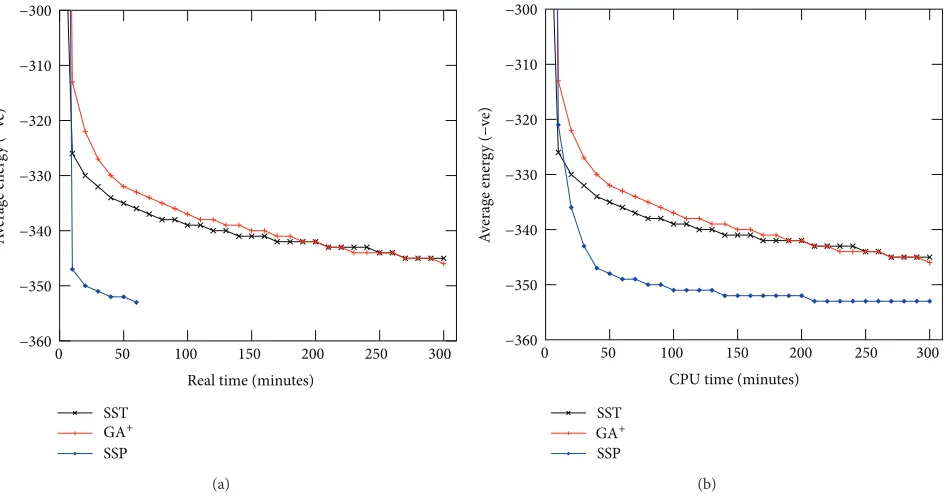
Figure 5: Search progress for protein R1 with (a) real time and (b) CPU time of 4 threads (4x real time). SST, GA+, and SSP represent tabu-based spiral search [9], genetic algorithms [8], and multipoint parallel spiral search, respectively.
various lengths. The bold-faced values are the minimum and the maximum improvements for the same column.
Improvement with respect to SS-Tabu. The experimental
results in Tables 4 and 5, at column RI under SS-Tabu,
show that our PSS is able to improve the search quality in terms of minimising the free energy level over all the 16 proteins considered for the test. The relative improvements
with respect to SS-Tabu range from0% to50%.
Improvement with respect to𝐺𝐴+.The experimental results in
Tables4and5, at column RI (relative improvement) under
GA+, show that our PSS is able to improve the search quality
in terms of minimising the free energy level over all 16
proteins considered for the test. The relative improvements
with respect to GA+range from0% to33%.
5.2.4. Search Progress. We compare the search progresses
of SS-Tabu, GA+, and PSS on the basis of real execution
time.Figure 5(a)shows the average energy values obtained
with times by the algorithms for protein R1. The graph shows that the progress of PSS stops at 75 minutes (1.25 hours). As we mentioned earlier, we run parallel threads (four threads) in our PSS for 1.25 hours to keep total CPU
time equal to five (1.25 × 4 = 5) hours. From the graph,
it is clear that multipoint local search with four parallel threads dramatically outperforms the local search and genetic algorithms within (1/4)th of the execution time.
However, in Figure 5(b), we compare the search
pro-gresses of SS-Tabu, GA+, and PSS over CPU time. The CPU
time of PSS is calculated by summing up the individual times
of all threads (time per thread×4) in different instances.
5.2.5. Comments on Our HP-Based Method. In Tables4and5,
the Columns LBFE represent the lower bound of free energy. Some of these values are taken from the literatures and others are obtained running exact and complete algorithms
based CPSP-tools [42]. However, we do not compare our
experimental results with results obtained from CPSP tools because of a fundamental conceptual difference between
our approaches and Will and Backofen [63, 64]. Will’s
HPstruct algorithm [65] proceeds with threading an input
HP sequence onto hydrophobic cores from a collection of precomputed and stored H-cores. On the other hand, our algorithms compute H-cores on the fly like Yue-Dill CHCC
method [61,66]. HPstruct requires a precomputed set of
H-cores for the number of H amino acids in the given sequence. Therefore, CPSP tools cannot find structure without the availability of a precomputed optimal H-core.
5.3. Experimental Results on 20×20 Benchmark. Besides HP
energy model, we apply our parallel framework on standard
20 × 20benchmark proteins. The protein instances used in our experiments are taken from the literature (as shown in
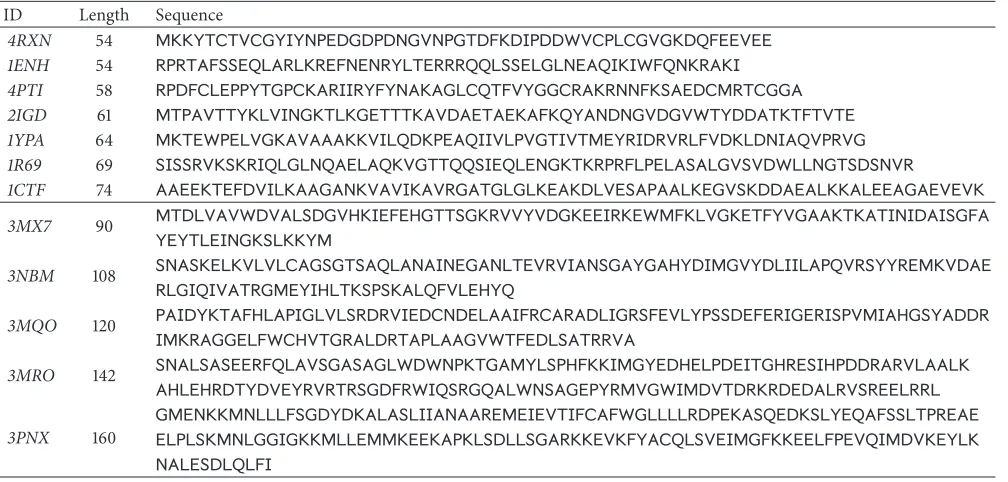
Table 6). The first seven proteins4RXN,1ENH,4PTI,2IGD,
1YPA,1R69, and1CTFare taken from [12] and the next five
proteins3MX7,3NBM,CMQO,3MRO, and3PNXfrom [10].
InTable 7, we present eight sets of experimental results. The approaches are described below.
(1) LS-Tabuis heuristically guided local search based on
tabu metaheuristic. The result presented in Table 7
under Column LS-Tabu is the output of 20 different
Table 6: The benchmark proteins used in our experiments. ID Length Sequence
4RXN 54 MKKYTCTVCGYIYNPEDGDPDNGVNPGTDFKDIPDDWVCPLCGVGKDQFEEVEE
1ENH 54 RPRTAFSSEQLARLKREFNENRYLTERRRQQLSSELGLNEAQIKIWFQNKRAKI
4PTI 58 RPDFCLEPPYTGPCKARIIRYFYNAKAGLCQTFVYGGCRAKRNNFKSAEDCMRTCGGA
2IGD 61 MTPAVTTYKLVINGKTLKGETTTKAVDAETAEKAFKQYANDNGVDGVWTYDDATKTFTVTE
1YPA 64 MKTEWPELVGKAVAAAKKVILQDKPEAQIIVLPVGTIVTMEYRIDRVRLFVDKLDNIAQVPRVG
1R69 69 SISSRVKSKRIQLGLNQAELAQKVGTTQQSIEQLENGKTKRPRFLPELASALGVSVDWLLNGTSDSNVR
1CTF 74 AAEEKTEFDVILKAAGANKVAVIKAVRGATGLGLKEAKDLVESAPAALKEGVSKDDAEALKKALEEAGAEVEVK
3MX7 90 MTDLVAVWDVALSDGVHKIEFEHGTTSGKRVVYVDGKEEIRKEWMFKLVGKETFYVGAAKTKATINIDAISGFA
YEYTLEINGKSLKKYM
3NBM 108 SNASKELKVLVLCAGSGTSAQLANAINEGANLTEVRVIANSGAYGAHYDIMGVYDLIILAPQVRSYYREMKVDAE
RLGIQIVATRGMEYIHLTKSPSKALQFVLEHYQ
3MQO 120 PAIDYKTAFHLAPIGLVLSRDRVIEDCNDELAAIFRCARADLIGRSFEVLYPSSDEFERIGERISPVMIAHGSYADDR
IMKRAGGELFWCHVTGRALDRTAPLAAGVWTFEDLSATRRVA
3MRO 142 SNALSASEERFQLAVSGASAGLWDWNPKTGAMYLSPHFKKIMGYEDHELPDEITGHRESIHPDDRARVLAALK
AHLEHRDTYDVEYRVRTRSGDFRWIQSRGQALWNSAGEPYRMVGWIMDVTDRKRDEDALRVSREELRRL
3PNX 160
GMENKKMNLLLFSGDYDKALASLIIANAAREMEIEVTIFCAFWGLLLLRDPEKASQEDKSLYEQAFSSLTPREAE ELPLSKMNLGGIGKKMLLEMMKEEKAPKLSDLLSGARKKEVKFYACQLSVEIMGFKKEELFPEVQIMDVKEYLK NALESDLQLFI
minutes duration. The algorithm runs on a single
thread using Berrera et al.20 × 20energy model.
(2) SS-Tabu is core directed local search based on
tabu metaheuristic works in an spiral fashion. The
result presented in Table 7 under Column SS-Tabu
is the output of 20 different runs of LS-Tabu [9] in
an identical setting over 60 minutes duration. The algorithm runs on a single thread using Berrera et al.
20 × 20energy model.
(3) PSSB4H0is a variant of parallel spiral search running
in 4 threads. In this variant of PSS, in all 4 threads,
the SS-Tabu is guided by Berrera et al.20 × 20energy
model. The parallel threads are terminated after 15
minutes. Therefore, the total CPU time remains (15 ×
4-threads) the same as the SS-Tabu or LS-Tabu.
(4) PSSB3H1is a variant of parallel spiral search running
in 4 threads. In this variant of PSS, in 3 threads,
the SS-Tabu is guided by Berrera et al. 20 × 20
energy model and in other threads, the SS-Tabu is guided by HP energy model. The parallel threads are terminated after 15 minutes. Therefore, the total CPU
time remains (15×4-threads) the same as the SS-Tabu
or LS-Tabu.
(5) PSSB2H2is a variant of parallel spiral search running
in 4 threads. In this variant of PSS, in 3 threads,
the SS-Tabu is guided by Berrera et al. 20 × 20
energy model and in other 2 threads, the SS-Tabu is guided by HP energy model. The parallel threads are terminated after 15 minutes. Therefore, the total CPU
time remains (15×4-threads) the same as the SS-Tabu
or LS-Tabu.
(6) PSSB1H3is a variant of parallel spiral search running
in 4 threads. In this variant of PSS, in 3 threads,
the SS-Tabu is guided by Berrera et al. 20 × 20
energy model and in other 3 threads, the SS-Tabu is guided by HP energy model. The parallel threads are terminated after 15 minutes. Therefore, the total CPU
time remains (15×4-threads) the same as the SS-Tabu
or LS-Tabu.
(7) PSSB0H4is a variant of parallel spiral search running
in 4 threads. In this variant of PSS, in all 4 threads, the SS-Tabu is guided by HP energy model. The parallel threads are terminated after 15 minutes. Therefore, the
total CPU time remains (15 × 4-threads) the same as
the SS-Tabu or LS-Tabu.
(8)𝐺𝐴+is population-based genetic algorithm that uses
hydrophobic-core directed macromutation operator and random-walk-based stagnation recovery tech-nique in addition to the regular GA operators. The
result presented inTable 7under Column GA+is the
output of 20 different runs of GA+[11] in an identical
setting over 60 minutes duration. The algorithm runs on a single thread using both HP and BM energy models in a mixing manner.
5.4. Energy Values on 20× 20 Benchmark. In Table 7, the
energy columns show the energy values obtained from
different approaches on 12 benchmark proteins (Table 6).
Although the searches are guided by both HP and BM energy models, the energy values are calculated by applying Berrera
et al.20 × 20energy matrix. The experimental results show
that amongst the parallel spiral search variants, PSSB1H3
(6out of12proteins) and PSSB0H4 (6out of12proteins)
produce better results in comparison to the other variants
performs better in comparison to the parallel spiral search
variants for9out of12proteins.
5.5. RMSD Values on 20 × 20 Benchmark. The RMSD is
frequently used to measure the differences between values predicted by a model and the values actually observed. We compare the predicted structures obtained by our approach with the state-of-the-art approaches by measuring the RMSD with respect to the native structures from PDB. For any given
structure, the RMSD is calculated using (10). The average
distance between two𝛼-Carbons in a native structure is3.8A.˚
To calculate RMSD, the distance between two neighbour
lattice points (√2 for FCC lattice) is considered as 3.8A.˚
Consider
RMSD= √∑
𝑛−1
𝑖=1 ∑𝑛𝑗=𝑖+1(𝑑𝑝𝑖𝑗− 𝑑𝑛𝑖𝑗)
2
𝑛 ∗ (𝑛 − 1) /2 , (10)
where𝑑𝑝𝑖𝑗and 𝑑𝑛𝑖𝑗denote the distances between𝑖th and𝑗th
amino acids, respectively, in the predicted structure and the native structure of the protein.
In Table 7, the RMSD columns show the root-mean-square deviation (RMSD) values obtained from different
approaches on 12 benchmark proteins (Table 6). The
exper-imental results show that amongst the parallel spiral search
variants, PSSB1H3 (7 out of 12 proteins) produces better
results in comparison to other variants in terms of lowest
RMSD values. However, when compared with GA+, the
parallel variants perform better for11out of12proteins.
5.6. Effect of Mixing Energy Models. The best hydrophobic
cores do not always correspond to the best structures in terms
of RMSD values [67,68]. These observations inspired us to
mix the energy models. The approaches presented inTable 7
are guided by BM, HP, or both energy models. However, the conformations are always evaluated using BM model. The experimental results show that when the variants are guided by HP or both BM and HP models (such as PSSB3H1, PSSB2H2, PSSB1H3, and PSSB0H4) it performs better than the variant guided by BM model (such as PSSB4H0). There-fore, from the observation of RMSD values, it is clear that HP model works as a better guidance heuristic, whereas BM model works as better model for evaluating conformations.
6. Conclusion
In this paper, we present a multipoint parallel local search framework that runs tabu-based local search (spiral search
[9]) in parallel threads. In our ab initio protein structure
prediction method, we develop two versions of SS-Tabu that
uses hydrophobic-polar energy model and20 × 20Berrera et
al. [25] energy model separately on face-centred-cubic lattice.
Collaboration and negotiation play vital roles in dealing with real world challenges. In our research, we try to adopt this analogy by considering each thread as a collaborator. We allow each thread to run for a predefined period of time. The threads are met in an assembly point when they finish
their execution and donate or accept better solutions to proceed with. The PSS starts with a set of random initial solutions by distributing a subset of solutions to different threads which are running different combinations of two versions of SS-Tabu. The interim improved solutions are stored threadwise and merged together when the threads finish. After removing the duplicates from the merged solu-tions, a selected distinct set of solutions is considered for the next iteration. In our approach, multipoint start helps find some promising solutions. For the next working set of solutions from the merged list, the most promising solutions are selected. Therefore, multipoint parallelism reduces the search space by exploring around the promising solutions in every iteration. The experimental results show that our new approach significantly improves over the results obtained by the state-of-the-art single-point search approaches.
Conflict of Interests
The authors declare that there is no conflict of interests regarding the publication of this paper.
Authors’ Contribution
Mahmood A. Rashid conceived the idea of applyingSpiral
Search in a parallel framework. M. A. Hakim Newton,
Swakkhar Shatabda, Md Tamjidul Hoque, and Abdul Sattar helped Mahmood A. Rashid in modeling, implementing, and testing the approach. All authors equally participated in analysing the test results to improve the approach and were significantly involved in the process of writing and reviewing the paper.
Acknowledgments
The authors would like to express their great appreciation
to the people managing theCluster Computing Services at
National ICT Australia (NICTA) and Griffith University. Md Tamjidul Hoque acknowledges the Louisiana Board of
Regents through the Board of Regents Support Fund,LEQSF
(2013-16)-RD-A-19. NICTA, the sponsor of the article for
publication, is funded by the Australian Government as represented by the Department of Broadband, Communica-tions and the Digital Economy and the Australian Research Council through the ICT Centre of Excellence program.
References
[1] A. Smith, “Protein misfolding,”Nature Reviews Drug Discovery, vol. 426, no. 6968, p. 78102, 2003.
[2] C. M. Dobson, “Protein folding and misfolding,”Nature, vol. 426, no. 6968, pp. 884–890, 2003.
[3] “So much more to know,”The Science, vol. 309, no. 5731, pp. 78– 102, 2005.
[5] C. A. Rohl, C. E. M. Strauss, K. M. S. Misura, and D. Baker, “Pro-tein structure prediction using rosetta,”Methods in Enzymology, vol. 383, pp. 66–93, 2004.
[6] J. Lee, S. Wu, and Y. Zhang, “Ab initio protein structure predic-tion,” inFrom Protein Structure to Function with Bioinformatics, pp. 3–25, 2009.
[7] Y. Xia, E. S. Huang, M. Levitt, and R. Samudrala, “Ab initio construction of protein tertiary structures using a hierarchical approach,”Journal of Molecular Biology, vol. 300, no. 1, pp. 171– 185, 2000.
[8] M. A. Rashid, M. T. Hoque, M. A. H. Newton, D. Pham, and A. Sattar, “A new genetic algorithm for simplified protein structure prediction,” inAI 2012: Advances in Artificial Intelligence, Lec-ture Notes in Computer Science, pp. 107–119, Springer, Berlin, Germany, 2012.
[9] M. A. Rashid, M. A. H. Newton, M. T. Hoque, S. Shatabda, D. Pham, and A. Sattar, “Spiral search: a hydrophobic-core directed local search for simplified PSP on 3D FCC lattice,”BMC Bioinformatics, vol. 14, supplement 2, article S16, 2013. [10] S. Shatabda and M. A. H. Newton, “Sattar a mixed heuristic
local search for protein structure prediction,” inProceedings of the 27th AAAI Conference on Artificial Intelligence, AAAI Press, 2013.
[11] M. A. Rashid, M. A. H. Newton, M. T. Hoque, and A. Sattar, “Mixing energy models in genetic algorithms for on-lattice protein structure prediction,”BioMed Research International, vol. 2013, Article ID 924137, 15 pages, 2013.
[12] A. D. Ullah and K. Steinh¨ofel, “A hybrid approach to protein folding problem integrating constraint programming with local search,”BMC Bioinformatics, vol. 11, supplement, article S39, 2010.
[13] S. R. D. Torres, D. C. B. Romero, L. F. N. Vasquez, and Y. J. P. Ardila, “A novel ab-initio genetic-based approach for protein folding prediction,” inProceedings of the 9th Annual Conference on Genetic and Evolutionary Computation (GECCO ’07), pp. 393–400, ACM, 2007.
[14] Y. Zhang and J. Skolnick, “The protein structure prediction problem could be solved using the current PDB library,” Proceedings of the National Academy of Sciences of the United States of America, vol. 102, no. 4, pp. 1029–1034, 2005.
[15] J. U. Bowie, R. Luthy, and D. Eisenberg, “A method to identify protein sequences that fold into a known three-dimensional structure,”Science, vol. 253, no. 5016, pp. 164–170, 1991. [16] A. Torda, “Protein threading,” in The Proteomics Protocols
Handbook, pp. 921–938, 2005.
[17] K. T. Simons, R. Bonneau, I. Ruczinski, and D. Baker, “Ab initio protein structure prediction of CASP III targets using ROSETTA,”Proteins, supplement 3, pp. 171–176, 1999.
[18] D. Baker and A. Sali, “Protein structure prediction and struc-tural genomics,”Science, vol. 294, no. 5540, pp. 93–96, 2001. [19] C. Levinthal, “Are there pathways for protein folding?”Journal
of Medical Physics, vol. 65, pp. 44–45, 1968.
[20] C. B. Anfinsen, “Principles that govern the folding of protein chains,”Science, vol. 181, no. 4096, pp. 223–230, 1973.
[21] T. C. Hales, “A proof of the Kepler conjecture,” Annals of Mathematics, vol. 162, no. 3, pp. 1065–1185, 2005.
[22] M. T. Hoque, M. Chetty, and A. Sattar, “Protein folding predic-tion in 3D FCC HP lattice model using genetic algorithm,” in Proceedings of the IEEE Congress on Evolutionary Computation, The Annals of Mathematics, pp. 4138–4145, 2007.
[23] K. F. Lau and K. A. Dill, “Lattice statistical mechanics model of the conformational and sequence spaces of proteins,” Macro-molecules, vol. 22, no. 10, pp. 3986–3997, 1989.
[24] S. Miyazawa and R. L. Jernigan, “Estimation of effective inter-residue contact energies from protein crystal structures: Quasi-chemical approximation,”Macromolecules, vol. 18, no. 3, pp. 534–552, 1985.
[25] M. Berrera, H. Molinari, and F. Fogolari, “Amino acid empirical contact energy definitions for fold recognition in the space of contact maps,”BMC Bioinformatics, vol. 4, article 8, 2003. [26] M. Cebri´an, I. IDot´u, P. V. Hentenryck, and P. Clote, “Protein
structure prediction on the face centered cubic lattice by local search,” inProceedings of the 23rd AAAI Conference on Artificial Intelligence, pp. 241–246, AAAI Press, July 2008.
[27] S. Shatabda, M. A. H. Newton, D. N. Pham, and A. Sattar, “Memory-based local search for simplified protein structure prediction,” in Proceedings of the 3rd ACM Conference on Bioinformatics, Computational Biology and Biomedicine (BCB ’12), ACM, Orlando, Fla, USA, 2012.
[28] B. Berger and T. Leighton, “Protein folding in the hydrophobic-hydrophilic (HP) model is NP-complete,”Journal of Computa-tional Biology, vol. 5, no. 1, pp. 27–40, 1998.
[29] F. Glover and M. Laguna,Tabu Search, vol. 1, Kluwer Academic, 1998.
[30] F. Glover, “Tabu search. Part I,”ORSA Journal on Computing, vol. 1, no. 3, pp. 190–206, 1989.
[31] C. Thachuk, A. Shmygelska, and H. H. Hoos, “A replica exchange Monte Carlo algorithm for protein folding in the HP model,”BMC Bioinformatics, vol. 8, article 342, 2007.
[32] A.-A. Tantar, N. Melab, and E.-G. Talbi, “A grid-based genetic algorithm combined with an adaptive simulated annealing for protein structure prediction,”Soft Computing, vol. 12, no. 12, pp. 1185–1198, 2008.
[33] R. Unger and J. Moult, “A genetic algorithm for 3D protein folding simulations,” in Proceedings of the 5th International Conference on Genetic Algorithms, Soft Computing-A Fusion of Foundations, Methodologies and Applications, pp. 581–588, Morgan Kaufmann Publishers, 1993.
[34] M. T. Hoque,Genetic Algorithm for ab initio protein structure prediction based on low resolution models [Ph.D. thesis], Gipp-sland School of Information Technology, Monash University, Monash, Australia, 2007.
[35] H. J. Bockenhauer, A. Z. M. D. Ullah, L. Kapsokalivas, and K. Steinhofel, “A local move set for protein folding in triangular lattice models,” inAlgorithms in Bioinformatics, K. A. Crandall and J. Lagergren, Eds., vol. 5251 ofLecture Notes in Computer Science, pp. 369–381, Springer, 2008.
[36] G. W. Klau, N. Lesh, J. Marks, and M. Mitzenmacher, “Human-guided tabu search,” inProceedings of the 18th National Confer-ence on Artificial IntelligConfer-ence (AAAI’ 02), pp. 41–47, August 2002. [37] C. Blum, “Ant colony optimization: Introduction and recent trends,”Physics of Life Reviews, vol. 2, no. 4, pp. 353–373, 2005. [38] V. Cutello, G. Nicosia, M. Pavone, and J. Timmis, “An immune
algorithm for protein structure prediction on lattice models,” IEEE Transactions on Evolutionary Computation, vol. 11, no. 1, pp. 101–117, 2007.
![Table 1: HP energy model [23].−](https://thumb-us.123doks.com/thumbv2/123dok_us/7916343.1314453/4.600.51.291.72.129/table-hp-energy-model.webp)