Individual performance effects of
multiple team-membership in research
and development
Student:
Maikel Snijder
Studentnumber:
1412817
Version:
3.0
2
Master thesis:
Individual performance effects of multiple team-membership in research and development
Faculty: Behavioural, Management and Social sciences (BMS) Program: Master Business Administration
Student: Maikel Snijder Studentnumber: 1412817
3
Preface
The master thesis in front of you is the final product of the master program “Business
Administration” at the University of Twente. The focus of this thesis is on the effect of Multiple Team Membership (MTM) on individual performance, which is very interesting and increasingly important in practice. This brings forth the need for more insights in this concept.
When I first discussed the effect of multiple team membership on individual performance with my supervisor, dr. Matthias de Visser, it seemed like a pretty straight forward topic. Boy was I wrong, talk about a mayor understatement! The effects of multiple team memberships on individual
performance are rather complex and are influenced by each level of the organization. The complexity of the subject at hand only served to increase my interest in the concept. As such, I genuinely hope future research will further our understanding of MTM and its effects on individual performance and the organization as a whole. Although studying MTM was more challenging than expected and conducting this study itself was not easy, the process was very rewarding and made everything worthwhile.
Even though I was the one who put in the work, I could not have done it on my own. When I started my master program at the University of Twente I was very determined to achieve the best results. Personal losses however made me lose my way and lose my focus. It was during this time that dr. de Visser kept guiding me and supporting me in finishing my thesis. Although this took a long while, he kept supporting me even when I was not as productive as I should have been. Thanks to his
continued support, I managed to find the courage and will to finish writing my thesis. For this I will be forever grateful. I also enjoyed the sessions we had regarding my thesis as it provided me with new insights and energy to continue my research. I also would like to thank dr. Ehrenhard for his feedback regarding earlier versions of this thesis. Secondly, I want to thank my family who always supported me and will continue to support me in the future. I also want to take the time to thank two of my friends, Martin Odink and Ferdi van Benthem, for their support and the interesting discussions I’ve had with them. Lastly, I would like to thank the most important person in my life, my wife Jolien Snijder, who helped me during the hard times and who continues to be a source of inspiration for me. Know that I love you.
I hope reading this master thesis will make you as enthusiastic as I am for the concept of multiple team membership.
Maikel Snijder
4
Abstract
Working in teams can be considered a standard within New Product Development (NPD) and R&D (O’Leary et al., 2011). In most cases employees will be involved in multiple teams simultaneously. The involvement of employees in multiple teams is called multiple team membership (MTM) and more research needs to be done on this concept due to its growing importance. The aim of this research is to add to the fast growing body of literature on MTM. This research focused on the relation between MTM and performance on the individual level. It was expected that MTM positive effects performance because it enables knowledge sharing between teams. Negative effects of MTM on individual performance were also expected due to the strain it puts on a individual’s cognitive abilities due to it dividing the individual’s attention and due to switching costs between projects. MTM influences all levels of the organization, so it also affects the team level (Hackman, 2003). The relation of performance on the individual and team level was also tested to provide insights on the connection between the levels. To test the expectations this research used a cross-sectional research design applying the use of a survey to gather data related to the variables. The data was gathered from one company and consisted of 18 surveys that were used in the sample. Due to the small sample size, a regression analysis could not be performed and thus the results of this study cannot be generalized. As such, the results can only be used as drivers for future research. The results overall did not show a significant correlation between MTM and individual performance. However the data suggested that the variables are connected and may moderate each other’s effect on individual performance. Further research should be done on this potentially moderation effect. The data showed that there is a significant correlation between individual performance and team
5
Table of content
Preface ... 3
Abstract ... 4
1 Introduction ... 7
1.1 Research question ... 9
2 Theoretical framework ... 10
2.1 Team-membership ... 10
2.2 Individual performance ... 11
2.3 MTM & Performance ... 12
2.3.1 Knowledge acquisition & attention ... 12
2.3.2 Transactive memory ... 14
2.3.3 Interdependencies ... 15
2.3.4 Individual vs team level ... 16
2.4 Research model ... 17
3 Methodology ... 18
3.1 Sample ... 18
3.2 Data collection ... 18
3.3 Measures ... 19
3.3.1 Dependent variable ... 19
3.3.2 Independent variable ... 20
4 Results ... 22
4.1 Descriptive statistics ... 22
4.2 Multiple team membership and individual project performance... 23
4.3 Portfolio heterogeneity and individual performance ... 24
4.4 Interdependency and individual performance ... 25
4.5 Individual and team performance ... 26
5 Discussion ... 27
5.1 Key findings & theoretical implications ... 27
5.2 Practical implications ... 28
5.3 Limitations and future research ... 29
5.4 Conclusion ... 30
6 References ... 31
7 Appendix ... 36
8 Although recent research acknowledges these negative effects, most studies on MTM focus on the organizational and team level, leaving out the aforementioned negative effects on the individual level (Mathieu et al., 2008; Schmidt & Dolis, 2009; Matthews et al., 2012). Therefore there is a growing interest on insights regarding the individual level and MTM. MTM may, for example, influence the experience and behaviors of individuals (Mortensen, Woolley and O’leary, 2007).
Thus it is important to provide insights on the challenges and opportunities brought on by MTM and how these could influence the individual job performance. Previous studies mostly focused on the psychological and cognitive influences of MTM and assumed that these influence the performance of the individual. The link between these psychological and cognitive influences and MTM however was not or limited empirically tested (Pluut et al., 2014; Zika et al., 2006; O’leary et al., 2011). What’s more, due to the three levels influencing each other, the link between MTM and performance can be considered very complex (O’leary et al., 2011). Despite the growing interest in MTM, previously research on MTM was mainly conducted in settings in which multiple team membership occurred noncontemporary, instead of in settings in which multiple team membership occurred
simultaneously, which, nowadays, is more often the case in current practice (Mathieu et al., 2008). As such, further research on MTM in multiple team memberships occurring simultaneously is needed.
As of 2015, only a few studies empirically tested the relationship between MTM and performance in a NPD setting (Bertolotti et al., 2015; Maynard, Gilson & Mathieu, 2012). Chan (2014) also concluded that empirical research is limited in this area. This thesis strives to close this gap in MTM literature, which is becoming increasingly relevant due to MTM slowly becoming the common way of working within NPD and R&D (Cummings & Haas, 2012; Pluut et al., 2014).
Most prior studies mostly focused on the team level and its effects (Bertolotti et al., 2015; Mortensen, 2014). I however suggest that these effects start at the individual level and that the effects are influenced by the number of projects one is simultaneously active in. As such, this thesis will also contribute to the existing literature by providing insights on the effects of the individual level, in MTM, on performance. Due to the complexity of all three levels, the interconnectivity of their effect on performance and the aforementioned gap, I choose to focus on the more overlooked level, the individual level. By doing so I strive to provide more insights on this level and its effects on performance and reduce the overall complexity of this subject. I also strive to further our
understanding on the connectivity of all three levels, as very little is known about the
9
1.1
Research question
All in all, this research strives to provide further insights on the relationship between MTM and individual performance. Secondly, it also strives to test the relationship between performance on the individual level and team level within a MTM setting. More specifically, the goal is to clarify and test the relationship between characteristics of MTM and performance. The characteristics included in this study: the number of MTM, the variance of the type of project and the extent of
interdependence of the team members within the project.
In order to achieve the aforementioned goal, the following research question was posited:
What are the effects of multiple team membership on individual performance and how does multiple team membership affect team performance?
10
2
Theoretical framework
This theoretic framework contains the key theories and constructs on MTM, its effects on the performance of an individual and the relationship between the individuals’ performance and team performance as a whole. This chapter starts off by defining the constructs team membership and individual performance. Subsequently, a description of multiple team memberships will be provided as will insights on its relation with performance. Lastly, the individual and team level will be
discussed. The hypotheses tested in this study will also be introduced in this section.
Relevant literature on these topics has been found using dedicated scientific databases, such as Scopus and Google Scholar. Appendix A provides an overview of the search terms used.
2.1
Team-membership
Kozlowski & Bell (2013) provide the following general definition regarding teams:
‘’Teams are composed of two or more individuals, who exist to perform organizationally relevant tasks, share one or more common goals, exhibit task interdependencies, interact socially, maintain and manage boundaries, and are embedded in an organizational context that sets boundaries, constrains the team, and influences exchanges with other units in the broader entity.’’(Kozlowski & Bell, 2013).
This definition encompasses what a team is, however what is more important for teams active in NPD.
In their research Hollenbeck, Beersma, and Schouten (2012) mention multiple types of teams based on their findings in literature. These types were categorized based on three dimensions. In their list of taxonomies, two types mentions innovation or improvements by new ideas and therefore relate the most to NPD. These taxonomies are the following:
- Project/development teams: teams that consist of professionals who collaborate on projects with (mostly) complex and unique outputs. These teams focus more on innovation, have broad autonomy, and an extended team life span (Sundstrom, de Meuse, Futrell, 1990). - Project teams: Teams that produce one-time outputs which involve a considerable amount
of knowledge, judgement, and expertise. The project team performance may be an improvement or a radical new idea. To achieve this, the team consist mostly of members from different disciplines and functional units (Cohen & Bailey, 1997).
11
2.2
Individual performance
Project performance is widely discussed in literature (Bonner, Ruekert, and Walker, 2002; Hoegl, Weinkauf, and Gemuenden, 2004; Olson et al., 2001). De Visser et al. (2014) define project
performance as the extent to which a team is able to meet established project objectives. As a team consist of individuals, project performance can be seen from the individual and team level (Peterson, 2007; Katz & Allen, 1985). Performance at the individual level affects the team performance and the organization of the team may affect the individual performance (Han & Williams, 2008; Gibson, 2001). Individual performance may vary between team members leading to reconfigurations of the team’s work in order to achieve the objectives of the project as a team (Han & Williams, 2008).
Job performance is applicable at the individual level and it encompasses the contributions of an individual towards the goals of a team (Motowidlo, Borman & Schmit, 1997). Regarding job performance a distinction is made between task performance and contextual performance
(Motowidlo & van Scotter, 1994). Task performance describes how the individual performs his/her tasks and meets his/her work goals. Task performance focusses on measuring individual
performance. Contextual performance encompasses behavior that go beyond the prescribed work goals that support the organization, focusing on the broader organizational environment (Motowidlo et al., 1997). Contextual performance focuses more on how an individual cooperates with others. Seeing as this study focusses on the individual’s performance, task performance seems to be the better fit for measuring individual performance. This research does not take into account the characteristics of the organization, as it is expected that this would increase complexity tremendously. This decision can be considered a limitation of this research.
17 However, the individual learning effects and possibilities of knowledge sharing may provide a
stronger positive effect at the team level (Gibson, 2001). Han & Williams (2008) tested this effect and found that the individual results extended towards the pooled team results. Shin, Kim, Lee and Brian (2012) as well as Tims, Bakker, Derks & van Rhenen (2013) all found a connection between the individual level performance and the team level performance. As such, one would expect a connection between the individual level performance and the team level performance in a MTM setting. Given the complexity of and challenges posited by a MTM setting, this connection should be tested within a MTM setting as well. This leads to the following hypothesis:
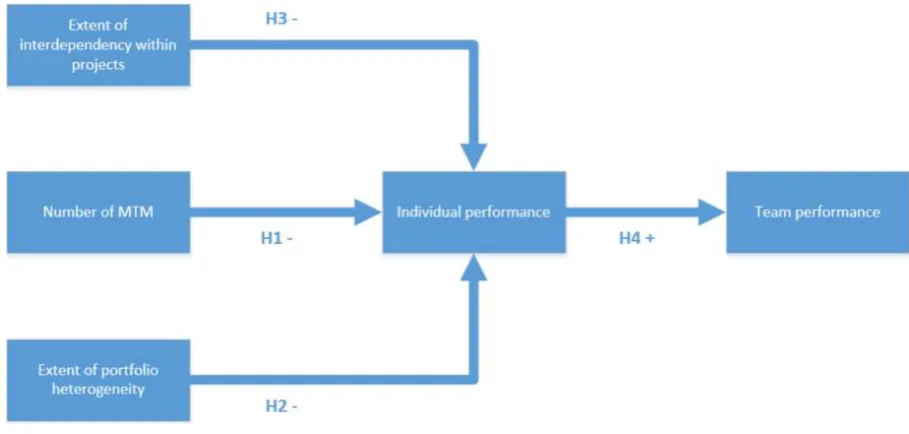
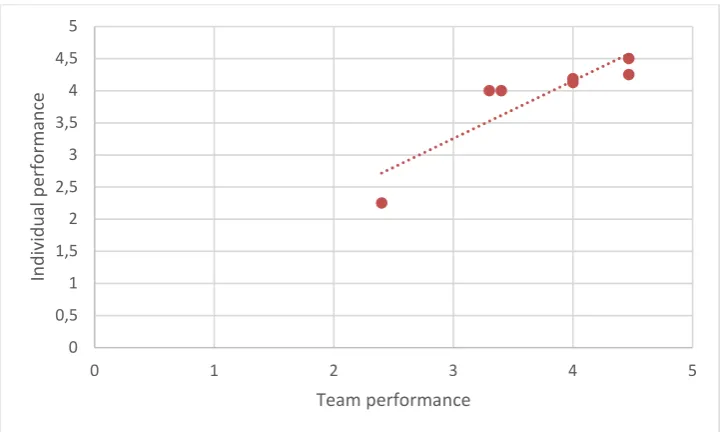
H4:The individual performance of team members positively relates to the team performance.
2.4
Research model
The hypotheses mentioned above led to the following research model for this research:
21 No consensus was reached in regards to a definition for both of these terms (Gupta, Smith & Shalley, 2006). In general exploration can be defined as the search for new knowledge and alternatives and exploitation focusses on exploiting the current knowledge and the improving the application thereof (March, 1991; Gupta, Smith & Shalley, 2006; Vermeulen & Barkema, 2001). To prevent ambiguity in regards to these terms, the respondents were provided with a short description of each of the categories:
- Explorative activities such as the development of new products or large adjustments to current products
- Exploitative activities such as improving a current product for production or efficiency purposes.
The projects were scored with a 5-point Likert scale (1 = Explorative, 5=Exploitative). The participants were asked to score their project as either explorative or exploitative, using the aforementioned Likert scale and the average score on this question was calculated for their portfolio. This average represents the general type of the portfolio and thus the type the respondent is most active in. This average score is compared with the individual scores for the projects in the sample. The difference between these two scores represents the variance between the portfolio and the focal project. The higher the difference the more heterogenous the individual project portfolio.
The extend of interdependencies in the project
To measure task interdependence the items from van der Vegt, Emans & van de Vliert (1999) are adopted. The items are mentioned below and measured with a 5-point Likert scale (1=strongly disagree, 5=strongly agree):
- My own performance depends on receiving information and advice from my colleague - I depend on my colleague’s work for materials and/or requisites that I need to do my job - I depend on my colleague’s work for help and support that I need to do my job
- I depend on my colleague’s in order to be able to do my work well
22
4
Results
The results of the analyses will be described in this section. First, the characteristics of the data and the descriptive statistics regarding the variables will be described. Second, the results for the hypotheses will be given.
4.1
Descriptive statistics
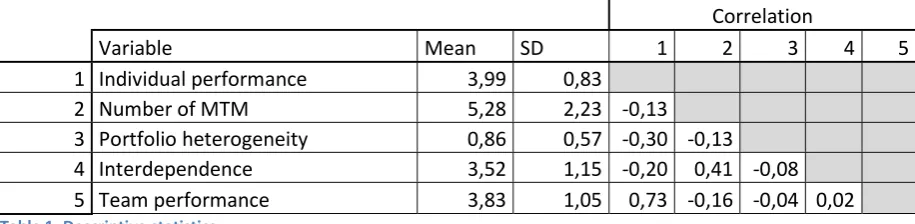
Table 1 shows the descriptive statistics and correlations for all variables used in this research. As mentioned earlier, not enough data was gathered for a regression analysis. Due to this, the
significance of the correlation was not determined using a P-value and other methods regarding the quality of the sample were not conducted. The results therefore can only be used as driver for future research.
Correlation
Variable Mean SD 1 2 3 4 5
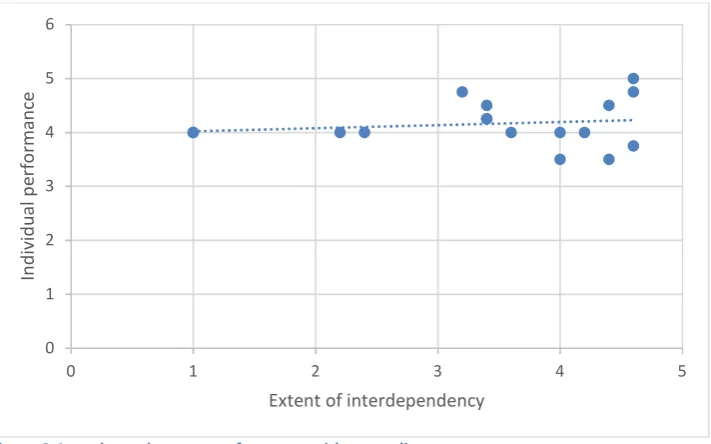
1 Individual performance 3,99 0,83 2 Number of MTM 5,28 2,23 -0,13 3 Portfolio heterogeneity 0,86 0,57 -0,30 -0,13 4 Interdependence 3,52 1,15 -0,20 0,41 -0,08 5 Team performance 3,83 1,05 0,73 -0,16 -0,04 0,02
Table 1: Descriptive statistics
30 The organization can take measures to support the MTM setting, for example by providing
employees with similar projects and task enabling knowledge transfer with positive effects. These measures at the organizational level were not taken into account in this research as it focused on the individual level. However more insight on how the different levels interact with each other is needed. As this research attempted to support a connection between the individual level and team level, future research should pursue this even further, while also taking the organization level into account.
Lastly, the results of this research are surprising and indicate that there is a connection between the independent variable of this study (Number of MTM, the heterogeneity of projects , and
interdependence). As this research did not test this effect, it provides an opportunity for future research.
I hope that the findings of this study will encourage potential research in the above mentioned directions.
5.4
Conclusion
The goal of this research was to contribute to the MTM literature by determining the effect of MTM on performance on the individual level and how the performance at the individual level correlates with performance at the team level. This led to the following research question:
What are the effects of multiple team membership on individual performance and how does multiple team membership affect team performance?
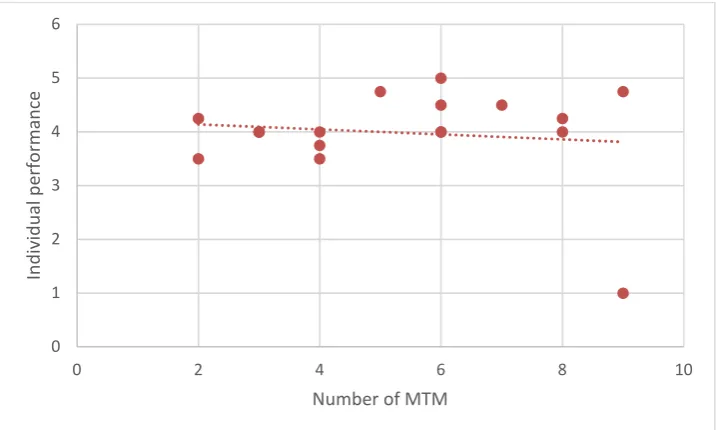
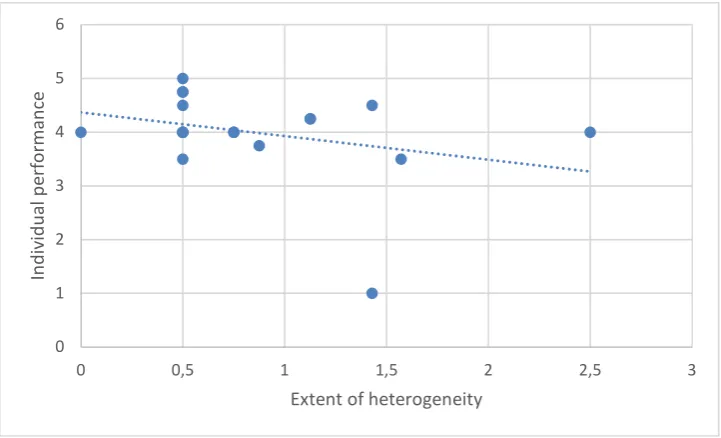
Using limited data gathered via a questionnaire several hypotheses were tested. The data mostly showed no significant correlations, which could be due to the limited data set. Given the explorative nature of this study, the results may still prove interesting for future research. A negative effect of MTM on individual performance was expected, however the data showed otherwise, indicating that the positive effects of MTM are more applicable/stronger than the negative effects. The second hypothesis expected a decrease in performance when projects within a portfolio showed less similarities is supported. As knowledge transfer is an important advantage of MTM, similarities between projects increases the positive effect of MTM on performance. The third hypothesis tested was not supported. The data showed an increase of performance with an increase of
31
6
References
Altmann, E. M., & Gray, W. D. (2008). An integrated model of cognitive control in task switching. Psychological Review, 115(3), 602–639.
Ancona, D. G., & Caldwell, D. F. (1992). Demography and design: Predictors of new product team performance. Organization science, 3(3), 321-341.
Austin JR (2003) Transactive memory in organizational groups: The effects of content, consensus, specialization, and accuracy on group performance. J. Appl. Psych. 88(5):866–878.
Baregheh, A., Rowley, J., & Sambrook, S. (2009). Towards a multidisciplinary definition of innovation. Management decision, 47(8), 1323-1339.
Bailey, B. P., & Konstan, J. A. (2006). On the need for attention-aware systems: Measuring effects of interruption on task performance, error rate, and affective state. Computers in human behavior,
22(4), 685-708.
Becker, T. E., Billings, R. S., Eveleth, D. M., & Gilbert, N. L. (1996). Foci and bases of employee commitment: Implications for job performance. Academy of management journal, 39(2), 464-482.
Bertolotti, F., Mattarelli, E., Vignoli, M., & Macrì, D. M. (2015). Exploring the relationship between multiple team membership and team performance: The role of social networks and collaborative technology. Research Policy, 44(4), 911-924.
Brandon, D. P., & Hollingshead, A. B. (2004). Transactive memory systems in organizations: Matching tasks, expertise, and people. Organization science, 15(6), 633-644.
Bresman, H., 2010. External learning activities and team performance: a multimethod field study. Org. Sci. 21 (1), 81–96.
Campion, M., Medsker, G., & Higgs, A. (1993). Relations between work groups characteristics and effectiveness: Implications for designing effective work groups. Personnel Psychology, 46, 823–855.
Campion, M. A., Papper, E. M., & Medsker, G. J. (1996). Relations between work team characteristics and effectiveness: A replication and extension. Personnel psychology, 49(2), 429-452
Chan, K. Y. (2014). Multiple project team membership and performance: Empirical evidence from engineering project teams. South African Journal of Economic and Management Sciences, 17(1), 76-90.
Cohen, S. G., & Bailey, D. E. (1997). What makes teams work: Group effectiveness research from the shop floor to the executive suite. Journal of management, 23(3), 239-290.
Cross, R., & Cummings, J. N. (2004). Tie and network correlates of individual performance in knowledge-intensive work. Academy of management journal, 47(6), 928-937.
32 De Veaux, R. D., Velleman, P. F., Bock, D. E. (2012). Stats: data and models. Boston: Pearson/Addison Wesley.
Engwall, M., & Jerbrant, A. (2003). The resource allocation syndrome: the prime challenge of multi-project management?. International journal of project management, 21(6), 403-409.
Gibson, C. B. (2001). Me and us: Differential relationships among goal-setting training, efficacy and effectiveness at the individual and team level. Journal of Organizational Behavior: The International Journal of Industrial, Occupational and Organizational Psychology and Behavior, 22(7), 789-808.
Gupta, A. K., Smith, K. G., & Shalley, C. E. (2006). The interplay between exploration and exploitation. Academy of management journal, 49(4), 693-706.
Gibson, C. B. (2001). Me and us: Differential relationships among goal-setting training, efficacy and effectiveness at the individual and team level. Journal of Organizational Behavior, 22(7), 789-808.
Green, S. B. (1991). How many subjects does it take to do a regression analysis. Multivariate behavioral research, 26(3), 499-510.
Hackman, J. R. (2003). Learning more from crossing levels: Evidence from airplanes, orchestras, and hospitals. Journal of Organizational Behavior, 24, 1–18.
Han, T. Y., & Williams, K. J. (2008). Multilevel investigation of adaptive performance: Individual-and team-level relationships. Group & Organization Management, 33(6), 657-684.
Hoegl, M., Weinkauf, K., & Gemuenden, H. G. (2004). Interteam coordination, project commitment, and teamwork in multiteam R&D projects: A longitudinal study. Organization science, 15(1), 38-55.
Hollenbeck, J. R., Beersma, B., & Schouten, M. E. (2012). Beyond team types and taxonomies: A dimensional scaling conceptualization for team description. Academy of Management Review, 37(1), 82-106.
Johnson, R., Chang, C., & Lord, R. (2006). Moving from cognition to behavior: What research says. Psychological Bulletin, 132(3), 381–415.
Kanfer, R., & Ackerman, P. L. (1989). Motivation and cognitive abilities: An integrative/aptitude-treatment interaction approach to skill acquisition. Journal of applied psychology, 657, 690.
Katz, R., & Allen, T. J. (1985). Project performance and the locus of influence in the R&D matrix. Academy of Management journal, 28(1), 67-87.
Kiggundu, M. N. (1981). Task interdependence and the theory of job design. Academy of management Review, 6(3), 499-508.
Koopmans, L., Bernaards, C. M., Hildebrandt, V. H., Schaufeli, W. B., de Vet Henrica, C. W., & van der Beek, A. J. (2011). Conceptual frameworks of individual work performance: a systematic review. Journal of Occupational and Environmental Medicine, 53(8), 856-866.
33 Kozlowski, S.W.J., & Bell, B.S. (2013). Work groups and teams in organizations: Review update. In N. Schmitt & S. Highhouse (Eds.), Handbook of psychology: Vol. 1. Industrial and organizational psychology (second ed., pp. 412-469). Hoboken, NJ: Wiley.
Kwon, S. W., & Adler, P. S. (2014). Social capital: Maturation of a field of research. Academy of management review, 39(4), 412-422.
Langfred, C. W. (2005). Autonomy and performance in teams: The multilevel moderating effect of task interdependence. Journal of management, 31(4), 513-529.
LePine, J. A., Podsakoff, N. P., & LePine, M. A. (2005). A meta-analytic test of the challenge stressor– hindrance stressor framework: An explanation for inconsistent relationships among stressors and performance. Academy of management journal, 48(5), 764-775.
Leroy, S. (2009). Why is it so hard to do my work? The challenge of attention residue when switching between work tasks. Organizational Behavior and Human Decision Processes, 109(2), 168-181.
Lewis, K. (2004). Knowledge and performance in knowledge-worker teams: A longitudinal study of transactive memory systems. Management Science, 50(11), 1519–1533.
Lewis, K., Lange, D., & Gillis, L. (2005). Transactive memory systems, learning, and learning transfer.
Organization Science, 16(6), 581-598.
Lin, N. (2017). Building a network theory of social capital. In Social capital (pp. 3-28). Routledge.
Maas, C. J., & Hox, J. J. (2005). Sufficient sample sizes for multilevel modeling. Methodology, 1(3), 86-92.
Mathieu, J., Maynard, M. T., Rapp, T., & Gilson, L. (2008). Team effectiveness 1997-2007: A review of recent advancements and a glimpse into the future. Journal of management, 34(3), 410-476.
March, J. G. (1991). Exploration and exploitation in organizational learning. Organization science, 2(1), 71-87.
Marsh, R. L., Hicks, J. L., & Bink, M. L. (1998). Activation of completed, uncompleted, and partially completed intentions. Journal of Experimental Psychology: Learning Memory and Cognition, 24(2), 350–361.
Matthews, T., Whittaker, S., Moran, T. P., Helsley, S. Y., & Judge, T. K. (2012). Productive
interrelationships between collaborative groups ease the challenges of dynamic and multi-teaming. Computer Supported Cooperative Work (CSCW), 21(4-5), 371-396.
Maynard, M. T., Gilson, L. L., & Mathieu, J. E. (2012). Empowerment—fad or fab? A multilevel review of the past two decades of research. Journal of Management, 38(4), 1231-1281.
Milgrom, P. R., & Roberts, J. D. (1992). Economics, organization and management.
34 Mortensen, M. (2014). Constructing the team: The antecedents and effects of membership model divergence. Organization Science, 25(3), 909-931.
Motowildo, S. J., Borman, W. C., & Schmit, M. J. (1997). A theory of individual differences in task and contextual performance. Human performance, 10(2), 71-83.
O'leary, M. B., Mortensen, M., & Woolley, A. W. (2011). Multiple team membership: A theoretical model of its effects on productivity and learning for individuals and teams. Academy of Management Review, 36(3), 461-478.
Olson, E. M., Walker, O. C., Ruekert, R. W., & Bonner, J. M. (2001). Patterns of cooperation during new product development among marketing, operations and R&D: Implications for project performance. Journal of Product Innovation Management, 18(4), 258-271.
Peterson, T. M. (2007). Motivation: How to increase project team performance. Project management journal, 38(4), 60-69.
Pluut, H., Flestea, A. M., & Curşeu, P. L. (2014). Multiple team membership: A demand or resource for employees?. Group Dynamics: Theory, Research, and Practice, 18(4), 333.
Post, C. (2012). Deep-level team composition and innovation: The mediating roles of psychological safety and cooperative learning. Group & Organization Management, 37(5), 555-588.
Ramamoorthy, N., & Flood, P. C. (2004). Individualism/collectivism, perceived task interdependence and teamwork attitudes among Irish blue-collar employees: A test of the main and moderating effects? Human Relations, 57, 347–366.
Reagans, R., McEvily, B., 2003. Network structure and knowledge transfer: the effects of cohesion and range. Admin. Sci. Quart. 48 (2), 240–267.
Rothaermel, F. T., & Deeds, D. L. (2004). Exploration and exploitation alliances in biotechnology: A system of new product development. Strategic management journal, 25(3), 201-221.
Saavedra, R., Earley, P. C., & Van Dyne, L. (1993). Complex interdependence in task-performing groups. Journal of applied psychology, 78(1), 61.
Salomo, S., Weise, J., & Gemünden, H. G. (2007). NPD planning activities and innovation performance: the mediating role of process management and the moderating effect of product innovativeness. Journal of product innovation management, 24(4), 285-302.
Schmidt, A. M., & Dolis, C. M. (2009). Something’s got to give: The effects of dual-goal difficulty, goal progress, and expectancies on resource allocation. Journal of Applied Psychology, 94(3), 678–691.
Shea, G. P., & Guzzo, R. A. (1987). Groups as human resources. Research in personnel and human resources management, 5, 323-356.
Shin, S. J., Kim, T. Y., Lee, J. Y., & Bian, L. (2012). Cognitive team diversity and individual team member creativity: A cross-level interaction. Academy of Management Journal, 55(1), 197-212.
35 Speier, C., Vessey, I., Valacich, J.S., 2003. The effects of interruptions, task complexity, and
information presentation on computer-supported decision-making performance. Decis. Sci. 34 (4), 771–797.
Sundstrom, E., De Meuse, K. P., & Futrell, D. (1990). Work teams: Applications and effectiveness. American psychologist, 45(2), 120.
Tasselli, S., Kilduff, M., & Menges, J. I. (2015). The microfoundations of organizational social networks: A review and an agenda for future research. Journal of Management, 41(5), 1361-1387.
Taylor, R. (1990). Interpretation of the correlation coefficient: a basic review. Journal of diagnostic medical sonography, 6(1), 35-39.
Tims, M., Bakker, A. B., Derks, D., & Van Rhenen, W. (2013). Job crafting at the team and individual level: Implications for work engagement and performance. Group & Organization Management, 38(4), 427-454.
Van Der Vegt, G., Emans, B., & Van De Vliert, E. (1999). Effects of interdependencies in project teams. The Journal of Social Psychology, 139(2), 202-214.
Van der Vegt, G., & Van de Vliert, E. (2002). Intragroup interdependence and effectiveness: Review and proposed directions for theory and practice. Journal of managerial psychology, 17(1), 50-67.
Vermeulen, F., & Barkema, H. (2001). Learning through acquisitions. Academy of Management journal, 44(3), 457-476.
Visser, M., Faems, D., Visscher, K., & Weerd-Nederhof, P. (2014). The impact of team cognitive styles on performance of radical and incremental NPD projects. Journal of product innovation
management, 31(6), 1167-1180.
Viswesvaran, C., Schmidt, F. L., & Ones, D. S. (2005). Is there a general factor in ratings of job
performance? A meta-analytic framework for disentangling substantive and error influences. Journal of Applied Psychology, 90(1), 108.
Wageman, R., & Gordon, F. (2005). As the twig is bent: How group values shape emergent task interdependence in groups. Organization Science, 16, 687–700.
Wageman, R., Gardner, H., Mortensen, M., 2012. The changing ecology of teams: new directions for teams research. J. Org. Behav. 33, 301–315.
Wegner DM, Erber R, Raymond P (1991) Transactive memory in close relationships. J. Personality Soc. Psych. 61(6):923–929.
Zellmer-Bruhn, M.E., 2003. Interruptive events and team knowledge acquisition. Manage. Sci. 49 (4), 514–528.
36
7
Appendix
Appendix A Search terms theoretical framework Appendix B Example questionnaire multiple projects Appendix C Items Koopmans et al. (2012)
7.1
A: Search terms theoretical framework
new product development performance team project performance new product development performance team standardized project management new product development performance team diversity measuring difference between projects team characteristics new product development development measuring scale
team characteristics innovation measuring scale individual performance
project team characteristics task interdependence pooled sequential reciprocal project team characteristics performance project task interdependence pooled sequential reciprocal
project team workload measuring project task interdependence
project team workload new product development task interdependence in projects team member workload project performance project task resemblance
project performance team project performance
individual project performance individual and team level
antecedents of project performance antecedents of multiple team membership
multiteam systems multiple team membership
attention theory switching costs
37
7.2
B: Example questionnaire multiple projects
General information
Name: Age: Gender:
Education (highest):
Date employed at organization: Department:
Occupation:
Personal characteristics
Below we list some personality characteristics.
Please circle the number next to each statement that best represents your degree of disagreement or agreement (where 1=Strongly Disagree; 4=Neutral; 7=Strongly Agree; and numbers between represent the varying degrees).
1 2 3 4 5 6 7
1 I like to rely on my intuitive impressions ☐ ☐ ☐ ☐ ☐ ☐ ☐
2 Using my gut feeling usually works well for me in figuring out problems in my life ☐ ☐ ☐ ☐ ☐ ☐ ☐
3 I believe in trusting my hunches ☐ ☐ ☐ ☐ ☐ ☐ ☐
4 Intuition can be a very useful way to solve problems ☐ ☐ ☐ ☐ ☐ ☐ ☐
5 I often go by my instincts when deciding on a course of action ☐ ☐ ☐ ☐ ☐ ☐ ☐
6 I try to avoid situations that require thinking in depth about something ☐ ☐ ☐ ☐ ☐ ☐ ☐
7 I enjoy solving problems that require hard thinking ☐ ☐ ☐ ☐ ☐ ☐ ☐
8 I am much better at figuring things out logically than most people ☐ ☐ ☐ ☐ ☐ ☐ ☐
9 I have a logical mind ☐ ☐ ☐ ☐ ☐ ☐ ☐
10 I don't reason well under pressure ☐ ☐ ☐ ☐ ☐ ☐ ☐
Project activities
From 2015-2017 you participated in a number of projects.
How was the total amount of project time allocated to the next two types of activities?
Explorative activities such as the development of new products or large adjustments to current products
Exploitative activities such as improving a current product for production or efficiency purposes
1 2 3 4 5
RDXXXXXX Explorative ☐ ☐ ☐ ☐ ☐ Exploitative
RDXXXXXX Explorative ☐ ☐ ☐ ☐ ☐ Exploitative
RDXXXXXX Explorative ☐ ☐ ☐ ☐ ☐ Exploitative
39
7.3
C: Items Koopmans et al. (2012)
Item Question Rating (0-4)
TP1 How do you rate thequality of your ownwork in the past 3months? insufficient – very good TP2 Compared to last year, I judge thequality of my work in the past 3months to be… much worse –much be er TP3 How o en was the quality of yourwork below what it should havebeen in the past 3 months? never – often
TP4 How do you rate the quan ty of yourown work in the past 3 months? insufficient –very good TP5 Compared to last year, I judge thequan ty of my work in the last 3months to be… much worse –much be er TP6 How o en was the quan ty of yourwork less than it should have been inthe past 3 months? never – often
TP7 I managed to plan my work so that itwas done on me. seldom – always
TP8 I worked towards the endresult of my work. seldom – always
TP9 I kept in mind the resultsthat I had to achieve in mywork. seldom – always
TP10 I had trouble se ngpriori es in my work. seldom – always
TP11 I was able to separatemain issues from sideissues at work. seldom – always
TP12 I was able to perform mywork well with minimal me and effort. seldom – always