The TASX-environment: an XML-based toolset for time aligned speech corpora
Jan-Torsten Milde & Ulrike Gut
Department of Linguistics and Literary Studies University of Bielefeld, Germany
[email protected], [email protected]
Abstract
This paper describes the design and implementation of an XML-based corpus environment for multi-tier annotated speech data. The TASX-environment (TASX: Time Aligned Signal data eXchange format) constitutes the technical basis for a corpus designed to explore the acquisition of prosody by second language learners. It supports all aspects of the corpus setup procedure: XML-based annotation of the speech data, all transformation of non XML-annotations, and the web-based analysis and dissemination of the data.
1.
Introduction
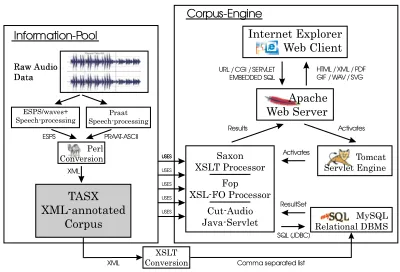
In this paper we describe ongoing research in the de-sign and implementation of an XML-based corpus envi-ronment for complex annotated speech data. The develop-ment of the corpus environdevelop-ment is part of the LeaP project, which explores the acquisition of prosody by both second language learners of German and English. In a period of two years a large set of audio and video recordings of sec-ond language learners’ speech will be made and phonolog-ically annotated. From this data an XML-annotated spoken language corpus will be set up. The model is based on a client/server approach. For performance reasons the XML-annotated data can be stored in a relational database. The XSL-T-based transformation of the data is a server sided process. The TASX-environment presented here supports the complete corpus setup procedure: XML-based annota-tion of raw speech data, the transformaannota-tion of non XML-data and the analysis and dissemination of the corpus.
The paper is organized in five sections. First, a short overview of the LeaP project will be given, which explains the specific requirements for the TASX-environment. In the next section the underlying XML-based TASX format will be explained and the components of the TASX-environment will be described in more detail. In section 4, we will then explain how the LeaP corpus has been set up with the TASX-environment and how the data can be linguistically analysed. Finally, a short conslusion will be given.
2.
The LeaP project
The LeaP (Learning Prosody) project1explores the
ac-quisition of prosody by second language learners of both German and English. It focuses on three areas of prosody: stress assignment on both the word and the phrase level, sentence intonation and speech rhythm. So far, the acqui-sition of second language prosody has not attracted a large amount of research but it has nevertheless often been pro-claimed to be nearly impossible (Boyle, 1987). However, this assumption of non-attainment so far has only been sup-ported by a few single case studies (Archibald, 1998).
In addition, the form and function of gestures in non-native speech are analysed. It is hypotheized that trans-fer and intertrans-ference from the native language as well as
1
http://www.spectrum.uni-bielefeld.de/LeaP/
an adapted variability and frequency of gestures will oc-cur. The alignment of gestures with prosodic features will be explored.
Research in the LeaP project is based on a large cor-pus of second language learners’ speech. The focus lies on two main research questions: first, a detailed description of the non-native prosody within the latest theoretical frame-works and a comparison to native speakers’ prosody will be carried out. It is assumed that second language prosody constitutes a good testing ground for theoretical concepts in prosody and might provide evidence for their further de-velopment. Equally, non-native gestures are described and compered to native gestures.
The second line of research is concerned with the ques-tion of whether and how prosodic aspects of a foreign lan-guage can be learned. The project thus investigates the ex-tralinguistic factors such as personal variables (e.g. native language, age at the beginning of language learning, mo-tivation, musicality) and the type of teaching method that might enhance the outcome and speed of the acquisition process. The LeaP experimental design comprises three treatment groups, who undergo intensive prosodic training in English and German of up to one and a half years dura-tion, as well as longitudinal studies of language learners in natural exposure settings.
For both research questions a multitude of data of var-ious types are being collected: the corpus of spoken lan-guage will consist of at least 400 recordings of between 2 and 10 minutes length. It comprises three different speech styles: read speech, prepared speech (a retelling of a story) and free speech. In the first ten months of the project, 184 audio and two video recordings have already been made. In addition to this speech material, meta data have been col-lected for every speaker. This consists of personal data such as the learners’ age, sex, native language and the onset of learning of the second language, as well as ratings of moti-vation and interest.
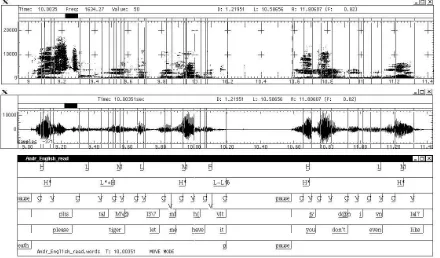
Figure 1: Prosodic annotation in the LeaP project is carried out on six tiers: a phrase, an orthographic tier, a syllable tier, a rhythm tier, a tone tier and a pitch tier.
the speech are annotated. On the fifth tier, a transcription of intonation in a ToBI (Silverman et al., 1992) style is carried out. The sixth tier, the pitch tier, contains an annotation of highs and lows in the pitch contour. This means that for each recording there are approximately 3000 time stamps. In the first ten months of the project, 129 recordings have been annotated in this fashion.
3.
The TASX format
A central aspect of our research is to explore up to which point current standard XML technology (XML, XSL-T, XSL-FO, XPATH, SVG, XQUERY) can be used to model linguistic databases, to transform, query and dis-tribute the content of such databases and to perform ade-quate linguistic analysis. As a result, all linguistic data in our system is stored in an XML-based format called TASX: the Time Aligned Signal data eXchange format.
A TASX-annotated corpus consists of a set of sessions, each one holding an arbitrary number of descriptive tiers, called layers. Each layer consists of a set of separated events. Each event stores some textual information (e.g. a syllable) and is linked to the primary audio data by two time stamps. Relations between events on different tiers can be encoded by defining links using the ID/IDREFS mecha-nism of XML. Finally, arbitrary meta-data can be assigned to the complete corpus, each session, each layer and each event. It might be sensible to extend the meta data descrip-tion in a way that tree structured data can immediately be described by XML annotations. Currently we rather use the simpler version with linear structure. The following DTD fragment formalizes the TASX format:
<!-- corpus data -->
<!ELEMENT tasx (meta*,session+)>
<!ELEMENT session (meta*,layer+)> <!ELEMENT layer (meta*,event+)> <!ELEMENT event (#PCDATA,meta*)>
<!-- meta data --> <!ELEMENT meta (desc*)> <!ELEMENT desc (name,val)> <!ELEMENT name (#PCDATA)> <!ELEMENT val (#PCDATA)>
<!-- atributes --> <!ATTLIST session
s-id CDATA #REQUIRED day CDATA #REQUIRED
ref IDREF #IMPLIED month CDATA #REQUIRED year CDATA #REQUIRED>
<!ATTLIST layer
l-id CDATA #REQUIRED ref IDREF #IMPLIED>
<!ATTLIST event
e-id CDATA #REQUIRED start CDATA #REQUIRED end CDATA #REQUIRED ref IDREF #IMPLIED mid CDATA #IMPLIED len CDATA #IMPLIED>
<!ATTLIST meta
m-id CDATA #REQUIRED ref IDREF #IMPLIED access CDATA #IMPLIED level CDATA #IMPLIED>
Despite ofs it simplicity, the TASX-format is powerful enough to encode most of the corpus annotation formats currently in use. Indeed a number of format transformation programms have been implemented. For example, in order to reconstruct the equivalent annotation graphs (Bird and Liberman, 1999) representation of a TASX annotated cor-pus, one only has to collect the time stamps encoded in the start and end attributes of the event tags, sort them and then produce the timeline. Finally the time stamps of the events have to be replaced by references to the timeline.
3.1. The TASX-annotator and the corpus engine
The complete TASX-environment consists of:
tools for the annotation of empirical language data (video and audio material),
an input mask for processing meta data
programs for the transformation of various formats of linguistic standard software (Transcriber, Praat, ESPS/waves+, SyncWriter, Exmaralda etc.)
a set of programs for linguistic analysis of the TASX-annotated data, and
a corpus system for the distribution of language data via the internet, including interactive corpus query and multimodal data display in a standard web browser.
In the following sections these modules will be de-scribed in more detail (see also (Milde and Gut, 2001)).
3.2. The TASX-annotator
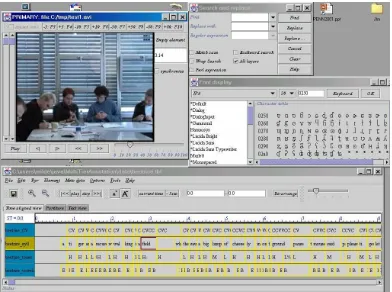
Figure 2: A screenshot of the TASX-annotator. In the bot-tom half, the main panel is visible, where the time aligned tier view has been selected. On top of the main window, the font selection panel is visible (showing some IPA char-acters) and above it the find tool. In the upper left corner the video display can been seen.
The programm is very user friendly and can be used without a high level of computer skills. It is possible to completely control the tool by either mouse or by keyboard shortcuts. Video and audio playback can be controlled by a foot switch. Different data views are programmed (time-aligned partiture, word-aligned partiture, sequential text view) to make annotation as effective as possible. The time aligned view is organized as a two dimensinal grid of infinite size. A layer is presented as a horizontal tier of events. The order of the layers is arbitrary and can be changed instantly. The user is able to define time intervals by dragging the mouse. Each time interval represents an event. The event is displayed as a graphical box which can be selected and moved with the mouse. The content of an event is entered in an additional text field. Any (unicode) font (e.g. IPA fonts, HamNoSys fonts etc.) available for the operating system can be used for the transcription. The user can choose font and fontpage from a table displaying all characters of the selected font. It is also possible to de-fine a virtual keyboard which maps the given keystrokes to arbitrary characters of the target font.
A separate video playback window will opened up for each video file making it possible to e.g. display multi-ple perspectives of the same scene. The video playback is synchronized with the transcription. For audio transcrip-tions an oszillogram is calculated and is displayed inside the main window.
In the text view the data can be manipulated in a stan-dard text editor panel. The content of the editor represents the layer and each line represents an event. A list selection box allows switching between different layers. It is possi-ble to transfer text from standard text editors, e.g. Microsoft Word, by cut and paste operations. In order to additionally speed up the transcription process, a word completion func-tion has been implemented for the text view. Entering the initial letter of a word and consecutively pressing CTRL+L will bring up all words starting with this letter. Once the text is tranferred into the TASX-annotator, the events still have to be aligned with the primary audio and video data.
Switching back to the time aligned view and moving the events with the mouse makes this task quite simple.
In the partiture view the data cannot be edited. In prac-tice this means that the data is transformed into an HTML table and then displayed to the user. A number of different HTML formatted views have been designed. The views can also be saved to external files and loaded into standard web browsers.
One potential strength of the TASX-annotator is its manner of handling the export/import of XML based infor-mation. A standard way of solving this problem would be the implementation of a set of format specific XML parsers which construct the internal representation (e.g. JDom) of the XML file. While powerful integrated development sys-tems such as Sun’s Forte for Java make the design of such XML handlers simpler, it still remains a complex task to implement such a parser. In the TASX-annotator we follow a different approach. The system integrates an XSL-T pro-cessor (saxon), making it easy to perform on the fly data transformations. The import of an XML-file is split into two steps: first an XSL-T stylesheet transforms the XML file into TASX, second another XSL-T stylesheet will trans-form the TASX file into a simple text oriented trans-format. This format can be loaded efficiently.
3.3. Transcoding tools
The development of tools for the TASX-environment is based on the concept that a re-implementation of function-alities already available in other speech processing software is not necessary. Established speech software such as Praat or ESPS/waves+ do not need to be duplicated.
TASX import export
Annotation graphs XSL-T XSL-T
Exmaralda XSL-T/Java Java/XSL-T
HTML-table – XSL-T
HTML-partiture – XSL-T
RTF – XSL-T/Java
Anvil XSL-T –
Praat-label Perl/XSL-T XSL-T
ESPS-label Perl XSL-T
ESPS-freq Perl/XSL-T/Java XSL-T
SyncWriter Perl –
Table 1: List of currently implemented transcoding tools. The table shows the programming languages used to im-plement the transcoders.
(Ihaka and Gentleman, 1996), (Venables and Ripley, 1999). R implements all major statistical tests and calculations and is equipped with a large number of high level graphic routines to generate visually informative presentations of the results. Even more important it includes efficient in-put/output routines to load and save semistructured data (ei-ther XML-annotated or plain ascii text).
4.
Setting up the TASX-annotated corpus
Once the prosodic annotation as described in section 2. is completed the TASX-annotated corpus can be set up.
4.1. LeaP data conversion
First , the manually labeled ESPS/waves+ files are being converted into the XML-based TASX format. This is done automatically by a small perl program calledesps2tasx. The converter is able to take a whole set of ESPS/waves+ files and transform them into one large TASX-annotated corpus. For each of the speakers a set of additional informa-tion has been collected. This informainforma-tion will be stored as session meta data and will be added to the TASX-annotated corpus.
The TASX-annotated data is finally stored in a relational database. This is done to improve the performance of the corpus system. Each session is stored as a binary large ob-ject.
After the data has been transformed into the TASX-annotated form, it becomes possible to use the complete set of tools of the TASX-environment.
4.2. Analysis of the prosodic data
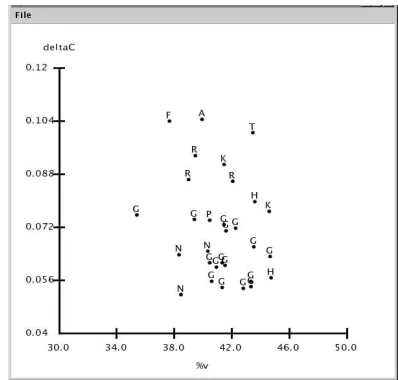
The phonetic analysis of the LeaP data is carried out in a semi-automatic style, supported by various TASX analysis tools. For the calculation of the speech rhythm according to Ramus et al. (Ramus et al., 1999) for example, the informa-tion of the fourth tier as described in secinforma-tion 2. is taken. The length of all vocalic (V) and all consonantal (C) parts of the utterances in the recording are calculated and their standard deviation ( V and C) is computed, as well as the propor-tion of vocalic intervals (%V) across the entire recording. These measurements have proved useful for the description of the difference in speech rhythm between languages and varieties of languages (Gut and Milde, 2002). The results for all speakers are illustrated in an automatically generated graph (see figure 4).
Similarly, the analysis of the speakers’ pitch range is carried out semi-automatically. From the time stamps of the fifth tier the pitch height is taken from the corresponding ESPS/waves+ get f0 file and the following measurements for the pitch range and pitch span analysis according to Pat-terson (PatPat-terson, 2000) are calculated: mean initial highs, mean subsequent highs, mean lows, mean final lows.
A third area of prosodic analysis of the speech data is tonal alignment in stressed syllables. English and German differ in that respect (Grabe, 1998) an it might be a useful feature for the description of non-native prosody. For the analysis, the time stamps on the tone tier, which provides information about the occurrence of stressed syllables, the time stamps on the pitch tier, which gives pitch maxima, and the time stamps on the rhythm tier, which indicates the
Figure 4: The graph shows an example for the distribu-tion of speech rhythm of British English native speakers (N) and learners of english: G=German, P=Polish, A=Arabic, H=Hungarian, K=Korean, T=Thai, F=French.
vowel boundaries, are combined and the presence of pitch height in relation to the vowel boundary is calculated.
Other features important for the analysis of language learners’ prososdy such as speech rate, fluency, and intona-tion patterns are also supported by TASX analysis tools. All tools will be freely available to the scientific community as open source software.
5.
Conclusions
Despite the early stage of the research the TASX-based approach has already proved to be highly efficient and re-liable. The time consuming task of phonetically analysing speech data is partially substituted by automatic analysis. In the transformation process from non-XML to XML-annotated data some errors in the human annotations can be detected. Furthermore, due to the highly structured for-mat of the TASX-converted data more complex research questions can be investigated in a systematic way.
The very good availabilty of XML aware software and tools enabled us to develop a powerful linguistic environ-ment in a very short time. Even more important, the TASX-annotated data can be transformed into large number of dif-ferent formats. The will hopefully lead to the creation of linguistic resources which can be used over a long period of time by different researchers with a wide range of scien-tific goals.
6.
References
J. Archibald. 1998. Second language phonology. Amster-dam: Benjamins.
S. Bird and M. Liberman. 1999. A Formal Framework for Linguistic Annotation. Technical Report MS-CIS-99-01, Department of Computer and Information Sci-ence, University of Pennsylvania.
P. Boersma. 2001. Praat, a system for doing phonetics by computer. Glot International, 5(9/10):341–345. J. Boyle. 1987. Perspectives on stress and intonation in
J.E. Garcia, U. B. Gut, and A. Galves. 2002. Vocale -a semi--autom-atic -annot-ation tool for prosodic rese-arch. In B. Bel and I. Marlien, editors, Proceedings of the
Speech Prosody 2002 conference, 11-13 April 2002. Aix-en-Provence: Laboratoire Parole et Langage, pages 327
– 330.
D. Gibbon and T. Trippel. 2001. Pax - an annotation based concordancing toolkit. In Peter Buneman Steven Bird and Mark Liberman, editors, IRCS Workshop on
Linguis-tic Databases, University of Pennsylvania, Philadelphia, USA.
E. Grabe. 1998. Comparative intonational phonology:
En-glish and German. MPI series in psycholinguistics.
U. B. Gut and J.-T. Milde. 2002. The prosody of nigerian english. In B. Bel and I. Marlien, editors, Proceedings of
the Speech Prosody 2002 conference, 11-13 April 2002. Aix-en-Provence: Laboratoire Parole et Langage, pages
367 – 370.
R. Ihaka and R. Gentleman. 1996. R: A language for data analysis and graphics. Journal of Computational and
Graphical Statistics, 5(3):299–314.
J.-T. Milde and U. B. Gut. 2001. An XML-annotated pho-netic corpus database. In Workshop on linguistically
in-terpreted corpora(LINC2001), Leuven.
D. Patterson. 2000. A Linguistic Approach to Pitch Range
modelling. Ph.D. thesis, University of Edinburgh.
F. Ramus, M. Nespor, and J. Mehler. 1999. Correlates of linguistic rhythm in the speech signal. Cognition, 73:265–292.
T. Schmidt. 2001. Gespr¨achstranskription auf
dem Computer - das System EXMARaLDA.
Gespr¨achsforschung, http://www.gespraechsforschung-ozs.de, 2.
K. Silverman, M. Beckman, J. Pitrelli, F. Ostendorf, C. Wightman, J. Pierrehumbert, and J. Hirschberg. 1992. Tobi: a standard for labeling english prosody. In Second
International Conference on Spoken Language Process-ing 2, Bannf, Canada, pages 867–870.
W. N. Venables and B. D. Ripley. 1999. Modern Applied
Statistics with S-Plus. Third Edition. Springer. ISBN