Use of XML and Relational Databases for Consistent Development and
Maintenance of Lexicons and Annotated Corpora
Masayuki Asahara
, Ryuichi Yoneda
, Akiko Yamashita
,
Yasuharu Den
y, Yuji Matsumoto
Graduate School of Information Science, Nara Institute of Science and Technology, Japan 8916-5 Takayama, Ikoma, Nara, 630-0101, JAPAN
fmasayu-a, ryuich-y, akiko-ya, [email protected]
y
Faculty of Letters, Chiba University 1-33 Yayoicho, Inage-ku, Chiba 263-8522, JAPAN
Abstract
In this paper, we present a use of XML and relational database for developing and maintaining Japanese linguistic resources. In languages that do not provide word delimitation in texts (e.g. Chinese and Japanese), consistent delimitation definition of words in a lexicon is a critical issue to build POS tagged corpora. When we change the definition of word delimitation in the lexicon, we need to modify the tagged corpora to make them consistent with the lexicon. We propose a use of relational database to perform these modifications in tandem. Hence, in the Japanese language, there are several standards for word delimitation definition. To accommodate more than one definition of word delimitation, we compose a compounding word lexicon in the database. The compounding word lexicon includes dependency structures of compounding words.
1.
Introduction
In languages that do not provide word boundaries in texts (e.g., Chinese and Japanese), consistent definition of word formation in the lexicon is crucial to natural language processing. Moreover, there is no consensus on the defi-nition of word delimitation in annotated corpora for these types of languages. The linguistic database, to keep mul-tiple definitions of word delimitation, is much in demand as the requirement for word delimitation tends to differ ac-cording to application areas.
To make matters worse, nominal compounding word of Japanese consist of various kinds of nouns with prefixes and suffixes. In many cases, nominal compounding word form different types of nouns from their constituent nouns, such as proper nouns or technical terms. Since complicated compounding words have syntactic structure within them-selves, such structure should be specified in the linguistic resources.
In this paper, we present a use of XML and relational database for consistent development and maintenance of linguistic resources of Japanese language, that are lexicons and annotated corpora. The database is also used for build-ing statistical models for Japanese language analyzers. This paper describes two major facilities of our current imple-mentation.
First, the system maintains two kinds of data in the database: lexicons and annotated corpora. The lexicons provide grammatical information as well as canonical form and the construction of the entry words. In order to keep consistency of word delimitation definition in the lexicon and the annotated corpus, we define the relationship be-tween the words in those two linguistic resources through the relational database. It is necessary to ensure changes in one resource to be reflected to another. Such mainte-nance is semi-automatically achieved by the use of
rela-tional database.
Second, we have to cope with multiple definition of word delimitation, as different applications call for dif-ferent definition of word delimitation. To accommodate more than one definition of word formation in the lexicon, we facilitate a hierarchical definition of word formation of compounding words in the database. The lexicon with the most fine-grained word definition is taken as the base lexi-con, and the compounding words are defined as binary tree structure consisting of the base entries. Users may select the grain size of the words so as to meet their requirements. Meanwhile, there are many contracted words in spoken lan-guage. Contracted words are derived from two or more words. We treat the original forms of contracted words too in this framework.
In section 2., we represent word delimitation definition of Japanese used in our database. In section 3., we show our database schema for Japanese POS tagged corpora. In section 4., we present our compounding words lexicon. Fi-nally, we give conclusions.
2.
Word delimitation definitions of Japanese
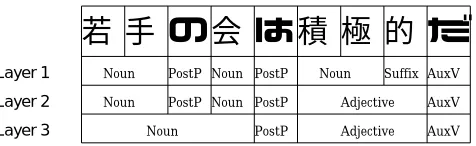
In this section, we present word delimitation definitions of Japanese language which we use in our database.
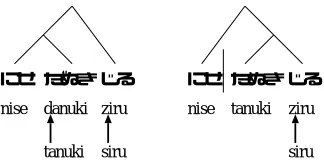
nise danuki ziru nise tanuki ziru
tanuki siru siru
Figure 3: Dependency structures and “rendaku”
B : the beginning of the unit I : the inside of the unit O : the outside of the unit
Figure 4 shows relation between branching structures and layer 2 chunks. The word, which do not match the reg-ular expression, are put tag O. When a word match the regu-lar expression, the word, which is left element of a subtree, is put tag B, otherwise the word is put tag I. In this sense, chunking based on BIO tag is suit for layer 2 definition.
Layer 1 delimitation
BIO tag B I I O B B B I
Layer 2 delimitation Dependency Structure
Figure 4: Layer 2 and BIO tag
Layer 3 defines much longer units like named entities, idioms and collocations. The definition has no relation with the dependency structure of word. Then, the relation be-tween BIO tag and dependency structure is weakened. Fig-ure 5 shows layer 3 chunks and BIO tags.
Layer 1 delimitation
BIO tag B I I O B B I I
Layer 3 delimitation Dependency Structure
Figure 5: Layer 3 and BIO tag
3.
Maintenance schema for Japanese POS
tagged corpora
When we develop corpora based on UniDic POS tagset, we must maintain POS tagged corpus for each layer with separate word delimitation definition. POS tag informa-tions of the layers will be overlapping on original texts.
Stand-off annotation(Henry S. Thompson and David McKelvie, 1997) enables us to cope with the overlapping problem. Stand-off annotation is the method separating markup from the material marked up.
First, we present former works of stand-off annotation. Second, we present our database schema for Japanese POS tagged corpora.
3.1. Stand-off Annotation
Stand-off annotation framework is initially formalized in a field of SGML. We illustrate the framework by the example of Henry et al. (Henry S. Thompson and David McKelvie, 1997).
Consider following marking sentence structure:
..
<w id=’w12’>Now</w><w id=’w13’>is</w><w id=’w14’>the</w> ..
<w id=’w27’>the</w><w id=’w28’>party</w><w id=’c4’>.</w> ..
We can mark sentences in a separate document as fol-lows:
..
<s xml-link=’simple’ href="#ID(w12)..ID(c4)"></s> <s xml-link=’simple’ href="#ID(w29)..ID(c7)"></s> ..
Their application enables us to see this document col-lection as a single stream with the words nested inside the sentences:
.. <s>
<w id=’w12’>Now</w><w id=’w13’>is</w><w id=’w14’>the</w> ..
<w id=’w27’>the</w><w id=’w28’>party</w><w id=’c4’>.</w> </s>
<s> .. </s> ..
They showed three reasons why separating markup from the material marked up:
1. the base material cannot copy to introduce markup be-cause of read-only and/or very large
2. the markup may involve multiple overlapping hierar-chies
3. distribution of the base document may be controlled, but the markup is intended to be freely available
Our strong reason to introduce stand-off annotation is to cope with overlapping problem of Japanese POS informa-tion.
we recursively define the parental relationship for the con-stituent words.
To examine the descendant on the dependency struc-ture via database, we can discriminate whether the com-pounding word has left and/or right branching structure. The discrimination is crucial information to identify layer 2 words of UniDic schema. Figure 8 exemplifies left and right branching structure of compounding words.
Left Branching Right Branching
N
N
B B B B B B
N
N
Figure 8: Left and Right Branching of Compounding Words
4.1.2. Ternary Tree of Compounding Words
Because of parallel structure, ternary structures can oc-cur in the dependency structure of compounding words. Nevertheless, we restrict within binary structures to repre-sent compounding words. Then, we extract ternary struc-ture into left branching binary strucstruc-ture. The extracted nodes are put category “P”. Figure 9 shows binarization of ternary tree structure.
N
P
P
B B B B
Figure 9: Binarization of Ternary Structure
4.1.3. Contracted Words
Contracted words are peculiar to spoken language in
Japanese. Contracted expression “Chau” is
composed by “Te” and “Shimau”. Our
database treat these contracted expressions with category “C” with original words. Figure 10 exemplify the expres-sion “Chau”.
C
B B
Figure 10: Contracted Word – “Chau”
4.1.4. Collocation, Idiom and Named Entity
When we annotate for collocations, idioms and named entities, some constituent words become fragments of com-pounding word, which we do not want to register into any
layer. In that case, we put category “X” for the fragments. Figure 11 is an example of case particle collocation. The
fragment “tsuite” is not registered into any layer.
N
X
B B
B
Figure 11: Case Particle Collocation –
“ni-tsuite”
4.1.5. Collocation without Dependency
There are some collocations without dependency in the lexicon. These words are registered because of accuracy of Japanese morphological analysis.
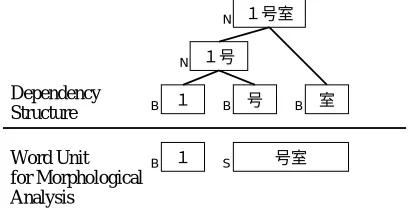
Figure 12 shows an example of numeral suffix “Goushitsu”. The constituent words of this collocation have neither dependency nor parallel relationship. Never-theless, this collocation has a trigger role of word forma-tion for numeral expression, then morphological analyzer contains such a word. We put category “S” for these words.
Word Unit for Morphological Analysis
Dependency Structure
B S
B B B
N N
Figure 12: Suffix ”Goushitsu”and Dependency
Structure
4.2. Compounding Lexicon on Relational Database
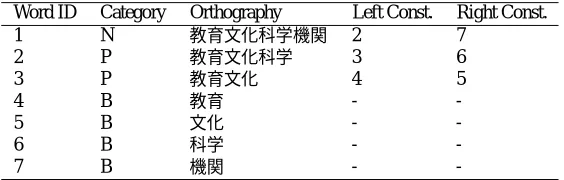
We presented the methods to represent word relation-ships by pointers for constituents. We keep these pointers on relational database as they stand. Table 2 shows com-pounding word table on our relational database. To sim-plify, we represent “Word ID” for the anchor of pointers. On our practical database, the anchor is a pair of “Word ID” and “CFORM ID” to transact Japanese conjugation.
Annotators are using GUI like figure 13 to annotate compounding relationships. In left below or right below fields, the GUI list up possible prefix or suffix matching words. Annotators select most suitable segmentation by top down strategy.
4.3. Extraction of Constituent Words
We use XML framework for distribution. Original lex-icon is exported from relational database into XML file as
figure 142. In the XML file, pointers to composed words
2Our practical lexicon contains much information: reading,
Table 2: Compouding Lexicion on Relational Databases
Word ID Category Orthography Left Const. Right Const.
1 N 2 7
2 P 3 6
3 P 4 5
4 B -
-5 B -
-6 B -
-7 B -
-Figure 13: GUI for compounding word annotation
are left as these stand. We use XSLT to extract constituent words from the pointers. An example of xsl file is figure 15. Using XSLT engines, lexicon is resolved as figure 16.
<?xml version="1.0" encoding="EUC-JP"?> <ipacomp>
<word lexid="1" cformid="0" category="N"> <orth> </orth>
<compleft lexid="3" cformid="0" /> <compright lexid="2" cformid="0" /> </word>
<word lexid="2" cformid="0" category="N"> <orth> </orth>
<compleft lexid="4" cformid="0" /> <compright lexid="5" cformid="0" /> </word>
<word lexid="3" cformid="0" category="B"> <orth> </orth>
</word>
<word lexid="4" cformid="0" category="B"> <orth> </orth>
</word>
<word lexid="5" cformid="0" category="B"> <orth> </orth>
</word> </ipacomp>
Figure 14: Example of compounding word lexicon
<?xml version="1.0" encoding="EUC-JP"?> <ipacomp>
<word category="N"> <orth> </orth> <word category="B">
<orth> </orth> </word>
<word category="N"> <orth> </orth> <word category="B">
<orth> </orth> </word>
<word category="B"> <orth> </orth> </word>
</word> </word>
<word category="N"> <orth> </orth> <word category="B">
<orth> </orth> </word>
<word category="B"> <orth> </orth> </word>
</word>
<word category="B"> <orth> </orth> </word>
<word category="B"> <orth> </orth> </word>
<word category="B"> <orth> </orth> </word>
</ipacomp>
Figure 16: Extracted compounding word lexicon
5.
Conclusions
<?xml version="1.0" encoding="EUC-JP"?>
<xsl:stylesheet version="1.0" xmlns:xsl="http://www.w3.org/1999/XSL/Transform"> <xsl:output method="xml" encoding="EUC-JP" />
<xsl:template match="ipacomp"> <ipacomp>
<xsl:apply-templates/> </ipacomp>
</xsl:template>
<xsl:template match="word"> <word>
<xsl:attribute name="category"> <xsl:value-of select="@category"/> </xsl:attribute>
<xsl:apply-templates/> </word>
</xsl:template>
<xsl:template match="orth">
<orth><xsl:value-of select="."/></orth> </xsl:template>
<xsl:template match="compleft">
<xsl:variable name="leftlexid" select="@lexid"/>
<xsl:apply-templates select="//word[@lexid=$leftlexid]"/> </xsl:template>
<xsl:template match="compright">
<xsl:variable name="rightlexid" select="@lexid"/>
<xsl:apply-templates select="//word[@lexid=$rightlexid]"/> </xsl:template>
</xsl:stylesheet>
Figure 15: Example of xsl file
defined the relationship between the words in the lexicon and those appearing in the tagged text. Because differ-ent application domains use differdiffer-ent definition of word delimitation, we designed multi-stratal word delimitation
definitions to cover demands of many domains. Then,
word delimitation definitions will be overlapped on raw texts. We introduced stand-off annotation framework to cope with overlapping problem. To maintain multiple defi-nitions of word delimitation, we composed tables for com-pound words. The tables also store syntactic structures of compound words, which is also useful to know phonologi-cal realization of the words.
We used mainly relational database framework to main-tain linguistic resources and we used XML framework only to distribute and transform resources, because relational database cannot do them. For example, whereas the query language SQL in relational database framework cannot re-trieve pointers recursively, XSLT can do the recursion.
6.
References
Haruo Kubozono. 1991. The Organization of Japanese
Prosody. Studies in Japanese Linguistics. kurosio
Pub-lishers, Inc.
Henry S. Thompson and David McKelvie. 1997. Hyper-link semantics for standoff markup of read-only docu-ments. In SGML Europe ’97.
Nancy Ide and Patrice Bonhomme and Laurentj Romary. 2000. XCES: An XML-based Encoding Standard for Linguistic Corpora.
Sadao Kurohashi and Makoto Nagao. 1999. JUMAN Ver. 3.61. http://www-nagao.kuee.kyoto-u.acjp/.
Steve DeRose and Eve Maler and Ron Daniel Jr. 2001. XML Pointer Language (XPointer) Version 1.0. http://www.w3.org/TR/xptr/.
Steven Bird and Mark Liberman. 2001. A formal frame work for linguistic annotation. Speech Communication, 33:23–60.
Takashi Masuoka and Yukinori Takubo. 1992. Kiso
Ni-hongo Bunpou – kaitei-ban –. kurosio Publishers, Inc.
Yasuharu Den, Takehito Utsuro, Atsushi Yamada,
Masayuki Asahara and Yuji Matsumoto. 2002. Design of an Electric Dictionary Suitable for Spoken Language Research. In Proceedings of the Second Spontaneous
Speech Science and Technology Workshop, pages p.p.
39–46.
Yuji Matsumoto, Akira Kitauchi, Tatsuo Yamashita, Yoshi-taka Hirano, Hiroshi Matsuda, Kazuma Takaoka and Masayuki Asahara. 2002. Morphological Analyzer ver-sion 2.2.9. http://chasen.aist-nara.ac.jp/.