International Journal of Scientific Research in Computer Science, Engineering and Information Technology © 2017 IJSRCSEIT | Volume 2 | Issue 3 | ISSN : 2456-3307
Android Application Based Robotic Vehicle
Divya Singh, Manisha Verma, Rachana Sahu, Shruti Kantode, Shailendra Singh
Electronics and Telecommunication Engineering, RSR Rungta College of Engineering & Technology , Bhilai, Chhattisgarh, India
ABSTRACT
The work is designed for spying purpose using android OS device for remote operation, dangerous area like war field, disasters, area covered by terrorism, for underground tunnel surveillance etc. where human cannot enter. An 8051 microcontroller (AT89S52) is used for the desired operation. At the transmitting end using android application device, commands are sent to the receiver to control the movement of the robot either to move forward, backward and left or right etc. At the receiving end two motors are interfaced to the microcontroller where both of them are used for the movement of the robot. Remote operation is achieved by any smart-phone/Tablet etc., with Android OS, upon a GUI (Graphical User Interface) based touch screen operation. The android application device transmitter acts as a remote control that has the advantage of adequate range, while the receiver have Bluetooth device fed to the microcontroller to drive DC motors via motor driver IC for necessary work. we use Bluetooth communication to interface controller and androidThe whole operation is controlled by a AT89S52 microcontroller. A motor driver IC is interfaced to the microcontroller through which the controller drives the motors.
Keywords : Android OS, Bluetooth , Spy robot , Microcontroller (AT89S52)
I.
INTRODUCTION
Now-a-days tracing and attacking enemies at different areas are very much difficult for the soldiers. There is always a chance for loss of lives of the soldiers during war and emergency situations. We have implemented a solution for the problem of replacing a soldier with a Robot Soldier completely controlled with a wireless network. The paper mainly concentrates on human gestures to control the hardware device.
The robot motions left, right, forward, backward. Interfacing is done between device and Bluetooth. Bluetooth device HC-05 module receives the command from smart phone via 8051 Microcontroller.
The system will consist of following parts:
Bluetooth technology,
Android smart phone
Microcontroller
DC motor
RF module
Android smart phone will act as remote of the system, Bluetooth will act as the connection link between robot and android smart phone, microcontroller will act as the brain of the robot, and DC motor will help us to move the robot. This report describes about the real time android technology that can be used as an interaction between embedded system.
We can operate this robot using two modes:
Android smart phone
Using RF module
In android device, we can control the movement of our robot using Text as well as through voice recognition system.
II.
METHODS AND MATERIAL
1. If it’s being controlled through Android phone
between device and Bluetooth. Bluetooth device HC-05 module receives the command from smart phone via 8051 Microcontroller.
Figure 2. Circuit diagram of android controlled robot
2. If it’s being controlled through RF Module:
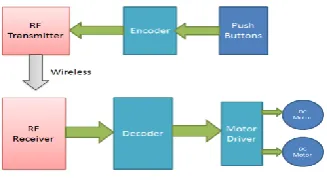
An RF module (radio frequency module) is a (usually) small electronic device used to transmit and/or receive radio signals between two devices. For many applications the medium of choice is RF since it does not require line of sight. RF communications incorporate a transmitter or receiver.
Figure 1. working of RF module
Voice Recognition System:
This system is in-built in android phones, in which robot works in voice commands, and perform particular task as per the instructions.
Figure 3. Flow chart of voice recognition system
Components:
A. AT89S52:
The AT89S52 is a low-power, high performance CMOS 8- bit microcontroller with 8k bytes of in system programmable flash memory. The Atmel AT89S52 is a powerful microcontroller which provides a highly-flexible and cost-effective solution to many embedded control applications. The AT89S52 Provides the following standard features: 8K bytes of flash, 256 bytes of RAM, 32 I/O lines, Watchdog timer, two data pointers, three 16-bit timer/counters, a six- vector two level interrupt architecture, a full duplex serial port, on-chip oscillator, and clock circuitry.
Figure 4. Microcontroller AT89S52
B. Bluetooth Module (HC-05):
Bluetooth Module is a Drop-in replacement for wired serial connections, transparent usage. You can use it simply for serial port replacement to establish connection between MCU and GPS, PC to your embedded project / Robot etc. The module can be configured for baud rates 1200 to 115200 bps.
Figure 5..bluetooth module HC-05
C. L293D:
Figure 6. Pin Diagram of L293D
D. DC motor:
Almost every mechanical movement that we see around us is accomplished by an electric motor. Electric machines are means of converting energy. Motors take electrical energy and produce mechanical energy.
Features:
A. PIR (Passive Infrared) Sensor:
PIR sensor is an electronic sensor that measures infrared (IR) light radiating from objects in its field of view. They are most often used in PIR-based motion detectors. Operating principles All objects with a temperature above absolute zero emit heat energy in the form of radiation. Usually this radiation isn't visible to the human eye because it radiates at infrared wavelengths, but it can be detected by electronic devices designed for such a purpose.. They work entirely by detecting the energy given off by other objects. PIR sensors don’t detect or measure "heat"; instead they detect the infrared radiation emitted or reflected from an object".
Figure 7. PIR sensor
B. Metal Detector:
A metal detector is an electronic instrument which detects the presence of a metal nearby. Metal detectors are useful for finding metal inclusions hidden within objects, or metal objects buried underground. They
often consist of a handheld unit with a sensor probe which can be swept over the ground or other objects.
The simplest form of a metal detector consists of an oscillator producing an alternating current that passes through a coil producing an alternating magnetic field. If a piece of electrically conductive metal is close to the coil, eddy currents will be induced in the metal, and this produces a magnetic field of its own.
Figure 8. Metal Detector circuit
C. Gas Detector
A gas detector is a device that detects the presence of gases in an area, often as part of a safety system. This type of equipment is used to detect a gas leak or other emissions and can interface with a control system so a process can be automatically shut down. A gas detector can sound an alarm to operators in the area where the leak is occurring, giving them the opportunity to leave. This type of device is important because there are many gases that can be harmful to organic life, such as humans or animals.
Figure 9. Gas Detector sensor
Application Instructions:
First make sure your HC-05 Bluetooth module is paired with your mobile. The default password for pairing is “1234” or “0000”. Check the manual of Bluetooth module. After pairing with Bluetooth modem with mobile
When enter “B” and press send message it
Click on “DISCONNECT” icon to disconnect paired Bluetooth modem.
Here we use “BLUETOOTH SPP MANAGER APP” to operate robot left , right , forward , backward.
It mainly consists of 3 parts
- Manager.
Results include the successful operation of android controlled spy robot. the metal sensor , gas detector and passive infrared sensor, are placed in such a way that the combination will help the project to use in many applications for wireless spy of a robot.
This project is being used as surveillance purpose in two modes, through android OS & RF module, as per the range required.
In android OS , there is two way to operate the robot: through text, & voice recognition system.
Human, metal , & gases can be detected using their respective sensors mount in the robot, as it comes under the range of robot.
IV.
CONCLUSION
The primary need for our paper would be accuracy. We have been able to view the things accurately that are going on as example left robot, near to object, clear up. With the help of the camera we are able to view the things that are happening in the surrounding area where the robot is hidden. By keeping the circuit easy and simple, most users will be able to use it easily. Thus, we should be able to manipulate its path when necessary, to create the robot safely. To all that, a control unit is needed , where control units RF signal is used. By using these signals encoding is done signal is sent through the transmitter. At the receiver end these decoded signal are given as input to drive the motor. Not for long range applications it can be used as a spy robot within short distances.
V.
REFERENCES
[1] Phey Sia Kwek , Zhan Wei Siew, Chen How Wong,, Bih Lii Chua, Kenneth Tze Kin Teo. “Development Of A Wireless Device Control
Based Mobile Robot Navigation System” IEEE
2012
[2] Neil MacMillan, River Allen, Dimitri Marinakis, Sue Whitesides, “Range-based navigation system for a mobile Robot” IEEE 2010 [2].
[3] Dhiraj Singh Patel, Dheeraj Mishra, Devendra Pandey, et al. International Journal of Emerging Technology and Advanced Engineering, ISSN 2250-2459. 2013; 3(2).
[4] Mr. Kumar sagar, Prof. R.T.Patil, “Design of
Monitoring System for Coal Mine Safety Based
on MSP430”, International Journal of
Engineering Science Invention ISSN, Volume 2, Issue 7, July 2013.
[5] T. Maria Jenifer, T. S. Vasumathi Priyadharshini, Raja Lavanya & S. Raj Pandian, “Mobile Robot
Temperature Monitoring System Controlled by
Android Application via Bluetooth” IJACTE
2013
[6] Prof. Y. M. Naik, Chiranjivi. M. Deshpande, Ravija. R. Shah, Rashmi. R. Kulkarni. International Journal of Software and Web Sciences (IJSWS), ISSN 2279-0063.
[7] Arpit Sharma, Reeteshverma, Saurabh Gupta,Sukhdeep kaurbhatia, “ Android phone
controlled robot using Bluetooth”,
IJEEE,Vol.7,pp-443-448, Nov- 2014
[8] M. Selvam, “Smart phone based robotic control
for surveillance application” ,IJRET,Vol.3,
Issue-3, pp-229-232, Mar- 2014.
[9] Sebastian van Delden and Andrew Whigham, “A
Bluetooth-based Architecture for Android
Communication with an Articulated Robot”,
IEEE, 978-1-4673-1382, pp-104- 108, Jul 2012 [10] Xiao Lu, Wenjun Liu, Haixia Wang, Qia Sun,
“Robot Control Design Based On Smartphone”,
IEEE, 978-1-4673- 1382, pp-2820-2823, Jun 2013
[11] Xiaolu et.al. "Robot control design based on smart phone." Control and Decision Conference (CCDC), 2013 25th Chinese. IEEE, 2013