mwetoolkit
: a Framework for Multiword Expression Identification
Carlos Ramisch
†∗, Aline Villavicencio
∗, Christian Boitet
††GETALP – Laboratory of Informatics of Grenoble, University of Grenoble (France)
∗Institute of Informatics, Federal University of Rio Grande do Sul (Brazil)
[email protected],[email protected],[email protected]
Abstract
This paper presents the Multiword Expression Toolkit (mwetoolkit), an environment for type and language-independent MWE iden-tification from corpora. Themwetoolkitprovides a targeted list of MWE candidates, extracted and filtered according to a number of user-defined criteria and a set of standard statistical association measures. For generating corpus counts, the toolkit provides both a corpus indexation facility and a tool for integration with web search engines, while for evaluation, it provides validation and annotation facilities. Themwetoolkitalso allows easy integration with a machine learning tool for the creation and application of supervised MWE extraction models if annotated data is available. In our experiments, themwetoolkitwas tested and evaluated in the context of MWE extraction in the biomedical domain. Our preliminary results show that the toolkit performs better than other approaches, especially concerning recall. Moreover, this first version can be extended in several ways in order to improve the quality of the results.
1
Introduction
A Multiword Expression (MWE) can be defined as a sequence of words that presents some characteristic be-haviour (at lexical, syntactic, semantic, pragmatic or sta-tistical level) and whose interpretation crosses the bound-aries between words (Sag et al., 2002). This rough def-inition includes a very wide range of constructions such as compound nouns (credit card,mountain bike), phrasal
verbs (carry on, go by [a name]), compound terms (
be-nign tumor,nuclear fusion), etc. MWEs are animportant
andfrequentphenomenon in human language, that must be handled adequately in Natural Language Processing (NLP) applications with some degree of semantic interpretation.
MWEs are an important aspect of languages, conferring
naturalness and fluency to a discourse. While native speak-ers rarely realize how often they employ MWEs, they are challenging for non-native speakers, since they are not only arbitrary to some extent but also too numerous and flexi-ble to learn/memorise. From a computational perspective, it is crucial to be able to deal with MWEs since they are not only a theoretical limitation of current formalisms but also, pragmatically speaking, common sources of errors like in-correct sentence parses and awkward literal translations.
Their frequency can be gauged by Jackendoff’s estimate
that, in the general lexicon of a native speaker, multiwords correspond to more than half of the entries (Jackendoff, 1997). As pointed out by Sag et al. (2002), this could be an underestimate since the proportion of MWEs in the lexicon of broad-coverage NLP systems tends to increase as they integrate domain-specific Language Resources (LRs). In-deed, the proportion of MWEs in natural language is larger in specialised domains or sub-languages; for Krieger and Finatto (2004), more than 70% of the entries in a terminol-ogy are composed of two or more words. In the latter case,
we will callMultiword Term (MWT)an expression
describ-ing a concept of the domain and whose meandescrib-ing cannot be directly inferred by a non-expert from its parts1.
1
Although this definition includes a large number of highly flexible constructions, we focus on MWTs that present limited syntactic flexibility.
However, there is often a disparity between the omnipres-ence of MWEs in natural language and the proportionally small number of multiword entries in LRs. For instance, while the Cambridge Dictionary of American English con-tains over 60,000 definitions, the Cambridge Phrasal Verbs Dictionary contains only 10% of that size, with 6,000 en-tries. Moreover, these phrasal verbs are composed by a very small subset of the verbs found in a dictionary: only 20% of the verbs listed in the Alvey Natural Language Tools lexi-con form a verb-particle lexi-construction (Villavicencio, 2005). Particularly in the context of domain-specific LRs, this is understandable, since the creation of specialised lexica is an expensive taskper se, that requires a great amount of man-ual effort from terminographers, lexicographers and do-main experts, whether for simplex or multiword entries. On the other hand, the coverage of specialised LRs influences the performance of NLP systems, and contribute to their portability, helping the adaptation of systems that work well on general-purpose language to domain-specific texts. As a consequence, there is a need for the development of tech-niques and tools for the (semi) automatic identification of MWTs for inclusion in specialised LRs. More generally, obtaining wide-coverage LRs for general MWEs is a cur-rent bottleneck and an important challenge in the develop-ment of real-world NLP systems. Particularly for languages that are less resource rich than English, there is a need for viable type, domain and language independent alternatives for MWE identification.
In this context, our paper describes the development of
the Multiword Expression Toolkit (mwetoolkit), an
en-vironment for MWE identification in corpora (Ramisch,
2009). Themwetoolkitemploys a standard
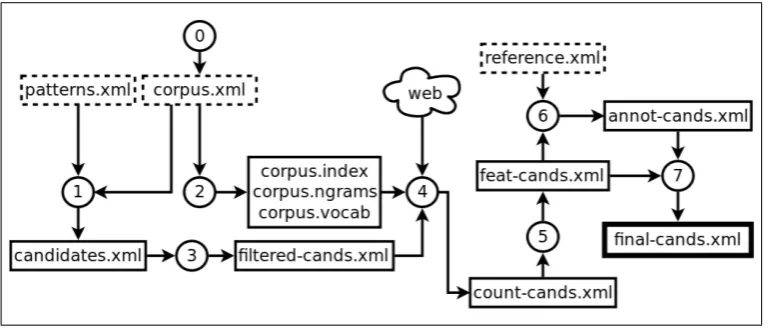
Figure 1: Architectural scheme ofmwetoolkit: (0) preprocess the corpus, (1) extract the candidates that match the patterns, (2) index the corpora using suffix arrays, (3) filter the candidates list, (4) countn-grams and words in the corpora, (5) calculate AMs and descriptive features, (6) automatically annotate (part of) the candidates and (7) train/apply a machine learning model. Inputs are boxed with dashed lines, output with a thick line.
quality of the extracted MWEs. Case homogenisation can
be performed throughmwetoolkit’s heuristic
lowercas-ing rules that tend to preserve the case of words that occur with different capitalisation throughout the corpus. This might be important because, in some domains, simple low-ercasing is not enough, e.g. in the case of chemical compo-nents and industry acronyms.
Once the corpus has been preprocessed, mwetoolkit
generates a first list of candidates based either on raw n -grams or on POS patterns. The former is a straightforward method to extract all possible word combinations ranging
from unigrams to10-grams and could be used as a backoff
strategy when no linguistic information is available. The latter allows the definition of fine-grained morphosyntactic constraints on the candidates, e.g. the extraction of Noun-NounandAdjective-Nounpairs or of collocations involving the adjectivestrong. Although deeper syntactic constraints (e.g. constituents or dependency relations) are not allowed, it is possible to define patterns containing wildcards, to ex-tract semi-fixed expressions with intervening words. The initial candidate list can be filtered a posterioriin order to exclude candidates that contain spurious punctuation,n -grams occurring less frequently than a given threshold or specific words and POS.
For each candidate, a set of features is generated in order to allow the application of machine learning models. Two
kinds of features are included in themwetoolkit
pack-age: descriptive features and statistical Association Mea-sures (AMs). The latter measure the degree of indepen-dence between the number of occurrences of the MWT candidate and the number of occurrences of the individual words that compose it. AMs are calculated as follows:
1. A corpus containingN word tokens is indexed using
a suffix array, a memory-efficient data structure that allows forn-grams of arbitrary size to be searched ef-ficiently in very large corpora.
2. For each candidate sequence of n contiguous words
w1 through wn, mwetoolkit gets the individual
word counts c(w1). . . c(wn)and the overalln-gram
countc(w1. . . wn)from the index.
3. We calculate the expectedn-gram countE if words
cooccurred by chance, i.e. if we suppose that word occurrences are independent events, ann-gram would occurE(w1. . . wn)≈ c(w1N)...cn−(1wn)times
3.
4. That information is used to calculate four statistical AMs for each MWE candidate in each corpus, namely:
• the maximum likelihood estimator:
mle= c(w1. . . wn)
N ;
• Dice’s coefficient:
dice= n×Pcn(w1. . . wn) i=1c(wi)
;
• the pointwise mutual information:
pmi= log2 c(w1. . . wn)
E(w1. . . wn) ;
• and Student’s t-score:
t-score=c(w1. . . wpn)−E(w1. . . wn)
c(w1. . . wn)
.
We are able to calculate these measures for arbitrary-size
n-grams because none of them uses contingency tables.
Since candidate extraction and counting are two separate steps, an arbitrary number of corpus frequencies can be calculated. One could, for example, complement a small specialised corpus with frequencies coming from a large
general-purpose corpus. Additionally,mwetoolkit
pro-vides full integration with Yahoo!’s API4and with Google’s
3
Actually, a corpus withN word tokens containsN−n+ 1
n-grams, and thereforeE = (N −n+ 1)×Qn i=1
c(wi)
N =
(N−n+1)
Nn ×
Qn
i=1c(wi). However, sincenN, we can ignore
the termn+ 1and consider that(N−Nnn+1) ≈Nn−1 1
4http://developer.yahoo.com/download/
Xtract Yahoo! terms mwetoolkit
t= 0 t= 1 t= 5
# cand 1,558 5,404 763 739 174
# ref 27,096 27,096 2,009 2,009 2,009
# TP 1,041 1,616 401 420 129
P 66.81% 29.90% 52.56% 56.83% 74.14%
R 3.84% 5.96% 19.96% 20.91% 6.42%
F 7.26% 9.94% 28.93% 30.57% 11.82%
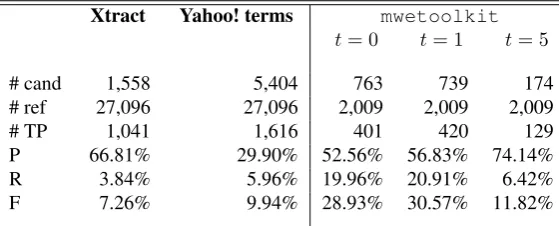
Table 1: Performance of Xtract and of Yahoo! terms on the whole Genia corpus. Performance of the mwetoolkit
considering (a) no filtering threshold, (b) a threshold oft= 1occurrence and (c) a threshold oft= 5occurrences.
ments performed, among all tested machine learning mod-els, SVM with polynomial kernel presented the best bal-ance between precision and recall (Ramisch, 2009). We applied this model to the test corpus (the remaining unan-notated 895 sentences of the Genia corpus) and evaluated the output in terms of precision and recall. We compared our system to the output of two other systems: Xtract and Yahoo! terms. Xtract was designed to identify collocations in general-purpose texts (Smadja, 1993) and has a free im-plementation in the Dragon toolkit9. Yahoo! terms is a free web service provided by Yahoo! that performs term iden-tification for English texts. As the application of the ex-traction algorithms for both of these approaches does not include a training phase and as Xtract identifies colloca-tions based on corpus counts, they were evaluated over the whole Genia corpus, and not on the small test corpus. The
mwetoolkit, on the other hand, was evaluated over a small portion of the corpus because the remainder was used as training data for the SVM classifier. However, the results will be reported in terms of the number of MWTs in each (sub)corpus.
The first two columns of table 1 summarise the perfor-mance of Xtract and of Yahoo! terms on the whole corpus. Both present a dramatically low recall, but the precision of Xtract is clearly better than that of Yahoo! terms. Despite the fact that Yahoo! terms shows a higher F-measure, the values in these two first columns give us an indication of the difficulty of the task. Indeed, to provide broad coverage and high quality in automatic MWE extraction is a great challenge for NLP systems.
The three last columns correspond to three different filter-ing configurations applied (both durfilter-ing trainfilter-ing and testfilter-ing)
to the candidates extracted by the mwetoolkitfrom the
test portion of the Genia corpus. In the first condition, we considered all candidates without any frequency threshold. In the second, we considered all the candidates which oc-curred more than once in the test corpus, while in the third, we kept all the candidates that occurred at least five times. The results show us that, as expected, statistical AMs cal-culated including candidates that occur only once are not reliable (t= 0), and discarding them helps to improve pre-cision and recall (t = 1). A higher threshold liket = 5 provides even better precision at the price of drastically re-ducing recall, but even so recall and F-measure in this con-figuration are still higher than those of the baseline systems
9http://dragon.ischool.drexel.edu/
with which we compared themwetoolkit.
For a given application, the exact value of the threshold can be customised according to whether the preference is for a higher recall or for a higher precision. For instance, if the goal is to create a terminological dictionary, a higher recall may be desirable with manual validation of the results. The results obtained can give an idea of the
useful-ness of the mwetoolkit for providing more targeted
domain-specific terminological extraction than a general-purpose collocation identification tool like Xtract.
More-over,mwetoolkitallows parametrisation and
customisa-tion of its various modules according to a particular applica-tion without being language- or domain-dependent. There-fore, its performance could be improved even further with better tuning to the domain or postprocessing of the results.
7
Conclusions and Future Perspectives
In this paper, we presented a new tool for automatic MWE
extraction from corpora. Themwetoolkitcan be used
not only to speed up the work of lexicographers and ter-minographers in the creation of terminological resources for new domains and languages, but also to contribute to the porting of NLP systems such as Machine Translation and Information Extraction across domains. The methodology employed in the toolkit is not based on symbolic knowledge or dictionaries, and the techniques implemented in it are language independent. Therefore, it can straightforwardly be applied to any language and domain for which a corpus is available, with the execution of simple corpus prepro-cessing steps and the definition and tuning of POS patterns, for improved performance.
We expect, in the future, to integrate a higher number of features about the MWE candidates into the classifiers, in order to provide more accurate results. Among possible im-provements are new descriptive features, contingency-table association measures and information coming from periph-eral sources such as parallel corpora (word alignments) and general-purpose or domain-specific dictionaries.
NLL (EMNLP-CoNLL 2007), pages 1034–1043, Prague, Czech Republic, Jun. ACL.
Aline Villavicencio. 2005. The availability of verb-particle constructions in lexical resources: How much is enough?
Comp. Speech & Lang. Special Issue on Multiword Ex-pressions, 19(4):415–432.
Yi Zhang, Valia Kordoni, Aline Villavicencio, and Marco Idiart. 2006. Automated multiword expression
predic-tion for grammar engineering. In Proc. of the