939
Graph Embeddings for Frame Identification
Alexander Popov
IICT, Bulgarian Academy of Sciences Sofia, Bulgaria
alex.popov @bultreebank.org
Jennifer Sikos IMS, University of Stuttgart
Stuttgart, Germany jen.sikos
@ims.uni-stuttgart.de
Abstract
Lexical resources such as WordNet (Miller,1995) and FrameNet (Baker et al.,
1998) are organized as graphs, where rela-tionships between words are made explicit via the structure of the resource. This work explores how structural information from these lexical resources can lead to gains in a downstream task, namely frame identification. While much of the current work in frame identification uses various neural architectures to predict frames, those neural architectures only use representations of frames based on an-notated corpus data. We demonstrate how incorporating knowledge directly from the FrameNet graph structure improves the performance of a neural network-based frame identification system. Specifically, we construct a bidirectional LSTM with a loss function that incorporates various graph- and corpus-based frame embed-dings for learning and ultimately achieves strong performance gains with the graph-based embeddings over corpus-based embeddings alone.
1 Introduction
Frames are common scenarios, expressed by their typical participants and the predicates which evoke them. The INFECTING frame, where some-one transmits an illness, has participants IN
-FECTED ENTITY and INFECTION CAUSE and is
evoked by predicates infect and give. A single predicate can evoke one or more frames;give, for instance, can evoke INFECTING (give someone a
cold) or GIVING (give someone a present). The disambiguation of which frame is evoked in con-text is the task offrame identification(FrameID),
which is, in essence, a word sense disambiguation task where the senses are frames (Das et al.,2010). The FrameNet resource (Baker et al.,1998) pro-vides concrete definitions of frames, predicates, and participants (called frame elements) and is structured as a hierarchical graph. Frames to-wards the top of the hierarchy are more abstract (ex. INTENTIONALLY ACT), while frames lower in the hierarchy are more granular (ex., SUBMIT
-TING DOCUMENTS). FrameNet’s graph structure captures the relationship between frames, their predicates, and their frame elements, such that a single frame can be connected to multiple frames via different relationships (Baker and Ellsworth,
2017). Given the structure of the resource, it is surprising that the graph is not used in cur-rent FrameID systems, as the relationships in the FrameNet graph have been previously shown as relevant to frame prediction, especially in cases of unseen predicates (Das et al.,2014).
This work leverages FrameNet’s graph structure to boost the performance of neural architectures for FrameID. Specifically, we construct frame em-beddings from the FrameNet graph structure and use them as input to a neural network. Although frame embeddings are often used in neural ar-chitectures for FrameID, prior work only learns these embeddings from frame-annotated corpus data (Hartmann et al.,2017;Hermann et al.,2014). To our knowledge, this is the first work to incor-porate embeddings composed from the FrameNet graph structure itself, thus incorporating all frame, frame element, and predicate relationships that could otherwise be missing from corpus data. We expand our frame graphs with knowledge from an-other lexical resource, WordNet, to achieve further gains in performance.
Section4 focuses on the FrameNet and WordNet graphs, while Sections 5 and 6 explain how we use the FrameNet knowledge base to build graph embeddings. Section7outlines our experiments, and Section8gives results and further analysis of the model performance.
2 Background
2.1 Graph Embeddings
Graph algorithms, especially random walk al-gorithms, have been applied to prediction tasks such as word sense disambiguation (Agirre et al.,
2014), measuring semantic similarity and relat-edness between words (Agirre et al., 2010), and entity linking (Guo et al., 2011). These algo-rithms traverse over the relations and nodes in a large knowledge base such as WordNet (Miller,
1995) or taxonomies built from Wikipedia links (Cucerzan, 2007) to uncover relationships be-tween the nodes in the knowledge base. How-ever, the effectiveness of shallow neural networks in learning word similarity, as shown by the pop-ular Word2Vec and GloVe models (Mikolov et al.,
2013; Pennington et al., 2014), rapidly replaced traditional graph-based methods for word simi-larity and prediction tasks. Word representations learned in these models, calledembeddings, pro-vide the latent features of a word in context as low-dimensional vectors. Recent work has sought to incorporate the best of graph algorithms and embeddings by learning representations for words over a neural network while using the structural in-formation found in knowledge bases (Goikoetxea et al.,2015;Faruqui et al.,2015).
Our method for constructing graph embeddings follows the work ofGoikoetxea et al.(2015) who use random walks to build a synthetic corpus based on entries in WordNet. In this corpus, a word’s contexts are the other words in the knowl-edge base that it is related to. They use the corpus to generate embeddings for words with CBOW and Skipgram models.
2.2 Neural Architectures for Frame Identification
The first work to use embeddings for FrameID used the WSABIE algorithm to project frames and predicate contexts into the same shared space (Hermann et al., 2014). The authors then ap-ply a pairwise loss to minimize the distance be-tween the frames and their predicate instances.
Subsequent FrameID models followed, including a system that constructed frame embeddings us-ing the Word2Vec model (Botschen et al.,2017). More recent state-of-the-art models use contextu-alized embeddings of frames in the BERT frame-work (Sikos and Pad´o,2019) or joint models with semantic dependencies and frames (Peng et al.,
2018). All of these prior neural architectures con-struct frame embeddings directly from annotated corpora, meaning the frame embeddings that are used to make predictions in the model are limited to frames that are seen in the corpora.
3 Frame Identification Model
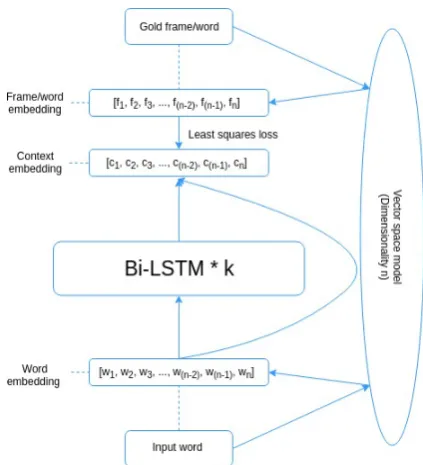
This section describes the overall architecture of our FrameID model. We adopt a bidirectional re-current neural network (Bi-LSTM) that accepts as input different embeddings that represent frames and predicates. This allows us to measure the ef-fectiveness of the pre-trained embeddings (corpus-based, graph-based and combined) for an apples-to-apples comparison within the same setting. The components of our neural network include:
• an input embedding layer; the network can allow two embedding inputs per word – the embeddings from separate sources (corpus/graph-based) are concatenated; • bidirectional recurrent layers; the forward
and backward states are concatenated; • an output vector with the same
dimensional-ity as the frame embeddings;
• an objective function that compares the fi-nal output and the gold frame embeddings; at those steps that do not introduce frame-evoking predicates the network attempts to reconstruct the embedding for the input word itself, so that “infect” should result in the em-bedding of INFECTING, but “the” should just be reconstructed to the embedding of “the”.
At evaluation time, output vectors are compared via cosine similarity to the frame embeddings, where the label for the closest frame is selected as the model’s prediction. Figure1shows the ar-chitecture of the network.
4 FrameNet as a Graph
Figure 1: Bi-LSTM for FrameID. The diagram shows a model with one embedding layer, but combining with an additional embedding source is done trivially via concatenation. The embeddings used for the input and the gold frames can either come from the same or a different vector space. The size of the word/frame embeddings isn;kis the number of hidden layers.
to hypernymy in WordNet (e.g., REVENGE in-herits from REWARDS AND PUNISHMENTS), Us-ing, which connects a concrete frame to a related, but more abstract frame (e.g. SPEED uses the MOTION frame), and Subframe, where the par-ent frame is a more complex evpar-ent that subsumes the child frame(s) (e.g. CRIMINAL PROCESS sub-sumes ARREST). See Ruppenhofer et al. (2006) for a more detailed description of all possible rela-tion types.
This network of relations is used as the basis of our graph. We construct a graph where each frame is a node, and we build edges between frames ac-cording to the available relational information in FrameNet. Frame elements (FEs) are also nodes that are connected to their frames. Some FE nodes, such as AGENT, are widely connected in the graph since they are linked to a diverse set of frames. In order to have a single FE node be distinctive to a single frame, the FE nodes are given unique iden-tifiers. For the unique identifier, the frame name is prepended to the name of the FE together with a colon separator, such as HIRING::EMPLOYEE. However, these unique FE nodes are further
con-nected to their abstract counterparts with an is-a relation (REVENGE::AVENGER is-a AVENGER), which preserves the connectedness of the FE in FrameNet and also provides some connectivity be-tween frames that share the same FE.
4.1 Extending the FrameNet graph
We empirically find that, on its own, the graph de-scribed above does not form a dense enough graph structure. This is due to the fact that few frames can be connected through short paths since some frames contain little to no relations to others and FrameNet FEs are often very specific to particular types of scenarios.
To overcome this limitation, we mapped FrameNet to the WordNet lexical resource. Word-Net groups synonymous words of the same part-of-speech category into concept clusters called synsets and provides lexical relations between word senses and the relations between synsets. Its dense semantic network provides a rich represen-tation of the ecology of lexical meaning, espe-cially when associated resources are brought into play. This allows for connecting concepts that might not be linked via lexico-semantic relations but nevertheless are mutually dependent due to contextual co-occurrence.
Mapping FrameNet predicates with the Pred-icate Matrix The mapping process is done in two steps. First, the verbal predicates in FrameNet are connected to their corresponding synsets in WordNet. Since one word can be mapped to several senses in WordNet, this mapping is far from straightforward. We map FrameNet pred-icates and WordNet synsets through an auxil-iary resource called the Predicate Matrix (De La-calle et al., 2014), which aimed to automati-cally extend the predicate mappings from Sem-Link (Palmer,2009). Within the Predicate Matrix, predicates from a FrameNet frame are linked to concept nodes, which are also connected to a cor-responding WordNet synset. Via these synsets, we now have access to WordNet’s semantic network, where words are interconnected through lexico-semantic relations such as hypernymy, antonymy, meronymy, as well as through other relations ex-pressing relatedness.
For instance, SELLERis strongly linked to lexical items such ascashier orsalesman, both available in WordNet. While the Predicate Matrix aligns the predicates in FrameNet to WordNet synsets, we additionally align these candidate fillers from WordNet to the FEs they instantiate in FrameNet. Aligning FrameNet’s FEs with WordNet is made possible by an automatically created extension of FrameNet (Bryl et al., 2012). The method used by the authors relies on a machine learn-ing model linklearn-ing nominal lexical fillers for the FEs in the authors’ FrameNet reference corpus to Wikipedia pages. The BabelNet resource (Navigli and Ponzetto, 2010) provides mappings between Wikipedia pages and the corresponding WordNet synsets, which are mapped to the frame-FE tuples. Because the process is automated, the correspon-dences are inevitably noisy. However, it provides a significant expansion of words are not directly given by the FrameNet lexicon but nevertheless in-tuitively related to the concepts in the frame; e.g., acashierandsalesmanare implicitly related to the COMMERCE SELL frame. In this sense, this step incorporates more world knowledge into a frame’s graph.
5 The FrameNet Graph as a Pseudo-Corpus
Once the nodes in FrameNet and WordNet are aligned, the resulting graph structure is leveraged to produce a large corpus of artificial sentences on which a vector space model can be trained. We follow the methodology of Goikoetxea et al.
(2015) for the generation of a pseudo-corpus, where each line contains a sequence of node iden-tifiers visited during one random walk of the algo-rithm as it moves along the graph. This is done with the UKB tool1 and its “ukb walkandprint” functionality. Thewemit probparameter is set to 0.5, which means that in half the cases it emits a dictionary key associated with the node ID gener-ated along the random walk, i.e., half the “words” in the artificial sentences are either predicates or frames corresponding to synsets, as established in the mapping process.
The UKB tool uses a particular dictionary for-mat for the creation of pseudo-corpora. Each line is constructed as follows: a key, often a predicate, begins the entry, followed by its associated Word-Net synsets. The result looks like the following:
1http://ixa2.si.ehu.es/ukb/
employment 13968092-n:9 00584367-n:9 01217859-n:6 00947128-n:1
where the synset number is given along with a letter after the synset (“-n”), which signifies the POS category and the number (“:9”) is the num-ber of instances of this specific sense found in a reference corpus. The ukb walkandprint func-tionality requires this dictionary for the emission of lexical items from the visited nodes along the random walks. In the case when wemit prob is set to a non-zero value, the tool will pick, with probability wemit prob, one dictionary key asso-ciated with the current WordNet synset. The dic-tionary provides information on what items belong to which synset. If thedict weightparameters are provided, the tool will also take into consideration the count-based weights for each predicate-synset pairing and emit a predicate according to the avail-able probability distribution.
Incorporating FrameNet frames into the UKB dictionary Because the graph now includes frames and FE relations, which are outside of the WordNet lexicon, those need to be included in the dictionary as well. Therefore, we add the frame IDs to the dictionary. This is done in two ways; first, the frames are added as keys corresponding to the synsets to which they have been mapped -below, the frame RENTINGis mapped:
Renting 02208537-v:1 02460619-v:1 02208903-v:2
Second, frames are added as values of lexical items that evoke them, as per the information en-coded in the FrameNet database. For instance, the predicatehire.vis evoked by the RENTINGframe:
hire.v Renting:0 02208537-v:0 02460619-v:1 02409412-v:33 Hiring:342
A frame ID can be emitted whenever a connected synset node is visited during a random walk, or if a frame node is visited, it might emit a lexical item connected to the frame as a key in the dictionary. Thus the pseudo-corpus includes both references to specific frames and frame-evoking expressions whose use is contextualized with respect to partic-ular frames. The weights for the frames in the dic-tionary are calculated by summing up the weights
2Note that because we are interested in obtaining
for the lemma-synset pairs mapped to the frames-as-values.
Augmenting the Graph with Wikipedia
With the graph and dictionary in place, ukb walkandprint is used to generate 200 million random walks. This pseudo-corpus is then concatenated to a lemmatized and POS-tagged Wikipedia dump (where each word is trans-formed to a lemma.pos lexical item), so that the embeddings can be trained on natural language text in addition to the graph-generated artificial sentences. This is a naive method to combine graph and text information, in that the model is never trained on both kinds of information in one and the same sentence, but it nevertheless allows it to encode real-text syntagmatic information within the lexical space projected from the graph structure. The Wikipedia data is approximately the same size as the pseudo-corpus.
6 Frame Embeddings
Graph embeddings of frames We now
have a pseudo-corpus composed from the FrameNet/WordNet graph structure, as described in Section 5. These graph representations are constructed for all the frames in the FrameNet lexicon. We use the popular Word2Vec tool3 to generate embeddings from the pseudo-corpus. This model uses negative sampling to learn word representations, and we apply the Skipgram variant of the model where a single word is used to predict its neighboring terms in the immediate context. This produces a large inventory of graph embeddings for frames in FrameNet and lexical items, all located in the same space.
Corpus embeddings of frames To compare the graph embeddings with frame embeddings learned from a corpus, we took the freely available em-beddings from Sikos and Pad´o (2018), in which the authors generated frame embeddings using the Word2Vec tool. Specifically, the authors took lem-matized sentences from the FrameNet annotated data and replaced each predicate (e.g.,say.v) with the frame it evokes:
FrameNet sentence Officialssay.vhe left Frame evoked STATEMENT
Embedding Input official STATEMENThe left
3https://code.google.com/archive/p/
word2vec/
This resulted in sentences of frames in context, so the example input above would not only pro-duce an embedding for the frame STATEMENT, but also embeddings for the context words such asofficial. In addition to training embeddings on this frame corpus, the authors also provide embed-dings based on the original FrameNet annotated corpus. This is important in our case, as we can use the embeddings trained on the original corpus at the input step and the embeddings trained on the frames corpus at the output.
7 Experiments
7.1 Model Setup
The inputs to our model are frame and lexical unit embeddings with 300 dimensions, and the Bi-LSTM has 1 recurrent layer. Each Bi-LSTM cell is of size 200, with 0.2 dropout applied to all its sublay-ers during training. We use the Adam optimizer with a least squares loss function. The training sentences are presented in batches of 128.
The graph that we use for generating the train-ing data for the embeddtrain-ing models consists of 129,101 nodes and 1,146,508 edges. The nodes correspond predominantly to WordNet synsets, with the rest being frame and FE IDs. The synset and FE IDs can be part of the pseudo-corpus or can be omitted from it, depending on the parametriza-tion of theukb walkandprintcommand. Depend-ing on this choice, the embeddDepend-ings will either con-tain representations of synsets and FEs, or will not, since they are not present as keys in the UKB dic-tionary.
The graph embeddings were produced by the Word2Vec tool in the Skipgram variant, which has many hyperparameters that can be tuned. We use the following hyperparameters to generate the graph embeddings: size=300; window=15; sample=1e-7; negative=5; iter=7.
7.2 Datasets
We use the annotated data from the FrameNet v1.5 full text annotations to train our models. Sentences are drawn from the balanced BNC corpus4, and overall there are over 11k frame-evoking predi-cates with their frames manually annotated. Stan-dard training, development and test splits are de-fined byDas et al.(2014), where 39 documents are used in training with over 15k target predicates, 16
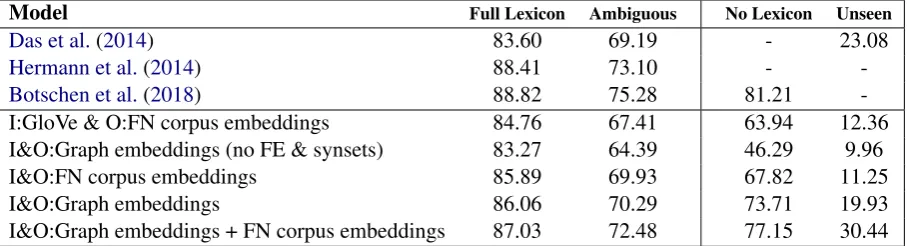
Model Full Lexicon Ambiguous No Lexicon Unseen
Das et al.(2014) 83.60 69.19 - 23.08
Hermann et al.(2014) 88.41 73.10 -
-Botschen et al.(2018) 88.82 75.28 81.21
-I:GloVe & O:FN corpus embeddings 84.76 67.41 63.94 12.36 I&O:Graph embeddings (no FE & synsets) 83.27 64.39 46.29 9.96 I&O:FN corpus embeddings 85.89 69.93 67.82 11.25
I&O:Graph embeddings 86.06 70.29 73.71 19.93
I&O:Graph embeddings + FN corpus embeddings 87.03 72.48 77.15 30.44
Table 1: Evaluation of FrameID with different frame embeddings. The table provides results obtained with the same architecture, but with different input and output embedding models; I stands for input embedding modeland O– for output embedding model; + means concatenation of vectors from two embedding models.
documents for development with over 4,500 tar-get predicates, and 23 documents for testing with 4,458 target predicates.
7.3 Evaluation Metrics
Standard FrameID systems are evaluated via sev-eral different metrics, and we evaluate our models on the most common types. “Full Lexicon” evalu-ation uses knowledge of the FrameNet lexicon, so that for each predicate we classify the most likely frame given the list of all possible frame candi-dates for that predicate. “Ambiguous” only runs evaluation on predicates that can evoke multiple frames, thus making the evaluation more challeng-ing by removchalleng-ing predicates that can only evoke one frame. “No Lexicon” reports only results from the classifier, where all frames in the FrameNet database are considered possible candidates. Fi-nally, “Unseen” is the most challenging, as it only evaluates predicates that were not seen in the train-ing data and also does not incorporate knowledge from the lexicon.
8 Results
Results of our models are given in Table 1. The best performing model combines graph-based em-beddings with corpus-based emem-beddings for frame prediction, where strong gains are seen over the basic model that uses corpus-based embeddings alone. “Unseen” results in particular show the largest performance gains, where the combined graph- and corpus-based embeddings allow the model to generalize over new predicates.
The model that uses the popular GloVe embed-dings (Pennington et al., 2014) at the input step performs worse than the model that uses the FN
corpus embeddings at input and output. This in-dicates that learning the mapping between pred-icates and frames is much easier if their corre-sponding representations are drawn from identical data. The graph-based embeddings are somewhat better than those based solely on the FrameNet an-notated corpus; the difference is especially pro-nounced in the evaluations without the lexicon. However, the graph embedding model that does not incorporate WordNet synsets and FrameNet FEs seems to perform the worst, indicating that those resources provide a strong conceptual skele-ton for situating the embeddings of frames and lex-ical items. What is clear from the results, then, is that both corpus-based and graph-based embed-dings contribute to frame prediction and that a richer structure underlying the graph-based em-beddings is crucial for improved accuracy.
Our model underperforms compared to other embedding frameworks from Hermann et al.
mod-ule. Since the FrameNet corpus is not annotated with such data, sequential transfer learning can be employed in order to train on two different signals at different stages (Ruder,2019).
The Botschen et al. (2018) model is most sig-nificantly different from ours in two respects: it uses multimodal embedding representations at the input (textual + visual), and it employs a softmax classifier at the output step, whereas we use MSE as a loss function. Prior work has shown that the first option is more powerful in the context of word sense disambiguation tasks (Popov, 2017). The two classification approaches can be com-bined, however, in a multitask learning setting to boost accuracy with respect to both (Popov,2019). Since our main goal in this paper has been to demonstrate the benefits of embedding FrameNet concepts using a graph model, we leave the task of improving the accuracy of the framework for future work.
Nevertheless, our Bi-LSTM does perform well compared to theDas et al.(2014) system, and we get strong results in the “No Lexicon” condition, suggesting the model is able to successfully learn frame categories without any knowledge from the lexicon. The “Unseen” metric shows a comple-mentarity between the graph- and corpus-based embeddings, which further suggests that the two sources of information encode very different lexi-cal and world knowledge.
8.1 Linguistic Analysis
We proceed with a qualitative comparison of frame performance to establish which frames have a boost in performance with graph or corpus-based knowledge. To discriminate the best performing frames within each model, we assign a ranking function for frame performance. We run this rank-ing function over each model to obtain a ranked list of its best performing frames.
Ranking combines the accuracy of each individ-ual frame Acc(Fi) with an added weight for the
frequency of the frame in the corpusF req(Fi)to
obtain an overall rank scoreRank(Fi). Acc(Fi)
is defined as the number of correctly predicted stances of the frame over the total number of in-stances. F req(Fi) is the total number of frame
instances over the total number of all frame in-stances in the test corpus. The F req(Fi) weight
ensures that frames with higher counts in the cor-pus are ranked higher than frames that have few
in-stances, so therefore a frame with a perfect score will receive a higher rank when there are 80 in-stances of that frame than a perfect score with only a single instance.
We defineRank(Fi)of a single frame as:
Rank(Fi) =Acc(Fi) +F req(Fi) (1)
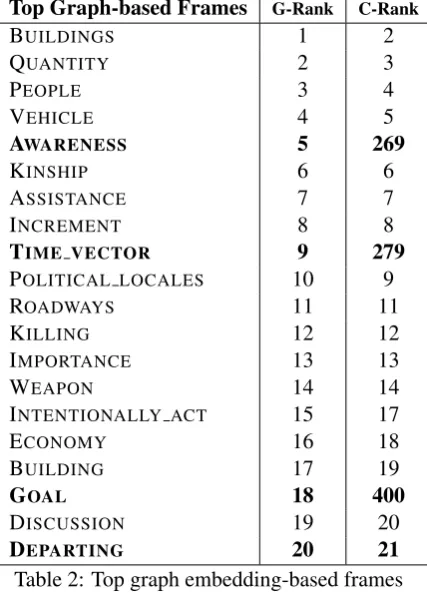
We then apply the ranking formula to all frames F in the test data and select the 20 highest ranked frames. The highest ranking frames for each model are given in Table 2 and Table 3. Table 2 gives frames that perform better with graph-based knowledge, including AWARENESS,
TIME VECTOR, GOAL, and DEPARTING. Inter-estingly, AWARENESS and TIME VECTOR both have a large number of predicates, where AWARE -NESS has predicates comprehend.v, know.v, and understand.v, and TIME VECTORcontains mostly function words such as after.prep, before.prep, and since.adv. Both frames have frame ele-ments that appear in multiple related frames, in-cluding EXPRESSOR and COGNIZER, which
ap-pear in AWARENESS and other frames relating to mental activity, and LANDMARK EVENT in the TIME VECTOR frame, which also appears
in the closely related TEMPORAL COLLOCATION
frame. This suggests that their graph structures are large but the knowledge in these frame graphs are tied to a specific domain.
Alternatively, Table 3 shows frames that per-form better in the corpus-based model, in-cluding ORIGIN, LEADERSHIP, and NATU
-RAL FEATURES. Their predicates are mostly re-stricted to one sense – ORIGIN, for instance, has predicates jamaican.n, canadian.n, and french.a, while NATURAL FEATUREShas predicates moun-tain.n andcontinent.n. However, their frame el-ements are more likely to appear across different domains. LOCALEis a frame element of the NAT -URAL FEATURES frame, and it appears in PO
-LITICAL LOCALES which has many politically-related predicates and politically-politically-related frames, all relatively unrelated to the concept of NATU
-RAL FEATURES. ENTITY is a frame element of the ORIGINframe, and it appears in AGING and
EVENTIVE AFFECTING frames – both are also only loosely related to the concept of an ORI
-GIN. Frames that perform better under the
sur-Top 20 frames in graph- versus corpus-based frame embedding models. Frames inboldare not in the top 20 of the other model, and thus have benefited from knowledge found in either the graph (Table2)
or corpus (Table3).
Top Graph-based Frames G-Rank C-Rank
BUILDINGS 1 2
QUANTITY 2 3
PEOPLE 3 4
VEHICLE 4 5
AWARENESS 5 269
KINSHIP 6 6
ASSISTANCE 7 7
INCREMENT 8 8
TIME VECTOR 9 279
POLITICAL LOCALES 10 9
ROADWAYS 11 11
KILLING 12 12
IMPORTANCE 13 13
WEAPON 14 14
INTENTIONALLY ACT 15 17
ECONOMY 16 18
BUILDING 17 19
GOAL 18 400
DISCUSSION 19 20
DEPARTING 20 21
Table 2: Top graph embedding-based frames with the graph model rank (G-rank) and the
corpus model rank (C-Rank)
Top Corpus-based Frames C-Rank G-Rank
LOCATIVE RELATION 1 269
BUILDINGS 2 1
QUANTITY 3 2
PEOPLE 4 3
VEHICLE 5 4
KINSHIP 6 6
ASSISTANCE 7 7
INCREMENT 8 8
POLITICAL LOCALES 9 10
ORIGIN 10 325
ROADWAYS 11 11
KILLING 12 12
IMPORTANCE 13 13
WEAPON 14 14
NATURAL FEATURES 15 286
LEADERSHIP 16 277
INTENTIONALLY ACT 17 15
ECONOMY 18 16
BUILDING 19 17
DISCUSSION 20 19
Table 3: Top corpus embedding-based frames with the corpus model rank (C-Rank) and the
graph model rank (G-rank)
prising that under these conditions the graph em-beddings do not help in prediction.
9 Conclusion
Our results here demonstrate that neural networks can achieve a significant boost when combin-ing representations learned from corpus data with representations learned from knowledge graphs. Many frames that perform poorly in pure corpus-based models improve in the graph-corpus-based models. The graph-based model seems to learn better when there is a large set of domain-specific knowledge extracted from the frame’s graph. Alternatively, corpus models provide benefits to frames whose graph structures are more diffuse, suggesting the corpus knowledge is better at helping the model to narrow down the sense of the predicate by us-ing the contextual cues found in the annotated data. By combining both embedding types, we achieve strong gains where the combined model can draw advantages from both graph- and
corpus-based embeddings.
Acknowledgements
Hao Peng, Sam Thomson, Swabha Swayamdipta, and Noah A. Smith. 2018. Learning joint semantic
parsers from disjoint data. CoRRabs/1804.05990.
http://arxiv.org/abs/1804.05990.
Jeffrey Pennington, Richard Socher, and Christopher Manning. 2014. Glove: Global vectors for word representation. InProceedings of the 2014 confer-ence on empirical methods in natural language pro-cessing (EMNLP). pages 1532–1543.
Alexander Popov. 2017. Word sense disambiguation with recurrent neural networks. In Proceedings of the Student Research Workshop associated with RANLP. pages 25–34.
Alexander Popov. 2019. Lexical modeling for natural language processing. In Selected papers from the CLARIN Annual Conference 2018, Pisa, 8-10 Oc-tober 2018. Link¨oping University Electronic Press, 159, pages 147–160.
Sebastian Ruder. 2019. Neural Transfer Learning for Natural Language Processing. Ph.D. thesis, NA-TIONAL UNIVERSITY OF IRELAND, GALWAY.
Josef Ruppenhofer, Michael Ellsworth, Myriam Schwarzer-Petruck, Christopher R Johnson, and Jan Scheffczyk. 2006. Framenet ii: Extended theory and practice .
Jennifer Sikos and Sebastian Pad´o. 2018. Using em-beddings to compare framenet frames across lan-guages. In Proceedings of the First Workshop on Linguistic Resources for Natural Language Process-ing. pages 91–101.