4FX: Light Verb Constructions in a Multilingual Parallel Corpus
Anita R´acz
1, Istv´an Nagy T.
1, Veronika Vincze
2 1Department of Informatics, University of Szeged[email protected], [email protected]
2Hungarian Academy of Sciences, Research Group on Artificial Intelligence
Abstract
In this paper, we describe 4FX, a quadrilingual (English–Spanish–German–Hungarian) parallel corpus annotated for light verb constructions. We present the annotation process, and report statistical data on the frequency of LVCs in each language. We also offer inter-annotator agreement rates and we highlight some interesting facts and tendencies on the basis of comparing multilingual data from the four corpora. According to the frequency of LVC categories and the calculated Kendalls coefficient for the four corpora, we found that Spanish and German are very similar to each other, Hungarian is also similar to both, but German differs from all these three. The qualitative and quantitative data analysis might prove useful in theoretical linguistic research for all the four languages. Moreover, the corpus will be an excellent testbed for the development and evaluation of machine learning based methods aiming at extracting or identifying light verb constructions in these four languages.
Keywords:light verb constructions, parallel corpus, multilinguality, English, Spanish, German, Hungarian
1.
Introduction
Multiword expressions (MWEs) are lexical items that con-tain space or “idiosyncratic interpretations that cross word boundaries”. They can be decomposed into single words and display lexical, syntactic, semantic, pragmatic and/or statistical idiosyncrasy (Sag et al., 2002; Calzolari et al., 2002; Kim, 2008). One subclass of MWEs are light verb constructions (LVCs). They are formed by the combina-tion of a nominal and a verbal component where the noun is usually taken in one of its literal senses but the verb loses its original sense to some extent. Due of their idiosyn-cratic behavior, they often pose a problem to natural lan-guage processing (NLP) systems. For instance, in machine translation they cannot be directly translated as the verbal component of the same light verb constructions may differ from language to language. Here we offer some English, German, Spanish and Hungarian LVCs:
to have a walk–eine Spaziergang machen(lit. a walk make) –dar un paseo(lit. give a walk) –
s´et´at tesz(lit. walk-ACC make)
to reach an agreement–llegar a un acuerdo(lit. arrive to an agreement) –eine Absprache treffen
(lit. an agreement meet) –megegyez´esre jut(lit. agreement-SUB get)
Here we describe 4FX, a quadrilingual (English–Spanish– German–Hungarian) parallel corpus annotated for light verb constructions. We present the annotation process and report statistical data on the frequency of LVCs in each lan-guage. We hope that the corpus will enhance multilingual research on light verb constructions both from a theoretical linguistic point of view and from a computational linguistic point of view (especially for the development of applica-tions).
The structure of the paper is as follows. First, related corpora and related work on the NLP treatment of mul-tiword expressions are presented. Then the corpus is
described together with annotation principles and inter-annotator agreement rates are also provided. After present-ing some statistical data on the corpus the paper concludes with illustrating how the corpus and the database can be exploited in several fields of NLP.
2.
Related work
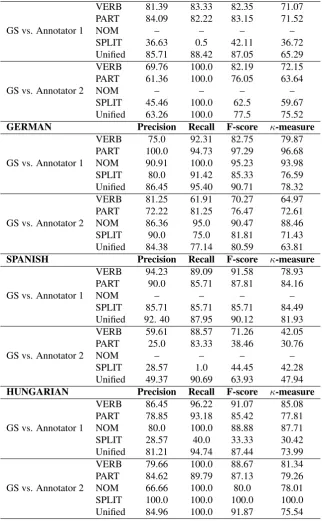
ENGLISH Precision Recall F-score κ-measure
GS vs. Annotator 1
VERB 81.39 83.33 82.35 71.07
PART 84.09 82.22 83.15 71.52
NOM – – – –
SPLIT 36.63 0.5 42.11 36.72
Unified 85.71 88.42 87.05 65.29
GS vs. Annotator 2
VERB 69.76 100.0 82.19 72.15
PART 61.36 100.0 76.05 63.64
NOM – – – –
SPLIT 45.46 100.0 62.5 59.67
Unified 63.26 100.0 77.5 75.52
GERMAN Precision Recall F-score κ-measure
GS vs. Annotator 1
VERB 75.0 92.31 82.75 79.87
PART 100.0 94.73 97.29 96.68
NOM 90.91 100.0 95.23 93.98
SPLIT 80.0 91.42 85.33 76.59
Unified 86.45 95.40 90.71 78.32
GS vs. Annotator 2
VERB 81.25 61.91 70.27 64.97
PART 72.22 81.25 76.47 72.61
NOM 86.36 95.0 90.47 88.46
SPLIT 90.0 75.0 81.81 71.43
Unified 84.38 77.14 80.59 63.81
SPANISH Precision Recall F-score κ-measure
GS vs. Annotator 1
VERB 94.23 89.09 91.58 78.93
PART 90.0 85.71 87.81 84.16
NOM – – – –
SPLIT 85.71 85.71 85.71 84.49
Unified 92. 40 87.95 90.12 81.93
GS vs. Annotator 2
VERB 59.61 88.57 71.26 42.05
PART 25.0 83.33 38.46 30.76
NOM – – – –
SPLIT 28.57 1.0 44.45 42.28
Unified 49.37 90.69 63.93 47.94
HUNGARIAN Precision Recall F-score κ-measure
GS vs. Annotator 1
VERB 86.45 96.22 91.07 85.08
PART 78.85 93.18 85.42 77.81
NOM 80.0 100.0 88.88 87.71
SPLIT 28.57 40.0 33.33 30.42
Unified 81.21 94.74 87.44 73.99
GS vs. Annotator 2
VERB 79.66 100.0 88.67 81.34
PART 84.62 89.79 87.13 79.26
NOM 66.66 100.0 80.0 78.01
SPLIT 100.0 100.0 100.0 100.0
Unified 84.96 100.0 91.87 75.54
Table 2: Inter-annotator agreement rates on the 4FX corpus
3.4.
Statistics on corpus data
The total number and the number of the subtypes of light verb constructions in each language are presented in Table 3.
In Table 4, the number of LVCs is contrasted to the num-ber of LVC lemmas and the frequency of each lemma on average is also presented. The number of hapax legomena (i.e. LVCs or light verbs that occur only once in the corpus) and their rate is also given here.
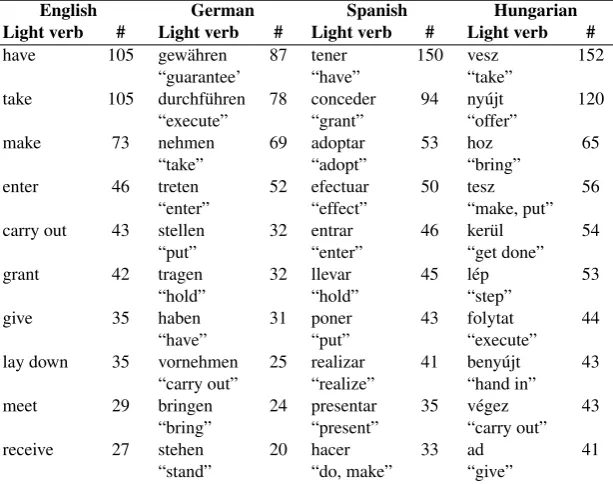
Tables 5 and 6 list the most frequent LVCs and light verbs in each language.
4.
Comparing multilingual data
The comparison of the data on the four languages reveals interesting facts. First of all, it is salient that the num-ber of light verb constructions in the languages are not the same: Hungarian texts seem to abound in LVCs while in English, there are about two third of the Hungarian fre-quency, German and Spanish being in the middle. How-ever, further annotated corpora are needed, preferably from other domains, in order to see whether this difference in fre-quency is a specificity of the legal domain or it is a general characteristics of the languages.English German Spanish Hungarian
LVC # LVC # LVC # LVC #
have regard 91 Hilfe gew¨ahren 51 tener en cuenta 79 t´amogat´ast ny´ujt 89 “grant aid” “take into account” “grant support”
enter into force 42 in Kraft treten 49 conceder ayuda 67 figyelembe vesz 74 “enter into force” “grant aid” “take into account”
grant aid 38 Stellung nehmen 46 entrar en vigor 45 r´eszt vesz 59 “adopt a position” “enter into force” “take part”
take into account 32 Flug durchf¨uhren 35 adoptar una medida 27 hat´alyba l´ep 45 “operate a flight” “adopt measures” “enter into force”
receive aid 20 Antrag stellen 23 beneficiarse de una ayuda 20 d¨ont´est hoz 27 “hand in an application” “receive aid” “make a decision”
take account 18 Bezug nehmen 20 efectuar un vuelo 20 meg´allapod´ast k¨ot 25 “make reference” “operate a flight” “make a contract”
lay down a rule 12 Rechnung tragen 20 celebrar un acuerdo 19 rendelkez´esre ´all 24 “take account” “conclude an agreement” “be at his disposal”
take measures 12 Lizenz erteilen 14 poner en el mercado 14 hat´ast gyakorol 18 “grant a licence” “place on the market” “have impact”
impose an obligation 11 in Verkehr bringen 14 prestar un servicio 14 k´erelmet beny´ujt 16 “place on the market” “provide a service” “hand in an application” meet a requirement 11 Erm¨aßigung gew¨ahren 12 recibir una autorizaci´on 12 t´amogat´asban r´eszes¨ul 16
“grant a reduction” “receive authorization” “receive support”
Table 5: The most frequent LVCs in the 4FX corpus.
English German Spanish Hungarian
Light verb # Light verb # Light verb # Light verb # have 105 gew¨ahren 87 tener 150 vesz 152
“guarantee’ “have” “take”
take 105 durchf¨uhren 78 conceder 94 ny´ujt 120 “execute” “grant” “offer”
make 73 nehmen 69 adoptar 53 hoz 65 “take” “adopt” “bring”
enter 46 treten 52 efectuar 50 tesz 56 “enter” “effect” “make, put” carry out 43 stellen 32 entrar 46 ker¨ul 54
“put” “enter” “get done” grant 42 tragen 32 llevar 45 l´ep 53
“hold” “hold” “step”
give 35 haben 31 poner 43 folytat 44 “have” “put” “execute” lay down 35 vornehmen 25 realizar 41 beny´ujt 43
“carry out” “realize” “hand in” meet 29 bringen 24 presentar 35 v´egez 43
“bring” “present” “carry out” receive 27 stehen 20 hacer 33 ad 41
“stand” “do, make” “give”
Table 6: The most frequent light verbs in the 4FX corpus.
a lot more split constructions than in other languages. This is most probably due to the German word order: in subor-dinate clauses, it is the verb that is the last element of the clause thus it may happen that the nominal component of the light verb construction precedes the verb and they are not adjacent such as in (we provide the English equivalent as well):
[...] k¨onnen sie gem¨aß Artikel 19 der Richtlinie einen Antragan die Kommissionrichten.
“they maysubmit a requestto the Commission in accor-dance with Article 19 of the Directive.”
We also calculated Kendall’s coefficient for the four cor-pora, which reflects similarities among languages,
concern-ing the frequency of LVC categories. Accordconcern-ing to the data, Spanish and German are very similar to each other (the coefficient is 1.0), Hungarian is also similar to both (0.9), but German differs from all these three to a greater degree (Kendall’s coefficient being 0.5 for Spanish and English and 0.3 for Hungarian). This may be another consequence of the German word order rules, which may be responsible for the bigger number of split constructions.
en de es hu Total
NOM 37 151 82 199 469
5.50% 18.73% 8.74% 6.91% 13.49%
VERB 245 265 519 384 1413 36.40% 32.88% 55.33% 51.51% 40.65%
SPLIT 127 278 132 94 631 18.87 % 34.49% 14.07% 8.88% 18.15%
PART 264 112 205 382 963 39.23 13.90% 21.86% 36.07% 27.70%
All 673 806 938 1059 3476 100.00 100.00 100.00 100.00 100.00
Table 3: Subtypes of light verb constructions in the 4FX corpus. NOM:nominal light verb constructions. VERB:
verbal occurrences. SPLIT:split light verb constructions.
PART:participial light verb constructions.
en de es hu
LVCs 678 806 938 1062
LVC lemmas 195 272 349 299 Average occurrence 3.48 2.96 2.69 3.55
LVC verbs 42 96 78 80
Average occ. in lemmas 4.64 2.83 4.47 3.74 Hapax LVCs 108 162 222 176 % 55.38 59.56 63.61 58.86 Hapax LVC verbs 11 35 28 24 % 26.19 36.46 35.90 30.00
Table 4: Statistics on the frequency of LVCs and LVC lem-mas in the 4FX corpus.
LVCs and light verbs also reflects a similar picture, which might be of interest in the automatic detection of LVCs: a dictionary lookup method can probably achieve better results in English than is the other languages (R´acz et al., 2014).
As for a qualitative analysis of the data, it can be observed that there are some common LVCs that are frequent in each of the four languages such as:
to enter into force – in Kraft treten – entrar en vigor – hat´alyba l´ep
to grant aid – Hilfe gew¨ahren – conceder ayuda – t´amogat´ast ny´ujt
Other construction occur among the top 10 LVCs in three of the languages (except for German) such as:
to take into account – tener en cuenta – figyelembe vesz to receive aid – beneficiarse de una ayuda – t´amogat´asban r´eszes¨ul
These are among the most frequent light verb constructions and they are also typical of the legal language. On the other hand, there are also language-specific light verb construc-tions in the data, which do not have an equivalent in all or any of the other languages just like the English phrase
having regard tocorresponds to the Hungarian phrase tek-intettelregard-INS “with regard to”.
If the most frequent light verbs are analyzed, we can again find some verbs that occur among the top 10 verbs in at least three languages, which are listed below:
• take,nehmenandvesz;
• enter,tretenandentrar;
• make,hacerandtesz;
• have,habenandtener.
It is interesting to observe that while the verbs meaning “to make” are very frequent in a light verb construction in English, Spanish and Hungarian, the verb machen rarely occurs in German LVCs. On the other hand, there is no translational equivalent of the verb “to have” in Hungarian – possessive sentences likeI have a carare expressed with the combination of a copula and some possessive suffixes on the noun –, which explains why no such verb occurs in the Hungarian data.
5.
Conclusions
In this paper, we presented 4FX, a quadrilingual parallel corpus annotated for light verb constructions. We explained the theoretical basis of the annotation by describing the types of LVCs and the most essential annotation principles we followed. We provided statistical data on the corpus, we offered inter-annotator agreement rates too, and we high-lighted some interesting facts and tendencies on the basis of comparing multilingual data from the four corpora. The corpus contains 673 LVCs in English, 806 in German, 938 in Spanish and 1059 in Hungarian. The qualitative and quantitative data analysis might prove useful in theoretical linguistic research for all the four languages. Moreover, the corpus will be an excellent testbed for the development and evaluation of machine learning algorithms aiming at detecting light verb constructions in these four languages, which we would like to implement in the future.
The annotated corpus is available free of charge for research and educational purposes at our website: http: //www.inf.u-szeged.hu/rgai/mwe.
6.
Acknowledgments
Istv´an Nagy T. was funded by the State of Hungary, co-financed by the European Social Fund in the framework of T ´AMOP-4.2.4.A/ 2-11/1-2012-0001 “National Excel-lence Program”. The other authors were funded in part by the European Union and the European Social Fund through the project FuturICT.hu (grant no.: T ´ AMOP-4.2.2.C-11/1/KONV-2012-0013).
7.
References
Bejcek, E. and Stran´ak, P. (2010). Annotation of multi-word expressions in the Prague Dependency Treebank.
Language Resources and Evaluation, 44(1-2):7–21. Calzolari, N., Fillmore, C., Grishman, R., Ide, N., Lenci,
Cinkov´a, S. and Kol´aˇrov´a, V. (2005). Nouns as Com-ponents of Support Verb Constructions in the Prague Dependency Treebank. In ˇSimkov´a, M., editor, Insight into Slovak and Czech Corpus Linguistics, pages 113– 139. Veda Bratislava, Slovakia.
Cook, P., Fazly, A., and Stevenson, S. (2008). The VNC-Tokens Dataset. InProceedings of the LREC Workshop Towards a Shared Task for Multiword Expressions (MWE 2008), pages 19–22, Marrakech, Morocco.
Kaalep, H.-J. and Muischnek, K. (2006). Multi-Word Verbs in a Flective Language: The Case of Estonian. In Proceedings of the EACL Workshop on Multi-Word Expressions in a Multilingual Contexts, pages 57–64, Trento, Italy. ACL.
Kaalep, H.-J. and Muischnek, K. (2008). Multi-Word Verbs of Estonian: a Database and a Corpus. In Pro-ceedings of the LREC Workshop Towards a Shared Task for Multiword Expressions (MWE 2008), pages 23–26, Marrakech, Morocco.
Kim, S. N. (2008). Statistical Modeling of Multiword Expressions. Ph.D. thesis, University of Melbourne, Melbourne.
Krenn, B. (2008). Description of Evaluation Resource – German PP-verb data. In Proceedings of the LREC Workshop Towards a Shared Task for Multiword Expres-sions (MWE 2008), pages 7–10, Marrakech, Morocco. Meyers, A., Reeves, R., Macleod, C., Szekely, R.,
Zielin-ska, V., Young, B., and Grishman, R. (2004). The Nom-Bank Project: An Interim Report. In Meyers, A., editor,
HLT-NAACL 2004 Workshop: Frontiers in Corpus Anno-tation, pages 24–31, Boston, Massachusetts, USA, May 2 - May 7. ACL.
R´acz, A., Nagy T., I., and Vincze, V. (2014). 4FX: f´elig kompozicion´alis szerkezetek automatikus azonos´ıt´asa t¨obbnyelv˝u korpuszon. In MSzNy 2014 – X. Magyar Sz´am´ıt´og´epes Nyelv´eszeti Konferencia, pages 317–324, Szeged, Hungary. University of Szeged.
Sag, I. A., Baldwin, T., Bond, F., Copestake, A., and Flickinger, D. (2002). Multiword Expressions: A Pain in the Neck for NLP. InProceedings of the 3rd Inter-national Conference on Intelligent Text Processing and Computational Linguistics (CICLing-2002, pages 1–15, Mexico City, Mexico.
Steinberger, R., Pouliquen, B., Widiger, A., Ignat, C., Erjavec, T., and Tufis¸, D. (2006). The JRC-Acquis: A multilingual aligned parallel corpus with 20+ languages. In Proceedings of the 5th International Conference on Language Resources and Evaluation (LREC’2006, pages 2142–2147.
Tan, Y. F., Kan, M.-Y., and Cui, H. (2006). Extending corpus-based identification of light verb constructions using a supervised learning framework. InProceedings of the EACL Workshop on Multi-Word Expressions in a Multilingual Contexts, pages 49–56, Trento, Italy. ACL. Tu, Y. and Roth, D. (2011). Learning English Light Verb Constructions: Contextual or Statistical. InProceedings of the Workshop on Multiword Expressions: from Pars-ing and Generation to the Real World, pages 31–39, Port-land, Oregon, USA. ACL.
Vincze, V. and Csirik, J. (2010). Hungarian corpus of light verb constructions. InProceedings of the 23rd Interna-tional Conference on ComputaInterna-tional Linguistics (Coling 2010), pages 1110–1118, Beijing, China. Coling 2010 Organizing Committee.
Vincze, V., Nagy T., I., and Berend, G. (2011). Mul-tiword Expressions and Named Entities in the Wiki50 Corpus. InProceedings of the International Conference Recent Advances in Natural Language Processing 2011, pages 289–295, Hissar, Bulgaria, September. RANLP 2011 Organising Committee.
Vincze, V., Nagy T., I., and Zsibrita, J. (2013). Learning to detect English and Hungarian light verb constructions.
ACM Transactions on Speech and Language Processing (TSLP), 10(2), June.