Extracting News Web Page Creation Time with DCTFinder
Xavier Tannier
LIMSI-CNRS
Univ. Paris-Sud, 91403 Orsay, France [email protected]
Abstract
Web pages do not offer reliable metadata concerning their creation date and time. However, getting the document creation time is a necessary step for allowing to apply temporal normalization systems to web pages. In this paper, we present DCTFinder, a system that parses a web page and extracts from its content the title and the creation date of this web page. DCTFinder combines heuristic title detection, supervised learning with Conditional Random Fields (CRFs) for document date extraction, and rule-based creation time recognition. Using such a system allows further deep and efficient temporal analysis of web pages. Evaluation on three corpora of English and French web pages indicates that the tool can extract document creation times with reasonably high accuracy (between 87 and 92%).
DCTFinder is made freely available on http://sourceforge.net/projects/dctfinder/, as well as all resources (vocabulary and annotated documents) built for training and evaluating the system in English and French, and the English trained model itself.
Keywords:temporal analysis, web, CRF
1.
Introduction
In most applications performing textual temporal analy-sis, addressed texts are newswire articles from only few sources. Considered corpora have a well-defined structure, with associated metadata – authors, title and document cre-ation time (DCT). Only a few systems have been run on open-domain web pages, for two main reasons:
• Web pages need to be cleaned before a proper analysis is performed on the text. The main textual content of a web page must be extracted, and menus, ads and non-informative content must be filtered out.
• As long as HTML5pubdatetag does not become widespread, there is no reliable metadata providing the web page creation time. However, document creation time is a necessary clue to analyze and normalize cor-rectly most of the temporal expressions (Llorens et al., 2012; Str¨otgen and Gertz, 2012; Chang and Manning, 2012). These temporal expressions are often relative (e.g. “Tuesday” or “June 21st”), and their reference time is often the DCT.
The first issue is addressed by Web page cleaners such as BodyTextExtraction (Finn et al., 2001), Boiler-pipe (Kohlschtter et al., 2010), jusText (Pomik´alek, 2011) or Readability1. Concerning the second one, systems run-ning on web pages only analyze absolute dates and are not able to extract any relative temporal information. However, Kessler et al. (2012) states that only 7% of the dates in news are absolute dates.
1.1. Motivation
Knowing the web page creation date would allow to ap-ply temporal normalization systems to web pages, and then
1http://www.readability.com/
to open the way to much more knowledge and application fields. However, even if almost all news web pages are time-stamped, there is no straightforward way to get their creation date: no metadata or server information are reli-able, and all sites have a different way to insert the date in the HTML content. A lot of dates occur in a web page, but only one is the creation date (see an example in Figure 1). Many applications using temporal analysis or temporal knowledge could benefit from a system extracting title and document creation time from a web page, so that much more temporal information can coincide with general knowledge from the Web.
By combining such a system to a web page cleaner, we could analyze web pages with the same information as pro-vided by a well-structured collection of newswire articles, i.e.a title, a DCT and an informative textual content.
1.2. Related Work
Temporal analysis of texts is a very dynamic research field in natural language processing (NLP). It has received grow-ing attention in the 2000s (Mani et al., 2005) and has lead to some standardization effort through the TimeML initia-tive (Pustejovsky et al., 2010).
Alonso et al. (2007), Alonso (2008), Kanhabua (2009), among others, have highlighted that the analysis of tem-poral information is often an essential component in text understanding and is useful in a wide range of NLP and information retrieval applications.
Current date
Creation date
Related articles dates
Figure 1: A typical news web page with different dates.
well as for aiding medical decision-making (Kim and Choi, 2011). Similarly, Jung et al. (2011) present an end-to-end system that processes clinical records, detects events and constructs timelines of patients’ medical histories. Finally, the evaluation campaigns TempEval 2007 (Verhagen et al., 2007) and TempEval 2010 (Verhagen et al., 2010) (and cur-rently running TempEval 2013) focused on temporal rela-tion identificarela-tion within a single text.
For all these applications, normalizing temporal expres-sions is necessary. Systems like Heideltime (Str¨otgen and Gertz, 2013), SUTime (Chang and Manning, 2012), Timen (Llorens et al., 2012) or ManTIME (Filannino et al., 2013) are dedicated to this task, which can only be per-formed if the time of creation of the parsed document is known.
2.
Extracting Web Page Creation Time with
CRFs
Many dates occur in a web page, but only one is the docu-ment creation time (DCT). Some pages include also the cur-rent date (“now”) or the date of last update. A lot of pages also provide links to other articles from the same site, with their associated dates. Finally, dates are present in the tex-tual content of the article. For these reasons, the challenge is not to detect dates, which is quite simple, but rather to select the DCT from all detected dates.
One important clue for achieving this selection is the prox-imity to the page title. Unfortunately, finding the page title is not that easy that we could think. For efficiency rea-sons, we do not want to rely on page rendering techniques. HTML tags dedicated to represent titles (mainly, <h1>) are not always used, or are used several times in the same
page. Section 2.1. describes heuristics used to extract the web page title.
We then use conditional random fields (CRFs) in order to extract all dates related to the web page itself (creation date, last update date and current date), as opposed to link-related or content-related dates (Section 2.2.). Finally, we parse the date texts; from this set, we choose a date that we consider as the DCT (Section 2.3.). We analyze dates at the day level, even when more fine-grained time information are provided in the text.
This workflow is illustrated in Figure 2.
2.1. Extracting Article Title
We use structured-based, hand-defined, prioritized rules for extracting article title from the web page. These rules are the following, from highest to lowest priority level:
1. Content of tag<h1>, if only one such tag is present in the document.
2. Content of any tag, if it is the longest string in the web page that is included in the HTML header<title> tag, and length higher than 15 characters.
3. Content of tag<h2>,<h3>or<h4>, if only one such tag is present in the document.
(ad-hoc parser) (CRFs - Wapiti)
Osborne must keep one eye on the ball
March 21, 2013 March 20, 2013
2013-03-20 1. Extract page title
(heuristics)
2. Extract document-related dates
3. Parse and select DCT
Language-dependent vocabulary Web Page
Figure 2: DCTFinder workflow.
2.2. Extracting Document-Related Dates with CRFs
As already stated, the difficulty in extracting the page cre-ation date is not to detect dates, but to choose the date that represents the DCT. Context and structure around dates are the main clues in this task. For this reason, condi-tional random fields (CRFs) are particularly suitable for our problem (Lafferty et al., 2001). This statistical modelling method is often applied in pattern recognition and struc-tured prediction tasks.
After a quick study achieved on a development set, we chose to build a classifier extracting indifferently the date of the day (“now”), the creation date and the last update date. The reason for this choice is that these three dates can appear in very close contexts and structure, and that it seems difficult to differentiate them. On the other hand, it is easy to select the DCT from these three dates after this classification step: it is simply the oldest one.
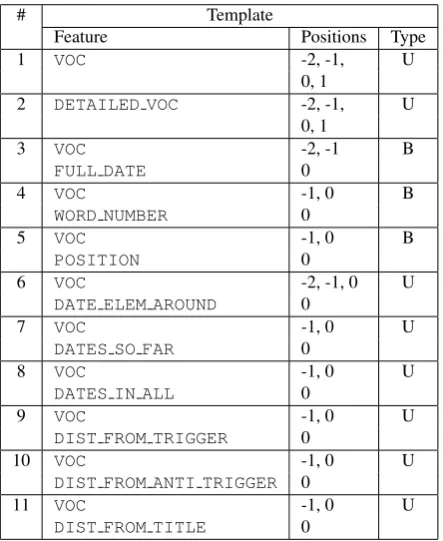
In CRFs, the training and test sets consist in the textual, tokenized content of the page, where each word and each HTML tag is associated to a number of features. Then, a feature template specifies which features will be used by the learning algorithm, as well as the relative position of the considered token feature. For example, in “published on Apr. 8, 2013”, we can learn that “Apr” (positionn) is probably part of the DCT content because:
1. it is itself a month name;
2. it follows the word “published” at positionn−2;
3. it is followed by a number and a year pattern at posi-tionsn+ 1andn+ 2.
CRFs make this modelisation possible. One can also spec-ify whether this template applies to the current class itself (“unigram”) or to the association between the current class and the previous one (“bigram”). Finally, all numeric val-ues must be discretized.
We used the CRF toolkit Wapiti (Lavergne et al., 2010). Im-plemented features and templates are described extensively
in this section; there are composed of lexical (language-dependent) features, such as date detection patterns or spe-cific vocabulary, as well as structural features, such as word number in a tag, number of dates in the article, distance from title.
2.2.1. Lexical (language-dependent) Features
DETAILED VOC. Date vocabulary and patterns (month, year, day, full date (such as “04/08/2013”), date zones (GMT, CET, etc.), time. Date triggers (“ pub-lished”, “created”, “release”, “on”. . . ) and anti-triggers (“comments”. . . ) are also included into DETAILED VOC.
VOC. Whether the word belongs to a date vocabulary class, such as a month name, a year pattern, a full date or a time zone (boolean value).
FULL DATE. Whether the word is a full date (boolean value).
2.2.2. Structural Features
WORD NUMBER. Word number in tag.
POSITION. Relative position in document: first quarter, second quarter, etc.
DATE ELEM AROUND. Number of date-related lexical en-tries around.
DATES SO FAR. Number of date patterns met so far in the document.
DATES IN ALL. Number of date patterns in the entire document.
DISTANCE FROM TITLE. Distance from the title.
DISTANCE FROM TRIGGER. Distance from lexical trig-gers.
Hector Llorens, Leon Derczynski, Robert Gaizauskas, and Estela Saquete. 2012. TIMEN: An Open Temporal Ex-pression Normalisation Resource. In LREC2012 (LRE, 2012).
2012. Proceedings of the Eighth International Lan-guage Resources and Evaluation (LREC’2012), Istanbul, Turkey, May.
Inderjeet Mani, James Pustejovsky, and Robert Gaizauskas, editors. 2005.The Language of Time: A Reader. Oxford University Press.
Jan Pomik´alek. 2011.Removing Boilerplate and Duplicate Content from Web Corpora. Ph.D. thesis, Masaryk Uni-versity, Faculty of Informatics, Brno.
James Pustejovsky, Kiyong Lee, Harry Bunt, and Lau-rent Romary. 2010. ISO-TimeML: An International Standard for Semantic Annotation. In Nicoletta Calzo-lari (Conference Chair), Khalid Choukri, Bente Mae-gaard, Joseph Mariani, Jan Odijk, Stelios Piperidis, Mike Rosner, and Daniel Tapias, editors,Proceedings of the Seventh International Conference on Language Re-sources and Evaluation (LREC’10), Valletta, Malta, may. European Language Resources Association (ELRA). Estela Saquete, Jose L. Vicedo, Patricio Mart´ınez-Barco,
Rafael Mu˜noz, and Hector Llorens. 2009. Enhancing QA Systems with Complex Temporal Question Process-ing Capabilities. Journal of Artificial Intelligence Re-search, 35:775–811.
Jannik Str¨otgen and Michael Gertz. 2012. Temporal Tag-ging on Different Domains: Challenges, Strategies, and Gold Standards. In LREC2012 (LRE, 2012).
Jannik Str¨otgen and Michael Gertz. 2013. Multilingual and Cross-domain Temporal Tagging. Language Re-sources and Evaluation, 47(2):269–298.
Xavier Tannier. 2012. WebAnnotator, an Annotation Tool for Web Pages. In Proceedings of the 8th Interna-tional Conference on Language Resources and Evalua-tion (LREC 2012), Istanbul, Turkey, May.
Marc Verhagen, Robert Gaizauskas, Franck Schilder, Mark Hepple, Graham Katz, and James Pustejovsky. 2007. SemEval-2007 - 15: TempEval Temporal Relation Iden-tification. InProceedings of SemEval workshop at ACL 2007, Prague, Czech Republic, June. Association for Computational Linguistics, Morristown, NJ, USA. M. Verhagen, R. Sauri, T. Caselli, and J. Pustejovsky. 2010.