A thesis submitted for the degree of Master of Science at the University of Twente
Roy David Spenkelink
Enschede, June 06, 2007
Graduation committee:
Prof. dr. ir. M. Aks¸it Dr. ir. L.M.J. Bergmans Ir. W. Havinga
Compose
?
is a project that aims at enhancing the power of component- and object-based pro-gramming, so that software becomes easier to structure and modularize, hence easier to de-velop, maintain and extend. In particular, Compose?
offers aspect-oriented programming through the composition filters model.One goal of the Compose
?
project is to familiarize a large audience with the concept of the composition filters model. Currently, Compose* runs on the .NET platform and C platform. This thesis describes in detail the process of porting Compose?
to the Java platform, resulting in Compose?
/J.My graduation time was a long but exciting process and I would not have missed it for the world. Many people contributed to the completion of this thesis, for which I am grateful. In particular, I would like to express my appreciation to the following people.
First, I would like to thank the members of my graduation committee. I would like to thank my supervisor Lodewijk Bergmans. Although he sometimes responded late to my e-mails, that did not weight up against his enthusiastic and expert guiding. I also would like to thank Wilke Havinga. His remarks and suggestions helped me a lot.
Abstract i
Acknowledgements iii
List of Figures vii
List of Listings ix
1 Introduction to AOSD 1
1.1 Introduction . . . 1
1.2 Traditional Approach . . . 2
1.3 AOP Approach . . . 4
1.3.1 AOP Composition . . . 5
1.3.2 Aspect Weaving . . . 5
1.3.2.1 Source Code Weaving . . . 5
1.3.2.2 Intermediate Language Weaving . . . 6
1.3.2.3 Adapting the Virtual Machine . . . 6
1.4 AOP Solutions . . . 7
1.4.1 AspectJ Approach . . . 7
1.4.2 Hyperspaces Approach . . . 9
1.4.3 Composition Filters . . . 10
2 Compose
?
13 2.1 Evolution of Composition Filters . . . 132.2 Composition Filters in Compose
?
. . . 142.3 Demonstrating Example . . . 16
2.3.1 Initial Object-Oriented Design . . . 16
2.3.2 Completing the Pacman Example . . . 18
2.4 Compose
?
Architecture . . . 194.3.2 Solution Model A: Exception handling in current composition filters model 34 4.3.3 Solution Model B: Two-way composition filters model . . . 37
5 Composition filters & Inner classes 49 5.1 Background . . . 49
5.1.1 Member classes . . . 49
5.1.2 Local classes . . . 50
5.2 Motivation & Demonstrating Example . . . 52
6 Composition filters & Java interfaces 57 6.1 Background . . . 57
8.2.2.1 Control flow harvesting . . . 81
8.2.2.2 Control flow collecting . . . 81
8.2.2.3 Language model . . . 82
8.2.3 Signature Transformation . . . 85
8.2.3.1 Control flow SITRA . . . 85
8.2.4 Weaver . . . 87
8.2.4.1 Editing expressions in Javassist . . . 87
8.2.4.2 Static structure of the weaver . . . 88
8.2.4.3 Control flow of the weaver . . . 89
8.3 Runtime . . . 90
9 Conclusion, Future Work and Related Work 93 9.1 Conclusions . . . 93
9.2 Future Work . . . 94
9.3 Related Work . . . 95
Bibliography 97
Appendices 99
A Example BuildConfiguration-file 100
1.1 Dates and ancestry of several important languages . . . 1
2.1 Components of the composition filters model . . . 15
2.2 UML class diagram of the object-oriented Pacman game . . . 17
2.3 Overview of the Compose
?
architecture . . . 214.1 Java Exception Hierarchy . . . 28
4.2 Control flow of a message in Compose
?
. . . 324.3 Current composition filters model in Compose
?
. . . 334.4 Control flow of a meta filter . . . 34
4.5 A possible way to support exception handling in current composition filters model. 34 4.6 Another way to support exception handling in current composition filters model. 36 4.7 Two way composition filters model: filter on return messages . . . 37
4.8 Different scenarios for the control flow of return messages. . . 39
4.9 Exception handling in two-way composition filters model. . . 39
4.10 Model C: Introduction of return filters . . . 41
4.11 Exception handling in action using a return filter. . . 42
7.3 Use case diagram: Compose*/J Eclipse plug-in actions. . . 66
8.1 UML static structure of the core part of the Compose*/J Eclipse plug-in. . . 73
8.2 build configuration data object model. . . 74
8.3 UML static structure of the language part of the Compose*/J Eclipse plug-in. . . 75
8.4 UML sequence diagram - control flow of building a Compose
?
/J application. . . 768.5 UML static structure of DUMMER. . . 78
8.6 UML sequence diagram - control flow of DUMMER. . . 79
8.7 UML static structure of collecting type information - (a) HARVESTER (b) COL-LECTOR (c) AnnotationCollector. . . 80
8.8 UML sequence diagram - control flow ofHARVESTER. . . 80
8.11 UML static structure of LAMA. . . 84
8.12 UML static structure of SITRA. . . 85
8.13 UML sequence diagram - control flow of SITRA. . . 86
8.14 UML static structure - editing expressions in javassist. . . 87
8.15 UML static structure of the Compose
?
/J weaver. . . 898.16 UML sequence diagram - control flow of the Compose
?
/J weaver. . . 908.17 UML static structure of Compose
?
/J interpreter. . . 91B.1 Wizard for creating a Compose
?
/J project. . . 103B.2 Setting the global Compose
?
/J compiler settings. . . 104B.3 Setting the project Compose
?
/J compiler settings. . . 1051.1 Modeling addition, display, and logging without using aspects . . . 3
(a) Addition . . . 3
(b) CalcDisplay . . . 3
1.2 Modeling addition, display, and logging with aspects . . . 4
(a) Addition concern . . . 4
(b) Tracing concern . . . 4
1.3 Example of dynamic crosscutting in AspectJ . . . 8
1.4 Example of static crosscutting in AspectJ . . . 9
1.5 Creation of a hyperspace . . . 9
1.6 Specification of concern mappings . . . 10
1.7 Defining a hypermodule . . . 10
2.1 Abstract concern template . . . 14
2.2 DynamicScoringconcern in Compose
?
. . . 192.3 Implementation of classScore . . . 20
2.4 DynamicStrategyconcern in Compose
?
. . . 214.1 Catching exceptions in Java. . . 29
4.2 Throwing exceptions in Java. . . 29
4.3 Snapshot implementation of classPersonDAO. . . 31
4.4 Snapshot partial implementation of class PersonDAO(i.e. without concerns) in Compose
?
. . . 314.5 ”Simple exception logging”concern in current composition filters model. . . 35
4.6 ”Simple exception logging”concern in current composition filters model. . . 37
4.7 ”Simple exception logging”concern in model B. . . 40
4.8 ”Simple exception logging”concern in model C. . . 42
4.9 Unclear semantics in current composition filters model. . . 43
4.10 Profiling concern in current composition filters model. . . 44
4.11 Generic profiling concern in current composition filters model. . . 44
5.1 Example member class . . . 50
5.2 Example local class . . . 50
5.3 Example anonymous class . . . 51
5.4 Example nested top-level class . . . 52
5.5 Demonstrating example . . . 52
5.6 Applying concern on anonymous class with current Compose
?
language toolset. 53 5.7 More specific selector that uses predicates specified for inner classes. . . 536.1 Interface declaration . . . 57
6.2 Implementing an interface . . . 58
6.3 Simulating multiple inheritance in Java . . . 59
6.4 Example concern that results in a growing interface (i.e. methodsfirst()andlast() are added to all classes that implement theListinterface). . . 60
6.5 In practice we cannot use references to interface types . . . 61
6.6 Interface predicates. . . 61
6.7 Weaving on Java interfaces by selecting an interface in the selector definition. . . 62
8.1 Example usage of meta variables. . . 88
Introduction to AOSD
The first two chapters have originally been written by seven M. Sc. students [6,7,12, 19, 20, 35,41] at the University of Twente. The chapters have been rewritten for use in the following theses: [9,10, 11,21, 22,34,38,40] and this thesis. They serve as a general introduction into Aspect-Oriented Software Development and Compose
?
in particular.1.1
Introduction
The goal of software engineering is to solve a problem by implementing a software system. The things of interest are called concerns. They exist at every level of the engineering process. A re-current theme in engineering is that of modularization: separation and localization of concerns. The goal of modularization is to create maintainable and reusable software. A programming language is used to implement concerns.
Fifteen years ago, the dominant programming language paradigm was procedural
program-object-oriented
ming. This paradigm is characterized by the use of statements that update state variables. Examples are Algol-like languages such as Pascal, C, and Fortran.
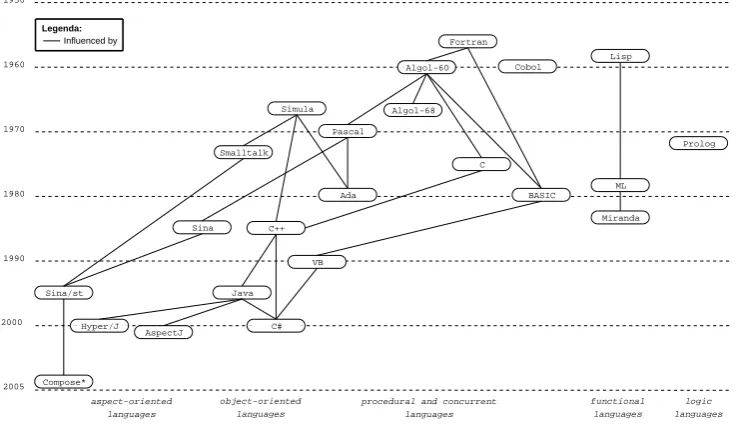
Other programming paradigms are the functional, logic, object-oriented, and aspect-oriented paradigms.Figure 1.1summarizes the dates and ancestry of several important languages [42]. Every paradigm uses a different modularization mechanism for separating concerns into mod-ules.
Functional languages try to solve problems without resorting to variables. These languages are entirely based on functions over lists and trees. Lisp and Miranda are examples of functional languages.
A logic language is based on a subset of mathematical logic. The computer is programmed to infer relationships between values, rather than to compute output values from input values. Prolog is currently the most used logic language [42].
A shortcoming of procedural programming is that global variables can potentially be accessed and updated by any part of the program. This can result in unmanageable programs because no module that accesses a global variable can be understood independently from other modules that also access that global variable.
The Object-Oriented Programming (OOP) paradigm improves modularity by encapsulating data with methods inside objects. The data may only be accessed indirectly, by calling the associated methods. Although the concept appeared in the seventies, it took twenty years to become popular [42]. The most well known object-oriented languages are C++, Java, C#, and Smalltalk.
The hard part about object-oriented design is decomposing a system into objects. The task is difficult because many factors come into play: encapsulation, granularity, dependency, adaptability, reusability, and others. They all influence the decomposition, often in conflict-ing ways [15].
Existing modularization mechanisms typically support only a small set of decompositions and usually only a single dominant modularization at a time. This is known as the tyranny of the dominant decomposition [37]. A specific decomposition limits the ability to implement other concerns in a modular way. For example, OOP modularizes concerns in classes and only fixed relations are possible. Implementing a concern in a class might prevent another concern from being implemented as a class.
Aspect-Oriented Programming (AOP) is a paradigm that solves this problem.
AOP is commonly used in combination with OOP but can be applied to other paradigms as well. The following sections introduce an example to demonstrate the problems that may arise with OOP and show how AOP can solve this. Finally, we look at three particular AOP method-ologies in more detail.
1.2
Traditional Approach
1 public class Add extends Calculation{
13 public void execute(int a, int b) {
14 trace.write("void Add.execute(int, int)");
10 System.out.println("Printing new value of calculation: "+value);
11 }
12 }
(b) CalcDisplay
Listing 1.1: Modeling addition, display, and logging without using aspects
by a method called write. Three concerns can be recognized: addition, display, and tracing. The implementation might look something likeListing 1.1.
From our example, we recognize two forms of crosscutting:code tanglingandcode scattering.
The addition and display concerns are implemented in classesAddandCalcDisplay respec-tively. Tracing is implemented in the class Tracer, but also contains code in the other two classes (lines5,10,14, and20 in (a) and2,5, and9in (b)). If a concern is implemented across several classes, it is said to be scattered. In the example of Listing 1.1, the tracing concern is scattered.
Usually a scattered concern involves code replication. That is, the same code is implemented a number of times. In our example, the classesAddandCalcDisplaycontain similar tracing code.
In class Add the code for the addition and tracing concerns are intermixed. In class CalcDisplay the code for the display and tracing concerns are intermixed. If more then one concern is implemented in a single class they are said to be tangled. In our example, the addition and tracing concerns are tangled. Also display and tracing concerns are tangled. Crosscutting code has the following consequences:
Code is difficult to change
1 public class Add extends Calculation{
10 public void execute(int a, int b) {
11 result = a + b;
Listing 1.2: Modeling addition, display, and logging with aspects
Code is harder to reuse
To reuse an object in another system, it is necessary to either remove the tracing code or reuse the (same) tracer object in the new system;
Code is harder to understand
Tangled code makes it difficult to see which code belongs to which concern.
1.3
AOP Approach
To solve the problems with crosscutting, several techniques are being researched that attempt to increase the expressiveness of the OO paradigm. Aspect-Oriented Programming (AOP) in-troduces a modular structure, the aspect, to capture the location and behavior of crosscutting concerns. Examples of Aspect-Oriented languages are Sina, AspectJ, Hyper/J, and Compose
?
. A special syntax is used to specify aspects and the way in which they are combined with reg-ular objects. The fundamental goals of AOP are twofold [18]: first to provide a mechanism to express concerns that crosscut other components. Second to use this description to allow for the separation of concerns.Join pointsare well-defined places in the structure or execution flow of a program where ad-ditional behavior can be attached. The most common join points are method calls. Pointcuts
describe a set of join points. This allows us to execute behavior at many places in a program by one expression.Adviceis the behavior executed at a join point.
In the example ofListing 1.2, the classAdddoes not contain any tracing code and only imple-ments the addition concern. ClassCalcDisplay also does not contain tracing code. In our example, the tracing aspect contains all the tracing code. The pointcuttracedCallsspecifies at which locations tracing code is executed.
the code of other objects. This has several advantages over the previous code.
Aspect code can be changed
Changing aspect code does not influence other concerns; Aspect code can be reused
The coupling of aspects is done by defining pointcuts. In theory, this low coupling allows for reuse. In practice, reuse is still difficult;
Aspect code is easier to understand
A concern can be understood independent of other concerns; Aspect pluggability
Enabling or disabling concerns becomes possible.
1.3.1 AOP Composition
AOP composition can be either symmetric or asymmetric. In the symmetric approach, every component can be composed with any other component. For instance, Hyper/J follows this approach.
In the asymmetric approach, the base program and aspects are distinguished. The base pro-gram is composed with the aspects. For instance, AspectJ (covered in more detail in the next section) follows this approach.
1.3.2 Aspect Weaving
The integration of components and aspects is calledaspect weaving. There are three approaches to aspect weaving. The first and second approach rely on adding behavior in the program, either by weaving the aspect in the source code, or by weaving directly in the target language. The target language can be intermediate language (IL) or machine code. Examples of IL are Java byte code and Common Intermediate Language (CIL). The remainder of this chapter considers only intermediate language targets. The third approach relies on adapting the virtual machine. Each method is explained briefly in the following sections.
1.3.2.1 Source Code Weaving
The source code weaver combines the original source with aspect code. It interprets the defined aspects and combines them with the original source, generating input for the native compiler. For the native compiler there is no difference between source code with and without aspects. Hereafter the compiler generates an intermediate or machine language output (depending on the compiler-type).
The advantages of using source code weaving are:
High-level source modification
Since all modifications are done at source code level, there is no need to know the target (output) language of the native compiler;
Aspect and original source optimization
opti-mization passes. However, optiopti-mizations specific to exploiting aspect knowledge are not possible;
Native compiler portability
The native compiler can be replaced by any other compiler as long as it has the same input language. Replacing the compiler with a newer version or another target language can be done with little or no modification to the aspect weaver.
However, the drawbacks of source code weaving are:
Language dependency
Source code weaving is written explicitly for the syntax of the input language; Limited expressiveness
Aspects are limited to the expressive power of the source language. For example, when using source code weaving, it is not possible to add multiple inheritance to a single in-heritance language.
1.3.2.2 Intermediate Language Weaving
Weaving aspects through an intermediate language gives more control over the executable pro-gram and solves some issues as identified inSection 1.3.2.1on source code weaving. Weaving at this level allows for creating combinations of intermediate language constructs that cannot be expressed at the source code level. Although IL can be hard to understand, IL weaving has several advantages over source code weaving:
Programming language independence
All compilers generating the target IL output can be used; More expressiveness
It is possible to create IL constructs that are not possible in the original programming language;
Source code independence
Can add aspects to programs and libraries without using the source code (which may not be available);
Adding aspects at load- or runtime
A special class loader or runtime environment can decide and do dynamic weaving. The aspect weaver adds a runtime environment into the program. How and when aspects can be added to the program depend on the implementation of the runtime environment.
However, IL weaving also has drawbacks that do not exist for source code weaving:
Hard to understand
Specific knowledge about the IL is needed; More error-prone
Compiler optimization may cause unexpected results. Compiler can remove code that breaks the attached aspect (e.g., inlining of methods).
1.3.2.3 Adapting the Virtual Machine
disadvantages as mentioned in Section 1.3.2.2. Aspects can be added without recompilation, redeployment, and restart of the application [31,32].
Modifying the virtual machine also has its disadvantages:
Dependency on adapted virtual machines
Using an adapted virtual machine requires that every system should be upgraded to that version;
Virtual machine optimization
People have spent a lot of time optimizing virtual machines. By modifying the virtual machine these optimizations should be revisited. Reintegrating changes introduced by newer versions of the original virtual machine, might have substantial impact.
1.4
AOP Solutions
As the concept of AOP has been embraced as a useful extension to classic programming, dif-ferent AOP solutions have been developed. Each solution has one or more implementations to demonstrate how the solution is to be used. As described by [14] these differ primarily in:
How aspects are specified
Each technique uses its own aspect language to describe the concerns; Composition mechanism
Each technique provides its own composition mechanisms; Implementation mechanism
Whether components are determined statically at compile time or dynamically at run time, the support for verification of compositions, and the type of weaving.
Use of decoupling
Should the writer of the main code be aware that aspects are applied to his code; Supported software processes
The overall process, techniques for reusability, analyzing aspect performance of aspects, is it possible to monitor performance, and is it possible to debug the aspects.
In the next sections, we introduce AspectJ [25], Hyperspaces [30] and Composition Filters [5], which are three main AOP approaches.
1.4.1 AspectJ Approach
AspectJ [25] is an aspect-oriented extension to the Java programming language. It is probably the most popular approach to AOP at the moment, and it is finding its way into the industrial software development. AspectJ has been developed by Gregor Kiczales at Xerox’s PARC (Palo Alto Research Center). To encourage the growth of the AspectJ technology and community, PARC transferred AspectJ to an open Eclipse project. The popularity of AspectJ comes partly from the various extensions based on it. Various projects are porting AspectJ to other languages resulting in tools such as AspectR and AspectC.
1 aspect DynamicCrosscuttingExample {
Listing 1.3: Example of dynamic crosscutting in AspectJ
Upward compatibility
All legal Java programs must be legal AspectJ programs; Platform compatibility
All legal AspectJ programs must run on standard Java virtual machines; Tool compatibility
It must be possible to extend existing tools to support AspectJ in a natural way; this includes IDEs, documentation tools and design tools;
Programmer compatibility
Programming with AspectJ must feel like a natural extension of programming with Java.
AspectJ extends Java with support for two kinds of crosscutting functionality. The first allows defining additional behavior to run at certain well-defined points in the execution of the pro-gram and is called thedynamic crosscutting mechanism. The other is called thestatic crosscutting mechanismand allows modifying the static structure of classes (methods and relationships be-tween classes). The units of crosscutting implementation are called aspects. An example of an aspect specified in AspectJ is shown inListing 1.3.
The points in the execution of a program where the crosscutting behavior is inserted are called
join points. Apointcuthas a set of join points. InListing 1.3 istraceMethodsan example of a pointcut definition. The pointcut includes all executions of any method that is in a class contained by packageedu.utwente.trese.
The code that should execute at a given join point is declared in an advice. Advice is a method-like code body associated with a certain pointcut. AspectJ supports before, after and around
advice that specifies where the additional code is to be inserted. In the example, both before and after advice are declared to run at the join points specified by thetraceMethodspointcut.
Aspects can contain anything permitted in class declarations including definitions of pointcuts, advice and static crosscutting. For example, static crosscutting allows a programmer to add fields and methods to certain classes as shown inListing 1.4.
1 aspect StaticCrosscuttingExample {
2 private int Log.trace(String traceMsg) {
3 Log.write(" --- MARK --- " + traceMsg);
4 }
5 }
Listing 1.4: Example of static crosscutting in AspectJ
With its variety of possibilities, AspectJ can be considered a useful approach for realizing soft-ware requirements.
1.4.2 Hyperspaces Approach
TheHyperspacesapproach is developed by H. Ossher and P. Tarr at the IBM T.J. Watson Research Center. The Hyperspaces approach adopts the principle of multi-dimensional separation of concerns [30], which involves:
• Multiple, arbitrary dimensions of concerns; • Simultaneous separation along these dimensions;
• Ability to dynamically handle new concerns and new dimensions of concern as they arise throughout the software life cycle;
• Overlapping and interacting concerns. It is appealing to think of many concerns as inde-pendent or orthogonal, but they rarely are in practice.
We explain the Hyperspaces approach by an example written in theHyper/Jlanguage. Hyper/J is an implementation of the Hyperspaces approach for Java. It provides the ability to identify concerns, specify modules in terms of those concerns, and synthesize systems and components by integrating those modules. Hyper/J uses bytecode weaving on binary Java class files and generates new class files to be used for execution. Although the Hyper/J project seems aban-doned and there has not been any update in the code or documentation for a while, we still mention it because the Hyperspaces approach offers a unique AOP solution.
As a first step, developers create hyperspaces by specifying a set of Java class files that contain the code units that populate the hyperspace. To do this is, you create a hyperspace specification, as demonstrated inListing 1.5.
Hyper/J will automatically create a hyperspace with one dimension—the class file dimension. A dimension of concern is a set of concerns that are disjoint. The initial hyperspace will con-tain all units within the specified package. To create a new dimension you can specify concern mappings, which describe how existing units in the hyperspace relate to concerns in that di-mension, as demonstrated inListing 1.6.
The first line indicates that, by default, all of the units contained within the package edu. utwente.trese.pacmanaddress the kernel concern of the feature dimension. The other
map-1 Hyperspace Pacman
2 class edu.utwente.trese.pacman.*;
1 package edu.utwente.trese.pacman: Feature.Kernel 2 operation trace: Feature.Logging
3 operation debug: Feature.Debugging
Listing 1.6: Specification of concern mappings
pings specify that any method named trace or debug address the logging and debugging concern respectively. These later mappings override the first one.
Hypermodules are based on concerns and consist of two parts. The first part specifies a set of hyperslices in terms of the concerns identified in the concern matrix. The second part specifies the integration relationships between the hyperslices. A hyperspace can contain several hyper-modules realizing different modularizations of the same units. Systems can be composed in many ways from these hypermodules.
Listing 1.7 shows a hypermodule with two concerns, kernel and logging. They are related by a mergeByNameintegration relationship. This means that units in the different concerns correspond if they have the same name (ByName) and that these corresponding units are to be combined (merge). For example, all members of the corresponding classes are brought together into the composed class. The hypermodule results in a hyperslice that contains all the classes without the debugging feature; thus, nodebugmethods will be present.
The most important feature of the hyperspaces approach is the support for on-demand remod-ularisation: the ability to extract hyperslices to encapsulate concerns that were not separated in the original code. This makes hyperspaces especially useful for evolution of existing software.
1.4.3 Composition Filters
Composition Filters is developed by M. Aks¸it and L. Bergmans at the TRESE group, which is a part of the Department of Computer Science of the University of Twente, The Netherlands. The composition filters (CF) model predates aspect-oriented programming. It started out as an extension to the object-oriented model and evolved into an aspect-oriented model. The current implementation of CF is Compose
?
, which covers .NET, Java, and C.One of the key elements of CF is themessage. A message is the interaction between objects, for instance a method call. In object-oriented programming, the message is considered an abstract concept. In the implementations of CF, it is therefore necessary to reify the message. Thisreified messagecontains properties, like where it is send to and where it came from.
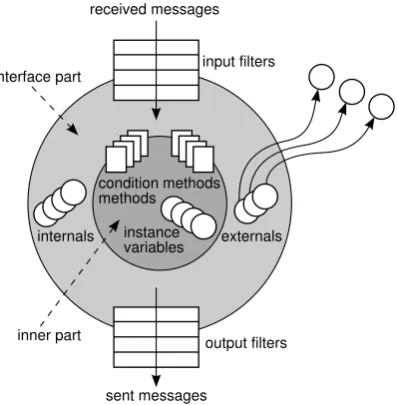
The concept of CF is that messages that enter and exit an object can be intercepted and manip-ulated, modifying the original flow of the message. To do so, a layer called theinterface partis introduced in the CF model. This layer can have several properties. The interface part can be placed on an object, which behavior needs to be altered, and this object is referred to asinner.
1 hypermodule Pacman_Without_Debugging
2 hyperslices: Feature.Kernel, Feature.Logging; 3 relationships: mergeByName;
4 end hypermodule;
Compose
?
Compose
?
is an implementation of the composition filters approach. There are three target environments: the .NET, Java, and C. This chapter is organized as follows, first the evolution of Composition Filters and its implementations are described, followed by an explanation of the Compose?
language and a demonstrating example. In the third section, the Compose?
architecture is explained, followed by a description of the features specific to Compose?
.2.1
Evolution of Composition Filters
Compose
?
is the result of many years of research and experimentation. The following time line gives an overview of what has been done in the years before and during the Compose?
project.1985 The first version of Sina is developed by Mehmet Aks¸it. This version of Sina contains a preliminary version of the composition filters concept called semantic networks. The semantic network construction serves as an extension to objects, such as classes, mes-sages, or instances. These objects can be configured to form other objects such as classes from which instances can be created. The object manager takes care of syn-chronization and message processing of an object. The semantic network construction can express key concepts like delegation, reflection, and synchronization [26].
1987 Together with Anand Tripathi of the University of Minnesota the Sina language is further developed. The semantic network approach is replaced by declarative specifi-cations and the interface predicate construct is added.
1991 The dispatch filter replaces the interface predicates, and the wait filter manages the synchronization functions of the object manager. Message reflection and real-time specifications are handled by the meta filter and the real-time filter [4].
1995 The Sina language with Composition Filters is implemented using Smalltalk [26]. The implementation supports most of the filter types. In the same year, a preprocessor providing C++ with support for Composition Filters is implemented [17].
1999 The composition filters language ComposeJ [43] is developed and implemented. The implementation consists of a preprocessor capable of translating composition filter specifications into the Java language.
and facilitation of crosscutting concerns.
2003 The start of the Compose
?
project, the project is described in further detail in this chapter.2004 The first release of Compose
?
, based on .NET. 2006 Compose?
is ported to the C platform.2.2
Composition Filters in Compose
?
A Compose
?
application consists of concerns that can be divided in three parts: filter module specifications, superimposition, and implementation. A filter module contains the filter logic to filter on incoming or outgoing messages on superimposed objects. Messages have a tar-get, which is an object reference, and a selector, which is a method name. A superimposition part specifies which filter modules, annotations, conditions, and methods are superimposed on which objects. An implementation part contains the class implementation of a concern. How these parts are placed in a concern is shown inListing 2.1.The working of a filter module is depicted inFigure 2.1. A filter module can contain input and output filters. The difference between these two sets of filters is that the first is used to filter on incoming messages, while the second is used to filter on outgoing messages. The return of a method is not considered an outgoing message. A filter has three parts: a filter identifier, a filter type, and one or more filter elements. A filter element exists out of an optional condition part, a matching part, and a substitution part. These parts are shown below:
Figure 2.1: Components of the composition filters model
A filter identifier is a unique name for a filter in a filter module. Filters match when both the condition part and the matching part evaluate to true. In the demonstrated filter, every message where the selector isgetNextMovematches. If an asterisk (*) is used in the target, every target will match. When the condition part and the matching part are true, the message is substituted with the values provided in the substitution part. How these values are substituted, and how the message continues, depends on the type of filter used. At the moment there are four basic filter types defined in Compose
?
. It is, however, possible to write custom filter types.Dispatch If the message is accepted, it is dispatched to the specified target of the message, otherwise the message continues to the subsequent filter. This filter type can only be used for input filters;
Send If the message is accepted, it is sent to the specified target of the message, otherwise the message continues to the subsequent filter. This filter type can only be used for output filters;
Error If the filter rejects the message, it raises an exception, otherwise the message contin-ues to the next filter in the set;
Meta If the message is accepted, the message is sent as a parameter of another meta mes-sage to an internal or external object, otherwise the mesmes-sage just continues to the next filter. The object that receives the meta message can observe and manipulate the message and can re-activate the execution of the message.
The identifier pacmanIsEvil, used in the condition part, must be declared in the conditions section of a filter module. Targets that are used in a filter can be declared as internal or external. An internal is an object that is unique for each instance of a filter module, while an external is an object that is shared between filter modules.
spec-ified in a selector definition. This selector definition uses predicates to select objects, such as isClassWithNameInList, isNamespaceWithName, andnamespaceHasClass. In addition to filter modules, it is possible to bind conditions, methods, and annotations to classes using su-perimposition.
The last part of the concern is the implementation part, which can be used to define the behav-ior of a concern. For a logging concern, for example, we can define specific log functions and use them as internal.
2.3
Demonstrating Example
To illustrate the Compose
?
toolset, this section introduces a Pacman example. The Pacman game is a classic arcade game in which the user, represented by pacman, moves in a maze to eat vitamins. Meanwhile, a number of ghosts try to catch and eat pacman. There are, however, four mega vitamins in the maze that make pacman evil. In its evil state, pacman can eat ghosts. A simple list of requirements for the Pacman game is briefly discussed here:• The number of lives taken from pacman when eaten by a ghost; • A game should end when pacman has no more lives;
• The score of a game should increase when pacman eats a vitamin or a ghost; • A user should be able to use a keyboard to move pacman around the maze; • Ghosts should know whether pacman is evil or not;
• Ghosts should know where pacman is located;
• Ghosts should, depending on the state of pacman, hunt or flee from pacman.
2.3.1 Initial Object-Oriented Design
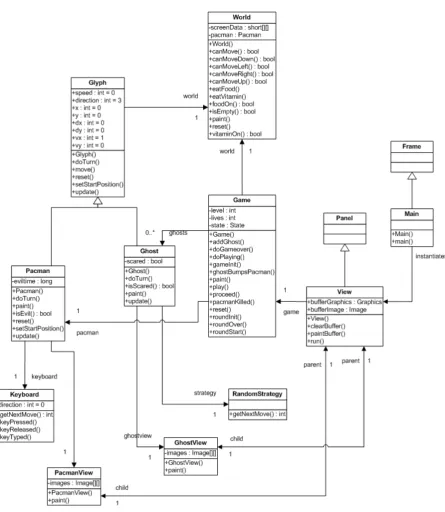
Figure 2.2shows an initial object-oriented design for the Pacman game. Note that this UML class diagram does not show the trivial accessors. The classes in this diagram are:
Game
This class encapsulates the control flow and controls the state of a game; Ghost
This class is a representation of a ghost chasing pacman. Its main attribute is a property that indicates whether it is scared or not (depending on the evil state of pacman);
GhostView
This class is responsible for painting ghosts; Glyph
This is the superclass of all mobile objects (pacman and ghosts). It contains common information like direction and speed;
Keyboard
This class accepts all keyboard input and makes it available to pacman; Main
This is the entry point of a game; Pacman
PacmanView
This class is responsible for painting pacman; RandomStrategy
By using this strategy, ghosts move in random directions; View
This class is responsible for painting a maze; World
This class has all the information about a maze. It knows where the vitamins, mega vitamins and most importantly the walls are. Every class derived from classGlyphchecks whether movement in the desired direction is possible.
2.3.2 Completing the Pacman Example
The initial object-oriented design, described in the previous section, does not implement all the stated system requirements. The missing requirements are:
• The application does not maintain a score for the user;
• Ghosts move in random directions instead of chasing or fleeing from pacman.
In the next sections, we describe why and how to implement these requirements in the Compose
?
language.2.3.2.1 Implementation of Scoring
The first system requirement that we need to add to the existing Pacman game is scoring. This concern involves a number of events. First, the score should be set to zero when a game starts. Second, the score should be updated whenever pacman eats a vitamin, mega vitamin or ghost. Finally, the score itself has to be painted on the maze canvas to relay it back to the user. These events scatter over multiple classes: Game (initializing score), World (updating score), Main (painting score). Thus scoring is an example of a crosscutting concern.
To implement scoring in the Compose
?
language, we divide the implementation into two parts. The first part is a Compose?
concern definition stating which filter modules to superimpose. Listing 2.2shows an example Compose?
concern definition of scoring.This concern definition is calledDynamicScoring(line1) and contains two parts. The first part is the declaration of a filter module called dynamicscoring(lines 2–11). This filter module contains one meta filtercalledscore_filter (line6). This filter intercepts five relevant calls and sends the message in a reified form to an instance of class Score. The final part of the concern definition is the superimposition part (lines 12–18). This part defines that the filter moduledynamicscoringis to be superimposed on the classesWorld,GameandMain.
1 concern DynamicScoring in pacman { 2 filtermodule dynamicscoring { 3 externals
4 score : pacman.Score = pacman.Score.instance();
5 inputfilters
6 score_filter : Meta = {[*.eatFood] score.eatFood,
7 [*.eatGhost] score.eatGhost,
14 scoring = { C | isClassWithNameInList(C, [’pacman.World’,
15 ’pacman.Game’, ’pacman.Main’]) };
16 filtermodules
17 scoring <- dynamicscoring;
18 }
19 }
Listing 2.2:DynamicScoringconcern in Compose
?
2.3.2.2 Implementation of Dynamic Strategy
The last system requirement that we need to implement is the dynamic strategy of ghosts. This means that a ghost should, depending on the state of pacman, hunt or flee from pacman. We can implement this concern by using the strategy design pattern. However, in this way, we need to modify the existing code. This is not the case when we use Compose
?
dispatch filters. Listing 2.4demonstrates this.This concern usesdispatchfilters to intercept calls to methodRandomStrategy.getNextMove and redirect them to eitherStalkerStrategy.getNextMoveorFleeStrategy.getNextMove. If pacman is not evil, the intercepted call matches the first filter, which dispatches the inter-cepted call to method StalkerStrategy.getNextMove (line 9). Otherwise, the intercepted call matches the second filter, which dispatches the intercepted call to methodFleeStrategy. getNextMove(line11).
2.4
Compose
?
Architecture
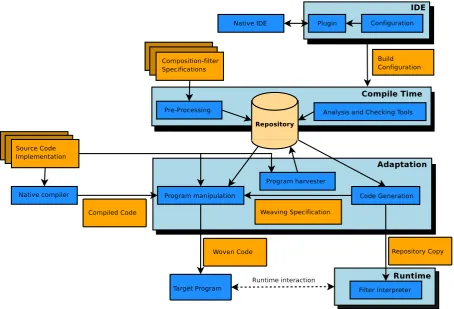
An overview of the Compose
?
architecture is illustrated inFigure 2.3. The Compose?
archi-tecture can be divided in four layers [28]: IDE, compile time, adaptation, and runtime.2.4.1 Integrated Development Environment
Some of the purposes of the Integrated Development Environment (IDE) layer are to interface with the native IDE and to create a build configuration. In the build configuration it is specified which source files and settings are required to build a Compose
?
application. After creating the build configuration, the compile time is started.1 import Composestar.Runtime.FLIRT.message.*;
7 private static Score theScore = null;
1 concern DynamicStrategy in pacman { 2 filtermodule dynamicstrategy { 3 internals
4 stalk_strategy : pacman.Strategies.StalkerStrategy;
5 flee_strategy : pacman.Strategies.FleeStrategy;
6 conditions
7 pacmanIsEvil : pacman.Pacman.isEvil();
8 inputfilters
9 stalker_filter : Dispatch = {!pacmanIsEvil =>
10 [*.getNextMove] stalk_strategy.getNextMove};
11 flee_filter : Dispatch = {
12 [*.getNextMove] flee_strategy.getNextMove}
13 }
14 superimposition { 15 selectors
16 random = { C | isClassWithName(C,
17 ’pacman.Strategies.RandomStrategy’) };
18 filtermodules
19 random <- dynamicstrategy;
20 }
21 }
Listing 2.4:DynamicStrategyconcern in Compose
?
of these plug-ins are the Visual Studio add-in for Compose
?
/.NET and the Eclipse plug-in for Compose?
/C.2.4.2 Compile Time
The compile time layer is platform independent and reasons about the correctness of the com-position filter implementation with respect to the program which allows the target program to be build by the adaptation.
The compile time ‘pre-processes’ the composition filter specifications by parsing the specifica-tion, resolving the references, and checking its consistency. To provide an extensible architec-ture to facilitate this process a blackboard architecarchitec-ture is chosen. This means that the compile time uses a general knowledgebase that is called the ‘repository’. This knowledgebase contains the structure and metadata of the program which different modules can execute their activities on. Examples of modules within analysis and validation are the three modules SANE, LOLA and FILTH. These three modules are responsible for (some) of the analysis and validation of the super imposition and its selectors.
2.4.3 Adaptation
The adaptation layer consists of the program manipulation, harvester, and code generator. These components connect the platform independent compile time to the target platform. The harvester is responsible for gathering the structure and the annotations within the source pro-gram and adding this information to the knowledgebase. The code generation generates a reduced copy of the knowledgebase and the weaving specification. This weaving specification is then used by the weaver contained by the program manipulation to weave in the calls to the runtime into the target program. The result of the adaptation is the target program that interfaces with the runtime.
2.4.4 Runtime
The runtime layer is responsible for executing the concern code at the join points. It is acti-vated at the join points by function calls that are woven in by the weaver. A reduced copy of the knowledgebase containing the necessary information for filter evaluation and execution is enclosed with the runtime. When the function is filtered the filter is evaluated. Depending on if the condition part evaluates to true, and the matching part matches, the accept or reject behavior of the filter is executed. The runtime also facilitates the debugging of the composition filter implementations.
2.5
Platforms
Compose
?
/.NET targets the .NET platform and is the oldest implementation of Compose?
. Its weaver operates on CIL byte code. Compose?
/.NET is programming language independent as long as the programming language can be compiled to CIL code. An add-in for Visual Studio is provided for ease of development. Compose?
/C contains support for the C programming language. The implementation is different from the .NET counterpart, because it does not have a run-time environment. The filter logic is woven directly in the source code. Because the language C is not based on objects, filters are woven on functions based on membership of sets of functions. Compose?
/C provides a plug-in for Eclipse.2.6
Features Specific to Compose
?
The Composition Filters approach uses a restricted (pattern matching) language to define fil-ters. This language makes it possible to reason about the semantics of the concern. Compose
?
offers three features that use this possibility, which originate in more control and correctness over an application under construction. These features are:Ordering of filter modules
It is possible to specify how the superimposition of filter modules should be ordered. Ordering constraints can be specified in a fixed, conditional, or partial manner. A fixed ordering can be calculated exactly, whereas a conditional ordering is dependent on the re-sult of filter execution and therefore evaluated at runtime. When there are multiple valid orderings of filtermodules on a join point, partial ordering constraints can be applied to reduce this number. These constraints can be declared in the concern definition;
Filter consistency checking
When superimposition is applied, Compose
?
is able to detect if the ordering and con-junction of filters creates a conflict. For example, imagine a set of filters where the first filter only evaluates methodmand another filter only evaluates methodsaandb. In this case the latter filter is only reached with methodm; this is consequently rejected and as a result the superimposition may never be executed. There are different scenarios that lead to these kinds of problems, e.g., conditions that exclude each other;Reason about semantic problems
When multiple pieces of advice are added to the same join point, Compose
?
can reason about problems that may occur. An example of such a conflict is the situation where a real-time filter is followed by a wait filter. Because the wait filter can wait indefinitely, the real-time property imposed by the real-time filter may be violated.The above mentioned conflict analyzers all work on the assumption that the behavior of every filter is well-defined. This is not the case for the meta filter, its user-undefined, and therefore unpredictable, behavior poses a problem to the analysis tools.
Furthermore, Compose
?
is extended with features that enhance the usability. These features are briefly described below:Integrated Development Environment support
Debugging support
The debugger shows the flow of messages through the filters. It is possible to place break-points to view the state of the filters;
Incremental building process
Incremental rebuilding re-uses the compilation results of previous buildings to safe com-pilation time
Some language properties of Compose
?
can also be seen as features, being:Language independent concerns
A Compose
?
concern can be used for all the Compose?
platforms, because the composi-tion filters approach is language independent;Reusable concerns
The concerns are easy to reuse, through the dynamic filter modules and the selector lan-guage;
Expressive selector language
Program elements of an implementation language can be used to select a set of objects to superimpose on;
Support for annotations
Problem Identification
This chapter identifies the challenges that exist in porting Compose
?
to the Java platform.3.1
Background
One goal of the Compose
?
project is to familiarize a large audience with the concept of the composition filters model. Currently, Compose?
runs on the .NET platform [6,16,20,40] and C platform [38]. Adding a third platform increases our audience. Furthermore, it helps us in proving the language and platform independent aspect of the composition filters model.Our choice for Java as the third platform is straightforward. First of all, Java is the most pop-ular programming language according to the TIOBE index published on the internet [39]. The TIOBE index gives an indication of the popularity of programming languages. The ratings are based on the world-wide availability of skilled engineers, courses and third party vendors. Java is especially popular in the Software Engineering research community. Secondly, since the in-troduction of AspectJ [25] in 2001, AOP has become increasingly popular on the Java platform. This increases the possibility of using or working with existing third-party tools, frameworks and libraries. Finally, previous efforts were made in the past to implement the composition filters model on the Java platform [33,43]. We can use this experience for the development of Compose
?
/J.3.2
Designing Compose
?
/J
Our first challenge is to design and implement Compose
?
/J.As described in Chapter 2, the Compose
?
architecture is divided in four layers [28]: IDE, compile-time, adaptation and runtime. The compile-time layer reasons about the composition filters model, and thus is considered language independent. All implementations of Compose?
share the analysis tools that exist in this layer.IDE integration. Integration into an existing Integrated Development Environment (IDE) in the form of a plug-in. One of the purposes of the plug-in is to create a build configuration. In the build configuration, it is specified which source files and settings are required to build a Compose
?
application.Type Collecting. In order to reason about concerns, the program structure and annotations within the source code are collected and stored in a knowledgebase. This technology is part of the adaptation layer.
Weaver. The weaver is responsible for weaving advice code into the target program. The weaver is also part of the adaptation layer.
Interpreter. The interpreter is responsible for executing concern code at the joinpoints. It is triggered by function calls that are woven in by the weaver. It is part of the runtime layer.
3.3
Supporting specific Java features
Since Compose
?
is a language independent solution, some of the Java features might not be supported by the composition filters model or even be supported in the future. Our second challenge is to investigate the possibility of supporting specific Java features in Compose?
/J. We focus on the following Java features:Exception Handling. Mechanism that handles the occurrence of an exceptional condition that changes the control flow of the normal execution of a program. Currently, Compose
?
generates exceptions, but it cannot handle them. Chapter 4discusses the possibilities for modularizing exception handling with composition filters.Inner Classes. Inner classes are classes defined inside the definition of another class. Currently, Compose
?
cannot handle inner classes. In Chapter 5, we discuss the possibilities for expressing crosscutting concerns on inner classes.Java Interfaces. An interface in Java is a group of related methods with empty bodies. They form a contract between classes and the outside world. Currently, Compose
?
only sup-ports class-based weaving.Chapter 6discusses the possibilities and benefits for weaving on Java interfaces.In our approach, we do not consider the language independence of Compose
?
. We assume that Compose?
is solely meant for the Java platform. Therefore, solutions presented in this thesis should be further investigated with the aspect of language independence in mind.3.4
Summary
Since the introduction of AspectJ, a lot of AOP tools have been on the Java platform. This fact combined with our intention to prove the language and platform independence of Compose
?
, motivates us to port Compose?
to the Java platform, yielding in Compose?
/J.Implementing Compose
?
/J comes with challenges. Our first challenge is to implement the language dependent technologies in Compose?
/J.Chapter 7andChapter 8present the design and implementation of Compose?
/J.Exception Handling in Compose*
This chapter focuses on the possibility of supporting exception handling in Compose
?
. First, it presents some background information. Then, it describes our motivation for modularizing exception handling with composition filters. After that, it defines a set of comparison criteria for composition filters models. Finally, it presents three possible composition filters models that support exception handling, applies the criteria on the models and evaluates them.4.1
Background
Exception handling is a mechanism to handle the occurrence of an exceptional condition that changes the control flow of the normal execution of a program. Such a condition is called anexception. When an exception occurs, ahandlertemporarily interrupts the normal execution. Nowadays, many computer languages have built-in support for exception detection and excep-tion handling. One of these languages is Java. Section 4.1.1describes the exception handling mechanism in Java. Section 4.1.2describes the error filter, which is currently the only built-in support in Compose
?
that deals with exceptions.4.1.1 Java Exception Handling
When an exceptional behavior causes an exception to be thrown, that exception is represented by an object. The Java exception hierarchy is shown inFigure 4.1.
All exception objects are instantiated from a class namedThrowableor one of its subclasses. Sun [36] states the following about the classThrowable:
The Throwable class is the superclass of all errors and exceptions in the Java language. Only objects that are instances of this class (or one of its subclasses) are thrown by the Java Virtual Machine or can be thrown by the Java throw statement. Similarly, only this class or one of its subclasses can be the argument type in a catch clause.
As we can see inFigure 4.1 the classThrowablehas two subclasses. The difference between these two can be best explained by looking again at their definition:
Figure 4.1: Java Exception Hierarchy
that the application cannot anticipate or recover from. These errors can be caught to notify the user about the problem, but it also makes sense to print the stack trace and exit the application.
The class Exception and its subclasses are a form of Throwable that indicates conditions that a reasonable application might want to catch.
Unlike many programming languages that support exception handling, Java distinguishes be-tween two types of exceptions:
Unchecked exceptions. Unchecked exceptions are types of exceptions that you can optionally handle, or ignore. If you elect to ignore the possibility of an unchecked exception (i.e. exception is never caught in the program), and one occurs, your program will terminate as a result. If you elect to handle an unchecked exception and one occurs, the result will depend on the code that you have written to handle the exception. Unchecked exceptions are exceptions instantiated fromRuntimeExceptionand its subclasses.
Checked exceptions. Checked exceptions are all exceptions instantiated from the class Exception, or from subclasses other thanRuntimeExceptionand its subclasses. These exceptions cannot be ignored while writing code. So checked exceptions represent abnormal conditions that should be anticipated and caught to prevent program from termination. The Java compiler raises an error when checked exceptions are not handled by a try/catch block or throws definition.
How to catch or throw an exception?
1 public class myClass
Listing 4.2shows an example of throwing exceptions in Java. A method can either throw an existing exception object (i.e. generated elsewhere) or throw a new exception. A new exception can be thrown by using the keywordsthrowandnew. Athrows-clause in the method decla-ration indicates that a method throws the declared exceptions. In this casemethodBthrows a new exception,methodAopts to ignore the exception and throws it again.
1 public class myClass
Currently, the error filter is the only filter in Compose
?
that deals with exceptions. The defini-tion of the error-filter is as follows:An error filter raises an exception when it rejects a message. The substitution part is ignored. When it accepts a message, the message continues through the next filter.
4.2
Motivation
In the world of AOP, exception handling is often mentioned as an example of a crosscutting concern. The following properties of crosscutting concerns explain this:
Code tangling. There is tangling between code for what the program should do (i.e. its normal behavior) and code for detecting and handling exceptions.
Code replication. Often responses to exceptions are similar. This leads to replication of code. Examples of such responses are: ”log and ignore”, ”set the return to a default value” and
”throw an exception of a different kind”. [27]
Code scattering. Code scattered among different objects can sometimes be identified as one concern. E.g. All methods that call a server should be prepared for network failures and retry calling it 3 times before giving up.
Since Compose
?
is an AOP solution, our motivation for supporting exception handling in Compose?
becomes clear. We would like to support the following things:Modularize exceptional/normal behavior. We want to split up the exceptional behavior from the normal behavior. Specificly, we want to express code belonging to exception detection and handling with composition filter code.
Eliminate scattering of exception declarations The use of checked exceptions forces program-mers to declare throws clauses at places in the program where they do not want to han-dle exceptions. This leads to scattering of exception declarations (i.e. numerous throws clauses). This scattering hampers the process of pinpointing the exact locations of where the exceptions are handled. We want to eliminate this redundancy by specifying in the concern code where exceptions are handled.
4.2.1 Demonstrating Example
As described above, exception handling can often lead to redundant code due to replication of code. Assume we write a data access object (DAO)PersonDAOfor retrieving and updating data of aPersonin a database, as shown inListing 4.3.
The two methods getPerson and updatePerson both have the same response to handling a SQLException. They simply log the exception.
We can say that lines 12, 14-17, 21 and 23-26 belong to a single concern”Simple logging of excep-tions”. It should be possible in Compose
?
to leave out these lines from the code and express them with composition filters code. Currently, Compose?
does not support this. The result could be a clear reduction of source code, no tangled code and modularization between nor-mal and exceptional behavior. The reduced source code is shown inListing 4.4.1 package apackage;
13 // ... execute query for retrieving Person data.
14 }
22 // ... execute qeury for updating Person data.
23 }
Listing 4.3: Snapshot implementation of classPersonDAO.
1 package apackage;
12 // ... execute query for retrieving Person data.
13 }
14
15 public void updatePerson() {
16 // ... execute qeury for updating Person data.
17 }
18 }
4.3
Solution Models
This section describes three possible composition filters models that enable us to modularize exception handling in Compose
?
. The next section compares these models based on three criteria, which we present below. Since these criteria are hard to measure, we evaluate them based on a qualitative study.Intuitive semantics. Using intuitive semantics facilitates reasoning about the composition fil-ters models and the filfil-ters used in the models. We define intuitive as: are things executed in the order in which they are written; are conditions evaluated at the moment a message passes a filter; is it clear what the filters do when they accept or reject a message; etc. Amount of ordering. Different orderings of the filters superimposed on an object can lead to
different results. This criteria evaluates in what degree it is possible to specify orderings between the filters in the different composition filters models. We evaluate this criteria by examining the possible orderings.
Reusability of concerns. This criteria evaluates the reusability of concerns in the different composition filters models. We define reusability of concerns as: 1) the ability to par-tially reuse concerns through apprioriate modularization(s) and 2) the ability to adapt concerns. We evaluate this criteria by examining concerns that can potentially be used by other concerns, e.g. exception handling and profiling.
4.3.1 Preliminaries
First, we give preliminaries to better understand the composition filters models presented be-low. Consider the control flow of a message currently in Compose
?
, illustrated inFigure 4.2.In the figure, we see three objects (A, B and C). Object A sends a message to object B. This message first runs through a set of outputfilters superimposed on object A. When a message runs through a filter, it first runs through the matching part of the filter. This matching part decides what filter action is going to be executed. Each filtertype defines four filter actions:
accept call, reject call, accept returnand reject return. If a message matches with the matching pattern, theaccept callaction of the specified filter is executed. If the message does not match with the matching pattern, the filter executes itreject callaction. Furthermore, the call actions are tightly coupled with the return actions. This means that if a filter executed itsaccept call
action, it executes itsaccept returnaction when it receives areturn(i.e. normal method return). Likewise, a filter executes itsreject returnaction when it rejected the message.
Figure 4.2: Control flow of a message in Compose
?
sends a message to object C. Again the message runs through a set of outputfilters and a set of inputfilters. Eventually the message is dispatched to object C and object C invokes the message.
After object C invokes the message, it sends areturnto its caller. Thisreturnruns through the same filters that were passed by the message, but in opposite direction. In contrast to messages,
returnsbypass the matching pattern part and run straight through the filter action part of the filters (i.e. the return action has already been decided on the call). The filters either perform theiraccept returnorreject returnaction, based on whether they accepted the call or not. In this case, no further action is taken onreturnsand thereturnreturns to object A.
Table 4.1shows the possible filter actions of the filtertypes currently supported in Compose
?
/J. For example, the dispatch filter only defines anaccept callaction (i.e. it dispatches a message). Furthermore, note that none of the current filters define any return actions.Filtertype accept call reject call accept return reject return
Dispatch dispatch x x x
Send dispatch x x x
Error x raise x x
Meta reify x x x
Table 4.1: Filter actions of the filtertypes.
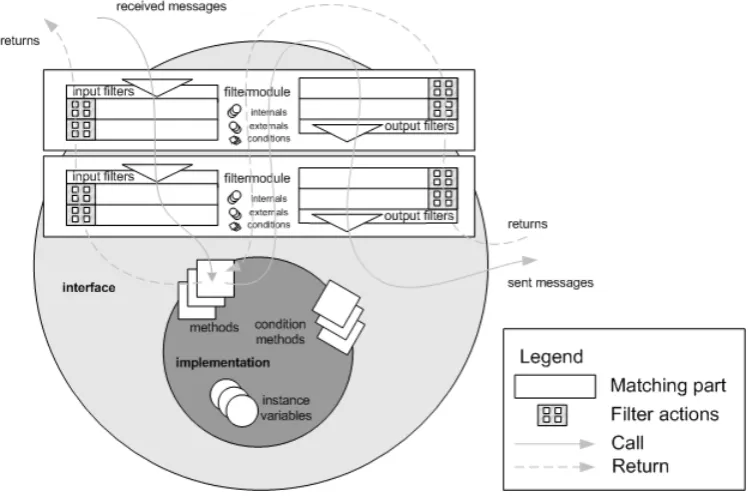
A more detailed figure of the composition filters model is shown inFigure 4.3.
Figure 4.3: Current composition filters model in Compose
?
It shows two filtermodules superimposed on an object. The implementation part of the ob-ject consists of instance variables, methods and condition methods (i.e. methods that return a boolean).
A filtermodule consists of conditions, internals and externals. It can also contain two filtersets:
used to filter on incoming messages, while the second is used to filter on outgoing messages. As described above, the filtertypes in each filterset define four possible actions: it can either
acceptorrejecta message or a return.
Furthermore, the ordering of the filtermodules is the same for incoming as for outgoing mes-sages. Filters in each filterset are evaluated in the order they are written.
This model acts as the base for the solution models. In two of the three models, we propose slight adjustments to this model in order to support modularizing exception handling with composition filters, but first we look at the current model. Is this model suitable for the job?
4.3.2 Solution Model A: Exception handling in current composition filters model
There exists several alternatives to modularize exception handling using the current composi-tion filters model. For example, consider the meta filter. Figure 4.4illustrates the control flow of the meta filter.
Figure 4.4: Control flow of a meta filter
In the figure, we see an example of an implementation of the logging concern. Object A sends a message to object B. This message runs through the outputfilters superimposed on object A. The first filter in the filterset is a meta filter. This filter accepts the message and sends a reified message to an instance of classLogger, which implements the logic for logging. AfterLogger finishes its logging procedure, the original message proceeds again through the filterset. Fi-nally, the dispatch filter dispatches the message to object B.
In other words, if we use a filter we can leave a filterset, either temporarily or completely. This behavior allows us to support exception handling, as is illustrated inFigure 4.5.
Figure 4.5: A possible way to support exception handling in current composition filters model.
new message) to an instance of the classExceptionHandler, which acts as a wrapper class for catching exceptions.ExceptionHandlerexecutes the original message, and catches exceptions thrown by this message.
A suitable name for filterX is the”catch”filter. We can use this filter either as an inputfilter or as an outputfilter. The possible semantics of this catch filter is:
If the catch filter accepts a message, it adds the message as an argument of a new message. This new message is send to the object defined in the substitution part. This object executes the message and catches exceptions thrown during the execution. The type of exceptions caught is specified by the implementation part of the object.
A possible implementation of the concern described inSection 4.2.1using the above semantics is shown below:
6 catchfilter : Catch = {[*.getPerson] exch.log,
7 [*.updatePerson] exch.log}
8 }
9 superimposition { 10 selectors
11 class = { C | isClassWithName(C, ’apackage.PersonDAO’) };
12 filtermodules
13 class <- SimpleLogExceptionConcern;
14 }
15 }
Listing 4.5: ”Simple exception logging”concern in current composition filters model.
The concern is calledSimpleLogExceptionConcern (line1) and it contains one filtermodule calledSimpleLogException(lines 2–8). The filtermodule contains one outputfilter catchfilter
(lines6–7) and is superimposed on all instances ofPersonDAO(lines9–14).
The catch filter accepts all outgoing messages with selector getPerson or updatePerson. Upon acceptance, the message is sent as an argument of a new message to the log() method of an instance of the classExceptionHandler. This method executes the original message and catches the exceptions thrown by the message.
Although the above semantics sound correct, there exist some drawbacks. For example, we cannot declare a filter after a catch filter, because the catch filter executes the message. This leads to unwanted restrictions. Suppose we want to log the execution of a method call and handle exceptions thrown by this method. We can only achieve this by declaring a meta filter before a catch filter. Such a relationship between filters is generally unwanted, since it hampers the programmers freedom.
There exist a second alternative that solves these drawbacks. As described in the previous section, a filter has four filter actions. It can either accept or reject a message or areturn. Now, we can consider a thrown exception as a return. In other words, we can create a filter that catches exceptions, as is illustrated inFigure 4.6.
Figure 4.6: Another way to support exception handling in current composition filters model.
In the figure, object A sends a message to object B. A catch filter intercepts this message. Upon acceptance, the catch filter does nothing and the message continues through the filterset. The next filter is a dispatch filter, which dispatches the message to object B and the message is executed. Exceptions thrown during the execution of this message run back through the filters in opposite direction. The dispatch filter does not define any return action, so the return is sent to the catch filter. Now, the catch filter defines anaccept returnaction. Since the catch filter accepted the call, this action is executed. The catch filter dispatches the exception to an instance of the classExceptionHandlerwhich handles the exception.
Table 4.2shows again the possible filter actions of the filtertypes. The catch filter only defines theaccept returnaction.
Filtertype accept call reject call accept return reject return
Dispatch dispatch x x x
Send dispatch x x x
Error x raise x x
Meta reify x x x
Catch x x dispatch x
Table 4.2: Filter actions of the filtertypes.
The semantics of the catch filter change