Copyright 2012 by Seungho Nam
26th Pacific Asia Conference on Language,Information and Computation pages 473–480
Syntax-semantics mapping of locative arguments
Seungho Nam
Seoul National University
599 Gwanak-ro, Gwanak-gu
Seoul, KOREA
[email protected]
Abstract
This paper proposes a syntax-semantics correspondence of locative expressions: This proposal is based on the syntactic hierarchy among three locative structures (PPs, VPs, and verbal affixes) and the semantic hierarchy among four locative arguments (Goal, Source, Symmetric Path, Stative Location). As for the syntactic hierarchy, the verbal affixes are closer to the head verb than the locative/path verbs are, and the locative/path verbs than the locative PPs. As for the semantic hierarchy, the following four arguments form a hierarchy due to their semantic closeness to the motion event: Goal > S-Path > Source > St-Location. (cf. Nam 1995, 2004) We argue for this correspondence claim by identifying some crucial typological implications holding between the syntactic/semantic hierarchies.
1 Introduction
Natural language uses various constructions to express spatial properties and relations. Languages like English and Russian employ prepositional phrases (PPs) to denote locations or trajectory of movement, but some languages like Kinyarwanda and Swahili use an applicative prefix or a separate locative verb. This paper, based on Nam’s (1995) semantic typology of locatives, aims to characterize the formal (syntactic/morphological) structures of locative expressions in natural language, and identifies typological implications among the different types of locatives. Thus, for example, we show that locative PPs are relatively free to scramble (fronting/extraposing) but locative VPs are not; and that if goal arguments can be
expressed in a PP in a language L, then source arguments can, too.
Nam (1995) proposes a semantic typology of locative expressions in English, where belong five classes of locatives as follows:
Goal locatives: John ran to the office.
– denote an ending place of a movement [PPs with to, into, onto]
Source locatives: John came from the office. – denote a starting place of a movement [PPs
with from]
Symmetric Path locatives:1 John ran across the street.
– denote a symmetric relation between the start point and the end point [PPs with across, over, through, past, around]
Directional locatives: John ran towards the office.
– denote a direction of a movement [PPs with
towards, up, down]
Stative Locatives: John ran on the street. – denote a place where an event take place
without location change [PPs with at, on, in, in front of, above]
The paper will show that the above semantic typology forms a coherent hierarchy among the different locative types, and further claims that the semantic hierarchy is closely linked to the syntactic hierarchy of the locatives. That is, the closer semantically is a locative to an event of a
1 Nam (1995) calls them “symmetric” since the relation
between source and goal is symmetric with respect to the reference object (landmark), thus symmetric locatives do not specify an inherent direction between the two regions.
motion verb, the closer syntactically is the locative to the motion verb. For example, a goal locative is essential to the semantic content of a VP whereas a source locative is not, so the goal locative is syntactically more united to the head verb than the source locative is.
The paper is organized as follows: Section 2 characterizes three types of formal structures of locative expressions – PPs, verbal affixes, and locative verbs – and identifies their semantic roles – goal, source, symmetric path, and stative locatives. Section 3 shows syntactic asymmetries among the three formal structures and four semantic types. Section 4 proposes the correspondence claim between syntax and semantics of locatives in terms of typological implications mapping the two levels.
2 Formal types of Locative expressions
Locative expressions take a variety of syntactic/morphological structures. Here, we group them into three formal types: (i) adpositional phrases – prepositional/postpositional phrases, (ii) verbal affixes – applicative/promotional affixes, and (iii) locative verbs specialized to denote a path. This section will illustrate representative examples in a few languages for each formal type, and discuss their general syntactic and semantic properties.
2.1 Adpositional Phrases
The following gives a short list of languages which take a prepositional phrase (PreP) or a postpositional phrase (PostP) to express locative arguments.
(1) a. Prepositional Phrases: English, German, Dutch (for source locatives), Russian, Malay,
Kinyarwanda, Chichewa, Thai (for source), etc. b. Postpositional Phrases: Korean, Japanese, Nepali,
Kazakh, Turkish, Dutch (for goal), etc.
Some languages like Dutch use both a preposition or a postposition to denote spatial relations, thus goal arguments are realized as a PreP or PostP whereas source arguments take a form of PreP only. (2a, b) below have a source PreP, but the goal arguments in (3a, b) show up as a PreP and a PostP, respectively.
(2) a. zij zijn gelopen van Amsterdam. they are walked from Amsterdam ‘They walked from Amsterdam.’
b. dat dit book [van [onder het bed]] is gekomen. that this book from under the bed is come ‘that this book came from under the bed’
(3) a. Zij is meteen [in het water] gesprongen. she is immediately in the water jumped ‘She jumped into the water immediately.’ b. Zij is meteen [het water in] gesprongen.
she is immediately the water in jumped ‘She jumped in the water immediately.’
The sentences in (3) derive a directional motion reading rather than a stative locative, so the PPs do not denote a stative location but a goal location of the events. This goal reading is also confirmed by the telic interpretation of the sentences with the auxiliary BE, i.e., is in (3). The PreP in (4a), however, is interpreted as denoting a stative location of a non-directional event, so the sentence refers to an atelic event. Thus the PreP cannot be substituted by a PostP as in (4b).
(4) a. Zij heeft [in het water] (op en neer) gesprongen. she has in the water (up and down) jumped ‘She jumped up and down in the water.’
b. *Zij heeft [het water in] (op en neer) gesprongen. she has the water in (up and down) jumped ‘She jumped in the water.’
The following data in (5) show us that the symmetric path locatives employ a PostP rather than a PreP. This tells us that the symmetric path locatives like ‘through under the bridge’ behave more like a goal locative than a source locative.2
(5) a. dat zij snel [PathP [PlaceP achter het konijn zijn] aan]
that they quickly behind the rabbit be at gelopen.
walk
‘that they chased the rabbit’
b. Het vliegtuig is [PathP [PlaceP vlak onder de brug]
The airplane is right under the bridge door] gevlogen.
through flown
'The airplane flew right under the bridge'
2
The sentences in (5) contain a complex PostP which
consists of a preposition (achter ‘behind’ and vlak unter ‘right
under’) and a postposition (aan ‘at’ and door ‘through’). This
is why such PostPs are called a “circumpositional phrase” in the literature.
Notice that the stative locatives are realized as a PreP in (5), so they have the same structure as the source locatives illustrated under (2).
Now let us see more typical locative PPs in other languages. Just like English, Russian and Malay use PrePs for locative expressions. Thus we have Russian in (6) and Malay in (7)
(6) a. ja pobežal k parku. (Russian) I ran to park-Dat ‘I ran to the park.’ b. on bežal ot parka.
He ran from park-Gen ‘He was running from the park.’ c. John šël čerez park/uliču.
John went through park/street
‘John went through/across the park/street.’
(7) a. Saya telah berlari ke taman itu. (Malay) I Perf run to park the ‘I ran to the park.’
b. Dia telah berlari dari taman itu. He Perf run from park the ‘He ran from the park.’
But, we will see shortly in 2.3 that Malay, unlike Russian, employs a separate locative verb to express symmetric path locatives like ‘through/across the park.’
As mentioned in (1) at the beginning, many languages use a PostP to denote a spatial relation. Kazakh and Turkish data below illustrate goal and source locatives in a PostP.
(8) a.Men park-ka jügir-dim. (Kazakh) I park-to ran
‘I ran to the park.’ b. Ol park-ten jügir-di. He park-from ran ‘He ran from the park.’
(9) a.ben park-a kostum. (Turkish) I park-to ran
‘I ran to the park.’ b. o.adam park-tan kostu. he park-from ran ‘He ran from the park.’
Chinese also makes use of locative verbs as well as locative prepositions. Thus a source argument or a stative locative shows up as a PreP, whereas the goal argument accompanies a locative verb. In (10b), the locative verb dao ‘arrive’ is incorporated
to the verb pao ‘run’ to get the reading of ‘run to.’
Such incorporation is not available for the source locatives as shown in (10c). Chinese also uses a PreP for a stative locatives as in (11) below.
(10) a. ta [cong gongyuan] pao le. (Chinese) he from park run Asp
‘He ran from the park.’
b. wo [cong shangdian] pao-dao-le bangongshi. I from store run-arrive-Asp office
‘I ran from the store to the office.’ c.*ta pao-cong-le gongyuan. he run-from-Asp park ‘He ran from the park.’
(11) a.ta zheng zou [zai jie shang]. he Prog walk on street top ‘He is walking on the street.’
b. zhege nüren [zai tushuguan li] xuexi le. this woman in library inside study Asp ‘This woman studied in the library.’
2.2 verbal affix
Verbal affixes in many languages denote a goal or a source of a motion event. Let us consider some data from two groups of languages: (i) African languages like Chichewa and Kinyarwanda and (ii) some North American aboriginal languages like Chickasaw and Choctaw. The former uses a few applicative suffixes and the latter a wide variety of applicative prefixes. We have taken the Chichewa sentences in (12) from Baker (1988), and the Kinyarwanda in (13) from Kimenyi (1980). Notice that the preposition kwa ‘to’ in (12a) is incorporated into the verb tumiz ‘send’ as an (goal)
applicative suffix ir in (12b).
(12) (Chichewa)
a. Ndi-na-tumiz-a chipanda cha mowa kwa mfumu. 1sS-PAST-send-Asp calabash of beer to
chief
‘I sent a calabash of beer to the chief.’
b. Ndi-na-tumiz-ir-a mfumu chipanda cha mowa. 1sS-PAST-send-Appl-Asp chief calabash of beer ‘I sent the chief a calabash of beer.’
Baker (1988) dubbed this phenomenon “preposition incorporation,” which extends the valency of the stem verb via an applicative affix (prefix or suffix). We note that the applicative suffixes are mostly used for goal and benefactive arguments, but not for source arguments. In (13b), we can find the applicative suffix er is used for the
benefactive argument of the verb som ‘read.’
(13) (Kinyarwanda)
a. Umukoobwa a-ra-som-a igitabo. girl SP-PRES-read-ASP book ‘The girl is reading the book.’
b. Umukoobwa a-ra-som-er-a umuhuungu igitabo. girl SP-PRES-read-Appl-ASP boy book ‘The girl is reading the book for the boy.’
Choctaw and Chickasaw use applicative prefixes for a source argument as well as a goal argument.3 The following data in (14) and (15) are from Broadwell (2006) and Munro (2000).
(14) (Choctaw)
a. South Carolina miti-li-h come-1SI-TNS 'I came to South Carolina.' b. South Carolina aa-miti-li-h
Appl-come-1sI-TNS 'I came from South Carolina.' c. Holissaapisa' aa-sa-fama-tok
school Appl-lsII-be.whipped-Past 'I was whipped at school.'
(15) (Chicasaw)
a. Nampanaa'-at kow-oshi' a-shiiyalhchi. string-nom cat-small Appl-be.tied 'The string is tied onto the kitten.' b. As-o-malli-tok.
lsII-Appl-jump-Past 'He jumped on me'
c. Ihoo-at bala'-a chipot in-chompa. woman-Nom beans-Acc child DatAppl-buy 'The woman buys beans for the child.'
German also uses such prefixes for goal argument, so the sentence in (16b) has an incorporated prefix be- to denote a directional goal argument ‘onto the fence.’ Such incorporated prefixes are called “promotional prefixes” in the literature. (cf. Kracht 2002)
3
Chickasaw and Choctaw are Western Muskogean languages of south-central Oklahoma. Munro (2000) claims that Chickasaw has no prepositions/postpositions and no oblique case markers, whereas Broadwell (2006: 248-256) reports that Choctaw has “postpositionlike” words denoting a location such as ‘on top of, inside, behind, under, on the other side of, across from, etc.’ Broadwell discusses some verbal/nominal properties of the words.
(16) a. Ein Mädchen sprang auf den Zaun. A girl jumped on the fence b. Ein Mädchen be-sprang den Zaun. A girl BE-jumped the fence
‘A girl jumped onto the fence.’
2.3 Locative verbs in a serial verb construction
Some languages employ special verbs in order to introduce source, goal, or symmetric path of a motion event. Let us first consider Swahili sentence of (17a), where the infinitival form of the verb kw-enda ‘to go/come’ is used to mark the goal location together with the place name bustani
‘park.’ We note here that the infinitival verb kw-enda ‘to go/come’ allows an extra goal argument for the manner verb likimbia ‘ran.’ Let us call the verb kw-enda a “locative (path) verb,” since it does not denote a core event of the sentence but it only introduces an extra locative argument – goal in (17) – just like the applicative affixes in Chichewa and Kinyarwanda. (17b) illustrates another locative verb ku-toka ‘to move from’ which introduces a source argument.
(17) a.Joni a-likimbia kw-enda bustani-ni. (Swahili) John he-ran Inf-go park-Loc
‘John ran to the park.’
b. a-li-kimbia ku-toka bustani-ni.4 he-Past- run Inf-move.from park-Loc ‘He ran from the park.’
Swahili makes extensive use of locative verbs to allow various locative arguments. The sentences in (18) below contain a locative verb ku-pita ‘to pass’ or ku-zunguka ‘to cross’ for a symmetric path argument.
(18) a.Joni a-li-tembea ku-pitia bustani-ni. (Swahili) John he-Past-walk Inf-pass park-Loc
‘John walked through the park.’
4
Notice that both of the locative verbs in (17) are infinitival and follow the main verb. But we will see in section 3 that a locative verb for source can move to the front of the sentence whereas a locative verb for goal cannot. This contrast suggests that the source locative is less closely united to the main verb than the goal locative is. The following sentence also support
this idea, for the same word toka ‘(away) from’ is used as a
preposition taking a source argument.
(i) a-me-kwenda toka nyumbani. he-Past-go away.from house ‘He went away from the house.’
b. Mvulana a-li-kimbia ku-zunguka mtaa. boy he-Past-run Inf-cross street ‘The boy ran across the street.’
Thai also uses locative verbs bpai ‘to go’ for
goal, phaan ‘to pass’ for symmetric path, and maa
‘to come’ for source locatives. However, the source locative verb maa ‘to come’ is optional and should be followed by a preposition jaag ‘from.’
(19a, b, c) below illustrate the uses of locative verbs in Thai.
(19) a. chan wing bpai suansaataarana. (Thai) I run go park
‘I ran to the park.’
b. John deern phaan suansaathaarana. John walk pass park
‘John walked through the park.’
c. khao wing (maa) jaag suansaataarana. he run come from park
‘He ran from the park.’
In 2.1, we saw Malay uses PPs for goal and source locatives, but Malay also uses locative verbs for symmetric path locatives. Thus each of the sentences in (20) contains a locative verb in between me- and -i: (i) lalu ‘to pass,’ (ii) lintas ‘to cross,’ and (iii) lampau ‘to pass over.’
(20) a.John telah berjalan me-lalu-i taman itu. (Malay) John Past walk ME-pass-I park the
‘John walked through the park.’
b. Budak.lelaki itu telah berlari me-lintas-i Boy the Past run ME-cross-I
jalanraya itu. street the.
‘The boy ran across the street.’
c.Seorang budak.perempuan telah melompat A girl Past jump me-lampau-i pagar itu.
ME-pass.over-I fence the. ‘A girl jumped over the fence.’
Chinese is another language which uses both prepositions and locative verbs, but Chinese locative verbs exhibit wider distribution than Malay ones. Thus, the following data of (21) show that goal arguments are expressed by a locative verb dao ‘to arrive,’ whereas the source argument uses a preposition cong ‘from.’ The symmetric path locatives are also expressed by a locative verb
guo ‘to pass’ as shown in (21c).5
(21) a.wo pao-dao-le bangongshi. (Chinese) I run-arrive-Asp office
'I ran to the office.
b. wo [cong shangdian] pao-dao-le bangongshi. I from store run-arrive-Asp office 'I ran from the store to the office.
c. yuehan zou-guo-le gongyuan. John walk- through-Asp park ‘John walked through the park.’
Choctaw and Chickasaw are also reported to use locative verbs. Broadwell (2006) gives examples like the following in (22). Broadwell claims that the verbal element hikii-t is a reduced participial form of the locative verb hikiiyah ‘to stand’ which introduces a source argument. Notice that the goal argument in (22) shows up like a direct object. He also reports that Chickasaw uses locative verbs for symmetric paths listed under (23).
(22) Moore hikii-t Norman ona-li-tok. (Choctaw) Moore stand-Part Norman arrive-1SI-PT ‘I went from Moore ro Norman.’
(23) a.‘across’ – abaanabli, lhop’li, lhopolli ‘to go across’ (Chicasaw)
b. ‘through’ – lhopolli, ootkochcha, ootlhopolli ‘to go through’
c. ‘past’ – abaanapa, ímmayya’chi, lhopolli ‘to go/run over, to pass’
Korean is another language which use several locative verbs for symmetric path locatives. Thus we have the list of locative verbs in (24), and (25) illustrate some of their uses. The goal and source of motion events in Korean, however, are expressed by a postpositional phrase.
(24) a. kenne-, nem- ‘to go over/across’ (Korean) b. cina- ‘to pass’
c. tol- ‘to go around’ d. thongha- ‘to go through’
5 In (21), the locative verbs dao/guo are incorporated into the
main verb, and this verbal complex is more like Cheng and Huang’s (1994) “resultative verb compound” illustrated below, where the resulting state of the subject is expressed by the
verb lei ‘to be tired’ incorporated into the main verb qi ‘to
ride.’
(i) zhangsan qi-lei-le. Zhangsan ride-tired-Asp ‘Zhangsan rode himself tired.’
(25) a.Koni-ka ttwie-se kil-ul kenne Koni-Nom run-Conn road-Acc go.across ka-ass-ta.
go-Past-Decl
‘Koni ran across the street.’
b. Koni-ka kakey-lul cinna kele-ka-ass-ta. Koni-Nom store-Acc pass walk-go-Past-Decl ‘Koni walked past the store.’
3 Syntactic asymmetries among locative
arguments
Now we briefly show that the semantic types of locative expressions – goal, source, and symmetric locatives – induce syntactic asymmetries in various phenomena. Nam (2004) argues for this claim with evidence mainly from English and Dutch, and we find the similar asymmetries in a variety of languages.
Nam (2004) claims that goal PPs in English are generated as a VP internal complement as illustrated in (26b) below (under the lower VP2), and that source PPs are generated as an adjunct of a higher VP1 as shown in (27b). Thus his claim predicts that a goal argument is less free in scrambling out of the VP than a source argument is.
(26) a. John swam to the boat.
b. [VP1 John [V1’ swim [VP2 [V2’ V2 [PP to the boat]]]
(27) a. John swam to the boat from the beach.
b. [VP1 John [V1’ swim [VP2 [V2’ V2 [PP to the boat]]]
[PP from the beach]]
Further, Nam claims that the source argument is interpreted as a modifier of the event denoted by the VP, and the goal argument is interpreted as a result state of the event. Thus, we have the following event structures (Nam 2004):
(28) John swam to the boat. E0:Transition / \ E1:Process E2:State | |
[john swim] [john BE-AT the-boat]
(29) John swam to the boat from the beach. E0: Transition
/ \ E1:Process E2:State / \ |
MOD E1 [john BE-AT the-boat] | |
[from the beach] [john swim]
We will provide with various syntactic phenomena from different languages, which show (i) a goal phrase is more closely united to the lexical verb than a source is, (ii) the source phrase is relatively free to move/scramble, while the goal phrase is much restricted to, and (iii) the goal phrase can be an object of an applicative (PI) verbal complex. The data will include the following:
(30) (i) constraints on movement/scrambling of PPs and locative VPs:
- PPs are relatively free to move/scramble. - Locative VPs in Chinese and Thai may not scramble.
- Source locatives and Stative locatives (in PPs rather than Verbal) are easy to move.
(ii) thematic hierarchy of (applicative) preposition incorporation
- PI is available for goal locatives, but not for sources or stative locatives.
(iii) prepositional (pseudo-) passives
(iv) degree of markedness of locative relations - Many languages may delete goal
prepositions/markers, but not source or symmetric path markers.
Let us just consider a little fragment of Chinese data, which expose subtle syntactic differences among the semantic types of locatives. First of all, as shown in (31), stative locatives are most free to move, so zai jie shang ‘on the street’ can show up before and after the verb, and freely move to the front of the sentence.
(31) a. ta zheng zou [zai jie shang]. he Prog walk on street top ‘He is walking on the street.’
b. ta [zai jie shang] zheng zou. he on street top Prog walk c. [zai jie shang], ta zheng zou. on street top, he Prog walk
‘On the street, he is walking.’
The other types are not free in scrambling, so as shown in (32-33), the locative verbs like dao ‘to
arrive’ and guo ‘to pass’ are not allowed to move
out of the verbal compound, and the source PP with cong ‘from’ is not free but marginal in
scrambling.
(32) a. yuehan zou-guo-le gongyuan. John walk- through-Asp park ‘John walked through the park.’ b. *[guo gongyuan] yuehan zou-le.
through park John walk-Asp ‘Through the park, John walked.’
(33) a. wo [cong shangdian] pao-dao-le bangongshi. I from store run-arrive-Asp office ‘I ran from the store to the office.’
b. *[cong gongyuan], yuehan pao-le. from park John run-Asp ‘From the park, John ran.’
c. ?wo pao-dao-le bangongshi [cong shangdian]. I run-arrive-Asp office from store ‘I ran to the office form the store.’
4 Typological implications and
syntax-semantics correspondence
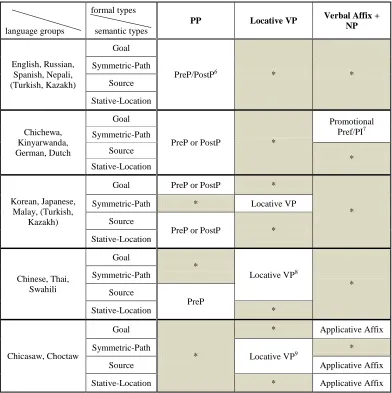
<Table 1> summarizes the discussions in section 2.
language groups
formal types
semantic types
PP Locative VP Verbal Affix +
NP
English, Russian, Spanish, Nepali, (Turkish, Kazakh)
Goal
PreP/PostP6 * *
Symmetric-Path
Source
Stative-Location
Chichewa, Kinyarwanda, German, Dutch
Goal
PreP or PostP *
Promotional
Pref/PI7
Symmetric-Path
Source
* Stative-Location
Korean, Japanese, Malay, (Turkish,
Kazakh)
Goal PreP or PostP *
*
Symmetric-Path * Locative VP
Source
PreP or PostP *
Stative-Location
Chinese, Thai, Swahili
Goal
*
Locative VP8
* Symmetric-Path
Source
PreP
Stative-Location *
Chicasaw, Choctaw
Goal
*
* Applicative Affix
Symmetric-Path
Locative VP9
*
Source Applicative Affix
Stative-Location * Applicative Affix
Table 1. Correspondence between semantic and formal types of locative expressions
6 Dutch postpositions are employed to express Goal and S-Path locatives.
7 German and Dutch uses promotional prefixes and incorporated Postpositions, respectively. 8
Chinese locative verbs, unlike Thai and Swahili ones, incorporate into the head verb to form a complex VP. Chinese does not employ a Source locative verb but a preposition cong ‘from’.
9 In Choctaw, a Source is indicated with the word hikiit, a reduced participle form of a locative verb hikii yah ‘to stand.’ (Broadwell 2006: 247)
We can see that PPs are most widely used for locative expressions, but some languages like Chickasaw and Choctaw do not employ PPs but verbal elements like applicative affixes and locative verbs. Nam (2009) claims that the three formal structures form a syntactic hierarchy in terms of the degree of constituency as follows: Verbal affixes > Locative PPs > PPs. That is, the higher one is more closely united to the main verb than the lower one is. Here we propose that the four types of locatives also form a semantic hierarchy depending on the degree of semantic unity between the locative and the VP. Thus we have the following correspondence between the two hierarchies:
(34) (i) [formal hierarchy]
Verbal Affix > Locative Verb > PP (ii) [semantic hierarchy]
Goal > S-Path > Source > St-Location
We can identify their close correspondence from Table-1, so we get the following typological implications:
(35) (i) If Goal locatives can be expressed as a PP in L, then Source/Stative locatives can, too. That is, <Goal, PP> <Source, PP> and <Stative-L, PP>
(ii) <Goal, Locative V> <Source, Locative V> and <Sym-Path, Locative V>
(iii) <Stative-L, Applicative>
<Source, Applicative> <Goal, pplicative>
The correspondence of (iii), for instance, states that the goal argument is easier to take an applicative structure than the stative or source argument, and further implies that the applicative affixes are more closely united to the head verb than a locative verb or a PP.
References
Baker, Mark. 1988. Incorporation: A Theory of Grammatical Function Changing. Chicago University Press.
Broadwell, George Aaron. 2006. A Choctaw
Reference Grammar. University of Nebraska Press.
Chao, Yuen R. 1968. A grammar of Spoken Chinese. Berkeley, CA: University of California Press.
Cheng, Lisa Lai-Shen, and C-T. James Huang. 1994. On the argument structure of resultative compounds, in Matthew Y. Chen and Ovid J. L. Tzeng, eds., In honor of William S-Y. Wang: Interdisciplinary studies on language and language change, 187–221. Taipei: Pyramid Press.
Couper-Kuhlen, E. 1979. The Prepositional Passive in English. Tuebingen: Max Niemeyer. Dowty, David. 1991. “Thematic Proto-roles and
Argument Selection,” Language 67, 547-619. Fong, Vivienne. 1997. The Order of Things: What
Directional Locatives Denote, PhD thesis, Stanford University.
Göksel, A. & C. Kerslake (2005) Turkish: A Comprehensive Grammar. Routledge. London & New York.
Hale, Kenneth and Samuel J. Keyser. 2002.
Prolegomenon to a Theory of Argument Structure. Linguistic Inquiry Monograph series #39. Cambridge, MA: MIT Press.
Kimenyi, A. 1980. A Relational Grammar of Kinyarwanda. Berkeley: University of California Press.
Kracht, Marcus. 2002. On the Semantics of Locatives, Linguistics and Philosophy 25, 157-232.
Munro, Pamela. 2000. The Leaky Grammar of the Chickasaw Applicatives, in Arika Okrent and John P. Boyle, eds., The Proceedings from the Main Session of the Chicago Linguistic Society's Thirty-sixth Meeting. Volume 36-1, 285-310. Chicago: Chicago Linguistic Society. Nam, Seungho. 1995. Semantics of Locative
Prepositional Phrases in English. Ph.D. thesis, University of California, Los Angeles.
Nam, Seungho. 2004. Goal and Source: Their Syntactic and Semantic Asymmetry,
Proceedings of the 30th Annual Meeting of the Berkeley Linguistics Society. Berkeley, CA: Berkeley Linguistics Society.