Recurrent Neural Network Based Loanwords Identification in Uyghur
Chenggang Mi
1,2, Yating Yang
1,2,3, Xi Zhou
1,2, Lei Wang
1,2, Xiao Li
1,2and Tonghai Jiang
1,2 1Xinjiang Technical Institute of Physics and Chemistry of Chinese Academy of Sciences,
Urumqi, 830011, China
2
Xinjiang Laboratory of Minority Speech and Language Information Processing,
Xinjiang Technical Institute of Physics and Chemistry of Chinese Academy of Sciences,
Urumqi, 830011, China
3
Institute of Acoustics of the Chinese Academy of Sciences, Beijing, 100190, China
{
micg,yangyt,zhouxi,wanglei,xiaoli,jth
}
@ms.xjb.ac.cn
Abstract
Comparable corpus is the most important re-source in several NLP tasks. However, it is very expensive to collect manually. Lexical borrowing happened in almost all languages. We can use the loanwords to detect useful bilingual knowledge and expand the size of donor-recipient / recipient-donor comparable corpora. In this paper, we propose a recur-rent neural network (RNN) based framework to identify loanwords in Uyghur. Addition-ally, we suggest two features: inverse lan-guage model feature and collocation feature to improve the performance of our model. Ex-perimental results show that our approach out-performs several sequence labeling baselines.
1
Introduction
Most natural language processing (NLP) tools rely on large scale language resources, but many lan-guages in the world are resource-poor. To make these NLP tools widely used, some researchers have focused on techniques that obtain resources of resource-poor languages from resource-rich lan-guages using parallel data for NLP applications such as syntactic parsing, word sense tagging, machine translation, semantic role labeling, and some cross-lingual NLP tasks. However, high quality parallel corpora are expensive and difficult to obtain, es-pecially for resource-poor languages like Uyghur. Lexical borrowing is very common between lan-guages. It is a phenomenon of cross-linguistic in-fluence (Tsvetkov et al., 2015a). If loanwords in resource-poor languages (e.g. Uyghur) can be iden-tified effectively, we can use the bilingual word pairs
as an important factor in comparable corpora build-ing. And comparable corpora are vital resources in parallel corpus detection (Munteanu et al., 2006). Additionally, loanwords can be integrated into bilin-gual dictionaries directly. Therefore, loanwords are valuable to study in several NLP tasks such as ma-chine translation, information extraction and infor-mation retrieval.
In this paper, we design a novel model to iden-tify loanwords (Chinese, Russian and Arabic) from Uyghur texts. Our model based on a RNN Encoder-Decoder framework (Cho et al., 2014). The En-coder processes a variable length input (Uyghur sen-tence) and builds a fixed-length vector representa-tion. Based on the encoded representation, the de-coder generates a variable-length sequence (Labeled sequence). To optimize the output of decoder, we also propose two important features: inverse lan-guage model feature and collocation feature. We conduct three groups of experiments; experimental results show that, our model outperforms other ap-proaches.
This paper makes the following contributions to this area:
• We introduce a novel approach to loanwords identification in Uyghur. This approach in-creases F1 score by 12% relative to traditional approach on the task of loanwords detection.
• We conduct experiments to evaluate the per-formance of off-the-shelf loanwords detection tools trained on news corpus when applied to loanwords detection. By utilizing in-domain and out-of-domain data.
to select the better loanword candidate.
The rest of this paper is organized as follows: Section 2 presents the background of loanwords in Uyghur; Section 3 interprets the framework used in our model; Section 4 introduces our method in detail. Section 5 describes the experimental setup and the analysis of experimental results. Section 6 discusses the related work. Conclusion and future work are presented in Section 7.
2
Background
Before we present our loanwords detection model, we provide a brief introduction of Uyghur and loan-words identification in this section. This will help build relevant background knowledge.
2.1 Introduction of Loanwords
A loanword is a word adopted from one language (the donor language) and incorporated into a differ-ent, recipient language without translation. It can be distinguished from a calque, or loan translation, where a meaning or idiom from another language is translated into existing words or roots of the host language. When borrowing, the words may have several changes to adopt the recipient language:
• Changes in meaning. Words are occasionally improved with a different meaning than that in the donor language
• Changes in spelling. Words taken into differ-ent recipidiffer-ent languages are something spelled as in the donor language. Sometimes borrowed words retain original (or near-original) pronun-ciation, but undergo a spelling change to repre-sent the orthography of the recipient language.
• Changes in pronunciation. In cases where a new loanword has a very unusual sound, the pronunciation of the word is radically changed.
2.2 Loanwords in Uyghur
Uyghur is an official language of the Xinjiang Uyghur Autonomous Region, and is widely used
which also includes languages such as the more distantly related Uzbek. In addition to influence of other Turkic languages, Uyghur has historically been influenced strongly by Person and Arabic and more recently by Mandarin Chinese and Russian (Table 1).
Loanwords in Uyghur not only include named entities such as person and location names, but also some daily used words.
2.3 Challenges in Loanwords Identification in Uyghur
Spelling Change When Borrowed From Donor Languages
To adopt the pronunciation and grammar in Uyghur, spelling of words (loanwords) may change when borrowed from donor languages. Changes of spelling have a great impact on the loanwords identification task.
Russian loanwords in Uyghur: “radiyo”1-“
radio”(“radio”)
Chinese loanwords in Uyghur: “koi”-“” (“kuai”)
Suffixes of Uyghur Words Affect the Loanwords Identification
A Uygur word is composed of a stem and several suffixes, which can be formally described as:
W ord=stem+suffix0+suffix1+...+suffixN (1)
If we just use the traditional approaches such as edit distance, in some cases, these algorithms cannot give us sure results, for example, the length of suffixes equal even greater than the original word’s length.
Data Sparsity Degrades the Performance of Loanwords Identification Model
Chinese loan words in Uyghur [in English] Russian loan words in Uyghur [in English]
shinjang() [Xinjiang] tElEfon(telefon) [telephone]
laza() [hot pepper] uniwErsitEt(universitet) [university]
shuji() [secretary] radiyo(radio) [radio]
koi() [Yuan] pochta(poqta) [post office]
lengpung() [agar-agar jelly] wElsipit(velosiped) [bicycle]
dufu() [bean curd] oblast(oblast) [region]
Table 1: Examples of Chinese and Russian Loanwords in Uyghur.
Loanwords detection can be reformulated as a se-quence labeling problem. Most sese-quence labeling tools (such as CRFs-based, HMM-based etc.) are built on large scales labeled data, lack of available labeled language resource makes decrease of perfor-mance on loanwords identification in Uyghur using above ”off-the-shelf” tools.
3
Methodology
Recent development of deep learning (representa-tion learning) has a strong impact in the area of NLP (natural language processing). According to traditional approaches, extraction of features often requires expensive human labor and often relies on expert knowledge, and these features usually cannot be expended in other situations. The most exciting thing of deep learning is that features used in most traditional machine learning models can be learned automatically.
In this section, we first introduced the most popu-lar deep learning models used in this paper, then, we involved in the details of this model.
3.1 Recurrent Neural Network
RNNs (Recurrent Neural Networks) are artificial neural network models where connections between units form a directed cycle (Jaeger, 2002). This cre-ates an internal state of the network which allows it to exhibit dynamic temporal behavior. RNNs can use their internal memory to process arbitrary se-quences of inputs. This makes them show great promise in many NLP tasks.
The most important feature of a RNN model is that the network contains at least one feed-back con-nection, so the activations can flow round in a loop. That makes the networks very suited for tasks like temporal processing and sequence labeling.
3.2 RNN Encoder-Decoder Framework
In this section, we give a brief introduction of the RNN Encoder-Decoder framework, which was proposed by (Cho et al., 2014a) and (Sutskever et al., 2014). We build a novel architecture that learns to identify loanwords in Uyghur texts based on this framework.
ሾݖݒͲǡ ݖݒͳǡ ݖݒʹǡ ǥ ǡ ݖݒሺ݈െͳሻǡ ݖݒ݈ሿ
ሾܷͲǡ ܷͳǡ ܷʹǡ ǥ ǡ ܷሺ݈െͳሻǡ ܷ݈ሿ ሾܱͲǡ ܱͳǡ ܱʹǡ ǥ ǡ ܱሺ݈െͳሻǡ ܱ݈ሿ
Decode
Encode
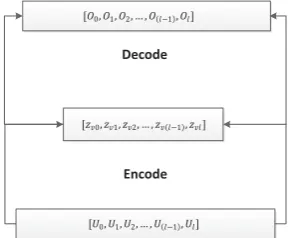
Figure 1: The Encoder-Decoder Framework Used in Loanword Identification Model.
U0, U1, U2, ..., Ul−1, Ul is a sequence of
Uyghur words, O0, O1, O2, ..., Ol−1, Ol is a sequence of labels (loanword or not), and
Zv0, Zv1, Zv2, ..., Zv(l−1), Zvl is a sequence of
vector representation of Uyghur words. The bold face ”Encode” and ”Decode” are two processes of encoder and decoder in our loanword identification model, respectively (Figure 1).
Encoder
In the RNN Encoder-Decoder framework, a
sentence is firstly transformed into a sequence of vectorsx = (x1, x2, ..., xl), then the encoder reads
xas a vectorc. The most common approach is to
And
c=q(h1, h2, ..., hl−1, hl) (3)
whereht ∈ γ is a hidden state at timet, andcis a vector generated from the sequence of the hidden states. f and q are some nonlinear functions. For instance, the Long-Short Term Memory (LSTM) is used asf, andq(h1, h2, ..., hl−1, hl)asht.
Decoder
In RNN framework, the decoder is often used to predict the next word yt given the context vector c and all the previously predicted words
y1, y2, ..., yt−1. In other words, the decoder
de-fines a probability over the identification yt by decomposing the joint probability into the ordered conditionals:
p(y) =
l
t=1
p(yt| {y1, y2, ..., yt−1},c) (4)
4
Loanwords Identification
To make our loanwords identification model stronger, we also proposed several features as the ad-ditional knowledge of RNN. These features can be derived from monolingual corpus. In this section, we present two features firstly, then, we introduce the decoding part of our model.
4.1 Features
Inverse Language Model Feature
A language model is a probability distribution over sequences of words in NLP. Traditionally, language models are widely used in applications such as machine translation, speech recognition, part-of-speech tagging, parsing, and information retrieval. For example, in statistical machine translation, language models are used to improve the fluency of generated texts (Lembersky et al., 2012)
p(e|f)∝p(f|e)p(e) (5)
that the stringeappeared in target language. Usually, there are different pronunciation systems between donor language and recipient language. Different pronunciation rules can be represented by different character-based language models. In our paper, we propose an inverse language model (ILM) to constraint the output of loanword identification system.
N-gram Model
N-gram is a contiguous sequence of n items from a given text. An n-gram model models natural language sequences using the statistical properties of n-grams. Practically, an n-gram model predictsxi based onxi−(n−1), ..., xi−1. This can be indicated by probability terms as
p(xi|xi−(n−1), ..., xi−1) (6)
When used in language modeling, independent assumptions are made so that each item word replies on its lastn−1words.
Inverse Language Model
As mentioned above, we can use a character-based language model to indicate a pronunciation system. Although a loanword may adapt the pro-nunciation of recipient language when borrowing, there are still some differences exist, and these dif-ferences usually reflect features of donor language pronunciation system. Accordingly, we computed the inverse language model feature as following
pilm= (1−λ1puyg) +λ2pdnr (7)
Where puyg is the language model probability of a given character sequence in Uyghur, pdnr is the language model probability of above sequence in donor languages. λ1 andλ2are weights which can be obtained during model optimization. Language model probabilities are all based on n-gram models.
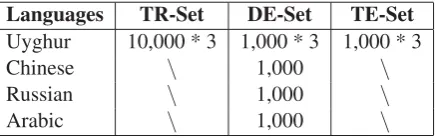
Arabic \ 1,000 \
Table 2: Statistic of Corpora.
the inverse language model, we used a java ver-sion language model tool which was implemented by ourselves. For the collocation extraction feature, we trained a model based on the word2vec, which was proposed by Tomas Mikolov, and a java ver-sion is also implemented in Deeplearning4j toolkits. To evaluate the performance of loanword identifi-cation models, several metrics are used in our exper-iments:
R= A
A+C, P =
A
A+B, F1 =
2 R P
P +R (11)
P(P recision) indicates the percentage of
loan-words found that match exactly the spans found in the evaluations data (test set);
R(Recall) means the percentage of loanwords
defined in the corpus that were found in the same location;
F1can be interpreted as the harmonic mean ofP andR.
5.2 Experiments and Analysis
For validate the effectiveness of our loanword identification model, we first compare our model (RNN-based model) with other loanword detection models, including CRFs-based model (CRFs) (Lafferty et al., 2001), the identification model based on string similarity (SSIM) (Mi et al., 2013), classification-based identification model (CBIM) (Mi et al., 2014). We suggest two important features in this paper to optimize the output of our loanword identification model, affection of these features are evaluated on identification performance. Loanwords can exist in any domains in a language; therefore, we also conduct experiments on texts in several domains.
Evaluation on Loanword Identification Mod-els
approaches, we summarized possible reasons as follow: 1) CRFs model rely heavily on labeled data, because we only have limited training examples, the CRFs model achieved lowest performance among four models; 2) SSIM model based on two string similarity algorithms: edit distance and the common substring, compare with the RNN model, SSIM has a limited ability of generalization, and cannot capture semantic information in Uyghur texts, so the SSIM achieved a relative low performance; 3) Several information including above two algo-rithms are integrated into the CIBM model, and consider the loanwords identification as a classifi-cation problem, the performance of CIBM model outperforms the CRFs model and SSIM model. However, like the SSIM model, there is almost no semantic information and limited generalization ability, therefore, the performance of CIBM model cannot achieve or outperform the RNN based model.
Evaluation on Features Used in RNN-based Model
Features used in our model optimized the out-put of loanword identification. We show the experimental results on combination of features:
RNN+f0(no additional feature used),RNN+f1 (inverse language model feature used),RNN+f2 (collocation feature used) and RNN + f1 + f2 (both inverse language model feature and colloca-tion feature are used).
In Table 4, RNN + f1 combines the in-verse language model information into loanword identification model, which apply the local feature in our task, so the performance of RNN + f1 outperforms the basic RNN model andRNN+f2.
Languages P-Chn R-Chn F1-Chn P-Rus R-Rus F1-Rus P-Arab R-Arab F1-Arab
CRFs 69.78 62.33 66.35 71.64 63.25 67.18 72.50 65.32 68.72
SSIM 66.32 77.28 71.38 75.39 70.02 72.61 73.76 67.51 70.50
CIBM 78.82 68.30 73.18 81.03 73.22 76.93 75.22 70.71 72.90
RNNs 78.97 79.20 79.08 82.55 75.93 79.10 83.26 77.58 80.32
Table 3: Experimental Results on Loanword Identification Models.
Languages P-Chn R-Chn F1-Chn P-Rus R-Rus F1-Rus P-Arab R-Arab F1-Arab
RNN+f0 77.65 67.89 72.44 78.02 68.33 72.85 78.38 70.96 74.49
RNN+f1 78.86 70.32 74.35 81.94 70.65 75.88 81.12 71.52 76.02
CIRNN+f2 78.79 69.54 73.88 81.35 71.28 75.98 80.76 70.20 75.11
RNN+f1+f2 78.97 79.20 79.08 82.55 75.93 79.10 83.26 77.58 80.32
Table 4: Evaluation on Features Used in RNN-based Model.
the RNN + f1 + f2 model achieved the best performance.
Evaluation on Cross-domain Corpora
We evaluate our model in two domains on
dif-ferent test sets: RNNLIS + NEW S and
RNNLIS+ORAL.
In Table 5, the experimental results on news
(RNNLIS +NEW S) which is similar with our
training examples are outperform the results on oral test set (RNNLIS+ ORAL). This may be no doubt. Amazingly, we found that performance
of RNNLIS + ORAL is just a little worse
compared with RNNLIS+NEW S. A possible reason is that our model can learn representation of knowledge beyond given training examples.
5.3 Discussion
In our experiments, we try to identify Chinese, Rus-sian and Arabic loanwords in Uyghur texts. We found that results on Arabic loanwords identification achieved the best performance. There are two possi-ble reasons. First, most of loanwords labeled in the training examples for Arabic loanwords identifica-tion are person names; therefore, it is relatively easy to find them out. Second, Persian has exerted some influence on Arabic, and borrowing much vocabu-lary from it. Meanwhile, Uyghur has historically been influenced strongly by Persian, so Arabic loan-words in Uyghur may have the similar pronunciation
system with Arabic. These two reasons contribute to Arabic loanwords identification in Uyghur.
We have limited number of labeled corpus, so a competitive identification result cannot be expected if a traditional approach is used (such as the CRF). Our proposed RNN Encoder-Decoder framework can learn features automatically and use its inter-nal memory to process arbitrary sequences of inputs. Additionally, two features inverse language model and collocation can constraint the output of identi-fication model. Therefore, our model achieved the best performance.
Loanword identification models are all trained on news corpora, so in cross-domain (news and oral) experiments, results in news are outperform results in oral. We analysis the results, and found that sev-eral errors including spelling error are exist in oral corpora, and these errors may affect the performance of our model.
6
Related work
There has been relatively few previous works on loanwords identification in Uyghur. Our work is in-spired by two lines of research: (1) recurrent neural network; (2) loanwords detection.
6.1 Recurrent Neural Network
In recent years, the Recurrent Neural Network has proven to be highly successful in capturing semantic information in text and has improved the results of several tasks in NLP area. (Socher et al., 2013) uses
Table 5: Evaluation on Cross-Domain Corpora.
a recursive neural network to predict sentence senti-ment. (Luong et al., 2013) generates better word rep-resentation with recursive neural network. (Cho et al., 2014a) proposed a RNN encoder-decoder model to learn phrase representations in SMT. (Irsoy et al., 2014) introduce a deep recursive neural network, and evaluate this model on the task of fine-grained sentiment classification. (Liu et al., 2014) propose a recursive recurrent neural network to model the end-to-end decoding process for SMT; experiments show that this approach can outperform the state-of-the-art baseline. (Yao et al., 2013) optimized the recur-rent neural network language model to perform lan-guage understanding. (Graves , 2012) apply a RNN based system in probabilistic sequence transduction.
6.2 Loanwords Detection
In general, word borrowing is often concerned by linguists (Chen, 2011; Chen et al., 2011a). There are relatively few researches about loanwords in NLP area. (Tsvetkov et al., 2015a) and (Tsvetkov et al., 2016) proposed a morph-phonological transfor-mation model, features used in this model are based on optimality theory; experiment has been proved that with a few training examples, this model can obtain good performance at predicting donor forms from borrowed forms. (Tsvetkov et al., 2015) sug-gest an approach that uses the lexical borrowing as a model in SMT framework to translate OOV words in a low-resource language. For loanwords detection in Uyghur, string similarity based methods were often used at the early stage (Mi et al., 2013). (Mi et al., 2014) propose a loanword detection method based on the perceptron model, several features are used in model training.
7
Conclusion
We have presented an approach to identify loan-words (Chinese, Russian and Arabic loanloan-words) in Uyghur texts, our model based on the RNN Encoder-Decoder framework. We also suggested
two important features: inverse language model and collocation feature to optimize the output of our loanword identification model. Experimental results show that our model achieves significant improve-ments in loanwords detection tasks. In the future, we plan to further validate the effectiveness of our ap-proach on more languages, especially on languages with rich morphology.
Acknowledgments
We sincerely thank the anonymous reviewers for their thorough reviewing and valuable sugges-tions. This work is supported by the West Light Foundation of The Chinese Academy of Sciences under Grant No.2015-XBQN-B-10, the Xinjiang Key Laboratory Fund under Grant No.2015KL031 and the Strategic Priority Research Program of the Chinese Academy of Sciences under Grant No.XDA06030400.
References
Shiming Chen. 2011. New Research on Chinese Loan-words in the Uyghur Language. N.W.Journal of Eth-nology,pages 176-180, 28(1).
Yan Chen and Ping Chen. 2011. A Comparison on the methods of Uyghur and Chinese Loan Words. Journal of Kashgar Teachers Collegepages 51-55, 32(2). Kyunghyun Cho, Bart van Merri¨enboer, Dzmitry
Bah-danau and Yoshua Bengio. 2014. On the properties of neural machine translation: Encoder-decoder ap-proaches. In Proceedings of the Eighth Workshop on Syntax, Semantics and Structure in Statistical Trans-lation (SSST-8), pages 103-111, October 25, Doha, Qatar. Association for Computational Linguistics. Kyunghyun Cho, Bart van Merri¨enboer, Caglar Gulcehre,