Incremental Semantics Driven Natural Language Generation With
Self-Repairing Capability
Julian Hough
Interaction, Media and Communication Research Group, School of Electronic Engineering and Computer Science,
Queen Mary University of London
Abstract
This paper presents the on-going develop-ment of a model of incredevelop-mental semantics driven natural language generation (NLG) for incremental dialogue systems. The ap-proach is novel in its tight integration of incremental goal-driven semantics and syn-tactic construction, utilizing Type Theory with Records (TTR) record types for goal concepts as its input and the grammar for-malism Dynamic Syntax (DS) for a word-by-word tactical generation procedure. The characterization of generation in terms of semantic input and word output graphs al-lows an integration into the incremental dia-logue system Jindigo and facilitates the gen-eration of human-like self-repairs in a se-mantically and syntactically motivated way.
1 Introduction
Recently, the arrival of incremental frameworks such as that described by Schlangen and Skantze (2011) has reignited the challenges for dialogue systems. Their implementation has recently shown success in micro-domains (Skantze and Schlangen, 2009) and has included some incre-mental natural language generation (NLG) capa-bilities which have been shown to be favored by users over non-incremental counterparts (Skantze and Hjalmarsson, 2010). However, this new brand of system has not taken account of incremental se-mantic processing on a word-by-word level in gen-eration, which is the nature of the model for NLG described here.
The consequences of taking a fine-grained in-cremental semantics approach for NLG include the possibility of closer integration with parsing, and the incorporation of self-repair in a natural
and context-sensitive way. Integrating self-repair into generation in the way described here should be beneficial for incremental dialogue systems with fragmentary and changing inputs to genera-tion, and could also give some insights for model-ing speech production.
1.1 Related Work
Traditionally, incremental generation has been motivated by developing autonomous processing models of human speech production. In partic-ular, Kempen and Hoenkamp (1987) and Lev-elt (1989)’s functional decomposition of distinct conceptualization, formulation and articulation phases provided a psycholinguistic model which continues to have an influence on NLG. Motivated by modeling memory limitation, the principle of incrementality was generally taken that the syn-tactic formulator was able to begin its processing without complete input from the conceptualizer- in grammatical terms, tree formation could be both lexically and conceptually guided- see e.g. De Smedt (1990).
Guhe (2007) modeled an incremental concep-tualizer which generated pre-verbal messages in a piece-meal fashion. While formulation was not the focus, the benefit of incremental semantic con-struction was clear: the conceptualizer’s incre-mental modification of pre-verbal messages could influence downstream tactical generation deci-sions, particularly with ‘correction’ increments causing self-repairs.
Albeit less psychologically motivated, Skantze and Hjalmarsson (2010) provide a similar ap-proach to Guhe in implementing incremental speech generation in a dialogue system. Genera-tion input is defined as canned-text speech plans sent from the dialogue manager divided up into
word-length speech units. Incremental generation is invoked to allow speech plans to change dy-namically during interaction with a user: a sim-ple string-based comparison of the incoming plan with the current one being vocalized allows both covert and overt self-repairs to be generated de-pending on the number of units in the plan realized at the point of difference detection.
This paper describes a new model for incremen-tal generation that incorporates word-by-word se-mantic construction and self-repairing capability, going beyond string-based plan corrections and strict delineation of conceptualization and surface realization. The model is also portable into incre-mental dialogue systems.
2 Background
2.1 Dynamic Syntax (DS)
Dynamic Syntax (DS, Kempson et al., 2001) is an action-based and semantically oriented incre-mental grammar that defines grammaticality as parsability. The DS lexicon consists of lexical ac-tions keyed to words, and also a set of globally applicable computational actions, both of which constitute packages of monotonic update opera-tions on semantic trees and take the form of IF-THEN action-like structures such as (1).
(1)
john:
IF ?T y(e)
THEN put(T y(e))
put(f o(john0))
ELSE abort
(2) arrive(john)T y(t),♦
T y(e), john
T y(e→t), λx.arrive(x)
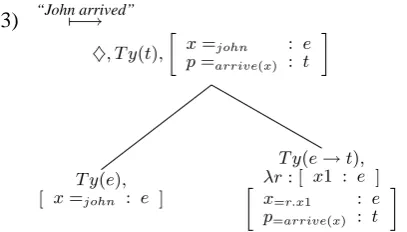
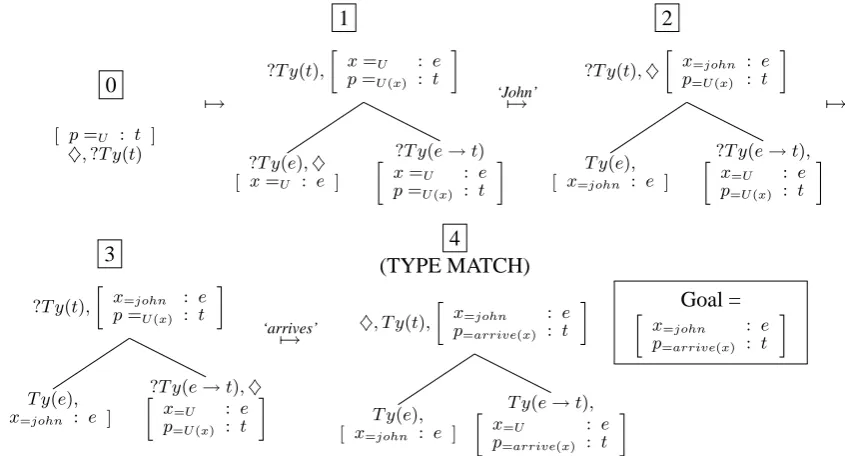
In DS parsing, if the pointer object (♦) currently satisfies the precondition of an action, (e.g. is at a node of type?T y(e)), then simple monotonic tree update operations of the tree logic LOFT (Black-burn and Meyer-Viol, 1994) are licensed. The trees represent terms in the typed lambda calculus, with mother-daughter node relations correspond-ing to semantic predicate-argument structure with no independent layer of syntax- see (2). Parsing begins with an axiom tree with a single node of requirement type?T y(t), and intersperses testing and application of lexical actions triggered by in-put words and execution of permissible (Kleene* iterated) sequences of computational actions.
Successful parses are sequences of applications of actions that lead to a tree which is complete (i.e. has no type requirements?T y(..)on any node, and has type T y(t) at its root node as in (2)) with a compiled formula. Incomplete partial structures are also maintained in the parse state as words are scanned in the input.
2.2 DS Generation as Parsing
As Purver and Kempson (2004) demonstrate, a tactical model of DS generation can be neatly de-fined in terms of the DS parsing process and a subsumption check against a goal tree. Goal trees are complete and fully specified DS trees such as (2), and generation consists of attempting to parse each word in the lexicon given the trees under construction, followed by a check to remove trees which do not subsume the goal tree from the parse state. Due to the stage-by-stage iteration through the lexicon, the DS generation process effectively combines lexical selection and linearization into a single action. Also, while no formal model of repair has hitherto been proposed in DS, self-monitoring is inherently part of the generation pro-cess, as each word generated is parsed.
2.3 Jindigo and the DyLan Interpreter
Jindigo (Skantze and Hjalmarsson, 2010) is a Java-implemented dialogue system following the abstract framework described by Schlangen and Skantze (2011). Its system is a network of mod-ules, each consisting of a left buffer for input in-crements, a processor and a right buffer for the output increments. It is the adding, commitment and revoking of incremental units (IUs) in a mod-ule’s right buffer and the effect of doing so on an-other module’s left buffer that determines system behaviour, and the IUs can have groundedIn re-lations between one another if it is desirable that they should be in some way inter-dependent. The buffers are defined graphically, with vertices and edges representing IUs, allowing for multiple hy-potheses in speech recognition and, as mentioned, revision of canned-text speech plans in generation (Skantze and Hjalmarsson, 2010).
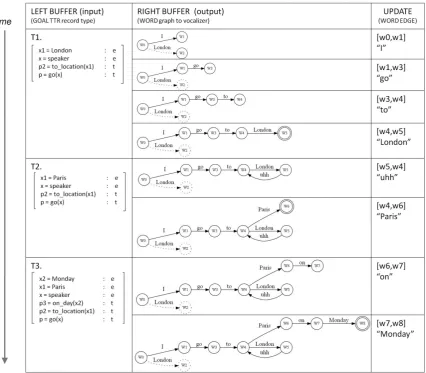
Figure 3: Incremental DS-TTR generation of a repair at time point T2 and extension at T3. Type-matched paths are double-circled nodes and uncommitted nodes and edges are dotted
after, or even during, the generation process, so trouble in generation may be encountered. Our
repair function explained above operates if there is an empty state, or no possible DAG ex-tension, after the semantic pruning stage of gener-ation (resulting in no candidate succeeding word edge) by restarting the generation procedure from the last committed parse state edge. It continues backtracking by one vertex at a time in an attempt to extend the DS DAG until successful.
Our protocol is consistent with Shriberg and Stolcke (1998)’s empirical observation that the probability of retracing N words back in an utter-ance is more likely than retracing from N+1 words back, making the repair as local as possible. Utter-ances such as “I want to go, uhh, leave from Paris” are processed on a semantic level, as the repair is integrated with the semantics of the part of the ut-terance before the repair point to maximize re-use of existing semantic structure.
A subset of self-repairs, extensions, where the repair effects an “after-thought”, usually in a tran-sition place in a dialogue turn, are dealt with straight-forwardly in our system. The DS parser treats these as monotonic growth of the matrix tree through LINK adjunction (Kempson et al., 2001), resulting in subtype extension of the root TTR record type. Thus, a change in goal concept dur-ing generation will not always put demands on the system to backtrack, such as in the case of gener-ating the fragment after the pause in “I go to Paris . . . from London”. It is only a semantics/syntax mismatch, where the revised goal TTR record type does not correspond to a permissible extension of a DS tree in the DAG, where overt repair will oc-cur (for a comparison see figure 3).
the string generated thus far to characterize self-repair. Instead, repair here is driven by attempt-ing to extend existattempt-ing parse paths to construct the new target record type, backtracking through the parse state in an attempt to find suitable departure points for restarting generation, retaining the se-mantic representation already built up during the DS-TTR generation process.
5 Conclusion and Future Work
A prototype NLG module has been described that utilizes incremental semantic construction of TTR record types constrained by incremental Dynamic Syntax tree extension and TTR supertype rela-tion checking to generate on a word-by-word ba-sis. Although yet to undergo thorough evaluation, the system is capable of generating test-set self-repairs given manually induced goal TTR record type changes in the input buffer. The coming eval-uation will not only involve a computational anal-ysis, but an interactional one, involving human judges and experimental measures along the lines proposed by Schlangen (2009).
In terms of future development, the conceptual and phonological levels of the model could be ex-panded upon to get even finer granularity and con-sequently allow more natural system responses. A possible immediate extension could be the incor-poration of a TTR subtyping process in the con-struction of goal concepts during generation by the dialogue manager, so as to incorporate incremen-tality into the conceptualization process (Guhe, 2007) as well as in surface realization.
Acknowledgments
Thanks go to my supervisor Matthew Purver and the RANLP reviewers for their helpful comments.
References
Patrick Blackburn and Wilfried Meyer-Viol. 1994. Linguistics, logic and finite trees. Logic Journal of the Interest Group of Pure and Ap-plied Logics, 2(1):3–29.
Robin Cooper. 2005. Records and record types in semantic theory. Journal of Logic and Compu-tation, 15(2):99–112.
Koenraad De Smedt. 1990. IPF: An incremental parallel formulator. In Current research in nat-ural language generation, pages 167–192. Aca-demic Press, London.
Markus Guhe. 2007. Incremental Conceptualiza-tion for Language ProducConceptualiza-tion. NJ: Lawrence Erlbaum Associates.
Gerard Kempen and Edward Hoenkamp. 1987. An incremental procedural grammar for sentence formulation. Cognitive Science, 11(2):201–258.
Ruth Kempson, Wilfried Meyer-Viol, and Dov Gabbay. 2001. Dynamic Syntax: The Flow of Language Understanding. Blackwell.
W.J.M. Levelt. 1989. Speaking: From intention to articulation. Mit Pr.
Matthew Purver and Ruth Kempson. 2004. Incre-mental context-based generation for dialogue. In A. Belz, R. Evans, and P. Piwek, editors, Pro-ceedings of the 3rd International Conference on Natural Language Generation (INLG04), num-ber 3123 in Lecture Notes in Artifical Intelli-gence, pages 151–160, Brockenhurst, UK, July. Springer.
Matthew Purver, Arash Eshghi, and Julian Hough. 2011. Incremental semantic construction in a dialogue system. In J. Bos and S. Pulman, editors, Proceedings of the 9th International Conference on Computational Semantics, pages 365–369, Oxford, UK, January.
Yo Sato. 2011. Local ambiguity, search strate-gies and parsing in Dynamic Syntax. In E. Gre-goromichelaki, R. Kempson, and C. Howes, ed-itors, The Dynamics of Lexical Interfaces, pages 205–233. CSLI.
David Schlangen and Gabriel Skantze. 2011. A general, abstract model of incremental dialogue processing. Dialogue and Discourse, 2(1):83– 111.
David Schlangen. 2009. What we can learn from dialogue systems that dont work. In Proceed-ings of DiaHolmia (Semdial 2009, pages 51–58.
Elizabeth Shriberg and Andreas Stolcke. 1998. How far do speakers back up in repairs? A quantitative model. In Proceedings of the Inter-national Conference on Spoken Language Pro-cessing, pages 2183–2186.
Gabriel Skantze and Anna Hjalmarsson. 2010. Towards incremental speech generation in dia-logue systems. In Proceedings of the SIGDIAL 2010 Conference, pages 1–8, Tokyo, Japan, September. Association for Computational Lin-guistics.