Twitter Part-of-Speech Tagging for All:
Overcoming Sparse and Noisy Data
Leon Derczynski
University of Sheffield
[email protected]
Alan Ritter
University of Washington
[email protected]
Sam Clark
University of Washington
[email protected]
Kalina Bontcheva
University of Sheffield
[email protected]
Abstract
Part-of-speech information is a pre-requisite in many NLP algorithms. However, Twitter text is difficult to part-of-speech tag: it is noisy, with linguistic errors and idiosyncratic style. We present a detailed error analysis of exist-ing taggers, motivatexist-ing a series of tagger aug-mentations which are demonstrated to improve performance. We identify and evaluate tech-niques for improving English part-of-speech tagging performance in this genre.
Further, we present a novel approach to sys-tem combination for the case where available taggers use different tagsets, based on vote-constrained bootstrapping with unlabeled data. Coupled with assigning prior probabilities to some tokens and handling of unknown words and slang, we reach 88.7% tagging accuracy (90.5% on development data). This is a new high in PTB-compatible tweet part-of-speech tagging, reducing token error by 26.8% and sentence error by 12.2%. The model, training data and tools are made available.
1
Introduction
Twitter provides a wealth of uncurated text. The site has over 200 million users active each month (O’Carroll, 2012) generating messages at a peak rate over 230 000 per minute (Ashtari, 2013). Information found on Twitter has already been shown to be useful for a variety of applications (e.g. moni-toring earthquakes (Sakaki et al., 2010) and predicting flu (Culotta, 2010)). However, the lack of quality part-of-speech taggers tailored specifically to this emerging genre impairs the accuracy of key down-stream NLP techniques (e.g. named entity recognition, term extraction), and by extension, overall application results.
Microblog text (from e.g. Twitter) is characterised by: short messages; inclusion of URIs; username men-tions; topic markers; and threaded conversations. It often presents colloquial content containing abbrevi-ations and errors. Some of these phenomena com-prise linguistic noise, which when coupled with mes-sage brevity (140 characters for “tweets”) and the lack
of labeled corpora, make microblog part-of-speech tag-ging very challentag-ging. Alongside the genre’s informal nature, such limits encourage “compressed” utterances, with authors omitting not only needless words but also those with grammatical or contextualising function.
Part-of-speech tagging is a central problem in natu-ral language processing, and a key step early in manly NLP pipelines. Machine learning-based part-of-speech (PoS) taggers can exploit labeled training data to adapt to new genres or even languages, through supervised learning. Algorithm sophistication apart, the perfor-mance of these taggers is reliant upon the quantity and quality of available training data. Consequently, lacking large PoS-annotated resources and faced with prevalent noise, state-of-the-art PoS taggers perform poorly on microblog text (Derczynski et al., 2013), with error rates up to ten times higher than on newswire (see Section 3).
To address these issues, we propose a data-intensive approach to microblog part-of-speech tagging for En-glish, which overcomes data sparsity by using the thousands of unlabeled tweets created every minute, coupled with techniques to smooth out genre-specific noise. To reduce the impact of data sparsity, we intro-duce a new method forvote-constrainedbootstrapping, evaluated in the context of PoS tagging. Further, we in-troduce methods for handling the genre’s characteristic errors and slang, and evaluate the performance impact of adjusting prior tag probabilities of unambiguous to-kens.
1. A comprehensive comparative evaluation of exist-ing POS taggers on tweet datasets is carried out (Section 3), followed by a detailed analysis and classification of common errors (Section 4), in-cluding errors due to tokenisation, slang, out-of-vocabulary, and spelling.
2. Address tweet noisiness through handling of rare words (Section 5.1) and adjusting prior tag prob-abilities of unambiguous tokens, using external knowledge (Section 5.2).
3. Investigate vote-constrained bootstrapping on a large corpus of unlabeled tweets, to create needed tweet-genre training data (Section 5.3).
4. Demonstrate that these techniques reduce token-level error by 26.8% and sentence-token-level error by 12.2% (Section 6).
Tagger Known Unknown Overall Sentence
TnT 96.76% 85.86% 96.46%
-SVMTool 97.39% 89.01% 97.16%
-TBL - - 93.67%
-Stanford - 90.46% 97.28% 56.79%
Table 1: Token-level labeling accuracy for four off-the-shelf PoS taggers on newswire. Not all these perfor-mance measures are supplied in the literature.
2
Related Work
Regarding Twitter part-of-speech tagging, the two most similar earlier papers introduce the ARK tagger (Gim-pel et al., 2011) and T-Pos (Ritter et al., 2011). Both these approaches adopt clustering to handle linguis-tic noise, and train from a mixture of hand-annotated tweets and existing PoS-labeled data. The ARK tag-ger1 reaches 92.8% accuracy at token level but uses a coarser, custom tagset. T-Pos2 is based on the Penn Treebank set and, in its evaluation, achieves an 88.4% token tagging accuracy. Neither report sentence/whole-tweet accuracy rates. Foster et al. (2011) introduce results for both PoS tagging and parsing, but do not present a tool, and focus more on the parsing aspect.
Previous work on part-of-speech tagging in noisy en-vironments has focused on either dealing with noisy tokens either by using a lexicon that can handle par-tial matches through e.g. topic models (Darling et al., 2012) or Brown clustering (Clark, 2003), or by apply-ing extra processapply-ing steps to correct/bias tagger perfor-mance, e.g., post-/pre-processing respectively (Gadde et al., 2011). Finally, classic work on bootstrapped PoS tagging is that of Clark et al. (2003), who use a co-training approach to improve tagger performance using unlabeled data.
3
Comparing taggers on Twitter data
In order to evaluate a new tagging approach, we must first have a good idea of the current performance of state-of-the art tools, and a common basis (e.g. corpus and tagset) for comparison.
3.1 Conventional Part-of-speech Taggers
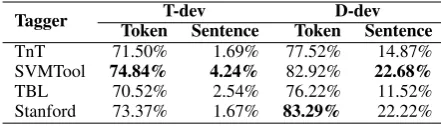
To quantify the disadvantage conventional PoS tag-gers have when faced with microblog text, we evaluate state-of-the-art taggers against Twitter data. We used the same training and evaluation data for each tagger, re-training taggers where required.
When measuring the performance of taggers, as per popular convention we report the overall proportion of tags that are accurately assigned. Where possible we report performance on “unknown” words – those that
1
http://www.ark.cs.cmu.edu/TweetNLP/
2https://github.com/aritter/twitter nlp
Tagger T-dev D-dev
Token Sentence Token Sentence
TnT 71.50% 1.69% 77.52% 14.87%
SVMTool 74.84% 4.24% 82.92% 22.68%
TBL 70.52% 2.54% 76.22% 11.52%
Stanford 73.37% 1.67% 83.29% 22.22%
Table 2: Token tagging performance of WSJ-trained taggers (sections 0-18) on Twitter data. Figures listed are the proportion of tokens labeled with the correct part-of-speech tag, and the proportion of sentences in which all tokens were correctly labeled.
do not occur in the training data. Further, as per Man-ning (2011) we report the rate of getting whole sen-tences right, since “a single bad mistake in a sentence can greatly throw off the usefulness of a tagger to downstream tasks”.3
We evaluated four state-of-the-art trainable and pub-licly available PoS taggers that used the Penn Tree-bank tagsettrereetagger: SVMTool (Gim´enez and Mar-quez, 2004), the Stanford Tagger (Toutanova et al., 2003), TnT (Brants, 2000) and a transformation-based learning (TBL) tagger (Brill, 1995) supported by se-quential n-gram backoff. The NLTK implementations of TnT and TBL were used (Bird et al., 2009). The ‘left3words’ model was used with the Stanford tagger, and ‘M0’ with SVMTool. For initial comparison, tag-gers were tested on standard newswire text from the Penn Treebank (Marcus et al., 1993),4 training with Wall Street Journal (WSJ) sections 0-18 and evaluat-ing on sections 19-21. The base performance for each tagger is given in Table 1.
3.2 Labeled Tweet Corpora
Three PoS-labeled microblog datasets are currently available. The T-Pos corpus of 15K tokens introduced by Ritter et al. (2011) uses a tagset based on the Penn Treebank tagset,plus four new tags for URLs (URL), hashtags (HT), username mentions (USR) and retweet signifiers (RT). The DCU dataset of 14K tokens (Fos-ter et al., 2011) is also based on the Penn Treebank (PTB) set, but does not have the same new tags as T-Pos, and uses slightly different tokenisation. The ARK corpus of 39K tokens (Gimpel et al., 2011) uses a novel tagset, which, while suitable for the microblog genre, is somewhat less descriptive than the PTB sets on many points. For example, itsVtag corresponds to any verb, conflating PTB’sVB,VBD,VBG,VBN,VBP,VBZ, and MDtags. Intuitively, this seems to be a simpler tagging task, and performance using it reaches 92.8% (Owoputi et al., 2012).
3
In fact, as sentence boundaries are at best unclear in many tweets, we use a slightly stricter interpretation of “sen-tence” and only count entire tweets that are labeled correctly.
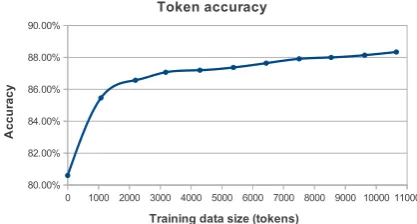
Figure 1: Stanford tagger token-level accuracy on T-dev with increasing amounts of microblog training text.
repairing the ground truth.
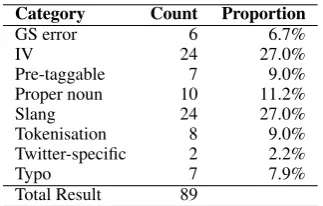
In-vocabulary– Tokens that are common in general, but do not occur in the training data. For example, In-ternetandbakeare unknown words and mis-tagged in the evaluation corpus. This kind of error may be fixed by a larger training set or the use of a lexicon, espe-cially for monosemous words.
Pre-taggable– Words to which a label may be reli-ably assigned automatically. This group includes well-formed URLs, hash tags and smileys.
Proper noun– Proper nouns not in the training data. Most of these should be tagged NNP, and are often useful for later named entity recognition. Incorrectly tagged proper nouns often had incorrect capitalisation; for example, derek and birmingham. Gazetteer ap-proaches may help annotate these, in cases of words that can only occur as proper nouns.
Slang – An abundance of slang is a characteristic feature of microblog text, and these words are often in-correctly tagged, as well as being rarely seen due to a proliferation of spelling variations (all incorrect). Ex-amples includeLUVZ,HELLAand2night. Some kind of automatic correction or expanded lexicon could be employed to either map these back to dictionary words or to include previously-seen spelling variations.
Tokenisation error – Occasionally the tokeniser or original author makes tokenisation errors. Exam-ples include ass**sneezes, which should have been split into more than one token as indicated by spe-cial/punctuation characters, andeventhough, where the author has missed a space. These are hard to correct. Specific subtypes of error, such as the joined words in the example, could be checked for and forcibly fixed, though this requires distinguishing intentional from un-intentional word usage.
Genre-specific– Words that are unique to specific sites, often created for microblog usage, such as unfol-lowing. Extra tweet-genre-specific training data may to reduce genre-specific word errors.
Orthographic error– Finally, although it is diffi-cult to detect the intent of the user, some content seems likely to have been accidentally mis-spelled. Examples include Handle] and suprising. Automatic spelling
Figure 2: Token-level performance on T-dev with vary-ing amounts of WSJ text, in addition to T-train and IRC data.
correction may improve performance in these cases. We also examined the impact the volume of train-ing data had on performance. Figure 1 shows a con-tinuing performance increase as ground-truth tweets are added, suggesting more tweet-genre training data will yield improvements. Conversely, there is already enough newswire-type training data and adding more is unlikely to greatly increase performance (Figure 2). Consequently, subsequent experiments do not include more newswire beyond the 50K-token WSJ corpus ex-cerpt also used in T-Pos.
5
Addressing Noise and Data Sparseness
Our examination of frequent PoS tagging errors identi-fied some readily rectifiable classes of problem. These were: slang, jargon and common mis-spellings; genre-related phrases; smileys; and unambiguous named en-tities. In addition, observations suggested that more tweet training data would help. Thus, we augmented our approach in three ways: improved handling of unknown and slang words; conversion of unambigu-ous tags into token prior probabilities; and addition of semi-supervised training data.
5.1 Normalisation for Unknown Words
Tagging accuracy on tokens not seen in the training data (out-of-vocabulary, orOOVtokens) is lower than that on those previously encountered (see Table 1). Consequently, reducing the proportion of unknown words is likely to improve performance. Informal er-ror analysis suggested that slang makes up a notable proportion of the unknown word set. To provide in-vocabulary (IV) versions of slang words (i.e. to nor-malise them), we created a set of mappings from OOV words to their IV equivalents, using slang dictionaries and manual examination of the training data. The map-ping is applied to text before it is tagged, and the origi-nal token is labeled with a PoS tag based on the mapped (normalised) word.
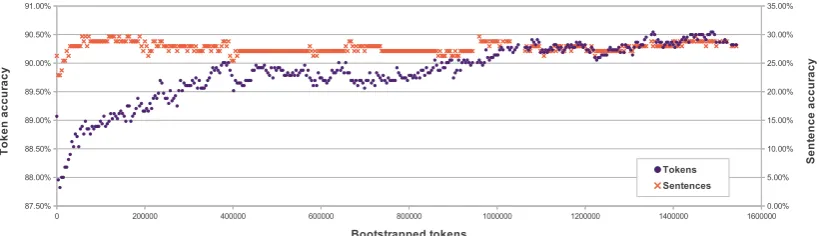
Figure 3: Bootstrapping the tagger using data with vote-constrained labelings.
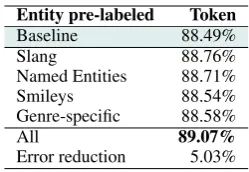
Tagging with Priors Results In our experiments, the tagger was adapted to take prior probabilities into account, and experiments run using a model trained on WSJ+IRC+T-train that includes the noise-handling augmentations described in Section 5.1. Table 7 shows the performance difference on each of the four cate-gories of token discussed above. Each has an effect, combining to yield a 5.0% error reduction (P<0.005, McNemar’s test). When the original model detailed in Table 3 is used, token performance improves from 83.14% accuracy to 86.93%. Assignment of priors af-fords 22.5% error reduction in this scenario. We com-pare fixing the tagbeforetagging the rest of the sen-tence, with tagging the whole sentence and overwriting such tokens’ tags. While the latter only affects unam-biguous tokens, the former affects the other tags in the sentence during tagging, via e.g. transmission prob-abilities and window features. This is a novel adap-tation of this tagger. To compare, when correcting this model’s labelspost-tagging, error reduction is only 19.0% (to 86.34%).
5.3 Vote-constrained Bootstrapping
Having seen the impact that tweet data has on per-formance, one choice is to increase the amount of la-beled training tweets. We have only a small amount of ground-truth, labeled data. However, large amounts of unlabeled data are readily accessible; a day’s discourse on Twitter comprises 500 million tweets of unlabeled data (Terdiman, 2012). In this scenario, one option is bootstrapping (Goldman and Zhou, 2000; Cucerzan and Yarowsky, 2002).
In bootstrapping, the training data is bolstered us-ing semi-supervised data, a “pool” of examples not hu-man curated but labeled automatically. To maintain high data quality, one should only admit to the pool instances in which there is a high confidence. We pro-pose vote-constrained bootstrapping as bootstrapping where not all participating systems (or classifiers) use the same class label inventory. This allows different approaches to the same task to be combined into an en-semble. It is less strict than classic voting, because al-though both approaches constrain the set of labels that are seen in agreement with each other, classic voting
constrains this maximally, to a 1:1 mapping.
In this scenario, equivalence classes are determined for class labels assigned by systems. Matches oc-cur when all outputs are in the same class, thus only constraining the set of agreeing votes. This permits the constraint of valid responses through voting. The caveat is that at least one voting classifier must use the same class inventory as the eventual trained classifier. Given unlabeled data, the method is for each system to perform feature extraction and then classifications of instances. For instances where all classifiers assign a label in the same equivalence class, the instance may be admitted to the pool, using whichever class label is that belonging to the eventual output system.
In this instances, our approach is to use T-Pos and the ARK tagger to create semi-supervised data. We used a single tokeniser based on the T-Pos tokenisa-tion scheme (PTB but catering for Twitter specific phe-nomena such as hashtags). To label the unlabeled data with maximum accuracy, we combined the two tag-gers, which are trained on different data with different features and different tagsets. The ARK tagger uses a tagset that is generally more coarse-grained than that of T-Pos, and so instead of requiring direct matches be-tween the two taggers’ output, the ARK labelings con-strainthe set of tags that could be considered a match.
To increase fidelity of data added to the pool, for PoS-tagging, we add a further criterion to the vote-constraint requirement. We define high-confidence in-stances as those from the tweets where the T-Pos label-ings fit within the ARK tagger output’s constraints on every token.
Tagger T-eval D-eval Token Sentence Token Sentence
T-Pos (Ritter et al., 2011) 84.55% 9.32% 84.83% 28.00% Our Augmented tagger 88.69% 20.34% 89.37% 36.80%
Error reduction 26.80% 12.15% 29.93% 12.22%
Table 8: Performance of our augmented tagger on the held-out evaluation data. ER is error reduction.
Vote-constraint results We set out to From our un-labeled data, taggers reached agreement on 19.2% of tweets. This reduced an initial capture of 832 135 En-glish tweets (9 523 514 tokens) to 159 492 tweets with agreed PoS labelings (1 542 942 tokens). To see how confident we can be in taggings generated with this method, we checked accuracy of agreed tweets on T-dev. When tested on the T-dev dataset, the taggers agreed on 17.8% of tweets (accounting for 15.2% of tokens). Of the labelings agreed upon over T-dev, these were correct for 97.4% of tokens (71.3% of sentences). After an initial dip, adding bootstrapped training data gave a performance increase. Figure 3 shows the benefit of using vote-constrained bootsrapping, giving
90.54% token accuracy(28.81% for sentences) on T-dev after seeing 1.5M training tokens. The shape of the curve suggests potential benefit from even more boot-strapping data.
6
Results
We set out to improve part-of-speech tagging on tweets, using the full, rich Penn Treebank set. We made a series of improvements based on observed difficulties with microblog tagging, including the introduction of a bootstrapping technique using labelers that have differ-ent tag sets.
Based on our augmentations, we evaluated against the held-out evaluation sets T-eval and D-eval. Results are in Table 8, comparing with T-Pos (the other tag-gers are far behind as to not warrant direct compari-son). Significance is at P<0.01 using the McNemar (1947) test with Yates’ continuity correction.
Note that we use different evaluation splits in this pa-per compared to that used in the original T-Pos work. In this paper, training data and evaluation data are always the same across compared systems.
The augmentations offered significant improve-ments, which can be both extended (in terms of boot-strapping data, prior-probability lists and slang lists) as well as readily distributed independent of platform. The performance on the development set is even higher, reaching over 90.5% tagging accuracy. Both these tag-ging accuracies are significantly above anything previ-ously reached on the Penn Treebank tagset. Critically, the large gains in sentence-level accuracy offer signifi-cant improvements for real world applications.
Regarding limits to this particular approach, the technique is likely sensitive to annotator errors given the size of the initial data, and probably limited by inter-annotator agreement. We have partially quantified
the linguistic noise this genre presents, but it is still a significant problem – unknown word tagging does not reach nearly as high performance as on e.g. newswire. Finally, the wide variation in forms of expression (pos-sibly encouraged by message length limits) may reduce the frequency of otherwise common phrases, making data harder to generalise over.
7
Conclusion
Twitter is a text source that offers much, but is diffi-cult to process, partially due to linguistic noise. Ad-ditionally, existing approaches suffer from insufficient labeled training data. We introduced approaches for overcoming this noise, for taking advantage of genre-specific structure in tweets, and for generating data through heterogeneous taggers. These combined to provide a readily-distributable and improved part of speech tagger for twitter. Our techniques led to signif-icant reductions in error rate, not only at the token but also at sentence level, and the creation of a 1.5 million token corpus of high-confidence PoS-labeled tweets.
Resources Presented – Our twitter part-of-speech tagger is available in four forms. First, as a stan-dalone Java program, including handling of slang and prior probabilities. Second, a plugin for the popu-lar language processing framework, GATE (Cunning-ham et al., 2013). Third, a model for the Stanford tagger, distributed as a single file, for use in existing applications. Finally, a high-speed model that trades about 2% accuracy for doubled pace. We also provide the bootstrapped corpus and its vote-constraint based creation tool, allowing replication of our results and the construction of new taggers with this large, high-confidence dataset.
This tagger is now part of the GATE TwitIE toolkit for processing social media text (Bontcheva et al., 2013). The tagger and datasets are also distributed via the GATE wiki, at:
http://gate.ac.uk/wiki/twitter-postagger.html
Acknowledgments
References
T. Almeida, J. Hidalgo, and A. Yamakami. 2011. Con-tributions to the study of SMS spam filtering: new collection and results.Proceedings of the 11th ACM symposium on Document engineering, pages 259– 62.
O. Ashtari. 2013. The super tweets of #sb47. http://blog.twitter.com/2013/02/the-super-tweets-of-sb47.html.
S. Bird, E. Loper, and E. Klein. 2009. Natural Lan-guage Processing with Python. O’Reilly Media Inc.
K. Bontcheva, L. Derczynski, A. Funk, M. A. Green-wood, D. Maynard, and N. Aswani. 2013. TwitIE: A Fully-featured Information Extraction Pipeline for Microblog Text. InProceedings of the International Conference on Recent Advances in Natural Lan-guage Processing. Association for Computational Linguistics.
T. Brants. 2000. TnT: a statistical part-of-speech tag-ger. InProceedings of the sixth conference on Ap-plied Natural Language Processing, pages 224–231. ACL.
E. Brill. 1995. Transformation-based error-driven learning and natural language processing: A case study in part-of-speech tagging.Computational Lin-guistics, 21(4):543–565.
S. Clark, J. Curran, and M. Osborne. 2003. Bootstrap-ping PoS taggers using unlabelled data. In Proceed-ings of the seventh Conference on Natural Language Learning, pages 49–55. ACL.
A. Clark. 2003. Combining distributional and mor-phological information for part of speech induction. InProceedings of the tenth conference of the Euro-pean chapter of the Association for Computational Linguistics, pages 59–66. ACL.
S. Cucerzan and D. Yarowsky. 2002. Bootstrapping a multilingual part-of-speech tagger in one person-day. InProceedings of the 6th Conference on Natu-ral Language Learning, pages 1–7. ACL.
A. Culotta. 2010. Towards detecting influenza epi-demics by analyzing twitter messages. In Proceed-ings of the First Workshop on Social Media Analyt-ics, pages 115–122. ACM.
H. Cunningham, D. Maynard, K. Bontcheva, and V. Tablan. 2002. GATE: an Architecture for Devel-opment of Robust HLT Applications. In Proceed-ings of the 40th Anniversary Meeting of the Associa-tion for ComputaAssocia-tional Linguistics. ACL.
H. Cunningham, V. Tablan, A. Roberts, and K. Bontcheva. 2013. Getting more out of biomedical documents with gate’s full lifecycle open source text analytics. PLoS Computational Biology, 9(2):e1002854, 02.
W. Darling, M. Paul, and F. Song. 2012. Unsupervised part-of-speech tagging in noisy and esoteric domains with a syntactic-semantic Bayesian HMM. In Pro-ceedings of the conference of the European chap-ter of the Association for Computational Linguistics, pages 1–9. ACL.
L. Derczynski, D. Maynard, N. Aswani, and K. Bontcheva. 2013. Microblog-Genre Noise and Impact on Semantic Annotation Accuracy. In Pro-ceedings of the 24th ACM Conference on Hypertext and Social Media. ACM.
E. Forsyth and C. Martell. 2007. Lexical and discourse analysis of online chat dialog. InInternational Con-ference on Semantic Computing, pages 19–26. IEEE.
J. Foster, O. Cetinoglu, J. Wagner, J. Le Roux, S. Hogan, J. Nivre, D. Hogan, and J. van Genabith. 2011. #hardtoparse: POS Tagging and Parsing the Twitterverse. InProceedings of the AAAI Workshop on Analyzing Microtext.
P. Gadde, L. Subramaniam, and T. Faruquie. 2011. Adapting a wsj trained part-of-speech tagger to noisy text: preliminary results. InProceedings of the Joint Workshop on Multilingual OCR and Analytics for Noisy Unstructured Text Data, pages 5:1–5:8. ACM.
J. Gim´enez and L. Marquez. 2004. SVMTool: A gen-eral POS tagger generator based on Support Vector Machines. In Proceedings of the 4th International Conference on Language Resources and Evaluation.
K. Gimpel, N. Schneider, B. O’Connor, D. Das, D. Mills, J. Eisenstein, M. Heilman, D. Yogatama, J. Flanigan, and N. Smith. 2011. Part-of-speech tagging for twitter: annotation, features, and experi-ments. InProceedings of the 49th Annual Meeting of the Association for Computational Linguistics: Hu-man Language Technologies, pages 42–47. ACL.
S. Goldman and Y. Zhou. 2000. Enhancing super-vised learning with unlabeled data. InProceedings of the International Conference on Machine Learn-ing, pages 327–334.
B. Han and T. Baldwin. 2011. Lexical normalisation of short text messages: Makn sens a# twitter. In Pro-ceedings of the 49th Annual Meeting of the Associ-ation for ComputAssoci-ational Linguistics: Human Lan-guage Technologies, volume 1, pages 368–378.
M. Kaufmann and J. Kalita. 2010. Syntactic normal-ization of twitter messages. InInternational Confer-ence on Natural Language Processing.
F. Liu, F. Weng, and X. Jiang. 2012. A broadcoverage normalization system for social media language. In Proceedings of the 50th Annual Meeting of the Asso-ciation for Computational Linguistics.
M. Marcus, M. Marcinkiewicz, and B. Santorini. 1993. Building a large annotated corpus of En-glish: The Penn Treebank. Computational Linguis-tics, 19(2):313–330.
Q. McNemar. 1947. Note on the sampling error of the difference between correlated proportions or per-centages. Psychometrika, 12(2):153–157.
L. O’Carroll. 2012.
Twit-ter active users pass 200 million. http://www.guardian.co.uk/technology/2012/dec/18/ twitter-users-pass-200-million.
O. Owoputi, B. O’Connor, C. Dyer, K. Gimpel, and N. Schneider. 2012. Part-of-Speech Tagging for Twitter: Word Clusters and Other Advances. Tech-nical Report CMU-ML-12-107, Machine Learning Department, Carnegie Mellon University.
J. Park, V. Barash, C. Fink, and M. Cha. 2013. Emoti-con Style: Interpreting Differences in EmotiEmoti-cons Across Cultures. InProceedings of the Seventh In-ternational AAAI Conference on Weblogs and Social Media, pages 466–475. AAAI Press.
D. Preotiuc-Pietro, S. Samangooei, T. Cohn, N. Gib-bins, and M. Niranjan. 2012. Trendminer: An ar-chitecture for real time analysis of social media text. InProceedings of the workshop on Real-Time Anal-ysis and Mining of Social Streams.
A. Ritter, S. Clark, O. Etzioni, et al. 2011. Named en-tity recognition in tweets: an experimental study. In Proceedings of the Conference on Empirical Meth-ods in Natural Language Processing, pages 1524– 1534. ACL.
T. Sakaki, M. Okazaki, and Y. Matsuo. 2010. Earth-quake shakes Twitter users: real-time event detec-tion by social sensors. InProceedings of the 19th in-ternational conference on World Wide Web (WWW), pages 851–860. ACM.
D. Terdiman. 2012. Report: Twitter hits half a billion tweets a day. http://news.cnet.com/8301-1023 3- 57541566-93/report-twitter-hits-half-a-billion-tweets-a-day/.