Confidence Estimation for Knowledge Base Population
Xiang Li
Computer Science Department New York University [email protected]
Ralph Grishman Computer Science Department
New York University [email protected]
Abstract
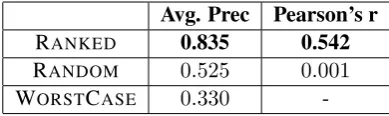
Information extraction systems automati-cally extract structured information from machine-readable documents, such as newswire, web, and multimedia. Despite significant improvement, the performance is far from perfect. Hence, it is useful to accurately estimate confidence in the cor-rectness of the extracted information. Us-ing the Knowledge Base Population Slot Filling task as a case study, we propose a confidence estimation model based on the Maximum Entropy framework, obtaining an average precision of 83.5%, Pearson coefficient of 54.2%, and 2.3% absolute improvement in F-measure score through a weighted voting strategy.
1 Introduction
Despite significant progress in recent years, In-formation Extraction (IE) technologies are still far from completely reliable. Errors result from the fact that language itself is ambiguous as well as methodological and technical limitations (Gan-drabur et al., 2006). Therefore, evaluating the probability that the extracted information is cor-rect can contribute to improve IE system perfor-mance. Confidence Estimation (CE) is a generic machine learning rescoring approach for measur-ing the probability of correctness of the outputs, and usually adds a layer on top of the baseline sys-tem to analyze the outputs using additional infor-mation or models (Gandrabur et al., 2006). There is previous work in IE using probabilistic and heuristic methods to estimate confidence for ex-tracting fields using a sequential model, but to the best of our knowledge, this work is the first proba-bilistic CE model for the multi-stage systems em-ployed for the Knowledge Base Population (KBP) Slot Filling task (Section 2).
The goal of Slot Filling (SF) is to collect infor-mation from a corpus of news and web documents to determine a set of predefined attributes (“slots”) for given person and organization entities (Ji et al., 2011a) (Section 3). Many existing methodologies have been used to address the SF task, such as Dis-tant Supervision (Min et al., 2012) and Question Answering (Chen et al., 2010), and each method has its own strengths and weaknesses. Many cur-rent KBP SF systems actually consist of several independent SF pipelines. The system combines intermediate responses generated from different pipelines into final slot fills. Since these interme-diate outputs may be highly redundant, if confi-dence values can be associated, it will definitely help re-ranking and aggregation. For this pur-pose, we require comparable confidence values from disparate machine learning models or differ-ent slot filling strategies.
Robust probabilistic machine learning models are capable of accurate confidence estimation be-cause of their intelligent handling of uncertainty information. In this paper, we use the Maximum Entropy (MaxEnt) framework (Berger et al., 1996) to automatically predict the correctness of KBP SF intermediate responses (Section 4). Results achieve an average precision of83.5%, Pearson’s r of54.2%, and2.3%absolute improvement in final F-measure score through a weighted voting system (Section 5).
2 Related Work
Confidence estimation is a generic machine learn-ing approach for measurlearn-ing confidence of a given output, and many different CE methods have been used extensively in various Natural Lan-guage Processing (NLP) fields (Gandrabur et al., 2006). Gandrabur and Foster (2003) and Nguyen et al. (2011) investigated the use of machine learning approaches for confidence estimation in machine translation. Agichtein (2006) showed
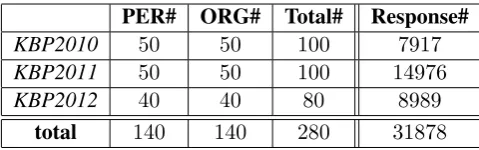
PER# ORG# Total# Response#
KBP2010 50 50 100 7917
KBP2011 50 50 100 14976
KBP2012 40 40 80 8989
total 140 140 280 31878
Table 1: Number of Queries and Number of Intermediate Responses from Each Year Data
patterns, two pattern-based slot fillers in which the patterns are generated semi-automatically from a bootstrapping procedure, one based on name coreference, and one distant-supervision based pipeline. The result of this stage is a set of inter-mediate slot responses, potentially highly redun-dant. Next, Response Combination validates an-swers and eliminates redundant anan-swers to aggre-gate all intermediate responses into final slot fills, where the best answer is selected for each single-valued slot and non-redundant fills are generated for list-valued slots. More details about our KBP Slot Filling system can be found in the system de-scription paper (Min et al., 2012).
4 Confidence Estimation Model
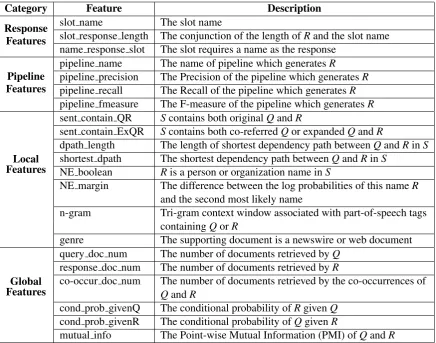
Our confidence estimation model is based on the Maximum Entropy (MaxEnt) framework, a prob-abilistic model able to incorporate all features into a uniform model by assigning weights au-tomatically. We implement a mix of binary and real-valued features from different aspects to es-timate confidence of each intermediate slot fill-ing response under a consistent and uniform stan-dard, incorporating four categories of features:
Response Featuresextract features from the slot and theResponsecontext;Pipeline Features indi-cate how well each pipeline performed previously;
Local Featuresexplore howQueryandResponse
are correlated in the supporting contextSentence;
Global Featuresdetect how closelyQuery corre-lates with Response in the global context. Each specific feature in the above categories is listed in Table 2, where Qrefers to a person or
organiza-tionQuery;Rindicates the pipeline-generated
Re-sponsefor a particular slot of a query; andS
rep-resents the Sentencethat supports the correctness of theResponse.
5 Experiments
We have collected and merged the previous three years’ KBP SF evaluation data, which consists of
a total of280queries, and Table 1 lists the number of person and organization queries as well as the number of intermediate responses from each year. There are in total 31878 intermediate responses generated by 6 different pipelines from our SF system. We trained our CE model and measured the confidence values through a 10-fold cross-validation, so that each fold randomly contains14 person queries and 14 organization queries with their associated intermediate responses. Then for each iteration, the CE model is trained on9folds and approximates the confidence values in the re-maining fold, and it assigns the probability of each intermediate response being correct as confidence.
5.1 Voting Systems
To evaluate the reliability of confidence values generated by this model, we used the weighted voting method to investigate the relationship be-tween the confidence values and the performance.
5.1.1 Baseline Voting System
Our baseline SF system applies a basic plural-ity voting to combine all intermediate responses to generate the final response submission. This voting system simply counts the frequencies of each response entity, which is a unique response tuple in the form <Query ID, Slot Name, Re-sponse Fill>. For a single-valued slot of a query, the response with the highest count is returned as the final response fill. For the list-valued slots, all non-redundant responses are returned as the final response fills. In this basic voting system, each intermediate response contributes equally.
5.1.2 Weighted Voting System
Category Feature Description
Response Features
slot name The slot name
slot response length The conjunction of the length ofRand the slot name name response slot The slot requires a name as the response
Pipeline Features
pipeline name The name of pipeline which generatesR
pipeline precision The Precision of the pipeline which generatesR
pipeline recall The Recall of the pipeline which generatesR
pipeline fmeasure The F-measure of the pipeline which generatesR
Local Features
sent contain QR Scontains both originalQandR
sent contain ExQR Scontains both co-referredQor expandedQandR
dpath length The length of shortest dependency path betweenQandRinS
shortest dpath The shortest dependency path betweenQandRinS
NE boolean Ris a person or organization name inS
NE margin The difference between the log probabilities of this nameR
and the second most likely name
n-gram Tri-gram context window associated with part-of-speech tags containingQorR
genre The supporting document is a newswire or web document
Global Features
query doc num The number of documents retrieved byQ
response doc num The number of documents retrieved byR
co-occur doc num The number of documents retrieved by the co-occurrences of
QandR
cond prob givenQ The conditional probability ofRgivenQ
cond prob givenR The conditional probability ofQgivenR
mutual info The Point-wise Mutual Information (PMI) ofQandR
Table 2: Features of Confidence Estimation Model
confidences that are lower thanτ would be elimi-nated. For each response entity, this weighted vot-ing system simply sums all the weights of the in-termediate responses that support this response en-tity as its weight. Then for a single-valued slot of a query, it returns the response with the highest weight as the final slot fill, while it returns all non-redundant responses as the final slot fills for the list-valued slots. The maximum confidence ψ of supporting intermediate responses is used as the final confidence for that slot fill. We also set a threshold η (optimized on a validation data set), where the final slot fills with confidenceψ lower thanηwould not be submitted finally.
5.1.3 Results
Table 3 compares the results of this weighted vot-ing system (withτ =0,η=0.17) and the baseline voting system, where the responses were judged based only on the answer string, ignoring the doc-ument ID. As we can see, the weighted voting system achieves 2.3% absolute improvement in F-measure over the baseline, at a 99.8%
confi-Precision Recall F-measure
Baseline 0.351 0.246 0.289 Weighted 0.441 0.241 0.312
Table 3: Results Comparison between Baseline Voting System and Weighted Voting System
dence level according to the Wilcoxon Matched-Pairs Signed-Ranks Significance Test. Precision obtains 9.0% absolute improvement with only a small loss of0.5%in Recall.
References
Eugene Agichtein. 2006. Confidence Estimation
Methods for Partially Supervised Relation
Extrac-tion. In Proceedings of SDM 2006.
Adam Berger, Vincent Della Pietra, and Stephen Della
Pietra. 1996. A Maximum Entropy Approach to
Nat-ural Language Processing. Computational Linguis-tics, Volume 22 Issue 1, March 1996, Pages 39-71, MIT Press Cambridge, MA, USA.
Zheng Chen, Suzanne Tamang, Adam Lee, Xiang Li, Wen-Pin Lin, Javier Artiles, Matthew Snover,
Marissa Passantino, and Heng Ji. 2010.
CUNY-BLENDER TAC-KBP2010 Entity Linking and Slot Filling System Description. In Proceedings of Text Analytics Conference (TAC) 2010.
Aron Culotta and Andrew McCallum. 2004.
Con-fidence Estimation for Information Extraction. In Proceedings of HLT-NAACL 2004.
Simona Gandrabur, George Foster, and Guy Lapalme.
2006. Condence Estimation for NLP Applications.
In ACM Transactions on Speech and Language Pro-cessing, Vol. 3, No. 3, October 2006, Pages 129.
Simona Gandrabur and George Foster. 2003.
Confi-dence Estimation for Translation Prediction. In Pro-ceedings of CoNLL 2003.
Heng Ji, Ralph Grishman, Hoa Trang Dang, Kira
Grif-fitt, and Joe Ellis. 2010. Overview of the TAC2010
Knowledge Base Population Track. In Proceedings of Text Analytics Conference (TAC) 2010.
Heng Ji, Ralph Grishman, and Hoa Trang Dang. 2011.
Overview of the TAC2011 Knowledge Base Popula-tion Track. In Proceedings of Text Analytics Con-ference (TAC) 2011.
Heng Ji and Ralph Grishman. 2011. Knowledge Base
Population: Successful Approaches and Challenges. In Proceedings of ACL 2011.
Annie Louis and Ani Nenkova. 2009. Performance
Confidence Estimation for Automatic
Summariza-tion. In Proceedings of ACL 2009.
Bonan Min, Xiang Li, Ralph Grishman, and Ang Sun.
2012. New York University 2012 System for KBP
Slot Filling. In Proceedings of Text Analytics Con-ference (TAC) 2012.
Bonan Min and Ralph Grishman. 2012. Challenges in
the TAC-KBP Slot Filling Task. In Proceedings of LREC 2012.
Bach Nguyen, Fei Huang, and Yaser Al-Onaizan.
2011. Goodness: A Method for Measuring
Ma-chine Translation Confidence. In Proceedings of ACL 2011.
Tobias Scheffer, Christian Decomain, and Stefan
Wro-bel. 2001. Active Hidden Markov Models for
Infor-mation Extraction. In Proceedings of IDA 2001.
Ang Sun, Ralph Grishman, Wei Xu, and Bonan Min.
2011. New York University 2011 System for KBP
Slot Filling. In Proceedings of Text Analytics Con-ference (TAC) 2011.
Cynthia Thompson, Mary Califf, and Raymond
Mooney. 1999. Active Learning for Natural
Lan-guage Parsing and Information Extraction. In Pro-ceedings of 16th International Conference on Ma-chine Learning.
Christopher White, Alex Acero, and Julian Odell.
2007.Maximum Entropy Confidence Estimation For