Inter-Annotator Agreement on a Linguistic Ontology for Spatial Language
A Case Study for GUM-Space
Joana Hois
Research Center on Spatial Cognition (SFB/TR 8) University of Bremen, Germany
P.O. Box 330 440, 28334 Bremen
Abstract
In this paper, we present a case study for measuring inter-annotator agreement on a linguistic ontology for spatial language, namely the spatial extension of the Generalized Upper Model. This linguistic ontology specifies semantic categories, and it is used in dialogue systems for natural language of space in the context of human-computer interaction and spatial assistance systems. Its core representation for spatial language distinguishes how sentences can be structured and categorized into units that contribute certain meanings to the expression. This representation is here evaluated in terms of inter-annotator agreement: four uninformed annotators were instructed by a manual how to annotate sentences with the linguistic ontology. They have been assigned to annotate 200 sentences with varying length and complexity. Their resulting agreements are calculated together with our own ‘expert annotation’ of the same sentences. We show that linguistic ontologies can be evaluated with respect to inter-annotator agreement, and we present encouraging results of calculating agreements for the spatial extension of the Generalized Upper Model.
1.
Introduction
In the field of natural language processing (NLP), ontolo-gies can be used as the central component of representing knowledge, in particular they can either be used to identify domain knowledge or semantic categories (Chandrasekaran et al., 1999). The combination of both plays an essen-tial role in understanding discourse of a given domain. In this paper, we present an evaluation of a linguistic ontol-ogy that specifies such semantic categories of natural lan-guage, namely the Generalized Upper Model (Bateman et al., 1995). It groups together distinguishable meanings that language itself constructs by providing a categorization into ontological classes and relations accordingly.
The Generalized Upper Model (GUM) provides semantic descriptions of parts of natural language sentences, and it supports the relation to contextualizations of these sen-tences. In particular, the GUM descriptions address just the degrees of underspecification that a linguistic utterance it-self leaves open, while they define precisely what can be extracted from an utterance’s semantics (Bateman et al., 1995). GUM has been further extended to specify those categories that are relevant for natural language of space (Bateman et al., forthcoming). It builds on related work in natural language research, such as (Talmy, 2006), (Levin-son, 2003) and (Halliday and Matthiessen, 1999), as well as on empirical analysis of natural language corpora, in or-der to construct appropriately motivated semantic types. In general, the quality of an ontology can be measured with regard to different types of criteria: (1)lexicalcriteria eval-uate appropriateness and intelligibility of used terms in the ontology; (2)structuralcriteria analyze metrical aspects of an ontology in terms of complexity, reasoning, and graph structure properties; (3) representationalcriteria evaluate whether an ontology adequately formalizes its intended do-main; (4)applicationcriteria test whether an ontology sup-ports certain applications in its intended ways; (5)usability
criteria evaluate availability and re-usability of an ontology;
and (6) philosophical criteria analyze formal ontological ideas of an ontology (cf. (Brank et al., 2005)). In particular, NLP techniques can further evaluate linguistic aspects of an ontology by measuring its precision and accuracy (Obrst et al., 2007).
As GUM’s spatial extension primarily aims at categoriz-ing spatial language and thus enablcategoriz-ing dialogue systems to understand spatial language (cf. (Ross, 2008) for an application-oriented analysis), we will here focus on evalu-ating representational criteria by measuring inter-annotator agreements. The next section introduces the spatial exten-sion of GUM and illustrates how the ontology specifies nat-ural language of space. We subsequently present how we conducted an inter-annotator agreement study for the spa-tial extension. Finally, we present the results of this study and discuss future work.
2.
The Spatial Extension of the Generalized
Upper Model
The linguistic ontology GUM-Space1 is developed for-mally as an ontological extension (Konev et al., 2009) of GUM by refining those components that are necessary to specify detailed information in spatial language utterances, primarily for English and German (Bateman et al., 2007). GUM itself is intended to be used within natural language dialogue systems by providing a specification of the seman-tics of language. GUM-Space has particularly been applied to a natural language dialogue system for spatial assistance (Ross et al., 2005). Furthermore, given the formal seman-tics that GUM-Space provides, it can be used for interpret-ing spatial expressions in a situational context, for instance, in relation to formal representations of spatial scenes (Hois and Kutz, 2008b; Hois and Kutz, 2008a).
1
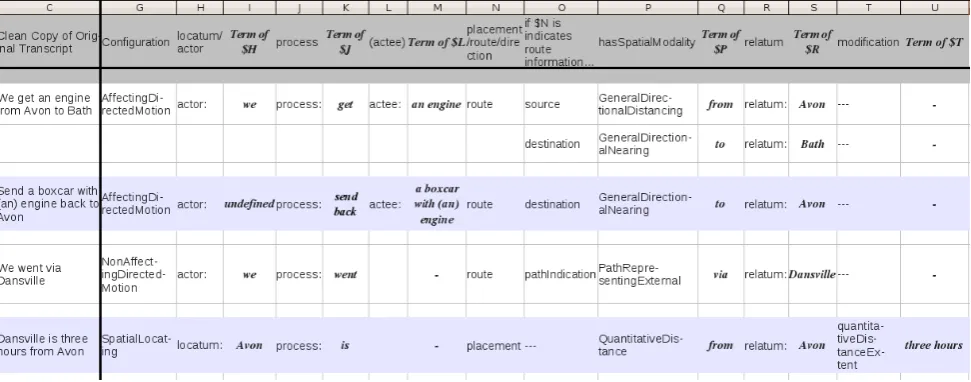
Figure 1: Examples of annotations from the Trains corpus. The upper row shows the different ontology classes and relations to be selected by the annotators, the left column shows the sample sentences, and the main part shows the annotation for these sentences.
that GUM-Space represents human conceptual structures of space or language of space. Instead it proves that GUM-Space’s categories can be learned by non-experts and (after a training phase) can be distinguished correctly. It also im-plies that the categories provide a distinction of groups and that they are not randomly chosen for some linguistic terms. Moreover, and this is the primary aim of GUM-Space, it en-sures a coherent representation as an underlying linguistic basis for dialogue systems.
3.
Inter-Annotator Agreement Study
Measuring the agreement between two or more annotators, who annotate the same data sample given a certain anno-tation schema, can prove the consistency and the reliabil-ity of the annotation schema (Gwet, 2001). Inter-annotator agreement can analyze the appropriateness, applicability, and comprehension of the categories of the schema. (Lom-bard et al., 2002) present several criteria and procedure as-pects for conducting studies of inter-annotator agreement. Our own inter-annotator agreement study for GUM-Space was mostly guided by this procedure. We evaluate repro-ducibility by comparing annotations between two novice annotators andaccuracyby comparing the annotations to a golden standard (Krippendorff, 1980). Novice annotators were also independent, i.e., they did not discuss their results (Krippendorff, 1980).The annotation schema for GUM-Space depends on the specific structure of the linguistic ontology. Annotation schemata most often provide annotations for few categories (or only one) for theunits (parts of sentences) to be ana-lyzed. Such categories are preferably binary types, an an-notator then only needs to check whether a certain condi-tion holds or not. Also, as few categories as possible are supposed to be annotated per unit, in order to keep the an-notation schema simple (Lombard et al., 2002). In case of GUM-Space, however, units are annotated as complex structures, as shown above. One sentence is defined by a construction that consists of different relations and cate-gories for each spatially-related unit in the sentence.
More-over there are 70 different types of spatial modalities to distinguish, which are hierarchically structured. Hence, in our study we also investigate whether it is possible at all to apply inter-annotator agreement for GUM-Space, and whether annotators are able to learn complex structures (similar to the annotation shown above for “The chair is next to the table.” and “From there carry on to the end of the road that you are on.”) and distinguish the different categories for annotating spatial language according to the schema.
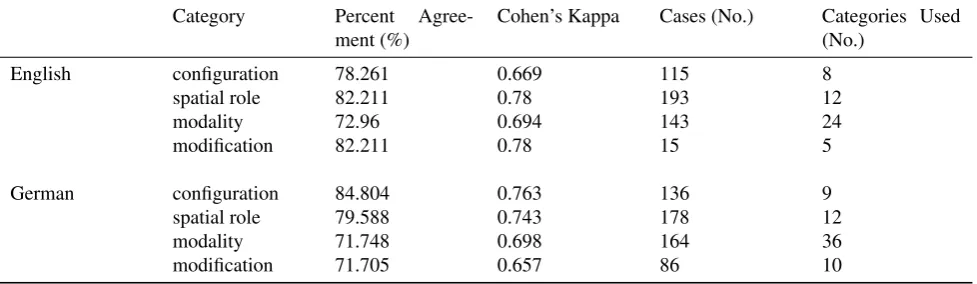
For the agreement study, all annotators were provided with a manual for annotating sentences with GUM-Space to-gether with a spreadsheet document file containing a struc-ture of the GUM categories in each column3. The annota-tion task was split into a training phase with 10 sentences, a supervised annotation phase with 2×50 sentences, and an unsupervised annotation sample with 100 sentences. Sentences from the training, supervised, and unsupervised phase did not overlap. Inter-annotator agreement was cal-culated for the unsupervised annotation samples. All of the sentences were randomly taken from experimental data on spatial language. The English annotation samples are taken from the corpora Trains 93 Dialogues (Heeman and Allen, 1995) and IBL (Instruction Based Learning) Corpus (Lau-ria et al., 2001), the German annotation samples are taken from the corpora Aibo2 (Fischer, 2007) and Rolland (Shi and Tenbrink, 2009). The study consists of two annota-tors per language and additionally one ‘expert’ annotator (the developers of GUM-Space), referred to as the “golden standard” (Gwet, 2001) as the third annotator per language. Annotators were instructed, first, to clean up the sentences, i.e., remove non-spatial information from the sentence and reformulate the sentence if necessary according to the man-ual instructions, and second, to annotate the sentence ac-cording to the GUM-Space specification as given by the
3
The manual, spreadsheets, and results are available at
hard Nebel, and Thomas Barkowsky, editors, Proceed-ings of International Conference Spatial Cognition IV, pages 478–499, Berlin, Heidelberg. Springer.
Robert J. Ross. 2008. Tiered models of spatial language interpretation. In Christian Freksa, Nora S. Newcombe, Peter Gärdenfors, and Stefan Wölfl, editors, Spatial Cognition VI. Learning, Reasoning, and Talking about Space, pages 233–249. Springer.
Hui Shi and Thora Tenbrink. 2009. Telling rolland where to go: HRI dialogues on route navigation. In Kenny Coventry, Thora Tenbrink, and John Bateman, editors,
Spatial Language and Dialogue, pages 177–189. Oxford University Press, Oxford.