Comparing the Influence of Different Treebank Annotations
on Dependency Parsing
C. Bosco∗, S. Montemagni†, A. Mazzei∗, V. Lombardo∗, F. Dell’Orletta†, A. Lenci¦†,
L. Lesmo∗, G. Attardi¦, M. Simi¦, A. Lavelli•, J. Hall+, J. Nilsson$, J. Nivre+
∗Universit`a di Torino, Italy,{bosco,mazzei,vincenzo,lesmo}@di.unito.it
†Istituto di Linguistica Computazionale - Pisa,{simonetta.montemagni, felice.dellorletta, alessandro.lenci}@ilc.cnr.it ¦Universit`a di Pisa,{attardi,simi}@unipi.it
•FBK-irst - Trento, [email protected]
+Uppsala University, Sweden,{johan.hall,joakim.nivre}@lingfil.uu.se $Vaxjo University, Sweden, [email protected]
Abstract
As the interest of the NLP community grows to develop several treebanks also for languages other than English, we observe efforts towards evaluating the impact of different annotation strategies used to represent particular languages or with reference to particular tasks. This paper contributes to the debate on the influence of resources used for the training and development on the performance of parsing systems.It presents a comparative analysis of the results achieved by three different dependency parsers developed and tested with respect to two treebanks for the Italian language, namely TUT and ISST–TANL, which differ significantly at the level of both corpus composition and adopted dependency representations.
1. Introduction
As the interest of the NLP community grows to develop several treebanks also for languages other than English, we observe efforts towards evaluating the impact of different annotation strategies used to represent particular languages or with reference to particular tasks. For instance, a re-cent line of research focuses on the question of whether and to what extent parsers developed with respect to dif-ferent syntactic resources differ in their performance; this issue is tackled from different perspectives by, among oth-ers, (Nivre et al., 2007c), (Boyd and Meuroth-ers, 2008) and (K¨ubler et al., 2009). A comparison of results obtained by the same parsing system with respect to different treebanks for the same language can, in fact, help to assess the im-pact of different training resources following different an-notation strategies at the parsing level. Nevertheless, the comparison among the results of systems developed on the basis of different resources is a very difficult task, first of all because of the number of variables usually involved, e.g. corpus composition and size, or different granularity in the representation of specific information.
The main goal of this paper is to contribute to the debate on the influence of training resources on the performance of parsing systems. Our methodology is based on a controlled experiment with different treebanks and parsers, and some common data for testing. In particular, we focus on the analysis of the results of three parsers which have been ap-plied to two different treebanks. The resources involved are two treebanks developed for Italian, namely the Turin Uni-versity Treebank1developed by the Natural Language
Por-cessing group of the University of Torino, and the ISST– TANL2, an annotated corpus originating as a revision of
the ISST–CoNLL corpus (Montemagni and Simi, 2007),
1http://www.di.unito.it/∼tutreeb
2http://medialab.di.unipi.it/wiki/SemaWiki
in turn derived from the Italian Syntactic–Semantic Tree-bank or ISST (Montemagni et al., 2003). In spite of the fact that both treebanks feature a dependency–based annotation, they differ significantly at the level of both corpus composi-tion and dependency annotacomposi-tion schemes, thus providing an interesting testbed to start evaluating the influence of tree-banks on the parsing performance.
As a starting point, we assume the results achieved within Evalita’093, an evaluation campaign carried out for Italian,
which included a dependency parsing track (Bosco et al., 2009) articulated into two subtasks differing at the level of treebanks: TUT was used as the development set in the Main Subtask, and ISST–TANL represented the develop-ment set for the Pilot Subtask. There have been five pars-ing systems which participated in both subtasks: two rule– based parsers (by Lesmo (2009) and by Testa et al. (2009)), and three statistical parsers, following different models (by Attardi et al. (2009), Lavelli et al. (2009) and Søgaard and Rishøj (2009)).
In this paper, we focus on the results obtained by the three systems which turned out to have achieved the best scores in the two subtasks, namely two statistical parsers (DeSR by Attardi et al., MaltParser by Lavelli et al.) and one rule– based parser (TULE by Lesmo). The performance of these systems appears to be in line with the state of the art de-pendency parsing technology for Italian (see tables 3 and 4 below)4 and for English 5. In particular, our aim is to
in-3http://evalita.fbk.eu/index.html
4The best results previously published for Italian are LAS
84.40, UAS 87.91, according to (Nivre et al., 2007b), were LAS (Labelled Attachment Score) represents the percentage of depen-dencies which are both correct and correctly labelled, and UAS (Unlabelled Attachment Score) the percentage of correct depen-dencies.
1 La IL ART ART DEF—F—SING 14 SUBJ 2 coppia COPPIA NOUN NOUN COMMON—F—SING 1 ARG
3 , # PUNCT PUNCT 2 OPEN+
PARENTHETICAL 4 residente RISIEDERE VERB VERB MAIN—PARTICIPLE—PAST— 2 RMOD+
INTRANS—SING—ALLVAL RELCL+REDUC
5 a A PREP PREP MONO 4 INDCOMPL
6 Milano MILANO NOUN NOUN PROPER—F—SING—CITY 5 ARG
7 anche ANCHE ADV ADV CONCESS 8 RMOD
8 se SE CONJ CONJ SUBORD—COND 4 RMOD
9 di DI PREP PREP MONO 8 ARG
10 origini ORIGINE NOUN NOUN COMMON—F—PL 9 ARG 11 siciliane SICILIANO ADJ ADJ QUALIF—F—PL 10 RMOD
12 , # PUNCT PUNCT 2 CLOSE+
PARENTHETICAL 13 stava STARE VERB VERB AUX—IND—IMPERF— 14 AUX+
INTRANS—3—SING PROGRESSIVE 14 trascorrendo TRASCORRERE VERB VERB MAIN—GERUND—PRES— 0 TOP
TRANS—SING
15 un UN ART ART INDEF—M—SING 14 OBJ
16 periodo PERIODO NOUN NOUN COMMON—M—SING 15 ARG
17 di DI PREP PREP MONO 16 RMOD
18 vacanza VACANZA NOUN NOUN COMMON—F—SING 17 ARG
19 . #˙ PUNCT PUNCT
14 END
Table 1: An example of TUT annotation in CoNLL format.
1 La lo R RD num=s—gen=f 2 det
2 coppia coppia S S num=s—gen=f 13 subj
3 , , F FF 4 punc
4 residente residente A A num=s—gen=n 2 mod
5 a a E E 4 comp loc
6 Milano milano S SP 5 prep
7 anche se anche se C CS 4 con
8 di di E E 4 conj
9 origini origine S S num=p—gen=f 8 prep 10 siciliane siciliano A A num=p—gen=f 9 mod
11 , , F FF 4 punc
12 stava stare V VA num=s—per=3—mod=i—ten=i 13 modal 13 trascorrendo trascorrere V V mod=g 0 ROOT
14 un un R RI num=s—gen=m 15 det
15 periodo periodo S S num=s—gen=m 13 obj
16 di di E E 15 comp
17 vacanza vacanza S S num=s—gen=f 16 prep
18 . . F FS 13 punc
Table 2: An example of ISST–TANL annotation in CoNLL format.
for data–driven dependency parsing that can be used to in-duce a parsing model from treebank data and to parse new data using the induced model. MaltParser implements the transition–based approach to dependency parsing, which has two essential components: (i) a nondeterministic transi-tion system for mapping sentences to dependency trees; (ii) a classifier that predicts the next transition for every possi-ble system conguration. Given these two components, de-pendency parsing can be performed as greedy deterministic search through the transition system, guided by the classier. With this technique, it is possible to perform parsing in linear time for projective dependency trees and quadratic time for arbitrary (non-projective) trees. Feature models developed in the CoNLL 2007 shared task were reused and four different parsing algorithms (Nivres arc-eager, Nivres arc-standard, Covingtons projective, and Covingtons non-projective) were evaluated. The best results were achieved with Covington’s non-projective parsing algorithm (Cov-ington, 2001).
3.3. TULE
TULE (Turin University Linguistic Environment) by Lesmo is a wide coverage rule-based parser, which has been applied to various domains and which has been the
starting point for the development of the treebank TUT. Moreover, it has been the best scored parser in Evalita 2007 (Lesmo, 2007). The parsing process is based on two main steps: chunking and analysis of verbal dependents. Chunk-ing consists in extractChunk-ing relevant portions of a sentence (chunks) on the basis of highly reliable rules. The analysis of verbal dependents collect instead the chunks and attach them to verbs in order to build complete connected struc-tures. This requires a selection of clause boundaries (ac-complished via heuristic rules) and the decision about the role of the dependents, made via verbal subcategorization and a flexible representation of verbal case frames.
4. Results and evaluation
size of our shared test set (100 sentences), we have to care-fully balance the evaluation based on it with that based on the whole larger test set.
In what follows, we report the results of the three parsing systems on the full and shared test sets (see section 4.1.) of both treebanks, followed by a dependency–based analysis of the performance of the parsing systems with respect to TUT and in ISST–TANL annotations.
4.1. Overall performance of parsers
System evaluation, carried out in terms of LAS and UAS measures, is presented separately for each subtask, respec-tively in tables 3 and 4. In particular, the tables show achieved results with respect to the whole and shared test sets.
participant whole shared
LAS UAS LAS UAS
TULE11 88.73 92.28 84.68 89.73
DeSR 88.67 92.72 82.60 89.17
MaltParser 86.5 90.88 79.91 87.15
average 87.97 91.96 82.40 88.69
Table 3: Performance results for TUT, whole test set and shared test set only.
participant whole shared
LAS UAS LAS UAS
DeSR 83.38 87.71 84.67 88.99
MaltParser 80.54 84.85 81.12 85.02
TULE 73.44 80.80 75.12 82.58
average 79.12 84.45 80.30 85.53
Table 4: Performance results for ISST–TANL, whole test set and shared test set only.
Let us compare the results obtained in the two subtasks. If we focus on the performance achieved with respect to the whole TUT and ISST–TANL test sets, it can be noticed that the best results refer to TUT for both the best score (i.e. LAS +5.35 wrt ISST–TANL) and the average score (i.e. LAS +8.85 wrt ISST–TANL). But if the comparison is circumscribed to the shared test sets, no significant dif-ference can be noticed between the best LAS scores in the two subtasks (TUT 84.68 vs ISST–TANL 84.67); for what concerns average results, the difference is much lower with respect to the whole test set, with TUT having +2.10 for LAS. By comparing the results obtained with respect to the whole and shared test sets, it should be pointed out that in the case of TUT the performance achieved on the shared test set is worst with respect to the whole test set, while in the case of ISST–TANL the reverse holds.
Since different parsing models can be differently influ-enced by the features of the annotations and text genres,
it is important to also consider the performance of indi-vidual parsers with respect to the two treebanks. Focusing on the statistical systems only, i.e. DeSR and MaltParser, and comparing the performance achieved in the whole and shared test sets, we see that the LAS scores are higher in the shared test set for ISST–TANL, but they are much lower in the case of TUT. The reverse holds for the rule–based parser TULE which is the top parser wrt TUT but whose perfor-mance is significanly lower wrt ISST–TANL (both whole and shared test sets). This can be mainly motivated by the fact that the parser has been developed in parallel with TUT and may be not enough tuned on the other resource. In the analysis of these results, it appears that various ele-ments should be taken into account. such as the dependency annotation schemes used in the two resources and the com-position of the training corpora. In principle, both issues can play a significant role in the parsers performance. In what follows we will focus on the influence of annotation schemes.
4.2. Dependency–based performance of parsers With the aim of assessing the impact of annotation schemes on parsing results, we performed a dependency–based anal-ysis of the performance of parsers. For each relation in the TUT and ISST–TANL dependency tagsets, we analyzed the performance of the three parsers in terms of Precision (P), Recall (R) and related f-score12. The analysis has been
cir-cumscribed to relations occurring at least 20 times13within
the whole test sets.
In order to identify problematic areas of parsing, both TUT and ISST–TANL selected dependency–relations were par-titioned into three classes with respect to the associated f-score, which could be taken to reflect their parsing diffi-culty. The three classes were defined as follows: we started from the results achieved by the best performing system in the two subtasks, i.e. respectively TULE for TUT and DeSR for ISST–TANL. We calculated the average of f-scores (av-f) obtained with respect to individual relations, which is 86.97 for TULE and 78.05 for ISST–TANL. We then found the thresholds for discriminating high, medium and low f-scores by averaging the scores respectively above and below the av-f value.
TULE DeSR
Low scored DR: ≤77.53 ≤60.31
Medium scored DR: 77.54–94.22 60.32–89.44
Best scored DR: ≥94.23 ≥89.45
Table 5: Thresholds for low, medium and high f-scores.
4.2.1. TUT: dependency–based performance
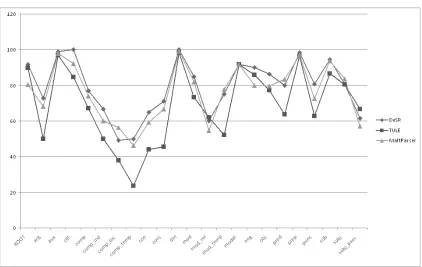
In the TUT test set, the low scored relations for all parsers are APPOSITION (which annotates unrestrictive modi-fiers and juxtappositions) and INDOBJ (indirect object), while for both the statistical parsers, i.e. MaltParser and
12The f-score formula we used is 2*(P*R)/(P+R).
13The average occurences for relation is around 106 in TUT test
Figure 1: Dependency–based performance of parsers wrt TUT: F-scores obtained in the shared test set.
Figure 2: Dependency–based performance of parsers wrt ISST–TANL: F-scores obtained in the shared test set.
a language-independent system for data-driven depen-dency parsing.Natural Language Engineering, 13(2). J. Nivre, J. Hall, S. K¨ubler, R. McDonald, J. Nilsson,
S. Riedel, and D. Yuret. 2007b. The CoNLL 2007 shared task on dependency parsing. In Proceedings of the EMNLP-CoNLL.
J. Nivre, J. Nilsson, and J. Hall. 2007c. Generalizing tree transformations for inductive dependency parsing. In
Proceedings of the ACL.