Extraction of German multiword expressions from parsed corpora
using context features
Marion Weller, Ulrich Heid
Universit¨at Stuttgart
Institut f¨ur maschinelle Sprachverarbeitung – Computerlinguistik –
Azenbergstr. 12 D 70174 Stuttgart [wellermn, heid]@ims.uni-stuttgart.de
Abstract
We report about tools for the extraction of German multiword expressions (MWEs) from text corpora; we extract word pairs, but also longer MWEs of different patterns, e.g. verb-noun structures with an additional prepositional phrase or adjective. Next to standard association-based extraction, we focus on morpho-syntactic, syntactic and lexical-choice features of theMWEcandidates. A broad range of such properties (e.g. number and definiteness of nouns, adjacency of the MWE’s components and their position in the sentence, preferred lexical modifiers, etc.) along with relevant example sentences, are extracted from dependency-parsed text and stored in a data base. A sample precision evaluation and an analysis of extraction errors are provided along with the discussion of our extraction architecture. We furthermore measure the contribution of the features to the precision of the extraction: by using both morpho-syntactic and syntactic features, we achieve a higher precision in the identification of idiomaticMWEs, than by using only properties of one type.
1.
Introduction
Much work has been done on the automatic extraction of multiword expressions (MWEs) from text corpora (cf. e.g. the regularACL SIGLEX workshops on multiword items). Some of these efforts mainly aim at the identification of se-mantically non-compositional combinations, leaving their detailed linguistic description for a separate step (e.g. (Fa-zly and Stevenson, 2006)).
In this article, we describe an approach which allows us to do both steps in one go: identifying idiomaticMWEs, and providing detailed corpus-based material for their lexical description, e.g. in entries of the lexicon of a formal gram-mar or in a database similar to the Dutch DuELMElexicon (Gr´egoire, 2007).
Our approach is applied to German data and uses dependency-parsed material (section 2). The parser relies on a substantial amount of lexical and subcategorization in-formation; its underspecified output distinguishes between attachment and label ambiguities. We describe the handling of both ambiguity types. The objective is to maximally ex-ploit the corpus data while keeping precision as high as pos-sible.
We use various forms of syntactic patterns to iden-tify candidates, going beyond simple verb+object, verb+prepositional phrase types: these are only basic patterns that can be expanded by adjectives, further nouns or prepositional phrases (PPs) (cf. section 4). The approach involves a variety of morpho-syntactic properties of the elements of the collocation candidates, insofar as we not only extract MWE-candidates, but also numerous context parameters: these morpho-syntactic properties are mostly preferential in nature, and many of them are idiomaticity indicators (section 3).
We do not differentiate between idioms and collocations; in order to keep our terminology simple, we will call the extracted patternscollocation candidates.
2.
Extraction methods
2.1. Preprocessing: dependency parsing
As German constituent order is quite flexible, the compo-nents of multiword expressions do not always occur adja-cently. Using the results of a deep syntactic analysis allows us to easily extractMWEs of different patterns together with their morpho-syntactic features, even if the components are distant.
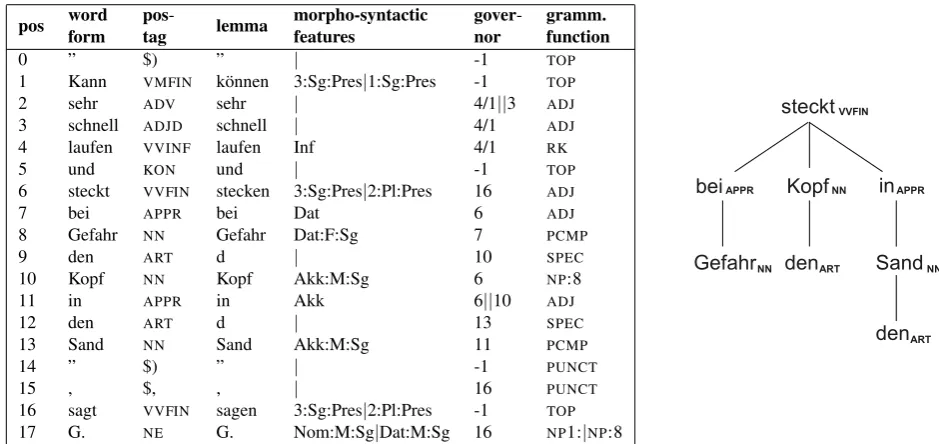
We work withFSPAR(Schiehlen, 2003), a finite-state based dependency parser which provides an explicitly underspec-ified (disjunctive) representation of syntactic ambiguities, both at the level of attachment and grammatical function (expressed by means of case). Its output format is one token per line, annotated with POS-tag, lemma, morpho-syntactic features, governors and information about the to-ken’s grammatical function in the sentence (cf. the columns in the table in figure 1). Morpho-syntactic features of nouns or adjectives indentified by the parser (and extracted along with the collocation candidates) include gender, number and case. As can be seen in the example (cf. figure 1) re-produced in figure 2, morpho-syntactic annotation as well as dependencies can be ambiguous: The parser lists two possible attachments for the preposition in line 11, refer-ring either to the noun directly above it (Kopf in den Sand: ’head in the sand’) or to the verb in line 6 (stecken [...] in den Sand: ’hide [...] in the sand’). Attachment ambigui-ties (line 11) and in particular case syncretism (ambiguous at the level of grammatical functions, cf. line 17) can be an obstacle for an accurate extraction of collocation candi-dates.
2.2. Extraction
pos word pos- lemma morpho-syntactic gover- gramm.
form tag features nor function
0 ” $) ” | -1 TOP
1 Kann VMFIN k¨onnen 3:Sg:Pres|1:Sg:Pres -1 TOP
2 sehr ADV sehr | 4/1||3 ADJ
3 schnell ADJD schnell | 4/1 ADJ
4 laufen VVINF laufen Inf 4/1 RK
5 und KON und | -1 TOP
6 steckt VVFIN stecken 3:Sg:Pres|2:Pl:Pres 16 ADJ
7 bei APPR bei Dat 6 ADJ
8 Gefahr NN Gefahr Dat:F:Sg 7 PCMP
9 den ART d | 10 SPEC
10 Kopf NN Kopf Akk:M:Sg 6 NP:8
11 in APPR in Akk 6||10 ADJ
12 den ART d | 13 SPEC
13 Sand NN Sand Akk:M:Sg 11 PCMP
14 ” $) ” | -1 PUNCT
15 , $, , | 16 PUNCT
16 sagt VVFIN sagen 3:Sg:Pres|2:Pl:Pres -1 TOP 17 G. NE G. Nom:M:Sg|Dat:M:Sg 16 NP1:|NP:8
steckt
bei
Gefahr
Kopf in
den Sand
APPR
NN
APPR
NN NN
den
ART
ART VVFIN
Figure 1: Slightly simplified output ofFSPAR. The numbers in thegovernorcolumn indicate to which line the respective word refers. The extracted structure is illustrated on the right.
” Kann sehr schnell laufen und steckt bei Gefahr den Kopf in den Sand ” , sagt G. ” Can very fast run and hides with danger the head in the sand ” , says G.
” It can run very fast and hides its head in the sand in case of danger”, says G.
Figure 2: Translation of the sentence used as example in figure 1.
(line 7) andin den Sand(line 11) refer to the verbstecken
in line 6, as well as the direct objectKopf(line 10). Infor-mation about the number and determiner of noun phrases is extracted as well.
2.3. Ambiguity handling
Due to the difficulty to distinguish between complement and adjunct PPs, pp-attachment is very often ambiguous. Since anyPPor a combination of severalPPs might be col-locationally relevant, we include every dependency listed in the parse output.
We assume that we can statistically even out the noise we get by including every possible pp-attachment listed in the parse-output: when applying statistical association mea-sures (e.g. log-likelihood ratio, (Evert, 2005)), idiomatic and collocational expressions (being highly associated) are better rated than mere free combinations.
However, noun phrases with case label ambiguities are not included in the data collection, in an attempt to keep the data as clean as possible. While this clearly leads to a loss in recall, we will not have to deal with multiple entries, as it would be the case with several noun phrases being anno-tated as either subject or as direct/indirect object.
2.4. Storage
Extraction results are stored in a PostgreSQL-database. Ta-ble 1(a) shows a (partial) entry containing the results ob-tained from the sentence given in figure 1. An entry in the columnV LEM is obligatory, while all other fields are optional as long as there is at least one subject, object or prepositional phrase.
(a)
V LEM SUBJ ACC ACC ACC DAT PREP
OBJ NUM DET obj PHRASE
stecken — Kopf sg def — bei:Gefahr in:Sand
(b)
V LEM ACC ACC PREP N LEM N N
OBJ DET NUM DET
stecken Kopf def in Sand sg def
stecken Kopf def bei Gefahr sg —
Table 1: Extraction results for the verbsteckenfrom table 1.
SincePPs often occur as adjuncts, there can be an unlimited
number of them inPREP PHRASE. To be able to study each of these prepositional phrases individually, multiple values in this column are split into separate entries, (illustrated in table 1(b)), which are enriched with morphological infor-mation about the respective PP. This design allows us to study patterns containing a single prepositional phrase as well as patterns with several combinedPPs.
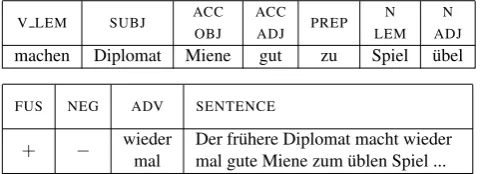
Table 2 gives an impression of a more extensive entry: the expressiongute Miene zum ¨ublen Spiel machenis idiomatic (’make the best of it’, lit. ’make (a) brave face to the bad game’) and only complete with both adjectives.
3.
Context parameters
V LEM SUBJ ACC ACC PREP N N
OBJ ADJ LEM ADJ
machen Diplomat Miene gut zu Spiel ¨ubel
FUS NEG ADV SENTENCE
+ − wieder Der fr¨uhere Diplomat macht wieder mal mal gute Miene zum ¨ublen Spiel ...
Table 2: Example for a data-base entry. Number and deter-miner of the nouns are not shown.
(cf.zurfused vs.zu derunfused).
Each noun has the featuresnumber,determinerand adjec-tive. There are 6 possible values for determination:definite, indefinite, demonstrative, possessive, nullandquantifying. In the case of a quantifying determiner, we also extract its lemma likejeder(’every’) orkeiner(’no’).
Occurring (nearly) always in a negated context is character-istic of a certain group ofMWES, namely negative polarity items. Since there are far more possibilities for negative contexts than just negation of the verb or noun (which can be derived from the negation particlenicht(featureNEG) or the quantifierkein), we experimented with modeling nega-tive contexts, to specifically extract neganega-tive polarity items. For example, an inherently negative verb like bezweifeln
(’to doubt’) would indirectly negate a subsequent state-ment. For a more detailed description of negative polar-ity items see (Lichte and Soehn, 2007) or (Fritzinger et al., 2010a).
In the case of preposition-noun-verb combinations (PNV -triples), we also applied two syntactically motivated fea-tures. As we expect the components of idiomaticMWEs to be (immediate) neighbours, we compute a simple adjacency measure. It is based on the positions of the preposition, the noun and the verb. While trivial preposition-noun-verb combinations can appear in combination with e.g. adjec-tives and adjuncts like relative clauses (as demonstrated in example 1), idioms and collocations tend to exclude such modifiers and hence are (immediately) adjacent (see exam-ple 2). Preposition, noun and verb of a non-trivial combi-nation cannot be immediate neighbours if a determiner or adjective is part of the idiom/collocation (shown in exam-ple 3). However, the relative position of verb, noun and preposition is still fixed.
1 AufkleinenZetteln, die an B¨aume geklebt worden waren ,
stand: “Wilson kommt”.
Onsmallnotes, that to trees glued been had,stood: “Wilson comes”.
On small notes that had been glued to trees, it read: “Wilson comes”.
2 Sie glauben, daß dadurch die Wirtschaft wiederin Fahrt kommt.
They believe that thereby the economy againin run comes.
They believe that thereby the economy gets going again.
3 Den Gr¨unen werden vorschnelle und un¨uberlegte Politik-spr¨ungeindieSchuhe geschoben.
The Greens are overhasty and unreflected political movesin
theshoes shoved.
Thes Greens are made responsible for overhasty and unre-flected political moves.
Furthermore, idiomaticMWEs rarely occur at the very be-ginning of a sentence (invorfeldposition), except in con-trastive contexts, e.g. together with adverbs like jedoch
(’however’).
We distinguish different types ofvorfeldoccurrences: All the MWE components (preposition, noun, verb) can be in thevorfeldwith the verb being either finite or infinite fol-lowed by an auxiliary verb. Idiomatic MWEs can appear in this structure ((partial) VP-fronting, cf. example 4), al-though usually only in contrastive or otherwise special con-texts. In the second type, only the preposition and the noun are invorfeldposition, followed by an auxiliary in the sub-sequent position (the linke Satzklammer, left verbal posi-tion) with the main verb later in the sentence. This structure does not work for idiomaticMWEs (example 5), but it can be used without problems for trivialMWEs (see example 6). We can thus use the restrictions on this particular context as one syntactic feature (among others) to tell idiomaticPNVs apart from non-idiomatic ones.
The non-trivial triple in Stellung bringen (’to bring into position’) (total frequency 188), occurs once in the vor-feld (example 4). Moving the verb out of thevorfeld, (as demonstrated in example 5), leads to an ungrammatical sentence as opposed to the sentence in example 6 with the trivial expressionin Klinik bringen(’to bring into hospi-tal’).
4 In Stellung gebrachtworden seien Al-Samoud-Raketen mit einer Reichweite von 200 Kilometern
In position broughtbeen have Al-Samoud missiles with a range of 200 kilometres
Al-Samoud missiles with a range of 200 kilometres have been positioned
5 *In Stellung seien Al-Samoud-Raketen mit einer Reich-weite von 200 Kilometerngebrachtworden
6 IndieKlinikhatten die Eltern sie gegen ihren Willen ge-bracht.
Into the hospital had the parents her against her will
brought.
The parents took her into a hospital against her will.
MWE f NUM DET ADJ
-in Jahr 271 Pl 150 def 129 – 208
aussehen Sg 121 – 85
dem 31
+ auf Barrikade 167 Pl 165 def 165 – 165
gehen Sg 2 – 2
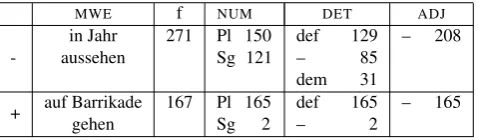
Table 3: Comparison between morphologically fixed and non-fixed preposition-verb-noun triples.
parameters are also an input for a detailed lexicographic description of the specific properties of a givenMWE. The parser also marks the head of compound nouns, al-lowing us to generalize across transparent compounds and, alternatively, to identify those compounds which do not inherit the collocation preferences of their heads (which are mostly lexicalized, non-transparent compounds; (Zins-meister and Heid, 2004)).
A further step towards more general predicate-argument-structure extraction, e.g. for texts from specialized lan-guage, could be to replace the actual nouns by an abstract term, such as the categories provided byGERMANET1.
4.
Experiments and results
4.1. Patterns
As illustrated in table 4, idiomatic expressions can be of different length and form. While components like certain adjectives or nouns can be obligatory within a givenMWE, there might be more variation in other cases. It is also possi-ble that an idiomaticMWEoccurring mostly with a certain (group of) adjective(s) can also felicitously occur without an adjective. The adjectives in lines 2, 5 and 8 of table 4 are integral parts of the respectiveMWE. Looking at the expres-sion ’auf ADJ Ohren stoßen’ (’(not) find a good listener’, table 5), it becomes evident that there is a clear preference for the two most frequent adjectives. However, to be id-iomatic at all, the expression must occur with an adjective, while e.g. the combinationWert legen(’to insist’) occurs (roughly) equally often with or without adjective.
The fact that longer patterns contain less complex ones leads to a problem of overlapping results: when extract-ing data covered by short patterns, we do not want to find incomplete expressions. Similarly, we are not interested in finding valid, shortMWEs combined with varying adjuncts. For more details, see section 4.4.
4.2. Data and evaluation
The corpus collection we worked with (269 million tokens) consists of newspaper articles (1987-99) and the proceed-ings of European parliament debates (EUROPARL2). Table 6 gives an impression of the number of extracted syntactic structures and the results of a simple evaluation we carried out for this selection of patterns.
4.3. Extraction errors
Generally, we can distunguish between two kinds of unde-sired extraction results: the first ones are trivialMwes, that
1
http://www.sfs.uni-tuebingen.de/lsd
2
http://www.statmt.org/europarl
Syntactic pattern example
1 noun verb Wert legen
2 adj noun verb gr¨un Licht geben
3 NOUN NOUN VERB (dem) Fass (den) Boden ausschlagen
4 prep noun verb in Sand setzen
5 prep adj noun verb f¨ur bar M¨unze nehmen
6 noun prep noun verb Kopf in Sand stecken
7 ADJ NOUN PREP NOUN dick Strich durch VERB Rechnung machen
8 ADJ NOUN PREP ADJ gut Miene zu b¨ose NOUN PREP Spiel machen
9 PREP NOUN PREP NOUN mit Kanone auf Spatz VERB schießen
10 PREP NOUN PREP NOUN wie Sand an Meer
11 PREP NOUN VERB VERB mit Angst (zu) tun bekommen
Table 4: Different syntactic patterns with entries of id-iomatic expressions (examples are lemmatized).
ADJ taub offen geneigt verschlossen —
f 222 92 1 1 1
Table 5: Adjective distribution for the expressionauf ADJ
Ohren stoßen.
can, at least partially, be filtered out by applying association measures. But there can also be ’false positive’ results, i.e. expressions that appear to be an idiom but are not idiomatic in all observed instances. Here again, we can distinguish two types: literal use of an idiomatic Mwe, vs. a wrong analysis, e.g. of pp-attachment making a combination look like a valid idiom. For more information, see Cook et al. (2008) or Sporleder et al. (2010) for English and Fritzinger et al. (2010b) for German, who investigate the actual rate of literal use of idioms in different corpora.
At this point, we ignore the possibility of literal usage and focus only on wrong pp-attachment in PNV-triples leading to false positives. We carried out an analysis of 69 valid idiomatic PNV-triples with 100 randomly chosen occurrences for each3. The sentence length was restricted to 40 tokens.
Example 7 shows the false positive triplein Betrieb sein(lit. ’to be in operation’: ’to operate’) found in a sentence with
in Lohn und Brot stehen(lit. ’to be in pay and bread’: ’to be in so.’s pay’), where the latter is an idiomatic expression andin Betrieb(’in business’) a mere adjunct.
If the verbal elements aresein(’to be’) orhaben(’to have’), our system might confuse auxiliary verb readings with full verb readings.
In the above examples, extracted triples are printed in bold-facewhile correct structures are underlined.
We found that MWEs containing certain noun-preposition combinations are prone to extraction errors; these noun-preposition combinations are commonly used as (id-iomatic) adjuncts: in+Augen(lit. ’in (his) eyes’: ’in his
3This set of sentences is smaller if the given idiom has a
PNV NPNV PANV NV ANV
EP NEWS EP NEWS EP NEWS EP NEWS EP NEWS
tokens 1.576.220 10.165.415 572.523 3.139.948 404.813 2.580.320 978.083 4.913.847 260.621 1.216.437
n=25 16 23 0 5 3 16 14 19 7 10
n=50 28 39 3 14 8 31 27 37 10 19
n=100 55 82 4 31 16 46 47 71 17 37
n=500 153 290 29 86 57 131 165 247 59 113
Table 6: Number of extracted database-entries (’tokens’) for the syntactic patterns highlighted in table 4 and number of non-trivial items in the top nwhen sorted by frequency. Results are split by corpus: Europarl (EP) and newspaper text (NEWS). Triples including nouns likeMark,DollarandProzent(’percent’) have been excluded.
(a)
idiom false positives valid occurrences
auf Weg machen 10 90
auf Weg bringen 10 90
in Raum stehen 9 89
in Auge haben 8 92
an Tag legen 5 93
in Betrieb sein 2 98
zu Schau stellen 0 100
unter Lupe nehmen 0 100
(b)
false
0 1 2 3 5 6 7 8 9 10 22
pos.
idioms 51 5 3 2 1 1 1 1 1 2 1
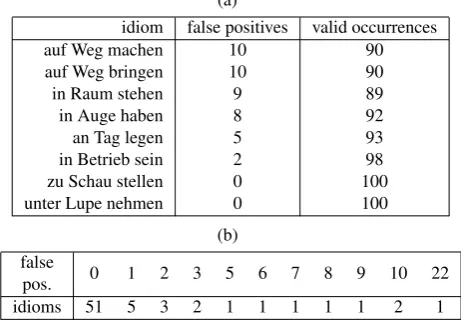
Table 7: Number of false positives for a a few selected id-ioms (a) and distribution of false positives for the examined 69 idioms (b). In total, we found 94 false positives in 6690 sentences.
opinion’), can be part of theMWEin+Auge+haben(lit. ’to have in eye’: ’to have sth. in mind’, cf. example 8), but it can also be used as an adjunct. In example 9,hatis the verb that belongs toschlechtes Ansehen haben(’to have a bad reputation’), but not the verb of the preposition-noun-verb triple as in example 8.
7 waren in192Betriebenknapp 20000 Mitarbeiter in Lohn und Brot.
were in192companiesalmost 20000 employees in pay and bread.
in 192 companies, almost 20000 members of staff were em-ployed.
8 weil alle nur die kurzfristigen Chancenim Auge haben.
because everybody only the short-term chancesin eye has.
because everybody has only the short-term chances in mind.
9 daß ein DienstleistungsunternehmenindenAugender Kun-den ein so schlechtes Ansehenhabe.
that a service providerintheeyesof the clients a such bad reputationhas.
that a service provider has such a bad reputation in the eyes of the clients.
Table 7(a) shows how many false positives were among 100 randomly chosen occurrences for some of the examined id-ioms, while table 7(b) gives an overall impression of the
evaluation. Note that the first entry in table 7(a) needs a re-flexive pronoun to be complete; although information about reflexivity of verbs is available, we chose to exlcude this feature from this evaluation in order to keep the evaluated data as simple as possible: we do not want the samePNV -triple to occur twice, with and without a reflexive pronoun. As can be seen in the examples, the idiomatic version and the adjunct have different preferences for determiner and number: If the morphological preferences of an idiom are known, false positives can be discarded in many cases.
4.4. Detailed analysis of the extracted morpho-syntactic features
As most of the above examples illustrate, collocations and idioms are morphologically and/or syntactically restricted. In the following experiment, we want to examine the use-fulness of the extracted morhosyntactic features for the identification of non-trivialMWEs.
The test set consists of the 1013 most frequentPNV-triples (f≥210) extracted from newspaper text. Nouns likeMark,
Franc,Prozent(’percent’), being very frequent in newspa-per text, but not interesting forMWE-extraction, have been excluded in advance. Two native speakers manually anno-tated the data deciding about the idiomaticity of each can-didate. Cases with conflicting annotation were discussed in detail with a third native speaker. Incomplete patterns, e.g. idiomatic triples with a missing adjective, were marked as valid idioms since we expect thePNV-part under rewiew to be morpho-syntactically restricted in the same way as the complete idiom would be. Overall, 513 candidates were labelled as non-trivialMWEs. To test the indicator value of morpho-syntactic features, we intend to identify these cases by searching for strong preferences (see section 4.5). For each triple, we computed a fixedness-score derived from the averaged or most prominent features of this triple. This score is intended to represent the morpho-syntactic preferences of anMWE. AllPNV-triples are then sorted ac-cording to their scores.
The quality of a sorted list can be measured with the
uninterpolated average precision (UAP) score, peaking at value 1 for a perfectly sorted list (Manning and Sch¨utze, 1999). We opt for this measure as we want to split candi-date expressions into trivial and non-trivial combinations. Since degrees of fixedness vary, we attempt to sort them ranging from very idiomatic at top to less idiomatic towards the end of the list.
respec-(a)
feature num det neg adjacency vorfeld uap 0.607 0.650 0.643 0.694 0.566
(b)
grouping M1 M2 S M2+S
det+num det+num+neg adja+vorf.
uap 0.635 0.681 0.664 0.830
(c)
weighted M2+2S M2+3S M2+4S M2+5S M2+6S uap 0.845 0.853 0.857 0.858 0.859
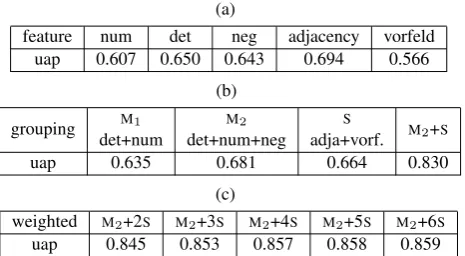
Table 8: UAP-values for the morpho-syntactic features computed separately (a), grouped (b), and weighted (c). Candidates with the same score are ordered alphabetically. Ordering according to frequency results in anUAP-value of 0.651.
tive scores are either based on the number of occurrences of the features in relation to the triple’s overall frequency ( vor-feld, neg) or the percentage of the most prominent value (num,det), i.e. singularorplural and the determiner oc-curring most often with a givenPNV-triple. The adjacency measure was averaged over all occurrences of a triple and averaged to be within 0 and 1.
Table 8(b) shows the resulting UAP-values when the fea-tures are grouped into morphologically and syntactically motivated categories. The features within the groups are weighted equally. Adding thenegfeature toM1improves the sorting quality, while combining morphological (M2) and syntactic (S) features results in an even bigger improve-ment. The morphologically and syntactically motivated features are independent from each other and complemen-tary: this can be exploited, for example, to identify a mor-phologically fixed trivial combination because of its lower
S-score for being syntactically unrestricted.
However, the syntactically motivated features have a greater impact on sorting quality than the morphological ones as illustrated in table 8(c), where the weight forShas been gradually increased. This might be due to the fact that
detandnumare related features while,vorfeldand the ad-jacency measure are independent. In fact, the adad-jacency measure has only been computed for verb-final sentences and therefore there is no overlap with thevorfeldfeature.
4.5. Expanding basic patterns
By detecting a strong preference for a certain object and/or adjective, basic, incomplete patterns could be expanded into more complex idioms.
In the following experiment, we want to focus only on ad-jectives inPNV-triples. There are two aspects we need to consider: Does a given PNV-triple occur always or nearly always with an adjective, and if so, is there lexical variation in adjectives or are they always the same?
As a first step, triples occurring mostly without adjectives are excluded: Out of 1013 PNV-triples,133 never appear with an adjective and 610 occur in at least 90% of all cases without an adjective. When sorting the list of candidate-triples by a score based on the combination of
morpho-size of test set 1013 [all] 610 [ADJ≤0.1] 133 [ADJ=0]
idioms 512 390 99
UAP 0.833 0.892 0.937
Table 9: Results when sorting according to a score based on morpho-syntactically features combined with the pre-cantage of adjectives per candidate.
logical and syntactic features (cf. table 8(b)) and the per-centage of adjective occurrences, an UAP-value of 0.833 is achieved, a slight improvement compared to the sorting result without the adjective feature (0.830). By reducing the entire list of 1013 candidates to the 610 supposedly adjective-free candidates, sorting quality is improved to a
UAP-value of 0.892. A further reduction to the 133 entirely adjective-free candidates results in anUAP-value of 0.937 (cf. table 9).
Using a threshold of 90%, we still allow for a few adjectives to occur occasionally with a candidate triple. By including the percentage of adjective appearances into the score, very few or no adjectives at all are rewarded compared to more adjectives indicating no clear preference.
Creative use of language definitely is an obstacle to our approach: Some idioms a native speaker would intuitively judge as not being able to be used with an adjective appear nevertheless in such combinations. In example 10, the id-iomzu Sache gehen(lit. ’to go to thing’: ’there is a great ambiance’) is used with the adjectivefr¨ohlich(’funny’) to describe the atmosphere at the event, resulting in a sentence on the verge to ungrammaticality.
10 Dortgehtes bei Schunkelmusik des Musikcorps Stier-stadtzurfr¨ohlichenSache.
Theregoesit with beer tent music of the music club ‘Stierstadt’to thefunnything.
With beer tent music played by the music club ‘Stier-stadt’, there is a great ambiance.
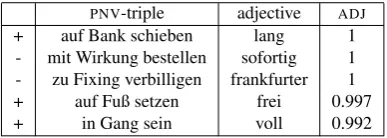
With supposedly adjective-free triples now identified and exluded from the test set, the remaining 403 candidates have to be divided into a set of idioms where a specific ad-jective is an obligatory part of the pattern vs. one where the presence of adjectives is common and not restricted. At this point, the distribution of adjectives co-occurring with a cendidate expression is used to indicate preferences. Table 10 shows candidate triples with their respective most frequent adejctive and the precentage of occurrence in all instances with an adjective. While there are idiomatic ex-pressions with a clear preference, there are also (morpho-syntactically fixed) frequent non-idiomatic formulae with a specific, obligatory adjective. In the case ofmit sofortig Wirkung bestellen(’to order with immediate effect’), only the preposition-adjective-noun construct is fixed: it can be used with different verbs. To overcome this problem, a more detailed study including the association between in-dividual parts of a pattern would be necessary (e.g. (Zins-meister and Heid, 2004)).