CSEIT1725221 | Received : 16 Oct 2017 | Accepted : 31 Oct 2017 | September-October-2017 [(2)5: 948-954]
International Journal of Scientific Research in Computer Science, Engineering and Information Technology © 2017 IJSRCSEIT | Volume 2 | Issue 5 | ISSN : 2456-3307
948
Offline Handwritten Malayalam Word Recognition using
Wavelet Transform
Jino P J
*1, Kannan Balakrishnan
2*1Artificial Intelligence Lab,Department of Computer Applications, Cochin University, Kerala, India
2
Department of Computer Applications , Cochin University,Kerala ,India
ABSTRACT
Wavelet transforms of malaylam handwritten images are used for the recogntion. A comparative study with Haar, Daubechies wavelets are also performed. Lexicon contains fourteen district names and a total of 736 samples.More than 90 % of recogntion is achieved.Low Frequency components are considered as features. For the classification SVM used with RBF kernel.The Dimensionality of the wavelet coefficients are reduced by Principal Component Analysis(PCA).
Keywords: Offline Handwritten Recognition, Wavelet Transform ,Feature Extraction method, Pattern Recognition.
I.
INTRODUCTION
Automatic Recognition of handwritten text documents is a pattern recognition problem, where pattern is the handwritten image. This pattern varies from human to human and it may vary significantly if the same person writes in different situation. The recognition of handwritten documents can be either using analytic or holistic method. In analytic method recognition starts from the basic unit of word , ie. from character level. Holistic method will treat word as a unit and tries to recognize it. Extraction of characters from the handwritten documents is a tedious task, so most often analytic recognition not suitable for certain type of handwriting styles. Handwritten district names will appear in different context for eg : It can be seen in the postal address, Application forms, Bus Boards etc.
Malayalam is the official language in the state of Kerala. Malayalam language has two scripts called old script and new script[1]. People use both in a mixed manner, that is the major hurdle of the researchers to recognize and differentiate script. There are wide variety of applications for offline handwritten recognition which includes converting the official douments in digital format and make necessary changes, Teaching aid for the visually challenged people, Analyze the progress of a paralyzed patient in medical field, Automated answer paper correction
written in malayalam.To some extend all these applications lead us to reduce the use of papers and also it will help to retrieve informations in fast and efficient manner.
The lexicon size of handwritten district names is fourteen and our purpose is the recognition of these words in unconstrained manner using wavelet transform. This is the first work for malayalam word recognition using wavelet coefficients. Collaborative research is required to fulfill a proven automatic
handwritten recognition mechanism. Wavelet
transform has a wide variety of applications in the area of medical images[2],Image compression [3], Image watermarking [4] , Satelite Image processing [5],Pattern Recognition[6]. Classification also plays a vital role in pattern recognition.SVM provides high recognition accuracy when compares with the classfiers like Modified quadratic Descriminant Function(MQDF),Multilayer Perceptron(MLP) and Polynomial Classifier(PC)[7][8].
II.
RELATED WORKS
In literature we can find several methods for handwritten recognition. In an attempt Ujjwal et al. [9] propose the recogntion of numeral in three Indian scripts using Daubechies-4 wavelet and MLP(Multi Layer Perceptron) as the classifier.Binu P. et al.[10] proposes a method for malayalam handwritten character recognition using Daubechies,Biorthoganal and symlet wavelets with ELM(Extreme Learning Machine) as the classfier.Best result they produced is for Daubechies-6 wavelet at level6.Haar wavelet is used by Jomy et al. [11] for the recognition of Malayalam handwritten characters.Approximation of wavelet coefficients in the second level reported best result. Zero crossing of wavelet coefficients are used by Raju G et al. [12] for Malayalam handwritten character recognition. Daubechies-4 wavlet with three
level decomposition is used for the
experiments.Wunsch P et al. [13] propose a method for the recognition of hand printed characters using wavelet descriptors and neural network topology for
the recognition. Sushama Shelle et.al [14]propose a
method for Marathi handwritten compound character recognition using Daubechies wavelet with level1 decomposition and Artificial Neural Network used for the recognition. For farsi character recognition Saeed Mozaffari et.al[15]use Haar wavelet coefficient at level 3 as features and SVM as the classifier. Patel et.al [16] propose a method for the recognition of handwritten uppercase letters with wavelet co-effients as features and Euclidean distance metric as the classifier. Pasha et.al [17]propose a method for Kannada character recognition with the combination of structural features and symlet wavelet coefficients used as the features and Artificial Neural Network used as the classifier.
III.
SELECTION OF WAVELET
wavelets are scaled or shifted as defined as [18]( )
√ (
)
Wavelet families include Haar, Daubechies, Symlets, Coiflets, Biorthogonal, Reverse biorthogonal, Meyer, Gaussian, Mexican hat, Morlet, Complex Gaussian,
Shannon, Frequency B-Spline and Complex Morlet. Orthogonal and biorthoganal are the two categories of wavelet family.The coefficients of orthoganal filters are real numbers and in case of biorthoganal filters it is real numbers or integers.Selection of a proper mother wavelet is required according to the application to achieve the state of art result.In our experiments, we consider Haar and Daubechies wavelet.
Haar scaling function
multi resolution approximation of ( ). One can then
easily show that the scaling function can be written as
( ) ( ) ( )
where ( ) is the one dimensional scaling function of
the multiresolution approximation ( ) . Relevance
is given to the horizontal and vertical directions in the image with a separable multi resolution approximation. This emphasis is apt for many types of images, such as
Let ( ) be a separable multi resolution
approximation of ( ) , Let ( ) ( ) be the
associated two dimensional scaling function. Let ( )
be the one dimensional wavelet associated with the scaling function ( ) , then the three "wavelets"
( ) ( ) ( )
frequencies and defined as
( ( ) ( )( ))
represents vertical high frequencies and
horizontal low frequencies as defined as
( ( ) ( ) ( )(
))
represents vertical low frequencies and
horizontal high frequencies as defined as:
( ( ) ( ) ( )(
))
represents vertical high frequencies and
horizontal high frequencies as defined as:
( ( ) ( ) ( )(
))
B. Daubechies Wavelet
According to Ingrid Daubechies et al. [20] Daubechies
wavelet is a function ( ) where
Scaling Filter coefficients for decomposition of image is shown in Table: 1
TABLE I Scaling Filter Coefficients
DB4 DB8 DB12 DB16
0.48296291314453 0.23037781330890 0.11154074335011 0.05441584224310 0.83651630373781 0.71484657055292 0.49462389039845 0.31287159091430 0.22414386804201 0.63088076792986 0.75113390802110 0.67563073629729 -0.12940952255126 -0.02798376941686 0.31525035170920 0.58535468365421 -0.18703481171909 -0.22626469396544 -0.01582910525635 0.03084138183556 -0.12976686756726 -0.28401554296155 0.03288301166689 0.09750160558732 0.00047248457391 -0.01059740178507 0.02752286553031 0.12874742662048 -0.03158203931749 -0.01736930100181
Wavelet Filter Coefficients for the decomposition of image is shown in Table: 2
TABLE II. Wavelet Filter Coefficients
DB4 DB8 DB12 DB16
-0.12940952255126 -0.01059740178507 -0.00107730108531 -0.00011747678412 -0.22414386804201 -0.03288301166689 -0.00477725751095 -0.00067544940645 0.83651630373781 0.03084138183556 0.00055384220116 -0.00039174037338 -0.48296291314453 0.18703481171909 0.03158203931749 0.00487035299345
-0.02798376941686 0.02752286553031 0.00874609404741 -0.63088076792986 -0.09750160558732 -0.01398102791740 0.71484657055292 -0.12976686756726 -0.04408825393079 -0.23037781330890 0.22626469396544 0.01736930100181
0.31525035170920 0.12874742662048
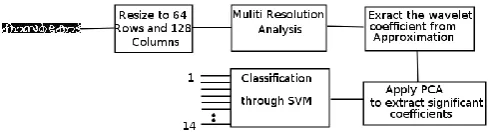
Proposed method uses wavelet co-efficients as the features and Pricipal Component Analysis for the dimensionality reduction. Block Diagram of the proposed method is shown in Fig:1
Figure 1. Proposed Method
A. Dataset
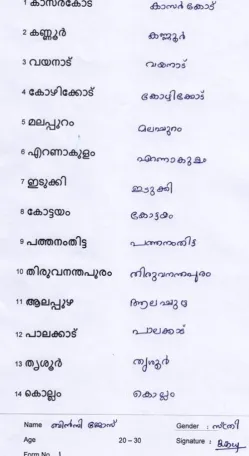
data collection which include the provision for entering Name,Age,Gender and Signature etc. Sample form is given in Fig: 2. All the forms are scanned by using a flatbed scanner in 300 dpi and digitized and stored in tiff format. Words are extracted from the form using horizontal and vertical projection profiles. All the extracted words are arranged folderwise, some of the samples are avoided for the learning process because it contains errors(48 samples). 80 % of the data used for training (588 samples) and 20 % of the data used for testing(148 samples).
Figure 2. Sample Form
Age wise statistics of the data collection is shown in Table: 3.
TABLE III. Age wise statistics
Age No.Of Writers
10-20 5
20-30 20
30-40 20
40-50 8
50-60 3
Samples from the dataset is shown in Fig:3
Figure 3. Samples From the Dataset
B. Preprocessing
All the images in the dataset are converted to gray scale. Images are trimmed to avoid whitespaces in the boundary. Finally images are resized to 64 rows and 128 columns using bicubic interpolation method.
C. Feature Extraction
Selection of Features from the dataset is critical for the performance of handwritten recognition system. The resized images are fed for multi resolution analysis. Wavelet transform converts the image in to different resolutions and the approximation level contains higher co-efficients. These low frequency components can be the feature for the recognition of handwritten documents. Significant co-efficients for classification are identified through Principal Component Analysis. In the multi resolution analysis image is decomposed
into four subbands LL( ), HL( ),LH( )
and HH ( ) are approximate,vertical,horizontal and
daigonal features respectively.Changes in both
horizontal and vertical directions in terms low
frequency is represented by approximate
frequencies in both horizontal and vertical directions. One of the observations after wavelet transform is that wavelet co-efficients are higher in approximation(LL) band. Large wavelet co-efficients are more important than smaller wavelet coefficients.Haar and Daubechis wavelet co-efficients are used as features for our
study.In the case of Haar = [0.70710678118655,
0.70710678118655] and =[0.70710678118655,
-0.70710678118655] , In the case of Daubechis-2 it is
=[0.48296291314453, 0.83651630373781,
0.22414386804201, -0.12940952255126] and
=[-0.12940952255126, -0.22414386804201,
0.83651630373781, -0.48296291314453] as defined in 1 and 2 applied to image. In the level 1 decomposition the approximation features will be 32*64 = 2048 and in level 2, it will be 512. Sample decomposition level-2 of word image of " / kollam" is shown in figure 4
Figure 4. Wavelet decomposition using haar wavelet
Support Vector Machine used as the classifier.The commonly used four kernels in SVM are Linear, Polynomial,RBF and sigmoid. In the present study we use RBFkernel and the parameters are selected using Gridsearch method[21].
Principal Component Analysis is a data reduction technique developed by Hotelling H in 1933. PCA allows as to represent the large dataset to fewer pricipal components thus ensure lower dimension. In our experiments we consider 50 Principal components.
V.
RESULTS AND INTERPRETATION
Experiments done with various types of wavelets and their results are exhibited in Table: 4
TABLE IV. Results with Haar and Daubechis
Type of Wavelet
Level Precision Recall F1 Score
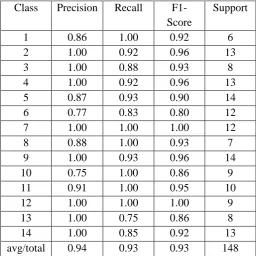
DB2 2 0.89 0.89 0.87 decomposition is shown in Table: 5
TABLE V. Detailed Analysis with Har Wavelet decomposed in level-1
Class Precision Recall
F1-Score
Precision(P),Recall(R), F1 Score(F1) are calculated using the following formula
Table VI. Confusion Matrix successfully implemented and achieved good results. This method is suitable for the recognition of small number of lexicons. Domain specific applications like Place name recogntions,students name recognition in a particular institution can be easily done through this approach.Methods we discussed here in this paper can
be implemented without much computational
cost.Work can be extended with other wavelts like Symlets,Coiflets etc.Futher various kind of image coding can use as the language specific features for recognition.
VII.
REFERENCES
[1] Neeba, NV and Namboodiri, Anoop and Jawahar,
CV and Narayanan, PJ.(2009) ‘Recognition of Malayalam documents’, Springer, pp.125-146.
[2] Mukhopadhyay, S., Das, N. K., Pradhan, A.,
Ghosh, N., and Panigrahi, P. K. (2014) ’Wavelet and multi-fractal based analysis on DIC images in epithelium region to detect and diagnose the cancer progress among different grades of tissues’, SPIE Photonics Europe,pp.91290Z-91290,International Society for Optics and Photonics
[3] Qureshi, Muhammad Ali, and Mohamed Deriche.
(2016) ’A new wavelet based efficient image
compression algorithm using compressive
sensing’, Multimedia Tools and Applications,Vol. 75, No. 12, pp.6737-6754
[4] Elshazly, Ehab H and Faragallah, Osama S and
Abbas, Alaa M and Ashour, Mahmoud A and El-Rabaie, El-SayedMand Kazemian, Hassan and Alshebeili, Saleh Aand El-Samie, Fathi E Abd and El-sayed, Hala S. (2015) ’Robust and secure
fractional wavelet image watermarking’, Signal, Image and Video Processing, Vol. 9, No. 1, pp.89-98, Springer
[5] Rasti, Pejman and Lüsi, Iiris and Demirel, Hasan and Kiefer, Rudolf and Anbarjafari,Gholamreza. 2014 ’Wavelet transform based new interpolation
technique for satellite image resolution
enhancement’, Aerospace Electronics and Remote Sensing Technology (ICARES), 2014 IEEE International Conference on,pp.185-188,IEEE.
[6] Abdulrahman, Muzammil and Gwadabe,
Tajuddeen R and Abdu, Fahad J and Eleyan, Alaa (2014) ‘IEEE’, Gabor wavelet transform based facial expression recognition using PCA and LBP,pp.2265-2268.
[7] Liu, Cheng-Lin and Sako, Hiroshi and Fujisawa,
Hiromichi. (2002) ‘Performance evaluation of pattern classifiers for handwritten character recognition’, International Journal on Document Analysis and Recognition, Vol. 4, No. 3, pp.191-204.
[8] LeCun, Yann and Jackel, LD and Bottou, Leon
and Brunot, A and Cortes, Corinna and Denker, JS and Drucker, Harris and Guyon, I and Muller, UA and Sackinger, Eduard and others. (1995)
‘Comparison of learning algorithms for
handwritten digit recognition’,International
conference on artificial neural networks, Vol. 60, pp.53-60.
[9] Bhattacharya, Ujjwal and Chaudhuri, Bidyut
Baran. (2009) ‘Handwritten numeral databases of Indian scripts and multistage recognition of mixed numerals’, IEEE transactions on pattern analysis and machine intelligence, Vol. 31, No. 3, pp.444-457.
[10] Chacko, Binu P and Krishnan,VRVimal and
Raju,Gand Anto, P Babu.(2012) ‘Handwritten character recognition using wavelet energy and
extreme learning machine’, International
Journal of Machine Learning and Cybernetics, Vol. 3, No. 2, pp.149-161.
[11] Jomy John and Pramod KV and Kannan
Balakrishnan.(2012) ‘Unconstrained handwritten Malayalam character recognition using wavelet transform and support vector machine classifier’, Procedia Engineering,Elsevier, Vol. 30,pp.598-605.
[12] Raju G.(2006) ‘Recognition of unconstrained
Conference on Advanced Computing and
Communications,ADCOM
2006,IEEE,pp.217-221.
[13] Wunsch, Patrick and Laine, Andrew F.(1995)
‘Wavelet descriptors for multiresolution
recognition of handprinted characters’, Pattern Recognition, Vol. 28, No. 8, pp.1237-1249. [14] Shelke, Sushama, and Shaila Apte. "Multistage
handwritten marathi compound character
recognition using neural networks." Journal of Pattern Recognition Research 2.253-268 (2011).
[15] Mozaffari, Saeed, Karim Faez, and Hamidreza
Rashidy Kanan. "Feature comparison between
fractal codes and wavelet transform in
handwritten alphanumeric recognition using SVM classifier." Pattern Recognition, 2004. ICPR 2004. Proceedings of the 17th International Conference on. Vol. 2. IEEE, 2004.
[16] Patel, Dileep Kumar, et al. "Handwritten character recognition using multiresolution technique and euclidean distance metric." Journal of Signal and Information Processing 3.02 (2012): 208.
[17] Pasha, Saleem, and M. C. Padma. "Handwritten Kannada character recognition using wavelet transform and structural features." Emerging Research in Electronics, Computer Science and Technology (ICERECT), 2015 International Conference on. IEEE, 2015.
[18] Antonini, Marc, et al. "Image coding using wavelet transform." IEEE Transactions on image processing 1.2 (1992): 205-220.
[19] Mallat, Stephane G.(1989) ‘A theory for
multiresolution signal decomposition: the wavelet representation’, IEEE transactions on pattern analysis and machine intelligence,IEEE,pp.674-693.
[20] Daubechies, Ingrid(1992) ‘Ten lectures on
wavelets’, SIAM.
[21] Hsu, Chih-Wei and Chang, Chih-Chung and Lin,
Chih-Jen and others.(2003) ‘A practical guide to
support vector classification’, Pattern