A Corpus-based Study of the German Recipient Passive
Patrick Ziering, Sina Zarrieß, Jonas Kuhn
Institute for Natural Language Processing University of Stuttgart
[Patrick.Ziering, Sina.Zarriess, Jonas.Kuhn]@ims.uni-stuttgart.de Abstract
In this paper, we investigate the usage of a non-canonical German passive alternation for ditransitive verbs, the recipient passive, in naturally occuring corpus data. We propose a classifier that predicts the voice of a ditransitive verb based on the contextually determined properties of its arguments. As the recipient passive is a low frequent phenomenon, we first create a special data set focussing on German ditransitive verbs which are frequently used in the recipient passive. We use a broad-coverage grammar-based parser, the German LFG parser, to automatically annotate our data set for the morpho-syntactic properties of the involved predicate arguments. We train a Maximum Entropy classifier on the automatically annotated sentences and achieve an accuracy of 98.05%, clearly outperforming the baseline that always predicts active voice (94.6%).
Keywords: Voice Alternations, Argument Structure, Corpus-based Syntax
1.
Introduction
Besides the regular passive voice, many languages exhibit so-called non-canonical passive constructions as for in-stance the get passive in English, the se faire passive in French or the recipient passive (also called bekommen pas-sive) in German which will be the focus of this work. The genesis of these non-canonical passives and their grammat-ical restrictions have been subject to extensive debates in theoretical linguistics. In this work, we are interested in the usage of this alternation which we consider as a meaning-equivalent paraphrase of the regular passive and the active. This is illustrated in Example (1) which presents the reali-sation of a German ditransitive verb in active, passive and recipient passive voice.
(1) a. Der The
Kellner waiter
serviert serves
den the
G¨asten guests
eine a
Flasche bottle Wein.
wine.
“The waiter serves the guests a bottle of wine.” b. Eine
A
Flasche bottle
Wein wine
wird is
den the
G¨asten guests
vom by
Kellner the serviert.
waiter served.
“A bottle of wine is served to the guests by the waiter.”
c. Die The
G¨aste guests
bekommen get
vom by
Kellner the
eine waiter Flasche
a
Wein bottle
serviert. wine served.
“The guests get served a bottle of wine by the waiter.”
The aim of our study is to be able to predict the voice of a German ditransitive verb from its given context in a corpus sentence. More precisely, we pursue the hypothesis that the German recipient passive can be predicted from the con-textually determined properties of its arguments (i.e. the definiteness of the agent, the person of the patient etc.). This hypothesis follows the work by Bresnan et al. (2005)
who show that the usage of the English dative alternation is guided by statistical tendencies which can be modeled on the basis of multiple contextual factors.
Since the corpus-based modelling of linguistic alternations typically requires relatively “deep” linguistic information (e.g. morphological information about definiteness etc.), previous approaches usually rely on manually annotated treebank data. However, in the case of the German re-cipient passive, the construction is too low frequent in or-der to be appropriately represented in standard German re-sources. Therefore, in a first step, we built a specialised data set of occurrences of German ditransitive verbs, ex-tracted from a set of German corpora. This data set was automatically annotated with the German LFG parser (Rohrer and Forst, 2006). In a second step, we exploit the automatically annotated sentences to train and test a maxi-mum entropy classifier that is given the context of a ditran-sitive verb and predicts its voice. The classifier achieves an accuracy of 98.05% over a baseline of 94.6% which always predicts the active voice.
While previous work on the German recipient passive has mostly dealt with syntactic, semantic and stylistic restric-tions on the phenomenon (Diedrichsen, 2004), the results presented in this paper suggest that the usage of the Ger-man recipient passive alternation is subject to soft statisti-cal constraints that can be modelled by means of multiple contextual factors. The constraints we observed are very similar to factors found in previous work on different alter-nations and languages.
2.
Related Work
There are a number of (mostly English) argument alterna-tions or syntactic paraphrases that have been investigated in corpus-based linguistic studies, such as the English passive (Thompson, 1987; Bresnan et al., 2001), the English da-tive alternation (Bresnan et al., 2005; Arnold et al., 2000) or that-clause reduction (Levy and Jaeger, 2007). In these works, the use of an argument alternation in language is typically related to a number of properties of their argu-ments, e.g. definiteness, animacy or complexity of the in-volved noun phrases. In Aissen (1999) and Aissen (2003), this idea is described in terms of markedness hierarchies (which can be formalised as Optimality-theoretic con-straints). These hierarchies associate argument functions with certain prototypical properties for person, animacy, or definiteness; e.g., subjects tend to be higher on the person scale than objects (1st person>3rd person).
Depending on the language, these markedness hierar-chies can be encoded as hard constraints in the gram-mar, or figure as soft, usage-related preferences. For the passive alternation, this contrast is nicely established in Bresnan et al. (2001) who investigate the relationship be-tween voice and person in English and Lummi. In Lummi, the person hierarchy is encoded as a hard constraint into the grammar of the language such that the subject must be higher in the person hierarchy than the object. This hierar-chy is illustrated in (1), meaning that in the case of a third-person agent and a first third-person patient, the verb is obligato-rily passivised in order to be able to realise the first person entity as the subject.
1.pers∪2.pers >3.pers (1)
Obviously, in English, there is no such hard constraint, both sentences in Example (2) are grammatical. Never-theless, Bresnan et al. (2001) found a clear statistical ten-dency for English passivation in cases where the Lummi hard constraint would be violated, indicating that this hard constraint is present as soft constraint in English. In our work, we hope to find similar factors accounting for prefer-ences of the recipient passive over the regular passive and the active.
(2) a. The man3pssees us1ps
b. We1psare seen by the man3ps
In a similar setting, Bresnan et al. (2005) investigate the English dative alternation. Verbs like give can have two variants of complements: two objects (the double object construction) or an object and a prepositional phrase, see Example (3).
(3) a. Susan gives the children toys b. Susan gives toys to the children
A possible explanation for this syntactic variation could be the meaning of the event: is it a kind of movement (use of a prepositional phrase) or a change of state (use of a double object construction)? Actually, similar, purely meaning-based explanations have been proposed for the German re-cipient passive, as we discuss in the following Section.
However, Bresnan et al. (2005) show that the alternation can be modeled taking into account a number of contex-tually determined argument properties, such as the com-plexity of the noun phrases, definiteness, pronominality, salience, number, and person. Based on these features, Bresnan et al. (2005) fit a logistic regression model that yields 94% prediction accuracy.
The methodology that is typically pursued in these theoret-ically motivated works on argument alternations is to hand-code a set of selected sentences where a specific alternation is displayed. By this means, the authors isolate the phe-nomenon under investigation relying on high-quality, man-ually annotated data. As a result, the obtained models allow for a detailed analysis of the individual contextual factors at play.
A somewhat different approach is taken in recent works from the domain of Natural Language Generation show-ing the relevance of syntactic alternations for computa-tional applications. Rajkumar and White (2011) model the realisation of that-clauses in a grammar-base generation component taking into account the features proposed in Levy and Jaeger (2007). Zarrieß et al. (2011) generate pas-sives interacting with free word order in German based on a linguistically-informed feature model that incorporates the relative hierarchy of the involved arguments.
In contrast to the previously mentioned theoretical works on argument alternations, these application-oriented works typically deal with more data where several syntactic vari-ation phenomena interact. Also, Zarrieß et al. (2011) con-duct their experiments on automatically parsed data, mean-ing that the statistical component has to deal with noise introduced from parsing errors. A further difference to investigations based on hand-coded data is the design of the feature model, and the type of argument properties taken into account. While Bresnan et al. (2005) encode the information status (or givenness) of the predicate argu-ments, the feature models in Rajkumar and White (2011) and Zarrieß et al. (2011) are based on morpho-syntactic in-formation that can be extracted from automatically pro-duced syntactic analyses. However, the information sta-tus of a noun phrase is often reflected in its morpho-syntactic realisation, such that these automatically obtain-able features typically provide relatively accurate models (Zarrieß et al., To appear).
The study of the German Recipient Passive that we present in this paper is clearly inspired from the theoretical ap-proach pursued in (Bresnan et al., 2001) or (Aissen, 1999). However, our ultimate goal is to inform generation-based approaches such as Zarrieß et al. (2011), where deep lin-guistic features such as informations status cannot be as-sumed to be available.
3.
The Recipient Passive
verb # occurences
schenken (give) 2,129
stellen (supply) 829
bieten (offer) 826
anbieten (provide) 698
zuweisen (assign) 653
verleihen (award) 622
vermitteln (broker) 618
zusprechen (grant) 568
zuschicken (send) 545
sagen (say) 529
erstatten (refund) 513
liefern (deliver) 513
zuteilen (assign) 445
servieren (serve) 426
bezahlen (pay) 419
¨uberreichen (hand over) 408
verpassen (inflict) 394
vorsetzen (present with) 377
pr¨asentieren (present) 376
zeigen (show) 344
(in die Hand) dr¨ucken (thrust (into hand))
323
auszahlen (disburse) 316
anzeigen (display) 312
aush¨andigen (surrender) 289
Table 2: Absolute frequency of ditransitives in the recipient passive (2)
verb # occurences rec.
pass.
zuschicken (send) 2,854 19.1%
vorsetzen (present with) 2,247 16.8%
zuteilen (assign) 3,789 11.7%
zusprechen (grant) 5,925 9.6%
aush¨andigen (deliver) 3,286 8.8%
zuweisen (allocate) 7,831 8.3%
schenken (give) 40,371 5.3%
servieren (serve) 8.373 5,1%
erstatten (refund) 10.200 5,0%
¨uberreichen (hand over) 9.616 4,2%
verleihen (award) 33.162 1,9%
Table 3: Frequency of the recipient passive for specific di-transitives
phrase, we also need to consider the active and regular pas-sive instances of these verbs in order to be able to compare their contexts. Thus, we extracted all instances of our 11 most frequent verb lemmas from our total set of corpora. The resulting data is a collection of 127,654 sentences. In Table 3, we report the relative frequency of the recipient passive for this specialised set of ditransitive sentences. While the occurence of a recipient passive can be detected
using flat PoS patterns, we need deeper linguistic informa-tion in order to appropriately analyse the respective con-texts of the construction. We use a hand-crafted, broad-coverage Lexical Functional Grammar (Bresnan, 2001) for German (Rohrer and Forst, 2006) for preparing our data set. It integrates a statistical disambiguation module and achieves parsing coverage of about 80% on German news-paper text. The syntactic analyses are encoded on two rep-resentation levels: constituent structure (c-structure) which encodes constituency and linear order and functional struc-ture (f-strucstruc-ture) representing grammatical functions and morphosyntactic features.
(15) a. Er He
bekommt gets
von by
seiner his
Mutter mother
ein a
Auto car geschenkt.
given.
“He has been given a car by his mother.”
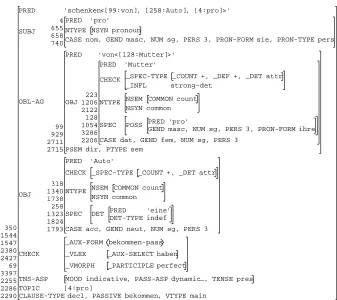
As an example, Figure 1 displays the f-structure for the sentence (15) derived by the German LFG. The f-structure contains a range of syntactic and morphological features that will be very useful for our classification experiments in Section 5., e.g. number and person for nouns (NUM and PERS), nominal and pronominal types (PRON-TYPE and NTYPE), definiteness (DET-TYPE).
5.
Classification Experiments
In this section, we present a classifier that predicts the voice of a ditransitive verb, given its intrasentential context. We used MegaM, a maxium entropy classifier to build a log-linear model for voice prediction.
Since f-structures are syntactic representations which en-code the voice of the given ditransitive verb, we have to hide this information to the classifier. We used a small set of hand-written rules in order to map the grammatical func-tions onto semantic roles. Thus, the subject of a passive is mapped to a theme or recipient, whereas the subject of an active is mapped to an agent.
Furthermore, we have to consider that the realisation of an agent is optional in both regular and recipient passive. If the ditransitive verb does not realise an agent, the proba-bility of the active voice will be zero. To eliminate these trivial cases from our classification, we divide the data into two subsets: (i) ditransitives which realise all 3 roles (agent, recipient, theme), (ii) ditransitives which realise 2 roles (re-cipient, theme). In Table 4, we report the distribution of the voices in the two subsets.
active passive recipient passive
agent 94.6% 3.3% 2.1%
no agent 0.0% 61% 39%
Table 4: Voice distribution for ditransitive realisations
"Er bekommt von seiner Mutter ein Auto geschenkt"
'schenken<[99:von], [258:Auto], [4:pro]>' PRED
'pro' PRED
pronoun NSYN NTYPE
CASE nom, GEND masc, NUM sg, PERS 3, PRON-FORM sie, PRON-TYPE pers 740
658 655 4 SUBJ
'von<[128:Mutter]>' PRED
'Mutter' PRED
_COUNT +, _DEF +, _DET attr _SPEC-TYPE
strong-det _INFL
CHECK
count COMMON NSEM
common NSYN NTYPE
'pro' PRED
GEND masc, NUM sg, PERS 3, PRON-FORM ihre POSS
SPEC
CASE dat, GEND fem, NUM sg, PERS 3 2206
3286 1054 128 2122 1206 223 OBJ
PSEM dir, PTYPE sem 2715
2711 929 99 OBL-AG
'Auto' PRED
_COUNT +, _DET attr _SPEC-TYPE
CHECK
count COMMON NSEM
common NSYN NTYPE
'eine' PRED
indef DET-TYPE DET
SPEC
CASE acc, GEND neut, NUM sg, PERS 3 1793
1824 1323 258 1738 1340 318 OBJ
bekommen-pass _AUX-FORM
haben _AUX-SELECT _VLEX
perfect _PARTICIPLE _VMORPH
CHECK
MOOD indicative, PASS-ASP dynamic_, TENSE pres TNS-ASP
[4:pro] TOPIC
CLAUSE-TYPE decl, PASSIVE bekommen, VTYPE main 2290
2286 2255 3397 69 2427 2380 1547 1544 350
Figure 1: F-structure for sentence (15)
features is listed in Table 8. For each feature, we also report its frequency for a given argument role in its different voice realisations. This frequencies will be further discussed in Section 6. Note that, in contrast to Bresnan et al. (2001), our features do not include a direct encoding of the infor-mations status or “newness” of a given argument since these cannot be extracted from an LFG f-structure. We hypoth-esise that we can approximate these properties to a certain extent via morpho-syntactic properties of the arguments. We randomly divide our data set into 90% training sen-tences and 10% test sensen-tences for both subsets (agent and no agent). In the agent subset, the classifier achieves an ac-curacy of 98.05% significantly beating the baseline which always predicts an active voice. Since this data set is so heavily unbalanced, it is also interesting to look at the pre-cision and recall for the different voices (Table 5). Despite the strong balance towards the active, the prediction of the recipient passive is still precise with a moderate recall.
Voice Score
Precision
Active 99.4%
Regular passive 73.7% Recipient passive 71.8%
Recall
Active 99.7%
Regular passive 76.3% Recipient passive 57.8%
Table 5: Voice predictions for ditransitives with agent
In the no agent subset (i.e. the predominant active voice
is excluded), the classifier achieves an accuracy of 81.31% outperforming the regular passive baseline about 20%. We then scored the precision and recall for the passive voices again (Table 6). Without the active voice, precision and recall for the recipient passive improve.
Voice Score
Precision Regular passive 83.4% Recipient passive 77.7%
Recall Regular passive 86.6% Recipient passive 73.1%
Table 6: Voice predictions for ditransitives without agent
6.
Analysis
In the last section, we have shown that it is possible to pre-dict the usage of the recipient passive by means of multi-ple contextual factors that mainly concern the properties of the predicate arguments. In this Section, we look at some of the features in more detail in order to see whether the model conforms to linguistic tendencies observed in previ-ous work. Doing this, we have to be aware of the fact that our data has been automatically parsed and annotated, and therefore necessarily contains errors.
the voice where it is realised as the subject. Thus, the agent has a high chance of being pronominal in the active (39.6%), but is not likely to be realised as a pronoun in the passives voices (3.2% and 9.5%). This statistical tendency is in accordance with previous works observing a bias of the canonical subject position to be a slot for given actants (i.e. for those that can be expressed by pronouns) (Aissen, 1999; Bresnan et al., 2001). We find a similar tendency for the person feature. Thus, the agent is more likely to be a non-third person entity in the active than in the passive voices. Features that do not excatly match theoretical hypotheses are ”Definiteness” (Def. in Table 8) and “Indefiniteness”. We would expect that, for instance, the recipient is often indefinite in the active and regular passive, and less often in the recipient passive. However, the opposite is true (6% in recipient passive vs. 2.2% in active and regular passive). On the other hand, the definiteness features of the agent and patient seem to be consistent with theoretical predictions. An important feature in our classification is the surface or-der of the arguments. This feature is not discussed in work on English alternations where the word order is fixed. By contrast, in German, the voice alternations interact with word order variation. In Table 8, the distribution of the “Precedes” feature shows that, for each voice, the subject precedes the objects most often (except of the recipient ceding the patient). Furthermore, the (optional) agent pre-cedes the non-subject patient in recipient passive more of-ten (43.5%) than the non-subject recipient in regular pas-sive (26.3%). Actually, in German, it is strongly dispre-ferred to realise the agent directly after the finite auxiliary of the regular passive.,as in Example (16-a). However, this surface order is possible in the recipient passive, see Exam-ple (16-b).
(16) a. * *
Das The
Formular form
wird is
von by
der the
Karla Karla
dem the
Karl Karl ausgef¨ullt.
filled in.
“The form is filled in by Karla for Karl.” b. Der
The Karl Karl
bekommt gets
von by
der the
Karla Karla
das the
Formular form ausgef¨ullt.
filled in.
“The form is filled in by Karla for Karl.”
For the distinction of the regular passive and the recipient passive, we had a feature encoding the presence of a prepo-sitional agent. The distribution is given in Table 7 showing that the agent occurs twice as often in the recipient passive as in the regular passive. Thus, it seems that the agent is somehow more prominent in recipient passive than in regu-lar passive. A possible explanation for this pattern could be found in the semi-grammaticalised status of the recipient passive. When the auxiliary bekommen still has a mean-ing reflex from its main verb, the agent is interpreted as the source of the possession transfer event.
7.
Conclusion
We have presented a corpus-based study of the German recipient passive asking whether it is possible to predict the choice of the two meaning-equivalent passive voices in
regular passive
recipient passive
agent 9.6% 21%
Table 7: Presence of a prepositional agent in passive voices
Feature Role Active Pass. Rec. Pass.
Pronoun
agent 39.6% 3.2% 9.5%
recipient 40% 32.3% 45.7%
patient 17.7% 24.9% 17.8%
¬3rd Pers. agent 9.4% 0.4% 3.6%
recipient 13.9% 7.9% 16.3%
3rd Pers.
agent 73.7% 95.1% 95.3%
recipient 84.1% 89.9% 74.5%
Def.
agent 15.9% 49.3% 38.2%
recipient 26.6% 31.1% 13.7%
patient 18.4% 31.9% 22.2%
Indef.
agent 3.8% 3.5% 8.1%
recipient 2.2% 2.2% 6%
patient 16.7% 9.9% 23.3%
No Def.
agent 7.8% 18.3% 10.3%
recipient 7.5% 9.6% 7%
patient 22.6% 11.9% 12.9%
Proper N.
agent 7.9% 12.5% 13.6%
recipient 7.4% 15.1% 10.5 %
patient 6.4% 6% 10.3%
Common N.
agent 30.1% 74.2% 70.9%
recipient 44.9% 43.9% 29.6 %
patient 67.3% 60.1% 65%
Complex
agent 14% 22.7% 17.4%
recipient 14.3 % 14.9% 10.8%
patient 29.1% 23% 23.3%
Quantified
agent 1.1% 0.9% 0.4%
recipient 1.7% 0.9% 2.6%
patient 4% 2.9% 2.9%
Precedes
Ag>Rec 64.4% 26.3% 18.3%
Ag>Th 65.6% 29.5% 43.5%
Rec>Ag 22% 69.2% 75.7%
Rec>Th 64.7% 39.7% 63.7%
Th>Ag 15.5% 50.5% 45.9%
Th>Rec 22% 37.6% 19.8%
Reentrant
Recipient 0.8% 0.6% 10.3%
patient 1.9% 4.7% 1.7%
Table 8: Argument properties used in voice classification
German, regular passive and recipient passive. We created a specialised data set of occurrences of German ditransi-tive verbs. We parsed the sentences with the German LFG parser and extracted contextual features for each involved argument. Giving these feature sets as input to a maximum entropy classifier yield a good performance beating the ac-tive voice baseline.
This study illustrates that the German recipient passive al-ternation is subject to soft statistical constraints that can be modelled by means of multiple contextual factors.
8.
References
The-ory, 17(4):673–711.
Judith Aissen. 2003. Differential Object Marking: Iconic-ity vs. Economy. Natural Language and Linguistic The-ory, 21:435–483.
Jennifer Arnold, Thomas Wasow, Anthony Losongco, and Ryan Ginstrom. 2000. Heaviness vs. newness: The ef-fects of structural complexity and discourse status on constituent ordering. Language, 76:28–55.
Joan Bresnan, Shipra Dingare, and Christopher D. Man-ning. 2001. Soft constraints mirror hard constraints: Voice and person in English and Lummi. In Proceed-ings of the LFG01 Conference, pages 13–32, Stanford, CA. CSLI Publications.
Joan Bresnan, Anna Cueni, Tatiana Nikitina, and R. Har-ald Baayen. 2005. Predicting the dative alternation. In Cognitive foundations of interpretation, pages 69–94. Joan Bresnan. 2001. Lexical-Functional Syntax.
Black-well Publishers, Oxford, UK.
Oliver Christ. 1994. A modular and flexible architecture for an integrated corpus query system. In Proceedings of COMPLEX’94: 3rd Conference on Computational Lex-icography and Text Research, pages 23–32, Budapest, Hungary.
Elke Diedrichsen. 2004. The german ‘bekommen-passive’ and rrg. In Proceedings of the International Role and Reference Grammar Conference (RRG), Dublin, Ireland, October.
Gabriele M. Diewald. 1997. Grammatikalisierung. Eine Einf¨uhrung in Sein und Werden grammatischer Formen. Niemeyer, T¨ubingen.
Peter Eisenberg. 1999. Grundriss der deutschen Gram-matik. Metzlersche J.B. Verlagsb, Stuttgart, 2. edition. Martin Forst. 2007. Filling statistics with linguistics –
property design for the disambiguation of german lfg parses. In ACL 2007 Workshop on Deep Linguistic Pro-cessing, pages 17–24, Prague, Czech Republic, June. As-sociation for Computational Linguistics.
Roger Levy and T. Florian Jaeger. 2007. Speakers optimize information density through syntactic reduction. In Pro-ceedings of the Twentieth Annual Conference on Neural Information Processing Systems.
Maxim Pimanyonok. 2004. Das bekommen-Passiv im Deutschen. GRIN Verlag.
Karin Pittner and Judith Berman. 2004. Deutsche Syntax. Narr Dr. Gunter.
Rajakrishnan Rajkumar and Michael White. 2011. Lin-guistically motivated complementizer choice in surface realization. In Proceedings of the UCNLG+Eval: Lan-guage Generation and Evaluation Workshop, pages 39– 44, Edinburgh, Scotland, July. Association for Computa-tional Linguistics.
Christian Rohrer and Martin Forst. 2006. Improving cover-age and parsing quality of a large-scale LFG for German. In Proceedings of LREC-2006, Genoa, Italy.
Sandra Thompson. 1987. The Passive in English: A Discourse Perspective. In Robert Channon and Linda Shockey, editors, In Honor of Ilse Lehiste, page 497511. Foris, Dordrecht.
Sina Zarrieß, Aoife Cahill, and Jonas Kuhn. 2011.
Un-derspecifying and predicting voice for surface realisa-tion ranking. In Proceedings of the 49th Annual Meet-ing of the Association for Computational LMeet-inguistics: Human Language Technologies, pages 1007–1017, Port-land, Oregon, USA, June. Association for Computational Linguistics.