Annotation Trees: LDC’s customizable, extensible, scalable annotation
infrastructure
Jonathan Wright, Kira Griffit, Joe Ellis, Stephanie Strassel, Brendan Callahan
Linguistic Data Consortium University of Pennsylvania, Philadelphia, PA {jdwright,kiragrif,joellis,strassel,bcal}@ldc.upenn.edu
Abstract
In recent months, LDC has developed a web-based annotation infrastructure centered around a tree model of annotations and a Ruby on Rails application called the LDC User Interface (LUI). The effort aims to centralize all annotation into this single platform, which means annotation is always available remotely, with no more software required than a web browser. While the design is monolithic in the sense of handling any number of annotation projects, it is also scalable, as it is distributed over many physical and virtual machines. Furthermore, minimizing customization was a core design principle, and new functionality can be plugged in without writing a full application. The creation and customization of GUIs is itself done through the web interface, without writing code, with the aim of eventually allowing project managers to create a new task without developer intervention. Many of the desirable features follow from the model of annotations as trees, and the operationalization of annotation as tree modification.
Keywords:annotation, web, software
1.
Introduction
Under the auspices of three DARPA natural language pro-grams, LDC has developed a new web-based annotation in-frastructure that goes beyond typical notions of annotation tools. The central component of the framework is the gener-alized model of annotation data as a tree of types, hence the idea of ”Annotation Trees”. A variety of other design ele-ments were built around this concept to address LDC’s di-verse annotation requirements, with the goal of supporting all annotation projects through a single platform. The pri-mary piece of software is a Ruby on Rails application called the LDC User Interface (LUI). The current purpose of LUI is to support annotation efforts for LDC sponsored projects, not only through annotation itself, but related tasks like re-porting. Here we discuss the current state of affairs, roughly 6 months into development, as well as future plans.
2.
History
As part of DARPA’s Machine Reading Program (MR), where multiple domains and tasks was part of the program design, LDC developed technical infrastructure for versa-tile and generalized annotation. The challenges of MR, namely the rapid development of multiple domains, repre-sented a microcosm of LDC annotation project operations, since LDC resources are highly distributed across projects. In other words, while other projects may themselves be less varied compared to MR, LDC staff typically support mul-tiple annotation projects, creating similar time constraints on individuals. In practice this often leads to reinventing the wheel; there is often no time to do otherwise. The de-sign of MR brought this problem into focus, and the anno-tation infrastructure developed was designed from the be-ginning to be maximally reusable, which amounts to easily customizable. Early reports on this work are Strassel et al. (2010) and Maeda et al. (2010). However, the infras-tructure as of mid 2011 was critically limited by a desktop
oriented, rather than web oriented, design. During the MR Phase 3 evaluation of 2011, where remote use was manda-tory, a new Ruby on Rails application was developed using the existing Annotation Tree model. During early 2012, the application has grown to support several projects, but primarily development has supported DARPA’s BOLT and RATS projects.
3.
Motivation
3.1. Logistical
Increasingly, remote annotation is either desired or abso-lutely necessary, since language experts can not always be found among in house staff. Furthermore, much annota-tion work occurs on nights and weekends when LDC is not open. Desktop applications are impractical due to problems of installation, annotator tracking, data transfer, etc. Cross platform software compatibility and the distribution of soft-ware has continually been a problem in cases where desk-top software was used. Concurrent annotation is another concern, even when annotation is done in the office, and an efficient means of integrating the work of large teams is needed.
3.2. Technical
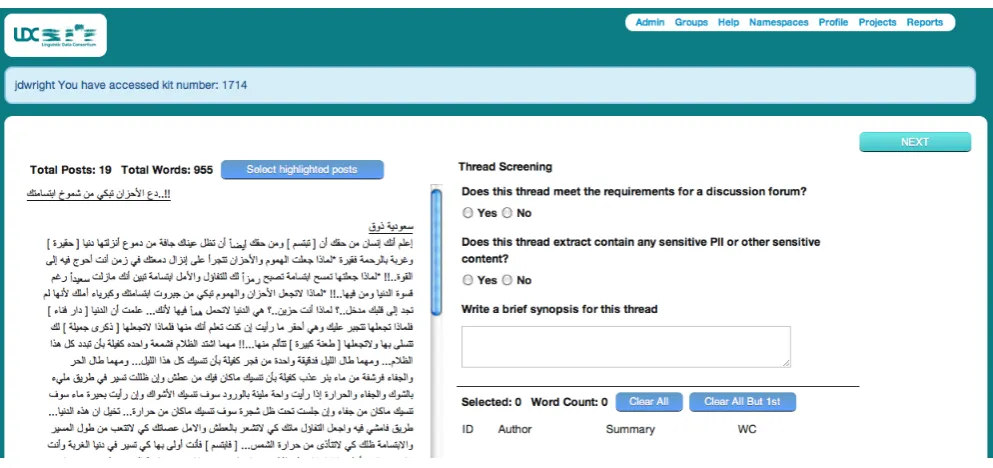
Figure 2: A snapshot of the BOLT triage tool.
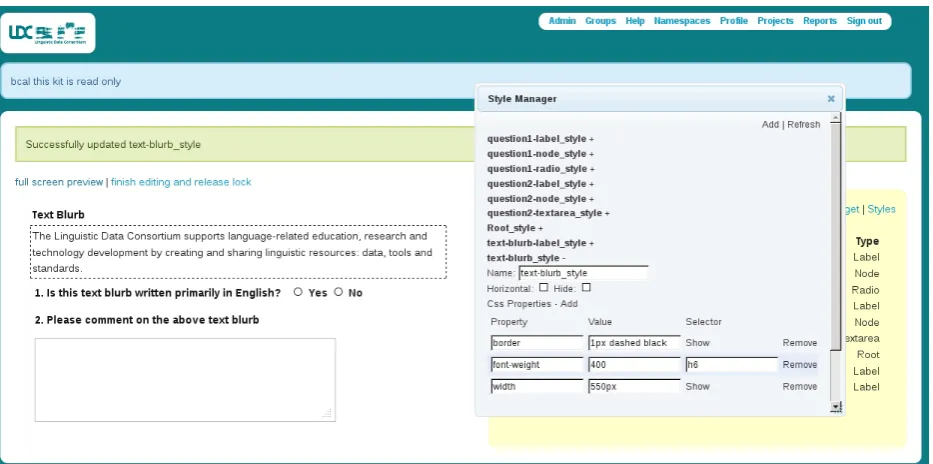
Figure 4: The namespace editor with a simple GUI layout.