© 2018 IJSRCSEIT | Volume 3 | Issue 3 | ISSN : 2456-3307
Efficient Data Communication in a Structural Grid base for
Mobile Ad-hoc Network Scenarios
Basanta Kumar Padhi1, Dr. Nilamadhab Mishra*2, Prof. (Dr.) Sabyasachi Patnaik3
1Research Scholar, P.G. Department of Information and Communication Technology, F.M.University, Vyasa
Vihar, Balasore, Odisha, India
2Assistant Professor, Post Graduate Teaching & Research Dept., School of Computing, Debre Berhan University,
Debre Berhan , Ethiopia
3Professor, P.G. Department of Information and Communication Technology, F.M.University, Vyasa Vihar,
Balasore, Odisha, India
ABSTRACT
An ad hoc wireless network consists of a set of mobile hosts operating without the aid of an established infrastructure of centralized administration. All nodes are capable of movement and can be connected dynamically in an arbitrary manner. The responsibilities for organizing and controlling the network are distributed among the terminals themselves. The nodes of these networks function as routers, which discover and maintain routes to other nodes in the networks. Energy consumption is also one of the most important performance metrics for wireless ad hoc networks, it directly relates to the operational lifetime of the networks. The approach in those works was to minimize the total consumed energy to reach the destination, which minimizes the energy consumed per unit flow or packet. If all the traffic is routed though through the minimum energy path to the destination the nodes in that path will be drain-out of batteries quickly while other nodes, which perhaps will be more power hungry if traffic is forwarded through them, will remain intact. In this work, we formulate an adhoc network scenario through Ad hoc On demand Distance Vector routing protocol in order to analyse the data communication efficiency through different network parameters, such as round trip time (RTT), data packet transmission, data packet reception, and loss. Our analysis states that, with the increasing of number of nodes in a structural grid, the average round trip time increases with the increased packet loss rate.
Keywords: structure grid, energy efficiency, adhoc wireless network, mobile nodes, round trip time, AODV
I.
INTRODUCTION
An ad hoc wireless network consists of a set of mobile hosts operating without the aid of an established infrastructure of centralized administration. Communication is done through wireless links among mobile hosts through their antennas. Due to concerns such as radio power limitation and channel utilization, a mobile host may not be able to communicate directly with other hosts
in a single-hop fashion. In this case, a multi hop scenario occurs, in which the packets sent by the source host must be relayed by several intermediate hosts before reaching the destination host [1].
the survivable adaptive radio networks (SURAD) program [2]. Ad hoc networks have play an important role in military applications and related research efforts, for example, the global mobile information systems (GloMo) program [3] and the near-term digital radio (NTDR) program [4]. Recent years have seen a new spate of industrial and commercial applications for wireless ad hoc networks, as viable communication equipment and portable computers become more compact and available. There are currently two variations of wireless networks: infrastructured and infrastructure less networks. The infrastructured networks have fixed and wired gateways or the fixed Base-Stations which are connected to other Base-Stations through wires. Each node is within the range of a Base-Station. A “Hand-off” occurs as mobile host travels out of range of one Base-Station and into the range of another and thus, mobile host is able to continue communication seamlessly throughout the network. Example applications of this type include wireless local area networks and Mobile Phone.
The other type of wireless network, infrastructure less networks, is knows as Mobile Ad-hoc Networks (MANET). These networks have no fixed routers, every node could be router. All nodes are capable of movement and can be connected dynamically in arbitrary manner. The responsibilities for organizing and controlling the network are distributed among the terminals themselves. The entire network is mobile, and the individual terminals are allowed to move freely. In this type of networks, some pairs of terminals may not be able to communicate directly with each other and have to rely on some terminals so that the messages are delivered to their destinations. Such networks are often referred to as multi-hop or store-and forward networks. The nodes of these networks function as routers, which discover and maintain routes to other nodes in the networks. The nodes may be located in or on airplanes, ships, trucks, cars, perhaps even on people or very small devices. Mobile Ad-hoc Networks are supposed to be
used for disaster recovery, battlefield communications, and rescue operations when the wired network is not available. It can provide a feasible means for ground communications and information access.
Now we discuss the Characters and Fundamental Challenges background of Wireless Ad-hoc Networks. Since Wireless Ad-hoc Networks are inherently different from the well-known wired networks, it is an absolutely new architecture. Thus some challenges raise from the two key aspects: self-organization and wireless transport of information [5].
First of all, since the nodes in a Wireless Ad-hoc Network are free to move arbitrarily at any time. So the networks topology of MANET may change randomly and rapidly at unpredictable times. This makes routing difficult because the topology is constantly changing and nodes cannot be assumed to have persistent data storage. In the worst case, we do not even know whether the node will still remain next minute, because the node will leave the network at any minute.
Bandwidth constrained is also a big challenge. Wireless links have significantly lower capacity than their hardwired counterparts.
Also, due to multiple access, fading, noise, and interference conditions etc. the wireless links have low throughput. Energy constrained operation. Some or all of the nodes in a MANET may rely on batteries. In this scenario, the most important system design criteria for optimization may be energy conservation. Limited physical security: Mobile networks are generally more prone to physical security threats than are fixed cable networks. There are increased possibility eavesdropping, spoofing and denial-of-service attacks in these networks.
be considered to analyse a wireless ad hoc network, such as routing, energy consumption, and reliability issues.
The rest of this paper is organized as follows. Section 2 discusses the associated studies on the wireless adhoc network by considering various issues. The methods considerations are deliberated in section 3. Section 4 highlights the scenarios analysis and discussion. Finally, section 5 concludes this paper along with the future work.
II.
ASSOCIATED STUDIES
The following review of literature is presented to discuss the works carried out on the said performance metrics of wireless networks. Dynamically changing topology and lack of centralized control make the design of an adaptive distributed routing protocol challenging. Many protocols have been proposed for mobile ad hoc networks; with the goal of making the route selection more efficient [6-19].The problem of designing an efficient routing protocol for wireless systems has been studied by many researchers. DARPA supported PRNET [20] and SURAN [21] projects provide automatic route setup and maintenance in a packet radio network with moderate mobility. Recent increased interest in such networks has resulted in the formation of a working group within the Internet Engineering Task Force (IETF) called Mobile Ad hoc Networking (MANET) [22].
This group supports development of new routing protocols for ad hoc networks apart from tailoring wire line Internet protocols to ad hoc networks. The Routing protocols for MANET can be classified as proactive and reactive [23], depending on how they maintain routing information and how they respond to topology changes. A node running a proactive protocol propagates routing information to its neighbours whenever a change in its link state is
detected. This information causes other mobile nodes to recompute their routing tables and initiate further route processing. Examples of proactive protocols include RIP, OSPF [24], and Destination Sequenced Distance Vector (DSDV) [13]. Proactive protocols have routes from a node to every other node in the system and such expensive route construction has to be followed even if nodes do not have such need. This wastes limited wireless bandwidth. Researchers have proposed reactive protocols, where routes are only constructed on an on demand basis, with three steps of route discovery by flooding, data forwarding, and route maintenance. Many reactive protocols, such as Dynamic Source Routing (DSR) [8], Signal Stability-based Adaptive Routing (SSA) [25], and Ad hoc on demand Distance Vector routing (AODV) [14], have been proposed. A hybrid of these two approaches, called Zone Routing Protocol (ZRP) [2], has also been proposed. When a mobile node wants to communicate with another node, it first tries to discover a good route to the destination on which the data packets are forwarded. In existing reactive protocols, a sending node utilizes the discovered route until it expires or is broken. The problem occurs when a route gets disrupted due to host mobility or poor signal strength. Whenever a node finds that its link to the next hop is broken, it will send a route error packet back to the source node, which will then invoke another route discovery procedure. However, this is costly as route discovery procedures activate a network flooding. This results in the wastage of scarce wireless bandwidth as well as long delays. The problem worsens when mobility is high, leading to more frequent route errors and route discovery packets. If the network size increases, delay will grow substantially because of the longer way for the route error and discovery packets [26]. Many real-time applications do not tolerate such long delays.
ad hoc networks, it directly relates to the operational lifetime of the networks.
The problem of minimum energy routing has been addressed before in [26-32]. The approach in those works was to minimize the total consumed energy to reach the destination, which minimizes the energy consumed per unit flow or packet. If all the traffic is routed though through the minimum energy path to the destination the nodes in that path will be drain-out of batteries quickly while other nodes, which perhaps will be more power hungry if traffic is forwarded through them, will remain intact. Instead of trying to minimize the consumed energy, the performance objective of maximizing the lifetime of the system, which is equivalent to maximizing the time to network partition [33] has been considered. In [33], the problem of maximizing the time to network partition was reported as NP-complete. Now, we review the Reliability issues of Wireless Ad-hoc Networks. A little research has been conducted in two-terminal reliability problem in wireless networks [38] [39]. Chen & Lyu [38] investigated the problem of two-terminal reliability in wireless networks resembled by Common Object Request Broker Architectures (CORBA) speciation‟s [40]. Chen & Lyu also proposed a new reliability term, the end-to-end expected instantaneous reliability (EIR), to accommodate for the hand-off procedures and different communication structures in wireless CORBA speciation. Only nodes are prone to failures, while wireless links, if exist, are fault-free. AboElFotoh et al [38] proposed two algorithms for computing the two-terminal reliability and computing the expected and the maximum message delay between sensors and the data sink in an operational distributed sensor networks (DSN). In this work, failures of static nodes are considered, whereas links are assumed to be fault-free. Both works ignored links failures and the nodes understudy are either static or their movement is comprehended by the hand-off process. Nevertheless, the reliability and survivability aspects of wireless
and mobile networks imply that each component in a wireless network is a potential point of failure and the reliability depends on the components' reliability and the degree of build-in redundancy in the wireless network architecture [41].
Broadcast is a basic service for many collaborative applications, as it enables any device to disseminate information to all other participants in the network. In particular, a useful broadcast service should be both efficient and provide a good level of reliability, meaning that most nodes in the system will receive almost every broadcasted message. The simplest way to obtain broadcast in a multiple hop network is by employing flooding. That is, sender sends the message to everyone in its transmission range. Each device that receives a message for the first time delivers it to the application and also forwards it to all other devices in its range. While this form of dissemination is very robust, it is also very wasteful and may cause contention and a large number of collisions [46]. A common alternative to flooding is to perform a constrained flooding on top of a deterministic overlay, e.g., [47][48], [49], [50].
III.
METHODS CONSIDERATIONS
The objective of the proposed work is to either solve or avoid the following problems as raised in wireless ad hoc networks with respect to their three fundamental performance measures viz. routing, energy consumption and reliability.
The main problems about the routing protocols are as following:
distance of the rapid-passing node, that will greatly improve the consumption of the bandwidth and the overhead of the networks. Third, obviously there will be tremendous delay of the data sending to the rapid-moving node.
Transmission between two hosts over a wireless network does not necessarily work equally well in both directions. Thus, some routes determined by some routing protocols may not work in some environments.
Many routing protocols may create redundant routes; periodically sending routing tables will waste network bandwidth. When the topology changes slowly, sending routing messages will greatly waste the bandwidth of Wireless Ad-hoc Networks. This will add additional burdens to the limited bandwidth of the Ad-hoc Networks.
In context to the problems while conserving the energy of wireless ad hoc networks; We emphasis energy consumption not only because that it is the key problem in the research of Wireless Ad-hoc Networks, but also, we find that Energy consumption problem also affects the routing protocols and the QoS of the whole networks. Let‟s assume that each source randomly selects one of the possible routes and asks the intermediate nodes on the route to relay traffic. Since energy is a valuable resource, intermediate nodes may not wish to consume their energy to carry the source‟s traffic. This is called “Selfish” of the node. However, if every node behaves „Selfish‟ and refuse to cooperate, network throughput may be drastically reduced. Also, there are many works have done to solve the energy consumption problem. However, unfortunately, little practical information is available about the energy consumption behaviour of wireless ad hoc network interfaces and device specifications do not provide information in a form that is helpful to protocol developers.
In context to the problems in evaluating the reliability of wireless ad hoc networks; the reliability problem has been studied extensively for wired networks with unreliable links under assumptions that the nodes are fault-free, static and their locations are known. In addition, links connecting the nodes are assumed to be irreplaceable with known probabilities of operation [34] [35] [36]. However, the reliability problem in wireless networks is quite different from that for wired networks. Wireless networks have several aspects that make them more susceptible to failures and loss of connectivity. These aspects include the medium characteristics and the properties of wireless devices [37]. For instance, the broadcast nature of wireless communication links makes them unique in their vulnerability to loss of connectivity due to interference, weather conditions, terrain effects and security breaches. Additionally, wireless mobile devices have limited power supplies, limited transmission range and ability to change their locations. Thus, the reliability computation techniques developed for wired networks cannot directly be utilized in wireless networks. Therefore, the proposed work seeks a simple method for computing the reliability in wireless ad hoc networks in which nodes and links are prone to failures.
Furthermore, the links
establishments/disconnections due to nodes' mobility are considered.
based approaches (and its derivatives, such as distance based and location-based forwarding), e.g., [6], [14], [41], [42], in which rebroadcasting a message depends on the number of retransmissions the node hears in its neighbourhood, and lazy gossip [43] in which nodes periodically gossip with their neighbours about the IDs of messages they have received and request missing messages from them. Previous analysis of probabilistic flooding [44], [45] has taught us that in order to obtain reasonable reliability level Since the nodes move randomly, the topology of the network changes with time.
The following approaches are proposed to use to resolve the various issues /problems associated with the different performance metrics of a wireless hoc network: Analytical method to compute the different parameters of wireless ad hoc network, a new
IV.
SCENARIOS ANALYSIS AND DISCUSSION
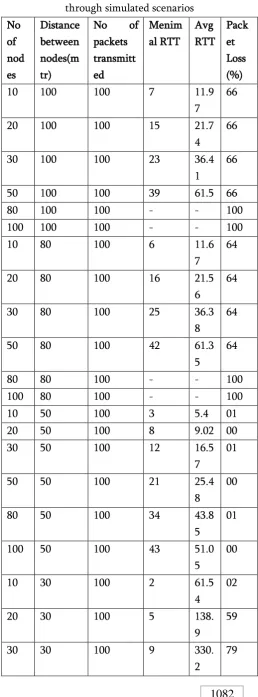
We articulate a configuration structure of mobile adhoc network, where the mobile nodes formulate the structural grids for the purpose of efficient data communication. In this work, we formulate an adhoc network scenario through Ad hoc On demand Distance Vector routing protocol in order to analyse the data communication efficiency through different network parameters, such as round trip time (RTT), data packet transmission, data packet reception, and loss. In this scenario, consider N number of mobile nodes, such that value of N varies from 10 to 100. We consider the distance “K” between mobile nodes in a structural grid, where the values of K range from 30 to 100. We set the simulation time to 100 sec. Assume that one data packet transmitted per second.
Now the detailed analysis is given in table-1 for further exploration.
50 30 100 16 581. 8
83
80 30 100 - - 100
100 30 100 - - 100
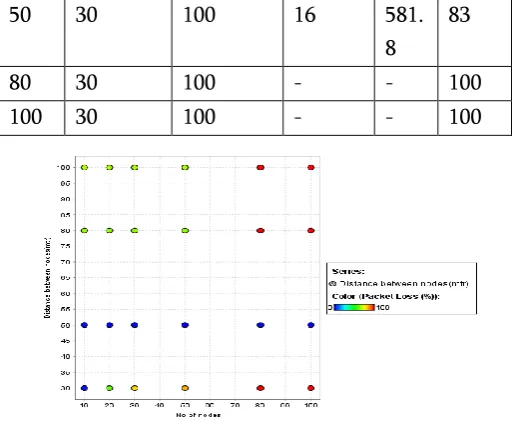
Figure 1. Packet loss analysis with respect to distance between nodes
Figure 2. Packet loss rate analysis with respect to node distance, minimal RTT, avg RTT, and no of data
packets transmitted
In figure-1 and figure-2, we analyse the data communication efficiency through creating several instances. Our analysis states that, with the increasing of number of nodes in a structural grid, the average round trip time increases with the increased packet loss rate. Round trip time measure is an important parameter for adhoc network scenarios, in which the packet sending to receiving time can be effectively measured. The packet loss rate can be successfully minimised when the inter nodes distance is 50 mtrs with respect to the mobile nodes variations in the structural grid. We used
node container, net device container, and IPV4 interface container while simulating the mobile adhoc scenarios.
V.
CONCLUSIONS
In this work, we discussed various research issues on Wireless Ad Hoc Networks. Our discussions are mainly highlighted on routing, energy consumption, and reliability issues those are to be considered to analyse the scenarios of wireless ad hoc network in a structural grid base. In this work, we formulated an adhoc network scenario through Ad hoc On demand Distance Vector routing protocol in order to analysed the data communication efficiency through different network parameters, such as round trip time (RTT), data packet transmission, data packet reception, and loss. Our analysis stated that, with the increasing of number of nodes in a structural grid, the average round trip time increases with the increased packet loss rate. In our feature work, we will cover other numerous issues, such as efficient utilization of different parameters like bandwidth, latency, routing of packets with least turnaround time, optimized energy consumption, and highly reliable transmission of packets.
VI.
CONFLICT OF INTERESTS
The authors declare that there is no conflict of interests regarding the publication of this paper.
VII.
ACKNOWLEDGMENT
The authors would like to express their deep appreciation to P.G. Department of Information and Communication Technology, F.M.University, Vyasa Vihar, Balasore, Odisha, India for supporting their research.
VIII.
REFERENCES
[2]. J. A. Freebersyser and B. Leinerr, "A DoD perspective on mobile ad hoc networks," in Ad Hoc Networking, C. E. Perkin, Ed. Addison-Wesley, 2001, pp. 29–51.
[3]. B. Leiner, R. Ruth, and A. R. Sastry, "Goals and challenges of the DARPA GloMo program," IEEE Personal Communications, vol. 3, no. 6, pp. 34–43, December 1996.
[4]. R. Ruppe, S. Griswald, P. Walsh, and R. Martin, "Near term digital radio (NTDR) system, "in Proceedings of IEEE MILCOM, vol. 3, November 1997, pp. 1282–1287.
[5]. M. Haardt W. Mohr R. Becher, M. Dillinger. Broadband, "wireless access and future communication networks". Proceedings of the IEEE, 89(1), 2001.
[6]. M.S. Corson and A. Ephremides, "A Distributed Routing Algorithm for Mobile Wireless Networks," ACM J. Wireless Networks, vol. 1, pp. 61-81, 1995. 2] Z.J. Haas and M.R. Pearlman, "The Zone Routing Protocol (ZRP) for Ad Hoc Networks (Internet-Draft)," www.ietf.org/internetdrafts/ draft-ietf-manet-zone-brp-01.txt, Feb. 1997.
[7]. M. Jiang et al., "Cluster Based Routing Protocol (CBRP) Functional Specification (Internet-Draft)," www.ietf.org/internetdrafts/ draft-ietf-manet-cbrp-spec-00.txt, Aug. 1998.
[8]. V.D. Park and M.S. Corson, "A Highly Adaptive Distributed Routing Algorithm for Mobile Wireless Networks," Proc. IEEE INFOCOM ‟97, pp. 103-112, Apr. 1997.
[9]. C.C. Chiang, "Routing in Clustered Multihop, Mobile Wireless Networks with Fading Channel," Proc. IEEE Singapore Int‟l Conf. Networks (SICON), pp. 197-221, Apr. 1997. [10]. S. Murthy and J.J. Garcia-Luna-Aceves, "An
Efficient Routing Protocol for Wireless Networks," ACM Mobile Networks and Applications J., pp. 183-197, Oct. 1996.
[11]. T. Hara, "Effective Replica Allocation in Ad Hoc Networks for Improving Data
Accessibility," Proc. IEEE INFOCOM, vol. 3, pp. 1568-1576, Apr. 2001.
[12]. D. Johnson et al., "The Dynamic Source Routing Protocol for Mobile Ad Hoc Networks Internet Draft)," www.ietf.org/ internet-drafts/draft-ietf-manet-dsr-07.txt, Feb. 2002. [13]. D.P. Agrawal, "Future Directions in Mobile
Computing," Mobile Computing and Comm. Rev., pp. 13-18, Oct. 1999.
[14]. P. Kermani and N.H. Vaidya, "Advances in Mobile Ad Hoc Networking," IEEE Personal Comm., vol. 8, no. 1, pp. 6-7, Feb. 2001.
[15]. Y. Ko and N.H. Vaidya, "Location-Aided Routing (LAR) in Mobile Ad Hoc Networks," Proc. MOBICOM, pp. 66-75, 1998.
[16]. C. Perkins and E. Royer, "Ad Hoc On-Demand Distance Vector (AODV) Routing (Internet Draft)," www.ietf.org/internet-drafts/ draft-ietf-manet-aodv-10.txt, Jan. 2002.
[17]. C.E. Perkins and P. Bhagwat, "Highly Dynamic Destination Sequenced Distance-Vector Routing (DSDV) for Mobile Computers," Proc. ACM SIGCOMM Symp. Comm., Architectures, and Protocols, 1994.
[18]. C. Perkins and E. Royer, "Ad Hoc On-Demand Distance Vector Routing," Proc. IEEE Workshop Mobile Computing Systems and Applications, vol. 3, pp. 90-100, Feb. 1999. [19]. J. Jubin and J. Tornow, "The DARPA Packet
Radio Network Protocols," Proc. IEEE, vol. 3, pp. 21-32, Jan. 1987.
[20]. N. Schacham and J. Wescott, "Future Direction in Packet Radio Architectures and Protocols," Proc. IEEE, pp. 83-99, 1987.
[21]. J. Macker and S. Corson, "Mobile Ad Hoc Network Chapter,"
www.ietf.org/html.charters/manet-charter.html, 1994.
[23]. S. Keshav, An Engineering Approach to Networking: ATM Networks, the Internet and Telephone Networks. Addison-Wesley, 1997. [24]. R. Dube, "Signal Stability Based Adaptive
Routing for Mobile Ad- Hoc Networks," Proc. IEEE Personal Comm., pp. 36-45, Feb. 1997. [25]. P. Jacquet and L. Viennot, "Overhead in
Mobile Ad-Hoc Network Protocols," INRIA Research Report RR-3965, July 2000.
[26]. Dennis J. Baker and Anthony Ephremides, "The architectural organization of a mobile radio network via a distributed algorithm," IEEE Transactions on Communications, vol. COM-29, no. 11, pp. 56–73, Jan. 1981.
[27]. Anthony Ephremides, Jeffrey E. Wieselthier, and Dennis J. Baker, "A design concept for reliable mobile radio networks with frequency hopping signaling," Proceedings of the IEEE, vol. 75, no. 1, pp. 56–73, Jan. 1987.
[28]. M. Ettus, "System capacity, latency, and power consumption in multihoprouted SS-CDMA wireless networks," in Proceedings of IEEE Radio and Wireless Conference (RAWCON) 98, Colorado Springs, CO, Aug. 1998, pp. 55– 58.
[29]. R.G. Gallager, P.A. Humblet, and P.M. Spira, "A distributed algorithm for minimum weight spanning trees," Tech. Rep. LIDS-P-906-A, Lab. Inform. Decision Syst., Massachusetts Inst. of Technol., Cambridge, MA, Oct. 1979.
[30]. Teresa H. Meng and Volkan Rodoplu, "Distributed network protocols for wireless communication," in Proceedings of the 1998 IEEE International Symposium on Circuits and Systems, ISCAS‟98, Monterey, CA, June 1998, vol. 4, pp. 600–603.
[31]. Volkan Rodoplu and Teresa H. Meng, "Minimum energy mobile wireless networks," in Proceedings of the 1998 IEEE International Conference on Communications, ICC‟98, Atlanta, GA, June 1998, vol. 3, pp. 1633–1639. [32]. Timothy Shepard, "Decentralized channel
management in scalable multihop spread
spectrum packet radio networks," Tech. Rep. MIT/LCS/TR-670, Massachusetts Institute of Technology Laboratory for Computer Science, July 1995.
[33]. S. Singh, M.Woo, and C.S. Raghavendra, "Power-aware routing in mobile ad hoc networks," in Proceedings of Fourth Annual ACM/IEEE International Conference on Mobile Computing and Networking, Dallas, TX, Oct. 1998, pp. 181–190.
[34]. S. Rai, A. Kumar, and E. V. Prasad, .Computing Terminal Reliability of Computer Network,. Reliability Engineering, vol. 16, no. 2, pp. 109. 119, 1986.
[35]. K. K. Aggarwal, J. S. Gupta, and K. B. Misra, .A simple method for reliability evaluation of a communication system,. IEEE Transaction on Communication, vol. 23, no. 5, pp. 563.566, May 1975.
[36]. K. K. Aggarwal and S. Rai, .Symbolic Reliability Evaluation Using Logic Signal Relations,. IEEE Transaction on Reliability, vol. 27, no. 3, pp. 202.205, August 1978.
[37]. D. P. Agrawal and Q.-A. Zeng, Introduction to wireless and mobile systems. Paci_c Grove, California: Thomson Brooks/Cole, 2003.
[38]. X. Chen and M. R. Lyu, .Reliability analysis for various communication schemes in wireless CORBA,. IEEE Transactions on Reliability, vol. 54, no. 2, pp. 232.242, June 2005.
[39]. H. M. F. AboElFotoh, S. S. Iyengar, and K. Chakrabarty, .Computing Reliability and Message Delay for Cooperative Wireless Distributed Sensor Networks Subject to Random Failures,. IEEE Transaction on Reliability, vol. 54, no. 1, pp. 145.155, March 2005.
[40]. Wireless Access and Terminal Mobility in CORBA, Object Management Group Std. 1.1,. April 2004.
Mobile Networks,. Computer, vol. 33, no. 7, pp. 49.55, July 2000.
[42]. Z. Haas, J. Halpern, and L. Li, "Gossip-Based Ad Hoc Routing," Proc. IEEE INFOCOM, pp. 1707-1716, June 2002.
[43]. M. Jelasity, S. Voulgaris, R. Guerraoui, A.-M. Kermarrec, and M. van Steen, "Gossip-Based Peer sampling," ACM Trans. Computer Systems, vol. 25, no. 3, 2007.
[44]. A.-M. Kermarrec and M. van Steen, "Gossiping in Distributed Systems," ACM SIGOPS Operating Systems Rev., vol. 41, no. 5, pp. 2-7, 2007.
[45]. Y. Sasson, D. Cavin, and A. Schiper, "Probabilistic Broadcast for Flooding in Wireless Mobile Ad Hoc Networks," Proc. IEEE Wireless Comm. and Networking Conf. (WCNC), Mar. 2003.
[46]. Stojmenovic, M. Seddigh, and J. Zunic, "Dominating Sets and Neighbour Elimination Based Broadcasting Algorithms in Wireless Networks," IEEE Trans. Parallel and Distributed Systems, vol. 13, no. 1, pp. 14-25, Jan. 2002.
[47]. Y.-C. Tseng, S.-Y. Ni, Y.-S. Chen, and J.-P. Sheu, "The Broadcast Storm Problem in A Mobile Ad Hoc Network," Wireless Networks, vol. 8, nos. 2/3, pp. 153-167, 2002.
[48]. Y.-C. Tseng, S.-Y. Ni, and E.-Y. Shih, "Adaptive Approaches to Relieving Broadcast Storms in a Wireless Multihop Mobile Ad Hoc Networks," Proc. 21st Int‟l Conf. Distributed Computing Systems (ICDCS), pp. 481-488, 2001.
[49]. B. Williams and T. Camp, "Comparison of Broadcasting Techniques for Mobile Ad Hoc Networks," Proc. ACM MobiHoc, pp. 194- 205, 2002.
[50]. Q. Zhang and D.P. Agrawal, "Dynamic Probabilistic Broadcasting in MANETs," J. Parallel Distributed Computing, vol. 65, no. 2, pp. 220-233, 2005.
Basanta Kumar Padhi is currently a research scholar in P.G. Department of Information and Communication Technology, F.M.University, Vyasa Vihar, Balasore, Odisha, India. He completed his MCA and M.Tech in computer science from Indian universities. His research areas focus adhoc network, mobile network, and vehicular network and intelligent transporation system. He has 16 years of academic teaching experience.
Dr. Nilamadhab Mishra is currently an Assistant Professor in Post Graduate Teaching & Research Dept., at School of Computing, Debre Berhan University, Ethiopia. He got his PhD in Computer Science and Information Engineering from Chang Gung University, Taiwan. He has around 15 years of rich global exposure in Academic Teaching & Research across recognized Indian, Taiwan, and African Universities. He publishes more than twenty researches in SCIE & SCOPUS indexed journals, other peer reviewed journals, ISBN Book, and IEEE conference proceedings, and serves as reviewer and editorial member in peer reviewed Journals and Conferences. Dr. Mishra has been pro-actively involved with several professional bodies: Life member of “CSI”, Member of “ORCID”, Member of “IAENG”, Fellow Member of “ISROSET”, Senior Member of “ASR” (Hong Kong), Senior Member of “IEDRC” (Hong Kong), and Member of “IEEE Collabratec”. His research areas focus on Network Centric Data Management and Knowledge Discovery, IoT Data Science and Knowledge Analytics, Business Intelligence, and Cognitive Applications exploration.