International Journal of Scientific Research in Computer Science, Engineering and Information Technology © 2018 IJSRCSEIT | Volume 3 | Issue 4 | ISSN : 2456-3307
Using Braingate Technology (BCI) for Recognizing Emotion and
Control a Device
1
Anand Manikpure,
1Nihal Tadas,
1Aishwary Gawande,
1Mahesh Gudadhe,
2Dr. Narendra Narole,
3Prof. Ganesh Padole
1 BE Scholars, Department of Electronics Engineering, Rajiv Gandhi College of Engineering and Research, Nagpur, Maharashtra, India 2 Assistant Professor, Department of Electronics and Telecommunications, Rajiv Gandhi College of Engineering and Research, Nagpur,
Maharashtra, India
3 Assistant Professor, Department of Computer Technology, Rajiv Gandhi College of Engineering and Research, Nagpur, Maharashtra, India
ABSTRACT
Stroke is the main source of long haul inability in grown-ups and influences around 20 million individuals for each year. Five millions stay impeded and subject to help with day-by-day life. Almost 30% of all stroke patients are younger than 60. Different ailments bringing about loss of motion at such early age incorporate Multiple Sclerosis (MS), influencing in excess of 2.5 million individuals around the world, or spinal string damage (SCI) with 12.1 to 57.8 cases for each million. BPI, the disturbance of the upper appendage nerves prompting a limp loss of motion of the hands, influences a large number of individuals consistently. Immobile patients are additionally called as "secured" patients. Because of a stroke brain damage, cerebral degenerative neurological ailment, for example, amyotrophic sidelong sclerosis their whole framework is incapacitated. The main beam of expectation is as of now the improvement of brain-computer interfaces (BCI), an immediate correspondence pathway between the brain and an outer gadget that records neural procedures. This gadget is utilized to assist those with serious handicaps, for example, the individuals who have lost the control of their appendages and other substantial capacities. There is a computer chip, which is connected into the brain of the patient, to screen the brain movement. This gadget can perceive patient's expectation by breaking down their brain action.
Keywords : SCI, BCI, EEG, CNS, Electroencephalography
I. INTRODUCTION
The number of inhabitants in incapacitated in India is assessed to be 90 million and 30 million are kids underneath the age of 14 years. One in each 10 youngsters is conceived with or obtains a physical, mental or tactile handicap. India has roughly 450 million kid populaces and the predominance rate mental hindrance is 0.5 to 1% (Planning commission of India). In each one lakh people in our aggregate populace, 94 are people with mental impediment. Then again neurological scatters, for example,
EEG accounts are the most altogether considered potential interface and have the upside of superb worldly determination, usability and convenientce.
Because of the loss of usefulness, muscles can't react to the charges send by the Central Nervous System (CNS). Brain Computer Interface (BCI) enables the clients to control a robotized outer gadget like a computer cursor, prosthesis or robot without requiring any strong development. Brain computer interface enables the client to discuss straightforwardly with an electronic or mechanized gadget. Physiological action in the projections of the brain can be distinguished, recorded, recognized, handled and translated through BCI frameworks. Different flag recording frameworks with various flag quality are accessible for flag obtaining. Flag securing procedure can be acknowledged through obtrusive or non-intrusive systems. Following sections give more data with respect to the flag recording and BCI applications.
As a novel innovation, the BCI draws in light of a legitimate concern for some agents who will direct examinations concentrated on enhancing the lives of patients experiencing serious neuromuscular issue like loss of motion and other physical impedances. Since organic signs have a urgent part in building up correspondence amongst brain and computer, numerous examiners that engaged with solution, data innovations and therapeutic designing keep on conducting thinks about on checking brain signals and physiological action by utilizing intrusive or non-invasive systems. Flag obtaining grants flag handling including highlight extraction, design acknowledgment, understanding and interpretation for BCI applications.
II. BRAIN COMPUTER INTERFACE
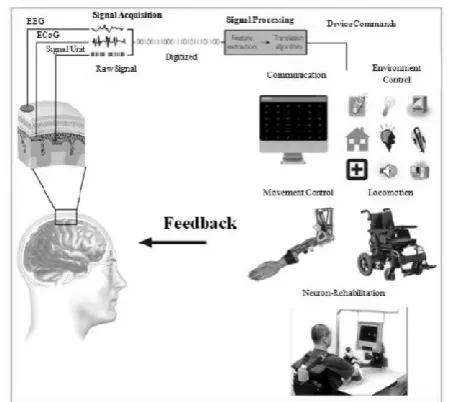
A Brain Computer Interface is fit to process the recorded brain flags and change over them into control orders for human-computer association to
complete the client's aim. Flag securing, pre-processing, include extraction and characterization are the four fundamental parts of the brain computer interfacing (Figure 1).
Figure 1: BCI Components
EEG is the most regularly utilized framework for flag procurement though obtrusive frameworks are additionally accessible for different applications. Computer applications possess a noteworthy place in recognizing the client's enthusiastic state. Flag handling for highlight extraction, interpretation, calculation, arrangement and development control requires a framework skilled to process every one of the information quick and precisely continuously. Amid the pre-processing, the framework dismisses all antiques and the pre-processed information are utilized for highlight extraction so as to recognize the contrast between two properties. At that point the framework changes over the information into a control summon for proposed application (Figure 2).
III.EMOTION AND EMOTION RECOGNITION METHODS
A. Comparison of Emotion Theories
Three essential methodologies gather the feelings into three classes; physiological, neurological, and subjective. Each human encounters positive or negative feelings every day.
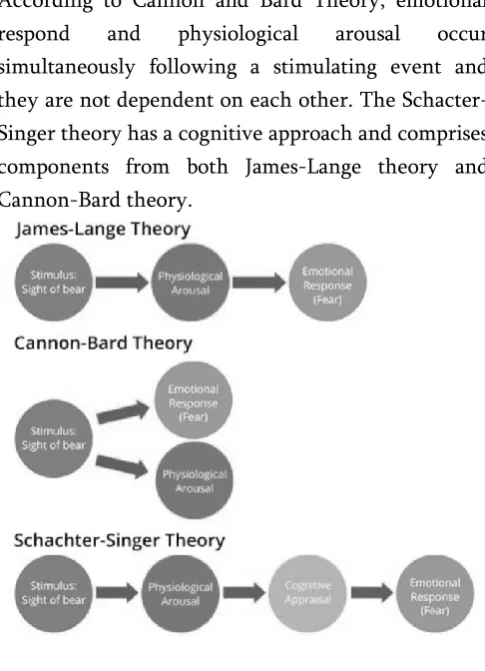
William James and Carl Lange projected that human nervous system reacts to the events happening in the surroundings by developing physiological reactions such as stomach ache, trembling, increased heart rate or relaxation. According to their theory, physiological arouses create emotions such as happiness, calmness, anger, fear, etc. Then Bradley and Lang proposed that emotional valence (positive versus negative) and arousal accounts for the most variance (P. J. Lang, 1995).
According to Cannon and Bard Theory, emotional respond and physiological arousal occur simultaneously following a stimulating event and they are not dependent on each other. The Schacter-Singer theory has a cognitive approach and comprises components from both James-Lange theory and Cannon-Bard theory.
Figure 3: Emotion Theories
B. Emotion Classification
1. EEG Recording
Introduction of sound or visual jolts drives the terminating of the neurons, which comes about as an electrical action inside the brain. Electroencephalography (EEG) is a non-invasive test that used to peruse brain waves through cathode framework. The greater part of the EEG frameworks that utilized generally in our days are fit to increase the brain flags and change over the simple information into advanced information. High and low-pass channels separate low and high recurrence antiquities. The enhanced and separated brain signals are put away and showed on the computer. The International 10– 20system (Towle VL et al, 1993) determines and names the anode areas on the scalp. Additionally other non-invasive or intrusive strategies can be utilized for the strategy. Gathering crude information by means of non-invasive or obtrusive procedures and changing over them into important information for different objectives can be acknowledged through full of feeling processing by means of brain computer interface frameworks. Numerous researchers and specialists have realized an awesome number of concentrates significant to the issue, up until now.
2. EEG Features
By assessment EEG flags and utilizing diverse techniques, a wide assortment of highlights related with the client's enthusiastic state can be removed and translated by means of novel emotional figuring.
3. EEG-based feeling acknowledgment and order
feelings by utilizing sound or visual jolts and remembering them through brain signals is developing as another and promising methodology for future applications went for fulfilling the client's needs determined by feelings and connections. Computer applications towards foreseeing feelings through brain signals by means of cathodes are in a developing pattern. Numerous investigations have just been directed on the issue. Nevertheless, few generally precise conclusions have been determined. The examinations on EEG based feeling acknowledgment and grouping through visual, sound or varying media boosts have been closed with 75-98 % exactness) (G. Chanel et al, 2006).
Feeling forecast and trait extraction by investigating the gathered information through different examination techniques constitute a noteworthy piece of the examinations on brain computer interface. As EEG is a straightforward and in addition, a quick technique with no ancient rarities, numerous examiners advantage from EEG top to record, measure and assess the neurophysiologic action of the brain. Figure 4. demonstrates an EEG recorded brain flag.
Figure 4: A recorded EEG flag
Feeling acknowledgment through EEG has picked up significance and the examinations on BCI constitute the linchpin of concentrates in view of bringing out feelings. Picking the suitable boosts to bring out the coveted feeling is a procedure that requirements extraordinary consideration. When we observe on the EEG based feeling acknowledgment contemplates completed up until this point, we can undoubtedly observe that sound, visual or varying media jolts
were utilized to initiate feelings for flag securing process. The vast majority of these boosts have been gotten from the IADS and the IAPS.
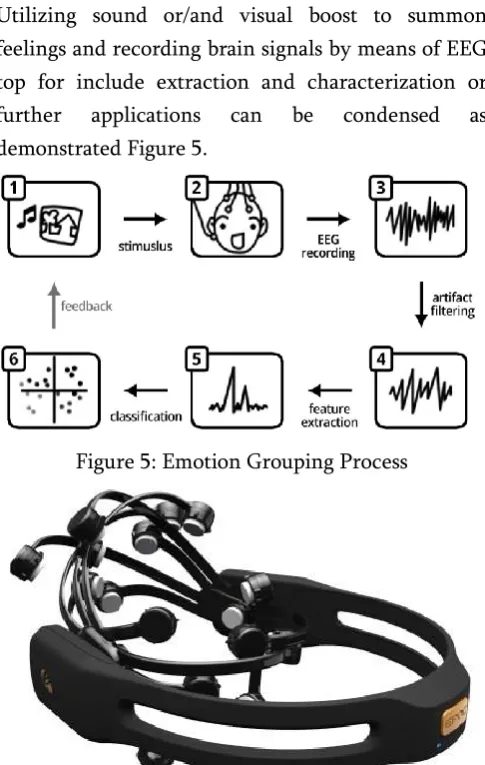
Utilizing sound or/and visual boost to summon feelings and recording brain signals by means of EEG top for include extraction and characterization or further applications can be condensed as demonstrated Figure 5.
Figure 5: Emotion Grouping Process
Figure 6: Emotiv EPOC Headset
4. Info and yield capacities
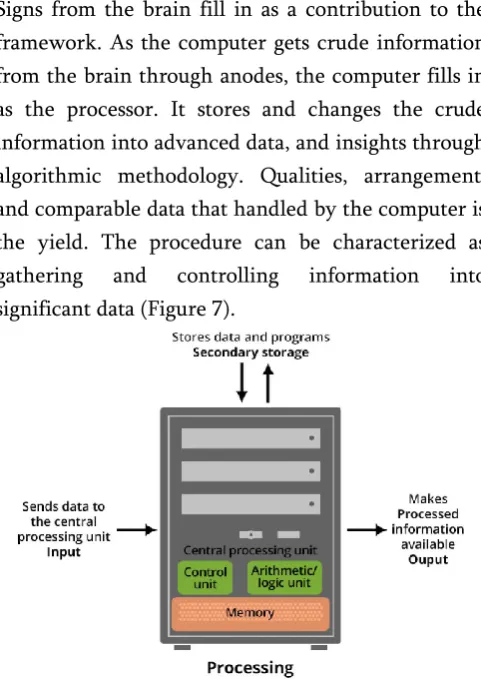
Signs from the brain fill in as a contribution to the framework. As the computer gets crude information from the brain through anodes, the computer fills in as the processor. It stores and changes the crude information into advanced data, and insights through algorithmic methodology. Qualities, arrangement, and comparable data that handled by the computer is the yield. The procedure can be characterized as gathering and controlling information into significant data (Figure 7).
Figure 7: Collecting crude information and handling it into important data through computer
The utilization of computers for electronic information handling or as such computerized information preparing or data innovation speaks to a noteworthy advancement and it is broadly utilized as a part of numerous spaces running from feeling acknowledgment, industry to drug. Most computers are outfitted with novel projects that include simple to computerized converter, separating piece, control unit, rationale unit and other programming like SPSS and SAS (Statistical Analysis System) (http://www2.hawaii.edu/~halina/603/SASintro.pdf) competent to process information and make significant data accessible.
5. EEG recording and Potential Difference
Amid EEG records, the computer shows the electrical possibilities; an upward (positive) avoidance shows up on the show when the
development of the current is towards the anode and a descending (negative) redirection when the present moves from the terminal. The positive or negative avoidances can increase meaning just when electrical capability of two combined cathodes are thought about. Unbiased electrode(s) that set on the ear lobe(s) encourage the examination methodology (Malmivuo J. furthermore, Plonsey R. 1995).
IV. IMPLEMENTATION
The EEG neurosheadset gives access to crude electroencephalography information. The EPOC brain head protector has eighteen attachments and can hold sixteen hubs or sensor cushions. The staying two attachments generally hold elastic cushions, and are known as the optional reference sensors, which are found instantly beneath and behind the ears. The essential reference sensors, which largely hold an ordinary sensor cushion, are found quickly above and behind the ears. The sensors cushions recognize electrical action on the surface of the brain. Open-source Matlab tool compartments, for example, EEGLAB, Fieldtrip, and the Neurophysiologic Biomarker Toolbox (NBT) can be utilized to process information from the electroencephalography.
Conscious considerations (Cognitiv suite): The gadget distinguishes 13 sorts of development - six headings (left, ideal, up, down, forward, and "pull/zoom") and six pivots (hostile to clockwise revolution, turn left and right, and influence in reverse and forward), in addition to one other representation ("vanish").
Emotions (Affectiv suite): "Fervor", "Engagement/Boredom", "Contemplation", and "Disappointment" can presently be estimated.
brainwaves recognize the articulations. Dissimilar to perusing mental action, these locations are quick passing on a conclusive favorable position and rendering them appropriate for quick-paced amusements in the FPS classification.
Head pivot: The precise speed of one's head can be estimated in the yaw and pitch (however not move) headings. This is identified by gyros, and isn't identified with the EEG highlights.
A brain– computer interface (BCI) is an immediate correspondence pathway between the brain and an outer gadget. BCIs are frequently coordinated at helping, expanding, or repairing human subjective or sensorymotor capacities the long haul target of this research is to make a multi-position, brain-controlled switch that is initiated by signals estimated straightforwardly from a person's brain. We trust that such a switch will permit a person with a serious incapacity to have compelling control of gadgets, for example, assistive machines, computers, and neural prostheses in indigenous habitats. This sort of direct-brain interface would expand a person's freedom, prompting a significantly enhanced personal satisfaction and lessen social expenses. Frequently the best coming up short of specialized guides for people with extreme physical handicaps (as above) is the insufficiency of the human-machine interface. With an all-inclusive, viable and proficient interface, current innovation has the capacity of giving considerable autonomy and consequently, an extraordinarily enhanced personal satisfaction for even the most seriously handicapped people. In quest for such a perfect interface, researchers have been contemplating the practicality of using electrical brain possibilities to specifically convey to gadgets, for example, a PC framework, mechanical, humanoid arm and UI applications.
V.CONCLUSION
In this study, it comprises of six sections where the Bluetooth interface and the Mindset Interface are given by Emotive. Straightforward BCI applications
incorporate frameworks for noting Yes/No inquiries, overseeing essential ecological control (e.g., lights, temperature), controlling a TV, or moving a wheel Computer and Information Science, Norwegian University of Science and Technology Trondheim, Norway
[2] Emotive neuroheadset SDK forum
[3] Baum, Michele."Monkey uses brain power to feed itself with robotic arm." Pitt Chronicle. http://www. chronicle. pitt. edu (2008).
[4] BrainGate - Turning Thought into Action. Available at: http://www. braingate.org/. [5] Chanel, G., Kronegg, J., Grandjean, D., & Pun,
T. (2006). Emotion assessment: Arousal evaluation using EEG’s and peripheral physiological signals. Multimedia content representation, classification and security, 530-537.
[6] Cyberkinetics. Available at: http://en. wikipedia.org/wiki/Cyberkinetics.
[7] Hochberg, L. R., Serruya, M. D., Friehs, G. M., Mukand, J. A., Saleh, M., Caplan, A. H., & Donoghue, J. P. (2006). Neuronal ensemble control of prosthetic devices by a human with tetraplegia. Nature, 442(7099), 164.
[8] Hjelm, S. I., & Browall, C. (2000, October). Brainball-using brain activity for cool competition. In Proceedings of NordiCHI (Vol. 7, No. 9).
[10] Lang, P. J. (1995). The emotion probe: Studies of motivation and attention. American psychologist, 50(5), 372.
[11] Levine, S. P., Huggins, J. E., BeMent, S. L., Kushwaha, R. K., Schuh, L. A., Rohde, M. M.,.& Smith, B. J. (2000). A direct brain interface based on event-related potentials. IEEE Transactions on Rehabilitation Engineering, 8(2), 180-185.
[12] Malmivuo, J., & Plonsey, R. (1995). Bioelectromagnetism: principles and applications of bioelectric and biomagnetic fields. Oxford University Press, USA.