International Journal of Scientific Research in Computer Science, Engineering and Information Technology © 2018 IJSRCSEIT | Volume 3 | Issue1 | ISSN : 2456-3307
An Efficient Approach for Personalized Travel Sequence
Recommendation on Multi-Source Big Social Media
Yasavarapu Naresh1, R Pitchiah2
1M.Tech Scho1lar, Department of CSE, Universal College of Engineering & Technology,Dokkiparru, Guntur District , Andhra Pradesh, India
2Associate Professor, Department of CSE, Universal College of Engineering & Technology,Dokkiparru, Guntur District,Andhra Pradesh, India
ABSTRACT
Online networking based proposal is the most understood approach, and is generally used in items, administrations and travel suggestions Location based collective separating travel suggestion strategies first mine Points of Interests (POI) in a city which has been gone by social clients utilizing geo-labels or GPS directions. At that point comparative clients are identified by computing the area co-events from clients' movement history and past experience. At that point comparable clients are identified by figuring the area co-events from clients' movement history. At last, the POIs of another city are prescribed by comparable clients' meeting history. In this paper, we give customized head out grouping wants to enthusiastic voyagers utilizing group contributed pictures with Geo Tagging, individuals traits and literary and picture depictions of photographs accessible in Social Networking Sites. We propose a customized travel arrangement designs suggestions when a client is going to visit another place. We take in clients' movement inclinations from the content depictions related with their mutual photographs via web-based networking media, rather than from GPS directions or registration records. Moreover, clients' similarities are measured with creator topic model instead of location co-occurrence. Spots are grouped in view of the geotag data, Number of Persons on the photograph and can be later utilized with POI suggestion. In customized travel proposal framework, we use clients' point inclinations as the law for collaborative filtering rather than area co-events. Dynamic touring plans are prescribed to the client in view of POI.
Keywords: Big Data, Social Media, Point Of Interest, Topical Package, Personalized Travel Sequence.
I.
INTRODUCTION
Big data has deeply rendered into both research and commercial fields such as health care, business and banking sectors. The advantages of big data progressively both research territory and mechanical region, for example, social insurance, back administrations, showcasing, and so forth. In explore region and industry zone both are confronted the issue of programmed travel suggestion, for example,
huge media, web-based social networking, they gives many offers to address many testing issues for movement proposal, GPS estimation and occasion [4] [6] [10]. The movement sites gives the offer of rich depiction of land checks and voyaging encounters of different clients composed by them.
social media which offers great chances to address many challenging problems like GPS location estimation, and constraint based travel recommendation. Different Travel websites (e.g., www.holidify.com) offer rich descriptions about places which includes best time to visit, estimated cost of the travel, distance and user experience written on blog pages. Community-contributed photos on social media include the metadata which involves tags, date taken, latitude, longitude etc. it maintains the record of users’ daily life and travel experience. These data are useful for mining POIs (points of interest), travel routes mining as well as this information provides an opportunity to recommend personalized travel POIs and routes based on user’s interest.
With the thriving of the social media and the accomplishment of numerous photograph sharing sites, as Flickr and Picasa, the volume of group contributed photographs has expanded definitely. Such vast scale client contributed photographs contain rich metadata data, for example, labels, time, and geo-areas (or geo-labels). These staggering measures of setting information, however loud, are massively valuable for some media applications including comment, seeking, publicizing and suggestion [1].
Among every one of the applications, travel proposal has been pulled in by numerous specialists due to the significance and the natural connection between individuals' consistently lives. By and large, a run of the mill travel suggestion framework comprises of two viewpoints: non-specific proposal and customized suggestion [2]. For the nonexclusive proposal, it contains the recommended travel data for the goal given by client when he/she is arranging an excursion, which answers the inquiry like "I need to go to New York, what are the must-see attractions?". The customized proposal, then again, considers client's profile to such an extent that it can give a more fitting suggestion result coordinating client
inclinations. The two perspectives are to help course arranging before the excursion.
Related Work: Zhiwen Yu et al. [3] explain the individual travel sequence the system certainly mined user’s and routes travel topical first choice also generates travel packages existing of dissimilar types of locations and visiting sequences. The location famous and user choice for POIs are modelled by make to use spatiotemporal advantage in use check-in records. There are some method use Topical Package Model: these learning method to automatically mine user travel interest from two publically media, community-collection of photos and searching anything, searching Mining any place, Cost, Time and Season getting information and Mining, path over which someone topical package model mining.
Optimal trip advice approaches and the optimization strategies.
Shuhui Jiang et al. [6] proposed a customized travel grouping suggestion framework by taking in topical bundle display from enormous multi-source online networking:travelogs and group contributed photographs. The upsides of our work are the framework naturally mined client's and courses' movement topical inclinations including the topical intrigue, cost, time and season, we prescribed POIs as well as movement succession, considering both the prominence and client's movement inclinations in the meantime. We mined and positioned well known courses in view of the likeness between client bundle and course bundle, and afterward streamlined the best positioned popular courses as indicated by social comparable clients' movement records. Be that as it may, there are still a few confinements of the present framework.
QiaoXiuquanl et al. [7] Social system administrations advance the rise of some novel customized administrations. Specifically, area based versatile informal community (LMSN) administrations are winding up progressively prominent to meet the rising SoLoMo (short for Social+Local+Mobile) showcase. Since LMSN locally incorporates client's disconnected exercises in the physical world with the online data in the virtual group, it gives another opportunity to clients make companions right away at a particular time and a particular area. In any case, up until now, neither the current companion proposals in the OSN nor the novel suggestion methodologies of LMSN have all around tended to this issue.
Karol Waga et al. [8] disclosed how to mine more information from client produced accumulations. They informed three writes regarding thing administrations, photographs and courses. The point of the creating is to prescribe purposes of interests to visit in client's encompassing. Database of guidance
MOPSI with no information purifying. Some technique utilized here are: Location-Aware Recommender System utilizes area mindful appraisals for guidance and MOPSI framework.
Shuhui Jiang et al. [9] clarify ATCF client purpose of intrigue are requested by comparative clients, who share same travel theme decision, option of crude GPS information just like that instance of most past works. Not at all like area based shared separating, even not in GPS records, same clients can in any case be mined accurately as per the same of client’s decision. Client's point decision can be mined from the literary clarification joined with his/her photographs through author topic model (ATM). Through ATM, travel and a client's subject decision can be inspired all the while. Strategy utilizes ATCF technique is offered to encourage comprehensive purposes of intrigue guidance for well-disposed clients. Theme demonstrates strategy has been acquired into claim travel guidance. TM is to the substance based strategy in item guidance frameworks.
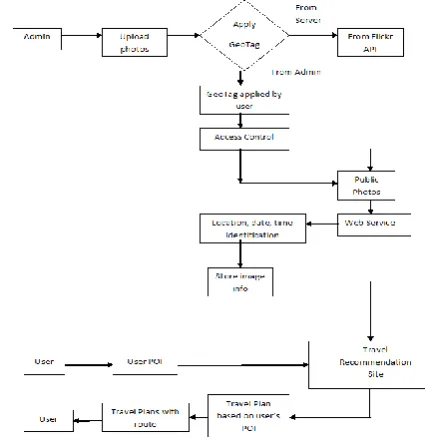
Proposed Work: The proposed work consists of the following parts for making our system more efficient. The parts are: Social Networking Website, Data collection and processing, Travel Recommendation Website and Personalized travel Plan.
Social Networking Website: In this part, we are creating a social networking profile that is specifically concentrated on users pictures. User will register their details and server stores user information in a database. Users will upload their pictures into the social networking site. While uploading, user provides tags for the picture, GeoTagging information and access privilege. User share photos in Social Networking Website.
Data collection and processing
GeoTaggingwill be applied to all downloaded public photos. GeoTagging applied using Flickr API. User can view their drive where all uploaded pictures by the user listed in this drive.
Travel Recommendation Website
We are creating a Travel Recommendation Website for recommending locations to the user. Admin will get permission from Social Website to access public photos with tags. After permission granted by the Social Website, Admin will perform preprocessing to the public photos. During preprocessing stage: location, date and time and tags of photos will be retrieved. These photos information is stored into database.
Personalized Itinerary Plan
Here, we will recommend travel destinations for the user based on user input. User specifies their Point of Interest and requirements for getting Travel Recommendations. User input will be current location, place to visit, duration, type and purpose of visit and budget cost. Based on user personalized POI, Server generate a personalized travel plan.
The proposed system architecture is given in the figure 1.
Figure 1.Proposed System Architecture
Xperimental Results: Compared with general routes recommendation, the recommended personalized travel sequential POIs are more accordant to user’s interest and more helpful for travel planning. To recommend personalized POI sequence, rank first, famous routes about the resemblance between user package and route package. Then Social similar users’ travel records further enhance top-ranked routes. Also, the enormous volume of details makes it a challenge for every tourist considers to a possible set of POIs to make a visit in any unknown city.
POI Package Mining Assessment: We look at the after-effects of POI bundle consequently mined with the data alluded to the official site. POI's topical intrigue, cost, time mined by our technique are signified as IP, CP, DP, while comes about because of the official site are meant as IO, CO, DO. We contrast our estimation comes about and the data of the official website. We utilize the outside connection of the official site on Wikipedia of the POI. To point, the first theme's precision rate is higher than 90 percent. The reason is that the agent labels in the point are separated from the labels of POIs of this theme. To cost, we utilize the mean cost of "grown-up", "youngsters and senior", "understudy and debilitated grown-up" to show the official cost.
Figure 2
meeting ubiquity disseminations of four case POIs: Ashok nagar, Radha Regent, power house church and Faraway tree gallery. We could see that diverse POIs are with various hot season.
II.
CONCLUSION AND FUTURE
ENHANCEMENT
To sort out the problem of having a huge volume of information which is a challenge for every tourist to pay attention to a potential set of POIs to make a visit on the unknown city, the community contributed pictures with GeoTagging is used. This method recommends that optimizing the POIs to the users’ interest preferences and POI popularity. Compared with general routes recommendation, this approach provides more relevant information based on user’s interest, and it is also more convenient for travel planning. To recommend personalized POI sequence, rank the first, the famous routes according to the similarity between users’ package and route package.
This system provides only the personalized travel route based on the users POI and not able to provide any information regarding the visiting time of POI especially the opening and closing time through travelogues, and it was hard to get more precise distributions of visiting time only through travelogues. recommendations from user-generated GPS traces". ACM Trans. Intell. Syst. Technol. Volume 2, Issue 1, 2011.
[3]. Zhiwen Yu, Huang Xu, Zhe Yang, and Bin Guo, "Personalized Travel Package With Multi-Point-of-Interest Recommendation
Based on Crowdsourced User Footprints", IEEE Transactions On Human-Machine Systems, VOL. 46, NO. 1, FEB. 2016.
[4]. Jing Li, Xueming Qian, "GPS Estimation for Places of Interest From Social Users’ Uploaded Photos", IEEE Transactions on Multimedia, VOL. 15, NO. 8, DECEMBER 2013.
[5]. Shih-Hsin Fang, Eric Hsueh-Chan Lu, Vincent S. Tseng," Trip Recommendation with Multiple User Constraints by Integrating Point-of-Interests and Travel Packages", 2014 IEEE 15th International Conference on Mobile Data Management.
[6]. Shuhui Jiang, Xueming Qian, "Personalized Travel Sequence Recommendation on Multi-Source Big Social Media", IEEE Transactions on Big Data, VOL. 2, NO. 1, 2016.
[7]. Qiao Xiuquanl, SU Jianchong, ZHANG Jinsong, XU WanglP, WU Budan, XUE Sida, CHEN Junliang", Recommending Friends Instantly in Location-based Mobile Social Networks", China Communications • February 2014.
[8]. Karol Waga, Andrei Tabarcea, Pasi Franti,"Recommendation of Points of Interest from User Generated Data Collection", 8th International Conference Conference on Collaborative Computing: Networking, Applications and Worksharing , Collaboratecom 2012 Pittsburgh, PA, United States, October 14-17, 2012.
[9]. Shuhui Jiang, Xueming Qian, Member, IEEE, Jialie Shen, Member, "Author Topic Model-Based Collaborative Filtering for Personalized POI Recommendations", IEEE Transactions on Multimedia, VOL. 17, NO. 6, JUNE 2015. [10]. H. Liu, T. Mei, J. Luo, H. Li, and S. Li, "Finding