A Listwise Approach to Coreference Resolution
in Multiple Languages
Oanh Thi Tran, Bach Xuan Ngo, Minh Le Nguyen, and Akira Shimazu
School of Information Science, JAIST, 1 - 8 Asahidai, Nomi, Ishikawa, Japan 923 - 1211 {oanhtt, bachnx, nguyenml, shimazu}@jaist.ac.jp
Abstract. This paper presents a listwise approach as an alternative to commonly used pair-wise approaches to the task of coreference resolution in multiple languages. In this listpair-wise approach, all antecedent candidates are examined simultaneously and assigned corresponding scores expressing the probability that each candidate is coreferent with a given mention. The experimental results on the corpora of SemEval-2010 shared task 1 showed that our proposed system gave the good results in English and Spanish, and comparative results in Catalan when compared to previous participating systems. These results prove that this approach is appropriate and quite efficient for Coreference Resolution in Multiple Languages.
Keywords: listwise approach, coreference resolution, multiple languages.
1 Introduction
Reference resolution (Jurafsky and Martin, 2009) (chapter 21, section 21.4) is a task of determin-ing to which entities are referred by which ldetermin-inguistic expressions. This task plays an important role in a large number of NLP applications such as Information Retrieval, Question Answering and Machine Translation. Therefore, it has attracted many attentions within the NLP community. Many works on various aspects (linguistic features (Ng, V., 2007), (Haghighi and Klein, 2009); machine learning models (Soonet al., 2001); multiple languages (Recasenset al., 2010a); and so on) of the coreference resolution task have been published.
Until the release of the SemEval-2010 task 1 (Recasenset al., 2010a), there has no competi-tion or public corpus that allows evaluating different coreference resolucompeti-tion systems in multiple languages. Most published systems only focus on a specific language and use the same data sets for example ACE or MUC corpora to train and test the systems. This makes the systems easy to unintentionally adapt themselves to the corpus but not to the problem in general. Therefore, this SemEval-2010 task 1 (Recasenset al., 2010a) made it possible to evaluate and compare various automatic coreference resolution systems in the aspects of: (i) the portability of systems across languages, (ii) the relevance of different levels of linguistic information, and (iii) the behavior of scoring metrics.
This shared task attracted lots of researchers’ attentions, but finally only six teams submitted their final results. The participating systems differed in terms of architecture, machine learning methods, etc. These systems mostly based on pairwise models, graph partitioning and entity-mention models. Unfortunately, these models suffered from an important weakness (Ng, V., 2010). In these models, each antecedent candidate is resolved independently with the other candidates. So the models could not determine the best candidate in the relation with the other candidates. To address this drawback, ranking models were proved to be a useful solution (Denis and Baldridge, 2007), (Ng, V., 2005), (Yanget al., 2003). Motivated from ranking models, in this paper, we present our proposal approach for learning-based reference resolution task in multiple languages.
We exploit the listwise approach, which is originally proposed for learning to rank task in infor-mation retrieval (Caoet al., 2007), to solve the SemEval-2010 Task on Coreference Resolution in Multiple Languages. This method allows the system to choose the best candidate for a given mention in the relation with other candidates. This means that all candidates will be examined simultaneously and the candidate with the highest score will be selected as a correct antecedent. This listwise approach has been successfully applied to information retrieval task (Cao et al., 2007). Our experimental results on the corpora of SemEval-2010 shared task 1 showed that when applied to coreference resolution task, this new listwise approach usually gave the better results than previous approaches. When estimated on the latest metric BLANC, our proposed system got the state-of-the-art performance.
The rest of the paper is organized as follows. Section 2 reviews related work proposed for this shared task. Section 3 describes our listwise approach to this shared task. Section 4 presents experimental results on the corpora of this SemEval-2010 shared task. Finally, section 5 gives some conclusion and future work.
2 Related Work
In this section, we preview previous approaches of the systems participated in the SemEval-2010 shared task 1. The experimental results of these systems are also used to make an experimental comparison with our proposed approach’s results. Here, we preview four systems: (1) RelaxCor system (Sapena et al., 2010); (2) SUCRE system (Kobdani and Schutze, 2010); (3) TANL-1 system (Attardiet al., 2010); and (4) UBIU system (Zhekova and Kubler, 2010). Table 1 presents an overview of the systems, their architecture and machine learning methods.
Table 1:Main characteristics of the previous systems.
Systems System Architecture Machine learning methods RelaxCor Graph Partitioning (solved by relaxation labeling) Decision trees, Rules SUCRE Best-first clustering, Relational database model,Regular feature definition language Decision trees, Nave Bayes,SVM, MaxEnt TANL-1 Highest entity-mention similarity MaxEnt
UBIU Pairwise model MBL
2.1 RelaxCor system
RelaxCor (Sapenaet al., 2010) is a constraint-based graph partitioning approach to coreference resolution solved by relaxation labeling. The approach combines the strengths of groupwise clas-sifiers and chain formation methods in one global method. This system includes three phases:
Phase 1: Graph representation
LetG = G(V, E) be an undirected graph. Each mentionmi in the document is presented
as a vertex vi ∈ V inG. An edgeeij ∈ E is added to the graph for pairs of vertices(vi, vj)
representing the possibility that both mentions corefer. A subset of constraintsCij ∈Cis used to
compute the weight valuewijof the edge connectingviandvj. Phase 2: Training process
Each mention pair(mi, mj)in training document is evaluated by the set of feature functions
which form a positive example if the mention pair corefers, and a negative otherwise. For each type of mention mj (for example: pronoun, named entity or nominal), a decision tree is generated and a set of rules is extracted with C4.5 rule-learning algorithm.
Given the training corpus, the weight of a constraintCkis related with the number of examples
Phase 3: Resolution Algorithm
The algorithm solves weighted constraint satisfaction problem dealing with the edge weights wij. In this manner, each vertex is assigned to a partition satisfying as many constraints as possible.
The algorithm assigns a probability for each possible label of each variable (corresponding to each vertex inG). The process updates the weights of the labels in each step until convergence. Finally, the assigned label for a variable is the one with the highest weight.
2.2 SUCRE system
This system developed a feature engineering which can help reducing the implementation effort for feature extraction. SUCRE has a novel approach to model an unstructured text corpus in a structured framework by using a relational database model and a regular feature definition lan-guage to define and extract the features.
In learning, there are four classifiers integrated in SUCRE: Decision tree, Nave bayes, Support vector machine and maximum entropy. However, finally the best reported results were achieved with Decision tree. In decoding, the coreference chains are created. The system uses best-first clustering. It searches for the best predicted antecedent from right-to-left starting from the end of the document.
2.3 TANL-1 system
The system is built based on highest entity-mention similarity. The authors applied Maximum Entropy classifier to determine whether two mentions refer to the same entity. The classifier is trained using the features extracted for each pair of mentions. If the pairwise classifier assigns a probability greater than a given threshold to the fact that a new mention belongs to a previously identified entity, it is assigned to that entity. In the case that more than one entity has a probability greater than the threshold; the mention is assigned to the one with highest probability by using best-first clustering strategy.
2.4 UBIU system
Classification in UBUI is based on mention pairs. The UBIU system used a combination of ma-chine learning, in the form of memory-based learning (MBL) in the implementation of TiMBL (Daelemanset al., 2007), and language independent features. MBL uses a similarity metric to find the k nearest neighbors in the training data in order to classify a new example.
Despite of the difference in feature engineering, learning methods and some processing tech-niques, it can be seen that three later systems - SUCRE, TANL-1, and UBIU - belong to the approach called pairwise approach. The typical machine learning approach of these three systems includes two steps:
• Classification: systems evaluate whether each pair of mentions is coreferent with each other
or not.
• Formation coreference chain: Given the previous classification, the systems form coreference
chain (mostly based on best-first clustering).
The approach presented in RelaxCor system joined classification and chain formation into the same step. In this manner, decisions are taken considering the whole set of mentions, ensuring consistency and avoiding that classification decisions are independently taken.
3 A listwise approach to coreference resolution task
3.1 Coreference resolution as a ranking problem
P r(D−x) =
0 ifDis not coreferent withx
1 ifDis coreferent withxandxis closest toD 0.5 ifDis coreferent withxandxis not closest toD
These training instances are used to learn parameters of the Neural Network modelωaccording to the algorithm 1.
Resolution phase
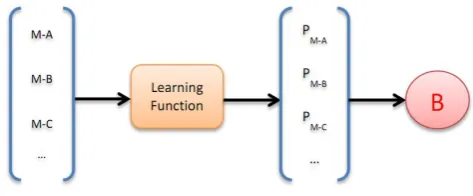
Figure 1 visualizes the resolution phase. In our listwise approach, we create instance as a list of candidates in learning and the learning function will assign a score for each candidate in that list. The candidate is chosen as a true antecedent is the one that has the highest score. To allow a mention to be non-anaphoric, we set up a thresholdθto determine whether a given mention is anaphoric or not. This parameter will be chosen using the development set. In figure 1, we assume thatBis selected as an exact antecedent of mentionM among the candidate list of A, B, C, and so on.
Figure 1:Visualizing the resolution phase.
4 Experiments
4.1 Describing the corpus and evaluation metrics
In these experiments, we used the corpora of SemEval-2010 task 1 on Coreference Resolution in Multiple Languages. We tested our system using three different languages (Catalan, English, and Spanish). The size of the task datasets are provided in the table 2:
Table 2:Size of the task datasets.
Languages #docs Training#sents #tokens #docsDevelopment#sents #tokens #docs Testing#sents #tokens
Catalan 829 8,709 253,513 142 1,445 42,072 167 1,698 49,260
English 229 3,648 79,060 39 741 17,044 85 1,141 24,206
Spanish 875 9,022 284,179 140 1,419 44,460 168 1,705 51,040
In the experiments, we evaluate our system using closed gold-standard setting. It means that we use the gold-standard columns with true mention boundaries and our system was built strictly with the information provided in the task datasets. This is because our system focuses on evaluating various approaches of previous participating systems versus our proposed listwise approach.
MUC-6/7 (Vilainet al., 1995)
This is the oldest and most widely-used metric measure. This metric is based on coreference links. First, we count the number of common links between the reference ( or ”truth”) and the system output (or ”response”). The link precision is the number of common links divided by the number of links in the system output, and the link recall is the number of common links divided by the number of links in the reference.
BCUB (Bagga and Baldwin, 1998)
The MUC metric yields unintuitive results because of two main shortcomings. First, it does not give any credit for single-mention entities since no link can be found in these entities. Second, all errors are considered to be equal because in some tasks, some coreference errors do more damage than others. These drawbacks lead to the proposal of BCUB metric. This metric first computes a precision and recall for each individual mention, and then takes the weighted sum of these individual precisions and recalls as the final metric. The choice of the weighting scheme is determined by the task for which the algorithm is going to be used.
CEAF (Luo, 2005)
The BCUB metrics still has its own problems: for example, the mention precision/recall is computed by comparing entities containing the mention and therefore an entity can be used more than once. Thus, they proposed Constrained Entity-Aligned F-measure or CEAF metric. It finds the best one-to-one mapping entities between the subsets of reference and system entities. They are aligned by maximizing the total entity similarity under the constraint that a reference entity is aligned with at most one system entity, and vice versa. After that, it computes the recall, precision and F-measure.
BLANC ( Recasens and Marti, 2010b)
BLANC, a measure obtained by applying the Rand index (Rand 1971) to coreference resolution and taking into account the shortcomings of above previous metrics. The Rand index seems to be especially adequate for evaluating coreference since it allows us to measure ’non-coreference’ as well as coreference links. Despite of its shortcomings, it addresses to some degree the drawbacks of previous metrics.
4.2 Feature Sets
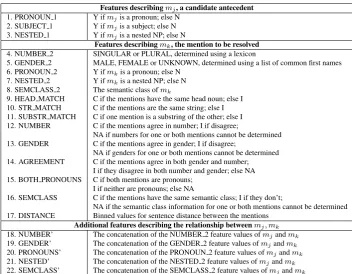
In this task, the feature sets were selected from the feature pool presented in (Haghighi and Klein, 2009). We selected 22 features which are divided into 3 groups as described in more detail in table 3. These features are popular and available in all languages of this SemEval-2010 shared task 1.
4.3 Experimental results
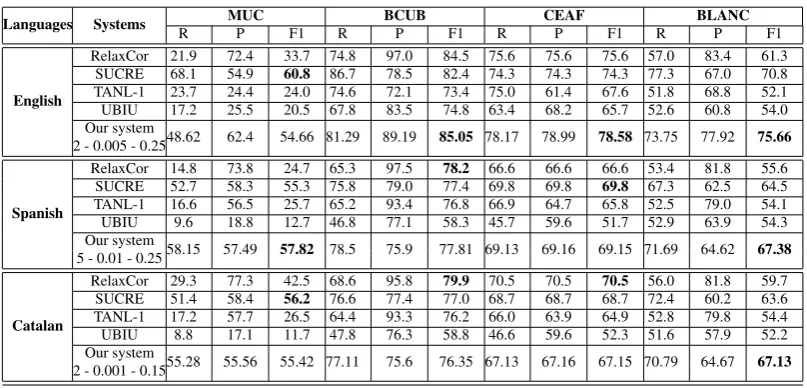
By implementing ListNet, our system had to choose the set of three parameters which are (1) number of iteration T; (2) learning rate η; and (3) the thresholdθ to determine a candidate is coreferent with a given mention or not. To determine the best parameter set, we varied their values and selected parameters that maximize the sum of four metrics based on the development sets. After that, we used these parameters to evaluate our proposed system on the test sets. The best parameter sets for three languages are presented in the table 4.
The experimental results are compared with four models which are (1) RelaxCor system (Sapena et al., 2010); (2) SUCRE system (Kobdani and Schutze, 2010); (3) TANL-1 system (Attardi et al., 2010); and (4) UBIU system (Zhekova and Kubler, 2010). Table 4 shows our experimental results of the proposed model for three languages using four metrics.
Table 3:The feature set for all languages.
Features describingmj, a candidate antecedent
1. PRONOUN 1 Y ifmjis a pronoun; else N
2. SUBJECT 1 Y ifmjis a subject; else N
3. NESTED 1 Y ifmjis a nested NP; else N
Features describingmk, the mention to be resolved
4. NUMBER 2 SINGULAR or PLURAL, determined using a lexicon
5. GENDER 2 MALE, FEMALE or UNKNOWN, determined using a list of common first names
6. PRONOUN 2 Y ifmkis a pronoun; else N
7. NESTED 2 Y ifmkis a nested NP; else N
8. SEMCLASS 2 The semantic class ofmk
9. HEAD MATCH C if the mentions have the same head noun; else I 10. STR MATCH C if the mentions are the same string; else I 11. SUBSTR MATCH C if one mention is a substring of the other; else I 12. NUMBER C if the mentions agree in number; I if disagree;
NA if numbers for one or both mentions cannot be determined 13. GENDER C if the mentions agree in gender; I if disagree;
NA if genders for one or both mentions cannot be determined 14. AGREEMENT C if the mentions agree in both gender and number;
I if they disagree in both number and gender; else NA 15. BOTH PRONOUNS C if both mentions are pronouns;
I if neither are pronouns; else NA
16. SEMCLASS C if the mentions have the same semantic class; I if they don’t;
NA if the semantic class information for one or both mentions cannot be determined 17. DISTANCE Binned values for sentence distance between the mentions
Additional features describing the relationship betweenmj, mk 18. NUMBER’ The concatenation of the NUMBER 2 feature values ofmjandmk 19. GENDER’ The concatenation of the GENDER 2 feature values ofmjandmk 20. PRONOUNS’ The concatenation of the PRONOUN 2 feature values ofmjandmk 21. NESTED’ The concatenation of the NESTED 2 feature values ofmjandmk 22. SEMCLASS’ The concatenation of the SEMCLASS 2 feature values ofmjandmk
For English language, our system got the best results on three F-scores of CEAF, BCUB and BLANC and got the second best on the remaining MUC F-score. In that, CEAF and BLANC F-scores increase significantly from the previous highest scores 75.6 to 78.58, and from 70.8 to 75.66. Our system also overcomes three systems of RelaxCor, TANL-1 and UBIU in all four metrics.
For Spanish language, our system got the best results on two F-scores of BLANC and MUC. For the two remaining F-scores of CEAF and BCUB, we got the results which are comparative to previous best scores (CEAF: 69.15 in comparison with 69.8; and 77.81 in comparison with 78.2). Our system beat TANL-1 and UBIU system. Compared with RelaxCor, our system got higher results on three F-scores of CEAF (from 66.6 to 69.15), MUC (from 24.7 to 57.82) and BLANC (from 55.6 to 67.38) which are all significant increase. For the remaining BCUB F-score, our system decreases insignificantly (from 78.2 to 77.81). Compared to SUCRE system, our system increases the F-score of MUC, BCUB and BLANC and decrease insignificantly on the CEAF F-score.
4.4 Discussion
The experimental results on these corpora showed that our proposed system gave the good results in English and Spanish; and comparative results in Catalan when compared to previous participat-ing systems. When applied to coreference resolution task in multiple languages, this new listwise approach overcomes most of previous approaches for all four available metrics. For other sys-tems which our system cannot overcome, usually we got the comparative results or insignificantly decrease in one metric and significantly increase in other remaining metrics.
Table 4:Experimental results of the proposed model for three languages and four metrics.
Languages Systems R MUCP F1 R BCUBP F1 R CEAFP F1 R BLANCP F1
English
RelaxCor 21.9 72.4 33.7 74.8 97.0 84.5 75.6 75.6 75.6 57.0 83.4 61.3
SUCRE 68.1 54.9 60.8 86.7 78.5 82.4 74.3 74.3 74.3 77.3 67.0 70.8
TANL-1 23.7 24.4 24.0 74.6 72.1 73.4 75.0 61.4 67.6 51.8 68.8 52.1
UBIU 17.2 25.5 20.5 67.8 83.5 74.8 63.4 68.2 65.7 52.6 60.8 54.0
Our system 48.62 62.4 54.66 81.29 89.19 85.05 78.17 78.99 78.58 73.75 77.92 75.66
2 - 0.005 - 0.25
Spanish
RelaxCor 14.8 73.8 24.7 65.3 97.5 78.2 66.6 66.6 66.6 53.4 81.8 55.6
SUCRE 52.7 58.3 55.3 75.8 79.0 77.4 69.8 69.8 69.8 67.3 62.5 64.5
TANL-1 16.6 56.5 25.7 65.2 93.4 76.8 66.9 64.7 65.8 52.5 79.0 54.1
UBIU 9.6 18.8 12.7 46.8 77.1 58.3 45.7 59.6 51.7 52.9 63.9 54.3
Our system 58.15 57.49 57.82 78.5 75.9 77.81 69.13 69.16 69.15 71.69 64.62 67.38
5 - 0.01 - 0.25
Catalan
RelaxCor 29.3 77.3 42.5 68.6 95.8 79.9 70.5 70.5 70.5 56.0 81.8 59.7
SUCRE 51.4 58.4 56.2 76.6 77.4 77.0 68.7 68.7 68.7 72.4 60.2 63.6
TANL-1 17.2 57.7 26.5 64.4 93.3 76.2 66.0 63.9 64.9 52.8 79.8 54.4
UBIU 8.8 17.1 11.7 47.8 76.3 58.8 46.6 59.6 52.3 51.6 57.9 52.2
Our system 55.28 55.56 55.42 77.11 75.6 76.35 67.13 67.16 67.15 70.79 64.67 67.13
2 - 0.001 - 0.15
in section 4.1. This situation makes it hard to successfully compare systems. Getting the state-of-the-art performance based on all this four common metrics seems to be a difficult task. Until now there is no common agreement on a standard measure for coreference resolution task.
However, based on formulas and characteristics of each metric, we saw that later-proposed metrics usually give the better quality than metrics proposed early. If using this criterion, we saw that we got the highest F-score for the latest proposed BLANC metric in all three languages. In other words, our proposed system got the state-of-the-art performance for coreference resolution task in multiple languages.
5 Conclusion and Future Work
In this paper, we present a new listwise approach to the task of SemEval-2010 task 1 on corefer-ence resolution in multiple languages. This new listwise approach allows all candidate antecedents are considered simultaneously and therefore brings in more benefit than traditional pairwise ap-proaches. The experimental results on the public corpora showed that this new proposed approach gave relatively good performance in all three languages. For the latest proposed metric BLANC, we got the state-of-the-art performance for this coreference resolution task in multiple languages. For the future works, we will continue to do experiments using other settings of the SemEval-2010 task 1 to fortify the strength of this listwise approach.
A straightforward generalization of twin-candidate model is the ranker model proposed by (Denis and Baldridge, 2007). In this ranker model, the computation of the model’s expectation of a feature is directly based on the probabilities assigned to the different candidates by using supervised maximum entropy ranking approach. In the future, we also would like to investigate other ranker models like this one on the corpora of this SemEval-2010 shared task number 1.
Acknowledgments
References
Attardi, G., Rossi, S. D., and Simi, M. 2010. TANL-1: coreference resolution by parse analysis and similarity clustering.SemEval-2, pp.108-111.
Bagga, A. and Baldwin, B. 1998. Algorithms for scoring coreference chains. LREC Workshop on Linguistic coreference, pp.563-566.
Cao Z., Qin T., Liu T.Y., Tsai M.F., Li H. 2007. Learning to rank: from pairwise approach to listwise approach.ICML, pp. 129-136.
Daelemans, W., Zavrel, J., Sloot, K., and Bosch, A. 2007. TiMBL: Tilburg memory based learner version 6.1 reference guide. Technical Report ILK 07-07, Induction of Linguistic Knowledge, Computational Linguistics, Tilburg University.
Denis, P. and Baldridge, J. 2007. A ranking approach to pronoun resolution. International Conference on Artificial Intelligence, pp.1588-1593.
Haghighi, A., Klein, D. 2009. Simple Coreference Resolution with rich syntactic and semantic features.Empirical methods in Natural Language Processing, pp.1152-1161.
Iida, R., Inui, K., Takamura, H., and Matsumoto, Y. 2003. Incorporating contextual cues in trainable models for coreference resolution. EACL Workshop on the computational Treatment of anaphora, pp.23-30.
Jurafsky D., Martin J.H. 2009. Speech and Language Processing. Prentice Hall Series in Artificial Intelligence, 2nd Edition.
Kobdani, H. and Schutze, H. 2010. SUCRE: Modular system for coreference resolution. SemEval-2, pp.92-95.
Luo, X. 2005. On coreference resolution performance metrics. HLT-EMNLP, pp.25-32.
Ng, V. 2005. Supervised ranking for pronoun resolution: Some recent improvements. AAAI, pp.1081-1086.
Ng, V. 2007. Semantic class induction and co-reference resolution. ACL, pp.536-543.
Ng, V. 2010. Supervised Noun phrase coreference research: The first fifteen years. Annual Meeting of the Association for Computational Linguistics, pp.1396-1411.
Rahman, A. and Vincent Ng. 2009. Supervised models for coreference resolution. Empirical Methods in Natural Language Processing, pp.968-977.
Recasens, M., Marquez, L., Sapena, L., Marti, M., Taule, M., Hoste, V., Poesio, M., Versley, Y. 2010a. SemEval-2010 Task 1: Co-reference Resolution in Multiple Languages. International Workshop on Semantic Evaluation, ACL, pp.1-8.
Recasens, M. and Hovy, E. 2010b. BLANC: Implementing the Rand Index for coreference evaluation.In prep.
Soon W.M., Ng H.T., Lim D.C.Y 2001. A machine learning approach to co-reference resolution of noun phrases.Computational Linguistics, pp.521-544.
Sapena, E., Padr, L., and Turmo, J. 2010. RelaxCor: A Global relaxation labeling approach to coreference resolution for the SemEval-2 Coreference Task.SemEval-2, pp.88-91.
Vilain, M., Burger, J., Aberdeen, J., Connolly, D., and Hirschman, L. 1995. A model-theoretic coreference scoring scheme.MUC-6, pp.45-52.
Yang, X., Zhou, G., Su, J. and Tan, C.L. 2003. Coreference resolution using competitive learning approach.ACL, pp.176-183.