Correcting Errors Using the Framework of Argumentation: Towards
Generating Argumentative Correction Propositions from Error
Annotation Schemas
Marie Garniera, Arnaud Ryknera, and Patrick Saint-Dizierb
a
Université Toulouse le Mirail, 5 allées Antonio Machado, 31058 Toulouse [email protected], [email protected]
b IRIT,
118 route de Narbonne, 31062 Toulouse [email protected]
Abstract. This paper presents a first step towards the automatic generation of argumentative responses to accompany the corrections proposed by a correction and writing-aid system. This system focuses on pairs of languages (e.g. French speakers writing in English), and incorporates a strong didactic orientation. We show how, in case several corrections are available, error annotations can be used to design argumentations weighing the pros and cons of each correction. Argumentation is paired with decision theory in order to help the user pick out the most appropriate correction. Argumentative responses produced manually are used to create the generation schemas required to implement the automatic generation of such texts in the future.
Keywords: Error annotation, error correction, correction rules, argumentation, decision.
1
Aims and Challenges
1.1
The Context
Our1 project aims at designing a didactic tool targeted at non-native speakers of a language (L2) who have to produce written documents in that language (e.g. French speakers writing in English). The project emerges from the simple observation that these writers often encounter lexical, grammatical, and stylistic difficulties which might hinder the comprehension of their message, as well as undermine their credibility and professionalism (Ellis, 1994).
Our main objective is to develop procedures for the correction of those errors which are not (and will not in the near future) be treated by the most advanced text processing systems such as the Office Suite, Open Office and the like (Lee and Seneff, 2006). We also aim at correcting style and text-level errors in the user's native language, since those are very frequent.
Research for this project is conducted on the basis of language pairs, as a large number of errors seem to be specific to a community of speakers of a L1, which is imputable to the influence of L1 structures and lexicon on the production of texts in L2 (Chan, 2004; Han et al., 2005). The present paper focuses on the pair French to English, but other language pairs are also being investigated in the project (e.g. Thai to English).
One of the fundamental aspects of this project is the inclusion of a didactic approach into the task of correcting errors. The resulting tool (also called an assistant) should be able to interact with the user in order to explain errors and provide grammatical, lexical or stylistic guidelines and information, as well as to produce argumentative responses where several corrections are possible. In contrast with text editors, but in the spirit of tutoring systems, we want to leave
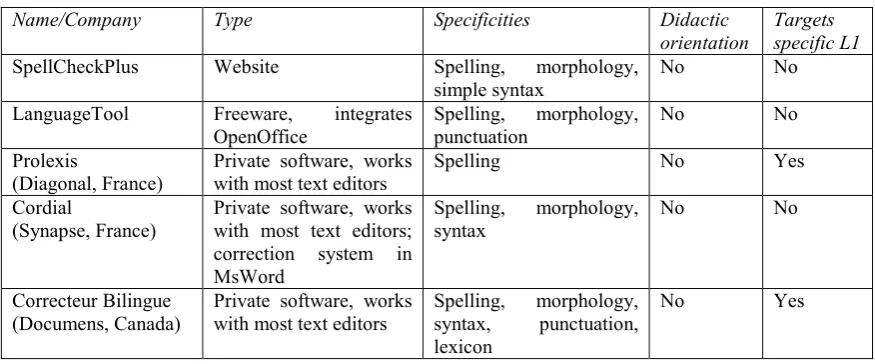
Tutoring systems on the other hand are designed to develop the competence of the writer in the production of texts in English. Writer's Workbench (EMO Solutions, USA) is a system which provides English speakers with advice on style and textual organization. TellMeMore (Auralog, France) targets French users of English, but focuses on the correction of oral productions, and only offers series of set grammatical exercises.
An efficient solution for French speakers wishing to develop their competence in the production of English texts through the use of a didactic correction system is thus still wanting. As we have said, the use of the framework of argumentation in the treatment of errors and their correction is a way to achieve the implementation of a strong didactic component into our system.
2
Annotating Errors and Proposing Corrections
2.1
Annotation Schema
Once manually detected in the corpus, errors are annotated following a schema designed in XML format. Annotations allow us to identify and categorize errors, as well as the parameters at stake when error correction is carried out by human correctors. Those parameters are a priori neutral in the annotation schemas. We then define a preference model which assigns polarity (positive, negative), and a weight to each of these parameters. The attributes we introduce are designed so as to allow the elaboration of an argumentation model. We will then consider these attributes as weighted arguments for or against a certain correction. Paired with a decision model, optimal corrections can be proposed to the user, together with explanations.
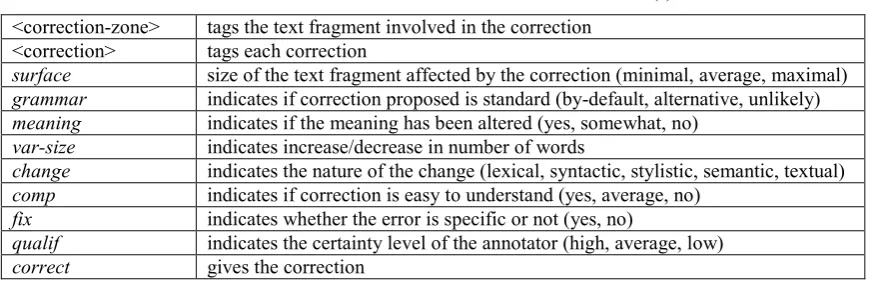
Our annotation schema contains several groups of tags and their attributes. Table 2 gives the tags and attributes designed to delimit and characterize errors, while Table 3 presents the tags and attributes designed to delimit and characterize corrections.
Table 2: Error delimitation and characterization
<error-zone> tags the group of words involved in the error comprehension indicates if the segment is understandable (0 to 4) grammaticality indicates how ungrammatical the error is (0 to 2)
categ main category of the error (lexical, syntactic, stylistic, semantic, textual) source transfer, overgeneralization, erroneous rule…
Table 3: Delimitation and characterization of correction(s)
<correction-zone> tags the text fragment involved in the correction <correction> tags each correction
surface size of the text fragment affected by the correction (minimal, average, maximal) grammar indicates if correction proposed is standard (by-default, alternative, unlikely) meaning indicates if the meaning has been altered (yes, somewhat, no)
var-size indicates increase/decrease in number of words
change indicates the nature of the change (lexical, syntactic, stylistic, semantic, textual) comp indicates if correction is easy to understand (yes, average, no)
fix indicates whether the error is specific or not (yes, no)
qualif indicates the certainty level of the annotator (high, average, low) correct gives the correction
Example 1
The second stage has therefore two goals: […] and the construction of <correction-zone>
<error-zone comprehension="2" grammaticality="1" categ="syntactic" source="calque"> the meaning utterance
<correction qualif="high" grammar="by-default" surface="minimal" meaning= "not altered" var-size="+2" change="synt" comp="yes" correct="the meaning of the utterance">
</correction>
<correction qualif="high" grammar="unlikely" surface= "minimal" meaning= "somewhat" var-size="0" change="lexical+synt" comp="average" correct="the meaningful utterance"> </correction>
</error-zone> </correction-zone>
with the metaphorical construction.
2.2
Deriving Correction Rules
Several steps are required in order to reach the stage of drafting rules for corrections. The approach is still exploratory, and needs further elaborations and evaluations. This is achieved through a gradual and manually controlled machine learning strategy. To define a correction rule, the segment of words in the error zone first gets a morpho-syntactic tagging, so that it can easily be identified as an erroneous pattern in any circumstance. All the errors that have the same erroneous pattern are grouped to form a single correction procedure. In that same category (named 'incorrect NØN constructions'), another pattern is [N(+plural) N] (e.g. horses carriage), and it results in a different correction rule. Concerning the pattern 'Det N N', when all the corresponding errors are grouped, another type of correction is found that corresponds to the inversion (the predicate meaning => the meaning of the predicate). Informally, a correction rule is defined as the union of all the corrections found for that particular pattern:
(1) merge all corrections which are similar, i.e. where the position of each word in the erroneous segment is identical to the one it has in the correction; the values of the different attributes of the <correction> tag are averaged,
(2) append all corrections which have a different correction following the word to word criterion above, and also all corrections for which the attribute 'fix' is true.
(3) tag the corrections with all the appropriate morphosyntactic details, (4) remove the text segments or keep them as examples.
For the example presented above, we get the following rule:
<correction-rule>
<error-zone comprehension="2" grammaticality="1" categ="syntactic" source="calque" pattern="[Det N(1) N(2)"]>
<correction qualif="high" grammar="by-default" surface="minimal" meaning="not altered" var-size="+2" change="synt" comp="yes" web-correct= "[Det N(1) of the N(2)]" >
</correction>
<correction qualif="high" grammar="unlikely" surface="minimal" meaning="somewhat" Var-size="0" change="lexical+synt" comp="average" correct="[Det Adj(deriv(N(1)) N(2)]" example="the meaningful utterance">
</correction>
Here we observe several competing solutions: when we find a segment such as "the meaning utterance", we have no information as to the noun order and the type of preposition to insert (however, 'of' is the most frequent one). In this example, the best solution is to use the web as a corpus. The attribute web-correct is a shortcut for a function that triggers a web search: the instantiated pattern is submitted to a search engine to evaluate its frequency of occurrence. The most frequent one is adopted. Other rules contain e.g. interactions with the user to get a missing argument or to correct a pronoun.
The form: pattern => correct (or) web-correct is a rewriting rule that operates the correction under constraints given in the correct attribute and under didactic constraints given in the associated attributes. Several corrections from the same rule or from different rules may be competing. This is a very frequent situation, for example in the case of misplaced adverbs, which may equally be either before the main verb, or at the beginning, or at the end of the sentence. A correction rule is active for a given correction iff all the constraints it contains in the correct attribute are met.
2.3
Configuration of Corrections
The two configurations of corrections mentioned above, i.e. the use of the web as a corpus and interaction with the user, correspond to the type of corrections that requires the use of resources which are external to the system. Dictionaries and terminologies are two other kinds of external resources that can be used. The other major type of corrections is that of corrections that can be carried out "internally", relying on correction rules which are implemented in the system, without any use of external resources.
Multiple propositions for corrections might arise in any of these cases. Let us introduce another example where several corrections are possible: "We think that some features introduce in any situation some inherent difficulties". Here the adverbial "in any situation" is misplaced, since it is placed between the verb and its object, which is not a canonical construction in English. Following is the annotated segment with the proposition of two corrections (i.e. "some features introduce some inherent difficulties in any situation", and ", in any situation, some features introduce some inherent difficulties"):
Example 2
We think that <correction-zone> <error-zone>
<comprehension="3" grammaticality="1" categ="syntactic" source="overgeneralization"> some features introduce in any situation some inherent difficulties
<correction>
<surface="maximal" grammar="by-default" meaning="no" var-size="0" change="syntactic" comp="yes" fix="no" qualif="high" correct="some features introduce some inherent difficulties in any situation">
</correction>
<surface="maximal" grammar="alternative" meaning="somewhat" var-size="0" change="syntactic" comp="yes" fix="no" qualif="high" correct=", in any situation, some featuresintroduce some inherent difficulties">
</error-zone> </correction-zone>
3
An Argumentation Model for Dealing with Multiple Corrections
As said above, our goal, within an 'active didactics' perspective, consists in identifying the best corrections and proposing them to the writer together with explanations, so that he can make the most relevant decisions. Classical decision theory must be paired with argumentation to produce explanations. In our framework, argumentation is based on the attributes associated with the tags of the correction rules. We assume that decisions are made in a rational way, i.e. in a way which is consistent with a set of preferences (note that in some areas of language, rationality is not as central, as in poetry) (Bratman, 1987). This view confers a kind of operational semantics to the tags and attributes we have defined.
Formally, a decision based on practical arguments is represented by a vector (D, K, G, R) defined as follows:
(1) D is a vector composed of decision variables associated with explanations: the list of the different decisions which can be considered, including no correction. The final decision is then made by the writer;
(2) K is a structure of stratified knowledge, possibly inconsistent. Stratifications encode priorities (e.g. Bratman, 1987; Amgoud et al., 2008). K includes, for example, knowledge on readers (e.g. in emails they like short messages, close to oral communication), grammatical and stylistic conventions or by-default behaviors, global constraints on texts or sentences. Each strata is associated with a weight wK ∈ [0,1];
(3) G is a set of goals, possibly inconsistent, that correspond to positive attributes Ai to promote in a correction. These goals depend on the type of document being written;
(4) R is a set of rejections: i.e. criteria that are not desired, e.g., longer text after correction. Format for R is the same as for G. R and G have an empty intersection. Rejections may also have weights. Some attributes may remain neutral (e.g. var-size) for a given type of document or profile.
The global scenario for correcting an error is as follows: while checking a text, when an error pattern (or more if patterns are ambiguous) is activated, then the corrections proposed in the <correction> tag are activated and a number of them become active because the corresponding 'correct' attribute is active. Then, for each such correction, the attributes in the correction, which form arguments, are integrated in the decision process. Their weight in G or R is integrated in a decision formula; these weights may be reinforced or weakened via the knowledge and preferences given in K. For each correction decision, a meta-argument that contains all the weighted pros and cons is produced. This meta-argument is the motivation and explanation for realizing the correction as suggested. It has no polarity. It can then be associated with a decision, based on general considerations on the attribute values or on the writer’s profile. The final result corresponds to the sample texts given below.
From a linguistic point of view, the evaluation of this approach is a real challenge. At the moment, we aim at evaluating the error recognition rate and whether the corrections proposed are appropriate. We are now exploring a way to evaluate the construction of arguments and the hierarchy of decisions which are proposed. This task has not yet been achieved due to the necessity of developing a prototype and an evaluation protocol first.
4
Generating Argumentative Texts to Accompany Correction Propositions
information provided by annotations to generate argumentative texts presenting the pros and cons of each correction in a synthetic and cooperative way.
4.1
Argumentative Texts Produced by Humans from Annotations
The first step towards the automatic generation of such texts is the identification of their nature and form. This can be carried out via the manual production of argumentative responses using error annotations. We asked a didactician who is familiar with our annotation schema to produce these responses using very simple language and weighing arguments for and against the different corrections proposed in the annotations. This allows us to induce generation patterns that will be used in any correction scenario.
The argumentative response given for the annotated segment "We think that some features introduce in any situation some inherent difficulties" is as follows:
Argumentation 1
The adverbial is incorrectly placed. Two corrections are possible. They are equal in every respect except meaning and grammar structure: the second one constitutes a slight change in meaning and is not the default grammatical form. For these reasons, the first correction might be preferable.
We also investigated cases in which no correction might be preferred to the single correction which is proposed. Here is an example of this type of situation, followed by the argumentative text produced (erroneous segment: "Heterogeneity is the main issue when several preexisting information sources have to cooperate"; proposition: "When several preexisting information sources have to cooperate, heterogeneity is the main issue")
Example 3
<correction-zone> <error-zone>
<comprehension="4" grammaticality="2" categ="stylistic" source="calque">
Heterogeneity is the main issue when several preexisting information sources have to cooperate <correction>
<surface="maximal" grammar="by-default" meaning="no" var-size="0" change="stylistic" comp="yes" fix="yes" qualif="average" correct="When several preexisting information sources have to cooperate, heterogeneity is the main issue">
</correction> </correction-zone>
Argumentation 2
The organization of information in the sentence is not optimal. The sentence can be corrected as proposed. However, the erroneous segment is easily comprehensible and grammatical, while the correction proposed has a maximal surface. For these reasons, it might be preferable not to correct the segment.
4.2
Generation Schemas
possibility of not making any correction, then the pros and cons of each choice. The message ends with a conclusion which is the preferred decision. The global schema is as follows:
[Diagnosis] [Motivation for correction] [Pros-Cons of each solution] [Decision] The Diagnosis expression is standard and is predefined in the correction rule (it can also be instantiated by the erroneous terms, possibly via colors, or other devices; it can also include links to grammar rules, etc.) The Motivation for Correction expression has different forms, as can be seen in the examples above (where variables can be inserted to denote more precise grammatical categories or terms from the segment): "There are N possible corrections…", "The sentence (or structure) can be improved as proposed…" etc. We have modeled these alternatives by means of a decision tree that considers the different correction situations.
More subtle is the Pros-Cons of each solution expression. A sub-rhetorical plan is generated that depends on the differences between corrections, their polarity and weight. The simplest way to achieve this is to sum up what is common to all corrections and then to contrast the differences. The least probable correction is presented first, with the values of the Pros and Cons from the different attributes which differ from other correction(s). The preferred correction is proposed at the end of the expression, in a similar way. If there are more than two corrections, then these are presented in an increasing preference order, so that the conclusion (i.e. choice) is natural. Obviously the attributes in the annotation system need to be paraphrased or explained so that they are understandable to a standard user. Links to grammatical considerations can be added for further information.
In the case attributes that differ need to be discussed, another possible approach consists in considering these one after the other for each correction and to argue for or against each one of them. This is the case for the second example given above. This level requires some interesting forms of planning, but in general the language generation part remains quite stereotyped.
Finally, the Decision expression summarizes the criteria and outlines a preferred solution (Amgoud et al., 2008) If the solution is very clear-cut, then a direct expression can be produced. Otherwise, some modals may be added: "should be preferred…" etc.
As indicated, several forms of cooperativity can be included into those messages, depending on the user's profile, expectations, etc. This is of much interest within a didactic perspective, much less when the user only wants to have his errors corrected, and does not wish to be given such argumentative responses (Prakken, 2006). The scenario above is independent of the kind of correction, be it internal or achieved with information from the web or the user (to retrieve incomplete arguments for example).
5
The Implementation Framework
So far, we have realized an implementation of the error detection and annotation parts, based on error patterns and defined via grammar rules. Since we work on the basis of errors made by French speakers writing in English, where a large number of errors are based on calque or transfer effects, we can define, from the French grammar, a type of grammar of errors which is induced from the study of corpora (see section 2.2). In that case, error identification is simpler since we have precise criteria to identify it: it does not simply correspond to the non-enforcement of grammar rules and lexical constraints in the target language.
data, etc.) can be added and tested in a principled and reliable way. Similarly, a non-regression test bed is being introduced to facilitate evaluations and controls, for example in development or customization contexts. The rule format, close to logical expressions, will allow for the integration of inference rules (common-sense or based on domain ontology). With the aim of allowing for an easy integration into industrial systems, Electronic Document management systems or dedicated applications, it will be embedded into the UIMA framework and its I/O parameters will be made UIMA compliant.
6
Conclusion
In this paper, we have presented an analysis of the most frequently encountered stylistic and grammatical errors. This is a really challenging, but important, problem since there is very little research in this area. We have presented the way we annotate errors and their possible corrections, noting that errors may get several types of corrections. From these annotations, we have shown how correction rules can be induced. Evaluating the performances of such a system is necessary but raises several problems, in particular because of the difficulty of detecting and analyzing errors, as our linguists disagree from time to time on the identification of errors and on their correction. This further motivates our interactive approach, in which the writer is given arguments for or against a certain correction.
Working on the basis of language pairs allows us to have a much better analysis of the causes of errors, and therefore to propose a more appropriate correction where text editors cannot propose anything besides standard corrections. This is being evaluated in detail. It would be of much interest to pursue the same research on other language pairs, in particular in the case of Asian languages to English, where the languages differ greatly (Izumi et al., 2005). In this respect, we are investigating the pair Thai to English, Thai being a language with a very flexible structure as well as numerous optional components. We also aim at studying the pair Bengali to English.
References
Albert, C., L. Buscail, M. Garnier, A. Rykner and P. Saint-Dizier. 2009a. Annotating Language Errors in Texts: Investigating Argumentation and Decision Schemas. Proceedings of the ACL-LAWIII workshop.
Albert, C., M. Garnier, A. Rykner and P. Saint-Dizier. 2009b. Analyzing a corpus of documents written in English by native speakers of French: classifying and annotating lexical and grammatical errors. Proceedings of the Corpus Linguistics Conference.
Albert, C., M. Garnier, A. Rykner and P. Saint-Dizier (in press). Eléments de stratégie de correction automatique de textes : le cas des francophones s'exprimant en anglais. Québec: Presses universitaires du Québec.
Amgoud, L., Y. Dimopoulos and P. Moraitis. 2008. Making decisions through preference-based argumentation. Proceedings of the International Conference on Principles of Knowledge Representation and Reasoning (KR08), pp. 113-123.
Bratman, M. 1987. Intentions, plans, and practical reason. Cambridge: Harvard University Press.
Chan, A. Y. W. 2004. Syntactic transfer: evidence from the interlanguage of Hong Kong Chinese ESL learners. The Modern Language Journal, 88(1) 56-71.
Ellis, R. 1994. The study of second language acquisition. Oxford: Oxford University Press. Han, N., M. Chodorow and C. Leacock. 2005 Detecting Errors in English Article Usage by
Non-native Speakers. Natural Language Engineering, 12(2) 115-129.
Leacock, C., M. Gamon and C. Brockett. 2009. User input and interactions on Microsoft Research ESL Assistant. Proceedings of the ACL-SIGPARSE.
Lee, H. and A. Seneff. 2006. Automatic Grammar Correction for Second-language Learners. Proceedings of InterSpeech.
Prakken, H. 2006. Formal systems for persuasion dialogue. Knowledge Engineering Review, 21:163188.
Walton, D., C. Reed and F. Macagno. 2008. Argumentation Schemes. Cambridge: Cambridge University Press.
Cordial, http://www.synapse-fr.com/
Correcteur Bilingue, http://www.documens.com/francais/produits_correcteurs.htm LanguageTool, http://www.languagetool.org/
Prolexis, http://www.prolexis.com/index/index.php SpellCheckPlus, http://spellcheckplus.com/