CSEIT411852 | Published - 25 April 2018 | March-April-2018 [ (4 ) 1 : 314-319 ]
National Conference on Recent Advances in Computer Science and IT (NCRACIT) International Journal of Scientific Research in Computer Science, Engineering and Information Technology
© 2018IJSRCSEIT | Volume 4 | Issue 1 | ISSN : 2456-3307
314
Comparative Analysis of Different Techniques of PAPR
Reduction in OFDM System
Sahil Hamid
1, Malik Mubashar Hassan
212Department of University Polytechnic BGSBU, Department of ITE BGSBU, Jammu & Kashmir, India
ABSTRACT
Orthogonal frequency division multiplexing (OFDM) is a well-organized frequently used multicarrier modulation method for high speed data communication over multipath fading channels. OFDM modulation technique offer many benefits for multicarrier transmission at high information rates. One of the major limitations of OFDM is high peak to-average power ratio (PAPR) of the transmitted signal that badly influences the complexity of high power amplifier. Various promising procedures have been anticipated and implemented to decrease PAPR of OFDM signal at the outlay of transmitted signal power, bit error rate (BER), complexity and so on. In this paper, Clipping and Filtering, Selective Mapping (SLM), Partial Transmits Sequence (PTS), tone insertion and tone reservation techniques are discussed briefly for PAPR reduction OFDM signal at transmitter. A brief comparison of these PAPR reduction techniques is done in light of CCDF and BER
Keywords : OFDM, PTS, BER, PAPR
I.
INTRODUCTION
Mobile radio communication systems are gradually required to offer a variety of brilliant multi-media services to mobile users. To meet these demands in far-flung broadband communication systems must have the capacity to support high limit, variable bit rate data transmission and high data transfer capacity effectiveness. In the mobile radio condition, signals are normally disabled by fading and what's more, multi-path delay phenomenon. In these channels, severe fading of the signal amplitude and inter symbol interference (ISI) due to frequency selectivity of the channel bring about an incompatible degradation of the error performance. Orthogonal frequency division multiplexing (OFDM) is a multi-carrier modulation scheme for high data rate mobile communication system because of its vigor to
interest of utilizing MIMO-OFDM procedures, which can diminish the recipient intricacy and manage the multipath fading effectively, incorporate high spectral efficiency and strength against narrowband interference, uniform average spectral density, capacity of dealing with exceptionally solid echoes, less non-linear distortion and efficient implementation. Notwithstanding, the principle limitation of utilizing MIMO-OFDM endures with the problem of high PAPR and carrier frequency offset sensitivity [6]. Subsequently, it is imperative to decrease the PAPR; otherwise, high power amplifier (HP A) in the transmitter need to have a linear region that is substantially bigger than the average power, which makes them costly and wasteful. This is because if HPA with a linear region somewhat more noteworthy than the average power is utilized, the saturation brought about by the vast peak will result in intermodulation distortion, which expands the bit error rate (BER) and causes spectral widening, bringing about adjacent channel interference. A number of PAPR reduction techniques have been proposed to handle this problem. One of the most widely used strategies is Clipping and Filtering, DFT Spreading and Partial Transmit sequence (PTS), utilizing probabilistic techniques [3]. The guideline of probabilistic strategy relies on upon decreasing the likelihood of high PAPR by creating several OFDM symbols (multiple candidates) conveying a similar information and choosing the one having the most minimal PAPR [2]. The probabilistic technique can likewise be classified into two systems: sub block partitioning methodology and entire block procedure. The sub block partitioning procedure, for example, partial transmit sequence (PTS) [8-9], separates frequency domain signals into several sub blocks. on the other hand, the entire block Strategy, for example, Clipping and Filtering, DFT Spreading, [5–8] consider the whole block for creating numerous candidates. To begin with, the entire block procedure of the probabilistic strategies to create numerous candidates is viewed as, and then the probability Distribution Function (PDF) for the multiple candidate system is investigated. When the
candidate having the reduced APR is chosen, the PDF of the amplitude of a selected OFDM symbol becomes a function of the number of candidates [1-4]. All through this paper we portray the fundamental rule of every one of these procedures. The determination of any of the PAPR reduction technique may be at the cost of PAPR reduction ability, synchronization between the transmitter and the receiver. The absence of the PAPR reduction techniques will cause the increase in the transmit power, bit error rate at the receiver, the data rate loss, and the computational complexity. Here we have studied through simulation result the performance of PTS and Clipping and Filtering, DFT Spreading based PAPR reduction techniques for these techniques in view of different parameters.
II.
PRINCIPLE ALGORITHM FOR REDUCING
PAPR
An OFDM signal includes various independently modulated sub-carriers, which can give a considerable PAPR when added up coherently. At the point when N signals are added with the similar phase, they generate a peak power that is N times the average power of the signal. So OFDM signal has a substantial PAPR, which is sensitive to non-linearity of the high power amplifier. PAPR is a historic issue in the advancement of the Wireless communication, the more PAPR of OFDM the more prerequisites and difficulties for executing the HPA. However the PAPR is computed from the peak amplitude of the waveform divided by the average value of waveform as follows:
PAPR = { } 2
2 0
n n X
E
X nT t maX
Where E{|x(t)|2} is average power of the waveform. The amplitude of the waveform has Rayleigh distribution. The distribution of PAPR states in term complementary cumulative distribution function (CCDF).
FX(PAPR) = Pr
probability increases. All the linearity in High Power Amplifier (HPA) and A/D converter ought to meet the necessities said above [1-3]. Since the hardware that meets these necessities is exceptionally costly, therefore, it is extremely requesting and essential to reduce PAPR in OFDM system [9-10].III.
PAPR AND ITS REDUCTION IN OFDM
SYSTEM
A block diagram of OFDM system is delineated in Fig.1. The OFDM flag comprises of an sum of subcarriers that are modulated by phase shift keying (PSK) or Quadrature Amplitude modulation (QAM). To start with, the serial input data stream is arranged into N group of bits, where Nc is the number of subcarriers. The number of bits in each of the Nc group decides the constellation size mea for that specific subcarrier. The mapped complex symbols are then serial-to-parallel (S/P) converter and oversampled by a factor L resulting in a block Nc L complex symbols [11].
Figure1. Block diagram of OFDM system.
subcarrier. By using OFDM modulation technique, a block of n data symbols (one OFDM symbol) {Xn , n=0,1….n-1} will be transmitted in parallel such that each symbol modulate a different carrier such that each modulates a different subcarrier from a set {fN , N = 0, 1… N-1}. The N subcarriers are orthogonal, that is fN= NΔf where Δf = 1/nT and T is the symbol time period. The above power attributes can likewise be portrayed regarding their magnitude (not power) by defining the crest factor (CF) as:
CF =
PAPR
In the PSK/OFDM system with N subcarriers, the most extreme power happens when the greater part of the N subcarrier components happen to be added with same phase. Assuming that E{|Xn|2} = 1. It result in PAPR = N, that is the maximum power equivalent to N times the average power. We have noticed that when M-QAM is greater than 4 times M-PSK, the PAPR will be large in this case. The Probability distribution of Xn will follow after the Gaussian distribution. The amplitude of OFDM signal has a Rayleigh distribution with zero mean and a variance of N times the variance of one complex sinusoid. let {Zn} be chance to be the extents of complex samples. Accepting that the average power of complex pass band OFDM signal Xn is equivalent to one, the {Zn} are the standardized Rayleigh arbitrary variable with its own average power, which has the probability density function [4-9] as shown below:
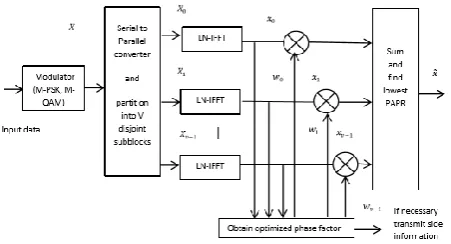
The Partial Transmit Sequence has been presented by Muller and Hubber in 1997 [11]. The PTS technique is based on phase shifting of sub-block of data and then multiplication of data structure by random vectors. This technique is flexible and efficient for OFDM framework. A block diagram of PTS technique is shown in figure 2. In partial transmit sequence [12] the input data block of N symbols is further divided into V disjoint sub-blocks. The input data block can be written in form of XV as: minimized [12]. This is shown as
Then the corresponding time domain signal with the lowest PAPR can be expressed as
{
}
In general the reduction in search complexity largely depends upon the selection of phase factor which is limited to a set of elements. As the set of allowed
Therefore search complexity is directly proportional to the number of sub-block.
Figure 2. A Block Diagram of PTS Technique
V.
CLIPPING AND FILTERING
Figure 3. (a) OFDM system (b) Clipping and Filtering Block diagram.
VI.
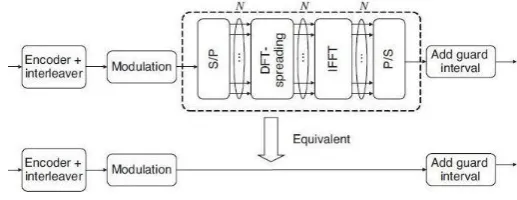
DFT SPREADINGDFT –Spreading stands for Discrete Fourier Transform spreading, it involves the spreading of input signal with the help of DFT (Discrete Fourier Transform) operation which can be taken into IDFT. DFT Spreading results in reduction of PAPR of OFDM signal to the extent of single carrier transmission. Mobile terminal in uplink transmission make use of this technique. It is called as single carrier FDMA. The single carrier FDMA (SC-FDMA) is used for uplink transmission in 3GPP LTE standard [12]. DFT of identical size as IDFT is used as (spreading code). Then OFDMA system becomes equivalent to SC-FDMA system. The reasons being DFT and IDFT operations cancel each other. In this case the PAPR of transmitted signal will be same as single carrier system. In OFDMA framework, subcarrier are partitioned and allocated to multiple mobile users. In this case each terminal in uplink uses a subset of subcarrier to transmit its own data whereas it does not happen in case of downlink. The remaining subcarriers which are not used for their own transmission will be filled with zeros. The effect of PAPR reduction depends on the way of assuming the subcarrier to each terminal [6]. Here the input data x[m] is DFT spread to produce X[i] and then allocated as
otherwise
M m
m s k s
k X k
x
0 / . 1, 1 0,1,2... 1~
Figure 4: Equivalent of OFDMA system with DFT spreading code to a single-carrier system [12]
VII. SELECTIVE MAPPING
In this scheme, firstly M statistically independent input data symbols which represent the similar information are generated and then each sequence are processed by M parallel N-point complex IFFT to generate M different time-domain OFDM symbols. The symbol with the minimum PAPR is chosen for transmission. The key point of SLM method lies in how to generate multiple divergent time-domain OFDM symbols when the input data for transmission is the same. For this purpose, M pseudo-random phase
rotation sequences
[ ] with
are defined; where and
is uniformly distributed in
[ ]. This method can be seen as performing a dot product operation on the input tones ( )
with rotation factor . In practice, all the
Figure 5: Block diagram SLM technique.
VIII.
COMPARISON
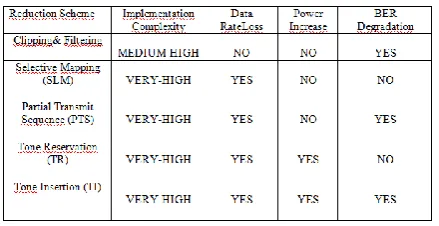
A brief comparison of various PAPR reduction techniques has been depicted in the table 1.
It is clear from the table 1, that none of the prior-art techniques have the entire desired feature: very large CCDF (PAPR) reduction, very low implementation complexity, no loss of capacity, no increase of transmit power, and so forth.
VI.CONCLUSION
OFDM is a remarkably attractive strategy for multicarrier transmission and has turned out to be one of the standard decisions for rapid speed transmission over a communication channel. It has various advantages; but has one noteworthy drawback, it has a high PAPR. In this paper, a few numbers of the techniques for decreasing the high PAPR of the OFDM system were analyzed and compared. Among the techniques that were analyzed, it was found that, no particular PAPR reduction strategy is the best solution for the OFDM framework. Different parameters like loss in rate, transmit signal power increment, BER increase, computational complexity increment should to be taken into consideration before choosing the appropriate PAPR technique.
VII.
REFERENCES
[1] Van Nee, R.D.J. (Nov. 1966) OFDM codes for peak to average power ratio reduction and error correction. IEEE GTC London, Vol.2, pp. 740-744.
[2] Davis, J.A. and Jedwab,J. (1999) Peak-to mean power control in OFDM, Golay complementary sequences, and Reed muller codes. IEEE Trans. Info. Theory, 45(7),2397-2417.
[3] Davis, J.A. and Jedwab,J. (1997) Peak-to mean power control in OFDM, Golay complementary sequences, and Reed muller codes. Electron. Lett,, 33(4),267-268 [4] Urbanke,R and Krishnakumar, A.S (Oct.1996)
Compact description of Golay sequences and their extensions. Proc. Of Thirty Fourth Annual Allerton Conference on Communication, Contol and Computing Pagination,Urbana, IL,pp.693-701.
[5] Li, X. and Ritcey, J.A. (1977) M-sequences for OFDM peak to average power ratio reduction and error correction. Electron. Lett, 33(7), 554-555.
[6] Tellambura, C. (1997) use of m-sequences for OFDM peak to average power reduction .Electron. Lett, 33(15), 1300-1301.
[7] Park, M.H. et al. (2000) PAPR reduction in OFDM transmission using Hadamard transform. IEEE ICC’00, vol.1,pp. 430-433.
[8] Bauml, R.M.,Fischer, R.F.H., and Huber, J.B.(1996) Reducing the PAPR of multicarrier modulation by selective mapping. Electron .Lett, 32(22), 2056-2057. [9] Hkubo, N. and Ohtsuki, T. (Apr. 2003) Design criteria
for phase sequences in selective mapping. IEEE VTC’03, vol.1,pp. 373-377.
[10]Muller, S.H. et al. (1997) OFDM with reduced PAPR by multiple signal representation. In Annals of Telecommunication, 52(1-2), 58-67.
[11]S.H. Muller and J.B. Hubber, A comparison of peak power reduction schemes for OFDM, in Proc. IEEE Global Communications Conference, Phoenix, AZ, November 1997 , pp. 1-5.
[12]Yuvraj Singh Ranawat, Mahendra Kumar, Performance Improvement Of MIMO-OFDM System PAPR Reduction using Pulse Shaping. IJSR,Vol.4,Issue 7, July 2015.