Simon Thompson
‘Recognition Beyond the State’
In Tony Burns and Simon Thompson (eds)
Global Justice and the Politics of Recognition
London: Palgrave Macmillan, 2013
Section 1.
In the introduction to this volume, it was observed that to date nearly all attempts to
formulate a political theory of recognition have taken as their object the basic structure of a
society regarded as what John Rawls called ‘a closed system isolated from other societies’
(Rawls, 1971: 8).1 Only Nancy Fraser has proved an exception to this rule, with her
development of an account of justice in which the power to determine the boundaries of
political associations plays a significant role (Fraser, 2008c [2005]). However, even her
efforts have thus far fallen well short of a fully fleshed out theory of global justice. Up to
now, the other leading contender in the field – Axel Honneth – has shown little interest in
global justice, focusing almost exclusively on principles of recognition that are already
institutionalized in what he refers to as ‘highly developed capitalist countries’ (Honneth,
2003a: 112).2 It was also suggested in the introduction that this neglect of the global
dimension to justice is probably the result not merely of oversight on the part of theorists of
recognition. Rather it is the consequence of their powerful although often tacit assumption
that relations of recognition take place in the context of particular life-worlds, which are
implicitly equated with particular societies. Any theorist of recognition who wanted to relax
this assumption, and so demonstrate that their theory could apply above the level of
general, would the global theory take exactly the same form as the domestic theory? Or are
there, at the extreme, two entirely distinct moral grammars of recognition at these two
levels? (Heins, 2011). More specifically, would the same principles of recognition apply at
the global level? Or would some fall away and others be transformed? Would the objects of
recognition still be persons? Or would they be supplemented or replaced by other objects
such as states?
In this chapter, my aim is to test the hypothesis that the particular version of the political
theory of recognition which I am in the process of developing could be applied in a relatively
unchanged form to issues of global justice. My nascent theory of recognition synthesises
Honneth’s and Fraser’s theories, contending that the former’s principlesof care, respect and
esteem can and should be intermeshed withthe latter’s account of the cultural, economic
and political dimensions of justice.3 At the global level, this theory would possess at least
two distinctive features. First, it would construe the idea of recognition broadly, so that it
would include the acknowledgement of the needs of all individuals, their capacity for
autonomy, and their capacity to make a contribution to the good of the global community.
Second, it would encompass three dimensions of justice, being concerned with the sphere
of global values, the redistribution of global resources, and the protection of universal
rights.4 Hence, if this theory could be scaled up from the domestic to the global level, there
would be a single grammar of recognition at both levels, the same principles would form the
key elements of such a grammar, and the objects of recognition would remain persons
rather than any kind of collective entities.
My argument proceeds in the following stages. In Section 2, I explain why, at the level of
particular political communities, a theory of recognition should combine Honneth’s
principles of recognition and Fraser’s dimensions of justice. Section 3 shifts the scale of
analysis, and considers whether, or to what extent, a combination of Honneth’s principles
and Fraser’s dimensions might similarly combine at the global level. I conclude in Section 4
foundation of a theory of global justice. I shall argue – perhaps surprisingly – that some
elements can be scaled up relatively smoothly to the global level, while others – not
surprisingly – must be abandoned or transformed.
Section 2.
Honneth and Fraser are two of the most important contemporary theorists of recognition.
Between them, their rival accounts cover much of the available intellectual field.5 Even a
superficial glance at these two accounts, however, suggests that they present us with
radically opposed alternatives. For Honneth, recognition describes an ethical relationship in
which the subject responds appropriately to the value of the object. He argues that this
relationship takes three principal forms – namely care, respect and esteem. For Fraser, by
contrast, recognition is simply a matter of status equality. Such equality is achieved when
institutionalized patterns of cultural value do not present obstacles to parity of participation.
Honneth’s and Fraser’s different conceptions of recognition also play very different roles in
their respective political theories. For Honneth, recognition explains a wide range of
phenomena from the formation of the individual psyche to the nature of social progress. For
Fraser, by contrast, recognition is a purely normative concept which constitutes one of the
three principal components of a deontological theory of justice.
It may seem that Fraser’s and Honneth’s stark disagreement over the meaning of
recognition places an insurmountable obstacle in the way of any attempt to synthesise their
theories. Indeed, David Owen and James Tully claim that Fraser’s and Honneth’s
conceptions of recognition are so dissimilar that ‘the “debate” between them becomes an
engagement in talking past each other’ (Owen & Tully, 2007: 268n6). In what follows, I want
to argue that it is precisely in virtue of this dissimilarity that these two thinkers can be made
to talk to each other, and, more strongly, that their two theories can be melded into one. To
be able to make this argument, however, it is necessary to make a choice between their two
conception of recognition in preference to Fraser’s. I argue that recognition is not a matter
merely of status equality, but rather must be regarded as an intersubjective relationship in
which one party values another. As I shall show, it is this one simple move which makes it
possible to unite these theories without contradiction. Before doing this, however, I must
explain briefly which elements I wish to take from each of their theories.
I begin with Honneth, who endorses what Fraser calls an ‘identity model’ of recognition
(Fraser, 2003a: 29). On this account, humans need recognition if they are to be able to form
integrated identities, and having such identities makes it possible for them to achieve
self-realization. Hence justice is achieved to the extent to which the relations of recognition
necessary for such self-realization are in place.6 Honneth maintains that recognition takes
three principal forms: ‘I proceed from a plurality of three equally important principles of
justice. This tripartite division arises from the consideration that subjects in modern
societies depend for their identity formation on three forms of social recognition, based on
the sphere-specific principles of love, equal legal treatment and social esteem (Honneth,
2003a: 180).’ Let me explain a little further. Care is a relationship of strong affective
attachment between significant others. In caring for another, one is responsive to their
unique needs. Respect is a relationship in which one treats all others as capable of rational
autonomy. Esteem is a relationship in which one values particular others for their
achievements, and in particular for the contribution that they make to societal goals.7 In
practice, these three forms of recognition are realized in distinctive ways: care
characteristically through practices informed by an ethic of care, respect in the form of
systems of individual rights, and esteem within the framework of shared value-horizons.
Thus if suitable relations of care, the right sort of system of rights, and an appropriate
value-horizon are all in place, individuals may form integrated identities and hence be able to
achieve self-realization. Honneth’s conclusion is that a ‘sufficiently differentiated theory of
It is important for the purposes of this chapter for me to argue that Honneth’s three
principles of recognition should not to be correlated with particular social institutions. To
my mind, it is regrettable that he sometimes gives this impression himself. For instance, he
does so with his reference to ‘sphere-specific principles’ in the quotation given just above.
He also does so in his account of the historical genesis of the three principles of recognition,
referring, for instance, to the emergence of the idea of a marriage based on mutual
affection, and the division of the premodern system of honour into two systems of universal
respect and individual achievement (Honneth, 2003a: 138-42). This seems to imply that
each principle of recognition can be associated with a particular sub-system of modern
societies, such as love with marriage. Better, for my purposes, are those points at which
Honneth is keen to make it clear that any such association of principles with institutions
would be a case of what he calls ‘misdirected concretization’ (Honneth, 1995c: 176). In
practice, he observes, more than one principle is often at play in a single institution. The
modern family, for example, is in part regulated by the principle of care, but at the same
time the principle of right (rightly) ensures ‘the legal regulation of intrafamilial interactions’.
In the welfare state, to take another example, a combination of the principles of right and
esteem can be found. Basic welfare measures ensure a minimum level of economic
resources are regarded as a social right, while above this level reward is (to some admittedly
imperfect degree) commensurate with achievement (Honneth, 2003a: 146-47).
In place of Honneth’s ‘identity model’, Fraser develops a rival ‘status model’ of recognition
that makes no reference to individual identity or self-realization. By contrast, she thinks that
justice should be understood as parity of participation, so that ‘[o]vercoming injustice
means dismantling institutionalized obstacles that prevent some people from participating
on a par with others, as full partners in social interaction’ (Fraser, 2008c [2005]: 73). There
are three types of obstacles and therefore three dimensions of justice. First, the cultural
dimension of justice corresponds to society’s ‘status order’. Here due recognition is
achieved if there are no status inequalities – such as sexism or racism – which can act as
obstacles to participatory parity. Second, the economic dimension of justice unsurprisingly
achieved by ensuring that citizens have the resourcesrequired in order to be able to
participate on a par with their peers. Third, the political dimension of justice corresponds to
the ‘political constitution’ of society. Here just representation requires that the way in which
political decisions are made and political boundaries are defined enables participatory parity
to be achieved (Fraser, 2008c [2005]: 73-76). For Fraser, in short, justice is achieved if
citizens possess the status, resources and voice necessary for them to be able to enjoy
parity of participation. It follows that recognition plays an important but strictly delimited
role in her theory, standing alongside redistribution and representation. On her account, all
three of these dimensions of justice need to be taken into account if participatory parity is
to be achieved.8
In parallel with my comment on Honneth, it is of great importance to my thesis to argue
that each of these dimensions of justice should not be correlated with a specific social
institution (or set of institutions). Unfortunately, some of the ways in which Fraser expresses
herself in this regard may mean that this point is not well understood. In particular, by
referring to ‘structures’, ‘orders’ and ‘constitutions’, she invites the misunderstanding that
these are concrete institutions. To take the case of recognition, while her point that cultural
values are necessarily embedded in institutions is well taken, her reference to an
‘institutionalized value hierarchy’ simpliciter may be taken to imply that this hierarchy has its own distinct institutional location.9 This misunderstanding is likely to be exacerbated
when Fraser says that each dimension of justice ‘corresponds to’ a structure, order or
constitution which ‘causally interact’ with one another. In order to avoid such
misunderstanding, I want to suggest that it would be better to abandon reference to
structure, order and constitution where possible, and to think instead in terms of what
Fraser calls ‘modes of social ordering’ (Fraser, 2003a: 51). Thus the cultural, economic and
political modes of social ordering determine the distribution of status, resources and voice
across the entire range of social institutions in a specific society. For example, if we are
seeking to determine what justice requires in the family, all three dimensions of justice will
be germane. In the case of status, for instance, a family may be patriarchal or egalitarian. So
between its members. Voice will also be important, since a family may make its key
decisions through more or less inclusive processes of deliberation. In short, rather than
being equated with particular ‘societal domains’, recognition, redistribution and
representation should be regarded as ‘analytically distinct ordering dimensions which cut
across institutional divisions’ (Fraser, 2003b: 217).
Thus far, I have endorsed Honneth’s claim that, if the principles of care, respect and esteem
are put into practice, then individuals will have the opportunity to achieve self-realization. I
have also endorsed Fraser’s proposition that, if the cultural, economic and political
dimensions of justice are taken into account, then the conditions may be created in which
individuals can participate on a par with one another. I now want to explain my claim that
these two apparently very different perspectives can be brought together in a single unified
theory. Perhaps the best way to do this is to show that each of these perspectives, taken by
itself, lacks something that the other can provide.
With regard to Honneth, I want to suggest that his theory, as it stands, lacks an adequate
account of the conditions which must be in place for each principle of recognition to be
realized. As I have suggested, this is not helped by his habit of sometimes linking each
principle to a specific institutional form. His association of care with the sphere of family and
friends is too restrictive since, as I shall show below, it can have a much broader range of
application than this. His identification of respect with subjective rights is too limited since
this evaluative attitude can be shown in a number of other ways (Ikäheimo, 2002: 471;
Laitinen, 2002: 471). And his setting of esteem in horizons of value is too idealized since he
does not provide an account of the specific material conditions on which such horizons
depend. It is in this regard that Fraser’s account can play a vital guiding role. By taking
account of her three dimensions of justice, it is possible to identify the exact cultural,
economic and political conditions necessary to realize the principles of care, respect and
esteem. As I shall demonstrate in the next section, the realization of each principle requires
So far as Fraser is concerned, my argument is that her theory, as it stands, is unable to
identify the specific arenas and institutions in which it is necessary to try to secure parity of
participation, and it is unable to specify the exact measures that are required in each of
these places.10 Why, for instance, is it much more important to achieve participatory parity
in the major institutions of democratic governance than it is to achieve it in the governance
of sports clubs? It is by using Honneth’s conception of self-realization that we can answer
this question. My claim is that it is necessary to try to secure participatory parity wherever
such parity will significantly enhance the possibility of individuals’ achieving self-realization.
In the case of the cultural dimension of justice, for instance, it is of vital importance to tackle
those systematic patterns of prejudice – such as racism and sexism – which have a
profoundly detrimental effect on individuals’ chances of realizing themselves. By contrast,
there is no need to be concerned about an institutionalized pattern of cultural value in a
particular society which values coffee-drinking over tea-drinking since such a pattern
extremely unlikely to have a significant effect on any individuals’ opportunity to achieve
self-realization.
Section 3.
Having laid out the essential elements of my political theory of recognition, I shall now
consider if this theory can be applied, not just to specific political communities, but also to
the world as a whole. That is to say, I want to determine whether my synthesis of Honneth’s
three principles of recognition and Fraser’s three dimensions of justice can provide guidance
on pressing questions of global justice.11 The easiest way I can find to test my hypothesis is
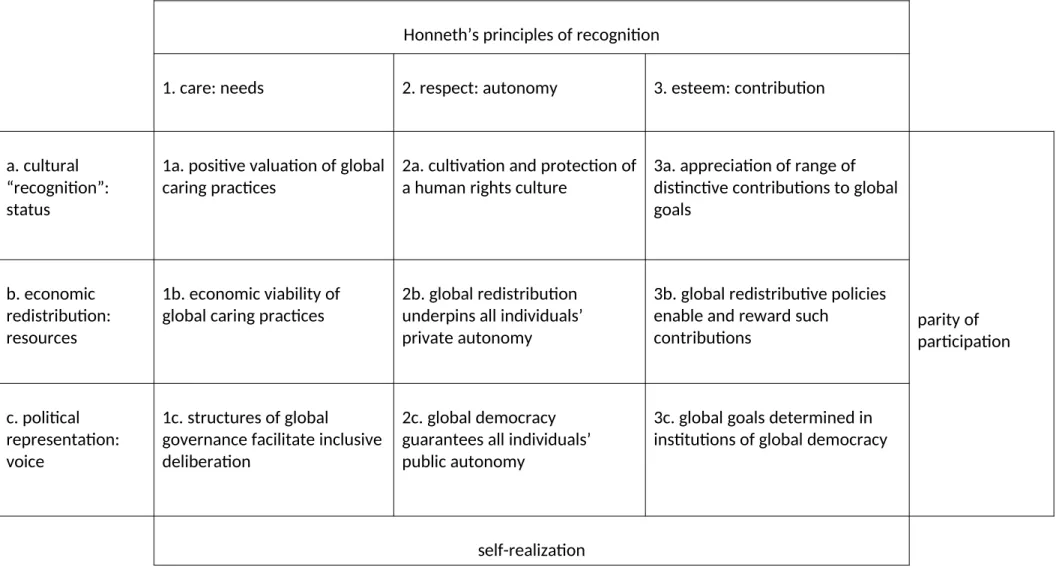
to put the theory I propose in the form of a table (see table 1). As you can see, this table has
three columns and three rows, creating a total of nine cells. In each column, one of
Honneth’s principles of recognition is represented. The final, fourth row indicates that, if
these principles are met, then self-realization is possible. In each row, one of Fraser’s
dimensions of justice is represented. The final, fourth column indicates that, if each
achieved. The arrow between parity of participation and self-realization stands for my claim
that, if participatory parity is attained, then self-realization is possible.12 In order to explain
further, I shall take up Honneth’s perspective, and use his three principles to guide us
through this table,column by column, and cell by cell.13
3.1 Care.
I begin, then, with Honneth’s first principle of recognition as care. At first blush, it may seem
difficult to see how this principle could be applied in a global context at all. If care is
necessarily restricted in its application to circles of significant others – such as family, lovers
and friends – then it cannot play a part in an account of global justice. However, some
theorists – and in particular advocates of an ethics of care – have suggested that on the
contrary it can indeed play such a part. According to Virginia Held, for instance, ‘caring
relations are not limited to the personal contexts of family and friends. They can extend to
fellow members of groups of various kinds, to fellow citizens and beyond. We can, for
instance, develop caring relations for persons who are suffering deprivation in distant parts
of the globe’ (Held, 2006: 157). In a similar vein, Olena Hankivsky contends that ‘an ethic of
care provides a theoretical foundation from which to develop more flexible and effective
practical ways to analyze and respond to a range of global inequalities and injustices’
(Hankivsky, 2006). Finally, Joan Tronto suggests that a ‘major contribution of care
theorists ... has been to emphasize the ongoing and permanent status of all humans ... as vulnerable’ (Tronto, 2007: 39). In this chapter, I cannot hope to provide a complete assessment of the claim that a principle of care can play a role in an account of global
justice. What I can do is to consider the demands which such a principle might plausibly be
said to make of each of Fraser’s three dimensions of justice.
3.1(a) Care and Cultural “Recognition”.14
If the theory of recognition that I have just outlined could be scaled up from the domestic to
dimension of global justice. In particular, it would require global patterns of cultural value
which acknowledged the importance of practices of care. To be more specific, it would
demand a global status order in which work is not systematically devalued and
care-workers are not rendered invisible. It’s worth making of couple of points here. First, it is
important to be aware of a problematic link between caring practices and women’s work.
Since it is generally assumed that carers are women, the danger is that attempts to revalue
care-work may run the risk of perpetuating the assumption that women are and should be
carers. This danger might suggest a need to revalue caring practices, but to detach this
revaluation from the assumption that such practices should be carried out by women. This,
however, may run the opposite risk of failing to give appropriate recognition to the women
who do in fact perform the vast majority of care-work in the world today. Second, it should
be understood that, while an ethics of care is centrally concerned with meeting individuals’
needs, it is also concerned with the quality of the relationships between the needy and
those who provide for their needs. Hence, as Held argues, it is necessary to value positively
not just political practices that are responsive to the concrete needs of specific individuals,
but also associated ethical qualities such as ‘mutual concern, trustworthiness, attentiveness,
responsiveness’ (Held, 2006: 158). As she says, without these qualities, relationships of care
can degenerate into ones marked by domination, exploitation, hostility and mistrust. The
problem is that, as the scale of a principle of care shifts upward, away from the personal and
toward the global, it is difficult to see how these desirable ethical qualities can be preserved.
While it may be possible to be sensitive, attentive and responsive to individuals with whom
one has a face to face relationship, it seems impossible to be so to all of those who, in Held’s
words, are ‘suffering deprivation in distant parts of the globe’. It is for this reason, I suspect,
that, as the principle of recognition as care is scaled up from the local to the global, the
ethical elements of care are lost as the principle is transformed into one of need. To be sure,
a principle of global justice according to which all individuals’ basic needs should be met is
highly ambitious. Even so, it is probably not as utopian as a principle which demands that all
individuals find themselves in relations of care.
If my theory of recognition could be scaled up to the global level, then its principle of care
would also make certain demands of the economic dimension of global justice. To put this in
very broad terms, it has been suggested that an ethic of care can make a valuable
contribution to accounts of global economic justice since it is particularly attuned to the
plight of the global poor. As Hankivsky puts it, such an ethic ‘deepens and makes more
comprehensive current approaches to examining and understanding globalization,
especially its implications for vulnerable countries and marginalized and poor persons’
(Hankivsky, 2006: 92). Focusing more narrowly on practices of care, it could be argued that
recognition as care would require a global economic structure in which caring practices are
economically viable. To this requirement I would add two important provisos. First, such a
redistribution would have make it possible for caring practices to be fairly shared between
men and women. This extends the point I just made with regard to the principle of care and
cultural values. Second, it would also have to ensure that caring practices can be fairly
distributed by location. Here I am thinking in particular of the injustices associated with
what Arlie Hochschild calls the ‘global care chain’. This consists of ‘a series of personal links
between people across the globe based on the paid or unpaid work of caring’, in which
women travel from poorer countries in order to provide care for the dependants of women
in richer countries (Hochschild, 2002). It may be possible to argue that a just redistribution
of global resources would be one sufficient to eliminate the rationale for this ‘chain.’ The
feasibility of this proposal depends, of course, on how radical a degree of resource
redistribution it would require. The more modest the resource requirements of caring
practices, the more feasible it is. My suspicion is that it would require a radical restructuring
of the global economy, and is thus highly idealistic. This is not an issue I can go into any
further here.
3.1(c) Care and Political Representation.
Finally, if my theory of recognition were to apply at the global level, its first principle would
make particular demands of the political dimension of global justice. To be specific, it would
society. At first sight, since Fraser defines a political constitution rather narrowly in terms of
the way in which decisions are made within states, and the way in which boundaries are
established between states, this claim may not look very plausible. It may reasonably be
asked what a principle of care has to do with voting systems or ways of determining political
boundaries. On closer examination, however, it may be possible to see a connection
between the principle of care and the political constitution of society. Take the case of
political decision-rules. Such rules are presumably of significance for Fraser since they
determine whether all citizens are able to enjoy equal voice in political deliberation. In order
to achieve equal voice, however, it is necessary not just to establish the right decision-rules,
but also to create an environment in which fair and inclusive deliberation can occur. Such
considerations, I would suggest, lead us to the work of a political theorist like Iris Marion
Young who has thought carefully about the necessary conditions of such deliberation. She
argues that political deliberation has conventionally been defined narrowly to mean the
exchange of reasons between autonomous citizens. By defining it in this way, she contends,
many sorts of voices are marginalized or excluded. Her proposed solution is to deploy a
broader conception of deliberation which makes space for ‘greeting, rhetoric and
story-telling’. In such deliberation, she believes, it would be possible for unconventional but still
legitimate voices to be heard (Young, 1997).15 In principle, it could be argued, this analysis
would also apply to the spacesof deliberationin the structures of global governance. Thus
Hankivsky suggests that her principle of ‘responsiveness’, as part of her ethic of care,
‘creates the enabling conditions for an authentic dialogue that allows for the experiences,
interests and needs of diverse communities to be heard and to have influence over the
current directions that globalization is taking’ (Hankivsky, 2006: 103). The problem with this
is that it is harder to sustain meaningful and inclusive dialogue the further one moves from
the local to the global, in part because members of the demos have less in common and
public spheres are more difficult to maintain. Overcoming this problem would require a
good deal of institutional innovation, not to mention political will.
I now turn to Honneth’s second principle of recognition as respect. The claim that such a
principle will have relevance for an account of global justice looks much more plausible than
it did in the case of care. Honneth contends that individuals deserve respect in virtue of
their capacity for rational autonomy, and he assumes that such respect is normally
expressed through the medium of subjective rights. When scaled to the global level, this
becomes an argument for universal human rights. Thus this part of my theory lines up with
the very many rights-based accounts of global justice currently on offer. Having said this, I
believe that my theory has a distinctive way of justifying universal human rights, and a
distinctive account of the conditions necessary for the realization of such rights. In order to
make good on this claim, I shall focus once again on the relations between recognition as
respect and each of Fraser’s three dimensions of justice.
3.2(a) Respect and Cultural “Recognition”.
So far as the cultural dimension of justice is concerned, I would argue that, if the principle of
respect were to be effectively realized in the form of a global system of human rights, it
would be necessary to cultivate and protect a global culture of human rights.16 With this
argument I put myself in opposition to those political theorists who would place political
principles and cultural commitments in opposition to one another. Brian Barry, for instance,
pits liberal egalitarian principles against any demands that may be made on the basis of
claims about cultural identity, as if those principles were themselves entirely without
cultural content (Barry, 2000). Against this position, I want to argue that the creation and
maintenance of an effectively functioning system of human rights would require the
existence of a globally institutionalized pattern of cultural values which supports those
rights. For some political theorists, such an argument would invite the criticism that human
rights express a specifically modern, Western or Eurocentric understanding of how
relationships between people should be regulated which it would be unfair to impose on
others. My argument is not vulnerable to this criticism just as it stands, however, since it
as an alien imposition by one sort of culture on others. Of course, this response to the
charge that human rights are culturally particular does not provide a magical solution. It
simply shifts the problem, since the difficulty then becomes the practical one of ensuring
that the cultural values supporting human rights are in fact universally accepted. This
important point notwithstanding, I remain convinced that we should not deny that human
rights are rooted in cultural values; rather, by working toward the universal acceptance of
those values, we should deny that this makes them necessarily partial.
3.2(b) Respect and Economic Redistribution.
With regard to the economic dimension of justice, I would argue that the effective
realization of the principle of respect would demand an appropriate distribution of
economic resources. This is because autonomy is not a capacity that all individuals are able
to exercise so long as they are left alone, without interference from political institutions or
fellow citizens. Rather, effective choice across a range of valuable options is possible only if
individuals have certain necessary resources. Hence it could be argued that a degree of
economic redistribution sufficient to underpin the capacity for autonomy would be needed
in order to ensure the realization of the principle of recognition as respect. Here I enter an
area of great complexity and controversy. Two questions in particular stand out. First, how
much redistribution is necessary to underpin autonomy? Second, by what means is such
redistribution best secured? An adequate answer to the first question would depend on a
detailed account of the conditions of effective choice. Here I would suggest that the ‘human
capabilities’ approach to questions of social justice – associated above all with Amartya Sen
– would provide the most promising way forward (Sen, 1999). With regard to the second
question, one suggestion is that civil and political rights must be supplemented by social
rights in order to ensure that all of these rights can be effectively exercised. Many states
already accept this argument. For instance, there are 47 signatories to the European Social
Charter which guarantees such rights.17 These signatories are, of course, among the richest
states in the world. The question is whether it is reasonable to expect poorer countries to
accept Kant’s general principle that ought implies can, I deny that the rightness of a
particular proposal – in this case, universal social rights – requires that it be immediately
practicable. More than this I cannot say here.
3.2(c) Respect and Political Representation.
If the principle of recognition respect were to be realized at the global level, it would also
necessitate a fair global distribution of political voice. It could be argued that, even if it did
not require a fully developed system of global democracy, it would require that the
institutions of global governance were significantly democratic in character. In making this
argument, I am following Jürgen Habermas’s account of the ‘equiprimordiality’ of private
autonomy and public autonomy (Habermas, 1994). According to Habermas, individuals
enjoy private autonomy when they are able to pursue their own individual life-projects. The
protection of such autonomy requires the institutionalization of civil and social rights.
Private autonomy on its own, however, would not be secure if the rights on which it
depends were simply granted to individuals by benign but despotic states. Thus individuals
must also enjoy public autonomy by having the opportunity to determine the conditions of
their private autonomy. This requires the institutionalization not just of civil and social but
also of political rights. Habermas’s conclusion is that ‘private and public autonomy are
equiprimordial’ (Habermas, 1994: 112-13). In more concrete terms, he argues that ‘there is
no such thing as a constitutional state without democracy’ (Habermas, 1994: 122). Although
this argument as it stands is intended to apply to the territorial state, it could be possible to
scale it up to the global level. There have, of course, been a number of notable attempts to
imagine what a full-blown global democracy would look like.18 But I share James Bohman’s
concern that there is a risk involved in seeking to achieve such a democracy. Simply giving
power to global political institutions would not by itself bring into being a single demos with
a coherent and well-functioning public sphere, both of which are essential if a global
democracy is to be legitimate and effective. For this reason, I share Bohman’s preference for
3.3 Esteem.
Finally I want to consider Honneth’s third principle of recognition as esteem. This looks like a
very unpromising candidate for a role in a global theory of recognition. It may be recalled
that, for Honneth, ‘the social standing of subjects is … measured in terms of what they can
accomplish for society within the context of their particular forms of self-realization’
(Honneth, 1995a: 127). If, for instance, a particular society values contributions to medical
science highly, then an individual who achieves notable success in this field can expect to
enjoy considerable esteem. The problem is that this account would appear to apply
exclusively to particular societies. As Volker Heins puts it: ‘There is no global equivalent to
those ethical values and goals that “comprise the cultural self-understanding of society”’
(Heins, 2008b: 148).19 In order to determine whether this principle of recognition can play
any part in an account of global justice, I turn for a final time to consider Fraser’s three
dimensions of justice.
3.3(a) Esteem and Cultural “Recognition”.
If the principle of esteem were to operate at the global level, it would have to be shown that
institutionalized patterns of cultural value enable all individuals to make valued
contributions to global goals. This takes us straight to the problem identified by Heins: if
there are no global goals in terms of which contributions could be measured, then there will
be no place for this principle in an account of global justice. To see whether there any way
around this problem, let us consider more closely what Honneth says about esteem. In the
quotation just given, we can see that there are two elements to his account. First, subjects’
esteem is ‘measured in terms of what they can accomplish for society’. This element on its
own does not help my case, since, as we have seen, it could reasonably be argued that there
is no agreement at the global level on which accomplishments are to be valued. Second,
subjects’ esteem is measured ‘within the context of their particular forms of
self-realization’. This element of Honneth’s account may at first seem less discouraging for my
hypothesis, since it suggests the possibility of a more pluralistic interpretation of the
according to their own lights. The problem with this reading, however, is that it puts these
two elements of Honneth’s account in tension with one another. To explain: according to
the logic of esteem, I am to be valued for my accomplishments by others in my political
community according to criteria of achievement which we both endorse. However, to the
extent to which these criteria are mine (or at least those of my own group) alone, others will
not be in a position to esteem me. In this case, the more pluralistic the interpretation of the
second element, the more it undermines the rationale of the first. My conclusion, to put it
bluntly, is that – at least for the foreseeable future – it is unlikely that Honneth’s principle of
esteem could play a role in an account of global justice.
3.3(b) Esteem and Economic Redistribution.
If, against this conclusion, the principle of esteem could play a part in a theory of global
justice, then it would follow that the global distribution of economic resources would have
to ensure that individuals were able to make contributions to global goals, and that, if they
did, their contributions were suitably rewarded. However, given the conclusion that I did
just reach, there is no reason for me to give further consideration to these two conditions
here.
3.3(c) Esteem and Political Representation.
If, once again against the conclusion I just reached, the principle of esteem could be scaled
up to the global level, then it would also have certain implications for the political dimension
of justice. To be specific, the deliberative structures of global governance would have to be
arranged so that all individuals were able to have a say in determining the criteria by which
esteem could be earned. Only if all individuals could take part in such a debate would it be
possible to agree on a set of goals to which everyone could make a contribution. However,
since I have concluded that agreement on such goals is currently impossible, I do not need
Section 4.
In this chapter, I have presented the outlines of a theory of global justice founded on a
conception of recognition. I began by explaining what I take from Honneth’s and Fraser’s
theories of recognition. I accepted the former’s contention that recognition encompasses
the three principles of care, respect and esteem; and I accepted the latter’s claim that there
are cultural, economic and political dimensions of justice. I then proposed a synthesis of
these two theories. I argued that, by taking account of the Fraser’s dimensions of justice, it
is possible to identify the means by which the principles of recognition can be put into
practice; and I contended that, by having regard for Honneth’s principles of recognition, it is
possible to appreciate the point of trying to achieve justice in these three dimensions.
I then sought to determine whether each element of this theory could be scaled up from the
domestic to the global level. It would be fair to say that the results of my investigation were
mixed. With regard to Honneth’s principles of recognition, the most straightforward case
can be made for the principle of respect which, scaled up to the global, entails a familiar
commitment to universal human rights. Perhaps surprisingly, it may also be possible to find
a place for the principle of care in a theory of global justice. But I suggested that, in order to
do so, it would have to be transformed into a principle of need. Finally, I had the least
success considering whether the principle of esteem could operate at the global level. In the
absence of agreement on global goals, this principle looks like a non-starter. So far as
Fraser’s three dimensions of justice were concerned, I think I successfully showed that the
right conception of global justice must attend to the three distinct dimensions of justice,
focusing on the appropriateness of global patterns of cultural values, the fairness of
resource distributions, and the inclusiveness of the structures of global governance –
I would suggest that there are important lessons to be learned from the results of my
investigation into the prospects for a global theory of justice as recognition. Where the
theory I have outlined can be scaled up from the local to the global, we learn something
about the scale-neutrality of some principles of recognition. Respect is the appropriate
response to others’ rational autonomy whether those others are our fellow citizens or
fellow human beings. Care, in the full-blooded sense of a responsiveness to others’
particular needs based strong affective attachment to them, may only apply within circles of
significant others. However, there is a more attenuated sense of care as concern for others’
basic needs which can apply to our fellow citizens and fellow human beings. Where the
theory I have outlined cannot be scaled up from the local to the global, we learn something
about the importance of particular life-worlds to processes and relations of recognition.
Thus I have argued that esteem, the appreciation of others’ contributions to common goals,
can only operate where there is agreement on such goals, and at present this only seems to
apply within particular political communities. I conclude that in some respects the limits of
the relations of recognition lie at the borders of territorial states. In others, however, it is
Table 1: Global principles of recognition and dimensions of justice
Honneth’s principles of recognition
1. care: needs 2. respect: autonomy 3. esteem: contribution
a. cultural “recognition”: status
1a. positive valuation of global caring practices
2a. cultivation and protection of a human rights culture
3a. appreciation of range of distinctive contributions to global goals
parity of participation b. economic
redistribution: resources
1b. economic viability of global caring practices
2b. global redistribution underpins all individuals’ private autonomy
3b. global redistributive policies enable and reward such
contributions
c. political representation: voice
1c. structures of global governance facilitate inclusive deliberation
2c. global democracy guarantees all individuals’ public autonomy
3c. global goals determined in institutions of global democracy
1Notes
?Earlier versions of the first half of this chapter were presented at the American Political
Science Association, the Western Political Science Association, the University of Leicester,
and Queen’s University, Belfast. I benefited greatly from the suggestions and comments
made by participants at these events, in particular Annika Bergman-Rosamond, Laura Brace,
Maeve Cooke, Volker Heins, Shane O’Neill, David Owen and Nick Smith. I owe a particular
debt to Andrew Buchwalter who took the time to write an extremely useful reply to my
APSA. paper
2See also, however, Honneth, 1997. For an important attempt to extend Honneth’s theory
to the global level, see Heins, 2008.
3My first attempt to describe this model can be found in Thompson, 2009. The current
chapter shares some phrases and sentences with that article.
4See Kok-Chor Tan’s comments on the distinction between economic and political theories
of global justice in Tan, 2004: 4. It may be noted that he makes no reference to the cultural
dimension of global justice.
5
Having said this, a good case could be made for saying that James Tully’s agonic account of
recognition represents a third, highly distinctive option. See Tully, 2008.
6This sentence is drawn from Thompson, 2009: 180.
7The previous four sentences are drawn from Thompson, 2009. It may be noted that in this
brief elucidation of Honneth’s three principles, I refer to them as care, respect and esteem
rather than ‘love, equal legal treatment and social esteem.’ I use ‘care’ rather than ‘love’
since the former term connotes a wider range of relationships than the latter, and I use
‘respect’ rather than ‘equal legal treatment’ since the former refers to the evaluative
8The previous three sentences are drawn from Thompson, 2009.
9See also how Fraser defines the political constitution of a society in terms of the boundaries
and decision-rules of territorial states in Fraser, 2008c [2005].
10For more of this argument, focusing in particular on the cultural dimension of justice, see
Armstrong & Thompson, 2009.
11
One of the reasons why I said at the start of this chapter that Fraser has not yet developed
a fully fledged theory of global justice is that her theory, as it stands, focuses almost
exclusively on the political dimension of justice to the neglect of its cultural and economic
dimensions.
12This claim is defended in Thompson, 2009.
13The previous eight sentences are adapted from Thompson, 2009.
14Since I refer here, and in the two corresponding sections below, to Fraser’s conception of
recognition, I put it in quotation marks to signal my rejection of it.
15For a detailed response to Young’s thinking on this subject, see Hoggett & Thompson,
2002.
16For detailed analysis of the idea of a culture of human rights, with some particular
reference to South Africa, see Brown, 2000; Gibson, 2004; Ibhawoh, 2000; and Nash, 2005.
17See http://www.coe.int/T/DGHL/Monitoring/SocialCharter/, date accessed 30th, June,
2009.
18
See, for instance, Dryzek, 2006 and Gould, 2004.