Extent of Integration of Priority Interventions
into General Health Systems: A Case Study of
Neglected Tropical Diseases Programme in
the Western Region of Ghana
Ernest O. Mensah1, Moses K. Aikins1, Margaret Gyapong1,2, Francis Anto1, Moses J. Bockarie3, John O. Gyapong1*
1School of Public Health, College of Health Sciences, University of Ghana, Accra, Ghana,2Dodowa Research Centre, Ghana Health Service, Dodowa, Ghana,3Vector Biology Department, Liverpool School of Tropical Medicine, Liverpool, United Kingdom
Abstract
Background
The global health system has a large arsenal of interventions, medical products and tech-nologies to address current global health challenges. However, identifying the most effec-tive and efficient strategies to deliver these resources to where they are most needed has been a challenge. Targeted and integrated interventions have been the main delivery strate-gies. However, the health system discourse increasingly favours integrated strategies in the context of functionally merging targeted interventions with multifunctional health care deliv-ery systems with a focus on strengthening country health systems to deliver needed inter-ventions. Neglected Tropical Diseases (NTD) have been identified to promote and perpetuate poverty hence there has been global effort to combat these diseases. The Neglected Tropical Diseases Programme (NTDP) in Ghana has a national programme team and office, however, it depends on the multifunctional health delivery system at the regional and district level to implement interventions. The NTDP seeks further health sys-tem integration to accelerate achievement of coverage targets. The study estimated the extent of integration of the NTDP at the national, regional and district levels to provide evi-dence to guide further integration.
Methodology/Principal Findings
The research design was a descriptive case study that interviewed key persons involved in the programme at the three levels of the health system as well as extensive document review. Integration was assessed on two planes—across health system functions– steward-ship and governance, financing, planning, service delivery, monitoring and evaluation and demand generation; and across three administrative levels of the health system–national, regional and district. A composite measure of integration designated Cumulative Integration a11111
OPEN ACCESS
Citation:Mensah EO, Aikins MK, Gyapong M, Anto F, Bockarie MJ, Gyapong JO (2016) Extent of Integration of Priority Interventions into General Health Systems: A Case Study of Neglected Tropical Diseases Programme in the Western Region of Ghana. PLoS Negl Trop Dis 10(5): e0004725. doi:10.1371/journal.pntd.0004725
Editor:Charles H. King, Case Western Reserve University School of Medicine, UNITED STATES
Received:January 20, 2016
Accepted:May 2, 2016
Published:May 20, 2016
Copyright:© 2016 Mensah et al. This is an open access article distributed under the terms of the
Creative Commons Attribution License, which permits unrestricted use, distribution, and reproduction in any medium, provided the original author and source are credited.
Data Availability Statement:All relevant data are within the paper and its Supporting Information file.
Index (CII) with a range of 0.00–1.00 was used to estimate extent of integration at the three levels of the health system. Service delivery was most integrated while financing and plan-ning were least integrated. Extent of integration was partial at all levels of the health system with a CII of 0.48–0.68; however it was higher at the district compared to the national and regional levels.
Conclusions/Significance
To ensure further integration of the NTDP, planning and finance management activities must be decentralized to involve regional and district levels of the health system. The study provides an empirical measure of extent of integration and indicators to guide further integration.
Author Summary
Two main strategies have been used to address diseases that affects large sections of popu-lations. One strategy called targeted or vertical programme sets up separate system from the general health system with its own human resources, management, implementation, data reporting and evaluation systems. Integrated (also called horizontal) strategy on the other hand uses existing health system structures to implement activities to control target health problems. Integrated strategy is preferred because it strengthens country health sys-tems. The Neglected Tropical Diseases Programme (NTDP) in Ghana has a dedicated management structure at the national level but uses general health system structures at the regional and district levels to implement activities. This study assessed the extent of inte-gration of the NTDP into the health system at the national, regional and district levels. It was found that the NTDP activities were better integrated at the district compared to the regional and national levels of the health system. Furthermore, it also found that service delivery activities were most integrated while financing and planning activities were least integrated at all levels of the health system. These findings provide points to guide efforts to make the NTDP more integrated and can be applied to other health programmes.
Introduction
The debate on targeted and integrated strategies to health care delivery is long standing and continues to attract policy discourse though the dichotomy is considered simplistic and unrep-resentative of reality for the reason that extremes of purely targeted or fully integrated interven-tions are excepinterven-tions; rather there is a continuum of integration of priority interveninterven-tions across various levels of the health system [1–4]. Other terminologies for targeted and integrated are: vertical and horizontal; disease control and general health care approaches; and selective and comprehensive health systems [3]. The global health system landscape is characterized by sev-eral targeted programmes especially in developing countries where health care is delivered by a public health system mainly with state support aimed at providing basic health care services to the population. The evidence is that these health systems have significant targeted programmes that emphasize specific interventions focused on priority diseases affecting sections of the pop-ulation. Continuous co-existence of the two service delivery strategies suggests importance of collection and analysis, decision to publish, or
preparation of the manuscript.
both strategies to achieving the goals of health systems–health, financial risk protection and responsiveness [5–7].
The Alma Ata Conference [8] which proposed primary health care and two important doc-uments produced by the World Health Organization [9,10] on indicators of health system per-formance and health system strengthening seemed to have tilted the debate towards integrated health system. They advocated the need to identify real drivers of effective health system and making efforts to strengthen them to deliver needed interventions to the general population. World Health Assembly (WHA) on the other hand, through its resolutions has been pivotal in providing direction for setting up of Global Health Initiatives (GHI) to control diseases of pub-lic health importance. The resolutions have set specific disease control agenda based on prevail-ing scientific evidence and proposed intervention end points—prevention, control, elimination or eradication [11–15]. These resolutions have been the rallying points for research, resource mobilization and programme design. Globally, successes in such GHI has been recorded in the eradication of smallpox, a real possibility of poliomyelitis and guinea worm eradication as well as a significant abatement of the rapid spread of HIV infection and associated morbidity and mortality in the last decade of the 20thCentury [1]. Put together, the WHA resolutions with associated resource mobilization to achieve its objectives and successes of GHI have been great advocates for targeted programmes characterizing the global public health landscape especially in developing countries. Global partnerships supporting specific GHI such as the Global Pro-gramme to Eliminate Lymphatic Filariasis (GPELF), Global Alliance for Vaccines and Immu-nization (GAVI), Drugs for Neglected Diseases initiative (DNDi), and Global Fund for HIV/ AIDS, Malaria and TB have reinforced targeted interventions. However, the ideal way forward is the strengthening of an integrated health system not only to effectively deliver the plethora of effective interventions and resources available–essential medicines, skilled human resource, community mobilization techniques, diagnostic and monitoring tools—to affected target pop-ulations; but also achieve high intervention coverage [10].
The Neglected Tropical Diseases Programme (NTDP) has a programme office and staff at the National level but uses decentralized regional and district level health structures (i.e. health system human resource, organizational and management arrangements, implementation pro-cesses, data reporting channels, and evaluation systems etc.) to implement its activities. The study evaluated the extent of integration of the NTDP activities into the public health system.
NTDP and the health system in Ghana
The past decade has seen global concerted effort to combat Neglected Tropical Diseases (NTDs) resulting in multiple global health organizations, donors, pharmaceutical companies, governments and researchers directing resources towards control of NTDs [16,17]. The five most prevalent NTDs in Ghana–lymphatic filariasis (LF), onchocerciasis, schistosomiasis, soil transmitted helminths and trachoma—have gained the most attention. Lymphatic filariasis and trachoma are targeted for elimination while the others have control targets [18]. To maxi-mize impact of increasing partnerships and resources dedicated to NTD control, four pro-gramme organizational strategies have been suggested. First, is coordination of partner
options require policy change by funding agencies or merger of separate programmes with pos-sibility of loss of authority by some programme management, and willingness of non-NTD programme managers to collaborate with NTD programmes; integration of NTDP activities into the health system depends largely on NTD programmes. The Neglected Tropical Diseases Programme in Ghana seeks increased health system integration to accelerate achievement of coverage targets [19].
The NTDP is responsible for implementing interventions (mass drug administration and morbidity management) for control of five NTDs in Ghana: Lymphatic filariasis, schistosomia-sis, soil transmitted helminths, onchocerciasis and trachoma which are endemic in several communities in Ghana [19–21].There is geographic overlap of these diseases. The total popula-tion at risk of lymphatic filariasis was estimated at 12 million in 2009 [19]. Preventive chemo-therapy through mass drug administration (MDA) provides ivermectin and albendazole annually to populations at risk of lymphatic filariasis. Ivermectin is administered annually or semi-annually in onchocerciasis endemic communities while Praziquantel and Albendazole or Mebendazole are administered especially to school age children for control of schistosomiasis and soil transmitted helminths. Azithromycin is administered to control trachoma [22].
At the national level the NTDP undertakes strategic planning, advocacy, monitoring and evaluation. However national, regional and district health system roles are not mutually exclu-sive. The NTDP is integrated to some extent but the nature and extent of integration at the var-ious levels of the health system is not known. The vision of the Ghana NTDP is to“improve on the capacity of the Ghana Health Service (GHS) to establish an integrated NTD control pro-gramme capable of delivering interventions to prevent, control, eliminate or eradicate the neglected tropical diseases by the year 2020”[19]. This study assessed the extent of integration of the NTDP into the public health system using health system functions to provide interven-tion points for further integrainterven-tion.
Conceptual framework
Integration in the health sector has been variously defined and applied to achieve ends broadly conceptualized as reducing fragmentation and duplication of interventions; aggregation of usu-ally segmented health care units or specialties and related social services to achieve a contin-uum of health care, ease of access, improved health outcomes, wide population coverage, user satisfaction and efficiency [23–25]. Three main forms of integration can be identified. The first, integrated health care, provides a‘one-stop shop’health care service encompassing health pro-motion, diagnostics, treatment and rehabilitation by bringing interdependent service providers under one organizational structure or management to improve accessibility, efficiency, quality of care and client satisfaction [26–28]. The second, is the delivery of multiple population-based health interventions on a single platform for efficiency and improved population coverage [29, 30]. The simultaneous administration of multiple drugs through MDA to a population affected by any combination of NTDs is an example. The third form, which is the focus of this study, is “. . .a process where disease control activities are functionally merged or tightly coordinated with multifunctional health care delivery”[31]. It involves the merger and delivery of specific disease control interventions with public health system structures and resources to improve access and coverage [2,32].
approach to evaluate the interface of priority health intervention programmes and health sys-tems through the lens of integration. This is relevant to the study because the 5 NTDs are man-aged as priority interventions delivered through the structures of the public health system especially at the sub-national levels. Secondly, the framework has been applied successfully to examine Global Fund sponsored priority health programmes (HIV/AIDS, Malaria and TB) in several countries with respect to extent and nature of integration [23,33–35]. Thirdly, the health system functions employed by the framework have universal application having been built on widely accepted health system function models [3,5,6,9,36].
The framework, presented inTable 1, identifies six functions of the health system desig-nated as Critical Health System Functions. These are stewardship and governance, financing, planning, service delivery, demand generation and monitoring and evaluation. The critical health system functions are similar to the WHO health system building blocks and functions described in other health system frameworks [5,9,10,36,37]. Each health system function is made up of elements which constitute defined activities classified under the function. A health system function is considered integrated when health system structures are applied to implement elements of the health system function. When distinct structures are used to implement elements of a health system function for the health system and the targeted inter-vention programme it is considered to have non-existent integration. On the other hand when elements of a health system function are implemented by both health system and the targeted intervention structures it is assessed as partial integration. The mean extent of inte-gration of health system elements is assigned as the extent of inteinte-gration for the health sys-tem function. A composite score of all six health syssys-tem functions is used to estimate the extent of integration of the priority intervention at each health system level—national, regional and district.
The extent of integration of priority interventions into a health system is influenced by sev-eral other factors including the nature of the disease and intervention, the adoption system, the health system characteristics and broad context. The nature of the disease relates to the epide-miology, severity and course of an episode of illness. For example, an acute disease such as Ebola Virus Disease with high fatality may require less integration compared to HIV which has a chronic course. The adoption system involves the health institutions such as the regional and district health administrations, hospitals and the key actors within the health system involved in implementation of the priority interventions. The characteristics of the health system involve the organization of the health system at the various levels. The political system, the eco-nomic, socio-cultural and technological situation in which the health system functions consti-tutes the broad health system context. However, these were not specifically studied as they were assumed to be similar for the study areas, diseases and country context.
Methods
This was a descriptive case study design. Key persons were purposively selected based on their key roles in implementation of the NTDP activities within the health system at the national, regional and district levels. In addition extensive review of programme and health system docu-ments related to policy guidelines, standard operating procedures and activity reports was done.
Ethics statement
Study area
The study was conducted in two districts, Ahanta West and Nzema East, in the Western region of Ghana. Western regions was selected because NTDP activities have been conducted in all districts in the region and each district had at least 2 NTDs targeted by the NTDP. Ahanta Table 1. Health system functions, elements and extent of integration.
Critical Health System Functions
Elements of Health System Function
Extent of integration of health system functions
Full Partial Non-existent
Stewardship and Governance
1. Accountability Governance arrangement for NTD same for public health system
Governance shared by public health system and NTD specific structure
Governance involves only NTD specific unit
2. Reporting 3. Performance management
Financing 1. Pooling of funds Fully funded through general health service budget
Funding by earmarked fund from government or donor agency channelled through health system
Funds provided directly through NTD programme to address only NTD issues
Planning 1. Needs assessment When elements are undertaken by public health system structures
When elements decision taken by NTD managers with involvement of stakeholders–local health system managers, community etc.
Planning decisions taken by NTD managers without consideration of public health system activities
2. Priority setting 3. Resource allocation
Service delivery 1. Structural Intervention service delivery by public health system structures/ staff or multi-purpose health workers
Service provision undertaken by public health system workers and NTD staff or service delivery linked to other public health system services
Service delivery relies on single purpose workers and have no linkages with other public health system interventions 2. Human resources
3. Shared infrastructure 4. Operational integration
5. Referral and counter referral systems 6. Procurement 7. Supply chain management Monitoring and Evaluation (M&E) 1. Information technology infrastructure
M&E activities conducted by agencies/units responsible for M&E in the public health system.
M&E activities/ responsibility shared by public health system and NTD specific M&E structure
Dedicated NTD M&E structure parallel to public health system M&E structure
2. Data collection and analysis
Demand generation
1.
Financial/non-financial incentives e.g. additional cash transfers
IEC activities and mechanisms to createfinancial incentives are provided jointly with other HS activities and undertaken by public health system staff
IEC activities and mechanisms to createfinancial incentives are provide jointly by NTD programme and public health system
IEC activities delivered as single purpose activities by single purpose health workers
2. Population interventions e.g. education and promotion, social mobilization)
Modified from Atun et al, 2010 [23].
West and Nzema East districts are among the earliest districts that started NTD interventions in Ghana. The Western region is a tropical rain forest area with coastal savannah and swamps. All 17 districts in the region are endemic for lymphatic filariasis and schistosomiasis while four districts including Nzema East are endemic for onchocerciasis. Ahanta West and Nzema East districts have had 10 and 11 rounds for MDA for lymphatic filariasis respectively. Night blood surveys conducted in the two districts in 2012 and 2011 respectively showed significant reduc-tion in microfilaria prevalence but did not meet the threshold for stopping MDA. The Western Regional Health Administration was studied as the regional level health system while the GHS headquarters from where the NTDP national office operates was included as the national level health system.
Study population
The study covered health staff working on NTDs at the national, regional and district levels. A manager on the NTDP and two programme officers responsible for LF, schistosomiasis and soil transmitted helminths at the national NTDP office were interviewed. A Director of Health and Disease Control Officer working on NTD control activities were interviewed at the West-ern Regional Health Administration and 2 study districts.
Data collection
An in-depth interview guide was used to obtain data on the structures used to conduct NTDP activities related to elements of the health system functions (Table 1) at the three levels of the health system. The guide was pretested with a manager of the NTDP.
Secondary data was obtained by review of the NTDP five year strategic document (Master Plan for Neglected Tropical Diseases, Ghana 2013–2017), MDA reports and Annual Reports of the study districts. Other documents reviewed included GHS Annual Reports, the GHS Act, and five-year Programme of Work of the GHS. The GHS website was also searched for infor-mation on the structure of the health system.
Data analysis
Measuring integration. Integration of the NTDP was determined in two stages–extent of integration of each of the six health system functions and an overall extent of integration at the three levels of the health system. The two stages were assessed at the three levels of the health system independently. Extent of integration of NTDP activities assessed within the GHS head-quarters represented the national level. Similarly, extent of integration of NTD activities assessed at the Regional Health Administration (RHA) and District Health Administration (DHA) represented extent of integration at the regional and district levels respectively. The overall evaluation of the extent of integration of the NTDP at the health system levels was des-ignated as Composite Integration Index (CII). The extent of integration of each health system function provides points of intervention where the objective is greater programme integration. On the other hand the CII allows for comparison of priority interventions within a health sys-tem or in different health syssys-tems.
assigned a score of one otherwise was assigned a score of zero. The average score of the ele-ments of a health system function determined extent of integration of the health system func-tion. Average score below the first quartile (<0.25) was classified as non-existent integration; the next two quartiles (0.25–<0.75) were classified as partial integration while average score from the third quartile or higher (0.75) was classified as full integration.
The extent of integration of NTD activities at the national, regional or district levels of the health system was estimated as a summation of the product of the average health function score and the weight of the respective health system function. The weight of a health system function is the proportion of its elements to the total elements of all six health system functions at the district region or national level.
CII¼PAverage health function scoreweight of health system function
Results
Extent of integration of health system functions
The interviews conducted showed that the manager at the NTDP and two programme officers for LF, soil transmitted helminths and schistosomiasis had worked at their current positions for 8, 11 and 6 years respectively. The Director of Health and the Disease Control officer inter-viewed at the Western RHA had been at post for 5 and 10 years respectively, however, they had worked in related capacities in the region for at least 15 years each. Both District Directors of Health for Ahanta West and Nzema East districts interviewed had been at post for at least 7 years. The Disease Control Officers for Ahanta West and Nzema East districts interviewed had been at post for 2 and 3 years respectively but had worked on disease control activities in the sub-districts before their current assignments. The Manager at the NTDP and Health Directors at the RHA and DHAs were physicians with at least a Master’s degree in public health while the rest had diplomas in disease control.
National level. Table 2shows findings at the national level of the health system. The NTDP is integrated into GHS national level with ultimate responsibility for programme out-come borne by the GHS. An NTDP respondent said—“NTDs control in Ghana is the responsi-bility of GHS through the MoH,but at the NTDP level the programme manager leads,working under the Head of Disease Control and Director of Public Health.”Respondents at all levels of the health system re-echoed integration of reporting channels made by a national respondent:
“Registers are used to compile reports at the community level and sent through the sub-districts to district then to regional level so at every level they put together every report and finally send it to the national.”Two out of three health system elements of the governance and stewardship function; accountability and reporting were conducted using public health system structures while performance management was carried out by the NTDP. Programme implementation was financed by earmarked funds mobilized by the NTDP which also allocated resources through planning and budgeting to the RHA and districts. An NTDP respondent said:“The
system structures for same while the programme had a dedicated information technology (IT) infrastructure. One of the elements of demand generation; population interventions which deals with social mobilization, health education and promotion was conducted with active par-ticipation and guidance of the Health Promotion Unit of the GHS; while incentives for staff to undertake demand generation activities were absent. Four health system functions—steward-ship and governance, service delivery, monitoring and evaluation and demand generation were partially integrated while financing and planning functions showed non-existent integration (Table 2).
Regional level. Table 3shows extent of integration of health system functions at the regional level. Governance and stewardship function was partially integrated at this level. The RHA received and transmitted NTDP reports through existing reporting channels and also monitored performance of NTD interventions in the region. However, the RHA conducted no activity to monitor treatment outcome. The RHA indicated that the role of the NTDP in the region was:“To provide funds,supply logistics,monitor MDA,and conduct prevalence studies.” Operational NTD control activities at the regional level were fully funded by earmarked funds from the NTDP as stated by a respondent:“MDA in the region is funded mainly by earmarked funds from the NTDP but indirectly funds for health education are leveraged to educate the pop-ulation on all disease conditions and interventions.”The RHA did not conduct planning activi-ties at this level of the health system. All three elements of the planning function were
conducted by the NTDP and not the RHA. All elements of the service delivery function except operational integration were conducted by RHA public health unit. Staff of the unit used RHA structures and logistics including shared ICT equipment to implement NTD control activities during MDA. Staff of the Public Health Unit worked across interventions including social mobilization and health education as stated by a respondent:“All technical officers irrespective of their focus area–Disease Control,Nutrition and Health Promotion Officers work on NTDP and the directors supervise.”The RHA provided a representative to support the NTDP to Table 2. Extent of integration of health system functions at national level of health system.
Critical Health System Functions
Health System Elements Average
score
Extent of integration
Stewardship and governance Director of Public Health of GHS ultimately accountable 0.67 Partial Data reported to the Public Health Division of the GHS
Performance management by NTDP
Financing Operational activities funded through donor earmarked funds 0 Non-existent
Planning Priorities based on NTDP baseline surveys 0 Non-existent
NTDP assessed resource needs at all levels of GHS NTDP allocated resources to the regions and districts
Service delivery NTDP structurally a unit of the GHS and uses GHS offices Staff are dedicated to NTDP
0.67 Partial
Procurement by GHS procurement unitDrugs and logistics managed by Central Medical
Stores
Shared Public Health Division vehicle pool
Operational activities not combined with other GHS interventions
Monitoring and evaluation Assessment surveys conducted with Public Health Reference Laboratory 0.50 Partial Not share Immunochromatographic Test infrastructure with other GHS units
Demand generation Health Promotion Unit involved in development of IEC materials and social mobilization.
0.50 Partial
Nofinancial incentives to improve demand for NTD
conduct MDA impact assessment surveys in the region. At the regional level, three health sys-tem functions namely stewardship and governance, demand generation and monitoring and evaluation were partially integrated; financing and planning functions indicated non-existent integration while service delivery was fully integrated (Table 3).
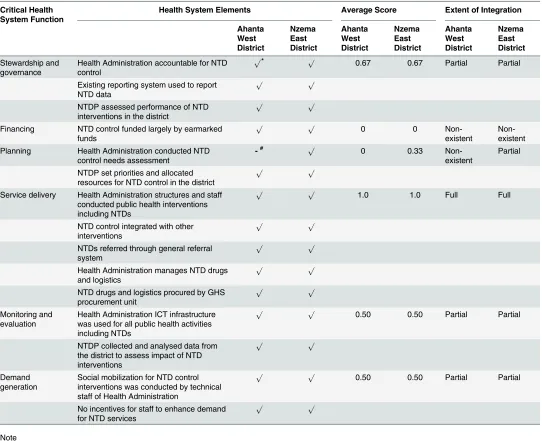
District level. Table 4summarises findings in the study districts–Ahanta West and Nzema East Districts. Concerning stewardship and governance the District Health Administra-tions (DHAs) were accountable for control of diseases of public health importance in the dis-tricts including NTDs with the District Directors having ultimate responsibility as leaders of the District Health Management Team. The DHD was considered a decentralized unit of the GHS as stated by a district respondent:“As a unit of the GHS in the district,the Director is ulti-mately responsible for NTDs in the district but as you know he works with a team—the Disease Control Officers,the Field Technicians as well as other colleagues.”The districts applied report-ing tools and channels for the public health system to report NTD intervention data. However the NTDP from the national level conducted performance management activities in the dis-tricts. As was seen at the regional level, funding of NTD control activities in the districts were principally through earmarked funds from the NTDP. The lack of response from higher levels of health system to budgets prepared by the DHA was breeding resignation in some cases as a respondent intimated:“Concerning budgeting we stopped doing it after a period because when
you budget you don’t get the money so we just see it as part of the general health sector challenge.” However Nzema East District DHA conducted needs assessment for NTD control activities in the district for each year as it helped the DHA determine MDA financing gap which formed the basis for raising additional funds from other revenue generating units in the district. A respondent in the district stated that:“In planning and budgeting we are able to determine the resources required for the whole MDA activities,identify resource short fall and then solicit for funds from the district assembly as well as the District Hospital.”Ahanta West district occasion-ally received funding support from one NGO. Priority setting and resource allocation for NTD control activities in the districts were conducted by the NTDP. All seven elements of the service delivery function were conducted with district level structures and resources. Both districts Table 3. Extent of integration of health system functions at regional level of health system.
Critical Health System Functions
Health System Elements Average
score
Extent of integration
Stewardship and governance NTDP accountable for NTD control in the region 0.67 Partial RHA monitored NTD control performance
Existing GHS reporting system used to report NTDs
Financing NTD control funded almost exclusively by earmarked funds 0 Non-existent
Planning Priority setting and needs assessment for NTD control done in the region conducted by NTDP
0 Non-existent
NTDP allocated resources to RHA and endemic districts
Service delivery Public Health unit of the RHA conducted NTD control activities 0.83 Full All technical staff of unit involved NTD control activities
No integration with other interventions
Regional Medical Stores managed NTD drugs and logistics GHS procured drugs and logistics
Monitoring and evaluation NTDP conducted impact assessment surveys. 0.50 Partial No dedicated NTD ICT equipment at RHA.
Demand generation Technical staff of RHA conducted social mobilization for all interventions. 0.50 Partial Nofinancial incentives for social mobilization.
recognized health education as an opportunity for integration in the context of limited funding. A respondent commented that:“When you have a problem whether there is money or not
some-times changing people’s behaviour helps so as I mentioned earlier concerning malaria,when we are conducting health education on long lasting bed nets we talk about lymphatic filariasis as well.”
The DHAs utilized their ICT equipment for all public health interventions including NTDs, however, the NTDP collected and analysed survey data from the districts to assess impact of MDAs on target diseases with less involvement of the DHAs. The DHAs conducted commu-nity sensitization and health education using commucommu-nity durbars, commucommu-nity public address Table 4. Extent of integration of health system function at district level of health system.
Critical Health System Function
Health System Elements Average Score Extent of Integration
Ahanta West District Nzema East District Ahanta West District Nzema East District Ahanta West District Nzema East District Stewardship and governance
Health Administration accountable for NTD control
p* p 0.67 0.67 Partial Partial
Existing reporting system used to report NTD data
p p
NTDP assessed performance of NTD interventions in the district
p p
Financing NTD control funded largely by earmarked funds
p p 0 0
Non-existent
Non-existent Planning Health Administration conducted NTD
control needs assessment
-# p 0 0.33
Non-existent
Partial
NTDP set priorities and allocated resources for NTD control in the district
p p
Service delivery Health Administration structures and staff conducted public health interventions including NTDs
p p 1.0 1.0 Full Full
NTD control integrated with other interventions
p p
NTDs referred through general referral system
p p
Health Administration manages NTD drugs and logistics
p p
NTD drugs and logistics procured by GHS procurement unit
p p
Monitoring and evaluation
Health Administration ICT infrastructure was used for all public health activities including NTDs
p p
0.50 0.50 Partial Partial
NTDP collected and analysed data from the district to assess impact of NTD interventions
p p
Demand generation
Social mobilization for NTD control interventions was conducted by technical staff of Health Administration
p p 0.50 0.50 Partial Partial
No incentives for staff to enhance demand for NTD services
p p
Note
*p= true statement # - = not a true statement
systems and radio stations. Community Health Nurses, Field Technicians and Disease Control Officers who conducted social mobilization for other diseases control interventions did same for NTD intervention. In the two study districts stewardship and governance, monitoring and evaluation as well as demand generation health system functions were partially integrated while service delivery was fully integrated with financing showing non-existent integration (Table 4). However planning function was partially integrated in Nzema East District but recorded non-existent integration in Ahanta West District.
Extent of integration of NTDP at health system levels
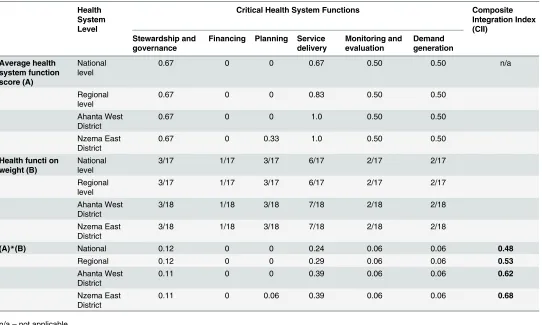
Estimation of CII for the national, regional and district levels of the health system is shown in Table 5. The NTDP considered its activities well integrated:“We have a national programme
and it is national in character meaning that though it started at the national level it is not a tar-geted programme it is well integrated into the GHS.”However, district level structures expected more integration for long term sustainability:“There is too much verticalization of the health
system,there is the need for integration that can take care of all aspects of health care.You know worms re-infection is common and we don’t have the resources to provide treatment when the programme ends and we have not found a way to integrate into current health system.I don’t
know what will happen,it will be difficult to say.”This view reflects the extent of integration recorded. All levels of the health system; national, regional and study districts recorded partial extent of integration with CII index of 0.48–0.62. However, the extent of integration was
Table 5. Estimation of Composite Integration Index. Health
System Level
Critical Health System Functions Composite
Integration Index (CII)
Stewardship and governance
Financing Planning Service delivery
Monitoring and evaluation
Demand generation Average health
system function score (A)
National level
0.67 0 0 0.67 0.50 0.50 n/a
Regional level
0.67 0 0 0.83 0.50 0.50
Ahanta West District
0.67 0 0 1.0 0.50 0.50
Nzema East District
0.67 0 0.33 1.0 0.50 0.50
Health functi on weight (B)
National level
3/17 1/17 3/17 6/17 2/17 2/17
Regional level
3/17 1/17 3/17 6/17 2/17 2/17
Ahanta West District
3/18 1/18 3/18 7/18 2/18 2/18
Nzema East District
3/18 1/18 3/18 7/18 2/18 2/18
(A)*(B) National 0.12 0 0 0.24 0.06 0.06 0.48
Regional 0.12 0 0 0.29 0.06 0.06 0.53
Ahanta West District
0.11 0 0 0.39 0.06 0.06 0.62
Nzema East District
0.11 0 0.06 0.39 0.06 0.06 0.68
n/a–not applicable
greatest at Nzema East district (CII = 0.68) and least at the national level (CII = 0.48). Extent of integration varied in the two study districts with Nzema East recording a higher extent of inte-gration (CII = 0.68) compared to Ahanta West (CII = 0.62).
Discussion
We found that the level of integration of the NTDP was much higher at the district level com-pared to the national and regional levels. This was because the District Health Management team (DHMT) operated an integrated unit coordinated by the District Director of Health Ser-vice. Findings of partial integration of NTDP at all levels of the health system albeit to varying extents emphasized that extremes of the integration spectrum–fully integrated and fully tar-geted were the exception; rather most tartar-geted programmes may be integrated to different extents at the various levels of the health system based on several factors [23,33]. The greater extent of integration of NTDP at district level compared to the national and regional levels may be due to districts’functioning as the basic service implementation unit of the health sys-tem in Ghana. The districts as implementers also felt more accountable for outcome of NTD interventions in the district. The regional level is made up of the RHA and the regional hospi-tal. The RHA served an administrative, supervisory and coordinating role over the districts in the region. The RHA was not directly involved in service delivery. However the regional hospi-tal’s participation in MDA was limited to management of referred cases of severe adverse event following MDA. The national level similarly has policy, planning, monitoring and evaluation roles with little direct service delivery function. This accounts for partial level of integration at the regional and national levels compared to full level of integration of the service delivery function in the two study districts. Planning of NTDP activities which consists of needs assess-ment, priority setting and resource allocation is centralized at the NTDP office leaving little planning at lower levels of the health system. This also means that the Policy Planning Moni-toring and Evaluation (PPME) division of the GHS does not perform planning functions for the NTDP. However, Nzema East District budgeted for NTD control activities to provide evi-dence of funding gap and to source funds and logistics support from other decentralized departments and district local government to meet the gap. This is an important finding indi-cating the importance of sub-unit planning. The operational activity of the NTDP is almost exclusively funded by earmarked donor support at all levels of the health system hence the non-existent level of integration of financing health system function recorded at national, regional and district levels of the health system. Although GHS employs and pays salaries of all staff along the chain of NTD control from the national to the district level, the framework used only included operational cost and additional incentives and not salaries [23]. The need for timely reporting, and measurement of outcome and impact indicators in donor funded pro-grammes leads to the setting up of parallel monitoring and evaluation systems. Though this was the case in the study, the limited capacity of districts in monitoring and evaluation of pro-grammes was another reason for the national level conducting most impact assessments.
Stewardship and governance function was partially integrated at all levels of the health sys-tem. It recorded the second highest extent of integration (0.67) consistently at all levels of the health system indicating some level of leadership responsibility at all levels of the health system. This finding supports the partial decentralized nature of the health system following health sys-tem reforms in Ghana [38]. Civil society involvement in other targeted interventions such as HIV and TB has been cited for promoting fragmentation rather than integration [34]. The NTDP in Ghana does not have significant civil society involvement.
implementation, epidemiology of the disease among others [33,34]. Health systems with high capacity and reach promote integration. The health system in Ghana has units in all districts and some sub-districts. The study sites had active RHA and DHA with sub-districts units and extension of health services to communities through services of Community Health Nurses and volunteers. The high capacity and reach of the health system in the study districts may have contributed to the high CII recorded. Each of the study districts were cre-ated over a decade ago and therefore had established administrative and service structures to the sub-district and community levels. The CII might be less in districts created more recently since it takes time to establish functioning health system structures. Diseases that have engaged public health attention for a long time such as malaria and tuberculosis have been found to be more integrated than HIV which is relatively a recent public health con-cern [35]. Though NTDs have been around for a long time it did not receive public attention until recently hence the extent of integration of NTDP may not be comparable to those of malaria and TB. However, the two study districts have been conducting MDA for at least 10 years each. Diseases with low epidemic potential are more likely to be integrated [34,35]. Though NTDs have very low epidemic potential the long neglect of these diseases over the years means that consistent interventions has been lacking hence adversely affecting the extent of integration.
The extent of integration was partial at all levels of the health system with different CII. The conceptual framework made it possible to account for the differences in the CII through variations in the extent of integration of health system functions. Additionally, the concep-tual framework accounted for all aspects of the programme and health system at the national, regional and district levels because it was based on the widely accepted functions or compo-nents of the health system. The study provides an empirical measure of the extent of integra-tion of the NTDP at various levels of the health system by estimating CII. It also provides further details by measuring extent of integration of six health system functions. Serial mea-surement of extent of integration can be used to monitor progress where the goal is better integration. The extent of integration of health system functions provide specific intervention points to improve integration rather than targeting the whole health system. Therefore the study has application where further integration is needed as in very low disease prevalence and post elimination surveillance as well as withdrawal of donor funding for targeted inter-ventions. In the first case, expenditure on parallel control structures may be inefficient con-sidering the low prevalence. In the case of donors withdrawing funding, government must either raise the resources or integrate the programme into the health system for sustainabil-ity. The study can offer guidance to integrate priority interventions at a more rapid and pre-dictable pace.
The study has two basic limitations. First it can be employed to measure the status of inte-gration of a priority intervention in a health system but the results may not be comparable to the findings in other health systems since contextual issues such as the capacity and reach of a health system, disease epidemiology, duration of intervention and degree of decentralization are unlikely to be the same in any two health systems unless these factors can be standardized. The second limitation of the study follows from the first. The findings cannot be generalized for NTDP in other health systems since the context may be very varied.
Supporting Information
S1 Text. Transcripts of all interviews.
Acknowledgments
We acknowledge the input of Dr Samuel Bosomprah of the School of Public Health, University of Ghana in the use of cumulative integration index to measure health system level of integra-tion. We also acknowledge the support and contribution of the Ghana National NTD Programme.
Author Contributions
Conceived and designed the experiments: JOG MJB EOM MKA. Performed the experiments: EOM FA. Analyzed the data: EOM MKA MG. Contributed reagents/materials/analysis tools: MKA MG. Wrote the paper: EOM MKA MG FA MJB JOG. Final editing of manuscript: EOM JOG.
References
1. Gyapong JO, Gyapong M, Yellu N, Anakwah K, Amofah G, B M., et al. Integration of control of neglected tropical diseases into health-care systems: challenges and opportunities. Lancet. 2010(375: ):160–5.
2. Mills A. Mass compaigns versus general health services: what have we learnt in 40 years about vertical versus horizontal approaches. Bulletin of the World Health Organization. 2005; 83(4):315–6. PMID:
15868024
3. van Olmen J, Bruno Marchal B, Van Damme W, Kegels WG, Hill PS. Health systems frameworks in their political context: framing divergent agendas. BMC Public Health. 2012; 12.
4. Cavalli A, Bamba SI, Traore MN, Boelaert M, Coulibaly Y, Polman K, et al. Interactions between Global Health Initiatives and Country Health Systems: The Case of a Neglected Tropical Diseases Control Programme in Mali. PLoS Neglected Tropical Diseases 2010; 4(8):e798. doi:10.1371/journal.pntd. 0000798PMID:20808908
5. Frenk J. The Global Health System: Strengthening National Health Systems as the Next Step for Global Progress. PLoS Medicine. 2010; 7(1).
6. Murray CJ, Frenk J. A framework for assessing performance of health systems. Bulletin of the World Health Organization. 2000; 78(6).
7. van Olmen J, Criel B, Van Damme W, Marchal B, Van Belle S, Van Dormael M, et al. Analysing Health Systems To Make Them Stronger. Studies in Health Services Organisation & Policy. 2010 27.
8. WHO. Declaration of Alma Ata. In: Organization WH, editor. International Conference on Primary Health Care; Alma Ata, Russia WHO; 1978.
9. WHO. The World Health Report 2000—Health Systems: Improving Performance. Geneva: World Health Organization 2000.
10. WHO. Everybody business: strengthening health systems to improve health outcomes: WHO’s frame-work for action. Geneva: World Health Organization, 2007.
11. WHA. WHA7 Campaign Against Smallpox Seventh World Health Assemblhy World Health Organiza-tion 1954.
12. WHA. WHA 47.32 Onchocerciasis Control Through Ivermectin Distribuition Forty-Seventh World Health Assembly WHO 1994
13. WHA. WHA 50.29 Elimination of Lymphatic Filariasis as a Public Health Problem Fiftieth World Health Assembly World Health Organization 1997.
14. WHA. WHA54.19 Schistosomiasis and soil-transmitted helminth infections. Fifty-fourth World Health Assembly World Health Organization 2001.
15. WHA. WHA 66.12 Neglected Tropical Diseases Sixty-Sixth World Health Assembly World Health Orga-nization 2013.
16. IFPMA. Ending neglected tropical diseases. Uniting To Conrol Neglected Tropical Diseases London 2012.
17. Moran M. A Breakthrough in R&D for Neglected Diseases: New Ways to get the Drugs we Need PLoS Med 2005; 2(9):e302. PMID:16138789
19. NTDP. Master Plan for Neglected Tropical Diseases Programme, Ghana (2011–2015) In: Public Health Division G, editor. Accra: GHS; 2011.
20. Gyapong JO, Adjei S, Sackey SO. Descriptive epidemiology of lymphatic filariasis in Ghana. TRANS-ACTIONS OF THE ROYAL SOCIETY OF TROPICAL MEDICINE AND HYGIENE. 1996; 90:26–30.
21. Gyapong JO, Badu JK, AdjeiI S, Binka F. Bancroftian filariasis in the Kassena N ankana District of the upper east region of Ghana: a preliminary study. Journal of Tropical Medicine and Hygiene. 1993(96: ):317–22.
22. WHO. Preventive chemotherapy in human helminthiasis: Coordinated use of anthelminthic drugs in control interventions: a manual for professionals and programme managers. Geneva: World Health Organization, 2006.
23. Atun R, de Jongh T, Secci F, Ohiri K, Adeyi O. A systematic review of the evidence on integration of tar-geted health interventions into health systems. Health Policy and Planning. 2010(25: ):1–14.
24. Grépin KA, Reich MR. Conceptualizing Integration: A Framework for Analysis Applied to Neglected Tropical Disease Control Partnerships PLoS Neglected Tropical Diseases 2008; 2(4):e174. doi:10. 1371/journal.pntd.0000174PMID:18446203
25. Shigayeva A, Atun R, McKee M, Coker R. Health systems, communicable diseases and integration Health Policy and Planning. 2010(25: ):i4–i20.
26. Grone O, Garcia-Barbero M. Integrated care: A position paper of the WHO European office for inte-grated health care services. International Journal of Inteinte-grated Care. 2001;1.
27. Leutz WN. Five laws for integrating medical and social services: lessons from the United States and the United Kingdom. 1999.
28. Shortell SM, Gillies RR, Anderson DA. The new world of managed care: creating organized delivery system. Health Affairs. 1994; 13(5):46–64. PMID:7868039
29. Contandriopoulus AP, Denis JL, Touati N, Rodriguez C. The integration of health care: dimensions and implementation. Montreal: Groupe de recherche interdisciplinaire en sante´, Universite´ de Montre´al., 2003.
30. WHO. Integration of Health Care World Health Organization 1996.
31. Unger JP, De Paepe P, Green A. A code of best practice for disease control programmes to avoid dam-aging health care services in developing countries. International Journal of Health Planning and Man-agement. 2003( 18(Suppl. 1)):S27–39. PMID:14661939
32. Tadesse Z, Hailemariam A, Kolaczinski JH. Potential for integrated control of neglected tropical dis-eases in Ethiopia. Transactions of the Royal Society of Tropical Medicine and Hygiene 2008; 102:313–4.
33. Conseil A, Mounier-Jack S, Coker R. Integration of health systems and priority health interventions: a case study of the integration of HIV and TB control programmes into the general health system in Viet-nam. Health Policy and Planning. 2010; 25:i32–i6 doi:10.1093/heapol/czq055PMID:20966106 34. Hanvoravongchai P, Warakamin B, Coker R. Critical interactions between Global Fund-supported
pro-grammes and health systems: a case study in Thailand. Health Policy and Planning. 2010 25:i53–7. doi:10.1093/heapol/czq059PMID:20966111
35. Tragard A, Shrestha IB. System-wide effects of Global Fund investments in Nepal. Health Policy and Planning. 2010; 25:i58–i62. doi:10.1093/heapol/czq061PMID:20966112
36. Shakarishvili G, Atun R, Berman P, Hsiao W, Burgess C, Lansang MA. Converging Health Systems Frameworks: Towards A Concepts-to-Actions Roadmap for Health Systems Strengthening in Low and Middle Income Countries. GLOBAL HEALTH GOVERNANCE. 2010; III(2).
37. Londono J, Frenk J. Structured pluralism: towards an innovative model forhealth system reform in Latin America. Health Policy 1997; 41:1–36. PMID:10169060