R E S E A R C H
Open Access
3D point cloud registration based on a
purpose-designed similarity measure
Carlos Torre-Ferrero
*, José R Llata, Luciano Alonso, Sandra Robla and Esther G Sarabia
Abstract
This article introduces a novel approach for finding a rigid transformation that coarsely aligns two 3D point clouds. The algorithm performs an iterative comparison between 2D descriptors by using a purpose-designed similarity measure in order to find correspondences between two 3D point clouds sensed from different positions of a free-form object. The descriptors (named with the acronym CIRCON) represent an ordered set of radial contours that are extracted around an interest-point within the point cloud. The search for correspondences is done iteratively, following a cell distribution that allows the algorithm to converge toward a candidate point. Using a single correspondence an initial estimation of the Euclidean transformation is computed and later refined by means of a multiresolution approach. This coarse alignment algorithm can be used for 3D modeling and object manipulation tasks such as“Bin Picking” when free-form objects are partially occluded or present symmetries.
Keywords:laser scanner, 3D point cloud, descriptor, similarity measure, coarse alignment, 3D registration
1. Introduction
The alignment of two point clouds is quite a frequent task, both in 3D modeling and in object recognition. Similarly, the need for automating certain applications, such as computer-aided manufacturing or bin-picking, has necessitated the use of 3D information about the parts being manipulated. This information can be sensed by 3D acquisition methods [1], such as laser scanners or time-of-flight cameras, which provide a range image for every different pose of the object.
Finding the rigid transformation producing a suitable alignment of the resulting point clouds, without having a previous estimate, is a problem that has been approached using different strategies [2,3]. Although no solution has prevailed as the most accepted, algorithms based on intrinsic properties have been more widely applied due to their generality. These algorithms extract shape descriptors [4-15], curves [16,17], structures [18,19], or graphs [20] from both point clouds (some-times meshes are used instead) in order to compare them. If several correspondences are found, then a
coarse transformation that aligns them in a suitable way can be calculated.
On the other hand, the algorithms that use extrinsic properties will be subject to one important restriction: as they match properties that are relative to a coordinate system, the surfaces must be roughly aligned in order to establish point correspondences. Therefore, these algo-rithms (such as the ICP algorithm [21,22] and its var-iants [23]) are used to refine that initial transformation and obtain a more precise one. Since this refinement process has been successfully achieved, the most chal-lenging part of the 3D point cloud alignment problem is to determine the rough initial transformation.
2. CIRCON descriptor
2.1. Introduction
After reviewing the state-of-the-art, the following pro-blems were found in the most significant alignment algorithms [2,3]: lack of generality (they work well with objects of a given topology), excessive computation time, problems with symmetries, poor behavior when point clouds have low density and when they overlap each other in a small region, need for a method (usually based on robust statistical techniques) that discards false correspondences and obtains a valid correspondence group to obtain the Euclidean transformation. All the * Correspondence: [email protected]
Electronics Technology, Systems and Automation Engineering Department, University of Cantabria, Av. Los Castros s/n 39005 Santander (Cantabria), Spain
methods reviewed show, to a greater or lesser extent, at least two of these drawbacks.
The three characteristics to which we have given most importance when designing our alignment algorithm are it must have no restrictions regarding the type of objects that can be used, a good performance in the presence of symmetries (which is quite common in industrial com-ponents) and good behavior when the overlap and the density of the point clouds are low. However, we have also taken into account the other problems that may occur.
One of the main drawbacks observed after analysis of the commonly used descriptors in the state-of-the-art is that although many of them are based on geometric properties of the environment of the point-of-interest, the evaluation of their similarity does not have a direct relationship with the distance between the point clouds [4,8-15]. Moreover, since a good alignment is character-ized by a small distance between corresponding points, it would be more convenient to use a descriptor that represents the geometry of the environment better. Furthermore, the descriptors analyzed need to find at least three good correspondences to determine an approximate Euclidean transformation.
Another drawback associated with some descriptors is that at the end of the local matching stage, a consider-able percentage of false matches can be found. This is usually caused by a descriptor with low discriminating capacity and a choice of similarity measure that is not sufficiently appropriate.
In our opinion, for the correspondence search to be effective, the descriptor used by the coarse alignment algorithm should:
• Be based on the geometry in the environment of
the points-of-interest.
• Be highly descriptive, so that the correspondences can be adequately discriminated and no false matches appear.
• Enable the use of a similarity measure based on
distances between points of the cloud.
• Enable the calculation of a Euclidean
transforma-tion based on a single correspondence.
•Be useful for 3D modeling (alignment of two scans
from two different views of the object) and for 3D object recognition (alignment of the point clouds in the scene and the model).
2.2. Descriptor construction
In order to obtain the descriptor associated with a parti-cular point-of-interest in the cloud (letwpqbe this point),
it is necessary to express the cloud points in a local coor-dinate system centered onwpq and whoseZq-axis is its
normal vector. TheXq-axis is chosen so that it is
perpen-dicular to both theYw-axis of the reference coordinate
system and the normal vector at the point-of-interest. Thus theYq-axis is determined by the cross product of
unit vectors along theXq andZq axes. This criterion
establishes a unique reference for the angles of rotation about theZq-axis (i.e., above normaln¯q), which will
sub-sequently facilitate the calculation of the Euclidean trans-formation associated with that correspondence.
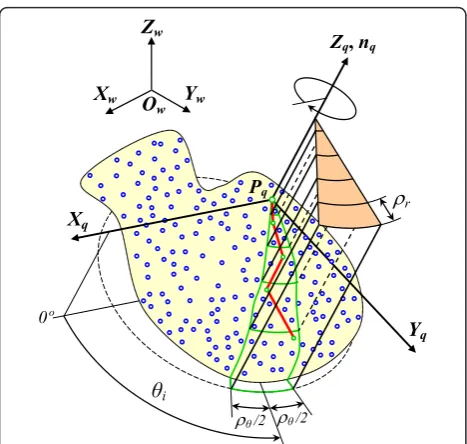
Once the cloud points are transformed to the local frame, the environment of the point-of-interest is con-sidered to be divided into nssectors (whose angle isrθ
radians), which are further divided radially into cells with lengthrrmm (excluding the cell closest to the
cen-tre,“cell 0”, which will be a sector with a radius 0.5 rr
mm). The sectors are numbered clockwise starting with the sector that is centred on the Xq-axis (θ1= 0). Figure
1 shows, around theZq-axis, this sense of numbering
and the nature of the cells for theith sector.
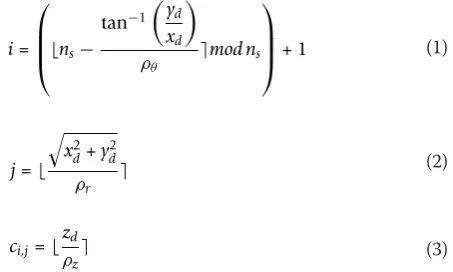
Taking into account this division of the point cloud into sectors and cells, a transformation based on cylind-rical coordinates is applied in order to obtain, for any point pdwith coordinates (xd, yd, zd) in the coordinate
system with origin at pq, the iindex corresponding to
the number of sector to which it belongs, the j index
indicating the cell within that sector, and the height value associated with its coordinatezd.
i= ⎛ ⎜ ⎜ ⎝ns−
tan−1
yd
xd
ρθ mod ns ⎞ ⎟ ⎟
⎠+ 1 (1)
j=
x2
d+y2d
ρr
(2)
ci,j=
zd
ρz (3)
where rθ is the angular resolution,rrthe radial
reso-lution, andrz the height resolution. Note also that⌊x⌉
is the nearest integer to x. Applying these three equa-tions to all points of the cloud and maintaining the maximum valuesci, j for each cell (which is equivalent
to saying that itszcoordinate is maximum), we obtain a set of triples (i, j,ci, j) that uniquely correspond to each
of the cells into which the environment of the point-of-interest has been divided. Therefore, the descriptor con-sists of a set of coded values that represent the contours
described by the points with the maximumzcoordinate
of each of the cells into which each sector is divided.
Figure 1 shows, for sector i, the contour described by
indexes (i, j) has a single value of ci, j, we can build a
matrixC whose row index is the sector number,i, and
whose column index is the number of cell,j, within that sector (see Figure 2). Note that the cells closest to the center (the origin of the local coordinate system) are not represented in this matrix since their value would always be close to zero.
Since the sequence should be closed because it describes the environment of the point-of-interest, the first and last rows must be considered adjacent, since their elements with the same column index correspond to adjacent cells. In other words, this descriptor has the property of being cyclical.
This matrix can also be viewed as an image (see Fig-ure 3) whose pixels represent the values ci, j, so that
each of them has an associated colour (or a gray level). Hence, this descriptor can be considered as a cyclical image of the environment of a point-of-interest. Since each row represents a radial encoding of the contour described by the maximum heights of each of the cells
in a sector, we will call this descriptor “CIRCON”,
which is an acronym of “Cyclical Image of Radial
CONtours”.
3. The proposed similarity measure
3.1. Introduction
Unlike the similarity measures based on correlation coefficient (CC), mutual information (MI) [24,25], joint entropy [26,27], or others [28,29] that have been used by the most popular coarse alignment algorithms, such as spin images, this similarity measure is based on dis-tance between pixels and takes into account the pro-blems of occlusion that can appear in real situations that need 3D registration or object recognition.
This similarity measure gives weighting to both the overlap and the proximity of two point clouds. This enables the simultaneous evaluation of the geometric consistency of the correspondences. Although computa-tional cost increases with the number of correspon-dences evaluated, the Euclidean transformation associated with this correspondence can be directly cal-culated, given that the rotation around the normal necessary to align the two point clouds is determined. Therefore, it will be possible to determine which corre-spondences give rise to the Euclidean transformation which fits best and to base the stopping criterion on their validation. In this way, the algorithm finalizes when the coarse transformation satisfies the end condi-tions imposed (detailed in the algorithm in Section 5.3), without necessity to evaluate all the points-of-interest selected in the two point clouds.
3.2. Sets of pixels
Assuming two CIRCON descriptors A and B
corre-sponding to two matched points; if both a pixel fromA, aij, and a pixel fromB,bij, represent a part of the point
cloud, it will be considered that this pair of pixels, with indexes (i, j), are overlapped.
Taking into account that the matrix elements not belonging to the point cloud will be considered compu-tationally as ‘not-a-number’ (i.e.,NaN), the following sets of pixels have been defined:
Intersection Set (overlapped pixels):
IAB={(i,j)|(aij=NaN)and(bij=NaN)} (4)
Zq,nq
Xq
Yq
Uș/2
ș
iU
rXw Yw
Zw
Ow
Pq
0º
Uș/2
Figure 1Construction of a CIRCON descriptor. Green shows cell division in sectoriand red indicates the contour formed by the points of the cells with the greatest z coordinate.
radius
nr ns, j ns, 2 ns, 1 ns, nr i, j i, 2 i, i,1 nr , 2 j , 2 2 , 2 1 , 2 nr , 1 j , 1 2 , 1 1 , 1c
c
c
c
c
c
c
c
c
c
c
c
c
c
c
c
angle
Exclusive-OR Set (non-overlapped pixels):
XAB={(i,j)|(aij=NaN)xor(bij=NaN)} (5)
Union Set (overlapped pixels and non-overlapped pix-els):
UAB={(i,j)|(aij=NaN)or(bij=NaN)} (6)
These sets of pixels will be taken into account in order to define the similarity measure.
3.3. Area represented by each cell
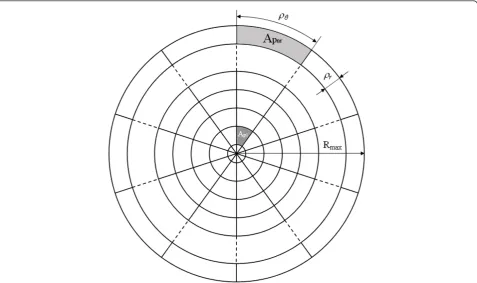
The top-view area represented by each cell (see Figure 4) increases with the distance from the central point (the point-of-interest where the descriptor has been gen-erated). Therefore, the size of this area will determine which points in the cloud correspond to a cell of the image matrix.
Accordingly, the pixels corresponding to a specific
col-umnjin the CIRCON image represent the points that
have a radius between rr(j-0.5) andrr (j+0.5).
There-fore, the theoretical area corresponding to each one of these pixels will be the same,Apj, and it will be given by
the following expression:
Apj= π
ns ·
((ρr·(j+ 0.5))2−(ρr·(j−0.5))2) (7)
nsbeing the number of angular divisions.
Simplifying,
Apj=
2π
ns ·ρ
2
r ·j (8)
3.4 Weight of the pixels
In the same way, the theoretical area corresponding to a pixel of the first column (equivalent to a cell of the first ring of the Figure 4) will be
Ap1= 2π
ns ·ρ
2
r (9)
Therefore, the relationship of areas between a pixel in thejth column and the one in the first column will be as follows
Apj
Ap1
=j (10)
Using this expression, the area represented by the pix-els in different columns will be taken into account to correctly weight the contribution of each pixel to the average distance in the overlapped area.
3.5. Similarity measure expression
As was explained previously, the similarity measure selected will depend on the distance and the overlap among the CIRCON images.
To calculate the average distance between the pixels of the two images, those of the overlapped area and those of the non-overlapped area will be considered separately.
Therefore, the average distance in the overlapped area will be defined using the following expression:
Dov= (i,j)∈IAB
Apj· |aij−bij|
(i,j)∈IAB Apj
= (i,j)∈IAB
j· |aij−bij| (i,j)∈IAB
j (11)
And the overlap ratio is defined as
σov= (i,j)∈IAB
j
(i,j)∈UAB
j (12)
which expresses the relationship between the weighted number of overlapping pixels and the weighted total number of pixels pertaining to the object (overlapping and non-overlapping).
The similarity measure proposed considers both terms and it provides values between 0 and 1,
MS = σ
ov
(ρ·Dov+λ) +σov·(1−λ) (13)
wherel’is defined asl’ =r l., lbeing a parameter whose value represents the additional distance with which non-overlapping pixels are penalized. In contrast
the parameterrmodifies the relationship between the
expected similarity value and the distanceDovthat
pro-duces it, when the overlap is 100%.
The values for these parameters used in our experi-ments arer=1 andl=1, which give a similarity value of 0.5 both when sov= 0.5 andDov= 0 and whenDov=
1 andsov= 1.
Since, given a matching pair, the point coordinates and their corresponding normal vectors are known for both points, only a free parameter is needed to compute the rigid transformation: the rotation around the nor-mal. This can be easily calculated using CIRCON images since these are cyclical. By shifting the last row to the top for the first CIRCON image (from point cloud 1) and leaving the second one fixed (from point cloud 2), the similarity measure for a rotationrθ can be
calcu-lated. If the last two rows are shifted to the top, the equivalent rotation will be 2rθ, and so on. This can be
angle k·rθ (k being the number of row shifts). A
preli-minary analysis of this similarity measure can be found in [30].
4. Coarse alignment algorithm
4.1. Point-of-interest selection
First, it will be necessary to select a set of points-of-interest in both clouds, {p1i} and {p2i}. An important
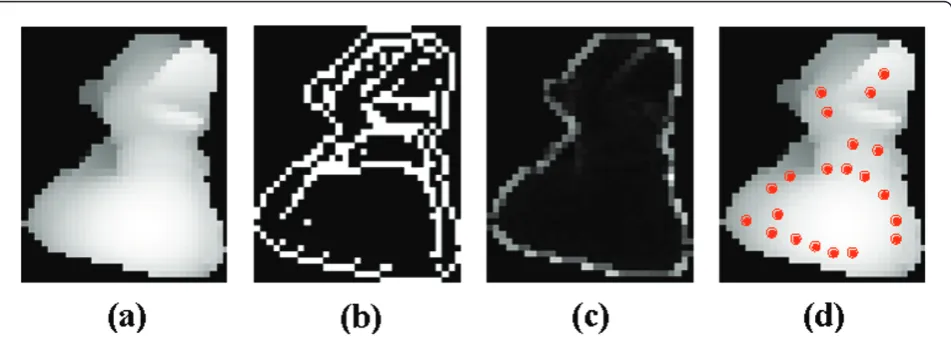
novelty is that the alignment algorithm does not need a thorough selection of the points-of-interest or a large number of them to obtain a proper alignment. Instead we have designed a simple algorithm that selects the points-of-interest by taking into account the particular characteristics of the descriptor proposed. First, normal vectors at each point are calculated by interpolation using the range image data. Applying basic morphologi-cal operations on the resulting image and the Laplace operator on the normal components (see Figure 5), points are extracted whose normal vectors are stable and also close to areas where the normal varies abruptly. This enables points-of-interest with a stable CIRCON descriptor to be selected that, in addition, represent close areas with relevant features.
The number of points extracted depends on the topol-ogy of the object, although a minimum distance between them is considered so that this number is not very high.
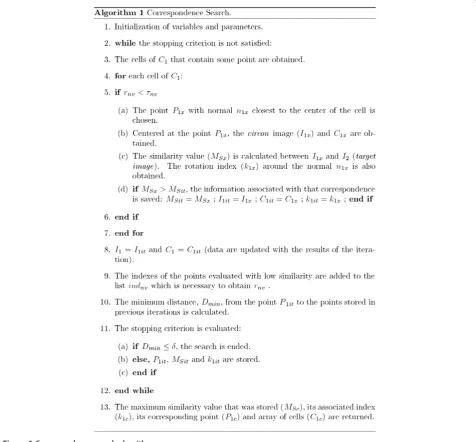
4.2. Correspondence search algorithm
This search algorithm is the core of the coarse align-ment algorithm. It is based on an iterative search for the greatest value of similarity measure using the array of
cells, C1, into which the environment of a
point-of-interest in point cloud 1 is divided. The chosen stopping criterion ensures that this search is convergent, since the
environment where the correspondences are searched for is progressively reduced.
The algorithm will evaluate correspondences between different points of cloud 1 and a point-of-interest selected from cloud 2. The degree of validity of two matching points is to be determined based on the
simi-larity between their CIRCON images: I1x (image of a
pointP1x in cloud 1) andI2 (target image). Since a
sin-gle point, P1x, is extracted from each cell of the array
C1, for each iteration, the algorithm performs as many
similarity measure evaluations as the number of ‘valid’ cells in the distributionC1 around the point of the
pre-vious iteration. Note that the points whose CIRCON images obtain a low similarity value are stored in a list of non-valid indexes, indnv. Thus, a cell will be
consid-ered ‘valid’when its ratio of non-valid points,rnv, is less
than a prefixed threshold τnv. This allows to
progres-sively reduce the number of cells to be checked.
Therefore, the similarity value returned by the algo-rithm,MSc, is the highest obtained in all the iterations
until the stopping condition is met. The algorithm ends when an iteration uses a starting point whose distance to one of the previously used points is less than a preset
δ(in our implementationδ=rr/16).
As will be explained in Section 5.3, the size of the descriptors used by this search algorithm depends on the resolution level in the main algorithm. Moreover, since one of its goals must be to avoid an incorrect alignment in the presence of occlusions and symmetries of the objects, the CIRCON images will represent the entire point clouds in order to increase their descriptive-ness. However, depending on the application (e.g., mixed objects), the environment size of the descriptor can be varied.
Figure 6 shows the steps that must be followed in order to perform this iterative search for correspondences.
4.3. Main algorithm: selection of the most suitable transformation
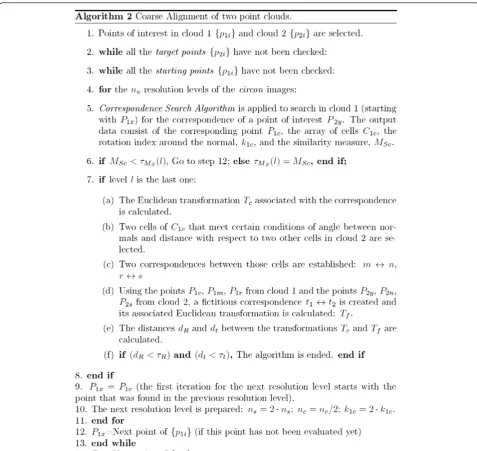
Figure 7 shows all the steps that must be followed in order to obtain a coarse alignment between two point
clouds. This algorithm uses the Correspondence Search
Algorithmintroduced in Section 5.2 in a multiresolution approach which refines the Euclidean transformation matrix.
For each interest-point chosen in cloud 2, P2y, the
search for correspondences by cells is established fornv
levels of resolution. The number of levels and the lowest
resolution must be determined through a compromise between computation time and accuracy of the point cloud alignment, which will depend on the application.
Thestarting points for the first level are the interest-points chosen in cloud 1, {p1i}. This first level enables
the discarding of those zones (cells) of the surroundings of the chosen point,P1x, where, due to their low
similar-ity, it is unlikely to find the desired correspondence.
Once the Correspondence Search Algorithmhas found
an approximate correspondence, P1c, for the first level,
the resolution is increased and a new search around this new starting pointis performed but with smaller cells. In this way, the search zone is reduced, which will be the object of progressive refinement for the next
resolution levels (since only the firstnc columns of the
array of cellsC1care used for the correspondence search
and this number is halved when the resolution is increased). When the convergence of the search asso-ciated with the last resolution level is achieved and the similarity valueMScof the resulting correspondence is
greater than a value τMS(nv), its corresponding
Eucli-dean transformation, Tc, is calculated using Equation
(22).
We propose a stopping criterion for the alignment algorithm that also takes into account the characteristics
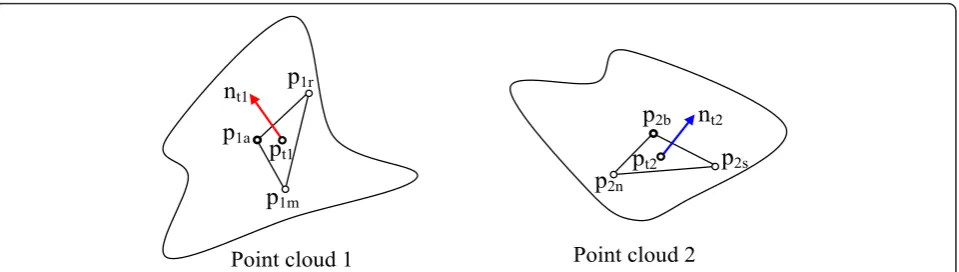
of the descriptor. It uses the correspondence found and two additional ones, (P1m,P2n) and (P1r,P2s), to create a
fictitious correspondence (see Figure 8) with which another transformation matrix, Tf, is computed. Those
additional points are chosen from corresponding cells in which both point clouds are distributed. The condition that must be satisfied for each of the two selected points in point cloud 1 is that the angle formed by their nor-mal vectors and the nornor-mal at the point being evaluated should be very similar to the angle formed by their cor-responding normal vectors in point cloud 2.
Then the matrix associated with the fictitious
corre-spondence,Tf, is compared with that obtained by the
algorithm, Tc. The execution is stopped if a distance
measure for the rotation, dR, and another for the
trans-lation,dt, do not exceed their respective thresholdsτR
andτt.
Thus, the rotation distancedRis obtained through the
following expression:
dR=
1 3(α
2
R+βR2+γR2) (14)
where (aR,bR, gR) are theZYXEuler angles from the
rotation matrix RT
f ·Rc; Rc being the rotation matrix
obtained by the algorithm, and Rf the rotation matrix
associated with the fictitious correspondence.
The translation distance dtwill be calculated as the
RMS distance between the translation vectors,tc andtf,
associated with both correspondences.
As will be shown in the results, the solution obtained by the algorithm can be sufficiently accurate for object manipulation tasks; however, the Euclidean transforma-tion could be refined using the ICP algorithm by taking advantage of the data provided by our algorithm about the correspondences between the points in the two clouds.
4.4. Calculation of the Euclidean transformation using a single correspondence
Once the correspondence with the highest similarity measure within the surroundings of the point-of-interest chosen for an iteration of the algorithm is found, the Euclidean transformation that coarsely aligns the point clouds can be calculated.
In the first place, it is necessary to express both point clouds within a frame of coordinates whose origin is each
of the two points that have been matched and whose
z-axis is aligned with the normal vectors at these points.
By convention, thex-axis of the new frame is perpen-dicular to the normal (new z-axis) and to the y-axis of
the original frame W, since the CIRCON images were
generated in this way.
Therefore, given an interest-point WPq with normal
vector n¯q expressed in the frame W, the data will be
rotated by using the following matrix:
q
WR= [x¯qn¯q× ¯xqn¯q]T (15)
where
¯
xq=
ˆ
yW× ¯nq
||ˆyW× ¯nq||
(16)
The translation vector is given by the coordinates of the point in the original frame. Therefore, the total Euclidean transformation will be given by the following expression:
q WT=
q WR −
q WR·WPq
01×3 1
−1
(17)
Given that the transformation matrix is 4 × 4, all the points in the following equations are expressed in homogeneous coordinates.
Suppose a correspondence between a point W1Pa of
cloud 1 and a point W2Pb of cloud 2. Let αW1T be the transformation matrix that enables the expression within the interest-point frame of the coordinates of a point in the cloud 1 expressed in the original frame W1. In the
same way, βW2T permits a similar transformation for
point cloud 2.
A pointW1Pi is expressed within the frame of point W1
Pain the following way:
αP
i=αW1T·
W1P
i (18)
Point cloud 1
Point cloud 2
p
1ap
1mp
1rn
t1p
t1n
t2p
t2p
2sp
2np
2bIn the same way, a point W2Pjin the frame centered
onW2Pbwill be:
βP
j=βW2T·
W2P
j (19)
As the points W1PaandW2Pbform a correspondence,
the origins of coordinates and the z-axes of the new
frames must be coincident. To align a pointaPiin point
cloud 1 with its corresponding pointbPjin cloud 2 it is
necessary to rotate cloud 1 about thez-axis of the new frame by an angle ofk·rθradians, wherekis the number
of rows the CIRCON image 1 was rotated to achieve the similarity value associated with this correspondence.
Therefore, to coarsely align the two points, the follow-ing must be fulfilled:
βP
j≈Rz(k)·αPi (20)
Substituting (18) and (19) into (20)
β W2T·
W2P
j≈Rz(k)·αW1T·
W1P
i (21)
Consequently, the final Euclidean transformation Tc
that coarsely aligns the two point clouds has the follow-ing expression:
Tc=βW2T −1·R
z(k)·αW1T (22)
where
RZ(k) = ⎛ ⎜ ⎜ ⎝
cos(ρθ·k) sin(ρθ·k) 0 0 −sin(ρθ·k) cos(ρθ·k) 0 0
0 0 1 0
0 0 0 1
⎞ ⎟ ⎟
⎠ (23)
5. Results
In order to enable the comparison of the proposed alignment algorithm with some of the existing ones we use some objects that were employed in different com-parative studies [2,23,31].
As in the comparative study by Salvi et al. [2], an ana-lysis of efficiency of the algorithm will not be carried out since, as discussed here, this is very implementation dependent (in our caseMatlab® was used). For this rea-son, we assess the performance of the algorithm in terms of effectiveness by measuring the alignment error for different free-form objects.
However, as a reference, it can be said that when the point clouds have an overlap of more than 70%, the time spent by the alignment algorithm is, in most cases, less than 5 s, while for very low overlap percentages, that value can be exceeded. In this case the time incre-ment is due, first, to the need to use more starting points for the algorithm in order to avoid false matches
and secondly because the choice of these points is not sufficiently suitable (given the simplicity of the points-of-interest selection algorithm), which implies, in both cases, an additional number of iterations.
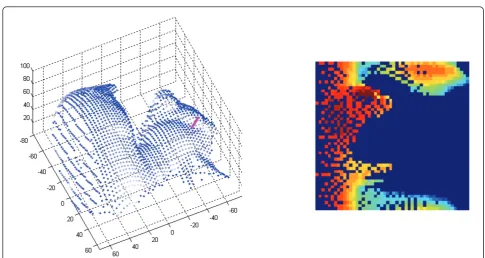
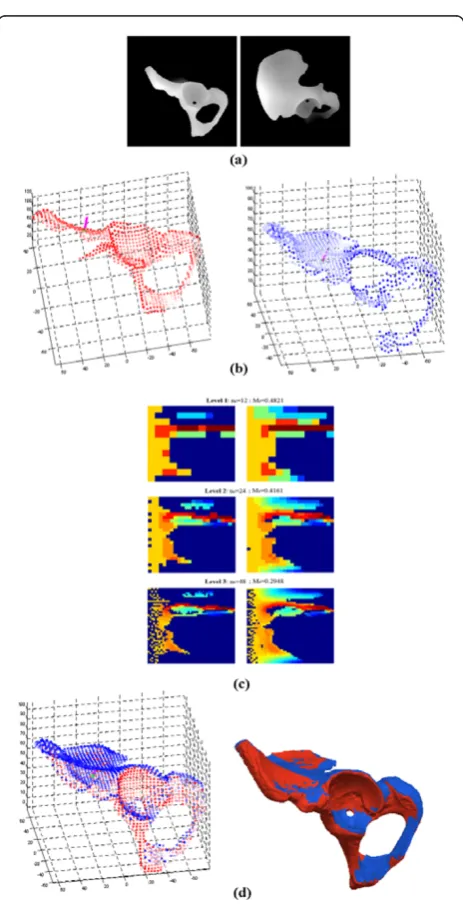
Figure 9 shows an example of the results obtained for the alignment of two range images using the algorithm presented in the previous sections. To accelerate the
Figure 9Alignment of two range images for the object‘hip’ from the Stuttgart University Database.(a)Range images.(b)
Corresponding points (normal vector in magenta) which obtained the maximum similarity value for the top resolution level.(c)
evaluation of the correspondences, reduced point clouds have been used (see Figure 9b). To do this, a simple algorithm has been implemented which creates a grid of x-ycoordinates (with a predetermined spacing) and
cal-culates thez coordinates through interpolation of the
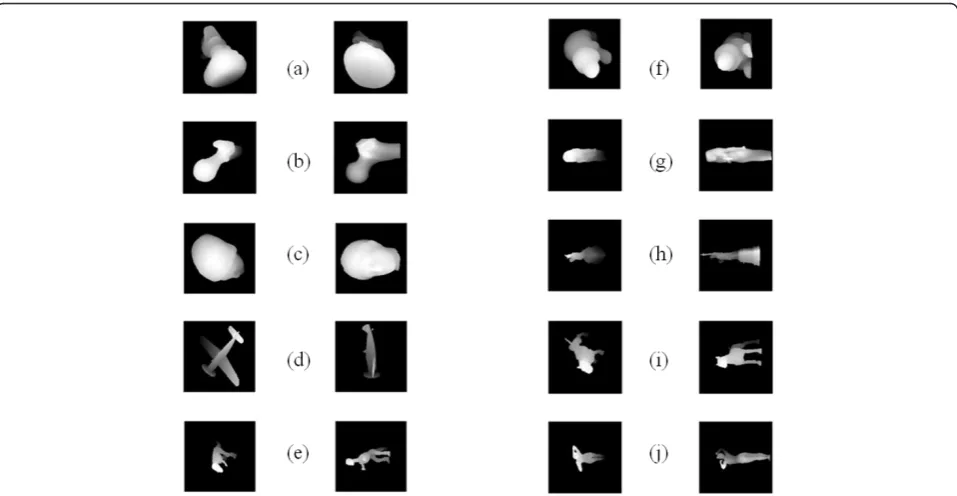
initial values of the surroundings of each new point. Obviously, this reduces the precision of the original point clouds; however, the results obtained for different objects (Figure 10) from the Stuttgart University Data-base [32] demonstrate the algorithm is robust to these alterations of the data.
The CIRCON images shown in Figure 9c correspond to the points in which the greatest similarity measure was obtained for the three resolution levels. The color map used to show these images was chosen with the aim of visualizing the similarity better.
The number of resolution levels used for the experi-ments was three with 12, 24, and 48 angular divisions. The number of search columns,nc, was, respectively, 8,
4, and 2 so that the number of search cells was always 96. These values were chosen for the implementation of our algorithm by testing different combinations to align synthetic point clouds. It was noted that with less than ten angular divisions the algorithm was faster at the first level, but it favored the emergence of false correspon-dences, which increases the computation time of the next levels and can lead to incorrect final alignment. On the other hand, we observed that 48 angular divisions for the highest resolution level are sufficient to obtain
an acceptable approximate alignment. Although the maximum error on the rotation around the normal vec-tor that could be committed is 3.75°, in practice the algorithm evaluates the similarity of so many correspon-dences with different orientations of the normal vector that usually the rotation error is under that value (as shown in the results).
Figure 9d shows the coarse alignment obtained for the reduced point cloud and a 3D rendering when the trans-formation obtained by the algorithm is also applied to the original data.
The rotation and translation errors were computed using similar expressions to those introduced in Section 5.3. In this case the transformation matrix chosen for comparison was obtained by refinement using a variant of the ICP algorithm [24].
As can be observed in the caption of Figure 9 and in Table 1, the rotation errors are less than 5° and the translation errors are, in all cases, less than the resolu-tion of the two reduced point clouds that are used by the coarse alignment algorithm.
This demonstrates that the algorithm is able to achieve a good performance despite using point clouds with few points (less than 6% of the original quantity) and different resolutions, which make it suitable for aligning point clouds with low density acquired by dif-ferent devices.
The alignment algorithm was also evaluated using three different similarity measures for comparing the
Figure 10Ten pairs of range images for different objects from the Stuttgart University database:(a)Ducky,(b)Femur,(c)Igea,(d)
descriptors: CC, MI, and the measure proposed (SM). This experiment aimed to demonstrate that the combi-nation of descriptor and similarity measure proposed has a better performance under conditions of low den-sity and overlap than the others. Using one single range image and removing different parts two new range images were created for different degrees of overlap. Previously, the resolution of the original range images was reduced by interpolation. Thus, the algorithm was evaluated starting from low resolution with the aim of obtaining an alignment with rotation and translation errors of less than 5° and 5 mm, respectively. If the algo-rithm were not capable of finding a good alignment, the resolution is increased successively having the original resolution as a limit. The number of points of the reduced range image (before removing parts) necessary for a good alignment is shown in Figure 11 for 12 range images corresponding to four different objects. These results show that the proposed algorithm and similarity measure have a good performance when both density and overlap are low, which is not possible with algo-rithms that use 2D or 3D descriptors [33], since they need a sufficient quantity of points in order to construct the descriptors.
Moreover, as is shown in Figure 12, the alignment algorithm can also be used to determine the pose of an object in a cluttered scene (problem that arises in bin-picking tasks). In this case, point cloud 1 represents the scene and point cloud 2 represents the object model. Thus, the radius of the point-of-interest environment must be limited to the maximum radius that can be obtained for the object (in Figure 12 this limit was fixed at 120 mm).
6. Conclusions
We have introduced a novel descriptor (CIRCON) which represents, through a cyclical image, the geometry
of the environment of a point-of-interest in the cloud. In order to construct the image matrix we distribute the points in sectors which, in turn, are subdivided into cells that have the same radial length. The values of the matrix elements represent the maximum z coordinate of the points contained in their corresponding cells. This represents an important difference with respect to other methods that use 2D histograms, such as spin images [8], which make them more vulnerable to the density changes of the point clouds (especially when their densi-ties are significantly different).
We have also designed a novel similarity measure that takes into account both the distances between the pixels of the descriptors and their degree of overlap, which are not considered by other methods due to the particular characteristics of the descriptors. Furthermore, this simi-larity measure takes advantage of the cyclical nature of the descriptor to obtain, along with the similarity value, an index that represents the rotation around the normal at the point-of-interest. When the similarity of two descrip-tors is evaluated, this rotation index, the matched points and their normal vectors can be used to calculate a Eucli-dean transformation matrix; that is, the two point clouds can be aligned by determining one single correspondence.
Using this similarity measure, the descriptors can be compared without having to restrict the neighborhood of the point-of-interest, so the discriminating power could be increased in order to avoid problems of misa-lignment when the objects have symmetries or repeated regions (problems that are not well solved by other methods, such as spin images, as is explained in [2]).
Based on this combination of descriptor and similarity measure we have designed a coarse alignment algorithm that eliminates the need to find a group of valid corre-spondences (which is necessary in most algorithms, including spin images [8]). One of the main advantages of this algorithm is that the stopping criterion is always
Table 1 Errors obtained by the coarse alignment algorithm for ten different objects
Reduced point cloud 1 Reduced point cloud 2 Rot. error (degrees)
Translation error (mm)
Number of points (% of total)
Resolution (mm)
Number of point (% of total)
Resolution (mm)
Ducky 859 (1.61%) 3.83 1142 (1.90%) 3.41 2.99 1.15
Femur 453 (1.54%) 3.75 497 (1.25%) 4.32 3.77 1.94
Igea 544 (0.93%) 4.67 419 (0.73%) 5.16 2.49 1.89
Fighter 635 (2.13%) 2.37 401 (2.67%) 2.20 1.50 0.47
Dino 528 (4.92%) 2.31 314 (2.45%) 2.87 4.09 1.00
Mole 673 (1.45%) 3.79 652 (1.65%) 3.41 2.34 1.06
Isis 543 (3.50%) 2.21 381 (1.47%) 3.37 3.62 2.06
Liberty 715 (5.27%) 1.93 428 (2.47%) 2.77 4.84 0.66
Pitbull 153 (0.83%) 4.99 108 (0.58%) 5.29 2.31 0.89
evaluated when it finds a correspondence that exceeds the maximum similarity value found until that moment. Thus, if certain conditions are met, the algorithm ends without having to find additional correspondences.
algorithm has to perform more iterations than necessary. As one of the advantages of our proposed algorithm is that it can end once it finds a correspondence that has high similarity and that meets the stopping criterion, if the points-of-interest are appropriately selected, it is very likely that the algorithm could end after the first iterations on the majority of occasions. Furthermore, if these key-points are obtained by new multiscale methods [34], the support sizes can be calculated for the descriptors in both point clouds and the alignment could be carried out, as in [35], using point clouds with different scale.
Acknowledgements
This study was carried out with the support of the Spanish CICYT project DPI2006-15313.
Competing interests
The authors declare that they have no competing interests.
Received: 9 March 2011 Accepted: 6 March 2012 Published: 6 March 2012
References
1. G Sansoni, M Trebeschi, F Docchio, State-of-the-art and applications of 3D imaging sensors in industry, cultural heritage, medicine, and criminal investigation. Sensors.9, 568–601 (2009). doi:10.3390/s90100568 2. J Salvi, C Matabosch, D Fofi, J Forest, A review of recent range image
registration methods with accuracy evaluation. Image Vis Comput.25, 578–596 (2007). doi:10.1016/j.imavis.2006.05.012
3. BM Planitz, AJ Maeder, JA Williams, The correspondence framework for 3D surface matching algorithms. Comput Vis Image Understand.97, 347–383 (2005). doi:10.1016/j.cviu.2004.08.001
4. CS Chua, R Jarvis, Point signatures: A new representation for 3D object recognition. Int J Comput Vis.25, 63–85 (1997). doi:10.1023/ A:1007981719186
5. N Gelfand, NJ Mitra, LJ Guibas, H Pottmann, Robust global registration, in Symposium on Geometry Processing, Vienna, Austria, pp. 197–206 (2005) 6. J Feldmar, N Ayache, Rigid, affine and locally affine registration of free-form
surfaces. Int J Comput Vis.18, 99–119 (1996). doi:10.1007/BF00054998 7. G Barequet, M Sharir, Partial surface matching by using directed footprints,
inProc 12th Annual Symp Computational Geometry, Philadelphia, USA, pp. 409–410 (1996)
8. AE Johnson, M Hebert, Using spin images for efficient object recognition in cluttered 3D scenes. IEEE Pattern Anal Mach Intell.21, 433–449 (1999). doi:10.1109/34.765655
9. AP Ashbrook, RB Fisher, C Robertson, N Werghi, Aligning arbitrary surfaces using pairwise geometric histograms, inProc NMBIA98, Glasgow, UK, pp. 103–108 (1998)
10. AP Ashbrook, RB Fisher, C Robertson, N Werghi, Finding surface correspondence for object recognition and registration using pairwise geometric histograms, inComputer Vision-ECCV’98, Freiburg, Germany, pp. 674–686 (1998)
11. SM Yamany, AA Farag, Surface signatures: an orientation independent free-form surface representation scheme for the purpose of objects registration and matching. IEEE Pattern Anal Mach Intell.24, 1105–1120 (2002). doi:10.1109/TPAMI.2002.1023806
12. T Masuda, Automatic registration of multiple range images by the local log-polar range images, inProc Third International Symposium on 3D Data Processing, Visualization, and Transmission, Chapel Hill, USA, pp. 216–223 (2006)
13. M Körtgen, M Novotni, R Klein, 3D shape matching with 3D shape contexts, inThe 7th Central European Seminar on Computer Graphics, Budmerice, Slovakia, pp. 1–12 (2003)
14. D Zhang, Harmonic shape images: a 3-D free-form surface representation and its application in surface matching, (Ph.D. dissertation, Carnegie Mellon University, 1999)
15. F Stein, G Medioni, Structural indexing: efficient 2D object recognition. IEEE Trans Pattern Anal Mach Intell.14, 1198–1204 (1992). doi:10.1109/34.177385 16. JV Wyngaerd, R Koch, M Proesmans, LV Gool, Invariant-based registration of surface patches, inIEEE International Conference on Computer Vision, vol. 1. Kerkyra, Greece, pp. 301–306 (1999)
17. P Krsek, T Pajdla, V Hlavác, R Martin, Range image registration driven by a hierarchy of surfaces, in22nd Workshop of the Austrian Association for Pattern Recognition, Illmitz, Austria, pp. 175–183 (1998)
18. C Song Chen, Y Ping Hung, J Bo Cheng, RANSAC-based DARCES: a new approach to fast automatic registration of partially overlapping range images. IEEE Trans Pattern Anal Mach Intell.21, 1229–1234 (1999). doi:10.1109/34.809117
19. CS Chua, R Jarvis, 3D free-form surface registration and object recognition. Int J Comput Vis.17, 77–99 (1996). doi:10.1007/BF00127819
20. J Cheng, H Don, A graph matching approach to 3-D point
correspondences. Pattern Recogn Artif Intell.5, 399–412 (1991). doi:10.1142/ S0218001491000223
21. PJ Besl, HD McKay, A method for registration of 3-D shapes. IEEE Pattern Anal Mach Intell.14, 239–256 (1992). doi:10.1109/34.121791
Figure 123D alignment in cluttered scenes (point-of-interest environment radius equal to 120 mm).(a)Range images: scene (left) and object model (right).(b)Corresponding points (normal vector in magenta) which obtained the maximum similarity value.
22. Y Chen, G Medioni, Object modelling by registration of multiple range images. Image Vis Comput.10, 145–155 (1992). doi:10.1016/0262-8856(92) 90066-C
23. S Rusinkiewicz, M Levoy, Efficient variants of the ICP algorithm, in Proceedings of the Third Intl Conf on 3D Digital Imaging and Modeling, Quebec City, Canada, pp. 145–152 (2001)
24. WM Wells III, P Viola, H Atsumi, S Nakajima, R Kikinis, Multi-modal volume registration by maximization of mutual information. Med Image Anal.1, 35–51 (1996). doi:10.1016/S1361-8415(01)80004-9
25. C Studholme, D Hill, D Hawkes, An overlap invariant entropy measure of 3D medical image alignment. Pattern Recogn.32, 71–86 (1999). doi:10.1016/ S0031-3203(98)00091-0
26. A Collignon, F Maes, D Delaere, D Vandermeulen, P Suetens, G Marchal, Automated multi-modality image registration based on information theory, inProc of International Conference on Information Processing in Medical Imaging, Ile de Berder, France, pp. 263–274 (1995)
27. C Studholme, DL Hill, DJ Hawkes, Multiresolution voxel similarity measures for MR-PET registration, inProc of International Conference on Information Processing in Medical Imaging, Ile de Berder, France, pp. 287–298 (1995) 28. D Skerl, B Likar, F Pernus, A protocol for evaluation of similarity measures
for rigid registration. IEEE Trans Med Imag.25, 779–791 (2006)
29. G Penney, J Weese, J Little, P Desmedt, D Hill, D Hawkes, A comparison of similarity measures for use in 2D-3D medical image registration. IEEE Trans Med Imag.17, 586–595 (1998). doi:10.1109/42.730403
30. C Torre Ferrero, J Llata, S Robla, E Sarabia, A similarity measure for 3D rigid registration of point clouds using image-based descriptors with low overlap. S3DV09, inIEEE 12th International Conference on Computer Vision, ICCV Workshops 2009, Kyoto, Japan, pp. 71–78 (2009)
31. T Zinsser, J Schmidt, H Niemann, A refined ICP algorithm for robust 3-D correspondence estimation, inProceedings of the International Conference on Image Processing, Barcelona, Spain, pp. 695–698 (2003)
32. K Eisele, G Hetzel, Range image database, University of Stuttgart. http:// range.informatik.uni-stuttgart.de/htdocs/html/
33. A Mian, M Bennamoun, RA Owens, A novel representation and feature matching algorithm for automatic pairwise registration of range images. Int J Comput Vis.66, 19–40 (2006). doi:10.1007/s11263-005-3221-0
34. A Mian, M Bennamoun, RA Owens, On the repeatability and quality of keypoints for local feature-based 3D object retrieval from cluttered scenes. Int J Comput Vis.89, 348–361 (2010). doi:10.1007/s11263-009-0296-z 35. J Novatnack, K Nishino, Scale-dependent/invariant local 3D shape
descriptors for fully automatic registration of multiple sets of range images, inProceedings of the 10th European Conference on Computer Vision: Part III, Marseille, France, pp. 440–453 (2008)
doi:10.1186/1687-6180-2012-57
Cite this article as:Torre-Ferreroet al.:3D point cloud registration based on a purpose-designed similarity measure.EURASIP Journal on Advances in Signal Processing20122012:57.
Submit your manuscript to a
journal and benefi t from:
7Convenient online submission
7 Rigorous peer review
7Immediate publication on acceptance
7 Open access: articles freely available online
7High visibility within the fi eld
7 Retaining the copyright to your article