Space Efficiencies in Discourse Modeling via Conditional Random Sampling
Brian Kjersten
CLSP
Johns Hopkins University
Benjamin Van Durme
HLTCOE
Johns Hopkins University
Abstract
Recent exploratory efforts in discourse-level language modeling have relied heavily on cal-culating Pointwise Mutual Information (PMI), which involves significant computation when done over large collections. Prior work has required aggressive pruning or independence assumptions to compute scores on large col-lections. We show the method of Condi-tional Random Sampling, thus far an underuti-lized technique, to be a space-efficient means of representing the sufficient statistics in dis-course that underly recent PMI-based work. This is demonstrated in the context of induc-ing Shankianscript-like structures over news articles.
1 Introduction
It has become common to model the distributional affinity between some word or phrase pair,(wi, wj),
as a function of co-occurance within some con-textboundary. Church and Hanks (1990) suggested pointwise mutual information: PMI(wi, wj) =
log Pr(wi,wj)
Pr(wi) Pr(wj), showing linguistically appealing
results using contexts defined by fixed width n-gram windows, and syntactic dependencies derived from automatically parsed corpora. Later work such as by Lin (1999) continued this tradition. Here we con-sider document, ordiscourse-level contexts, such as explored by Rosenfeld (1994) or Church (2000), and more recently by those such as Chambers and Juraf-sky (2008) or Van Durme and Lall (2009b).
In the spirit of recent work in randomized algo-rithms for large-scale HLT (such as by Ravichandran
et al. (2005), Talbot and Osborne (2007), Goyal et al. (2010), Talbot and Brants (2008),Van Durme and Lall (2009a), Levenberg and Osborne (2009), Goyal et al. (2010), Petrovic et al. (2010), Van Durme and Lall (2010), or Goyal and Daum´e (2011)), we pro-pose the method of Conditional Random Sampling (CRS) by Li and Church (2007) as an efficient way to storeapproximationsof the statistics used to cal-culate PMI for applications in inducing rudimentary script-like structures.
Efficiently storing such structures is an impor-tant step in integrating document-level statistics into downstream tasks, such as characterizing complex scenarios (Chambers and Jurafsky, 2011), or story understanding (Gordon et al., 2011).
2 Background
Conditional Random Sampling (CRS) Li and
Church (2007) proposed CRS to approximate the contingency table between elements in a query, to be used in distributional similarity measures such as cosine similarity, correlation, and PMI. Central is the idea of the postings list, which is made up of the identifiers of each document that contains a given word or phrase. A set of such lists, one per type in the underlying vocabulary, is known as an inverted index. To reduce storage costs, a CRS trun-cates these lists, now calledsketches, such that each sketch is no larger than some length parameterk.
Formally, assume an ordered list of document identifiers, Ω = (1,2, ...), where each referenced document is a bag of words drawn from a vocabu-lary of sizeV. LetPi ⊆ Ωbe the postings list for
some elementwi ∈ V. The functionπrepresents a
random permutation on the space of identifiers inΩ. The sketch,Si, is defined as the firstkelements of
the permuted list:Si= mink(π(Pi)). 1
Let q be a two-element query, (wi, wj). Given
the postings lists for wi, wj, we can construct
a four-cell contingency table containing the fre-quency of documents that contained only wi, only
wj, both together, or neither. A CRS allows for
approximating this table in O(k) time by rely-ing on a sample of Ω, specific to q: π(Ω)q =
(1,2,3, ..., min(max(Si), max(Sj))).
The PMI of q, given Ω, can be estimated from
π(Ω)q using the approximate word occurrence,
Pr(wi) =|Si∩π(Ω)q|/|π(Ω)q|, and co-occurrence,
Pr(wi∩wj) =|Si∩Sj∩π(Ω)q|/|π(Ω)q|.
This scheme generalizes to longer queries of lengthm, where storage costs remain O(V k), and query time scales atO(mk). Li and Church (2007) proved that CRS produces an unbiased estimate of the probabilities, and showed empirically that vari-ance is a function ofkandm.
Despite its simplicity and promise for large-scale data mining in NLP, CRS has thus-far seen minimal application in the community.
Trigger Language Models As here, Rosenfeld (1994)’s work on trigger language models was con-cerned with document level context. He identified trigger pairs: pairs of word sequences where the presence of the first word sequence affects the prob-ability of the other, possibly at long distances. He recommended selecting a small list of trigger pairs based on the highest average mutual information (often simply called mutual information), although intuitively PMI could also be used. Computational constraints forced him to apply heavy pruning to the bigrams in his model.
Scripts Ascript, proposed by Schank (1975), is a form of Minsky-styleframethat captures common-sense knowledge regarding typical events. For ex-ample, if a machine were to reason abouteating at a restaurant, it should associate to this event: the
ex-1
For example, assume some wordwithat appears in
doc-umentsd1, d4, d10andd12. The identifiers are then randomly permuted viaπsuch that: d03 = d1,d20 = d4,d07 = d10and d01 = d12. Following permutation, the postings list forwiis
made up of identifiers that map to the same underlying docu-ments as before, but now in a different order. If we letk= 3, thenSi= (1,2,3), corresponding to documents:(d12, d4, d1).
istence of acustomerorpatronthat usuallypaysfor themealthat is orderedby the patron, thenserved by thewaiter, etc.
Chambers and Jurafsky (2008) suggested induc-ing a similar structure called anarrative chain: fo-cus on the situational descriptions explicitly pertain-ing to a spertain-ingle protagonist, a series of references within a document that are automatically labeled as coreferent. With a large corpus, one can then find those sets of verbs (as anchors of basic sit-uational descriptions) which tend to co-occur, and share a protagonist, leading to an approximate sub-set of Schank’s original conception.2
Underlying the co-occurrence framework of Chambers and Jurafsky was finding those verbs with high PMI. Starting with some initial element, chains were built greedily by adding the term,x, that max-imized the average of the pairwise PMI between x
and every term already in the chain:
Wn+1 = arg max
W
1
n
n
X
j=1
pmi(W, Wj)
By relying on the average pairwise PMI, they are making independence assumptions that are not al-ways valid. In order to consider more nuanced joint effects between more than two terms, more efficient methods would need to be considered.
3 Experiments
Setup Following Chambers and Jurafsky (2008), we extracted and lemmatized the verbs from the New York Times section of the Gigaword Corpus us-ing the Stanford POS tagger (Toutanova et al., 2004) and the Morpha lemmatizer (Minnen et al., 2000). After filtering various POS tagger errors and setting a minimum document frequency (df) of 50, we went from a vocabulary of 94,803 words to 8,051.3 For various values ofkwe built sketches over 1,655,193 documents, for each resulting word type.
2
Given a large collection of news articles, some on the topic of local crime, one might see a story such as:“... searched for Michaeli... heiwas arrested ... Mikeiplead guilty ... convicted
himi...”, helping to support an induced chain: (search, arrest,
plead, acquit, convict, sentence).
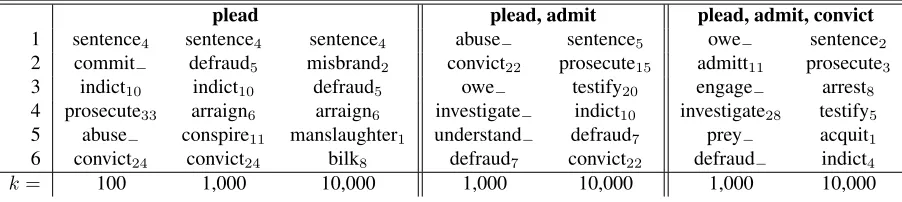
Table 1: Top-nby approximate PMI, for varyingk. Subscripts denote rank under true PMI, when less than 50. plead plead, admit plead, admit, convict 1 sentence4 sentence4 sentence4 abuse− sentence5 owe− sentence2
2 commit− defraud5 misbrand2 convict22 prosecute15 admitt11 prosecute3
3 indict10 indict10 defraud5 owe− testify20 engage− arrest8
4 prosecute33 arraign6 arraign6 investigate− indict10 investigate28 testify5
5 abuse− conspire11 manslaughter1 understand− defraud7 prey− acquit1
6 convict24 convict24 bilk8 defraud7 convict22 defraud− indict4
k= 100 1,000 10,000 1,000 10,000 1,000 10,000
We use a generalized definition of PMI for three or more items as the logarithm of the joint probabil-ity divided by the product of the marginals.
Subjective Quality We first consider the lemma-tized version of the motivating example by Cham-bers and Jurafsky (2008): [plead, admit, convict], breaking it into 1-, 2-, and 3-element seeds. They reported the top 6 elements that maximize average pairwise PMI as: sentence, parole,fire,indict,fine, deny. We see similar results in Table 1, while not-ing again the distinction in underlynot-ing statistics: we did not restrict ourselves to cooccurrence based on shared coreferring arguments.
These results show intuitive discourse-level rela-tionships with a sketch size as small as k = 100 for the unary seed. In addition, when examining the true PMI rank of each of these terms (reflected as subscripts), we see that highly ranked items in the approximate lists come from the set of items highly ranked in the non-approximate version.4 A major benefit of the approach is that it allows for approxi-mate scoring of larger sets of elementsjointly, with-out the traditionally assumed storage penalty.5
Accuracy 1 We measured the trade-off between PMI approximation accuracy and sketch size. Triples of verb tokens were sampled at random from thenarrative clozetest set of Chambers and Jurafsky (2008). Seed terms were limited to verbs with df be-tween 1,000 and 100,000 to extract lists of the top-25 candidate verbs by joint, approximate PMI. For
4The word ”sentence” is consistently higher ranked in the approximate PMI list than it is in the true PMI list: results stem from a givensharedpermutation across the queries, and thus approximation errors are more likely to be correlated.
5For example, we report that PMI(plead, admit, convict) > PMI(plead, admit, owe), when k = 1,000, as com-pared to: avg(PMI(plead, convict), PMI(admit, convict)) >
avg(PMI(plead, owe), PMI(admit, owe)).
a given rankr, we measured the overlap of thetrue top-3 PMI and the approximate list, rankror higher (see Figure 1(a)). If query size is 2, k = 10,000, the true top-3 true PMI items tend to rank well in the approximate PMI list. We observe that these randomly assembled queries tax the sketch-based approximation, motivating the next experiment on non-uniformly sampled queries.
Accuracy 2 In a more realistic scenario, we might have more discretion in selecting terms of interest. Here we chose the first word of each seed uniformly at random from each document, and selected subse-quent seed words to maximize the true PMI with the established words in the seed. We constrained the seed terms to have df between 1,000 and 100,000. Then, for each seed of length 1, 2, and 3 words, we found the 25-best list of terms using approximate PMI, considering only terms that occur in more than 50 documents. Figure 1(b) shows the results of this PMI approximation tradeoff. With a sketch size of 10,000, a rank of 5 is enough to contain two out of the top three items, and the number gradually con-tinues to grow as rank size increases.
Memory Analysis Accuracy in a CRS is a func-tion of the aggressiveness in space savings: ask ap-proaches the true length of the posting list for wi,
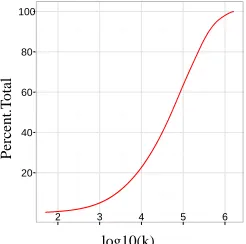
the resulting approximations are closer to truth, at the cost of increased storage. Whenk=∞, CRS is the same as using an inverted index: Fig. 2 shows the percent memory required for our data, compared to a standard index, as the sketch size increases. For our data, a full index involves storing 95 million docu-ment numbers. For thek = 10,000results, we see that23%of a full index was needed.
Rank
Mean.Observ
ed
0.0 0.5 1.0 1.5 2.0 2.5 3.0
● ●
● ● ● ●
● ●
● ●
● ●
5 10 15 20 25
k
1000 10000
m ●2 3 4
(a)
Rank
Mean.Observ
ed
0.0 0.5 1.0 1.5 2.0 2.5 3.0
● ●
● ●
● ●
● ●
● ● ● ●
5 10 15 20 25
k
1000 10000
m ●2 3 4
(b)
Percent.Memory
Mean.Observ
ed
0.0 0.5 1.0 1.5 2.0 2.5
3.0 ● ● ●●
●
●
●
●
● ● ●
0 20 40 60 80 100
m ●2
3 4
(c)
Figure 1: (a) Average number of true top-3 PMI items when seed terms have 1,000≤df≤100,000 and are chosen uni-formly at random from documents. (b) Average number of true top-3 PMI items when seeds are moderate-frequency high-PMI tuples. (c) Average number of true top-3 PMI items in the top ten approximate PMI list, as a function of memory usage, when seeds are moderate-frequency high-PMI tuples.
log10(k)
Percent.T
otal
20 40 60 80 100
[image:4.612.89.525.60.213.2]2 3 4 5 6
Figure 2:%of inverted index stored, as function ofk.
top 3 true PMI items to appear in the top 10. Over 40% memory is needed for a 4-word query. 2.5 of the top 3 true PMI items appear in the top 50 when the memory is about 35%. This suggests that CRS allows us to use a fraction of the memory of storing a full inverted index, but that memory requirements grow with query size.
Discussion Storing exact PMIs of three or four words would be expensive to store in memory for any moderately sized vocabulary, because it would involve storing on the order of Vm count statis-tics. If we are approximating this with a CRS, we store sketches of length k or less for every word in the vocabulary, which is O(kV). Table 1 and Fig. 1(b) show that the two-word queries start to get good performance whenkis near 10,000. This
requires 22.7% of the memory of a complete in-verted index, or 21.5 million postings. The three and four word queries get good performance near
k = 100,000. With this sketch size, 60.5 million postings are stored.
4 Conclusion
We have proposed using Conditional Random Sam-pling for approximating PMI in the discourse under-standing community. We have shown that the ap-proximate PMI rank list produces results that are in-tuitive and consistent with the exact PMI even with significant memory savings. This enables us to ap-proximate PMI for tuples longer than pairs without undue independence assumptions. One future av-enue is to explore the use of this structure in appli-cations such as machine translation, as potentially enabling greater use of long distance dependencies than in prior work, such as by Hasan et al. (2008).
5 Acknowledgements
[image:4.612.123.246.302.424.2]References
Nathanael Chambers and Dan Jurafsky. 2008. Unsuper-vised learning of narrative event chains. In Proceed-ings of ACL.
Nathanael Chambers and Dan Jurafsky. 2011. Template-based information extraction without the templates. In Proceedings of ACL.
Kenneth Church and Patrick Hanks. 1990. Word asso-ciation norms, mutual information and lexicography. Computational Linguistics, 16(1):22–29.
Kenneth W. Church. 2000. Empirical estimates of adap-tation: The chance of two noriegas is closer to p/2 than p2. InProceedings of COLING.
Andrew Gordon, Cosmin Bejan, and Kenji Sagae. 2011. Commonsense causal reasoning using millions of per-sonal stories. InProceedings of AAAI.
Amit Goyal and Hal Daum´e. 2011. Lossy conservative update (lcu) sketch: Succinct approximate count stor-age. InAAAI.
Amit Goyal, Jagadeesh Jagarlamundi, Hal Daum´e, and Suresh Venkatasubramanian. 2010. Sketch techniques for scaling distributional similarity to the web. In6th WAC Workshop at NAACL-HLT.
Sasa Hasan, Juri Ganitkevitch, Hermann Ney, and J. Andr´es-Ferrer. 2008. Triplet lexicon models for statistical machine translation. In Proceedings of EMNLP.
Abby Levenberg and Miles Osborne. 2009. Stream-based randomised language models for smt. In Pro-ceedings of EMNLP.
Ping Li and Kenneth Church. 2007. A sketch algo-rithm for estimating two-way and multi-way associ-ations. Computational Linguistics, 33(2):305–354. Dekang Lin. 1999. Automatic identification of
non-compositional phrases. InProceedings of ACL. Guido Minnen, John Carroll, and Darren Pearce. 2000.
Robust, applied morphological generation. In Pro-ceedings of the 1st International Natural Language Generation Conference.
Sasa Petrovic, Miles Osborne, and Victor Lavrenko. 2010. Streaming first story detection with application to twitter. InProceedings of NAACL.
Deepak Ravichandran, Patrick Pantel, and Eduard Hovy. 2005. Randomized Algorithms and NLP: Using Lo-cality Sensitive Hash Functions for High Speed Noun Clustering. InProceedings of ACL.
Ronald Rosenfeld. 1994. Adaptive statistical language modeling: A maximum entropy approach. Ph.D. the-sis, Carnegie Mellon University.
Roger C. Schank. 1975. Using knowledge to understand. InTheoretical Issues in Natural Language Processing.
David Talbot and Thorsten Brants. 2008. Randomized language models via perfect hash functions. In Pro-ceeedings of ACL.
David Talbot and Miles Osborne. 2007. Randomised language modelling for statistical machine translation. InProceedings of ACL.
Kristina Toutanova, Dan Klein, Christopher D. Manning, and Yoram Singer. 2004. Feature-rich part-of-speech tagging with a cyclic dependency network. In Pro-ceedings of NAACL.
Benjamin Van Durme and Ashwin Lall. 2009a. Proba-bilistic Counting with Randomized Storage. In Pro-ceedings of IJCAI.
Benjamin Van Durme and Ashwin Lall. 2009b. Stream-ing pointwise mutual information. InNIPS.