INCENTIVES AND EARNED PRIVILEGES
This instruction applies to:- Reference:-
Prisons PSI 30/2013
Issue Date Effective Date
Implementation Date
Expiry Date
24 October 2013 (Revised)
01 November 2013 04 September 2017
Issued on the authority of
NOMS Agency Board
For action by (Who is this Instruction for)
All staff responsible for the development and publication of policy and instructions
NOMS HQ All prisons
High Security Prisons only Contracted Prisons* Governors
Heads of Groups
* If this box is marked, then in this document the term Governor also applies to Directors of Contracted Prisons
Instruction type Service Specification Support For information All staff in prison establishments
Provide a summary of the policy aim and the reason for its development / revision
This instruction has been developed to provide guidelines and mandatory actions on the operation of the Incentives and Earned Privileges policy including guidance on the changes announced by Ministers on 30 April 2013.
Update: 24 October 2013 – Amendments have been made as per the Notice to Governors on 24 October 2013 from Simon Greenwood, Joint Head of Policy team, NOMS Equality, Rights and Decency Group. This includes updates made to paragraph 10.4 clarifying the examples of exceptional circumstances of when the Governor can use discretion to allow items to be handed in and paragraph 10.5 provides clarity to those items that can be handed in to unconvicted prisoners. Annex F (which incorporates the generic facilities list) has also been updated following further consultation with prisons.
Contact Equality Rights and Decency Group
Nigel Mulcaster - [email protected] Tel: 0300 047 6619
Paul Norman - [email protected] Tel 0300 047 5687
Associated documents
PSI 16/2011: Providing Visits and Services to Visitors
PSI 23/2011: Licence for DVD/Video Films, Music and TV in Prisons PSI 26/2011: NOMS Finance Manual
PSI 32/2011: Ensuring Equality
PSI 47/2011: Prisoner Discipline Procedures PSI 49/2011: Prisoner Communication Services PSI 51/2011: Faith and Pastoral Care for Prisoners
PSI 64/2011: Management of prisoners at risk of harm to self, to others and from others (Safer Custody)
PSI 74/2011: Early Days in Custody – Reception In, First Night in Custody, and Induction to Custody
PSI 75/2011: Residential Services PSI 01/2012: Manage Prisoner Finance
PSI 08/2012: Care and Management of Young People PSI 41/2012: Sentence Planning
Replaces the following documents which are hereby cancelled:- None
Audit/monitoring:- Deputy Directors of Custody and Controllers will monitor compliance with the mandatory actions set out in this Instruction.
Introduces amendments to the following documents: PSI 11/2011: Incentives and Earned Privileges Scheme
From 1 November 2013 PSI 11/2011 will apply only to adult prisoners (aged 18 and over)
received into prison custody before that date and until they have migrated onto the new IEP Framework (see paragraph 1.2 below for further details). PSI 11/2011 will also continue to apply to young people (under 18s).
PSI 12/2011: Prisoners’ Property:
Paragraphs 2.3 & 2.63 and Annex A: To be amended to take into account the standardised
facilities list introduced at Paragraph 10.2 and Annex F in this PSI.
Paragraph 2.62: To be amended to reflect that there are now four levels of IEP privilege;
Basic, Entry, Standard and Enhanced.
Paragraphs 2.64 and 2.67 have been amended to take into account new restrictions on
what items can be handed in and sent in to prisoners by their families and friends (see paragraphs 10.4 and 10.5 below).
PSI 26/2011: NOMS Finance Manual:
Paragraph 15.3.9: To be amended to record the four levels of IEP privilege; Basic, Entry,
Standard and Enhanced.
Paragraph 15.3.11: To be amended to record that further information on private cash is
given in PSI 01/2012 and that the private cash IEP levels are now given in Paragraph 9.16 of this PSI.
PSI 75/2011: Residential Services:
Paragraph 2.4: To be amended to record the four levels of IEP privilege; Basic, Entry,
Standard and Enhanced.
PSI 01/2012: Manage Prisoner Finance:
Paragraph 2.4: To be amended to record the four levels of IEP weekly spend limits as set
CONTENTS
Hold down ‘Ctrl’ and click on section titles below to follow link
Section Subject For reference by:
1. Executive Summary
Directors of contracted prisons, Governors and all staff involved in the
IEP process 2 Specification Outcomes
3 Compacts
4 IEP Levels and Requirements
5 Progression and Regression
6 Reviews and Appeals
7 IEP Warnings
8 Adjudications and the IEP Scheme
9 Local Schemes and Incentivising Good Behaviour
10 Additional Non-Designated Key Earnable Privileges
11 18 Rated and Unrated DVDs
12 Release on Temporary Licence
13 Equality and Fairness
14 Special Groups of Prisoners
15 Retention of Privilege Level on Transfer
16 Monitoring
17 Changes to P-NOMIS
Annex A IEP Prisoner Compact
Annex B Criteria of Requirements for Progression
Annex C Entry Level Checklist
Annex D Deniers and Appellants
Annex E In-Cell Television and Compact
Annex F Facilities List
Appendix A - Games Consoles Appendix B - Hobbies
Appendix C - Religious Practice Appendix D - Volumetric Control Appendix E - Unconvicted Prisoners
Annex G Prison and YOI Rules
Annex H IEP Review – Quality and Consistency
1. E xecutive Summary
1.1 This PSI sets out the revised operational framework for all prisons and Young Offender
Institutions (YOIs) in delivering the Incentives and Earned Privileges Scheme (IEP), which is part of the Residential Services Specification. This revised policy does not apply to young people (those under the age of 18) as there is a separate scheme for them that operates
under PSI 08/2012 - Care and Management of Young People and PSI 11/2011 - Incentives
and Earned Privileges. Therefore these PSI’s will remain in place for young people. All subsequent references to Governors in this PSI should be taken to include Directors of contracted out prisons.
1.2 This PSI has been issued following a review of the IEP scheme, the outcome of which was
announced by Ministers on 30 April 2013. The changes will come into effect from 1 November 2013. This policy applies to all adult prisoners (aged 18 and over), including recalls, received into prison custody on or after 1 November 2013. Existing adult prisoners in prison custody will not be affected by the new policy, save for paragraphs 10.4 and 10.5 until:
Their next review, whether the routine annual review or as a consequence of performance or behaviour (good or bad);
Or, if unconvicted, until their conviction (provided it is on or after 1 November 2013).
1.3 This means that PSI 11/2011 will continue to apply to existing prisoners, including any local
facility lists in place under that scheme, until they have reached either of the two stages above. A prison transfer will not automatically trigger a review unless it is for behaviour and/ or performance related reasons. Therefore prisons will need to operate two schemes for prisoners aged 18 or over until all such existing prisoners have migrated across to the new policy. Once a prisoner is on the revised scheme their in-possession items will be managed within the new facilities list.
1.4 In order to prepare for the introduction of the revised scheme, prisons must, from September 2013:
Identify the potential number of prisoners who will require prison issue clothing and order the items. Public sector prisons should order items through existing channels. Private sector prisons should submit any orders to the following email address [email protected]. Prisons must ensure that they do not over order to avoid placing unnecessary demands on stock;
Make the content of the revised scheme available to all new and existing prisoners. It is important that existing prisoners are informed of the changes introduced by this PSI. Local communications with staff and prisoners will be vital to the successful implementation of the scheme and to assist, a communication package will be sent to prisons in due course. Existing prisoners, when they migrate to the revised IEP scheme, must be judged against the ‘Criteria of Requirements for Progression’ set out in Annex B, so it is important to ensure that existing prisoners are made aware of these requirements in sufficient time before they are reviewed under the revised scheme.
Background
1.5 Prison Rule 8 and YOI Rule 6 (Annex G) require every prison and YOI to provide a system
minimum entitlements under the Rules, subject to their reaching and maintaining specified standards of conduct and performance.
1.6 The Incentives and Earned Privileges (IEP) scheme was introduced in 1995 with the expectation that prisoners would earn additional privileges through demonstrating responsible behaviour and participation in work or other constructive activity. Since then a number of revised instructions have reflected slight changes in the approach. On 30 April 2013 Ministers announced the outcome of a review of the IEP scheme and made it clear that, in order to earn privileges, prisoners will now have to work towards their own rehabilitation, behave well and help others. The absence of bad behaviour alone will no longer be sufficient to progress through the scheme.
1.7 In addition Ministers announced that prisoners will be required to make payment towards
any damage that they cause to prisons and prison property. The adjudication process will be used to determine whether recovery is appropriate and the amount to be recovered and
an amendment to PSI 47/2011 - Prisoner Discipline Procedures will be issued.
1.8 The revised IEP scheme introduces a new Entry level which sits between Basic and Standard level. Entry level applies to all:
Prisoners received into custody on or after 1 November 2013;
Unconvicted prisoners in prison custody who are subsequently convicted on or after
1 November 2013. Such prisoners must revert to the ‘Entry’ level on conviction
regardless of whether they have previously completed Entry level;
Recalled prisoners who are received into custody on or after 1 November 2013.
1.9 Other changes include the following:
Male convicted prisoners on Entry level will be required to wear prison issue clothing;
Prisoners on Entry level will not be permitted access to higher paid work;
Prisoners on Entry level will have a level of private cash allowance above Basic
level but lower than Standard level;
Prisoners will not be allowed to watch TV when they should be at work, in education, engaged in activities to reduce their reoffending or other activities as directed (see paragraph 9.9 and Annex E for further details);
Subscription TV channels have been removed;
There will be a standardised facilities list which applies to all prisons. This will be in
the form of a ‘menu’ which governors may select from, but must not add to. There are no exceptions to this rule albeit the facilities list will be reviewed annually to ensure it remains relevant. There are also restrictions on what items can be handed in and sent in to prisoners by their families and friends. Further details can be found
at paragraphs 10.2 -10.5 and Annex F. Where items are selected and where they
appear at more than one IEP level, they must be allowed at all the levels specified unless the Deputy Director of Custody has authorised an exemption;
Save for where there is a medical need, only prisoners on Standard and Enhanced
levels may have access to the Gym above the requirement for physical exercise in
Prison Rules. Any such access must take place outside the prisoner’s core working
day or during periods where the prisoner would otherwise be legitimately unoccupied (for example, as a result of part-time work; instructor absence; unemployment).
games are not permitted to be received, purchased, viewed or retained in-possession;
IEP reviews will now require only one member of staff (minimum of Band 4 for
routine reviews and Band 5 for immediate reviews). Where Governors choose to
have more than one person involved in routine reviews and the decision making process, the review must be chaired by a member of staff at a minimum of Band 4 level.
Desired outcomes
1.10 Prisoners engage with their rehabilitation. Good behaviour is incentivised and bad behaviour is challenged with loss of incentives. Local incentive schemes operate on four levels: Basic, Entry, Standard and Enhanced.
1.11 Incentives arrangements are fair, consistent and not subject to unfair discrimination. They
support the requirements of the establishment and meet the needs of the population where practicable. Basic level provides access to the safe, legal and decent requirement of a regime on normal location.
1.12 Prisoner conduct and behaviour on the wing is managed. Privilege levels are determined by
patterns of behaviour, compliance with the regime or individual sentence plan targets, helping prison staff or other prisoners, whether the prisoner is taking an active part in their rehabilitation, and/or significant events (where the misconduct would warrant an adjudication charge being laid, for example for violence, supply and possession of drugs, possession of a mobile phone, abscond or possession of a weapon). Decisions are recorded and the prisoner and stakeholders are notified.
Application
1.13 All staff involved in the IEP process must be familiar with this PSI and any associated policy changes.
Mandatory actions
1.14 Governors must implement an IEP process in accordance with the instructions and mandatory actions set out in this PSI which must be approved and authorised by the Deputy Director of Custody.
Resource Impact
Digby Griffith
OPERATING INSTRUCTIONS
This policy sets out a national framework that applies to all prisons but Governors need to devise local schemes that are consistent with the framework.
2. S pecification Outcomes
2.1 This PSI deals solely with the 3 specific outcomes in the Residential Services Specification
that relate to IEP (Outcomes 4, 5 and 6). For other outcomes see PSI 75/2011 -Residential Services.
2.2 Outcome 4: A commitment to rehabilitation and good behaviour is incentivised and poor
behaviour is challenged. Local incentive arrangements operate on four levels: Basic, Entry, Standard and Enhanced.
2.3 Outcome 5: Incentives arrangements are fair, consistent and not subject to unfair discrimination, support the requirements of the establishment and meet the needs of the population, where practicable. The basic level provides access to the safe, legal and decent
requirement of a regime on normal location.
2.4 Outcome 6: Prisoner conduct and behaviour on the wing is managed. Privilege levels are
3. C ompacts
3.1 All prisoners will be required to sign an IEP Compact (Annex A) when they join, or as an
existing prisoner, migrate onto the new IEP framework, to accept that they have read (if able to), understood and had the opportunity to question the requirements of the scheme. Staff must ensure that they have explained the requirements of the scheme to the prisoner and given them the opportunity to ask questions. Staff must sign the compact to evidence that the prisoner has been made aware of the scheme. If the prisoner refuses to sign the compact the presumption will be to put them on Basic regime unless all other aspects of the individual’s behaviour and performance are acceptable.
3.2 A document entitled “Criteria of Requirements for Progression”, which includes behavioural expectations, has been designed to ensure a consistent approach across the prison estate (see Annex B). The document sets out the specific expectations of prisoners in order to progress. The ‘Behavioural Expectations’ section applies to all prisoners on the revised
scheme. Prisoners must be given a copy of Annex B. An easy read version of the Compact
4. IE P Levels and Requirements
4.1 Under the revised IEP scheme, prisoners are expected to demonstrate a commitment towards their rehabilitation, engage in purposeful activity (for example, attend work and / or education), reduce their risk of reoffending, behave well and help other prisoners / staff. Prisoners must not be penalised if their failure to demonstrate any of the above is through no fault of their own (e.g. where they are willing to engage but where operational pressures have limited the opportunity).
4.2 The revised IEP scheme must operate on four levels: Basic, Entry, Standard and Enhanced. The definitions of these levels and the specific requirements are set out below. In addition to those requirements prisoners are required to comply with the ‘Behavioural Expectations’ section set out in Annex B.
4.3 Governors must ensure that the specific statutory protections afforded to unconvicted prisoners, such as the right not to work and the right not to wear prison clothing are complied with. PSO 4600 - Unconvicted, Unsentenced and Civil Prisoners sets out further information on the rights of unconvicted prisoners.
Basic Level
4.4 Basic level is for those prisoners who have demonstrated insufficient commitment to rehabilitation and purposeful activity, or behaved badly and/or who have not engaged sufficiently with the regime to earn privileges at a higher level.
4.5 All prisoners on Basic level will continue to receive the entitlements laid down in Prison/YOI
Rules and other instructions in relation to visits, letters, telephone calls, provision of food and clothing, and any other minimum activity provided locally for all prisoners, apart from those in segregation.
4.6 In addition to satisfying the Behavioural Expectations set out in Annex B, prisoners on
Basic will be considered suitable for progression to the next appropriate level (see paragraphs 5.1 - 5.16 for further details on progression) if they:
Where appropriate, complete the induction process;
Where identified, attend any offending behaviour courses or treatment programme
assessments;
Engage and co-operate with health, drug and alcohol assessments, drug testing
and where identified recovery focused interventions/services;
Engage and co-operate with the prison regime and any identified purposeful activity,
for example, attend work or education;
Where appropriate, engage with the early days in custody screening interview and
demonstrate a willingness to address any identified issues. For example housing and drug and alcohol misuse;
Wear prison issue clothing, unless permitted not to do so for reasons related to a
protected characteristic, such as religious belief or disability. The requirement to wear prison issue clothing does not apply to unconvicted prisoners and prisoners in female prisons at any level of the IEP scheme. See also paragraph 9.11.
Entry Level
custody on the ‘Entry’ level of the new IEP scheme.
4.8 Unconvicted prisoners in prison custody who are subsequently convicted on or after 1 November 2013 must revert to the ‘Entry’ level on conviction, unless they are currently on Basic. If the prisoner is on Basic when they are convicted they must first demonstrate they are suitable for progression before moving onto Entry level. All newly convicted prisoners must complete the full 14 days on Entry level afresh, regardless of whether they have done so before as an unconvicted prisoner.
4.9 Existing prisoners (see 4.8 above) who are placed on the revised scheme and recalled
prisoners will not necessarily need to complete all of the requirements listed below and it will be for Governors to decide and communicate to prisoners which elements are applicable. For example, where a remand prisoner has been in the prison for a significant period of time before they are convicted, the requirement to complete the induction process is unlikely to be necessary.
4.10 In addition to satisfying the Behavioural Expectations set out in Annex B, prisoners on
‘Entry’ Level are expected to:
Participate in all aspects of the induction process;
Take steps identified during the Offender Management initial screening interview to
tackle issues such as housing, employment, training, education and drug and alcohol misuse;
Where appropriate, be willing to attend and engage in purposeful activity such as
education / work and where appropriate seek to obtain qualifications;
Participate fully in sentence planning (see PSI 41/2012 – Sentence Planning);
Engage and co-operate with drug and alcohol assessments, drug and alcohol
testing and where identified recovery focused interventions/services;
Wear prison issue clothing, unless permitted not to do so for reasons related to a
protected characteristic, such as religious belief or disability. The requirement to wear prison issue clothing does not apply to unconvicted prisoners and prisoners in female prisons at any level of the IEP scheme. See also paragraph 9.11;
Engage and co-operate with the prison regime by attending activities as required, by
following orders and instructions from staff and completing any other additional requirements imposed by the Governor.
.
4.11 To assist staff in reviewing a prisoner’s compliance with the Entry level requirements a
checklist is attached at Annex C. It will be for Governors to determine which aspects of the checklist apply to individual prisoners and to add to the list as appropriate.
Standard Level
4.12 ‘Standard’ level of the IEP scheme is for all prisoners who have successfully completed the
‘Entry’ level requirements and those who are considered to be meeting rehabilitation expectations, participating in the regime and behaving well.
4.13 In addition to satisfying the Behavioural Expectations set out in Annex B, ‘Standard’ Level
prisoners are expected to:
Engage with the requirements of their sentence plans;
Demonstrate a willingness to attend and engage in identified offending behaviour
Engage and co-operate with drug and alcohol assessments, drug testing and identified recovery focused interventions/services;
Actively seek to engage with treatment assessments/programmes;
Unless the Governor has decided to allow Standard level prisoners to wear their
own clothes, wear prison issue clothing, unless permitted not to do so for reasons related to a protected characteristic, such as religious belief or disability. The requirement to wear prison issue clothing does not apply to unconvicted prisoners and prisoners in female prisons at any level of the IEP scheme. See also paragraph 9.11;
Engage and co-operate with the prison regime by attending activities as required, by
following orders and instructions from staff and completing any other additional requirements imposed by the Governor.
Enhanced Level
4.14 The ‘Enhanced’ level of IEP scheme is reserved for those prisoners who have demonstrated, for a minimum period of 3 months, that they are fully committed to their rehabilitation, seeking to reduce their risk of reoffending, complying with the regime and meeting the Behavioural Expectations set out in Annex B.
4.15 In addition, Enhanced level prisoners must demonstrate that they have helped other prisoners or staff, for example, acting as Listener, mentoring other prisoners. It is recognised that opportunities such as this may be limited and it is for the Governor to determine what activities enable prisoners to demonstrate that they have helped others or
given something back for a sufficient period to be able to earn Enhanced status. A prisoner
must not be elevated to Enhanced status without meeting this requirement. Governors must ensure all prisoners have an equal opportunity to demonstrate such behaviour and make reasonable adjustments for those who may find it more difficult for reasons such as disability.
4.16 In addition to satisfying the expected Behavioural Expectations set out in Annex B, to reach and remain on Enhanced level, prisoners must:
Show a commitment to their rehabilitation;
Demonstrate a proactive and self motivated level of engagement with the requirements of their sentence plans;
Demonstrate a proactive and self motivated level of engagement in identified offending behaviour courses;
Where appropriate, demonstrate an exemplary attendance and attitude towards purposeful activity such as education / work and where possible seek to obtain qualifications;
Fully engage in recovery focused interventions/services and drug testing;
Where appropriate, demonstrate a proactive and self motivated level of engagement with treatment assessments/programmes;
Help other prisoners or prison staff (e.g. be involved in the Listener Scheme, Toe by Toe, Buddy Scheme, peer supporter/recovery champion, Wing Representative, assist prisoners with disabilities);
Demonstrate an exemplary attitude towards staff;
5 Progression and Regression Prisoners on Entry Level
5.1 Following the 14 day Entry level period, progression to Standard level must depend on the prisoner’s successful completion of the required activities as set out in 4.10 above, taking into account any mitigating factors including any lack of compliance through no fault of the prisoner, combined with an assessment of their behaviour against the criteria in Annex B. 5.2 Where the reviewer considers that the prisoner has failed to complete the required activities
and/or where their behaviour is assessed as not meeting required standards after taking account of any mitigating circumstances, they must be downgraded to Basic level.
Prisoners on Basic Level
5.3 Progression must depend on the prisoner’s successful completion of the required activities as set out in 4.6 above, taking into account any mitigating factors including any lack of compliance through no fault of the prisoner, combined with an assessment of their behaviour against the criteria in Annex B.
5.4 Where a prisoner has been regressed to ‘Basic’ through non-compliance with ‘Entry’ level (either on assessment at the end of the 14 day period or at any point during the 14 days) and has subsequently been assessed as suitable for progression, they must complete the full 14 days on ‘Entry’ afresh before being progressed to ‘Standard’.
5.5 Similarly if an unconvicted prisoner is on Basic and is subsequently convicted they must complete the full 14 days on ‘Entry’ afresh before being progressed to ‘Standard’. However, they must first demonstrate behaviour that warrants a progressive move from Basic.
5.6 If the prisoner has been regressed to Basic through non compliance with Standard or Enhanced level, and has subsequently been assessed as suitable for progression they must be placed on Standard level unless the circumstances described in 5.5 above apply. 5.7 Where it has been considered that the prisoner has failed to complete the requirements set
out above in 4.6 and/or where their behaviour is assessed as not meeting required standards after taking account of any mitigating factors, they must remain on Basic level until they are assessed as suitable for progression.
Prisoners on Standard Level
5.8 Where the reviewer considers that the prisoner has failed to complete the required activities and/or where their behaviour is assessed as not meeting required standards after taking account of any mitigating factors, they must be downgraded to Basic level.
5.9 Where the reviewer considers that the prisoner is doing enough to comply with paragraph 4.13 but no more, they must remain on Standard level.
to complete all of the requirements listed above in 4.10 and it will be for the Governor to
decide which elements are applicable. For example, where a remand prisoner has been in
the prison for a significant period of time before they are convicted, the requirement to complete induction is unlikely to be necessary.
Prisoners on Enhanced Level
5.12 Where the reviewer considers that the prisoner has failed to complete the requirements and/or where their behaviour is assessed as not meeting required standards after taking account of any mitigating factors, they must be downgraded to Standard level (but see paragraph 5.15).
5.13 To remain on Enhanced level prisoners must successfully complete all of the requirements set out in 4.16 above, taking into account any mitigating factors including any lack of compliance through no fault of the prisoner, and comply with the Behavioural Expectations set out in Annex B.
5.14 Where an unconvicted prisoner on Enhanced is convicted on or after 1st November 2013
they must revert to Entry level on conviction and must complete the full 14 days regardless of whether they have done so before. However, existing prisoners will not necessarily need to complete all of the requirements listed above in 4.10 and it will be for Governor to decide which elements are applicable. For example, where a remand prisoner has been in the prison for a significant period of time before they are convicted, the induction process may not be necessary.
5.15 The downgrading of prisoners from ‘Enhanced’ to ‘Basic’ is reserved for the most serious
cases of misconduct e.g. where the misconduct would warrant an adjudication charge being laid, for example for violence, supply and possession of drugs, possession of a mobile phone, abscond or possession of a weapon. The examples listed are not
exhaustive. In such instances, an immediate review must take place and be undertaken by
a member of staff who must be a minimum of Band 5. There will be a strong presumption that such incidents will lead to an immediate downgrade to Basic level unless there are compelling reasons to only downgrade to Standard or maintain the current privilege level. If the adjudication is subsequently quashed, dismissed or not proceeded with, a further review should take place to determine the prisoner’s appropriate IEP level.
6 Reviews and Appeals
6.1 IEP reviews will require only one member of staff (minimum of Band 4, save for immediate
reviews – see paragraph 6.7). Where Governors choose to have more than one person
involved in routine reviews and the decision making process, the review must be chaired by a member of staff at a minimum of Band 4 level. Where operationally possible, prisoners must be able to make prior representations. They must be recorded and any decisions notified to the prisoner must include sufficient information for the prisoner to understand what criteria they failed to meet, the evidence to support this assertion, and how any representations by the prisoner (or by a member of staff) have been taken into account. Prisoners must also be informed of the local appeal process, including complaint procedures. Any appeal must be considered by a more senior member of staff than the person who took the decision that is being challenged.
6.2 Decisions about the appropriate privilege level for each prisoner must be open, fair and consistent. Views must be sought from across the establishment, including education and workshop staff, reports from any treatment programmes which have been completed as part of the sentence plan and any other staff who have close dealings with the prisoner. 6.3 Assessments should be based on the prisoner’s efforts to meet the requirements and
behavioural expectations and must take account of any mitigating factors. It is therefore important for staff to record on P-NOMIS good, as well as bad, behaviour and performance for all prisoners to allow for meaningful reviews to take place.
6.4 Prisoners placed on Basic level must be reviewed within seven days and, if they are not suitable for progression, informed of the steps they need to take to return to either ‘Entry’ or ‘Standard’ level. This should include realistic targets to assist them to progress. Adult prisoners that remain on Basic must be reviewed at least every 28 days.
6.5 Prisoners on Entry level must be reviewed after 14 days unless the circumstances described in 6.7 below arise. The ‘Entry’ level assessment is supported by a checklist attached at Annex C. It will be for Governors to determine which aspects of the checklist apply to individual prisoners and to add to the list as appropriate.
6.6 Prisoners on ‘Standard’ level may apply for progression to ‘Enhanced’ level after three
months, and at three monthly intervals thereafter. Standard level prisoners who do not apply for progression, and all those on Enhanced, should be reviewed annually to ensure their behaviour is reflective of their incentive level. An earlier review can take place if there is a change in overall performance or behaviour.
6.7 An immediate IEP review must be undertaken by a member of staff, who must be a minimum of Band 5, for serious single incidents of bad behaviour that would normally lead to an adjudication, such as those involving violence, drugs, mobile phones, abscond or possession of a weapon. There will be a strong presumption that such incidents will lead to an immediate downgrade to Basic level unless there are compelling reasons to only downgrade to Standard or maintain the current privilege level. To ensure a holistic approach is achieved, Governors should ensure the IEP scheme is compatible with their violence reduction strategy.
reviewed annually. These reviews should again take account of the views of the offender supervisor and Treatment manager.
6.9 When a prisoner is to transfer from one prison to another, before the transfer takes place the sending establishment must ensure that the prisoner is at the appropriate IEP level. The IEP scheme must allow prisoners received on transfer to retain their privilege level. As a minimum, they must be able to retain the national key privileges wherever these are available (See also paragraphs 15.1 and 15.2).
Prisoners who deny their offence or who are appealing their conviction
6.10 In determining IEP levels, the fact that someone is in denial of their offence should not
7 IEP Warnings
7.1 Under this revised policy, prisoners will be allowed a maximum of two warnings if they fail
to meet requirements before an IEP review is instigated. The second warning must trigger a
review within a reasonable time frame. Where a first warning is given the Band 4 must decide the time period during which the warning will apply, but this must not be more than 12 months. This will depend on the seriousness of the incident and any individual circumstances that the reviewer considers are relevant.
8 Adjudications and the IEP scheme Double jeopardy
8.1 The disciplinary system and IEP scheme are two separate systems. Privilege levels are
determined by commitment to rehabilitation, purposeful activity and good behaviour. The adjudication process helps maintain order and discipline within a prison by awarding punishments for specific incidents. However, there may be occasions when behaviour results in both a disciplinary punishment for a specific act and a review and downgrading of privilege level because the prisoner’s behaviour falls significantly below expected standards. So for example a prisoner who assaults someone may be adjudicated against for the offence and also have his IEP level reviewed.
Forfeiture of individual privileges under the prison disciplinary system
8.2 Loss of specified privileges for a defined period as a result of an adjudication is separate
from IEP, which is an administrative system.
Forfeiture of privileges at Governor’s discretion
8.3 Some day-to-day operational decisions affect prisoners’ access to privileges; for example
where lack of space means a prisoner cannot be accommodated on a wing where certain facilities exist, or if a facility has to be temporarily withdrawn for security or other operational
reasons. However, Governors must not use their discretion to withdraw privileges from
individual prisoners in response to any behaviour or conduct on the part of the individual without going through the processes described in this instruction, and must have regard to any safer custody implications of their decisions.
8.4 The loss of a particular privilege as a disciplinary punishment following an adjudication, or
9 Local Schemes and Incentivising Good Behaviour
9.1 Each scheme must be approved and authorised by the Deputy Director of Custody. It must include a written statement published and made freely available to all prisoners and staff, setting out:
which of the key earnable privileges, and other locally available privileges, will be provided, for whom, and in which parts of the establishment;
details of what is available for each of the four privilege levels;
the criteria for earning, retaining and losing privileges set out in this PSI;
the procedures by which decisions will be made about earning, retaining and losing privileges, including who will make and assess reports on prisoners, the frequency of assessment meetings, opportunities for prisoners to challenge adverse reports, and who will make final decisions;
procedures for informing prisoners of decisions, reasons for adverse decisions, and appeals.
9.2 All prisoners affected by the revised scheme must be informed of the scheme and provision made for those who have difficulty reading or understanding English. Detailed information on the scheme must be conveyed to prisoners during the induction period.
9.3 It is good practice to provide information in a variety of languages and formats, for example,
large print text or braille. Governors must ensure that information about the local scheme is
available to all prisoners. Reasonable adjustments, such as the availability of large print and easy read versions, must be made to anticipate the needs of disabled prisoners. Governors must consider the language needs of the prisoner population and make translations available accordingly. To assist, the Compact and the Criteria of Requirements for Progression have been translated centrally into foreign languages.
9.4 When designing local schemes under the framework of this policy Governors should bear in
mind that the privileges available at each level should be sufficiently attractive to provide prisoners with a genuine incentive to progress upwards.
9.5 Where operationally possible, the following 6 designated key earnable privileges must be included in local IEP schemes at levels appropriate for Basic, Entry, Standard and Enhanced:
Extra and improved visits;
Eligibility to earn higher rates of pay; Access to in-cell television;
Opportunity to wear own clothes; Access to private cash;
Time out of cell for association. Visits
9.6 The Prison and YOI Rules set out the minimum statutory entitlement to visits. This
information can also be found in PSI 16/2011 - Providing Visits and Services to Visitors
9.7 Prisoners on Enhanced level may receive improved visits if possible in better surroundings and with more flexibility over times.
Higher Rates of Pay
9.8 The potential to earn higher rates of pay applies only to prisoners on Standard and Enhanced levels. Detailed guidance on prisoner’s pay policy is set out in PSO 4460 -Prisoners Pay. The policy allows for prisoners doing the same work to earn different rates of pay if they are on different IEP levels. It also includes mandatory minimum pay rates. Governors may set local pay rates above the minimum to reflect regime priorities, in
particular, to encourage and reward prisoner’s constructive participation in the regime. Pay
rates must not discourage participation in an activity that forms part of their rehabilitation e.g. an activity on a sentence/learning plan that is intended to reduce their risk of re-offending. Prisoners on the Standard or Enhanced levels are eligible for higher pay rates, with Enhanced prisoners being considered first.
Access to In-cell television
9.9 Prisoners on Entry, Standard or Enhanced levels are eligible for access to in-cell television.
These can be via an electricity supply or, a battery operated set. Prisoners on Basic must
not be allowed in-cell TV unless the exemptions in Annex E apply. Prisoners must not be allowed to watch in-cell television when they should be at work, education, engaged in activities to reduce their reoffending or other activities as directed (this excludes prisoners who are willing to work but for whom no work or purposeful activity is available and those who are not required to work). It is recognised that operational considerations will mean that there may be occasions when Governors decide not to apply this, but those will be
exceptions. Prisoners must still pay the weekly rental costs and sign the in-cell TV compact
(see Annex E) regardless of the restrictions on access to television.
9.10 An amendment to Prison, YOI Rules and the Adjudication policy (PSI 47/2011) will allow
adjudicators, if they find a prisoner guilty of damaging the prison or prison property in
relation to behaviour exhibited on or after 1st November 2013, to impose a non-punitive
award for recovery of monies from the prisoner to pay for the damage that they cause. Should the prisoner damage their TV and should such an award be made, the Governor may wish to consider whether a replacement TV should be withheld until the debt has been paid. However, care needs to be taken not to penalise any innocent party by not providing a replacement set (e.g. where the perpetrator shares a cell with another prisoner who is complying with the regime).
Opportunity to Wear Own Clothes
9.11 Under the policy, the following prisoners will be allowed to wear their own clothes:
All prisoners in female establishments, including transsexual prisoners. The term
Adult (18 or over) male prisoners who are on Standard or Enhanced levels of the IEP scheme, unless the local scheme requires prisoners on Standard to wear prison issue clothing;
All unconvicted prisoners;
All civil prisoners.
9.12 Convicted adult (18 or over) male prisoners who are on Basic or Entry level will be required
to wear prison issue clothing unless:
They have a disability that would make this very difficult;
It would interfere with their religious observance.
They are transsexual (male to female). See paragraph 9.11 above.
9.13 In accordance with PSI 51/2011 - Faith and Pastoral Care for Prisoners, prisoners must be allowed to wear dress, including headdress, that accords with the requirements of their registered faith as agreed between the Faith Adviser and the Prison Service. Information on
the agreed position is contained in Part Two (Faith Annexes) of PSI 51/2011.
9.14 PSI 07/2011 - The Care and Management of Transsexual Prisoners states that “Permitting prisoners to live permanently in their acquired gender will include allowing prisoners to dress in clothes appropriate to their acquired gender and adopting gender-appropriate names and modes of address. An establishment must allow transsexual people access to the items they use to maintain their gender appearance, at all times and regardless of their level on the Incentives and Earned Privileges Scheme or any disciplinary punishment being served.” Therefore, as there is no requirement for female prisoners to wear prison issue clothing, male to female transsexual prisoners will not be required to wear it. Female to male transsexual prisoners in female establishments are also exempt.
Access to Private Cash
9.15 Prisoners are allowed to spend from their earnings and to supplement this with private cash
allowance (i.e. money in possession at reception or sent from outside). Guidance on
access to private cash, save for Entry level, is given in PSI 01/2012 - Manage Prisoner
Finance.
9.16 The mandatory weekly IEP cash allowances are:
IEP Level Unconvicted Convicted
Basic £22.00 £4.00
Entry £35.00 £10.00
Standard £47.50 £15.50
Enhanced £51.00 £25.50
Time out of cell
9.17 The amount of time prisoners are allowed to spend outside their cells to engage in activities
Enhanced level. Establishments may find this easier to manage where the privilege is location-based, rather than mixing prisoners on different levels.
10 Additional Non Designated Key Earnable Privileges
10.1 In addition to the 6 key earnable privileges, Governors may allow other suitable activities to
incentivise prisoners. When considering what items to allow in-possession Governors must
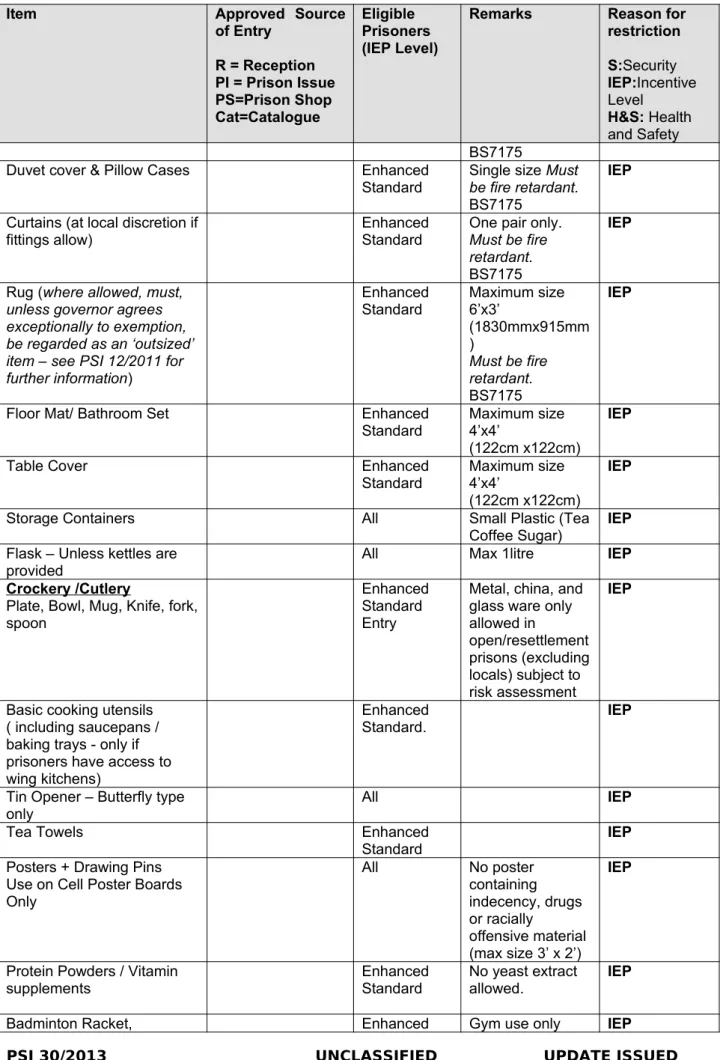
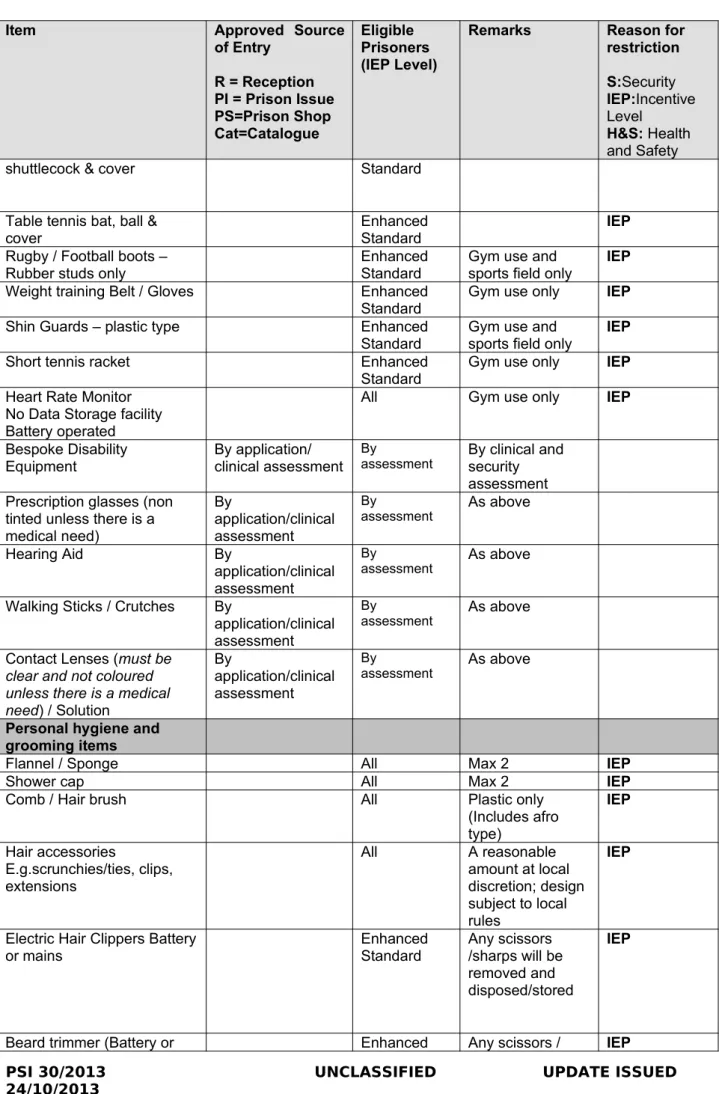
only select from the standardised facilities list attached at Annex F. Facilities List and items available at each IEP level
10.2 The standardised facilities list, or ‘menu’ has been introduced to ensure consistency across
the prison estate. The ‘menu’ provides Governors with a list of in-cell items available for selection and application to each level of the IEP scheme in order to meet local needs and
circumstances. Governors may select items from the list but must not add to it. Where
items are selected and where they appear at more than one IEP level they must be allowed at all the levels specified unless the Deputy Director of Custody has authorised an exemption.
10.3 Should Governors believe that there is a need for the list to be expanded to include certain
items they should raise the issue with their Deputy Director of Custody (DDC). If the DDC supports the change then the DDC or Governor should contact the Equality, Rights and Decency Group (ERD) and it will record the request and consider it further at the next annual review of the facilities list. If the need warrants swifter action, the reasons, supported by the DDC, should be made clear to ERD and it will be actioned as soon as practicable.
10.4 The following two paragraphs apply to all prisoners regardless of which national IEP operational framework applies to them (i.e. PSI 11/2011 or PSI 30/2013). To ensure that the IEP scheme is not undermined the general presumption will be that items for prisoners will not be handed in or sent in by their friends or families unless there are exceptional circumstances. Governors have discretion to determine what constitutes exceptional circumstances; this could include for example disability/health aids or an artefact for religious observance, stamped-addressed envelopes so as to facilitate a prisoner’s ability to communicate or where there is a need to replace clothing due to restricted access to laundry
facilities. In determining whether other exceptions are justified Governors should consider
the impact on their IEP scheme, the potential risk to security associated with smuggling contraband and whether they have sufficient resources to examine resources to examine and search the incoming property.
10.5 Governors also have discretion to allow a one-off parcel of clothing to be handed in or sent
in following conviction. In addition, in accordance with Prison Rule 23 unconvicted prisoners must be allowed to have sufficient clean clothing sent in to them from outside the prison (whether through visits, by post or other means). Prison Rule 43 also provides for unconvicted prisoners to have supplied to them at their own expense, writing materials. Therefore, unconvicted prisoners are not subject to the same one-off parcel restriction that applies to convicted prisoners, nor are they subject to the ‘exceptional circumstances’ test
referred to above in respect of stamped-addressed envelopes. However, in accordance
with volumetric control limits and the need to reduce the amount of excess property within the system it may be reasonable to refuse to deliver to an unconvicted prisoner additional clothing if this results in other suitable clothing being placed in storage as this may indicate that the additional clothing is over and above what is “sufficient”.
10.6 Where games consoles and games are allowed as an additional privilege under the local IEP scheme, they must not be provided at public expense and only prisoners on the Enhanced level of the IEP scheme may be allowed them in possession.
10.7 Only devices that do not provide internet connectivity are permitted.
10.8 18-rated games are not permitted to any prisoner under any circumstances.
10.9 All prisons have previously been made aware that “new generation” games consoles, which
have built in wireless access to the internet, are not permitted in possession. ICT Group has constructed the following list of the types of consoles that are considered to present a
low threat to securityas they do not, on their own, provide internet connectivity:
Microsoft Xbox (without network adaptor & associate cabling)
Nintendo GameCube (without modem or broadband adaptor & cabling)
Nintendo GameBoy
Nintendo GameBoy Color (without infrared port)
Nintendo GameBoy Advance
Nintendo GameBoy Advance SP
Nintendo GameBoy Micro
Sony PlayStation
Sony PlayStation 1
Sony PlayStation 2 (without network adaptor & cabling)
10.10 These games consoles are considered to present a high threat to security as they provide internet connectivity:
Microsoft XBox 360
Nintendo Wii
Nintendo DS
Nintendo DS Lite
Nintendo DSi
Sony PlayStation 3
Sony PlayStation Portable (PSP)
Sony PlayStation Portable Slim and Lite - 2000
Sony PlayStation Portable - 3000
Sony PlayStation Portable Go
Sony PlayStation Vita.
11 18 Rated and Unrated DVDs
11.1 All 18 rated (or equivalent) DVDs should have been removed from prisoners by 14 May
2013. These are not permitted to be viewed, held in possession or handed in to or ordered
by any prisoner. Unrated DVDs (save for unrated DVDs for corporate use such as those
12 Release on Temporary Licence (ROTL)
13 Equality and Fairness
13.1 The IEP scheme must include a range of earnable privileges to incentivise appropriate commitment to rehabilitation and good conduct by all prisoners including those who are elderly, disabled or who have other special needs. To the extent possible published schemes should be applicable to all prisoners but bespoke alternatives may be required to provide for special needs and this should be made clear in the published scheme.
13.2 IEP schemes must be inclusive and take account of equality considerations relating to any of the Protected Characteristics which are:
Age;
Disability;
Gender identity;
Marriage/civil partnership;
Pregnancy/maternity;
Race,
Religion/belief;
Sex
Sexual orientation.
13.3 Governors must ensure local schemes offer a range of earnable privileges so that all prisoners can receive equal benefit in return for positive behaviour. For example, if additional gym sessions are offered as an earnable privilege, there must be an alternative for prisoners who are physically unable to benefit. The design of the scheme must also ensure equitable treatment for prisoners located in particular units. For example, for their own protection, or as part of their residence on a drug recovery or drug-free wing.
13.4 It must also be possible for all prisoners to earn Enhanced level with a similar degree of effort. For example, as taking part in work contributes to earning Enhanced status for convicted prisoners, there must be comparable ways for older and unconvicted prisoners to earn that status.
13.5 Moving prisoners between IEP levels involves individual staff judgement in interpreting
compliance with the requirements set out elsewhere in this PSI. Prisons must ensure that
the IEP scheme is applied proportionately and fairly to all prisoners. Decisions affecting IEP levels must be properly documented using P-NOMIS (or where P-NOMIS is not available on other systems), and diversity outcomes monitored.
13.6 Governors must ensure that published procedures are in place for earning and losing privileges that are in line with the guidance set out in this PSI. Staff must ensure that provision is made for those who have difficulty reading or speaking English, regardless of nationality, to enable them to understand the operation of the IEP scheme.
13.7 Governors must ensure a sample of IEP review decisions are quality assured on a monthly basis to determine fairness, consistency and proper application of the IEP levels. The sample size for quality assurance must be determined by the Governor on the basis of an assessment of the IEP data and the results of previous checks. To assist with the review a
checklist of issues to consider is attached at Annex H. IEP data must be produced quarterly
different protected characteristics is discovered, Governors must ensure that the scheme is revised to include an action plan setting out how this will be further investigated, what remedial action will be taken and how progress will be monitored over the following year. 13.8 Prisons must ensure that, where a convicted prisoner would normally be required to wear
prison issue clothing, adequate provision is made for prisoners for whom the standard prison issue clothing is unsuitable e.g. because of a disability or where a transsexual prisoner requires items to maintain their gender appearance.
13.9 Governors must ensure that their IEP scheme does not penalise behaviour which is the direct consequence of a protected characteristic such as disability or age. PSI 32/2011 Ensuring Equality provides guidance. Flexibility should be applied to deal with individual circumstances, such as prisoners with learning difficulties, where expectations may need to be tempered by what is realistically achievable and an understanding of characteristics which influence an offender's behaviour. Whilst it is the expectation that offenders demonstrate good behaviour, it should be recognised that some conditions, for example
autism, can on occasion lead to challenging behaviour. Reasonable adjustments must be
14 Special Groups of Prisoners Unconvicted prisoners
14.1 Unconvicted prisoners must be included in IEP schemes.
14.2 Unconvicted prisoners have not been found guilty of an offence and their time in prison
should not be seen as punitive. For this reason, they hold certain rights under Prison Rules. For example, they are not required to engage in sentencing planning discussions or work, but may choose to do so where sufficient work is available. They are, however, required to comply with the regime and should be encouraged to take part in activities. If they refuse to participate, they may be locked up while the activity is taking place. If no work or activity is available, they may be unlocked and allowed to associate where operationally possible. They may receive as many visits as they wish within reasonable limits and are not required to wear prison issue clothing.
14.3 The Entry level IEP scheme will apply to unconvicted prisoners subject to the caveats
above.
Immigration Detainees
14.4 Immigration detainees including those held solely on an IS91 must be treated in the same way as unconvicted prisoners.
Prisoners Committed for Contempt of Court
14.5 Prisoners covered by Prison Rule 7(3), (contempt of court), are generally treated as convicted prisoners with the exception of clothing, letters and visits where they are treated the same as an unconvicted prisoner.
Foreign National Prisoners
14.6 Foreign national prisoners may be more likely to have friends and families that live outside
of the UK and may be more likely to value extra and more flexibly timed opportunities to make telephone calls (including long distance), rather than visits. This applies equally to UK citizens with relatives abroad. Governors should consider such needs when designing local schemes.
Prisoners in Segregation Units
14.7 Information on the management of prisoners in segregation units is contained in PSO 1700
- Segregation.
Prisoners Assessed to be Vulnerable or at Risk of Suicide or Self-harm
15 Retention of Privilege Level on Transfer
15.1 Where a prisoner is transferred and received into custody at the new site using the Receive
HMP Transfers screen (OIDITRAN) of P-NOMIS, the system will automatically default their IEP level to the default level set up at the receiving prison. If the prisoner is admitted to the receiving prison using the Receive Offender screen (OIDADMIS), there is no automatic IEP
Level assigned at the receiving prison. To ensure prisoners retain the privilege level they
were on at the sending establishment, staff must check previous history and amend the status field accordingly. Transferred prisoners should be assessed within two weeks (wherever possible) after arrival to ensure they have been placed on the appropriate privilege level.
15.2 Transferred prisoners may find that the actual privileges available at Basic, Entry, Standard
and Enhanced are different in some respects from their previous establishment but access
to the six key earnable privileges should be made available. Where a prisoner is transferred
16 Monitoring
16.1 The points to be considered when annuallyreviewing IEP schemes include:
Is the scheme consistent with the national framework and approved and signed by the
Deputy Director of Custody?
Does the scheme incentivise prisoners to seek to engage in their rehabilitation;
Does the scheme meet local aims and address local problems (e.g. violence, drugs)?
What impact has it had on prisoner behaviour, and on staff? Are any changes necessary?
Are the methods of informing new receptions and prisoners on Induction of the scheme
effective, including for those who have difficulty reading or understanding English?
Are the four privilege levels sufficiently differentiated?
Are prisoners able to make representations? Are decisions properly recorded and reasons given to prisoners? Are prisoners aware of the appeal process?
Do all relevant staff contribute to decision making, submitting reports that are consistent
with the scheme and make sound recommendations?
Does the scheme encompass the cultural and diverse needs of the local prisoner population?
Are the figures provided by those responsible for collecting and scrutinising equalities
monitoring data for all prisoners considered and acted upon?
Are the needs of disabled prisoners considered and monitored? (see PSI 32/2011)
Is the scheme fully integrated into, and compatible with, the rest of the regime (e.g.,
OASys and sentence planning, compacts), but separate from the disciplinary system?
Is there an auditable system in place and are management checks carried out and
recorded?
17 Changes to P- NOMIS
17.1 To assist staff in implementing the requirements of the revised IEP scheme, a number of
changes have been made to the P-NOMIS system. The guides will be stored in the ‘Prison-NOMIS Guidance’ part of the ‘Help and Support’ section on the Intranet front page. User's
can type “What's New Prison-NOMIS” into the search box at the top of the Intranet page to
Annex A Incentives & Earned Privileges Scheme – Prisoner Compact
Name: Number:
By signing this compact, I accept that I have read and understood the IEP Criteria of Requirements for Progression and have had the opportunity to ask questions. I also understand that:
a: In order to progress through the IEP scheme, I must abide by all aspects of the ‘IEP Criteria
of Requirements for Progression’;
b: I will be required to spend my first 14 days in prison custody on Entry level. If I am unconvicted I will revert to Entry level again if convicted;
c: If I do not abide by the ‘Entry’ level requirements including the Behavioural Expectations of
the ‘IEP Criteria of Requirements for Progression’ at any point during the first 14 days in custody, I may be moved to ‘Basic’ level. Where it is determined that I can progress from ‘Basic’ level, I will then have to complete afresh 14 days on ‘Entry’ level;
d: If I do abide by the ‘Entry’ level requirements including the Behavioural Expectations of the
‘IEP Criteria of Requirements for Progression’, I will move to ‘Standard’ level at the end of the 14 day period. The review of my performance will be automatic on completion of the 14 day period.
e*: If I am not required to complete ‘Entry’ level and I am on Basic I will have to abide by the
requirements on ‘Basic’ level before I can progress to ‘Standard’ level.
f: If I am moved to ‘Standard’ level I may apply for ‘Enhanced’ level after three months.
g: Regardless of whether I agree to this compact or not, if I am found guilty on adjudication of
a disciplinary offence involving damage or destruction of any part of the prison or any items of prison property, I will normally be ordered to pay for some or all of the damage caused and the Governor will recover the money directly from my prison financial accounts.
Prisoner Signature: Date:
Staff Name: Staff Signature:
Annex B Incentives & Earned Privileges Scheme – Criteria of Requirements for Progression
A. Rehabilitation, Reducing Risk and Good Behaviour
Under the revised Incentives and Earned Privileges (IEP) Scheme, prisoners are expected to demonstrate a commitment towards their rehabilitation, engage in purposeful activity (for example, attend work and / or education and recovery focused interventions and services), reduce their risk of reoffending and be well behaved.
The criteria must be used by all prisons and the ‘Behavioural Expectations’ section immediately below is applicable to all prisoners. The criteria for movement between the IEP levels are set out at Section B below. Governors must ensure that the specific statutory protections afforded to unconvicted prisoners, such as the right not to work and the right not to wear prison clothing are complied with. PSO 4600 sets out further information on the rights of unconvicted prisoners.
Behavioural Expectations
Treating others in the prison with respect, avoiding violent, intimidating, threatening and
abusive language and behaviour;
Behaving in a way that respects the diversity of others in the prison;
Acting with decency at all times remembering prisons/cells are not private dwellings (this
includes not engaging in sexual activity);
Maintaining awareness of the effect of noise on others and keeping noise to an acceptable
level;
Co-operating with staff in the performance of their duties including complying with orders
and requests;
Behaving honestly and openly with staff, other prisoners and visitors to the prison in a way
that promotes trust and integrity.
Complying with prison compacts, rules and regulations;
Making sure you only have items to which you are allowed access;
Following all the requirements of the prison’s safer custody and violence reduction policies,
avoiding trafficking or taking items from other prisoners;
Co-operation with drug and alcohol testing policies;
Avoid selling and trading items, taxing or gambling;
Staying within designated boundaries;
Having due regard for personal hygiene and health (including appearance, neatness and
suitability of clothing);
Maintaining the cleanliness of cell/prison/equipment;
Respecting prison property and that belonging to others;
Complying with fire safety procedures, including rules governing smoking;
B. Definition of IEP Levels Basic Level
Basic level is for those prisoners who have demonstrated insufficient commitment to their rehabilitation and purposeful activity, or behaved badly and/or who have not engaged sufficiently with the regime to earn privileges at a higher level. All prisoners on Basic level will continue to receive the entitlements laid down in Prison/YOI Rules and other instructions in relation to visits, letters, telephone calls, provision of food and clothing, and any other minimum facilities provided locally for all prisoners, apart from those in segregation.
In addition to the behaviours set out in section A above and in order to be considered suitable for movement from ‘Basic’ to ‘Standard’ level, ‘Basic’ Level prisoners are expected to:
Where appropriate, complete the induction process;
Where identified, attend any offending behaviour courses or treatment programme
assessments;
Engage and co-operate with health, drug and alcohol assessments, drug and alcohol testing and where identified, recovery focused interventions/services;
Engage and co-operate with the prison regime and any identified purposeful activity, for
example, attend work or education;
Where appropriate, engage with the early days in custody screening interview and demonstrate a willingness to address any identified issues. For example housing and substance misuse;
Wear prison issue clothing, unless permitted not to do so for reasons related to a protected
characteristic, such as religious belief or disability. The requirement to wear prison issue clothing does not apply to unconvicted prisoners and prisoners in female prisons at any level of the IEP scheme.
However, where a prisoner has been regressed to ‘Basic’ through non-compliance with ‘Entry’ level and where they are now ready for progression, they must successfully complete the full 14 days ‘Entry’ afresh before being moved to ‘Standard’.
In addition, an unconvicted prisoner on ‘Basic’ IEP level, who is subsequently convicted on or after 1 November 2013, will, once ready to move up, be required to successfully complete ‘Entry’ level (regardless of any previous completion of ‘Entry’ level as an unconvicted prisoner), before they can be progressed to ‘Standard’.
Entry Level
All new prisoners, including those on remand, newly convicted or recalled to prison following licence revocation, received into custody on or after 1 November 2013 will enter custody on the ‘Entry’ level of the new IEP Scheme.
Unconvicted prisoners in prison custody who are subsequently convicted on or after 1 November 2013 must revert to the ‘Entry’ level on the date of their conviction, unless they are currently on Basic. If the prisoner is on Basic when they are convicted they must first demonstrate they are suitable for progression before moving onto Entry level. All newly convicted prisoners must complete the full 14 days on Entry level afresh, regardless of whether they have done so before as an unconvicted prisoner.