Syntax-Based Word Ordering Incorporating a Large-Scale Language
Model
Yue Zhang University of Cambridge
Computer Laboratory [email protected]
Graeme Blackwood University of Cambridge Engineering Department [email protected]
Stephen Clark University of Cambridge
Computer Laboratory [email protected]
Abstract
A fundamental problem in text generation is word ordering. Word ordering is a com-putationally difficult problem, which can be constrained to some extent for particu-lar applications, for example by using syn-chronous grammars for statistical machine translation. There have been some recent attempts at the unconstrained problem of generating a sentence from a multi-set of input words (Wan et al., 2009; Zhang and Clark, 2011). By using CCG and learn-ing guided search, Zhang and Clark re-ported the highest scores on this task. One limitation of their system is the absence of an N-gram language model, which has been used by text generation systems to improve fluency. We take the Zhang and Clark system as the baseline, and incor-porate an N-gram model by applying on-line large-margin training. Our system sig-nificantly improved on the baseline by 3.7 BLEU points.
1 Introduction
One fundamental problem in text generation is word ordering, which can be abstractly formu-lated as finding a grammatical order for a multi-set of words. The word ordering problem can also include word choice, where only a subset of the input words are used to produce the output.
Word ordering is a difficult problem. Finding the best permutation for a set of words accord-ing to a bigram language model, for example, is NP-hard, which can be proved by linear reduction from the traveling salesman problem. In prac-tice, exploring the whole search space of permu-tations is often prevented by adding constraints.
In phrase-based machine translation (Koehn et al., 2003; Koehn et al., 2007), a distortion limit is used to constrain the position of output phrases. In syntax-based machine translation systems such as Wu (1997) and Chiang (2007), synchronous grammars limit the search space so that poly-nomial time inference is feasible. In fluency improvement (Blackwood et al., 2010), parts of translation hypotheses identified as having high local confidence are held fixed, so that word or-dering elsewhere is strictly local.
Some recent work attempts to address the fun-damental word ordering task directly, using syn-tactic models and heuristic search. Wan et al. (2009) uses a dependency grammar to solve word ordering, and Zhang and Clark (2011) uses CCG
(Steedman, 2000) for word ordering and word choice. The use of syntax models makes their search problems harder than word permutation us-ing anN-gram language model only. Both meth-ods apply heuristic search. Zhang and Clark de-veloped a bottom-up best-first algorithm to build output syntax trees from input words, where search is guided by learning for both efficiency and accuracy. The framework is flexible in allow-ing a large range of constraints to be added for particular tasks.
We extend the work of Zhang and Clark (2011) (Z&C) in two ways. First, we apply online large-margin training to guide search. Compared to the perceptron algorithm on “constituent level fea-tures” by Z&C, our training algorithm is theo-retically more elegant (see Section 3) and con-verges more smoothly empirically (see Section 5). Using online large-margin training not only im-proves the output quality, but also allows the in-corporation of an N-gram language-model into
the system. N-gram models have been used as a standard component in statistical machine trans-lation, but have not been applied to the syntac-tic model of Z&C. Intuitively, anN-gram model can improve local fluency when added to a syntax model. Our experiments show that a four-gram model trained using the English GigaWord cor-pus gave improvements when added to the syntax-based baseline system.
The contributions of this paper are as follows. First, we improve on the performance of the Z&C system for the challenging task of the general word ordering problem. Second, we develop a novel method for incorporating a large-scale lan-guage model into a syntax-based generation sys-tem. Finally, we analyse large-margin training in the context of learning-guided best-first search, offering a novel solution to this computationally hard problem.
2 The statistical model and decoding algorithm
We take Z&C as our baseline system. Given a multi-set of input words, the baseline system builds aCCGderivation by choosing and ordering
words from the input set. The scoring model is trained using CCGBank (Hockenmaier and Steed-man, 2007), and best-first decoding is applied. We apply the same decoding framework in this paper, but apply an improved training process, and incor-porate anN-gram language model into the syntax model. In this section, we describe and discuss the baseline statistical model and decoding frame-work, motivating our extensions.
2.1 Combinatory Categorial Grammar
CCG, and parsing with CCG, has been described elsewhere (Clark and Curran, 2007; Hockenmaier and Steedman, 2002); here we provide only a short description.
CCG (Steedman, 2000) is a lexicalized gram-mar formalism, which associates each word in a sentence with a lexical category. There is a small number of basic lexical categories, such as noun (N), noun phrase (NP), and prepositional phrase (PP). Complex lexical categories are formed re-cursively from basic categories and slashes, which indicate the directions of arguments. The CCG
grammar used by our system is read off the deriva-tions in CCGbank, following Hockenmaier and
Steedman (2002), meaning that theCCG combina-tory rules are encoded as rule instances, together with a number of additional rules which deal with punctuation and type-changing. Given a sentence, itsCCGderivation can be produced by first
assign-ing a lexical category to each word, and then re-cursively applyingCCGrules bottom-up.
2.2 The decoding algorithm
In the decoding algorithm, a hypothesis is an edge, which corresponds to a sub-tree in a CCG
derivation. Edges are built bottom-up, starting from leaf edges, which are generated by assigning all possible lexical categories to each input word. Each leaf edge corresponds to an input word with a particular lexical category. Two existing edges can be combined if there exists aCCGrule which combines their category labels, and if they do not contain the same input word more times than its total count in the input. The resulting edge is as-signed a category label according to the combi-natory rule, and covers the concatenated surface strings of the two sub-edges in their order or com-bination. New edges can also be generated by ap-plying unary rules to a single existing edge. Start-ing from the leaf edges, the bottom-up process is repeated until a goal edge is found, and its surface string is taken as the output.
This derivation-building process is reminiscent of a bottom-upCCGparser in the edge combina-tion mechanism. However, it is fundamentally different from a bottom-up parser. Since, for the generation problem, the order of two edges in their combination is flexible, the search prob-lem is much harder than that of a parser. With no input order specified, no efficient dynamic-programming algorithm is available, and less con-textual information is available for disambigua-tion due to the lack of an input string.
Algorithm 1 The decoding algorithm.
a←INITAGENDA( ) c←INITCHART( )
while not TIMEOUT( ) do new←[]
e←POPBEST(a)
if GOALTEST(e) then
returne
end if for e′
∈UNARY(e, grammar) do APPEND(new,e)
end for for ˜e∈c do
if CANCOMBINE(e,˜e) then e′
←BINARY(e,˜e, grammar) APPEND(new,e′)
end if
if CANCOMBINE(e˜,e) then
e′←B
INARY(˜e,e, grammar) APPEND(new,e′)
end if end for
for e′ ∈new do
ADD(a,e′
)
end for
ADD(c,e)
end while
decoding finishes. Otherwise it is extended with unary rules, and combined with existing edges in the chart using binary rules to produce new edges. The resulting edges are scored and put onto the agenda, while the original edge is put onto the chart. The process repeats until a goal edge is found, or a timeout limit is reached. In the latter case, a default output is produced using existing edges in the chart.
Pseudocode for the decoder is shown as Algo-rithm 1. Again it is reminiscent of a best-first parser (Caraballo and Charniak, 1998) in the use of an agenda and a chart, but is fundamentally dif-ferent due to the fact that there is no input order.
2.3 Statistical model and feature templates
The baseline system uses a linear model to score hypotheses. For an edgee, its score is defined as:
f(e) = Φ(e)·θ,
whereΦ(e)represents the feature vector ofeand
θis the parameter vector of the model.
During decoding, feature vectors are computed incrementally. When an edge is constructed, its score is computed from the scores of its sub-edges and the incrementally added structure:
f(e) = Φ(e)·θ
= X es∈e
Φ(es)
+φ(e)·θ
= X
es∈e
Φ(es)·θ
+φ(e)·θ
= X
es∈e
f(es)
+φ(e)·θ
In the equation,es∈erepresents a sub-edge of
e. Leaf edges do not have any sub-edges. Unary-branching edges have one sub-edge, and binary-branching edges have two sub-edges. The fea-ture vectorφ(e)represents the incremental struc-ture when e is constructed over its sub-edges. It is called the “constituent-level feature vector” by Z&C. For leaf edges, φ(e) includes informa-tion about the lexical category label; for unary-branching edges,φ(e)includes information from the unary rule; for binary-branching edges, φ(e) includes information from the binary rule, and ad-ditionally the token, POSand lexical category bi-grams and tribi-grams that result from the surface string concatenation of its sub-edges. The score
f(e)is therefore the sum off(es) (for alles∈e) plusφ(e)·θ. The feature templates we use are the same as those in the baseline system.
An important aspect of the scoring model is that edges with different sizes are compared with each other during decoding. Edges with different sizes can have different numbers of features, which can make the training of a discriminative model more difficult. For example, a leaf edge with one word can be compared with an edge over the entire in-put. One way of reducing the effect of the size dif-ference is to include the size of the edge as part of feature definitions, which can improve the compa-rability of edges of different sizes by reducing the number of features they have in common. Such features are applied by Z&C, and we make use of them here. Even with such features, the question of whether edges with different sizes are linearly separable is an empirical one.
3 Training
best-first search is guided to a solution by the model, and a good model will lead to a solution being found more quickly. In the ideal situation for the best-first decoding algorithm, the model is perfect and the score of any gold-standard edge is higher than the score of any non-gold-standard edge. As a result, the top edge on the agenda is always a gold-standard edge, and therefore all edges on the chart are gold-standard before the gold-standard goal edge is found. In this oracle procedure, the minimum number of edges is expanded, and the output is correct. The best-first decoder is perfect in not only accuracy, but also speed. In practice this ideal situation is rarely met, but it determines the goal of the training algorithm: to produce the perfect model and hence decoder.
If we take gold-standard edges as positive ex-amples, and non-gold-standard edges as negative examples, the goal of the training problem can be viewed as finding a large separating margin be-tween the scores of positive and negative exam-ples. However, it is infeasible to generate the full space of negative examples, which is factorial in the size of input. Like Z&C, we apply online learning, and generate negative examples based on the decoding algorithm.
Our training algorithm is shown as Algo-rithm 2. The algoAlgo-rithm is based on the decoder, where an agenda is used as a priority queue of edges to be expanded, and a set of accepted edges is kept in a chart. Similar to the decoding algo-rithm, the agenda is intialized using all possible leaf edges. During each step, the top of the agenda
eis popped. If it is a gold-standard edge, it is ex-panded in exactly the same way as the decoder, with the newly generated edges being put onto the agenda, and e being inserted into the chart. If eis not a gold-standard edge, we take it as a negative examplee−, and take the lowest scored
gold-standard edge on the agendae+as a positive
example, in order to make an udpate to the model parameter vector θ. Our parameter update algo-rithm is different from the baseline perceptron al-gorithm, as will be discussed later. After updating the parameters, the scores of agenda edges above and including e−, together with all chart edges,
are updated, and e− is discarded before the start
of the next processing step. By not putting any non-gold-standard edges onto the chart, the train-ing speed is much faster; on the other hand a wide range of negative examples is pruned. We leave
Algorithm 2 The training algorithm.
a←INITAGENDA( ) c←INITCHART( )
while not TIMEOUT( ) do new←[]
e←POPBEST(a)
if GOLDSTANDARD(e) and GOALTEST(e)
then returne
end if
if not GOLDSTANDARD(e) then
e−←e
e+←MINGOLD(a)
UPDATEPARAMETERS(e+,e−)
RECOMPUTESCORES(a, c)
continue end if for e′∈U
NARY(e, grammar) do
APPEND(new,e)
end for for e˜∈c do
if CANCOMBINE(e,e˜) then
e′
←BINARY(e,e˜, grammar) APPEND(new,e′)
end if
if CANCOMBINE(˜e,e) then
e′ ←B
INARY(e˜,e, grammar) APPEND(new,e′
)
end if end for for e′
∈new do ADD(a,e′
)
end for
ADD(c,e)
end while
for further work possible alternative methods to generate more negative examples during training.
Another way of viewing the training process is that it pushes gold-standard edges towards the top of the agenda, and crucially pushes them above non-gold-standard edges. This is the view de-scribed by Z&C. Given a positive examplee+and
a negative example e−, they use the perceptron
algorithm to penalize the score forφ(e−)and
re-ward the score of φ(e+), but do not update
pa-rameters for the sub-edges ofe+ande−. An
argu-ment for not penalizing the sub-edge scores fore−
the perspective of correctness, it is unnecessary to find a margin between the sub-edges ofe+and
those ofe−, since both are gold-standard edges.
However, since the score of an edge not only represents its correctness, but also affects its pri-ority on the agenda, promoting the sub-edge of
e+ can lead to “easier” edges being constructed
before “harder” ones (i.e. those that are less likely to be correct), and therefore improve the output accuracy. This perspective has been ob-served by other works of learning-guided-search (Shen et al., 2007; Shen and Joshi, 2008; Gold-berg and Elhadad, 2010). Intuitively, the score difference between easy gold-standard and harder gold-standard edges should not be as great as the difference between gold-standard and non-gold-standard edges. The perceptron update cannot provide such control of separation, because the amount of update is fixed to 1.
As described earlier, we treat parameter update as finding a separation between correct and incor-rect edges, in which the global feature vectorsΦ, rather thanφ, are considered. Given a positive ex-amplee+ and a negative examplee−, we make a
minimum update so that the score ofe+is higher
than that ofe−with some margin:
θ←arg min θ′
kθ′
−θ0 k,s.t.Φ(e+)θ′−Φ(e−)θ ′
≥1
whereθ0 and θdenote the parameter vectors
be-fore and after the udpate, respectively. The up-date is similar to the upup-date of online large-margin learning algorithms such as 1-best MIRA
(Cram-mer et al., 2006), and has a closed-form solution:
θ←θ0+
f(e−)−f(e+) + 1
kΦ(e+)−Φ(e−)k2
Φ(e+)−Φ(e−)
In this update, the global feature vectorsΦ(e+)
and Φ(e−) are used. Unlike Z&C, the scores
of sub-edges of e+ and e− are also udpated, so
that the sub-edges ofe− are less prioritized than
those ofe+. We show empirically that this
train-ing algorithm significantly outperforms the per-ceptron training of the baseline system in Sec-tion 5. An advantage of our new training algo-rithm is that it enables the accommodation of a separately trainedN-gram model into the system.
4 Incorporating anN-gram language model
Since the seminal work of the IBM models (Brown et al., 1993), N-gram language models
have been used as a standard component in statis-tical machine translation systems to control out-put fluency. For the syntax-based generation sys-tem, the incorporation of an N-gram language model can potentially improve the local fluency of output sequences. In addition, the N-gram language model can be trained separately using a large amount of data, while the syntax-based model requires manual annotation for training.
The standard method for the combination of a syntax model and an N-gram model is linear interpolation. We incorporate fourgram, trigram and bigram scores into our syntax model, so that the score of an edgeebecomes:
F(e) = f(e) +g(e)
= f(e) +α·gfour(e) +β·gtri(e) +γ·gbi(e),
where f is the syntax model score, and g is the
N-gram model score. g consists of three com-ponents, gfour, gtri and gbi, representing the
log-probabilities of fourgrams, trigrams and bigrams from the language model, respectively. α,β and
γare the corresponding weights.
During decoding, F(e)is computed incremen-tally. Again, denoting the sub-edges ofeases,
F(e) = f(e) +g(e)
= X
es∈e
F(es)
+φ(e)θ+gδ(e)
Heregδ(e) =α·gδfour(e) +β·gδtri(e) +γ·gδbi(e)
is the sum of log-probabilities of the new N -grams resulting from the construction of e. For leaf edges and unary-branching edges, no newN -grams result from their construction (i.e.gδ = 0). For a binary-branching edge, newN-grams result from the surface-string concatenation of its sub-edges. The sum of log-probabilities of the new fourgrams, trigrams and bigrams contribute togδ with weightsα,βandγ, respectively.
For training, there are at least three methods to tuneα,β,γandθ. One simple method is to train the syntax model θ independently, and select α,
negative examples; the training algorithm finds a value of θ that best suits the precomputed α, β
andγ values, together with theN-gram language model. We call this method g-precomputed in-terpolation. Yet another method is to initialize α,
β, γ and θas all zeroes, and run the training al-gorithm taking into account theN-gram language model. We call this methodg-free interpolation.
The incorporation of an N-gram language model into the syntax-based generation system is weakly analogous toN-gram model insertion for syntax-based statistical machine translation sys-tems, both of which apply a score from the N -gram model component in a derivation-building process. As discussed earlier, polynomial-time decoding is typically feasible for syntax-based machine translation systems without an N-gram language model, due to constraints from the grammar. In these cases, incorporation of N -gram language models can significantly increase the complexity of a dynamic-programming de-coder (Bar-Hillel et al., 1961). Efficient search has been achieved using chart pruning (Chiang, 2007) and iterative numerical approaches to con-strained optimization (Rush and Collins, 2011). In contrast, the incorporation of anN-gram lan-guage model into our decoder is more straightfor-ward, and does not add to its asymptotic complex-ity, due to the heuristic nature of the decoder.
5 Experiments
We use sections 2–21 of CCGBank to train our syntax model, section 00 for development and section 23 for the final test. Derivations from CCGBank are transformed into inputs by turn-ing their surface strturn-ings into multi-sets of words. Following Z&C, we treat base noun phrases (i.e.
NPs that do not recursively contain otherNPs) as atomic units for the input. Output sequences are compared with the original sentences to evaluate their quality. We follow previous work and use the BLEU metric (Papineni et al., 2002) to com-pare outputs with references.
Z&C use two methods to construct leaf edges. The first is to assign lexical categories according to a dictionary. There are 26.8 lexical categories for each word on average using this method, cor-responding to 26.8 leaf edges. The other method is to use a pre-processing step — aCCG supertag-ger (Clark and Curran, 2007) — to prune can-didate lexical categories according to the
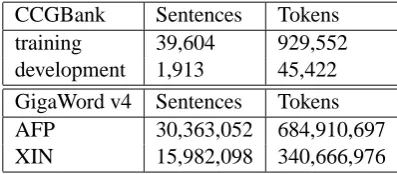
[image:6.595.310.509.71.158.2]gold-CCGBank Sentences Tokens training 39,604 929,552 development 1,913 45,422 GigaWord v4 Sentences Tokens AFP 30,363,052 684,910,697 XIN 15,982,098 340,666,976
Table 1: Number of sentences and tokens by language model source.
standard sequence, assuming that for some prob-lems the ambiguities can be reduced (e.g. when the input is already partly correctly ordered). Z&C use different probability cutoff levels (the
β parameter in the supertagger) to control the pruning. Here we focus mainly on the dictionary method, which leaves lexical category disam-biguation entirely to the generation system. For comparison, we also perform experiments with lexical category pruning. We choseβ = 0.0001, which leaves 5.4 leaf edges per word on average.
We used the SRILM Toolkit (Stolcke, 2002) to build a true-case 4-gram language model es-timated over the CCGBank training and develop-ment data and a large additional collection of flu-ent sflu-entences in the Agence France-Presse (AFP) and Xinhua News Agency (XIN) subsets of the English GigaWord Fourth Edition (Parker et al., 2009), a total of over 1 billion tokens. The Gi-gaWord data was first pre-processed to replicate the CCGBank tokenization. The total number of sentences and tokens in each LM component is shown in Table 1. The language model vo-cabulary consists of the 46,574 words that oc-cur in the concatenation of the CCGBank train-ing, development, and test sets. The LM proba-bilities are estimated using modified Kneser-Ney smoothing (Kneser and Ney, 1995) with interpo-lation of lower n-gram orders.
5.1 Development experiments
Method max BLEU avg. BLEU
baseline 38.47 37.36
margin 41.20 39.70
[image:7.595.124.472.71.186.2]margin +LM (g-precomputed) 41.50 40.84 margin +LM (α= 0, β = 0, γ= 0) 40.83 — margin +LM (α= 0.08, β= 0.016, γ= 0.004) 38.99 — margin +LM (α= 0.4, β= 0.08, γ = 0.02) 36.17 — margin +LM (α= 0.8, β= 0.16, γ = 0.04) 34.74 —
Table 2: Development experiments without lexical category pruning.
The first three rows represent the baseline sys-tem, our largin-margin training system (margin), and our system with theN-gram model incorpo-rated using g-precomputed interpolation. For in-terpolation we manually choseα= 0.8,β = 0.16 and γ = 0.04, respectively. These values could be optimized by development experiments with alternative configurations, which may lead to fur-ther improvements. Our system with large-margin training gives higher BLEU scores than the base-line system consistently over all iterations. The
N-gram model led to further improvements. The last four rows in the table show results of our system with theN-gram model added us-ing test-time interpolation. The syntax model is trained with the optimal number of iterations, and different α, β, andγ values are used to integrate the language model. Compared with the system using noN-gram model (margin), test-time inter-polation did not improve the accuracies.
The row withα, β, γ = 0represents our system with the N-gram model loaded, and the scores
gf our, gtri and gbi computed for each N-gram during decoding, but the scores of edges are com-puted without using N-gram probabilities. The scoring model is the same as the syntax model (margin), but the results are lower than the row “margin”, because computing N-gram probabil-ities made the system slower, exploring less hy-potheses under the same timeout setting.1
The comparison betweeng-precomputed inter-polation and test-time interinter-polation shows that the system gives better scores when the syntax model takes into consideration theN-gram model during
1
More decoding time could be given to the slowerN -gram system, but we use 5 seconds as the timeout setting for all the experiments, giving the methods with theN-gram language model a slight disadvantage, as shown by the two rows “margin” and “margin +LM (α, β, γ= 0).
37 38 39 40 41 42 43 44 45
1 2 3 4 5 6 7 8 9 10
BLEU
training iteration baseline
margin margin +LM
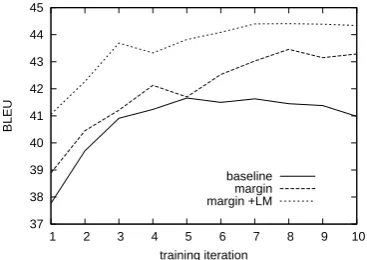
Figure 1: Development experiments with lexical cate-gory pruning (β = 0.0001).
training. One question that arises is whether g -free interpolation will outperformg-precomputed interpolation. g-free interpolation offers the free-dom ofα,βandγduring training, and can poten-tially reach a better combination of the parameter values. However, the training algorithm failed to converge withg-free interpolation. One possible explanation is that real-valued features from the language model made our large-margin training harder. Another possible reason is that our train-ing process with heavy pruntrain-ing does not accom-modate this complex model.
Figure 1 shows a set of development experi-ments with lexical category pruning (with the su-pertagger parameter β = 0.0001). The scores of the three different systems are calculated by varying the number of training iterations. The large-margin training system (margin) gave con-sistently better scores than the baseline system, and adding a language model (margin +LM) im-proves the scores further.
[image:7.595.305.489.235.365.2]baseline margin margin +LM as a nonexecutive director Pierre Vinken
, 61 years old , will join the board . 29 Nov.
61 years old , the board will join as a nonexecutive director Nov. 29 , Pierre Vinken .
as a nonexecutive director Pierre Vinken , 61 years old , will join the board Nov. 29 .
Lorillard nor smokers were aware of the Kent cigarettes of any research on the workers who studied the researchers
of any research who studied Neither the workers were aware of smokers on the Kent cigarettes nor the researchers
Neither Lorillard nor any research on the workers who studied the Kent cigarettes were aware of smokers of the researchers .
you But 35 years ago have to recognize that these events took place .
recognize But you took place that these events have to 35 years ago .
But you have to recognize that these events took place 35 years ago . investors to pour cash into money funds
continue in Despite yields recent declines
Despite investors , yields continue to pour into money funds recent declines in cash .
Despite investors , recent declines in yields continue to pour cash into money funds .
yielding The top money funds are cur-rently well over 9 % .
The top money funds currently are yield-ing well over 9 % .
The top money funds are yielding well over 9 % currently .
where A buffet breakfast , held in the mu-seum was food and drinks to . everyday visitors banned
everyday visitors are banned to where A buffet breakfast was held , food and drinks in the museum .
A buffet breakfast , everyday visitors are banned to where food and drinks was held in the museum .
A Commonwealth Edison spokesman said an administrative nightmare would be tracking down the past 3 12 years that the two million customers have . whose changed
tracking A Commonwealth Edison spokesman said that the two million cus-tomers whose addresses have changed down during the past 3 12 years would be an administrative nightmare .
an administrative nightmare whose ad-dresses would be tracking down A Com-monwealth Edison spokesman said that the two million customers have changed during the past 3 12 years .
The $ 2.5 billion Byron 1 plant , Ill. , was completed . near Rockford in 1985
The $ 2.5 billion Byron 1 plant was near completed in Rockford , Ill. , 1985 .
The $ 2.5 billion Byron 1 plant near Rockford , Ill. , was completed in 1985 . will ( During its centennial year , The
Wall Street Journal report events of the past century that stand as milestones of American business history . )
as The Wall Street Journal ( During its centennial year , milestones stand of American business history that will re-port events of the past century . )
[image:8.595.71.548.73.399.2]During its centennial year events will re-port , The Wall Street Journal that stand as milestones of American business his-tory ( of the past century ) .
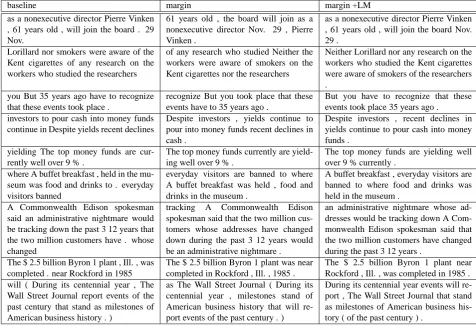
Table 3: Some chosen examples with significant improvements (supertagger parameterβ= 0.0001).
method, the examples are chosen from the devel-opment output with lexical category pruning, af-ter the optimal number of training iaf-terations, with the timeout set to 5s. We also tried manually se-lecting examples without lexical category prun-ing, but the improvements were not as obvious, partly because the overall fluency was lower for all the three systems.
Table 4 shows a set of examples chosen ran-domly from the development test outputs of our system with the N-gram model. The optimal number of training iterations is used, and a out of 1 minute is used in addition to the 5s time-out for comparison. With more time to decode each input, the system gave a BLEU score of 44.61, higher than 41.50 with the 5s timout.
While some of the outputs we examined are reasonably fluent, most are to some extent frag-mentary.2 In general, the system outputs are still far below human fluency. Some samples are
2Part of the reason for some fragmentary outputs is the
default output mechanism: partial derivations from the chart are greedily put together when timeout occurs before a goal hypothesis is found.
syntactically grammatical, but are semantically anomalous. For example, person names are often confused with company names, verbs often take unrelated subjects and objects. The problem is much more severe for long sentences, which have more ambiguities. For specific tasks, extra infor-mation (such as the source text for machine trans-lation) can be available to reduce ambiguities.
6 Final results
The final results of our system without lexical cat-egory pruning are shown in Table 5. Row “W09 CLE” and “W09 AB” show the results of the maximum spanning tree and assignment-based al-gorithms of Wan et al. (2009); rows “margin” and “margin +LM” show the results of our large-margin training system and our system with the
sys-timeout = 5s timeout = 1m drooled the cars and drivers , like Fortune 500 executives . over
the race
After schoolboys drooled over the cars and drivers , the race like Fortune 500 executives .
One big reason : thin margins . One big reason : thin margins . You or accountants look around ... and at an eye blinks .
pro-fessional ballplayers
blinks nobody You or accountants look around ... and at an eye . professional ballplayers
most disturbing And of it , are educators , not students , for the wrongdoing is who .
And blamed for the wrongdoing , educators , not students who are disturbing , much of it is most .
defeat coaching aids the purpose of which is , He and other critics say can to . standardized tests learning progress
gauge coaching aids learning progress can and other critics say the purpose of which is to defeat , standardized tests . The federal government of government debt because Congress
has lifted the ceiling on U.S. savings bonds suspended sales
[image:9.595.70.540.72.221.2]The federal government suspended sales of government debt because Congress has n’t lifted the ceiling on U.S. savings bonds .
Table 4: Some examples chosen at random from development test outputs without lexical category pruning.
System BLEU
[image:9.595.125.235.259.348.2]W09 CLE 26.8 W09 AB 33.7 Z&C11 40.1 margin 42.5 margin +LM 43.8
Table 5: Test results without lexical category pruning.
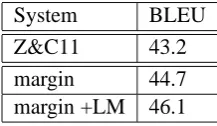
System BLEU
Z&C11 43.2 margin 44.7 margin +LM 46.1
Table 6: Test results with lexical category pruning (su-pertagger parameterβ= 0.0001).
tem outperforms the baseline methods. The acu-racies are significantly higher when the N-gram model is incorporated.
Table 6 compares our system with Z&C using lexical category pruning (β = 0.0001) and a 5s timeout for fair comparison. The results are sim-ilar to Table 5: our large-margin training systems outperforms the baseline by 1.5 BLEU points, and adding theN-gram model gave a further 1.4 point improvement. The scores could be significantly increased by using a larger timeout, as shown in our earlier development experiments.
7 Related Work
There is a recent line of research on text-to-text generation, which studies the linearization of dependency structures (Barzilay and McKeown, 2005; Filippova and Strube, 2007; Filippova and Strube, 2009; Bohnet et al., 2010; Guo et al.,
2011). Unlike our system, and Wan et al. (2009), input dependencies provide additional informa-tion to these systems. Although the search space can be constrained by the assumption of projec-tivity, permutation of modifiers of the same head word makes exact inference for tree lineariza-tion intractable. The above systems typically ap-ply approximate inference, such as beam-search. While syntax-based features are commonly used by these systems for linearization, Filippova and Strube (2009) apply a trigram model to control local fluency within constituents. A dependency-based N-gram model has also been shown effec-tive for the linearization task (Guo et al., 2011).
The best-first inference and timeout mechanism of our system is similar to that of White (2004), a surface realizer from logical forms usingCCG.
8 Conclusion
We studied the problem of word-ordering using a syntactic model and allowing permutation. We took the model of Zhang and Clark (2011) as the baseline, and extended it with online large-margin training and anN-gram language model. These extentions led to improvements in the BLEU eval-uation. Analyzing the generated sentences sug-gests that, while highly fluent outputs can be pro-duced for short sentences (≤10 words), the sys-tem fluency in general is still way below human standard. Future work remains to apply the sys-tem as a component for specific text generation tasks, for example machine translation.
Acknowledgements
[image:9.595.125.234.384.447.2]References
Yehoshua Bar-Hillel, M. Perles, and E. Shamir. 1961. On formal properties of simple phrase structure grammars. Zeitschrift f¨ur Phonetik, Sprachwis-senschaft und Kommunikationsforschung, 14:143–
172. Reprinted in Y. Bar-Hillel. (1964). Language
and Information: Selected Essays on their Theory and Application, Addison-Wesley 1964, 116–150.
Regina Barzilay and Kathleen McKeown. 2005. Sen-tence fusion for multidocument news summariza-tion. Computational Linguistics, 31(3):297–328. Graeme Blackwood, Adri`a de Gispert, and William
Byrne. 2010. Fluency constraints for minimum Bayes-risk decoding of statistical machine trans-lation lattices. In Proceedings of the 23rd
Inter-national Conference on Computational Linguistics (Coling 2010), pages 71–79, Beijing, China,
Au-gust. Coling 2010 Organizing Committee.
Bernd Bohnet, Leo Wanner, Simon Mill, and Alicia Burga. 2010. Broad coverage multilingual deep sentence generation with a stochastic multi-level re-alizer. In Proceedings of the 23rd International
Conference on Computational Linguistics (Coling 2010), pages 98–106, Beijing, China, August.
Col-ing 2010 OrganizCol-ing Committee.
Peter F. Brown, Stephen Della Pietra, Vincent J. Della Pietra, and Robert L. Mercer. 1993. The mathe-matics of statistical machine translation: Parameter estimation. Computational Linguistics, 19(2):263– 311.
Sharon A. Caraballo and Eugene Charniak. 1998. New figures of merit for best-first probabilistic chart parsing. Comput. Linguist., 24:275–298, June. David Chiang. 2007. Hierarchical
Phrase-based Translation. Computational Linguistics,
33(2):201–228.
Stephen Clark and James R. Curran. 2007. Wide-coverage efficient statistical parsing with CCG and log-linear models. Computational Linguistics, 33(4):493–552.
Koby Crammer, Ofer Dekel, Joseph Keshet, Shai Shalev-Shwartz, and Yoram Singer. 2006. Online passive-aggressive algorithms. Journal of Machine
Learning Research, 7:551–585.
Katja Filippova and Michael Strube. 2007. Gener-ating constituent order in german clauses. In
Pro-ceedings of the 45th Annual Meeting of the Asso-ciation of Computational Linguistics, pages 320–
327, Prague, Czech Republic, June. Association for Computational Linguistics.
Katja Filippova and Michael Strube. 2009. Tree lin-earization in english: Improving language model based approaches. In Proceedings of Human
Lan-guage Technologies: The 2009 Annual Conference of the North American Chapter of the Association for Computational Linguistics, Companion Volume:
Short Papers, pages 225–228, Boulder, Colorado,
June. Association for Computational Linguistics. Yoav Goldberg and Michael Elhadad. 2010. An
effi-cient algorithm for easy-first non-directional depen-dency parsing. In Human Language Technologies:
The 2010 Annual Conference of the North American Chapter of the Association for Computational Lin-guistics, pages 742–750, Los Angeles, California,
June. Association for Computational Linguistics. Yuqing Guo, Deirdre Hogan, and Josef van Genabith.
2011. Dcu at generation challenges 2011 surface realisation track. In Proceedings of the Generation
Challenges Session at the 13th European Workshop on Natural Language Generation, pages 227–229,
Nancy, France, September. Association for Compu-tational Linguistics.
Julia Hockenmaier and Mark Steedman. 2002. Gen-erative models for statistical parsing with Combi-natory Categorial Grammar. In Proceedings of the
40th Meeting of the ACL, pages 335–342,
Philadel-phia, PA.
Julia Hockenmaier and Mark Steedman. 2007. CCG-bank: A corpus of CCG derivations and dependency structures extracted from the Penn Treebank.
Com-putational Linguistics, 33(3):355–396.
R. Kneser and H. Ney. 1995. Improved backing-off for m-gram language modeling. In International
Conference on Acoustics, Speech, and Signal Pro-cessing, 1995. ICASSP-95, volume 1, pages 181–
184.
Philip Koehn, Franz Och, and Daniel Marcu. 2003. Statistical phrase-based translation. In Proceedings
of NAACL/HLT, Edmonton, Canada, May.
Philipp Koehn, Hieu Hoang, Alexandra Birch, Chris Callison-Burch, Marcello Federico, Nicola Bertoldi, Brooke Cowan, Wade Shen, Christine Moran, Richard Zens, Chris Dyer, Ondrej Bojar, Alexandra Constantin, and Evan Herbst. 2007. Moses: Open source toolkit for statistical ma-chine translation. In Proceedings of the 45th
An-nual Meeting of the Association for Computational Linguistics Companion Volume Proceedings of the Demo and Poster Sessions, pages 177–180, Prague,
Czech Republic, June. Association for Computa-tional Linguistics.
Kishore Papineni, Salim Roukos, Todd Ward, and Wei-Jing Zhu. 2002. Bleu: a method for auto-matic evaluation of machine translation. In
Pro-ceedings of 40th Annual Meeting of the Associa-tion for ComputaAssocia-tional Linguistics, pages 311–318,
Philadelphia, Pennsylvania, USA, July. Association for Computational Linguistics.
Robert Parker, David Graff, Junbo Kong, Ke Chen, and Kazuaki Maeda. 2009. English Gigaword Fourth Edition, Linguistic Data Consortium.
la-grangian relaxation. In Proceedings of the 49th
An-nual Meeting of the Association for Computational Linguistics: Human Language Technologies, pages
72–82, Portland, Oregon, USA, June. Association for Computational Linguistics.
Libin Shen and Aravind Joshi. 2008. LTAG depen-dency parsing with bidirectional incremental con-struction. In Proceedings of the 2008 Conference
on Empirical Methods in Natural Language Pro-cessing, pages 495–504, Honolulu, Hawaii,
Octo-ber. Association for Computational Linguistics. Libin Shen, Giorgio Satta, and Aravind Joshi. 2007.
Guided learning for bidirectional sequence classi-fication. In Proceedings of ACL, pages 760–767, Prague, Czech Republic, June.
Mark Steedman. 2000. The Syntactic Process. The MIT Press, Cambridge, Mass.
Andreas Stolcke. 2002. SRILM - an extensible lan-guage modeling toolkit. In Proceedings of the
In-ternational Conference on Spoken Language Pro-cessing, pages 901–904.
Stephen Wan, Mark Dras, Robert Dale, and C´ecile Paris. 2009. Improving grammaticality in statisti-cal sentence generation: Introducing a dependency spanning tree algorithm with an argument satisfac-tion model. In Proceedings of the 12th Conference
of the European Chapter of the ACL (EACL 2009),
pages 852–860, Athens, Greece, March. Associa-tion for ComputaAssocia-tional Linguistics.
Michael White. 2004. Reining in CCG chart realiza-tion. In Proc. INLG-04, pages 182–191.
Dekai Wu. 1997. Stochastic inversion transduction grammars and bilingual parsing of parallel corpora.
Computational Linguistics, 23(3).
Yue Zhang and Stephen Clark. 2011. Syntax-based grammaticality improvement using CCG and guided search. In Proceedings of the 2011
Confer-ence on Empirical Methods in Natural Language Processing, pages 1147–1157, Edinburgh,