R E S E A R C H
Open Access
Low PAPR space frequency block coding for
multiuser MIMO SC-FDMA systems: specific
issues for users with different
spectral allocations
Cristina Ciochina
*, David Mottier and Damien Castelain
Abstract
Single-carrier space frequency block coding (SC-SFBC) is an innovative mapping scheme suitable for implementing transmit diversity in single-carrier frequency division multiple access (SC-FDMA) systems. The main advantage of SC-SFBC is that it preserves the low envelope variations of SC-FDMA, which is particularly interesting for the uplink of wireless communications systems. In this article, we apply the SC-SFBC concept in a multiuser multiple-input multiple-output (MU-MIMO) scenario. We introduce a novel algorithm allowing the optimization of the parameters of SC-SFBC to enable low-complexity decoding at the receiver side and to maximize the overall spectral occupancy in MU-MIMO SC-FDMA systems, and we show the good performance of the proposed MU scheme.
Keywords:SC-FDMA, transmit diversity, single-carrier space frequency block coding, multi-user MIMO, peak to aver-age power ratio.
1. Introduction
Orthogonal frequency division multiple access
(OFDMA) and OFDMA-based multi-carrier (MC) trans-mission schemes have undeniably become one of the main references in modern communications systems. Almost all recent communication standards rely on an OFDMA downlink air interface and implement multi-ple-input multiple-output (MIMO) techniques [1]. Such is the case in IEEE 802.11n for wireless local area net-works, IEEE 802.16e-2005 for mobile WiMAX, Long-Term Evolution (LTE) of Universal Mobile Telecommu-nications System, and also in the future LTE-advanced standard.
The general acceptance of OFDMA as a good option for the downlink of recent communications systems is motivated by its well-known advantages: good spectral efficiency, good coverage, flexible dynamic frequency allocation, simple equalization at tone level [2]. Even though OFDMA is widely employed in the downlink, its use in the uplink is hampered by the high
peak-to-average power ratio (PAPR) it displays. The PAPR pro-blem, common for all MC transmission schemes, induces numerous performance issues such as reduced power efficiency, spectral regrowth and in-band distor-tion when using nonlinear high power amplifiers (HPA). Many efforts were directed to efficiently alleviating the PAPR problem [3-6], but because of either some standard-compatibility issues or some practical system limitations the problem is not yet considered as comple-tely solved [7].
While the PAPR problem, inevitable in the downlink, can be coped with by using highly linear (and thus expensive) HPAs for example, this is a much more sen-sitive issue in the uplink. Mobile users strive for good coverage and good autonomy handsets, but do not neglect the associated costs. On one hand, backing-off the uplink signal level to the linear region of the HPA would reduce the coverage. On the other hand, using highly linear HPAs would increase the handset cost. For these reasons, the uplink physical layer of LTE [8] was chosen to be a precoded OFDMA air interface, called single-carrier frequency division multiple access (SC-FDMA). The precoder is a discrete fourier * Correspondence: [email protected]
Wireless Communications Systems, Mitsubishi Electric R&D Centre Europe, Rennes, France
transform (DFT), which restores the low envelope fluctuations of single-carrier (SC) systems [9,10]. But SC-FDMA may lose its low-PAPR property in MIMO systems if no precaution is taken.
A PAPR-preserving transmit diversity technique for SC-FDMA, coined single-carrier space frequency block coding (SC-SFBC), was already introduced for user with two transmit antennas in [11], and some extensions to users with four transmit antennas were also presented in a single-user (SU)-MIMO scenario. SC-SFBC makes use of an innovative subcarrier mapping to apply the well-known Alamouti scheme [12] in an SC-FDMA sys-tem at subcarrier level in the frequency domain without degrading the PAPR.
The aim of this article is to extend the SC-SFBC con-cept to the multiuser (MU)-MIMO SC-FDMA scenario, by notably taking into account the specific issues of users with different spectral allocations. After the intro-duction in Section 1, we will briefly review the princi-ples of SC-SFBC in Section 2. Section 3 states the problems raised by employing SC-SFBC in an MU-MIMO transmission and explains how the parameters of SC-SFBC can be optimized to allow MU transmission and also gives an algorithm of spectral occupancy opti-mization. Some results are presented in Section 4. Finally, Section 5 presents the conclusions of this study.
2. Low-PAPR MIMO techniques for SC-FDMA Future mobile terminals will be equipped with typically two or even four transmit antennas and several radiofre-quency chains. It is therefore natural to try and apply MIMO techniques for the uplink of future wireless com-munications systems, since terminals will be able to use their multiple transmit antennas to increase throughput, increase link quality, mitigate interference or perform a trade-off among the above [13]. More particularly, transmit diversity techniques are interesting to be applied for users at cell edge experiencing poor propaga-tion condipropaga-tions; for high mobility users not having access to reliable channel state information (CSI); or, more generally, for the transmission of sensitive data such as control information, where a good reliability is required despite the absence of feedback information.
2.1 Transmit diversity in SC-FDMA
SC-FDMA combines an SC signal with an OFDMA-like multiple access to achieve both the low PAPR specific to SC signals and the flexible dynamic frequency allocation specific to OFDMA. In its frequency domain implementation [8], SC-FDMA is a precoded OFDMA transmission scheme, where precoding is done by means of a DFT. As in all cyclic-prefixed OFDMA-based
systems, the system in the frequency domain [before passing through the inverse DFT (IDFT)] experiences an equivalent diagonal channel [14]. Therefore, it is after the DFT precoding that a transmit diversity precoding module must be inserted, in order to be able to cor-rectly apply at subcarrier level time (ST) or space-frequency (SF) block codes (BC) that were originally designed for narrowband channels.
In Figure 1, at time t, data block vector
x(t)= [x(0t). . .x(Mt)−1]composed ofMmodulation symbols xk(t)(k= 0...M -1), e.g., quadrature phase shift keying (QPSK) symbols, is DFT-precoded by means of a M-sized DFT FM. M-sized vectors S(t)thus obtained
undergo ST/SF precoding, resulting inM-sized vectors
sTxn,(t),n= 0. . .N
Tx−1, where NTx is the number of
transmit antennas. These vectors are then mapped on
M out ofNinputs of the IDFTFH
N (the superscript (.)
H
stands for the Hermitian of a vector or matrix) accord-ing to the subcarrier mappaccord-ing strategy to be transmitted on antennas Txn. In this article, we will consider that
the mapping matrixQcorresponds to localized
subcar-rier mapping. To combat the effect of the frequency selective channel, a cyclic prefix (CP) is inserted in front of eachN-sized block thus obtained.
Classically applying transmit diversity in SC-FDMA systems raises several issues. Let us suppose thatNTx=
2. The choice of an Alamouti code [12] is natural for a scenario with two transmit antennas, since it has full rate, full diversity and is easily decodable.
If trying to apply an Alamouti-based STBC (i.e., pre-coding in the time domain between time-consecutive frequency samples s(t0)
k0 and s (t1=t0+1)
k0 carried by the same
k0 th subcarrier), then we coarsen the granularity of the
system. All transmission bursts would need to be com-posed of an even number of SC-FDMA symbols, which is difficult to guarantee into practice.
In the LTE-Advanced system for example, for certain formats of the uplink control channel, only five SC-FDMA symbols will be present in a slot [15]. This renders impossible the use of STBC. The advantage of STBC is that it preserves the SC-like PAPR of SC-FDMA.
On the other hand, if trying to apply an Alamouti-based SFBC (i.e., precoding in the frequency domain between frequency-adjacent frequency sampless(t0)
k0 and s(t0)
2.2 The principles of SC-SFBC
SC-SFBC [11] is an innovative mapping scheme, suitable for implementing transmit diversity in SC-FDMA sys-tems. It conserves both the flexibility of SFBC and the good PAPR of STBC. Just as classical SFBC, SC-SFBC performs Alamouti-based precoding in the frequency domain between frequency samples belonging to the same SC-FDMA symbol. The main difference with respect to classical SFBC is that SC-SFBC precodes
between non-adjacent frequency samples s(t0)
k0 and s(t0)
k1=(p−1−k0)modM, where Mis the number of subcarriers allocated to a user andpis an even integer satisfying 0
≤ p<M - 1. In the following, the superscripts (t0) will
be omitted. SC-SFBC is constructed such as the original SC signal is transmitted on the fist transmit antenna
Tx0 and a transformed signal is transmitted on the
second transmit antenna Tx1:
sTx0 =s
sTx1 = SCp
M(s)
(1)
TheSCpM(s)operation consists in taking the complex conjugates of vectorsin reversed order, applying alter-native sign changes and then cyclically shifting down its
elements by ppositions. This is depicted in Figure 2.
Alamouti-precoded pairs appear on couples of non-adja-cent subcarriers (k0,k1) with:
k1=
p−1−k0
modM. (2)
Intuitively, based on the properties of the Fourier
transform, the frequency domainSCpMoperation
(con-sisting in spectrum reversal, alternative sign changes and
frequency domain shifting by p positions) does not
impact on the SC nature of the signal, since neither spectrum shuffling nor amplitude modifications of the spectral components are performed. Indeed, in the time
domain, the SCpMoperation is equivalent to complex
conjugation and phase shifts, but no amplitude modifi-cation is performed. It is fully proven in [11], both analytically and by means of simulation, that SC-SFBC does not increase the PAPR of the resulting signal and that the signal yTx1on the second transmit antenna Tx
1
has the same PAPR as the original SC-FDMA signal
yTx0, both for localized and for distributed subcarrier mapping. In the case of localized subcarrier mapping for example, in [11] it is proven that
yTx1
n =y
Tx0
n+N/2, n= 0...N−1 (3)
Equation 3 formally proves that yTx1has strictly the
same PAPR as the original SC-FDMA signal yTx0, and
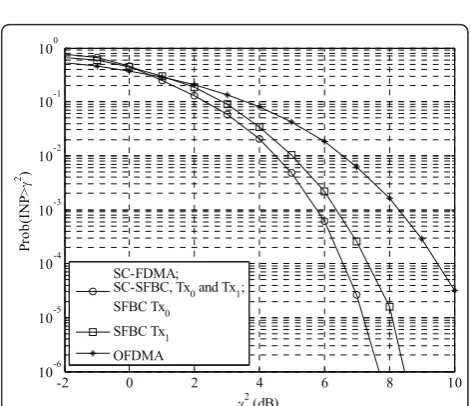
the simulation results are reproduced in Figure 3. The maximum separation between subcarriers carrying frequency samples precoded together is max(p, M - p) and is thus controlled by the parameter p. Distant subcarriers might experience different or even uncorrelated channel realizations, which generates some interference within the Alamouti-precoded pair. Some slight performance degradation can therefore occur on very selective channels and/or when the precoding distance is rather large. The optimum value of p, mini-mizing the maximum distance between subcarriers car-rying Alamouti pairs, is the even integer closest toM/2:
popt= 2·floor
M/4 (4)
Figure 1SC-FDMA transmitter with ST/SF precoding (Mout of
Nallocated subcarriers,NTxtransmit antennas).
0
Tx :
s
1
Tx :
s
6 12
SCp M
6
pn * 0
s
* 3
s
*
1
s
* 2
s
* 4
s
* 5
s
*
6
s
* 7
s
* 8
s
* 9
s
* 10
s
* 11
s
3
s
1
s s2 s4 s5 s6 s7
0
s s8 s9 s10 s11
Figure 2SC-SFBC precoding; example forM= 12,p= 6.
-2 0 2 4 6 8 10
10-6 10-5 10-4 10-3 10-2 10-1 100
J2 (dB)
Pr
ob
(I
N
P>
J
2 )
SC-FDMA; SC-SFBC, Tx0 and Tx1; SFBC Tx0
SFBC Tx1 OFDMA
Figure 3The distribution of the instantaneous normalized
SC-SFBC can benefit from low-complexity frequency-domain decoding. Indeed, couples of subcarriers (k0,k1)
carrying Alamouti pairs can be identified and separately decoded. To minimize the impact of the interference created within the Alamouti pair by precoding onto dis-tant subcarriers, minimum mean square error (MMSE) is employed instead of the maximum ratio combining usually employed in Alamouti decoding. MMSE decod-ing remains low-complexity (inversion of one order-2
matrix for each of the M/2 Alamouti pairs in one
SC-FDMA symbol).
3. Multi-user SC-SFBC
So far, the study reviewed in the previous section concentrated on transmit diversity techniques for SU-MIMO transmission, where each mobile station (MS) uses its transmit antennas to improve the perfor-mance at a given throughput, making use of the avail-able spatial diversity. Let us now introduce the principles of SC-SFBC in a MU-MIMO scenario.
3.1 Extending SC-SFBC to MU transmission
We consider that several users, each user having an MS equipped with two transmit antennas, are managed by the same base station (BS). The BS tries to optimally map the uplink signals of these users in a given limited bandwidth. Each such user implements SC-SFBC as a transmit diversity scheme. According to the desired throughput, to the capabilities of each MS and to the corresponding channel quality, the scheduler at the BS will decide the modulation and coding scheme (MCS) and the spectral allocation of each user. To optimize the spectral occupancy and increase the throughput, it is interesting to allow some spectral reuse between users having either the same or different overlapping allocated bandwidths.
Let us assume that the scheduler allows two users (MS0 and MS1) to share some (or all) of the subcarriers
allocated to each user. Each user is employing transmit diversity techniques, e.g., SC-SFBC, and there is some spectral overlapping between users. More clearly, the MU-MIMO scheme used here combines spatial multi-plexing with SC-SFBC. This is depicted in Figure 4. The
MU-MIMO channel hasNTX=NTX+NTX= 4 transmit
antennas (two antennas for each of the two user). At least two receive antennas are needed at the BS to sepa-rate the two users.
At the scheduler, the number of subcarriers Mi, as
well as the starting positionniof the portion of
spec-trum allocated to each MSi, is computed. When
SC-SFBC is used, Equation 4 shows that, to minimize the maximum distance between subcarriers coded together, the best strategy is to employ SCpM=2floor(M/4). For
simplification, let us consider in the following that Mis
a multiple of 4 and thuspopt=M/2. In an MU-MIMO
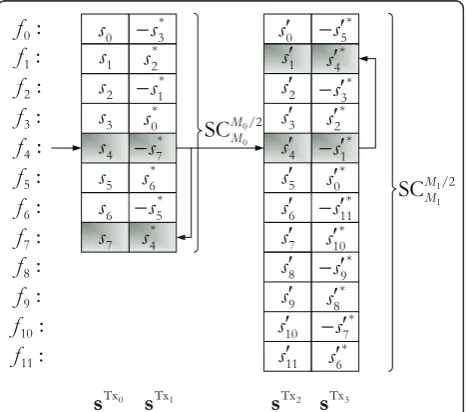
context, double SC-SFBC might have some pairing incompatibility problems. Indeed, let us analyze the situation depicted in Figure 5, where MS0 is allocated
M0 = 8 subcarriers and MS1 is allocatedM1 = 12
sub-carriers. The portions of spectrum occupied by the two MSs start with the same spectral position n0 =n1 = 0,
which means that the first occupied subcarrier by each MS is the one with index 0, denoted asf0in Figure 5.
Therefore, MS0 should useSC48and MS1 should use
SC6
12. Subcarriers with indexes (k0, k1) obtained by
applying Equation 2 contain Alamouti pairs. Each MS uses its optimumpparameter, respectively,p0= 4 andp1
= 6 in this example. On the fifth occupied subcarrierf4for
example, MS0 transmits frequency samples s4 and−s∗7 onto its two transmit antennas, respectively. Next,f4is
paired withf7, onto which MS0transmits frequency
sam-pless7ands∗4, respectively. On the same subcarrierf4, MS1
transmits frequency sampless4and−s∗1, respectively, onto Figure 4 MU-MIMO SC-SFBC: two users with spectral overlapping.
0 Tx
s
s
Tx1s
Tx2s
Tx3 3:
f
1:
f
2:
f
4:
f
5:
f
6:
f
7:
f
0:
f
8:
f
9:
f
10:
f
11:
f
* 0s
* 3s
* 1s
* 2s
* 4s
* 6s
* 7s
* 5s
3s
1s
2s
4s
5s
6s
7s
0s
* 0s
c
* 3s
c
* 1s
c
* 2s
c
* 4s
c
* 6s
c
* 7s
c
* 5s
c
* 10s
c
* 8s
c
* 9s
c
* 11s
c
3s
c
1s
c
2s
c
4s
c
5s
c
6s
c
7s
c
0s
c
8s
c
9s
c
10s
c
11s
c
0 0 /2SC
M M 1 1 /2SC
M Mits two transmit antennas. Since MS1 usesSC 612,f4 is
paired withf1. As a result, the pairing of subcarriers is not
compatible between MS0and MS1. Because of this
incom-patibility, this structure does not correspond to a double SC-SFBC construction and the conventional MMSE sim-plified detector cannot be employed anymore.
A joint MMSE detection over all the bandwidth con-taining cross-codes subcarriers is necessary in this case. For the example in Figure 5, this would involve
invert-ing a matrix of order M0 +M1 = 20 instead of two
matrices of order 4 and two matrices of order 2, as it would have been the case if the two MS were correctly aligned to form double Alamouti pairs on the overlap-ping subcarriers, and simple Alamouti pairs on the remaining subcarriers. The problem becomes even more complex when three or more users have overlapping subcarriers. This complexity issue is a real problem in practice. Since the number of subcarriers allocated to each user is variable, and the number of users having partially overlapping transmission bandwidths with one another may be more than 2, the receiver must be dimensioned for the worst-case scenario and should be able to invert matrices of rank hundreds or thousands. For an LTE transmission in the 5-MHz bandwidth (using 300 data carriers for example), the receiver should be dimensioned so as to be able to invert matrices of order 600.
3.2 Parameter optimization
To show how this incompatibility problem can be avoided, let us notice that any SCpMoperation can be seen as the concatenation ofSC0
pandSC0M−poperations,
applied onto the firstpand, respectively, the lastM - p samples of the input vector:
SCpMs0...sM−1
=SC0
p
s0...sp−1
,SC0
M−p
sp...sM−1 (5)
This is a direct result of the very structure of SC-SFBC. Indeed, in the example in Figure 2, we notice that sTx1 = SC6
12
sTx0while the first (respectively last) six frequency samples ofsTx1respect the relationship:
⎧ ⎪ ⎨ ⎪ ⎩
sTx1 0 ...s
Tx1
p−1=5 = SC 0
p=6
sTx0 0 ...s
Tx0
p−1=5
sTx1
p=6...s Tx1
M−1=11 = SC0M−p=6
sTx0
p=6...s Tx0
M−1=11
(6)
Let us denote the number of subcarriers simulta-neously used by two MSs byMoverlap. To avoid any
pair-ing incompatibility, the two MSs need to transmit the same symbol structure over the overlapping spectral portion. Based on the property stated above, when the two MSs have strictly different spectral allocations, the
only valid option is to chose p parameters pi and
spectrum positionsnisuch that the overlapping portion has a structure based on SC0Moverlap. While an
optimiza-tion of parameter p has no direct impact on the
allo-cated set of subcarriers, an optimization of the spectrum
positions ni limits the flexibility of the frequency
scheduler.
The case where the two MSs have the same number
of allocated subcarriers M0 =M1 and share the same
bandwidth is trivial since no pairing incompatibility arises. Pairs of subcarriers (k0,k1) carrying double
Ala-mouti pairs can be identified and low-complexity
MMSE decoding can be applied (involvingM/2 order-4
matrix inversions). We only treat here of the case of different spectral allocationM0 ≠M1, let us assume for
example M0 <M1. The case of users with the same
number of allocated subcarriersM0 =M1 but different
allocated bands n0 ≠ n1 can be treated in a similar
manner.
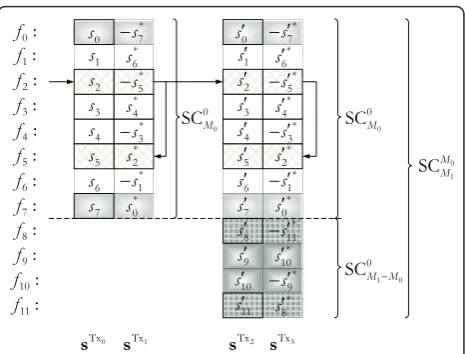
For n0 =n1, a solution is given in Figure 6. We need
to impose MS0 to useSC
p0=0
M0 and MS1 to use SC
p1=M0
M1 . The SCp1=M0
M1 can be seen as the concatenation of two
SC-like operations
•SC0M0to match the configuration of MS0; on this
part of the spectrum, double SC-SFBC transmission can thus be employed;
•The remainingSC0M1−M0corresponds to a simple SC-SFBC transmission and keeps an overall SC-type signal to be transmitted by MS1.
Hence, it is no longer possible to use a default value for thepparameter for all the system (highest even inte-ger inferior to half of the respective number of allocated
0
Tx
s sTx1 sTx2 sTx3
3: f 1: f 2: f 4: f 5: f 6: f 7: f 0: f 8: f 9: f 10: f 11: f * 0 s * 3 s * 1 s * 2 s * 4 s * 6 s * 7 s * 5 s 3 s 1 s 2 s 4 s 5 s 6 s 7 s 0 s * 0 sc * 3 sc * 1 sc * 2 sc * 4 sc * 6 sc * 7 sc * 5 sc * 10 sc * 8 sc * 9 sc * 11 sc 3 sc 1 sc 2 sc 4 sc 5 sc 6 sc 7 sc 0 sc 8 sc 9 sc 10 sc 11 sc 0 0
SCM 0
0 SCM
1 0
0 SCMM
0 1 SCM
M
Figure 6MU double SC-SFBCM0<M1, an example forM0= 8,
subcarriers), but double SC-SFBC structure is kept at the expense of a modification of the pparameter, i.e., some performance degradation as the maximum dis-tance between subcarriers that are jointly precoded is increased. But, complexity is strongly reduced: only two matrices of order 4 and two matrices of order 2 need to be inverted during MMSE decoding for the example in Figure 6, while for the structure in Figure 5 an inversion of an order-20 matrix was required. It should also be noted that additional signaling is necessary to indicate the values ofpto be used by each MS in this case.
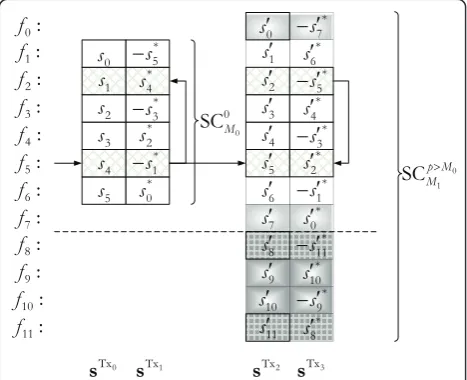
An alternative solution for the case when the spectral bands allocated to the two MSs do not have the same
spectral starting position is to decompose SCp1
M1into SC 0
p1andSC 0
M1−p1, and to allocate MS0 in the middle of
the bandwidth occupied bySC0
p1if p1 >M0, or in the middle of the bandwidth occupied by SC0M1−p1 other-wise. An example is depicted in Figure 7. Nevertheless, this might lead to a modified double SC-SFBC (there is a sign inversion within the double SC-FDMA pair on
antenna Tx3) which needs to be taken into account at
the receiver, without any performance loss. In both cases depicted in Figures 6 and 7, it is possible to allow double SC-SFBC; thanks to an optimization of
para-meter p only. No constraint is introduced in the
fre-quency scheduler to optimizen0andn1.
3.3 Optimization of spectral occupancy
Let us now extend the particular cases treated in the previous section to a general framework where a BS
manages several MS, let their number be Nusers. We
propose here to optimize not only the parameterpbut
also the spectrum positionsniso as to allow using dou-ble SC-SFBC by several terminals having overlapping spectrum allocations.
Depending on the needs and capabilities of uplink communication of each MS, the BS determines the number of subcarriersMiallocated to each MSi,i = 0...
Nusers- 1. Each MS is equipped of at least two transmit
antennas. Each MS uses SC-FDMA with SC-SFBC trans-mit diversity for its uplink communication. Our purpose
is to schedule these NusersMSs in such a manner that
the occupied bandwidth is minimized and the overall throughput is optimized. The couple (pi,ni),
represent-ing the pparameter and the first occupied subcarrier,
needs to be determined for each MSi.
The main idea behind the solution is to determine two groups of users, A and B. Spectral bands allocated to each user do not overlap inside of each group, but each user of each group can have overlapping subcarriers with a maximum of two users from the other group, such as onto the overlapping subcarriers double Ala-mouti pairs are formed.
Let subcarrier numbering starting at nA
0= 0;nB0 can be either null or take another positive value. nAandnB are auxiliary parameters indicating the index of the first available subcarrier in groups A and B,
respec-tively. We suppose that BS tries to map Nusers MSs in
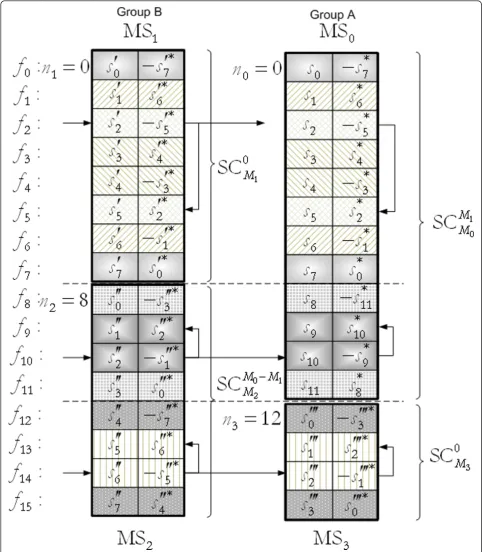
a bandwidth that is as compact as possible (alterna-tively, it could have one given available bandwidth and would try to map as many users as possible; algorithm still stands but the STOP condition needs to be modi-fied). The algorithm presented in the Annex (addi-tional file 1) tries to minimize the number of subcarriers allocated to only one single MS to improve the overall spectral efficiency, while forming double SC-SFBC pairs on the subcarriers simultaneously allo-cated to two MSs to ensure low-complexity decoding. The principle of this algorithm is to use the fact that the SC operator can be decomposed as shown in Sec-tion 3.2, with the purpose of optimizing the spectral occupancy. Users are treated one at a time, and at
each step the treated user is allocated a p parameter
such as to share a maximum number of subcarriers
with the previous user by forming “double Alamouti”
pairs. STOP condition is attained when all the users have been scheduled.
Let us apply the algorithm in Annex (additional file 1) for a BS that schedules four MSs with different commu-nication needs, and decides to allocate them, respec-tively,M0= 12,M1= 8,M2 = 8,M3= 4 subcarriers
START:i= 0, nA0 = 0, nB0= 0, Nusers= 4
nA=nA
0= 0, nB=nA0+nB0= 0
0 Tx
s sTx1 sTx2 sTx3 3: f 1: f 2: f 4: f 5: f 6: f 7: f 0: f 8: f 9: f 10: f 11: f * 0 s * 3 s * 1 s * 2 s * 4 s * 5 s 3 s 1 s 2 s 4 s 5 s 0 s * 0 sc * 3 sc * 1 sc * 2 sc * 4 sc * 6 sc * 7 sc * 5 sc * 10 sc * 8 sc * 9 sc * 11 sc 3 sc 1 sc 2 sc 4 sc 5 sc 6 sc 7 sc 0 sc 8 sc 9 sc 10 sc 11 sc 0 0 SCM 0 1
SCp M
M
!
i<Nusers? YES:
Select MS0, determine M0 = 12
nA<nB? NO:
nA=nB? YES:
Select MS1, determine M1= 8
M0 =M1? NO:
n0 =n1= 0,p0=M1 = 8,p1= 0
nA= 12,nB= 8,i= 2
i<Nusers? YES:
Select MS2, determine M2 = 8
nA<nB? NO:
nA=nB? NO: M2 >nA-nB? YES
n2 =nB= 8,p2=nA-nB= 4
nB= 16,i= 3
i<Nusers? YES:
Select MS3, determine M3 = 4
nA<nB? YES:
nA=nA
0? NO: M3 >nB-nA? NO:
n4 = 12,p4 = 0
i= 4
i<Nusers? NO:
STOP.
The results are depicted in Figure 8. In a similar man-ner, all the cases depicted in Figures 6 and 7 can be deduced based on this algorithm.
Of course, this scheduling strategy directly constrains the frequency scheduler. However, it should be under-stood that transmit diversity is mainly intended for terminals that cannot benefit from any close-loop pro-cessing as CSI-based frequency scheduling. In other words, no frequency scheduling gain can be achieved in this case and the constraint imposed on the fre-quency scheduler is only a specific ordering of each allocated spectrum, given predetermined spectrum sizesMi.
4. Simulation results
Let us consider an SC-FDMA system withN= 512
sub-carriers, among which 300 are active data sub-carriers, to fit a bandwidth of 5 MHz. To retrieve frequency diversity, groups of 12 SC-FDMA symbols with QPSK signal map-ping are encoded together with a rate-1/2 turbo code using the LTE interleaving pattern [8]. A CP with a length of 36 samples is employed. We consider an uncorrelated Vehicular A MIMO channel with six taps
and a maximum delay spread of 2.51 μs [17]. Localized
subcarrier mapping and ideal channel estimation are assumed. We employ MMSE detection, with successive interference cancelling to reduce the inter-user interfer-ence in the MU-MIMO case.
From the discussion in Section 2.2, we can deduce
that not using the individual optimumpparameter (4)
for the schemes proposed in Section 3 might lead to some performance degradation. Let us first evaluate the severity of this degradation in the SU case. Let us
con-sider that M = 120 localized subcarriers (covering
around five times the channel coherence bandwidth) are allocated to a user traveling at 3 kmph, and benefiting from perfect channel estimation and MMSE decoding.
Figure 9 analyzes how the choice of parameter p
influ-ences the performance of SC-SFBC. Performance is eval-uated in terms of frame error rate (FER).p= 60 andp= 30, corresponding top=M/2 andp=M/4, respectively,
have similar performance. Employing p= 16 andp= 0
leads to a degradation of 0.2 and 0.4 dB, respectively. For vehicular A channel and for the present simulation parameters, the correlation bandwidth Bcohcorresponds
to approximately 26 subcarriers. In these conditions,
when employing p= 60 and p= 30, about 43% of the
Alamouti pairs (26 out of 60 pairs) are situated on sub-carriers having highly correlated fadings. This
percen-tage drops to 35 and 21% when choosingp= 16 andp
= 0, respectively. This is a worst-case scenario, since users needing to employ transmit diversity are usually in bad propagation conditions and are allocated rather small numbers of subcarriers. We can thus conclude that the associated performance degradation due to
optimizing thepparameter as proposed in Sections 3.2
and 3.3 is negligible in practice.
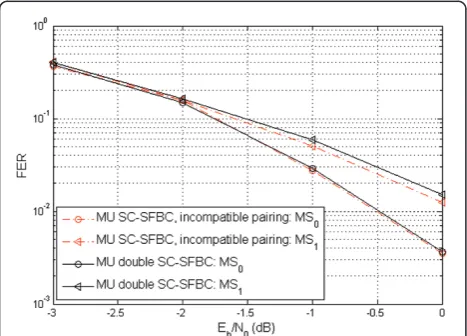
Let us now investigate the performance of the MU double SC-SFBC scheme with low decoding complexity proposed in Section 2.2 with respect to the MU SC-SFBC scheme with incompatible subcarrier pairing (e.g., like in Figure 5). We consider thatM0= 60 and,
respec-tively,M1 = 20 localized subcarriers are allocated to two
users and four receive antennas are present at the BS.
are not optimal from a user-egoistic point of view, since they were optimized with the aim of reducing the decoding complexity. As shown in Figure 9 and 9dis-cussed in the previous paragraph, this might lead to some performance degradation.
The results of this evaluation are presented in Figure
10. In both cases, MS0 performs better than MS1
because of the higher frequency diversity (more allo-cated subcarriers), and of lower inter-user interference profile (MS0 only suffers from inter-user interference
within 1/5 of its spectrum, while MS1 is interfered
within the totality of its spectrum). At a target FER of 2 × 10⁻², for MS0, both schemes exhibit similar
perfor-mance. For MS1, the MU SC-SFBC with incompatible
subcarrier pairing has a slight advantage (0.14 dB), due
to the use of user-egoistic optimum p parameters, as
explained in Figure 9. Nevertheless, the performance dif-ference between MU SC-SFBC with incompatible pair-ing and MU double SC-SFBC with low decodpair-ing complexity is negligible. This is in favor of the latter scheme, who exhibits a much lower complexity decoding.
5. Conclusions and future work
SC-FDMA imposed itself as a good option for the uplink air interface of wireless communications systems. In order to preserve its main advantage, which consists in the low envelope variations it exhibits, special care needs to be taken when applying MIMO techniques in SC-FDMA systems. SC-SFBC has already been proposed as a robust SU-MIMO transmit diversity scheme com-patible with SC-FDMA. In this article, we extended the principles of SC-SFBC to MU-MIMO.
A novel algorithm allowing the optimization of the parameters of SC-SFBC to enable low-complexity decoding at the receiver side and to maximize the over-all spectral occupancy in MU-MIMO SC-FDMA sys-tems is introduced. We show the good performance of the proposed algorithm. Future study will concentrate in further investigation of the proposed algorithm, includ-ing throughput evaluations for several MCSs.
Additional material
Additional file 1: Annex A. PDF file containing Annex A.
Acknowledgements
Part of the study presented in this article was developed within the framework of the European collaborative research project“Advanced Radio Interface TechnologIes for 4G SysTems”(ARTIST 4G). The authors would also like to thank Mr. Xiaoran Jiang for his helpful input concerning the evaluation of the techniques presented in this article.
Competing interests
The authors declare that they have no competing interests.
Received: 15 October 2010 Accepted: 8 September 2011 Published: 8 September 2011
References
1. WWR Forum (ed.), inTechnologies for the Wireless Future, vol. 3. (John Wiley, 2008)
2. H Sari, G Karam, I Jeanclaude, Frequency-domain equalization of mobile radio and terrestrial broadcast channels, inGLOBECOM’94(December 1994) 3. J Tellado,Multicarrier Modulation with Low Peak to Average Power
Applications to xDSL and Broadband Wireless(Kluwer Academic Publishers, Boston, 2000)
4. Z Li, X-G Xia, PAPR reduction for repetition space-time-frequency coded MIMO-OFDM systems using Chu sequences. IEEE Trans Wireless Commun. 7(4), 1195–1202 (2008)
5. T Jiang, Y Wu, An overview: peak-to-average power ratio reduction techniques for OFDM signals. IEEE Trans Broadcast.54(2), 257–268 (2008)
-1 0 1 2 3 4 5
10-3 10-2 10-1 100
Eb/N0 (dB)
FE
R
p=60
p=30
p=16
p=0
Figure 92 × 2 SC-SFBC with variablep: 3 kmph, 120 localized subcarriers, QPSK 1/2, MMSE decoding with ideal channel estimation.
Figure 10 Performance comparison of SC-SFBC with incompatible subcarrier pairing and MU double SC-SFBC with
reduced decoding complexity, an example forM0= 60,M1=
6. H Ochai, H Imai, Performance of the deliberate clipping with adaptive symbol selection for strictly band-limited OFDM systems. IEEE J Sel Areas Commun.18(11), 2270–2277 (2000). doi:10.1109/49.895032
7. C Ciochina, F Buda, H Sari, An analysis of OFDM peak power reduction techniques for WiMAX systems, inICC’06, (Istanbul, Turkey, June 2006) 8. 3rd Generation Partnership Project; Technical Specification Group Radio
Access Network; Evolved Universal Terrestrial Radio Access (E-UTRA),
“Physical Channels and Modulation (Release 9)”. 3GPP TS 36.211 V9.1.0 (March 2010)
9. HG Myung, J Lim, DJ Goodman, Single carrier FDMA for uplink wireless transmission. IEEE Veh Technol Mag.3(1), 30–38 (2006)
10. HG Myung, J Lim, DJ Goodman, Peak-to-average power ratio of single carrier FDMA signals with pulse shaping, in17th Annual IEEE International Symposium on Personal, Indoor and Mobile Radio Communications (PIMRC’06), (Helsinki, Finland, September 2006)
11. C Ciochina, D Castelain, D Mottier, H Sari, New PAPR-preserving mapping methods for single-carrier FDMA with space-frequency block codes. IEEE Trans Wirel Commun.8(10), 5176–5186 (2009)
12. SM Alamouti, A simple transmit diversity technique for wireless communications. IEEE J Sel Areas Commun.16(8), 1451–1458 (1998). doi:10.1109/49.730453
13. D Tse, P Viswanath,Fundamentals of Wireless Communication(Cambridge University Press, Cambridge, 2005)
14. Z Wang, G Giannakis, Wireless multicarrier communications. Signal Process Mag IEEE.17(3), 29–48 (2000). doi:10.1109/79.841722
15. 3rd Generation Partnership Project; Technical Specification Group Radio Access Network; Evolved Universal Terrestrial Radio Access (E-UTRA),
“Multiplexing and Channel Coding (Release 10)”. 3GPP TS 36.212 V10.1.10 (March 2011)
16. 3rd Generation Partnership Project, RAN1, Performance Evaluations of STBC/SFBC Schemes in E-UTRA Uplink, R1-063179, Alcatel
17. 3GPP TR 25.996 V7.0.0 (2007-06), Spatial channel model for Multiple Input Multiple Output (MIMO) simulations
doi:10.1186/1687-6180-2011-54
Cite this article as:Ciochinaet al.:Low PAPR space frequency block coding for multiuser MIMO SC-FDMA systems: specific issues for users with different spectral allocations.EURASIP Journal on Advances in Signal Processing20112011:54.
Submit your manuscript to a
journal and benefi t from:
7Convenient online submission
7 Rigorous peer review
7Immediate publication on acceptance
7 Open access: articles freely available online
7High visibility within the fi eld
7 Retaining the copyright to your article