Access and adequate utilization of malaria control interventions in rural Malawi: a descriptive quantitative study
Alinune Nathanael Kabaghe 1,2 , Michael Give Chipeta 2,3,4, Robert Sean McCann 2,5, Dianne Jean Terlouw 4, Tinashe Tizifa 2, Zinenani Truwah 6, Kamija Samuel Phiri 2, Michèle van Vugt 1
1 Center of Tropical Medicine and Travel Medicine, Department of Infectious Diseases, Academic Medical Center, University of Amsterdam, 1105 AZ Amsterdam, Netherlands
2 School of Public Health and Family Medicine, College of Medicine, University of Malawi, Blantyre 3, Malawi
3 Lancaster University, Lancaster Medical School, Lancaster, LA1 4YG, UK
4 Malawi-Liverpool Wellcome Trust Clinical Research Program, Queen Elizabeth Central Hospital, College of Medicine, Blantyre, Malawi
5 Laboratory of Entomology, Wageningen University and Research Centre, 6708 PB Wageningen, Netherlands
6 Management Sciences for Health – Malawi Program, EBC Building, Off Paul Kagame Road, Private Bag 398, Lilongwe 3, Malawi
*Corresponding authors
Abstract Background
Despite the availability of cost effective malaria control interventions, such as insecticide-treated bed nets (ITN), diagnosis and effective treatment of malaria, and intermittent preventive treatment during pregnancy (IPTp), the lack of equitable access and coverage affect utilization of these interventions in rural communities. Aggregated rates of access and utilization of malaria interventions in national surveys mask substantial variations in intervention coverage. Utilization of interventions and factors affecting utilization need investigation in rural communities.
Methods
One year of quantitative data collected from a rolling Malaria Indicator Survey (April 2015 – April 2016) in Chikhwawa District, Malawi, before the ITN distribution campaign, were analysed. Univariate analyses were used to quantify rates of ITN usage, care-seeking for fever in children aged 6-59 months and women aged 49 years and IPTp uptake (for women aged 15-49 years with a recent delivery). Results were compared to national survey estimates; factors associated with these outcomes were determined using multivariate regression models.
Results
doses of IPTp were 40.6% and 15.0%, respectively, among women with a pregnancy in the last two years.
Conclusion
To achieve effective malaria control, fine-scale or district-based surveillance should be used to identify and target communities requiring scaling up of interventions. Qualitative research and a participatory community approach should be used to address behavioural factors affecting how people make use of interventions.
Background
The World Health Organization’s first aim towards achieving a world free of malaria is to ensure “universal access to malaria prevention, diagnosis and treatment” [1]. Malaria prevention using insecticide-treated bed nets (ITN), and treatment with artemisinin-based combination therapy (ACT), are cost effective, and have reduced disease incidence and prevalence in the African population [2, 3]. For pregnant women, intermittent preventive therapy in pregnancy with sulfadoxine-pyrimethamine (IPTp-SP) is a cost effective intervention to prevent adverse effects of malaria in pregnancy for both women and the unborn child, and reduces disease burden in stable transmission areas [4-7]. However, the lack of equitable access (availability, affordability, and acceptability) [8] and coverage affect utilization of the interventions in poor and rural communities [9, 10]; poor communities have a disproportionately higher burden of malaria infection than wealthier communities [11]. Other key factors affecting utilization depend on the quality of the health system and traditions of behaviour in the community [12].
In this study, data from repeated cross-sectional malaria indicator surveys were analysed to quantify access and utilization of adequate prompt diagnosis and treatment of reported fever in children and women in a rural Malawian community. ITN usage (before the ITN distribution campaign), and an evaluation of access to and utilization of adequate IPTp in pregnant women are described and compared to 2014 MIS. Finally, factors associated with ITN and IPTp utilization and care-seeking for fever in the rural community are investigated.
Methods
Study design and setting
This paper describes and analyses quantitative data collected during a rolling malaria indicator survey (rMIS) in rural Malawi. rMIS involves a sequence of cross-sectional surveys collecting demographic and health-related data from different sampled households, within a defined community [15]; each cross-sectional survey used a questionnaire and laboratory procedures adapted from standardized Malaria Indicator Survey (MIS) [16].
The MMP catchment area has five public and two private health centres, offering primary health-care services. One district hospital, offering both primary and secondary health-health-care services, is located on average 23 km (range 3-42 km) from the households in the catchment area (by Euclidian distance approximation). There are some private clinics and shops which stock anti-malarial drugs such as sulfadoxine-pyrimethamine and quinine. On average, the number of health workers, defined as nurse or clinician, is 2.1 per 10,000 population in the primary health-care system [18]. Malaria diagnosis using malaria rapid diagnostic test (SD Bioline malaria Ag Pf HRP-2 Standard Diagnostics Inc, Korea) and treatment with the recommended anti-malarial drug artemether-lumefantrine (AL), as first line for uncomplicated cases, artesunate-amodiaquine as second line, and intravenous quinine or parenteral artesunate for severe malaria, are freely available for all ages in both public and private health centres. Private clinics and dispensaries do not provide malaria tests although they sell anti-malarial drugs. During the study period, community health workers, locally known as Health Surveillance Assistants, prescribed malaria treatment to children below five years based on symptoms only without a confirmatory parasitological test. These community health workers are based in communities defined as “hard to reach” by the Malawi Ministry of Health. Intermittent preventive-treatment in pregnancy with sulfadoxine-pyrimethamine (IPTp-SP) is also free in all facilities. Private facilities charge a small consultation fee for all patients and patients may pay for drugs other than anti-malarial drugs; diagnosis and treatment for malaria are free in both private and public facilities.
Participants
IPTp-SP utilization, women who were recently pregnant (delivered a live or stillbirth in the preceding two years), were included.
Data collection
An enumeration of all households in the MWR perimeter was conducted from August to December 2014. All household and primary health-care facility Global Positioning System (GPS) coordinates were recorded using a Samsung Galaxy Tab 3 running Android 4.1 Jellybean operating system. Age, sex and relationship to head of household for all household members were also recorded. Household sampling has been described previously [17]. Briefly, from the enumeration database, a probability-based sample of households (without replacement) per survey sequence, were selected using inhibitory geostatistical sampling initially [19], then adaptive geostatistical sampling (AGD) [20]. Inhibitory sampling requires that a pair of sampled units/locations be separated by a specific distance and AGD relies on previous sample results to sample new units/locations. Members of the sampled households, specifically all women aged 15-49 years, and all children aged 6-59 months (accompanied by their guardian), were invited to a central location within the community. The members were requested to bring their health passport, a book containing details of visits to health facilities.
and use by eligible individuals during the previous night, recent pregnancies (for women) and recent fever (fever in the preceding two weeks). For the women aged 15-49 years, highest education attained and details of IPTp-SP utilization in the recent pregnancy (within the preceding 2 years), were recorded. IPTp-SP doses were confirmed in the respondent’s health passport. Socio-demographic details and insecticide-treated bed net ownership and use were recorded for all households.
Quantitative variables
The primary outcomes, ITN use the previous night and care-seeking for fever by the participants (children aged 6-59 months and women aged 15-49 years), and IPTp-SP utilization by women with a pregnancy in the previous two years, were binary. Care-seeking applied to participants who reported a fever within the preceding two weeks. ITN utilization is reported based on interview responses. IPTp-SP utilization was reported primarily based on documented proof in health passport, although participant-reported IPTp-SP is also reported. Adequate IPTp-SP use was based on health passport-confirmed three or more doses of SP.
Statistical methods
Stata software version 13 (StataCorp, Texas, USA) was used for statistical analysis. For univariate analysis, means and proportions are reported. T-tests and χ2 for continuous and binary variables, respectively, were determined using bivariate analysis. Multivariate binomial logistic regression was used to determine factors associated with each of the three separate primary outcomes: ITN use; care-seeking for fever; and confirmed three or more doses of IPTp-SP during pregnancy. The variables included in each model were selected a priori based on whether they can potentially affect the outcome from previous reports. For example, distance and season have been previously reported to affect care seeking in the same population [22, 23]. Only variables with p-values less than 0.05 were considered statistically significant in the multivariate analysis.
Ethical consideration
The rMIS study was reviewed and approved by College of Medicine Research and Ethics Committee (P.09/14/1631) in Malawi. All participants or their legal guardians signed an informed consent before enrolment.
Results
Summary characteristics of study participants
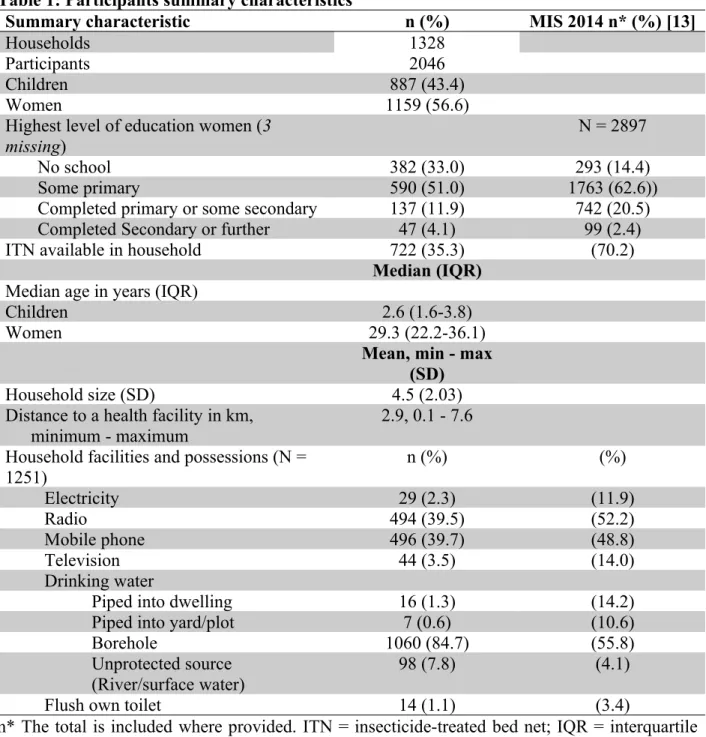
participants, 887 were children and 1159 were women aged 15-49 years. The median age of the children and women were 2.6 and 29.3 years respectively. Fifty one percent of the women had some primary education; few women had completed secondary school. There were more women with no formal education in the study area compared to the 2014 MMIS [13]. Reported ownership of at least one ITN per household was 35.3% which was lower than the 2014 MMIS. Fewer households had access to electricity, protected drinking water and owned valuable household items in the study population compared to the 2014 MMIS. The mean distance to a health facility was 2.9 km and the average household size was 4.5 people.
ITN use, care-seeking, diagnosis, and treatment of fever
5.5% of the participants took non-recommended first-line anti-malarial drugs. There were 20.9% and 22.0% children and women, respectively, who paid for health services.
IPTp-SP
The total number of women who had given birth within the previous two years was 438 (Fig. 1) of whom 429 were eligible to receive IPTp-SP. Of the eligible women, antenatal care (ANC) attendance was high, although 14.9% did not receive SP despite attending ANC. The recommended minimum three doses of IPTp-SP was documented in 15.0% of the women although 17.0% had reported completing the dose completion; there was no difference (statistically) between the two proportions (p-value = 0.350).
ITN use, fever and care-seeking for fever by sampling round
Both ITN use and reported fever decreased steadily from April/May 2015 (after the rainy season) to October/November (Fig. 2). Care-seeking for fever remained between 40 and 55% for those with a reported fever.
Factors associated with ITN use, care-seeking and IPTp-SP utilization
Discussion
The study findings suggest suboptimal utilization of malaria control interventions in the study area. ITN ownership and usage, prompt care-seeking for diagnosis and effective treatment of malaria, and IPTp-SP rates in these communities are lower than both national estimates, and universal coverage targets. This highlights that national coverage aggregations mask substantial inequities in intervention coverage [24] and are not ideal for identifying and targeting high burden and low intervention marginalized communities. District-based and fine-scale surveillance may improve identification of these marginalized communities. The Malawi National Malaria Control Programme conducted free nationwide ITN distribution campaign in April 2016, and increased availability of free diagnosis and treatment of malaria in both public and private health facilities. Recently, provision of uncomplicated malaria diagnosis and treatment for children below five years old by community health workers has increased availability and access in remote communities. MMP also implemented a community-led behaviour change programme to improve care-seeking and ITN use. An evaluation of access and utilization of the interventions following their scale up and MMP community-led intervention will be published.
asymptomatic cases are parasite reservoirs for continued transmission [26]. Although distance to a health facility has been reported in the same area to affect care-seeking [22, 23], distance was not a significant factor in the current study. Distance to facility may have been an important factor in previous reported studies which had a wider variation in distance (communities located 8km or more were compared with those close to the hospital) than the current study (less than 3 km on average). In the current study, an estimate of the distance between the household and a primary health facility was a Euclidean distance calculated based on GPS locations. This estimation method may not reflect the true distance of the actual path between the household and health facility which is determined by geographical (i.e. terrain) and man-made barriers. The lack or delay in accessing diagnosis and treatment of fever may be more related to socio-cultural factors which were not investigated in this quantitative analysis. MMP is currently conducting qualitative research and implementing a malaria behaviour change communication (BCC) strategy [27] within the community to understand and improve, respectively, socio-cultural factors affecting care-seeking.
ownership was previously reported to be associated with lower odds of parasitaemia in children in this community [17], meaning that the children in households without ITNs are not only at higher risk of malaria infection, but also serve as a source of malaria parasites to surrounding communities. These poor households and communities are not identified in national surveys for targeted interventions. Evidence for improving household ownership of ITN through mass distribution campaigns has yielded mixed results in sub-Saharan Africa; in some countries, equity between the relatively wealthier and the less wealthy has increased, while in others, it decreased [31-33]. Deliberately addressing inequity and specifically developing strategies aimed at improving community socio-economic status may improve malaria control for poor communities [34]. For instance, fine-scale mapping of malaria burden and intervention coverage can potentially assist identifying and targeting marginalized communities. Surveillance using district-based health teams may also increase fine scaling mapping and identifying such communities. Most rural areas have community health workers who can be utilized for this role.
The implementation of malaria interventions through the health system were suboptimal. Although reported utilization of ANC services was high, the supply of IPTp-SP was inadequate (Fig. 1), as 14.9% of women who attended ANC did not receive it. This discrepant use of IPTp-SP needs further investigation from both health system and patient perspective. For those who sought care for fever, the number who had a finger prick for malaria test was 41%, far below the universal access to malaria diagnosis target. Health system barriers for IPTp-SP and diagnosis and treatment of malaria were not investigated in this study, although in other studies, these affect rural areas disproportionately to urban areas. Barriers include availability of medical supplies and understaffing, [14] as most health care workers do not want to work in remote areas.
Conclusions
List of abbreviations
ACT = artemisinin-based combination therapy; AL = artemether-lumefantrine; AMD = anti-malarial drug; ANC = antenatal care; aOR = adjusted odds ratio; ASAQ = artesunate-amodiaquine; BCC = behaviour communication change; CI = confidence interval; CPT = cotrimoxazole preventive therapy; GPS = Global Positioning System; HRP = histidine-rich protein; IPTp-SP = intermittent preventive therapy in pregnancy with sulfadoxine-pyrimethamine; ITN = insecticide-treated bed net; IQR = interquartile range; MMIS = Malawi Malaria Indicator Survey; MIS = Malaria Indicator Survey; MMP = Majete Malaria Project; MWR = Majete Wildlife Reserve; PHC = primary health care facility; rMIS = rolling Malaria Indicator Survey; SD = standard deviation; SP = sulfadoxine-pyrimethamine
Declarations
Ethics approval and consent to participate
The primary study was reviewed and approved by College of Medicine Research and Ethics Committee (P.09/14/1631) in Malawi. All participants or their legal guardians signed an informed consent before enrolment.
Consent for publication Not applicable.
Availability of data and materials
All data generated or analysed during this study are included in this published article and its supplementary information files.
Competing interests
Funding
This work was supported by Dioraphte Foundation, Netherlands. The content is solely the responsibility of the authors and does not necessarily represent the official views of the funders. Author contributions
All listed authors were involved in designing the primary study. ANK, MGC, RSM and ZT implemented the study. MGC sampled the households for rMIS. ANK and MGC analysed the data. ANK wrote the first draft. All authors contributed in developing the manuscript and approve submission of the final version.
Acknowledgements
References
1. WHO: Global technical stategy for malaria 2016-2030. In World Health Organisation. United Kingdom2015.
2. Bhatt S, Weiss DJ, Cameron E, Bisanzio D, Mappin B, Dalrymple U, Battle KE, Moyes CL, Henry A, Eckhoff PA, et al: The effect of malaria control on Plasmodium falciparum in Africa between 2000 and 2015. Nature 2015, 526:207-211.
3. World Health Organisation: World Malaria Report 2016. Geneva 2016.
4. Verhoeff FH, Brabin BJ, Chimsuku L, Kazembe P, Russell WB, Broadhead RL: An evaluation of the effects of intermittent sulfadoxine—pyrimethamine treatment in pregnancy on parasite clearance and risk of low birthweight in rural Malawi. Annals of
Tropical Medicine & Parasitology 1998, 92:141-150.
5. Wilson NO, Ceesay FK, Obed SA, Adjei AA, Gyasi RK, Rodney P, Ndjakani Y, Anderson WA, Lucchi NW, Stiles JK: Intermittent preventive treatment with sulfadoxine-pyrimethamine against malaria and anemia in pregnant women. Am J Trop
Med Hyg 2011, 85:12-21.
6. Menéndez C, Bardají A, Sigauque B, Sanz S, Aponte JJ, Mabunda S, Alonso PL: Malaria Prevention with IPTp during Pregnancy Reduces Neonatal Mortality. PLOS ONE 2010, 5:e9438.
7. Sicuri E, Bardají A, Nhampossa T, Maixenchs M, Nhacolo A, Nhalungo D, Alonso PL, Menéndez C: Cost-Effectiveness of Intermittent Preventive Treatment of Malaria in Pregnancy in Southern Mozambique. PLOS ONE 2010, 5:e13407.
9. Schellenberg JA, Victora CG, Mushi A, de Savigny D, Schellenberg D, Mshinda H, Bryce J: Inequities among the very poor: health care for children in rural southern Tanzania. The Lancet, 361:561-566.
10. van Eijk AM, Hill J, Alegana VA, Kirui V, Gething PW, ter Kuile FO, Snow RW: Coverage of malaria protection in pregnant women in sub-Saharan Africa: a synthesis and analysis of national survey data. The Lancet Infectious Diseases 2011, 11:190-207. 11. Snow RW, Guerra CA, Noor AM, Myint HY, Hay SI: The global distribution of clinical
episodes of Plasmodium falciparum malaria. Nature 2005, 434:214-217.
12. Hill J, Hoyt J, van Eijk AM, D'Mello-Guyett L, ter Kuile FO, Steketee R, Smith H, Webster J: Factors Affecting the Delivery, Access, and Use of Interventions to Prevent Malaria in Pregnancy in Sub-Saharan Africa: A Systematic Review and Meta-Analysis.
PLOS Medicine 2013, 10:e1001488.
13. National Malaria Control Programme (Malawi) and ICF international: Malawi Malaria Indicator Survey (MIS) 2014. In NMCP and ICF International. Lilongwe Malawi2014. 14. Mubyazi GM, Bloch P, Byskov J, Magnussen P, Bygbjerg IC, Hansen KS:
Supply-related drivers of staff motivation for providing intermittent preventive treatment of malaria during pregnancy in Tanzania: evidence from two rural districts. Malar J 2012, 11:48.
15. Roca-Feltrer A, Lalloo DG, Phiri K, Terlouw DJ: Rolling Malaria Indicator Surveys (rMIS): a potential district-level malaria monitoring and evaluation (M&E) tool for program managers. The American journal of tropical medicine and hygiene 2012, 86:96-98.
17. Kabaghe AN, Chipeta MG, McCann RS, Phiri KS, van Vugt M, Takken W, Diggle P, Terlouw AD: Adaptive geostatistical sampling enables efficient identification of malaria hotspots in repeated cross-sectional surveys in rural Malawi. PLOS ONE 2017, 12:e0172266.
18. Kabaghe AN, Phiri MD, Phiri KS, van Vugt M: Challenges in implementing uncomplicated malaria treatment in children: a health facility survey in rural Malawi.
Malaria Journal 2017, 16:419.
19. Chipeta M, Terlouw D, Phiri K, Diggle P: Inhibitory geostatistical designs for spatial prediction taking account of uncertain covariance structure. Environmetrics 2017, 28. 20. Chipeta MG, Terlouw DJ, Phiri KS, Diggle PJ: Adaptive geostatistical design and
analysis for prevalence surveys. Spatial Statistics 2016, 15:70-84.
21. Vyas S, Kumaranayake L: Constructing socio-economic status indices: how to use principal components analysis. Health Policy Plan 2006, 21:459-468.
22. Ewing VL, Lalloo DG, Phiri KS, Roca-Feltrer A, Mangham LJ, SanJoaquin MA: Seasonal and geographic differences in treatment-seeking and household cost of febrile illness among children in Malawi. Malar J 2011, 10.
23. Ewing VL, Tolhurst R, Kapinda A, Richards E, Terlouw DJ, Lalloo DG: Increasing understanding of the relationship between geographic access and gendered decision-making power for treatment-seeking for febrile children in the Chikwawa district of Malawi. Malaria Journal 2016, 15:521.
25. Chuma J, Abuya T, Memusi D, Juma E, Akhwale W, Ntwiga J, Nyandigisi A, Tetteh G, Shretta R, Amin A: Reviewing the literature on access to prompt and effective malaria treatment in Kenya: implications for meeting the Abuja targets. Malaria Journal 2009, 8:243.
26. Landier J, Parker DM, Thu AM, Carrara VI, Lwin KM, Bonnington CA, Pukrittayakamee S, Delmas G, Nosten FH: The role of early detection and treatment in malaria elimination. Malaria Journal 2016, 15:363.
27. Malenga T, Kabaghe AN, Manda-Taylor L, Kadama A, McCann RS, Phiri KS, van Vugt M, van den Berg H: Malaria control in rural Malawi: implementing peer health education for behaviour change. Global Health 2017, 13:84.
28. Clark S, Berrang-Ford L, Lwasa S, Namanya D, Twesigomwe S, Team IR, Kulkarni M: A Longitudinal Analysis of Mosquito Net Ownership and Use in an Indigenous Batwa Population after a Targeted Distribution. PLOS ONE 2016, 11:e0154808.
29. Bernard J, Mtove G, Mandike R, Mtei F, Maxwell C, Reyburn H: Equity and coverage of insecticide-treated bed nets in an area of intense transmission of Plasmodium falciparum in Tanzania. Malar J 2009, 8:65.
30. Noor AM, Mutheu JJ, Tatem AJ, Hay SI, Snow RW: Insecticide-treated net coverage in Africa: mapping progress in 2000-07. Lancet 2009, 373:58-67.
31. Taylor C, Florey L, Ye Y: Equity trends in ownership of insecticide-treated nets in 19 subSaharan African countries. Bulletin of the World Health Organization 2017, 95. 32. Noor AM, Amin AA, Akhwale WS, Snow RW: Increasing coverage and decreasing
33. Steketee RW, Eisele TP: Is the scale up of malaria intervention coverage also achieving equity? PLoS One 2009, 4:e8409.
34. Tusting LS, Willey B, Lucas H, Thompson J, Kafy HT, Smith R, Lindsay SW: Socioeconomic development as an intervention against malaria: a systematic review and meta-analysis. The Lancet 2013, 382:963-972.
35. Kayentao K, Garner P, van Eijk AM, Naidoo I, Roper C, Mulokozi A, MacArthur JR, Luntamo M, Ashorn P, Doumbo OK, ter Kuile FO: Intermittent preventive therapy for malaria during pregnancy using 2 vs 3 or more doses of sulfadoxine-pyrimethamine and risk of low birth weight in Africa: systematic review and meta-analysis. Jama 2013, 309:594-604.
36. Diakite OS, Kayentao K, Traore BT, Djimde A, Traore B, Diallo M, Ongoiba A, Doumtabe D, Doumbo S, Traore MS, et al: Superiority of 3 over 2 doses of intermittent preventive treatment with sulfadoxine-pyrimethamine for the prevention of malaria during pregnancy in mali: a randomized controlled trial. Clin Infect Dis 2011, 53:215-223.
37. Dionne-Odom J, Westfall AO, Apinjoh TO, Anchang-Kimbi J, Achidi EA, Tita ATN: Predictors of the use of interventions to prevent malaria in pregnancy in Cameroon.
Malaria Journal 2017, 16:132.
38. Bennett A, Smith SJ, Yambasu S, Jambai A, Alemu W, Kabano A, Eisele TP: Household Possession and Use of Insecticide-Treated Mosquito Nets in Sierra Leone 6 Months after a National Mass-Distribution Campaign. PLOS ONE 2012, 7:e37927.
HIV-affected households in Rakai, Uganda: results from interviews and home visits. Malaria
Journal 2009, 8:76.
Figure legends
Fig. 1 IPTp-SP in pregnancy.
The proportion of women reporting 3 or more doses of IPTp-SP (17.0%) and those with a
documented IPTp-SP of 3 or more doses (15.0%) were not different (p-value = 0.350). ANC =
antenatal care; CPT = cotrimoxazole prophylactic therapy; IPTp-SP = intermittent preventive therapy in pregnancy with sulfadoxine-pyrimethamine.
Fig. 2 ITN use, fever and care-seeking for fever by round.
Tables
Table 1: Participants summary characteristics
Summary characteristic n (%) MIS 2014 n* (%) [13]
Households 1328
Participants 2046
Children 887 (43.4)
Women 1159 (56.6)
Highest level of education women (3 missing)
N = 2897
No school 382 (33.0) 293 (14.4)
Some primary 590 (51.0) 1763 (62.6))
Completed primary or some secondary 137 (11.9) 742 (20.5)
Completed Secondary or further 47 (4.1) 99 (2.4)
ITN available in household 722 (35.3) (70.2)
Median (IQR) Median age in years (IQR)
Children 2.6 (1.6-3.8)
Women 29.3 (22.2-36.1)
Mean, min - max (SD)
Household size (SD) 4.5 (2.03)
Distance to a health facility in km,
minimum - maximum 2.9, 0.1 - 7.6
Household facilities and possessions (N = 1251)
n (%) (%)
Electricity 29 (2.3) (11.9)
Radio 494 (39.5) (52.2)
Mobile phone 496 (39.7) (48.8)
Television 44 (3.5) (14.0)
Drinking water
Piped into dwelling 16 (1.3) (14.2)
Piped into yard/plot 7 (0.6) (10.6)
Borehole 1060 (84.7) (55.8)
Unprotected source (River/surface water)
98 (7.8) (4.1)
Flush own toilet 14 (1.1) (3.4)
Table 2: ITN use, care-seeking, diagnosis and treatment of fever
Participants Total Children a (%) Women a (%) p-value ITN used previous night 646 (31.6) 297 (33.5) 349 (30.2) 0.104
Reported fever N (%) n (%) n (%)
Total with fever (% of
participants) 401 (19.5) 196 (22.1) 205 (17.6) 0.013*
Sought treatment at PHC
152 (37.6) 88 (44.9) b 64 (31.2) 0.005*
Sought treatment at
PHC within 24 hours 78 (19.5) 43 (21.9) 35 (17.1) 0.219*
Self-treatment or private clinics
52 (13.0%) 26 (13.2) 26 (12.7) 0.862*
Mean distance to access care in km, (95% CI)
PHC 3.0, (2.5 - 3.4) 2.7, (2.0 - 3.3) 0.487**
Village clinic 1.9, (0.6 - 3.2) NA
Diagnosis and Treatment: n (% or SD)
Finger prick 165 (41.1) 96 (49.0) 69 (33.7) 0.002*
Drugs prescribed 191 (47.6) 109 (57.1) 82 (42.9) 0.191
AL 105 (26.2) 69 (35.2) 36 (17.6) <0.001*
Other anti-malarial drug c
22 (5.5) 15 (3.6) 7 (1.0) 0.10
Antibiotics 29 (7.2) 18 (9.2) 11 (5.4) 0.401
Paid for treatment 86 (21.4) 41 (20.9) 45 (22.0) 0.809
Amount in MK (SD) 450 (186 - 714) 426 (297 - 555) 0.863
a Children aged 6-59 months and women aged 15-49 months. b 8 children were seen at village clinic. c other anti-malarial drugs were sulfadoxine-pyrimethamine, quinine and artesunate-amodiaquine (second line treatment of uncomplicated malaria).
* = χ2; ** = t-test. Bold p-values are statistically significant.
Table 3: Factors associated with ITN use, health care-seeking and IPTp-SP in rural Chikwawa
aOR (95% CI) ITN use
Participants Children Ref
Women 0.84 (0.69 - 1.00)
Wealth Lowest Ref
Second 1.90 (1.36 - 2.64)
Middle 1.28 (0.93 - 1.77)
Fourth 1.74 (1.26 - 2.41
Top
Sampling round Apr-May ’15 Ref
Jun-Jul ’15 0.75 (0.57 - 0.98) Aug-Sep ’15 0.63 (0.48 -0.84) Oct-Nov ’15 0.44 (0.32 - 0.58) Jan-Mar ‘16 0.53 (0.40 - 0.71)
Household size 0.98 (0.94 - 1.03)
Sought treatment
Participants Children Ref
Women 0.52 (0.34 - 0.79)
Wealth Lowest Ref
Second 0.85 (0.41 - 1.76)
Middle 0.87 (0.43 - 1.75)
Fourth 1.29 (0.64 - 2.61)
Top 1.67 (0.84 - 3.32)
Sampling round Apr-May ’15 Ref
Jun-Jul ’15 1.01 (0.60 - 1.70) Aug-Sep ’15 0.87 (0.47 - 1.62) Oct-Nov ’15 0.76 (0.35 - 1.64) Jan-Mar ‘16 0.80 (0.37 - 1.73) Distance to health facility (km) 1.06 (0.95 - 1.19)
Total people in household 1.04 (0.92 - 1.17)
3 or more IPTp-SP doses
Age 0.997 (0.99 - 1.00)
Education category None Ref
Some primary 0.54 (0.28 - 1.02) Completed primary or
some secondary 0.90 (0.34 - 2.40) Completed secondary 0.47 (0.05 - 4.63)
Wealth quintile Lowest Ref
Second 1.75 (0.70 - 4.41)
Middle 1.26 (0.50 - 3.17)
Distance to health facility (Km) 0.93 (0.79 - 1.09)