Vision Systems with the Human in the Loop
Christian Bauckhage
Faculty of Technology, Bielefeld University, P.O. Box 100131, 33501 Bielefeld, Germany Email:[email protected]
Marc Hanheide
Faculty of Technology, Bielefeld University, P.O. Box 100131, 33501 Bielefeld, Germany Email:[email protected]
Sebastian Wrede
Faculty of Technology, Bielefeld University, P.O. Box 100131, 33501 Bielefeld, Germany Email:[email protected]
Thomas K ¨aster
Faculty of Technology, Bielefeld University, P.O. Box 100131, 33501 Bielefeld, Germany Email:[email protected]
Michael Pfeiffer
Faculty of Technology, Bielefeld University, P.O. Box 100131, 33501 Bielefeld, Germany Email:pfeiff[email protected]
Gerhard Sagerer
Faculty of Technology, Bielefeld University, P.O. Box 100131, 33501 Bielefeld, Germany Email:[email protected]
Received 31 December 2003; Revised 8 November 2004
The emerging cognitive vision paradigm deals with vision systems that apply machine learning and automatic reasoning in order to learn from what they perceive. Cognitive vision systems can rate the relevance and consistency of newly acquired knowledge, they can adapt to their environment and thus will exhibit high robustness. This contribution presents vision systems that aim at flexibility and robustness. One is tailored for content-based image retrieval, the others are cognitive vision systems that constitute
prototypes ofvisual active memorieswhich evaluate, gather, and integrate contextual knowledge for visual analysis. All three
sys-tems are designed to interact with human users. After we will have discussed adaptive content-based image retrieval and object
and action recognition in an office environment, the issue of assessing cognitive systems will be raised. Experiences from
psycho-logically evaluated human-machine interactions will be reported and the promising potential of psychopsycho-logically-based usability experiments will be stressed.
Keywords and phrases:cognitive vision, adaption, learning, contextual reasoning, architecture, evaluation.
1. INTRODUCTION
Currently, the computer vision community is witnessing the emergence of a new paradigm. Even though its roots at least date back to work by Crowley and Christensen [1] from the early 1990s, the idea of bringing together the achievements
This is an open access article distributed under the Creative Commons Attribution License, which permits unrestricted use, distribution, and reproduction in any medium, provided the original work is properly cited.
of 30 years of research in artificial intelligence, automatic per-ception, machine learning, and robotics was termedcognitive computer visionjust recently (cf. [2]).
(a) (b)
Figure1: (a) Interactive content-based image retrieval using speech and haptics. (b) Head-mounted cameras and display for augmented
reality visualisation of recognised objects and events in an office environment.
active process. Instead of just monitoring its surroundings, a cognitive vision system is able to communicate or interact with its environment. This underlines that the acquisition, storage, retrieval, and use of knowledge is no end in itself but guides the system’s perception and (re)action. Simulta-neously, the capabilities to perceive and act guide cognitive processes. Without perception and the possibility to manipu-late or communicate perceived entities or events, knowledge cannot be acquired. Memory, however, is a limited resource. Besides mechanisms for learning, cognitive vision thus also implies attention control and a sense for relevance which comes along with the capability to forget irrelevant infor-mation. This requires flexible knowledge representation and techniques for top-down and bottom-up processing as well as functionalities for contextual reasoning and categorisa-tion. Together with the biologically motivated principle of multiple computations [4], categorisation yields adaptabil-ity, flexibiladaptabil-ity, and robustness.
Christensen even argues that embodiment is a prerequi-site for cognitive vision systems. Only the capability to in-terfere with the environment can close the so-called percep-tion acpercep-tion cycle. However, even though there is considerable progress in the fields of mechatronics and robotics, machines that independently explore their environments are still in their infancy. In this contribution, we will thus argue that human-machine interaction can compensate embodiment. We will report results and experiences from two joint re-search projects on complex vision systems that make exten-sive use of the idea of thehuman in the loop.
First, we will present a system for interactive content-based image retrieval (CBIR). Although state-of-the-art re-trieval systems adapt to the preferences of their users, the in-volved learning processes only occur on the feature level of vision and there is no real knowledge acquisition. Claiming CBIR as a subfield of cognitive vision would therefore mean to overstretch the idea. However, CBIR systems are a per-fect example of the benefits of bringing together pure com-puter vision and human-machine interaction. The retrieval system introduced inSection 2combines machine learning and adaption with intuitive multimodal interfaces for image retrieval. While working with the system, the user may use natural language or a touch screen facility to indicate inter-esting image content (seeFigure 1a).
Then, we will introduce systems which follow the cogni-tive vision paradigm. They are being developed in a research project dedicated to architectures and computational models forvisual active memories(VAMs). Visual active memories are systems which evaluate given facts or gather and integrate contextual knowledge for visual analysis. VAMs can learn new concepts and categories as well as new spatiotemporal relations. They can adapt to unknown situations and may be scaled to different domains. Furthermore, the project inves-tigates techniques and interfaces for advancedinteractive re-trieval. As an example,Figure 1bshows impression from ex-periments with a prototype of a mobile VAM. Working in a natural office environment, the user wears a head-mounted device which is equipped with cameras and a display. Infor-mation about recognised objects and results of user queries are visualised using augmented reality (AR). Likewise, by dis-playing status messages and prompts into the user’s field of view, the system can communicate with its user and thus close the perception-action cycle. Asking for manipulations of the environment in order to study their effects can accom-plish interactive object and event learning.
The long-term perspective for interactive VAM research is to proceed towardsmemory prosthetic devices. The system in Figure 1b, for instance, can be seen as a first prototype ofmemory spectaclesthat may assist the memory challenged. But, of course, expecting assistive technology to answer ques-tions like “Where did I put my keys”? requires vision sys-tems that will operate in everyday environments. The VAM demonstrators presented inSection 3are situated in uncon-strained office environments. Applying multiple computa-tions and contextual reasoning, the systems are able to iden-tify different objects, actions, and activities. They can be op-erated using speech and gesture; they cope with varying illu-mination as well as cluttered video signals and have capabili-ties in interactive object learning.
Offline Insertion unit
Configuration Image processing
module
Online Retrieval unit
Retrieval module Image processing
module Bayesian module Image dataset
Feature set Segmentation set
Modalities GUI
Human-system interaction
Data storage
Retrieval query Result set Data storage
Image database Database management
system
Figure2: Components and conceptual architecture of the INDI system.
accepted evaluation framework that deals with these aspects has been established. InSection 4, we will point out that us-ability experiments provide a promising avenue to solve this problem. We will report on a study designed by psychologists we performed with naive users of our CBIR system. As we will see, this methodology can lead to surprising insight on how the human in the loop experiences his interaction with a cognitive system. Finally, a conclusion will close this con-tribution.
2. THE INDI SYSTEM
This section will present a system for content-based image retrieval (CBIR) that results from a project on Intelligent Navigation in Digital Image databases. Its characteristics are adaptability and multimodal interaction. Adaption to the pe-culiarities of a certain retrieval task is guided by user feedback and happens on the feature level of computer vision. Multi-modal input devices are provided in order to facilitate intu-itive handling.Figure 2sketches the conceptual architecture of the INDI system. In the following, we will concentrate on the retrieval module displayed in the middle of the figure as well as on the user interface seen on the left.
2.1. A hierarchical CBIR approach
Image retrieval usually starts with low-level feature extrac-tion either from an entire image or from certain image re-gions. The INDI system considers the following features: local moments in the LUV colour space as introduced by Stricker and Dimai [5], fuzzy histograms of the hue channel of the HSV colour space, and edge co-occurrence histograms which according to Brandt and Oja [6] are local shape de-scriptors.
Since local image signatures increase the precision in CBIR, our system automatically extracts regions of inter-est. In an initial keypoint detection process, the most salient points in a colour image are identified using the gener-alised Harris keypoint detector [7]. Afterwards, they are clus-tered using support vector clustering [8]. Pixels within the
resulting clusters represent regions of interest which allow the computation of meaningful signatures and can be refer-enced during a retrieval process.
Following the approach of Rui and Huang [9], we assume an image objectOk, that is, an image or parts of an image, to be characterised by several attributes: (i) a set of pixels; (ii) a set of feature classes, such as colour or texture; (iii) for each feature class fi, there is a set of specific features. Examples of specific colour features could be histograms in different colour spaces or some sort of brightness information. All in-stances jof specific features are stored as sets of feature vec-torsR= {rij∈Rij}.
Our system follows the commonquery-by-example ap-proach and compute similarities between the database image objectsOkand a query objectQ. Using generalised Euclidian distances
mijrij,qij=rij−WijqijTΩijrij−Wijqij, (1)
whererij andqij are the feature vectors of the image object and the query object, respectively, similarities are computed separately for each feature class.
Again for each feature class, the image objects Ok are sorted yielding several ranked lists Lij. Then, the ranks of the objects are linearly combined which produces an over-all similarity ranking of the image objectsOk,k = 1,. . .,n, of the database with respect to the query object. Since the user of a content-based retrieval system will only want to see reasonable matches, only the lmost similar images (where l n) will be selected from the database and displayed on the screen.
2.2. Adaption from relevance feedback
Figure3: Exemplary query images taken from a database of 1250
images from 10 different domains.
Preserving the information of previous search steps is accomplished by adapting the feature weightsWij. Weights of features that allow the distinction of relevant and non-relevant images and thus allow to characterise the user’s intention are increased, others are decreased:
W
ij=Wij+ l
k=1
VOk·λρOk,Lij. (2)
Here,V(Ok) is the score of image objectOkassigned by the user.ρrepresents the rank of image objectOkin the feature-dependent, ascendingly ordered result listLij.λis a continu-ous descending function andis a learning rate.
Adopting another idea by Rui and Huang [10], the dis-similarity measures are refined as well. The matrix Ωij is adapted using the covariances of the feature vectors of to the image objects rated to berelevantorhighly relevant. Finally, a query vector adaption is applied where the query vectors in the feature spacesRijare slowly moved towards feature vec-tors ofrelevantandhighly relevantimage objects [11,12].
2.3. Evaluation of the CBIR components
The adaptability of the INDI system was evaluated in diff er-ent query tasks which were formulated as category searches like “show me images resembling Q.” Independence of the image domain was ensured by testing different categories, namely,autoracing,flowers, andgolfing examples of which can be seen inFigure 3.
Following the usual custom in information retrieval, a
precision value was applied to evaluate efficiency and eff
ec-tiveness. For thesth step of an interactive query, it is defined as
precision(s,t)=Ns,t
t , (3)
whereNs,trepresents the number of correct category images retrieved in session swithin the first t = 1,. . .,lretrieved images.
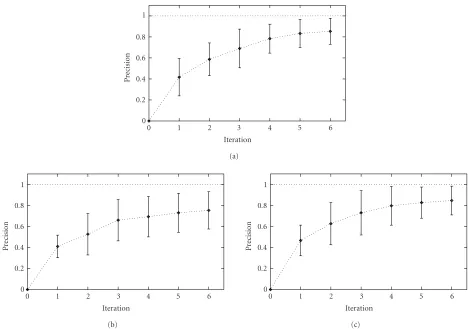
The adaptivity of our system is illustrated inFigure 4. It shows the evolution of the precision values for l = 27 returned images over sequences of six interactive retrieval steps.
2.4. User interface
In order to enable easy and intuitive handling, the INDI sys-tem provides different modalities for interaction. Except for the mouse, there also is a touch screen facility. Both input
devices enable the selection of images or image regions. They can be used to rate displayed database content and to ini-tiate further selections from the database. Furthermore, a speech recognition component developed by Fink and col-leagues was integrated whose core component is a statistical speech recogniser based on hidden Markov models [13].
Often, it is natural to use several input modalities simul-taneously. For instance, users may point to the screen saying things like “this image.” Therefore, a hierarchical event han-dling module was developed that can fuse asynchronous in-put events from different sources [14].
Given all these input devices, the system must be able to relate verbally uttered commands to currently selected im-ages or image regions in order to comprehend the user’s in-tentions. However, fusing results from speech and vision pro-cessing suffers from uncertainties like erroneous recognition or partial or unspecific descriptions. Consequently, we treat the task of speech and image integration as a probabilistic decoding processwhich is modelled using Bayesian networks (cf., e.g., [15]).
Adopting algorithms developed by Wachsmuth [16], each region description recognised in an utterance and each region detected in an image, are represented as separate sub-networks. Matches between attributes obtained from speech recognition and those derived from image processing can be found by means of the relations in the network. After the re-laxation of such a network, regions intended by the user will have the highest joint probability of being part of the image and also being referred to in an utterance [11].
3. VAMPIRE SYSTEMS
In this section, we will describe how the concept of human-machine interaction for computer vision can be extended to higher cognitive levels. While the previous section demon-strated how interaction can trigger adaption on the mere feature level of vision, this section will introduce cognitive vision systems that can learn new concepts and can adapt to a physical environment. We will present two systems that are being developed in a research project called Visual Ac-tive Memory Processes for InteracAc-tive REtrieval [17]. Both systems are able to recognise objects and activities in an un-constrained office environment. They can be operated us-ing speech and gesture. Both make use of the principle of multiple computations and store results from different per-ceptual modules in a hierarchically organised memory. Pro-cesses registered in the memories apply contextual reason-ing to verify the consistence and correctness of the incom-ing data. The memories themselves coordinate the registered processes and provide a notification mechanism to activate them if the memory content requires it. As such a mem-ory is thus not a passive unit but rather is another active component of a system, we call it a visual active memory (VAM).
1 0.8 0.6 0.4 0.2 0
P
recision
0
Iteration
1 2 3 4 5 6
(a)
1 0.8 0.6 0.4 0.2 0
P
recision
0
Iteration
1 2 3 4 5 6
(b)
1 0.8 0.6 0.4 0.2 0
P
recision
0
Iteration
1 2 3 4 5 6
(c)
Figure4: Adaptation to the user’s intention expressed in terms of the evolution of the precision values in different category searches: (a) autoracing, (b) flowers, and (c) golfing. Beginning with the second out of six search steps, positive feedback was provided. The depicted precision values are averaged over 10 experiments.
above the other provides a side view of the desk.Figure 5b shows a snapshot recorded with the top-view camera. In this example, the user is pointing to one of the objects on the desktop. InFigure 5c, the results of a view-based object recognition algorithm are cast into the image andFigure 5d displays the results of skin colour segmentation and hand de-tection. As the index finger is stretched out, a gesture recogni-tion algorithm identified a pointing gesture.Figure 5e visu-alises the angular probability distribution that indicates the most likely direction of this gesture.
Figure 6a exemplifies the side view on the scene. This viewpoint is used to recognise actions and activities. Figure 6b shows a skin colour segmentation procedure for this example. While larger regions are assumed to depict faces, smaller ones are assumed to represent hands. In Figure 6c, the trajectory of one of the hands is cast into the image. Such trajectories are analysed by a module for ac-tion recogniac-tion. Furthermore, we see a fan projected into the middle of the image. It indicates the image area near a moving hand where the system expects objects which might be manipulated next. According to the text displayed at the top of the image, the activity that was recognised last in this example was “reach middle” and the object that is currently expected to be manipulated is a cup.
Figure 7 shows the interaction with the mobile VAM demonstrator that was introduced inFigure 1b. By means of verbal commands or pointing gestures, the user can browse through a command menu displayed on the right of his field of view. Selecting or deselecting menu buttons activates dif-ferent operational modes of the system. Pointing gestures may also be used to reference objects or regions of interest in current the field of view. This resembles the use of the touch screen discussed in the last section. Here, however, space is becoming the interface; gestures are no longer bound to the operation of a physical input device.
3.1. Architecture and components
Top view camera Side view camera
(a) (b) (c)
(d) (e)
Figure5: (a) VAM demonstrator with two static cameras monitoring a human sitting at an office desk. Exemplary results from processing top-view images: (b) gesture seen from above, (c) object recognition results, (d) skin colour detection, and (e) estimated pointing cone.
(a) (b) (c)
Figure6: Office scene and results obtained from the side-view camera. (a) Side view of the office scene. (b) Skin coloured regions. (c) Results from action recognition.
(a) (b)
Figure7: Office desk as seen through the mobile memory spectacles shown inFigure 1b. (a) Menu selection using pointing gestures. (b) Object referencing using pointing gestures.
All algorithms perform in real time and run simultane-ously. As we will detail below, the results they forward to theactive memoryare not considered as irrevocable facts but as hypotheses. Processes registered on the database that pro-vides the infrastructure for the memory continuously verify
Concepts
Contextual reasoning
Object learning Hypotheses Trained detectors
Object view
Categorial memory
Episodic memory
Feature-based memory
Pictorial memory
Hypotheses
Hypotheses
Trained detectors
Data fusion
Action recognition (hand tracking) Object recognition
Images XML data XML enabled
communication framework Memory interface
(a)
Extrinsic memory processes
Memory interface API
XCF
Query Insert Event
Memory server Intrinsic memory processes
DB XML Berkeley DB
<Object>
<Class>Cup< /Class> · · ·
< /Object> XCF
(b)
Figure8: (a) Conceptual architecture of the current VAMPIRE demonstrators and (b) active memory infrastructure.
are stored in the memory, temporary occlusion or misinter-pretations of the current scene can be filtered out using tem-poral context. Next, we will outline the applied algorithms and technologies. For implementation details, please refer to [18,19] for the static and mobile systems, respectively.
3.1.1. Object recognition
For object recognition, the VAMPIRE systems employ appearance-based methods. On the one hand, VPL classi-fiers as introduced by Heidemann et al. [20] are applied.
Windows successfully passing through the whole cascade de-pict a known object. Either method is initially trained given manually labelled views of objects which were recorded in different positions and under varying illumination.
Both methods allow for interactive online object learn-ing. Two techniques are being used. Either, the mobile AR-gear is used to focus on an unknown object. To acquire useful views of the object, template-based image feature tracking as proposed by Gr¨aßl et al. [23] compensates head movements. The second method incorporates the pointing mechanism described above. Introducing a rejection class label that is as-signed to salient image regions which cannot be classified, these regions can be pointed to. If the user then moves the referred object to produce different views, the system can ac-quire a series of exemplary image patches. Randomly warp-ing and distortwarp-ing them yields artificial views which are then used to retrain the classifiers [24]. In either case, object labels are assigned verbally; to this end, the systems are equipped with a speech recognition component [13] that was already mentioned inSection 2.
3.1.2. Gesture and action recognition
Both, gesture as well as action recognition, rely on the detec-tion of skin coloured image regions. To ensure robustness, we apply adaptive skin colour segmentation based on Gaus-sian mixtures models as described by Fritsch [25]. The mo-bile system provides yet another way for skin colour adjust-ment. After selecting a command for colour retraining from the interaction menu, moving the hand in front of the head mounted cameras produces data required for the adaption. Skin coloured image patches of a certain size are analysed by a VPL classifier which decides whether they depict a hand or a even a pointing gesture.
Our action recognition framework is based on CON-DENSATION particle filtering as introduced by Isard and Blake [26]. Black and Jepson [27] adapted this approach to the classification of hand trajectories. Using parameterised trajectory models, their techniques enable the recognition of activities solely on the basis of hand motions without incor-porating any kind of context. For instance, “pick” motions can be detected without information about what part has been taken.
In [25], Fritsch proposes an extension to the work of Black and Jepson in order to incorporate contextual knowl-edge. He distinguishes thesituationalcontext and thespatial context of a gesture.
The situational context of a gesture describes its neces-sary preconditions as well as the effect the gesture has on the scene. The spatial context of a gesture relates hand trajecto-ries to objects being manipulated. Obviously, these objects must be close enough to a hand trajectory to be touched or picked for interaction. Therefore, we define acontext areato be the image area depicting objects potentially relevant for a specific gesture. The context area is given as a circle segment of a certain radius and angle. For interaction with objects that do not have an intrinsic “handling direction”, its orientation is defined relative to the moving direction of a hand. For ob-jects that have an intrinsic “handling direction,” the context
area has an absolute orientation. Besides definingwhere sym-bolic context is expected, we need to specifywhatcontext is expected. This includes the relevance of the context (irrele-vant, necessary, or optional) as well as the type of the context object.
Actually incorporating context into recognition is done in two ways: the situational context is applied in the select step of the particle filter in order to initialise and select only those samples whose preconditions match the current situa-tion. The spatial context is taken into account in the update step where it changes the weights of samples that match the observations. The calculation of sample weights is extended by a multiplicativecontext factorrepresenting how well the observed scene fits the expected symbolic context.
3.1.3. Probabilistic information fusion
Due to flawed results of the perceptual modules or to a change in the environment, it might occur that hypotheses stored in the memory contradict one another. Consistency validation has to detect such conflicts and resolve them. As motivated in [28,29], elements in the memory are stored as XML fragments. Apart from information describing ob-jects, these fragments also contain metadata like, for instance, the reliability of a hypothesis. An intrinsic memory pro-cess that lowers the reliability of stored data guides the re-moval, that is, theforgetting, of conflicting hypotheses. The risk of conflicting results from object and action recognition is minimised by considering contextual and functional rela-tions among incoming hypotheses. As they easily integrate different types of information, we apply Bayesian networks to model dependencies among the various facts our system gathers during runtime.
Consistency validation is realized as a memory pro-cess that usesfunctional dependency concepts(FDCs) to rate stored hypotheses. FDCs basically consist of Bayesian net-works that model expectations for the relations between spe-cific types of hypotheses.
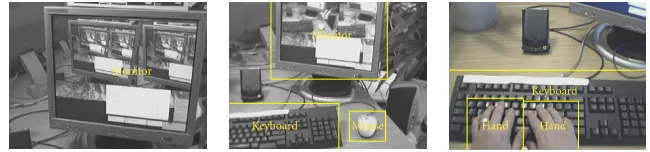
As an example, consider a situation where the user is sitting in front of a terminal and occasionally performs an action called “typing.” Images of this situation that were recorded with a head-mounted camera are shown in Figure 9. Recognising a “typing” action is reasonable only under certain contextual prerequisites. For example, if there is no keyboard in the scene, “typing” hypotheses have to be doubted.Figure 10shows a Bayesian network and the cor-responding conditional dependency tables used to represent contextual prerequisites for the “typing” action.
Nodes with the prefix vis denote observable variables, whereas exist -nodes arehiddenand can only be inferred by the process. Inferring a computer, for instance, requires the observation of a keyboard, a mouse, and a monitor. The ob-ject context required by a “typing” action is modelled as a directed arc from the action node exist A typing to the ob-ject node exist O computer.
Monitor
Monitor
Mouse Keyboard
Keyboard
Hand Hand
Figure9: Three images of a sequence with annotated observations.
exist A typing exist O computer
t
0.30
f
0.70 tf
t f
0.92 0.98
0.08 0.02
vi
s
O
hand
vi
s
A
ty
ping
vi
s
O
ke
yb
o
ar
d
vi
s
O
mouse
vi
s
O
monit
or
t
0.96
t f 0.49
f
0.04 0.51
t
0.94
t f 0.01
f
0.06 0.99
t
0.67 0.47
t f
f
0.33 0.53
t f
0.17 0.37
t f
0.83 0.63
t f
0.45 0.42
t f
0.55 0.58 Figure10: Bayesian network for a computer setup scenario.
and scene understanding. Conflicting memory content is de-tected as follows: for a given VAM content, the variables of an FDC are assignedevidencese= {e1,e2,. . .,em}. From evalu-ating the whole network, a conflict value conf can be calcu-lated as a kind of emergence measure defined in [31]:
conf(e)=log2
m
i=1P
ei
P(e) . (4)
Here,P(e) denotes the overall probability of the given evi-dences while theP(ei) are the marginal probabilities of the involved random variables of the Bayesian network. If there is a conflict, the probabilityP(e) is expected to be small com-pared to the product of the probabilities P(ei) because in this case the evidences are not explained by the given FDC. Therefore, we will have conf(e)>0 which allows the detec-tion of conflicts.
In order to cope with uncertainty of the underlying per-ception processes, soft evidences are used for the observ-able nodes. Their variobserv-ables are assigned an evidence vector
e = (etrue,efalse)T with 0 ≤ ei ≤ 1 andei = 1. A node’s
evidence is controlled by the reliability of the corresponding hypothesis. The more reliable the hypothesis is, theharderis its evidence. Evidences are set according to
etrue,efalse
T =
0.5(1 +r), 0.5(1−r)T. (5) Thus, for a reliabilityr=1, the evidence is set toe=(1, 0)T while r = 0 will yielde = (0.5, 0.5)T which is equivalent
to an unobserved variable with no evidence. Details on the lowering of reliabilities in case of conflicts can be found in [32].
Probabilities for the conditional dependencies of the net-works were estimated from manually annotated or correctly preprocessed video data. Figure 9 shows three out of 700 training images for the network in Figure 10. If all nodes of the network are observable, parameter estimation sim-ply means counting the different configurations. Otherwise, with some nodes being not observed, an EM algorithm is used (cf. [33]).
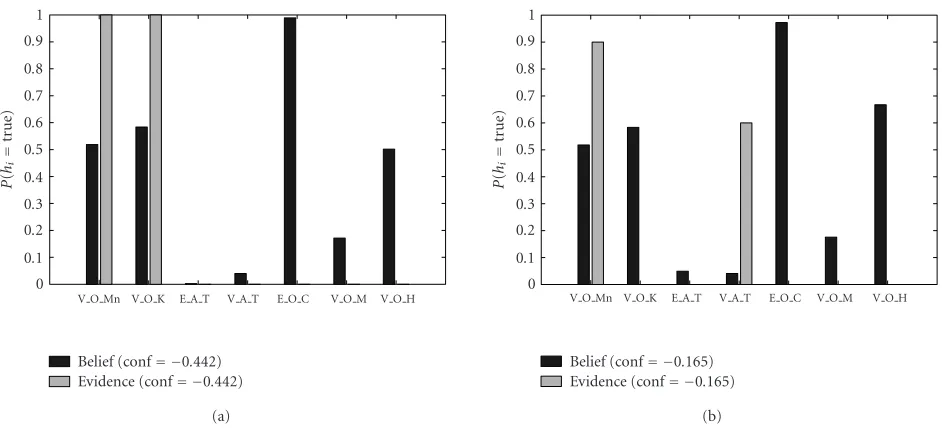
To evaluate our consistency validation approach, we de-fined FDCs for different constellations of objects and actions that are typical for an office scenario.Figure 11displays pro-totypic results for the FDC of the “typing” action.
Figure 11a depicts a situation corresponding to a con-sistent memory content. It shows highly reliable hypotheses vis O monitor and vis O keyboard, which mutually support each other. Note that conf(e)<0.
On the other hand, the configuration inFigure 11b rep-resents a conflict leading to conf(e) > 0. In this example, there are hypotheses of a monitor and a “typing” action but no hypothesis for the keyboard which violates the expecta-tion that a keyboard should be visible while typing.
3.2. System integration
1 0.9 0.8 0.7 0.6 0.5 0.4 0.3 0.2 0.1 0
P
(
hi
=
tru
e)
V O Mn V O K E A T V A T E O C V O M V O H
Belief (conf= −0.442) Evidence (conf= −0.442)
(a)
1 0.9 0.8 0.7 0.6 0.5 0.4 0.3 0.2 0.1 0
P
(
hi
=
tru
e)
V O Mn V O K E A T V A T E O C V O M V O H
Belief (conf= −0.165) Evidence (conf= −0.165)
(b)
Figure11: Two examples of beliefs and conf-value for the FDC of the “typing” action. (a) Fitting set of hypotheses. (b) Conflict, weak reliability
Concerning the development of a VAM, there are two major issues: (i) information storage and data organisation for the VAM and (ii) a suitable communication framework allowing to distribute the different algorithms over several computers.
3.2.1. VAM infrastructure
Since it is very flexible and suited for abstract concept de-scriptions, XML was chosen to describe content stored in the memory. Thus, a schema for symbolic data derived from vi-sion algorithms (e.g., objects, actions, etc.) was developed whose instance documents are composed of common and specific element structures (e.g., metadata-like reliability val-ues). Beyond the simple and self-describing nature of XML documents, this has several other advantages. For example, the partition into common and specific elements is bene-ficial for the realisation of generic software modules where schema evolution allows for extensibility and XQuery/XPath techniques provide standardised access and selection mecha-nisms.
According to these consideration, a native XML database [34] provides the basic infrastructure for the VAM. On top of this embedded library, a server architecture as shown in Figure 8bwas implemented that provides data management not only for XML but also for referenced binary data. Thus, pictorial data can also be used in the active memory and shared by several processes in parallel. Reference manage-ment is carried out using RDF information that links sym-bolic vision data to pictorial memory data. For both kinds of data, powerful standard DBMS methods like insert,update, remove, andqueryare exposed. Node selection and referral is based on XPath statements.
Within this active memory server, for reasons of close coupling and performance, a run-time environment for intrinsic memory processes like forgetting or other, more
generic, statistical processes was realised. Typical scenarios are small, fast computations that work on large subsets of the system data. Furthermore, a subscription model for dis-tributed event listeners was implemented, so that memory events can trigger registered processes and the memory in-deed becomesactive. Though realized in C++ there also is a Matlab interface for rapid prototyping of further recognition or active memory components.
3.2.2. Communication framework
Faced with the problem of distributing the algorithms dis-cussed above over different machines in order to guaran-tee real-time performance, a comparative study of existing framework technologies was carried out [35]. It yielded that by now there is no suitable integration framework tailored to the needs of cognitive vision. As most vision researchers are not middleware experts, the use of CORBA, for example, was ruled out due to its complexity and bloated standardisation. Rather, owing to the academic background of this work, an integration framework for an agile software process (cf. [36]) is needed.
Consistency validation
exist Aty
ping
exit Oco
mpu ter
vis Atyping vis Okeyb oard · · · · · ·
Memory interface
Memory server Forgetting reliability<0.5
Trigger
<Object>
<Hypothesis> · · ·
<Reliability value=“0.6/ >
</Hypothesis>
<Class>Keyboard< /Class> · · ·
</Object>
Event listener Xpath query
DB
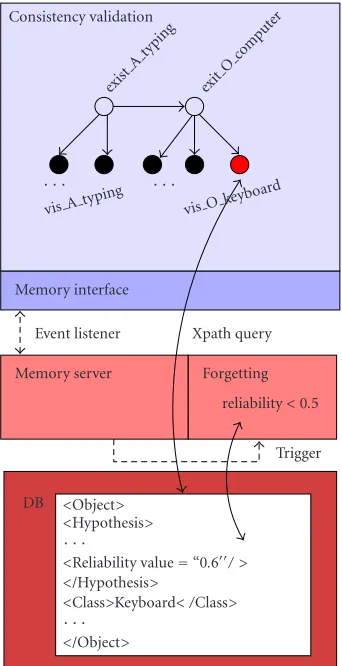
Figure12: Example of interaction between extrinsic and intrinsic memory processes.
Figure 12presents a more technical sketch of the consis-tency validation example discussed above. After an extrin-sic memory process, like object recognition, inserts a new hypothesis into the database, consistency validation is trig-gered. Related database content is queried using XPath and a conflict value is computed. Changes in the reliability values of stored hypotheses will trigger another intrinsic process. If they become too unreliable, hypotheses will be purged from the memory.
This example underlines that, in combination, the XML-based memory infrastructure and the XCF framework enable to realize an architecture with low coupling between compo-nents. Furthermore, this decoupling and the capability of the memory to asynchronously gather and provide information yields a high robustness against component failure.
3.3. Technical performance
Currently, the static system is running on five standard Linux PCs (Pentium 4, 2.4 GHz, 512 MB); images are captured us-ing SONY DFW VL 500 firewire cameras providus-ing a resolu-tion of 640×480 pixels. The mobile demonstrator is run-ning on a high-performance DELL notebook (Pentium 4, 1.8 GHz, 512 MB); images are captured from fire-I firewire cameras with a resolution of 320×200 pixels.
Evaluating the core components of our systems as if they were stand alone modules yielded the following results: at a frame rate of 4 Hz, the VPL-based recognition of gestures and objects yields an accuracy between 90% and 82% depending on the number of objects that have been trained [24]. The cascaded classifier approach to object recognition processes 6 images per second and yields 92% correctness. Trained with averaged trajectories from different videos and manu-ally annotated information about object context, actions like “drinking from a cup,” “reading a book,” “phoning” or “typ-ing on the keyboard” can reliably be recognised. A test with 420 sequences yielded an accuracy of 93% [25]. Finally, local queries with low selectivity (approximately 1% of the whole dataset is returned) on a memory instance require an average of 0.57 seconds on a basis of 100, 000 documents in a per-sistent memory (for an in-depth technical discussion of the evaluation of the XML enabled framework and the memory component, please refer to [28,29]).
Having read all these figures, it appears that traditional performance assessment does not tell much about the over-all performance of an integrated vision system. It is obvious that it does not take into account the continuous nature of human-machine interaction. Interaction with a flexible vi-sion system is a process throughout which there will be mu-tual adaption. Learning and adaption may improve the sys-tem performance over time; recognition and interpretation errors that may appear during an interactive session might be corrected later on.
These considerations thus raise the problem of how to as-sess the long-term performance of an interactive vision sys-tem. Based on the experience reported in the next section, we are tempted to claim that asking thehumanin the loop may provide a solution.
4. INTEGRATED SYSTEM EVALUATION
Modern evaluation of intelligent systems for advanced human-machine interaction has a history of about 10 years (cf., e.g., [38,39]). Proposed approaches range from assess-ment by means of exemplary benchmarks [40] to the def-inition of measurable performance indices [41]. However, practical experience with performance measures was not re-ported. Moreover, neither do the methods known from lit-erature consider situations of triadic interaction, that is, sit-uations where two agents coordinate their perception about a third person, thing, or event, nor do they regard adaptive systems.
Table1: Experimental results with respect to target image.
Target image TE= time[s]
experiment FBE=
feedbacks
experiment NI=
iterations
experiment TI= time[s]
iteration FBI=
feedbacks iteration
RaceCar-78 73.0 9.2 2.1 33.95 4.28
Balloon-36 81.3 10.8 3.3 24.65 3.29
Flowers-32 96.5 15.3 4.2 22.98 3.65
Table2: Experimental results with respect to input modality.
Modality SE TE=
time[s]
experiment FBE=
feedbacks
experiment NI=
iterations
experiment TI= time[s]
iteration
M 0.73 88.6 15.13 4.33 20.46
T 0.8 71.8 9.33 2.86 25.1
MS 0.73 79.66 11.8 2.93 27.18
TS 0.67 94.4 10.93 2.73 34.57
(i) Thespeedof task execution.
(ii) Thefunctionalityof the system, that is, how many dif-ferent tasks can be performed?
(iii) Thequalityof the results, that is, how good is the aver-age performance in different tasks?
(iv) Thespeed of learning, that is, how quick can users learn to perform tasks with the system?
(v) Themental load, that is, do users have to think care-fully while interacting with the system?
(vi) User satisfaction, that is, do users like working with the system?
4.1. Procedure and design
We considered a database of 1250 images from 10 seman-tic categories which are taken from the ArtExplosion image collection. A total of 20 computer experienced subjects (2 fe-male and 18 fe-male) who had never before operated a CBIR system were tested. They were divided into four groups of five people each and the input modalities,
(i) mouse(M),
(ii) mouse and speech(MS), (iii) touch screen(T),
(iv) touch screen and speech(TS),
were evaluated. The modalitiesmouse and touch screenas well asmouse, touch screen and speech were not examined since initial tests revealed that people never used mouse and touch screen simultaneously.
Each subject took part in three interactive experiments. In each experiment, they were asked to retrieve an image from the database that was shown to them at the beginning (seeFigure 13).
In every iteration of an interactive search, 27 images were displayed to the subjects which they could rate in order to navigate through the database and find the query image. They could either score entire images or select certain regions from an image. The maximum amount of time for each ex-periment was limited to three minutes; if a subject was not
Figure13: Target images for query tasks.
able to retrieve the requested image within this time, the ex-periment was counted as a failure.
Besides the success rate SEaveraged over all experiments, the quality of interaction is characterised by the average time TEthe subjects needed to perform an experiment and by the mean number FBEof user inputs, that is, the amount of feed-back provided in an experiment. Given the average number NIof iterations of a query, it is possible to deduce the ra-tios TIand FBIdescribing the average time per iteration and number of feedbacks per iteration, respectively. The above-mentioned aspects of learning, mental load, and user satis-faction were examined by means of the questionnaires the subjects were asked to fill out. Faced with statements like “It was fun to interact with the system,” they ranked their sensa-tion on a scale from 1 (no) to 5 (yes).
4.2. Results
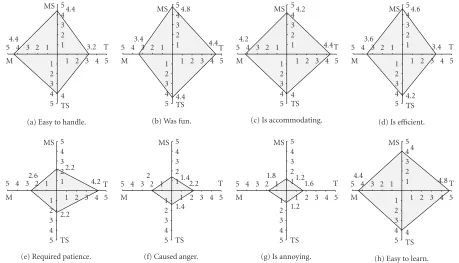
Tables1and2andFigure 14summarise our findings. Look-ing at the figures inTable 1, it is noticeable that the three tar-get searches were of increasing complexity. This is expressed in the increasing amount of time and feedback as well as in the growing number of interactions shown in the table.
5 4 3 2 1 4.4
M 1 2 3 4 5
3.2 T 1
2 3 44.4
1 2 3 4 5 4 TS (a) Easy to handle.
5 4 3 2 1 3.4
M 1 2 3 4 5
4.4 T 1
2 3 44.8 MS
1 2 3 4 5 4TS.4 (b) Was fun.
5 4 3 2 1 4.2
M 1 2 3 4 5
4.4T 1
2 3 44.2 MS 1 2 3 4 5 4 TS (c) Is accommodating.
5 4 3 2 1 3.6
M 1 2 3 4 5
3.4 T 1
2 3 44.6 MS 1 2 3 4 5
4.2 TS (d) Is efficient.
5 4 3 2 1 2.6
M 1 2 3 4 5
4.2 T 1
2 3 4 5
2.2 MS 1 2 3 4 5
2.2 TS (e) Required patience.
5 4 3 2 1 2
M 1 2 3 4 5
2.2 T 1
2 3 4 5
1.4 MS 1 2 3 4 5
1.4
TS (f) Caused anger.
5 4 3 2 1 1.8
M 1 2 3 4 5
1.6 T 1
2 3 4 5
1.2 MS 1 2 3 4 5
1.2
TS (g) Is annoying.
5 4 3 2 1 4.4
M 1 2 3 4 5
4.8 T 1 2 3 4 5 4 MS 1 2 3 4 5 4 TS (h) Easy to learn.
Figure14: Averaged results of a questionnaire survey on usability aspects in interactive CBIR. For each interaction modality (mouse (M), touch screen (T), mouse and speech (MS), touch screen and speech (TS)), each aspect had to be rated on a scale from 1 (no) to 5 (yes).
The latter observation is especially interesting if we re-gardFigure 14. The diagrams in this figure depict the aver-age ranking of the factors asked for in the questionnaires. In Figure 14a, for instance, we notice that the easiness of han-dling the mouse and the easiness of hanhan-dling mouse and speech were both ranked 4.4; for the touch screen and speech modality, it yielded 4.0 and the easiness of only using the touch screen reached 3.4, These figures accord with those inFigure 14ewhich summarise our subjects notion regard-ing the patience their interaction required. Here, the touch screen users felt that they had to be most patient. Another interesting result becomes apparent from Figure 14d: users of multimodal input devices rated their interaction with our CBIR system to be more efficient than those subjects who only worked with the mouse or touch screen.
4.3. Discussion
With respect to our six evaluation criteria, our findings suggest the following. (i) Speed, functionality, and quality: concerning the time TE, the number of iterations NI, as well as the number of user feedbacks FBE, performances of monomodal and multimodal interaction diverge. While us-ing mouse and speech is faster than only usus-ing the mouse, it is the other way round for using touch screen and speech. How-ever, in any case, different target searches can be performed satisfyingly with regard to the average success as well as to av-erage time need. (ii)Learnability: regarding the tested input facilities, users did not sense a significant difference among modalities. (iii)Mental load: measured results and user sen-sations are inconsistent. Even though the touch screen group
performed best, their sensations concerning easiness and ef-ficiency were worst. (iv) User satisfaction: multimodal in-put facilities are well appreciated by the users of our system. Even though their results in interactive image retrieval were not the best, the subjects who could use speech and another modality felt least annoyed and considered the interaction they had with the system to be efficient and fun.
5. CONCLUSION
This contribution reported on vision systems which make use of the concept of the human in the loop. The first sys-tem we described is designed to enable efficient, intuitive, and easy content-based retrieval from image databases. On the one hand, it applies flexible techniques for image feature extraction and adaption on the lower levels of computer vi-sion. On the other hand, it provides several input modali-ties. Understanding the problem of integrating the different modalities as a probabilistic decoding task enables to fuse the different types into consistent interpretations. As a con-sequence, natural and seamless interaction with the system becomes possible.
Robustness results from applying the principles of mul-tiple computations and contextual reasoning. Different algo-rithms for object and gesture recognition process image se-quences are obtained from different views or from a set of head mounted cameras. The results of these computations are not seen as irrevocable facts but first of all as hypotheses. Hypotheses resulting from recognition processes applied to salient parts of the signal are forwarded to a memory com-ponent. There, processes that make use of probabilistic, top-down and bottom-up Bayesian reasoning verify their con-sistency. As processes like consistency verification and data deletion are triggered by the memory component, the mem-ory indeed is anactivemodule.
Basing the memory infrastructure on an XML database and realising the technical system integration using an XML enabled framework results in ease of use, extensibil-ity, and robustness against component failure. Moreover, the human-in-the-loop approach provides an avenue to even more flexibility. While for the image-retrieval system, adap-tion was only possible by weight adjustment on the feature level of visual processing, the presented VAMs can learn on higher cognitive levels. Through interaction with their users, they can extend preacquired knowledge and learn represen-tations and labels for new objects.
The systems introduced in this contribution thus demon-strate that the goals of the cognitive vision paradigm are not just illusory. Machine learning, contextual reasoning, relevance control, and active system introspection can be brought together and human-machine interaction can com-pensate for embodiment. And indeed, in combination, these techniques result in integrated systems of high robustness and flexibility.
However, dealing with the evaluation of complex inte-grated vision systems, human-machine interaction comes along with new challenges. Up to now, there is only scarce literature on how to characterise the mid- and long-term performance of interactive systems. By means of our image retrieval system, we thus exemplified how usability studies might help to assess the cognitive capabilities of artificial sys-tems. As a matter of fact, some of the results are surprising: even though the users of simple interaction devices felt least content with the performance of the system, they performed best. On the other hand, users of input devices of higher cog-nitive adequacy (natural language) experienced their inter-action with the system to be very pleasant and efficient. Even though they practically obtained the worst retrieval results. Therefore, at least for now, it seems fair to conclude that re-search in cognitive vision must face the fact that cognition first of all lies in the eye of the beholder.
ACKNOWLEDGMENTS
This work has been supported by the BMB+F under con-tract 01IB 001B and by the European Union IST 2001-34401 project VAMPIRE. The authors would like to thank Silke Fis-cher for the valuable support and suggestions she provided for our usability experiments.
REFERENCES
[1] J. L. Crowley and H. I. Christensen, Eds.,Vision as Process,
Springer-Verlag, Berlin, Germany, 1995.
[2] European Research Network for Cognitive Vision Systems,
2004,http://www.ecvision.info.
[3] H. I. Christensen, “Cognitive (vision) systems,”ERCIM News,
no. 53, pp. 17–18, 2003.
[4] H. Cruse, “The evolution of cognition—a hypothesis,”
Cogni-tive Science, vol. 27, no. 1, pp. 135–155, 2003.
[5] M. Stricker and A. Dimai, “Spectral covariance and fuzzy
re-gions for image indexing,”Machine Vision and Applications,
vol. 10, no. 2, pp. 66–73, 1997.
[6] S. Brandt, J. Laaksonnen, and E. Oja, “Statistical shape
fea-tures in content-based image retrieval,” in Proc. 15th IEEE
International Conference on Pattern Recognition (ICPR ’00), vol. 2, pp. 1062–1065, Barcelona, Spain, September 2000.
[7] P. Montesinos, V. Gouet, and R. Deriche, “Differential
invari-ants for color images,” inProc. 14th IEEE International
Con-ference on Pattern Recognition (ICPR ’98), vol. 1, pp. 838–840, Brisbane, Queensland, Australia, August 1998.
[8] A. Ben-Hur, D. Horn, H. Siegelmann, and V. Vapnik,
“Sup-port vector clustering,”Journal of Machine Learning Research,
vol. 2, no. 2, pp. 125–137, 2001.
[9] Y. R. Rui, T. S. Huang, M. Ortega, and S. Mehrotra, “Relevance feedback: a power tool for interactive content-based image
re-trieval,”IEEE Trans. Circuits Syst. Video Technol., vol. 8, no. 5,
pp. 644–655, 1998.
[10] Y. R. Rui and T. S. Huang, “Optimizing learning in image
re-trieval,” inProc. IEEE International Conference on Computer
Vision and Pattern Recognition (CVPR ’00), vol. 1, pp. 236– 243, Hilton Head, SC, USA, June 2000.
[11] C. Bauckhage, T. K¨aster, M. Pfeiffer, and G. Sagerer,
“Content-based image retrieval by multimodal interaction,” in Proc.
29th Annual Conference of the IEEE Industrial Electronics So-ciety (IECON ’03), vol. 2, pp. 1882–1887, Roanoke, Va, USA, November 2003.
[12] T. K¨ampfe, T. K¨aster, M. Pfeiffer, H. Ritter, and G. Sagerer,
“INDI—intelligent database navigation by interactive and
in-tuitive content-based image retrieval,” inProc. IEEE
Interna-tional Conference on Image Processing (ICIP ’02), vol. 3, pp. 921–924, June 2002.
[13] G. A. Fink, “Developing HMM-based recognizers with
ES-MERALDA,” inProc. International Workshop Text, Speech and
Dialogue (TSD ’99), vol. 1692 ofLecture Notes in Artificial Intelligence, pp. 229–234, Springer-Verlag, Berlin, Germany, September 1999.
[14] T. K¨aster, M. Pfeiffer, C. Bauckhage, and G. Sagerer,
“Combin-ing speech and haptics for intuitive and efficient navigation
through image databases,” inProc. 5th International
Confer-ence on Multimodal Interfaces (ICMI ’03), pp. 180–187, Van-couver, British Columbia, Canada, November 2003.
[15] J. Pearl,Probabilistic Reasoning in Intelligent Systems, Morgan
Kaufmann, San Francisco, calif, USA, 1988.
[16] S. Wachsmuth and G. Sagerer, “Bayesian networks for speech
and image integration,” inProc. 18th National Conference on
Artificial Intelligence (AAAI ’02), pp. 300–306, Edmonton, Al-berta, Canada, August 2002.
[17] VAMPIRE,http://www.vampire-project.org.
[18] C. Bauckhage, M. Hanheide, S. Wrede, and G. Sagerer, “A
Cognitive vision system for action recognition in office
en-vironments,” inProc. IEEE International Conference on
Com-puter Vision and Pattern Recognition (CVPR ’04), vol. 2, pp. II-827–II-833, Washington, DC, USA, June–July 2004. [19] G. Heidemann, I. Bax, H. Bekel, et al., “Multimodal
International Conference on Multimodal Interfaces (ICMI ’04), pp. 53–60, State College, Pa, USA, October 2004.
[20] G. Heidemann, R. Rae, H. Bekel, I. Bax, and H. Ritter, “Inte-grating context free and context-dependent attentional
mech-anisms for gestural object reference,” inProc. 3rd International
Conference on Computer Vision Systems (ICVS ’03), pp. 22–33, Graz, Austria, April 2003.
[21] J. Kittler, A. Ahmadyfard, and D. Windridge, “Serial multiple classifier systems exploiting a coarse to fine output coding,” inProc. 4th International Workshop Multiple Classifier Systems (MCS ’03), vol. 2709 ofLecture Notes in Computer Science, pp. 106–114, Springer-Verlag, Guildford, UK, June 2003. [22] P. Viola and M. Jones, “Rapid object detection using a boosted
cascade of simple features,” inProc. IEEE International
Confer-ence on Computer Vision and Pattern Recognition (CVPR ’01), vol. 1, pp. I-511–I-518, Kauai, Hawaii, USA, December 2001. [23] C. Gr¨aßl, T. Zinßer, and H. Niemann, “Illumination
insensi-tive template matching with hyperplanes,” inProc. 25th
Pat-tern Recognition Symposium (DAGM ’03), vol. 2781 of Lec-ture Notes in Computer Science, pp. 273–280, Springer-Verlag, Magdeburg, Germany, September 2003.
[24] H. Bekel, I. Bax, G. Heidemann, and H. Ritter, “Adaptive
com-puter vision: online learning for object recognition,” inProc.
26th Pattern Recognition Symposium (DAGM ’04), vol. 3175 ofLecture Notes in Computer Science, pp. 447–454, Springer-Verlag, T¨ubingen, Germany, August 2004.
[25] J. Fritsch, Vision-based recognition of gestures with context,
Ph.D. thesis, Bielefeld University, Bielefeld, Germany, 2003. [26] M. Isard and A. Blake, “Condensation—conditional
den-sity propagation for visual tracking,”International Journal of
Computer Vision, vol. 29, no. 1, pp. 5–28, 1998.
[27] M. J. Black and A. D. Jepson, “A Probabilistic framework for matching temporal trajectories: CONDENSATION-based
recognition of gestures and expressions,” inProc. European
Conference on Computer Vision (ECCV ’98), pp. 909–924, Freiburg, Germany, June 1998.
[28] S. Wrede, J. Fritsch, C. Bauckhage, and G. Sagerer, “An XML
based framework for cognitive vision architectures,” inProc.
17th IEEE International Conference on Pattern Recognition (ICPR ’04), no. 1, pp. 757–760, Cambridge, UK, August 2004. [29] S. Wrede, M. Hanheide, C. Bauckhage, and G. Sagerer, “An
active memory as a model for information fusion,” inProc.
7th International Conference on Information Fusion, no. 1, pp. 198–205, Stockholm, Sweden, June–July 2004.
[30] K. Murphy, A. Torralba, and W. T. Freeman, “Using the forest to see the trees: a graphical model relating features, objects,
and scenes,” inProc. Advances in Neural Information Processing
Systems 16 (NIPS ’03), Vancouver, British Columbia, Canada, December 2003.
[31] F. V. Jensen,Bayesian Networks and Decision Graphs,
Informa-tion Science and Statistics, Springer-Verlag, 2001.
[32] M. Hanheide, C. Bauckhage, and G. Sagerer, “Memory
con-sistency validation in a cognitive vision system,” inProc. 17th
IEEE International Conference on Pattern Recognition (ICPR
’04), vol. 2, pp. 459–462, Cambridge, UK, August 2004.
[33] S. Lauritzen, “The EM algorithm for graphical association
models with missing data,”Computational Statistics & Data
Analysis, vol. 19, no. 2, pp. 191–201, 1995.
[34] Berkeley DB XML, Sleepycat Software, 2004, http://www.
sleepycat.com/products/xml.shtml.
[35] S. Wrede, W. Ponweiser, C. Bauckhage, G. Sagerer, and M. Vincze, “Integration frameworks for large scale cognitive
vi-sion systems—an evaluative study,” inProc. 17th International
Conference on Pattern Recognition (ICPR ’04), vol. 1, pp. 761– 764, Cambridge, UK, August 2004.
[36] A. Cockburn,Agile Software Development, Addison-Wesley,
Boston, Mass, USA, 2001.
[37] The Internet Communications Engine, 2004, http://www.
zeroc.com/ice.html.
[38] G. Lindegaard, Usability Testing and System Evaluation: a
Guide for Designing Useful Computer Systems, Chapman & Hall, London, UK, 1994.
[39] J. Preece, Y. Rogers, and H. C. Sharp, Beyond
Human-Computer Interaction, John Wiley & Sons, Chichester, UK, 2002.
[40] C.-P. Tung and A. C. Kak, “Integrating sensing, task planning
and execution for robotic assembly,”IEEE Trans. Robot.
Au-tomat., vol. 12, no. 2, pp. 187–201, 1996.
[41] N. Beringer, U. Kartal, K. Louka, F. Schiel, and U. T¨urk, “PROMISE—a procedure for multimodal interactive system
evaluation,” in Proc. Workshop Multimodal Ressources and
Multimodal System Evaluation, Las Palmas, Gran Canaria, Spain, 2002.
Christian Bauckhagestudied computer sci-ence in Bielefeld and Grenoble. He received the Diploma and the Ph.D. degree from Bielefeld University in 1998 and 2002, re-spectively. Afterwards, he worked in the Eu-ropean Union IST project VAMPIRE. Cur-rently, he is a Postdoctoral Fellow at the Centre for Vision Research, York University, Toronto. He is interested in computer vision and cognitive systems as well as in theory and application of machine learning techniques.
Marc Hanheide received the Diploma in computer science from Bielefeld University in 2001. Afterwards, he joined the Research Group for Applied Computer Science in Bielefeld where he is working in the IST project VAMPIRE. He is interested in mod-elbased object recognition, image process-ing, and computer vision.
Sebastian Wredereceived the Diploma in computer science from Bielefeld University in 2002. Afterwards, he joined the Research Group for Applied Computer Science in Bielefeld to work in the IST project VAM-PIRE. His research interests are vision sys-tems, software architecture, system integra-tion, middleware, and database technolo-gies.
Michael Pfeiffer received the Diploma in electrical engineering from the Technical University of Braunschweig in 1994. From 1997 to 2000, he was working in the Real-Time Systems Group, the RWTH Aachen University. He joined the Applied Com-puter Science Group, Bielefeld University in 2000. There he was working in the BMB+F project LOKI. His research interests are computer vision and intelligent systems.