Sequential Processivity and CAND1 Regulate SCF Ubiquitin
Ligases
Thesis by Nathan William Pierce
In Partial Fulfillment of the Requirements for the Degree of
Doctor of Philosophy
California Institute of Technology Pasadena, California
2012
(Defended November 10, 2011)
2012
Nathan William Pierce All Rights Reserved
Acknowledgments
There are many people to thank for help getting to this point. First, I would like to send my deepest regards to the teachers throughout my life who made science and learning fun and interesting. Second, I would like to thank the people who wrote my recommendation letters for graduate school including James Nelson, David K Stevenson, and Gerry Fuller. Without their guidance and support I would not be here. Third, I would like to thank Caltech itself for accepting me to graduate school. Despite getting interviews at several schools, I was only accepted to MIT and Caltech.
I want to thank my family and wife Terrell for constant support throughout these years. There are many people I have met at Caltech that deserve mention: This includes Gary Kleiger and Anj Saha for providing key support and discussions
regarding the mechanisms of SCF ubiquitin ligases. Tara Gomez, Natalie Kolawa, Mike Rome, Kuang-‐Jung Chang, and Ruzbeh Mosadeghi for marching beside me in the trenches of graduate student life in the Deshaies lab. Eugene Lee for everything regarding Mass Spec. Willem den Besten for fantastic discussions and knowledge of molecular and cellular biology. Narimon Honarpour for a sunny disposition and great insight into future family life. Tsui-‐Fen Chou for great discussions regarding future scientific life. Rob Oania for always being there when I needed something for my experiments. Heenam Park and Geoff Smith for pouring fantastic gels
Radhakrishnan for comic relief and straight answers. Dane Mohl for critical critiques of ideas on SCF mechanisms. Xin Zhang for serious science and hilarious lab manner. Peera Jaru-‐Ampornpan for always telling me to get back to work. Sowmya
Chandrasekar, without whom I would never know what was going on. Thang Nguyen for adventures in step aerobics and zumba. Ishu Sarogi for her deep
understanding of life’s truer meanings. Kuang Shen for spicy food and spicy science. David Akopian for his philosophical grasp on this absurd reality. Adler Dillman for continued friendship down the hall. Aadel Chaudhuri for always keeping it real. Megan Dobro for several years of awesome skits at the bio retreat. Amy McMahon for support and friendship. Alex Nisthal for being my roommate. The Woods Hole Physiology course for fantastic summer in 2010. Beth Larimore for sending me her unpublished construct for Fbxw7 expression.
I would like to thank the entire Caltech faculty for putting up with me and my crazy ideas for skits at the annual bio retreat; Ellen Rothenberg and David Chan for making teaching highly enjoyable; Paul Sternberg for being on my committee; and Bill Dunphy for being the head of my committee, being a great teacher to work with, and writing me a recommendation for post-‐doc fellowships.
Abstract
The modular design of the multi-‐subunit SCF ubiquitin ligases allows for recognition of a diverse set of target proteins. However, the speed and complexity of the SCF ubiquitylation reaction have precluded direct experimental tests to
understand how SCF complex formation is regulated and the pathway by which ubiquitin chains are generated. Herein we introduce new theoretical and
experimental methodologies to address both limitations. First, a quantitative framework based on product distribution predicts that the really interesting new gene (RING) E3s SCFCdc4 and SCFβ-‐TrCP work with the E2 Cdc34 to build polyubiquitin chains on substrates by sequential transfers of single ubiquitins. Measurements with millisecond time resolution directly demonstrate that substrate
polyubiquitylation proceeds sequentially. Second, we present a novel FRET assay that enables real-‐time measurements of binding dynamics of the SCFFbxw7 complex. We find that the Cul1-‐associated protein CAND1 is able to actively remove
Fbxw7/Skp1 from Cul1/Rbx1 by changing the dissociation rate of the complex a million-‐fold, yet CAND1 does not affect the assembly rate of SCFFbxw7. This activity is abolished when Cul1 is neddylated. Experiments show that CAND1 accelerates the rate at which multiple SCF complexes can form. Thus, CAND1 appears to function as an exchange factor. Lastly, several measurements reveal an extra step in the
Contents
Chapter 1. Introduction 1 Chapter 2. Detection of Sequential Polyubiquitylation 6 on a Millisecond Timescale
Abstract 7
Introduction 8
Results 10
Discussion 21
Methods 24
Chapter 3. CAND1 Functions as an Fbox Exchange Factor 29
Abstract 30
Introduction 31
Results 34
Methods 43
Chapter 4. Unpublished Work 44
Appendices
A. Supplementary Materials for Chapter 2 59 B. Supplementary Materials for Chapter 3 78
Bibliography 80
Chapter 1:
Introduction
In the past 30 years, the degradation of proteins through the ubiquitin
proteasome system (UPS) has emerged as an essential process that governs a wide
range of biological processes. As such, mutations in many of the basic UPS
components are now understood to serve as the underlying molecular cause of
several diseases and disorders. Understanding the fundamental mechanisms of how
the UPS works gives promise for the development of future treatments.
Discovery of Ubiquitin
Results from early metabolic studies in rats revealed that protein turnover
was extensive and rapid (Schoenheimer et al., 1939). Protein degradation was
initially thought to occur exclusively in the lysosome, an intracellular compartment
with destructively low pH that at the time was known to degrade proteins after
endocytosis. However, several studies indicated that ATP was required for the
specific degradation of certain types of abnormal proteins. This indicated, although
it did not prove, that mechanisms existed outside the context of the lysosome that
were responsible for protein catabolism. The beginnings of the UPS field can be
traced back to the seminal work of Alfred Goldberg at Harvard Medical School.
Goldberg and colleagues established a cell-‐free system in rabbit reticulocyte lysate
that recapitulated the ATP-‐dependent degradation of hemoglobin upon mis-‐
incorporation of the valine analog 2-‐amino-‐3-‐chlorobutyric acid (ClAbu) (Etlinger
and Goldberg, 1977). Using this assay, the lab of Avram Hershko set out to find the
enzymes that were responsible for this activity through biochemical fractionation of
activity (Ciechanover et al., 1978). The group of Art Haas quickly discovered that
this protein was in fact ubiquitin, an abundant eukaryotic protein with unknown
function that had been shown to become covalently linked to histone 2A (Wilkinson
et al., 1980; Goldstein et al., 1975; Goldknopf and Busch, 1977). In a now famous
paper, Hershko and Irwin Rose observed radiolabeled ubiquitin attachment to
lysozyme and proposed that ubiquitin attachment to proteins served as an
intermediate to the delivery of proteins to some unknown protease (Hershko et al.,
1980). This served as the reason for the ATP dependence on protein degradation
activity seen in the lysate.
The Ubiqutin Enzymes
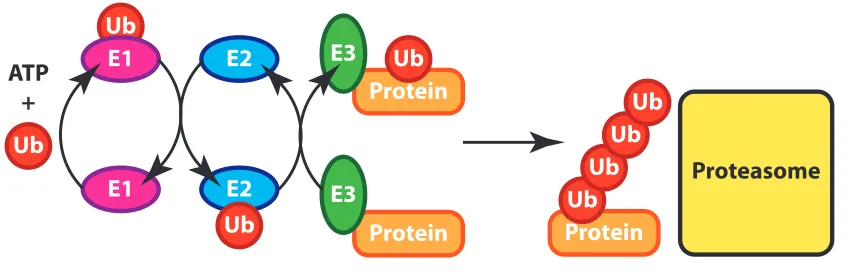
In general, a sequential cascade of three enzymes carries out the transfer of
mono-‐ubiquitin to target proteins and the synthesis of polyubiquitin chains: a
ubiquitin activating enzyme (E1), a ubiquitin conjugating enzyme (E2), and a
ubiquitin ligase (E3) (Figure 1.1) (Dye et al., 2007). The E1 enzyme uses ATP to
catalyze the formation of an adenylate conjugate at the C-‐terminus of ubiquitin
(Hershko et al., 1981). This high-‐energy intermediate is hydrolyzed to directly
attach the E1 to ubiquitin through a thiolester linkage between an active site
cysteine on the E1 and the C-‐terminus of ubiquitin (Haas et al., 1982). Almost all
eukaryotic organisms have a single ubiquitin E1, with the exception of humans,
which have two (Jin et al., 2007). Most organisms have around ten E2s. E2s interact
directly with the E1 and the ubiquitin is transferred from the catalytic cysteine of
Figure 1.1 | The General Scheme for the UPS. Three enzymes work in succession to covalently
attach ubiquitin and ubiquitin chains to target proteins: the ubiquitin activating enzyme (E1), the
ubiquitin conjugating enzyme (E2), and the ubiquitin ligase (E3). The massive multi-‐subunit protease
the proteasome recognizes ubiquitin chains through its receptors, leading to subsequent degradation.
E3 ligases are aptly named because they interact directly with the protein to
be ubiquitylated. There are two main types of E3 ligases. HECT domain E3s accept
ubiquitin from an E2 onto a catalytic cysteine, while RING (really interesting new
gene) E3s catalyze the direct transfer of ubiquitin from an E2 to a lysine on a target
protein (Petroski and Deshaies, 2005a). Cullin-‐RING ubiquitin ligases (CRLs) are the
largest family of E3s and are typified by the SCF complexes, which in humans are
composed of four proteins: the scaffold Cul1, the RING containing Rbx1, the adaptor
Skp1, and a substrate binding protein that contains the Fbox motif (Deshaies and
Joazeiro, 2009). 69 proteins in the human genome have Fbox motifs, and 42 have
been shown to form SCF complexes (Lee et al., 2011). Although this modular design
of SCF complexes allows for recognition of a diverse set of target proteins, how SCF
complex formation is regulated remains unclear
Protein E3
Ub
Ub
E1 E2
E1 E2
Ub
ATP +
Protein E3
Protein Ub
Ub Ub
Ub
Proteasome
The UPS highlights several modern aspects of the understanding of proteins
in biology. First, post-‐translational modifications of proteins serve to expand and
regulate the function of a wide array of cellular processes. Second, degradation of
proteins is a mechanism of control critical for proper cellular signaling and function.
This is pronounced by the vast array of diseases that are currently linked with the
ubiquitin proteasome system.
Chapter 2:
Detection of Sequential
Polyubiquitylation on a Millisecond
Timescale*
*This chapter, first published in Nature in 2009, was written by Nathan W. Pierce, Gary Kleiger, Shu-‐ou Shan, and Raymond J.
Abstract
The pathway by which ubiquitin chains are generated on substrate via a
cascade of enzymes consisting of an E1, E2, and E3 remains unclear. Multiple
distinct models involving chain assembly on E2 or substrate have been proposed.
However, the speed and complexity of the reaction have precluded direct
experimental tests to distinguish between potential pathways. Here we introduce
new theoretical and experimental methodologies to address both limitations. A
quantitative framework based on product distribution predicts that the really
interesting new gene (RING) E3s SCFCdc4 and SCFβ-‐TrCP work with the E2 Cdc34 to
build polyubiquitin chains on substrates by sequential transfers of single ubiquitins.
Measurements with millisecond time resolution directly demonstrate that substrate
polyubiquitylation proceeds sequentially. Our results present an unprecedented
glimpse into the mechanism of RING ubiquitin ligases and illuminate the
quantitative parameters that underlie the rate and pattern of ubiquitin chain
Introduction
Attachment of a polyubiquitin chain with at least four ubiquitins linked
together through their lysine 48 residue (Lys48) targets proteins to the proteasome
for degradation (Thrower et al., 2000). A cascade of three enzymes carries out the
synthesis of polyubiquitin chains: a ubiquitin activating enzyme (E1), a ubiquitin
conjugating enzyme (E2), and a ubiquitin ligase (E3) (Dye et al., 2007). RING (really
interesting new gene) E3s catalyze the direct transfer of ubiquitin from an E2 to a
lysine on a target protein (Petroski and Deshaies, 2005a). SCFCdc4 is the founding
member of the largest family of E3s—the cullin-‐RING ubiquitin ligases (CRLs) that
may comprise the majority of all human ubiquitin ligases (Petroski and Deshaies,
2005a). Thus, unraveling the mechanism of SCF will have broad functional
ramifications for the preponderance of human E3s.
Different pathways for ubiquitin chain assembly by RING E3s have been
envisioned based on indirect evidence. On the one hand, Cdc34-‐SCF ubiquitylates
substrates bearing a single ubiquitin significantly faster than non-‐ubiquitylated
substrates (Saha and Deshaies, 2008; Petroski and Deshaies, 2005b), suggesting that
it processively builds polyubiquitin chains on substrates with an initial slow
transfer of ubiquitin followed by rapid elongation into a Lys48-‐linked polyubiquitin
chain. On the other hand, the E2 Ube2g2, a close relative of Cdc34, collaborates with
the E3 gp78 to build a polyubiquitin chain on its active site cysteine that can be
transferred en bloc to substrate (Ravid and Hochstrasser, 2007; Li et al., 2007).
Various permutations of the en bloc mechanism have been entertained, in which the
et al., 2009; Deshaies and Joazeiro, 2009). Due to the rapid speed of ubiquitin chain
synthesis, intermediates that would reveal the underlying pathway cannot be
kinetically resolved. Thus, it has not been possible to establish definitively the
pathway of chain assembly for any RING E3. Here we introduce new theoretical and
Results
Quantitative analysis of product distribution
Processivity emerges from the relationships between reaction and
dissociation rates for different product intermediates (Fersht, 1999). To quantify
the processivity of SCF, we established an assay capable of simultaneously
monitoring the concentrations of substrate and its different ubiquitylated product
intermediates. Our assay consisted of an engineered phosphopeptide substrate
derived from human Cyclin E1 (CycE) and purified Saccharomyces cerevisiae Cdc34-‐
SCFCdc4 (Saha and Deshaies, 2008; Petroski and Deshaies, 2005b; Nash et al., 2001).
CycE was selected because it is a defined, chemically homogeneous substrate that
binds with high affinity to the substrate-‐binding pocket of SCFCdc4 (Nash et al., 2001;
Orlicky et al., 2003). Moreover, intact Cyclin E is a substrate of SCFCdc4 in vivo
(Strohmaier et al., 2001) and the degron from CycE can support turnover in vivo of
an engineered substrate, Sic1, from which the endogenous degrons have been
eliminated (Nash et al., 2001). To examine the simplest system that recapitulated
the processive behavior of Cdc34-‐SCFCdc4, we focused on single turnover reaction
conditions containing an excess of SCFCdc4 over radiolabeled CycE. We initiated
reactions by combining two pre-‐incubated mixtures: the ‘charged E2’ mixture
containing ubiquitin, E1, ATP, and Cdc34 was pre-‐incubated for two minutes to
ensure the formation of saturating concentrations of Cdc34~ubiquitin thioesters
(E2~Ub), and the ‘substrate-‐ligase’ mixture containing SCF and radiolabeled
substrate was pre-‐incubated to ensure the formation of an enzyme-‐substrate
were fractionated on long SDS-‐polyacrylamide gels. Consistent with previous assays
performed with Sic1 (Petroski and Deshaies, 2005b), conjugation of the Nedd8
homologue Rub1 to the Cdc53 subunit of budding yeast SCFCdc4 did not alter the
ubiquitylation kinetics of CycE (Supplementary Figure A.1), and thus all subsequent
SCFCdc4 assays were performed with unmodified E3.
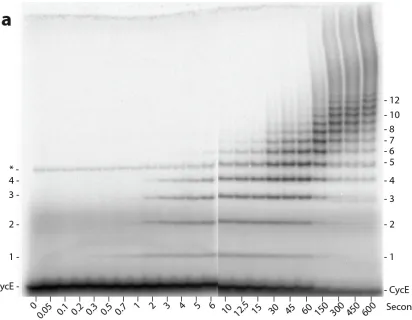
Under these reaction conditions, CycE was extensively polyubiquitylated by
Cdc34-‐SCFCdc4 within 30 seconds (reaction 1, Figure 2.1a), and products containing ≥
6 ubiquitins were visible within 10 seconds (Supplementary Figure A.1). Thus, with
the time resolution offered by manual mixing it was not apparent whether ubiquitin
conjugates were formed by multiple sequential transfers of monoubiquitin or by en-‐
bloc transfer of pre-‐formed chains. However, we reasoned that quantitative analysis
of the length distribution of polyubiquitin chains attached to CycE during a single
encounter with SCF might provide clues to the pathway of chain assembly. To
determine the length distribution we carried out reactions with 1,000-‐fold excess
chase of the unlabeled substrate peptide added to the ‘charged E2’ mixture (reaction
2, Figure 2.1a). Under these conditions, radiolabeled substrate pre-‐bound to SCF
was rapidly ubiquitylated, but upon dissociation further ubiquitylation occurred at a
significantly reduced rate due to competition from the chase peptide. To evaluate
the effectiveness of the chase, we carried out a parallel reaction in which the chase
peptide was added to the ‘substrate-‐ligase’ mixture prior to initiation (reaction 3,
Figure 2.1a). The distribution of products in reaction 3 was subtracted from the
Figure 2.1 | Final product distribution for SCFCdc4 and CycE. a, In reaction 1, pre-‐incubated 32P-‐
labeled CycE and SCFCdc4 were added to the charged E2 mix. In reactions 2 and 3, excess unlabeled
CycE was pre-‐incubated with charged E2 mix and labeled CycE, respectively. b, The single encounter polyubiquitin chain length distribution, λCycE. Error bars: +/-‐ SD, n=3. c, If η(1)=100%, then φ=λ. d, If
φ(1)=100%, then η=λ. e, Deconvolution of λCycE and exponentially distributed η. f, Deconvolution of
λCycE and normal distributed φ. g, Mass spectrometry of Cdc34 thioesterified for 2’ with indicated
components. h, Simulated kinetics η(1)=100%. i, Simulated kinetics φ(1)=100%.
to yield the average distribution for substrate, λ (Figure 2.1b). Three main points
were highlighted by these experiments. First, it is evident from reaction 2 that the
single encounter reaction was complete within 30 seconds. Second, 72% of CycE
encounters with SCFCdc4 resulted in no ubiquitin modification (Figure 2.1a and
Supplementary Figure A.2). Third, of those substrates that were modified, 68% of
CycE acquired a polyubiquitin chain with 4 or more ubiquitins (Figure 2.1b).
We next sought to develop a quantitative framework to address whether the
experimentally determined product distribution λCycE (Figure 2.1b) places
constraints on the potential pathways of ubiquitin chain assembly. We considered
three hypothetical situations. First, we imagined that only monoubiquitin was
attached in each transfer event (Figure 2.1c, ‘sequential’). Binning all of the transfer
events per substrate gave the transfer distribution φ, which in this case would equal
λ. Second, we imagined the other extreme in which only one transfer event occurs
per substrate (Figure 2.1d, ‘en-‐bloc’). In this case, λ would be equal to the
distribution of pre-‐assembled polyubiquitin chains thioesterified to E2, which we
transfers. For example, there are eight possible ways of making substrate modified
with four ubiquitins (Sn, where n=4), including two transfers of diubiquitin or
transfer of monoubiquitin followed by transfer of triubiquitin, etc. From this
analysis, a key point emerged: regardless of the type of distribution we started with,
the family of η and φ distributions compatible with λCycE (see Supplementary
Methods) was restricted to extreme cases where either η or φ was nearly equal to
λCycE (Figure 2.1e, f and Supplementary Figure A.3-‐7). Therefore, the vast majority of
substrates either underwent one transfer per binding event or received a single
ubiquitin per transfer event. Thus, accurately measuring product distribution
constrained the number of possible pathways that could give rise to the reaction
products we observed.
As a first test of whether ubiquitins were transferred all at once or
sequentially, we measured the distribution of polyubiquitin chain lengths present
on the active site of Cdc34 in the presence or absence of SCFCdc4 by intact mass
spectrometry. Cdc34 subjected to our standard ‘charged E2’ pre-‐incubation was
completely converted to thioesters carrying a single ubiquitin (Cdc34~Ub; Fig. 1g
and Supplementary Figure A.10). In the presence of SCFCdc4, 89% of Cdc34 was
detected as Cdc34~Ub and 11% was unmodified; no Cdc34 species with more than
one ubiquitin attached were detected. A control experiment run with diubiquitin
confirmed that our assay was able to detect diubiquitin chains thioesterified to the
active site of Cdc34 (Cdc34~Ub2; Supplementary Figure A.11), but charging of
Cdc34 with diubiquitin occurs with poor efficiency (~ 20%). Thus, our analysis of
thioesterified to Cdc34 under our reaction conditions (an estimate of η) strongly
predicts that Cdc34–SCFCdc4 assembles ubiquitin chains on substrate primarily by
sequential transfers of single ubiquitin molecules.
Millisecond kinetics of SCF
As a second, more definitive test of the hypothesis stated above, we sought to
measure directly how the product distribution (Figure 2.1b) developed as a function
of time. During a single encounter between a RING ubiquitin ligase and substrate,
each intermediate should either undergo a transfer event or dissociate. If
monoubiquitin is composed 100% of η as in Figure 2.1c, the products of the reaction
should appear sequentially in time starting with S1 and followed by S2, then S3, etc.
Thus, the appearance of each sequential product should be delayed by a ‘lag’ phase
(Figure 2.1h). In contrast, if a single transfer composed 100% of φ as in Fig. 1d, then
the pattern of ubiquitin chains attached to substrate at the earliest time-‐points
should reveal the distribution of pre-‐assembled chains thioesterified to Cdc34 (Fig.
1i). Thus, products of increasing mass should accumulate sequentially if chain
synthesis is sequential, but should accumulate contemporaneously if chains are
transferred en bloc. Therefore, with sufficient time resolution a single encounter
experiment would provide definitive data to distinguish between the alternative
models. To achieve the necessary time resolution, we performed our single
encounter reactions on a quench flow apparatus that allowed us to take
measurements on a time scale ranging from 10 milliseconds to 30 seconds (Figure
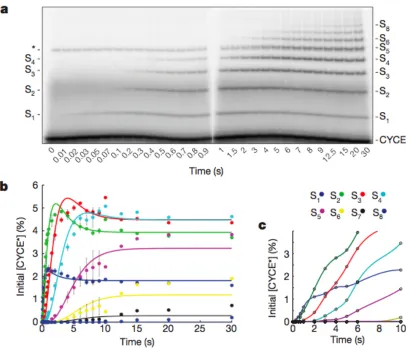
from Figure 2.2a was fractionated on a gel with different resolving capabilities
(Supplementary Figure A.12). Three major conclusions arose from these
experiments. First, the product CycE–Ub (S1) was formed starting at the earliest
Figure 2.2 | Millisecond kinetics of a single encounter reaction reveal sequential processivity.
a, To achieve millisecond temporal resolution CycE reactions were performed on a quench flow apparatus and products were evaluated by SDS-‐PAGE and phosphorimaging. The reaction scheme
matched reaction 2 of Figure 2.1a. The asterisk marks a contaminant. Sn refers to CycE modified with
n ubiquitins. b, Quantification shows successively longer lag phases for each additional ubiquitin added in the chain. The data was fit using closed form solutions refined by global regression analysis
time points (10-‐20 milliseconds) without a lag phase, indicating that E2~Ub binding
to SCF was rapid. This is consistent with stopped-‐flow measurements carried out
with SCFb-‐TrCP and hCdc34 (Kleiger et al., 2009). Second, each new ubiquitylated
product appeared sequentially with non-‐concurrent lag phases (Figure 2.2a, b and
Supplementary Figure A.12). Third, the early reaction products S1-‐S3 ‘overshot’ their
final levels, indicating that these reaction intermediates serve as templates for the
formation of subsequent products, supporting the model that polyubiquitin chains
are built from multiple transfer events (Supplementary Figure A.16). Combined with
the constraints on η and φ calculated above as well as our direct evaluation of the
Cdc34~Ub pool (Figure 2.1g), these data demonstrate that the underlying kinetic
mechanism of our system was principally derived from sequential transfers of single
ubiquitins.
To ensure that our conclusions were not an artifact of the reaction design, we
changed the order of addition in our reactions. SCFCdc4 was pre-‐incubated with the
‘charged E2’ mixture for 2 minutes (in which case 89% of Cdc34 is present in
thioesterified form; Figure 2.1g) and reactions were initiated by combining with
radiolabeled CycE. Products appeared following non-‐concurrent lag phases of
increasing duration (Figure 2.2c), analogous to that observed when the reaction was
initiated by addition of Cdc34~Ub to CycE prebound to SCFCdc4 (Figure 2.2a). Thus,
regardless of whether CycE first encountered Cdc34~Ub–SCF or Cdc34~Ub
encountered CycE–SCF, single ubiquitins were transferred to substrate in a
delayed compared with those initiated by addition of Cdc34~Ub, indicating that
Cdc34~Ub productively associates with SCFCdc4 faster than does CycE.
SCFβ-‐TrCP is sequentially processive
We next sought to test whether the sequential processive chain assembly we
observed for SCFCdc4 is unique or illuminates a general principle of SCF ubiquitin
ligase mechanism. To address this issue, we evaluated ubiquitylation of a
phosphopeptide derived from β-‐Catenin (β-‐Cat) by its cognate E2-‐E3 complex,
hCdc34 and human SCFb-‐TrCP. Nedd8 conjugated E3 (N8-‐SCFβ-‐TrCP) was used for these
experiments, because prior work demonstrated a potent stimulation of β-‐Cat
ubiquitylation upon Nedd8 conjugation (Saha and Deshaies, 2009). As was seen
with CycE–SCFCdc4, β-‐Cat was rapidly modified by N8-‐SCFβ-‐TrCP and it was not
possible to resolve intermediates in chain assembly by manual mixing4 (Figure 2.3a).
Quantification of product distribution λβ-‐Cat revealed that 6% of β-‐Cat molecules
were modified in a single encounter with N8-‐SCFβ-‐TrCP, of which 85% received ≥ 4
ubiquitins (Figure 2.3b and Supplementary Figure A.2). Distribution analysis of λβ-‐Cat
(Figure 2.3c) and kinetic resolution of β-‐Cat ubiquitylation by quench-‐flow (Figure
2.3d, e) revealed sequential appearance of intermediates analogous to those
observed with CycE ubiquitylation by SCFCdc4.
Although the general behavior of SCFCdc4 and N8-‐SCFβ-‐TrCP were similar, the
enzymes differed in the extent to which they converted bound substrate to product
and elongated ubiquitin chains. Using a kinetic model in which monoubiquitin
nucleic acid polymerases (Kati et al., 1992) to extrapolate estimates for the
individual reaction and dissociation rate constants from our single encounter
Figure 2.3 | Human Cdc34-‐SCFβ-‐TrCP is sequentially processive. a, same as Figure 2.1a, except that
human Cdc34 and Nedd8-‐conjugated SCFb-‐TrCP were assayed with 32P-‐labeled b-‐Cat substrate. b,
Product distribution (lb-‐Cat) was quantified as in Figure 2.1b. Error bars: +/-‐ SD, n=3. c, The Poisson
distribution of φ using λβ-‐Cat that deviated the most from φ(1)=100% within our set error bounds
with α=0.2. d, β-‐Cat reactions with the scheme of reaction 2 (Figure 2.1a) performed on a quench
flow apparatus. e, Quantification shows successively lengthening lag phases for each additional ubiquitin added in the chain. The data was fit as in Figure 2.2b.
Discussion
Functional implications of our model
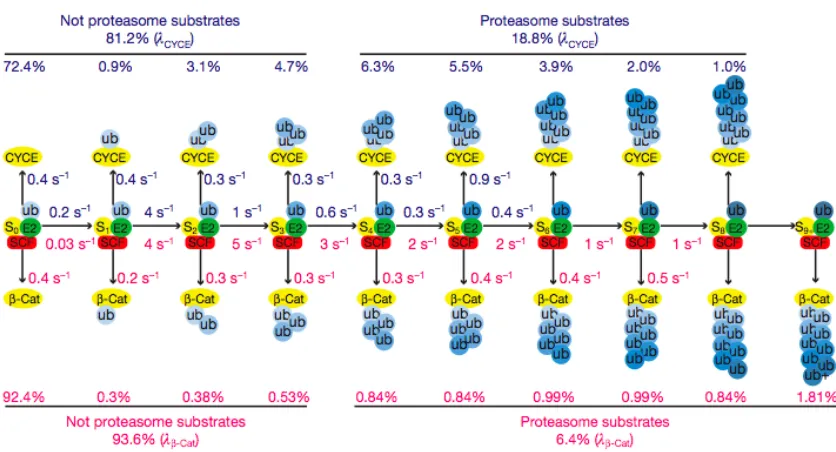
The model shown in Figure 2.4 reveals the kinetic basis of processive
polyubiquitin chain synthesis by budding yeast Cdc34-‐SCFCdc4 and human Cdc34-‐
SCFβ-‐TrCP and accounts for the differences in their behavior. Most encounters of
substrate and SCF are unproductive because koff is faster than kUb1. This is
particularly exaggerated for b-‐Cat owing to its low value for kUb1. Once a single
ubiquitin is attached, the majority of substrates are committed to polyubiquitylation
due to the drastic increase in kUb2 relative to a nearly constant koff. This gives rise to
the high percentage of modified substrates with four or more ubiquitins in their
chain (68% for CycE and 85% for β-‐Cat). The overall chain length is limited by the progressive decrease in transfer rates (kUbn) as the chain becomes longer matched
against the relatively constant rate at which product intermediates dissociate. This
reduction in transfer rate most likely arises because the distal end of the flexible
2006). The longer chains on β-‐Cat are a result of a less dramatic decline in kUbn after
the second
Figure 2.4 | Kinetic basis for Cdc34-‐SCF processivity. The millisecond kinetics of a single encounter reaction were fit to a sequential model revealing estimates for individual transfer and
dissociation rates for each intermediate in the generation of polyubiquitylated CycE (blue numbers)
and β-‐Cat (red numbers) products. The percentages listed above or below each product were the
percentages from the final product distributions (λ) shown in Figures 2.1b and 2.3b.
ubiquitin is attached. We do not understand the basis for this difference. Meanwhile,
the constant rate of dissociation for both CycE and β-‐Cat implies that ubiquitin
chains of increasing length do not change the intrinsic affinity of these substrates for
SCF.
Casual inspection of our model suggests that modest changes in the ratio
kUb1/koff for the first step would substantially alter the fraction of substrate that
provides a simple basis for SCF to modulate a substrate’s degradation half-‐life (i.e.,
the larger koff is or smaller kUb1 is, the lower the probability that a substrate is
modified in a single encounter with SCF, which would translate to a longer half-‐life).
Comparison of CycE and b-‐Cat, which have distinct kUb1/koff ratios, underscores how
the efficiency and pattern of substrate ubiquitylation can be tuned by these
parameters. Despite these differences, it is remarkable how similar the reaction
parameters are for two different enzymes from organisms separated by over 1
billion years of evolution. In both cases koff was ~ 0.4 sec-‐1 and the fastest rate of
ubiquitin chain elongation was 4-‐5 sec-‐1. This suggests that true substrates are
tuned to dissociate within a few seconds and that a transfer rate of 5 sec-‐1 may be
imposed by a conserved rate-‐limiting step. It will be of great interest to determine
what molecular event enforces this speed limit.
We conclude that polyubiquitin chains are built on SCF substrates by
sequential transfers of single ubiquitins. We establish a mechanistic framework that
can be applied to other CRLs and RING ubiquitin ligases to obtain individual rate
constants for substrate dissociation and ubiquitin transfer at each step in the
process of chain assembly. Our model indicates that the processivity, efficiency, and
pattern of ubiquitylation is governed by the sharp discontinuity in rates between
the first transfer and subsequent transfers, contrasted with the shared dissociation
rate among substrate and product intermediates.
Methods
Methods summary
Proteins
CycE and β-‐Cat phosphopeptide were purchased from New England Peptide.
Ubiquitin and K48 diubiquitin were purchased from Boston Biochem. Uba1 and
SCFCdc4 were prepared and purified as described (Petroski and Deshaies, 2005b).
Full-‐length yeast Cdc34 was purified as described (Feldman et al., 1997). His7-‐Rub1
was purified from E. coli inclusion bodies (Saha and Deshaies, 2008) and human E1,
UbcH3B (hCdc34), and Nedd8-‐SCFβ-‐TrCP were prepared and purified as described
(Saha and Deshaies, 2008). Yeast Ubc12 and Ula1–Uba3 were purified as described
(Kamura et al., 1999). Rub1, Ubc12, Ula1–Uba3, and ATP were incubated with
immobilized SCFCdc4 to make Rub1-‐conjugated SCFCdc4. PKA was purchased from
New England Biolabs.
Ubiquitylation assay
CycE (200 nM) or β-‐Cat (2 µM) was incubated with g-‐[32P]-‐ATP (132 nM) and
PKA for 45 minutes at 30°C to make radiolabeled CycE or β-‐Cat. Yeast ubiquitylation
reactions contained ATP (2 mM), ubiquitin (60 µM), Uba1 (0.8 µM), Cdc34 (10 µM),
SCFCdc4 (150 nM), and radiolabeled CycE (10 nM). Human ubiquitylation reactions
contained ATP (2 mM), ubiquitin (60 µM), E1 (1 µM), Cdc34 (10 µM), SCFβ-‐TrCP (500
nM), and radiolabeled β-‐Cat (100 nM). As indicated, single encounter reactions
contained an unlabeled CycE chase (10 µM) or β-‐Cat chase (100 µM). Millisecond
Flow). Reactions contained a buffer previously described (Petroski and Dehsaies,
2005c) at 23°C. Reactions were quenched with SDS-‐PAGE buffer with βME and run
on 20 cm 5-‐20% tricine gels (CycE) or Glycine gels (β-‐Cat) that were quantified with a phosphor screen (Molecular Devices). Thioester formation assays contained Cdc34
(10 µM), Uba1 (1 µM), ATP (2 mM), ubiquitin or K48 diubiquitin (15 µM), and
SCFCdc4 (100 nM), as indicated. After 2 minutes, reactions were stopped with excess
5% acetic acid and analyzed on an Agilent LC-‐MSD.
Analysis
Deconvolutions and regression were performed in Matlab. Global fitting was
performed with KinTek Global Kinetic Explorer. Mass spec data was processed using
the Chemstation software package.
Full Methods
RDB 2289 with pGEX2-‐T His7-‐Rub1 was made by cloning a His7 tag in place
of the GST tag in RDB 1436. To make Rub1-‐conjugated SCFCdc4, the procedure for
isolating SCFCdc4 was modified (Petroski and Deshaies, 2005c). Instead of eluting
SCFCdc4 from Py conjugated protein A beads after washing, 50 µM Rub1, 10 µM
Ubc12, 1 µM Ula1–Uba3, and 2 mM ATP were incubated together overnight. The
beads were washed before elution.
For all reactions, gels were dried and exposed to Phosphor screens
(Molecular Dynamics). Images were scanned and then quantified in ImageQuant
using a rolling ball background subtraction. For each lane, every band was
The relationship between η, φ, and λ was mathematically analogous to the
probability of the sum of multiple dice throws. However, the probability of throwing
each number on the dice was a weighted normalized distribution (analogous to η)
and the number of throws was also a weighted normalized distribution (analogous
to φ). A distribution that is normalized sums to 1. Thus, λ equaled the weighted sum
of multiple discrete convolutions of η with itself as governed by φ, as shown by
example in Supplementary Figure A.3. Knowledge of λ and η allowed us to calculate
φ by multiple weighted deconvolutions, as shown by example in Supplementary
Figure A.4. This was true for calculating η from λ and φ, as shown by example in
Supplementary Figure A.5a. If we assigned a distribution to η, we determined φ by
deconvolutions with λ, and vice versa. Considering normalized distributions of η
that only contain η(1) and η(2), exponential distributions, poisson distributions, and
normal distributions, we varied parameters over a wide range and performed
deconvolutions, as shown by example in Supplementary Figure A.5b. An exponential
distribution is described by a single parameter, here called α. A poisson distribution
is also described by a single parameter, here called α. The normal distribution is
described by two parameters, the mean and the standard deviation (SD).
Parameters were varied starting at 0 and increasing by step sizes of 0.1 until
parameters equaled 10. For the normal distribution, each value of the mean was
held constant while the SD was varied. We sought the distribution which deviated
most from η(1)=100% whose φ did not contain values > 1 or < 0, and that when
convoluted with φ, the sum of λ fell within 0.95 and 1.05, or an error rate of ± 5%
Supplementary Figures A.6 and A.7. Random distributions were also considered
(data not shown).
For mass spectrometry analysis, Uba1 (1 μM), Cdc34-‐Δ270 (10 μM), and
ubiquitin or K48 linked di-‐ubiquitin (15 μM, Boston Biochem) were incubated for 2
minutes in reaction buffer (30 mM Tris, pH 7.5, 100 mM NaCl, 5 mM MgCl2, 2 mM
DTT, and 2 mM ATP) in a volume of 10 µl, both in the presence and absence of SCF
(100 nM). Reactions were quenched by the addition of 90 µl 5 % acetic acid.
Quenching was verified by an order of addition reaction where E1 was left out of the
initial incubation and was added following quenching. This resulted in 100%
quenching of the thioester charging reaction. Separation of E2 thioesters in the
presence of SCF was accomplished by the addition of 100 mM DTT after the 2
minute incubation period. The DTT was incubated with the reaction mixture for 5
minutes, followed by the addition of 90 µl of 5 % acetic acid. Detection of proteins
was carried out on an Agilent LC-‐MSD (Agilent, Palo Alto, CA). Mass spectra were
acquired in positive-‐ion mode, scanning from 500 to 1700 m/z. The electrospray
voltage was set to 4 kV and the gas temperature in the spray chamber was
maintained at 350°C. A stationary phase, Zorbax 300SB C3 150×2.1-‐mm column
was used for separation (Agilent; Bodman, Aston, PA). Mobile phase A was 0.2%
formic acid and mobile phase B was 0.2% formic acid, 10% methanol, and 90%
acetonitrile. The flow rate was 0.200 ml/min. After a 25 min delay, the effluent was
directed into the mass spectrometer. Linear gradients started with 5% mobile
phase B and finished at 95% from 25 – 50 min. Data were processed using the
amino acids from positions 1 to 270 of the yeast Cdc34 sequence followed by the
sequence ARPLHHHHHH, yielding a theoretical molecular mass of 32,245 Daltons.
The theoretical mass of Cdc34-‐Δ270 thioesterified with ubiquitin (40,792) was
calculated by summing the masses of Cdc34-‐Δ270 (32,245) and ubiquitin (8,565)
and subtracting the mass of a water molecule, which is lost during formation of the
thioester bond.
For CycE global fitting with KinTek Global Kinetic Explorer, the average of
two independent experiments was fit to a model with η=1, and the fit for k1 through
k4 used the normalized option, while the rest of the rate constants did not. For β-‐Cat
global fitting, rate constants were fit without normalization. To improve fitting,
neighboring rate constants were constrained by the end point.
Chapter 3:
CAND1 Functions as an Fbox
Exchange Factor
Abstract
The modular design of the multi-‐subunit SCF ubiquitin ligases allows for
recognition of a diverse set of target proteins. However, how SCF complex formation
is regulated remains unclear. Cullin-‐associated and neddylation-‐dissociated protein
1 (CAND1) is a Cul1-‐associated protein that has been reported to inhibit SCF
complex formation. Nonetheless, the function of CAND1 remains elusive given the
lack of a mechanistic framework for each of its reported activities. Here we present
a novel FRET assay that enables real-‐time measurements of binding dynamics of the
SCFFbxw7 complex. We find that CAND1 is able to actively remove Fbxw7/Skp1 from
Cul1/Rbx1 by changing the dissociation rate of the complex a million-‐fold, yet
CAND1 does not affect the assembly rate of SCF Fbxw7. This activity is abolished when
Cul1 is neddylated. Experiments show that CAND1 accelerates the rate at which
multiple SCF complexes can form. Thus, CAND1 appears to function as an exchange
factor. Our results serve as a basis to resolve the function of CAND1 in vivo.
Introduction
Three enzymes work in succession to covalently attach ubiquitin and
ubiquitin chains to target proteins: a ubiquitin activating enzyme (E1), a ubiquitin
conjugating enzyme (E2), and a ubiquitin ligase (E3) (Dye and Schulman, 2007).
The proteasome, a massive multi-‐subunit protease, recognizes and degrades
proteins attached with lysine 48 linked polyubiquitin chains containing at least four
ubiquitins (Thrower et al., 2000). Cullin-‐RING ubiquitin ligases (CRLs) are the
largest family of E3s and are typified by the SCF complexes, which in humans are
composed of four proteins: the scaffold Cul1, the RING containing Rbx1, the adaptor
Skp1, and a substrate binding protein that contains the Fbox motif (Petroski and
Deshaies, 2005a). 69 proteins in the human genome have Fbox motifs, and 42 have
been shown to form SCF complexes (Lee et al., 2011). Although this modular design
of SCF complexes allows for recognition of a diverse set of target proteins, how SCF
complex formation is regulated remains unclear.
Cullin-‐associated and neddylation-‐dissociated protein 1 (CAND1) was
originally isolated as a Cul1 associated protein whose binding was mutually
exclusive with the Fbox/Skp1 sub-‐complex (Liu et al., 2002; Zheng et al., 2002).
CAND1’s dissociation from Cul1/Rbx1 was coupled to the attachment of the
ubiquitin-‐like protein Nedd8 to lysine 720 of Cul1 (Liu et al., 2002; Zheng et al.,
2002). Neddylation of Cul1 activates SCF complexes by inducing a major
conformational rearrangement in Cul1 and stimulates ubiquitin transfer from
al., 2008). In vitro, CAND1 acts as an inhibitor of CRL ubiquitylation and neddylation
(Liu et al., 2002; Zheng et al., 2002; Siergiejuk et al., 2009). For these reasons,
CAND1 was recognized as a negative regulator of SCF complex assembly. However,
genetic evidence indicates that CAND1 acts as a positive regulator of CRL function in
vivo. First, knock down of CAND1 by siRNA stimulates assembly of Cul3Keap1 but
reduces its ability to target Nrf2 for degradation (Lo, Hannink 2006). Second, siRNA
against CAND1 stabilizes the SCFSkp2 substrate p27 (Zheng et al., 2002). Lastly,
mutations in CAND1 in plants disrupt auxin and gibberellin signaling through
stabilization of the SCFTir1 substrate IAA7 and the SCFSLY1 substrate RGA,
respectively (Chuang et al., 2004; Feng et al., 2004). These observations gave rise to
the idea that CAND1-‐mediated CRL adaptor recycling was crucial for proper CRL
function (Liu et al., 2002; Cope and Deshaies 2003; Schmidt et al., 2009; Zhang et al.,
2008). Furthermore, the role of CAND1 was envisioned to be coupled to cycles of
neddylation and de-‐neddylation in which CAND1 sequesters a substantial fraction of
naked Cul1/Rbx1 devoid of Fbox/Skp1 and Nedd8 (Deshaies and Cope, 2003).
However, a recent analysis of the CRL network in vivo found that in the absence of
neddylation CAND1 does not sequester Cul1/Rbx1 away from Fbox/Skp1 complexes
(Bennett et al., 2010).
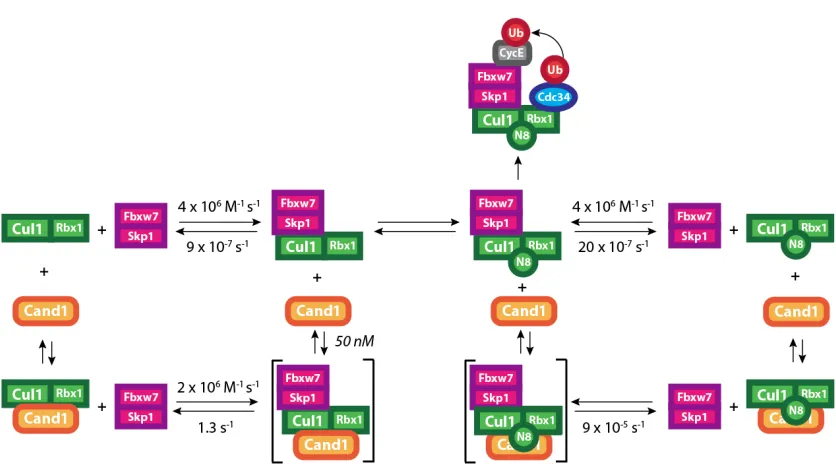
In order to reconcile the above observations, we have constructed the first
kinetic framework for the assembly of a CRL complex in vitro using a novel FRET
assay that enables real-‐time measurements of SCFFbxw7 binding dynamics. CAND1’s
perturbations of these dynamics reveal that CAND1 acts as a Nedd8-‐dependent Fbox
involving multiple Fboxes that reconstitutes the activator function of CAND1 in vitro
with pure components. Our biochemical results show for the first time that CAND1
is sufficient for CRL adaptor cycling in vitro and that this activity leads directly to
CAND1-‐mediated stimulation of CRL ubiquitin ligase activity. Further, CAND1’s
exchange factor activity represents a novel form of regulation for protein-‐protein
interactions that thus far has only been seen for protein-‐small-‐molecule interactions,
such as the GEFs.
Results
Intrinsic assembly properties of SCFFbxw7
To characterize the assembly properties of SCF complexes, we developed a
real-‐time assay based on FRET that monitors the binding dynamics between the
sub-‐complexes of Fbox/Skp1 and Cul1/Rbx1. The C-‐terminus of the Fbox protein
Fbxw7 was fused to the peptide sequence LPETGG and co-‐expressed recombinantly
with Skp1. After purification, we reacted the complex with the trans-‐peptidase
enzyme Sortase in the presence of the peptide GGGGK-‐TAMRA, producing Fbxw7
covalently labeled with TAMRA (Popp et al., 2009). The trans-‐peptidation reaction
was efficient and did not compromise ubiquitylation activity (Supplementary Figure
B.1a). We observed FRET between Fbxw7-‐TAMRA/Skp1 and Cul1 fused N
terminally to cyan fluorescent protein (CFP) co-‐expressed with Rbx1 (Figure 3.1a).
The rate of complex assembly was determined by monitoring the changes of donor
Cul1 NTD CFP/Rbx1 fluorescence when mixed with varying concentrations of
Fbxw7 TAMRA/Skp1 in a stop flow apparatus. The change in signal was fit to single
exponential curves (Figure 3.1b). The change in the observed rate of the reaction as
a function of acceptor concentration revealed a fast binding rate of 4 x 10⁶ M-‐1 s-‐1
(Figure 3.1c). The FRET observed in our assay could be chased away by excess non-‐
fluorescent Fbox/Skp1 (Figure 3.1d). Using this chase assay, we measured a
dissociation rate for SCFFbxw7 of 9 x 10-‐7 s-‐1 or 0.5 week-‐1 (Figure 3.1e). These
measurements revealed an extraordinarily tight complex with a Kd of 2 x 10-‐13 M
(200 fM). Neddylation of Cul1 did not affect the FRET efficiency in our assay, the
Supplemental Figure B.1b-‐d). To extend our finding to other SCF complexes we
attempted to make FRET assays using a similar strategy for Skp2 and β-‐TrCP, but
were unsuccessful (data not shown). In lieu of direct binding data, we designed an
assay that used Fbxw7-‐TAMRA/Skp1 as the chase and monitored gain of FRET
(Supplemental Figure B.1e). An upper limit of 5 x 10-‐5 s-‐1 for the dissociation rate
was found for SCFβ-‐TrCP (Fig. 1f).
Figure 3.1 | FRET Reveals Properties of SCF Assembly. a, Fluorescence emission spectra from
excitation at 430 nm of 70 nM Cul1 NTD CFP/Rbx1, 70 nM Fbxw7-‐TAMRA/Skp1, a mixture of the two,
or buffer alone reveals FRET with 30% efficiency upon complex formation. Normalized to peak donor
emission at 478 nm. b, The change in donor fluorescence versus time in a stop flow apparatus with 5
nM Cul1 NTD CFP/Rbx1 and varying concentrations of Fbxw7 TAMRA/Skp1. Signal changes were fit
to single exponential curves. c, The rate of signal change in b versus the concentration of Fbxw7
TAMRA/Skp1. Fitting the data to (kobs = kon*[Fbxw7] + koff) gave kon of 4 x 10⁶ M-‐1 s-‐1 regardless of
Cul1’s neddylation status. Error bars: +/-‐ SD, n≥3. d, 700 nM Skp2/Skp1 (chase) competes FRET
NTD CFP for 5 min. e, Fluorescence emission at 478 nm versus time after addition of chase to pre-‐
incubated Cul1 NTD CFP/Rbx1 and Fbxw7 TAMRA/Skp1 normalized to peak donor emission in d.
Single exponential fit with a fixed end point of 1 gave koff of 8.5 x 10-‐7 s-‐7. Kd is thus 2 x 10-‐13 M. Error
bars: +/-‐ SD, n=3. f, Fluorescence emission at 478 nm versus time after addition of 210 nM Fbxw7
TAMRA/Skp1 to 70 nM Cul1 NTD CFP �